Global Supply of Phosphate

Waste to Worth: Spreading science and solutions logoWaste to Worth home | More proceedings….

Why Are We Concerned About Global Phosphorus Supply?

There has been a great deal of press coverage in the past few years about the supplies and reserves of rock phosphate across the globe with some predicting exhaustion of these supplies within a few decades. This presentation examines the supplies, reserves and trends in the world phosphorus supply.

Authors

Mike Stewart, International Plant Nutrition Institute mstewart@ipni.net

Additional Information

International Plant Nutrition Institute http://www.ipni.net


The authors are solely responsible for the content of these proceedings. The technical information does not necessarily reflect the official position of the sponsoring agencies or institutions represented by planning committee members, and inclusion and distribution herein does not constitute an endorsement of views expressed by the same. Printed materials included herein are not refereed publications. Citations should appear as follows. EXAMPLE: Authors. 2013. Title of presentation. Waste to Worth: Spreading Science and Solutions. Denver, CO. April 1-5, 2013. URL of this page. Accessed on: today’s date

Environmental Protection Agency (EPA) Perspective on Nutrient Pollution

Waste to Worth: Spreading science and solutions logoWaste to Worth home | More proceedings….

Why Discuss Regulations and Nutrient Pollution?

Provide EPA’s perspective on nutrient pollution and encourage an open dialogue to help address this problem which is rapidly becoming one of the most challenging environmental problems that we face.

What Did We Do?

Although nutrients, nitrogen and phosphorus in particular, are essential for aquatic life, too many nutrients can create significant problems for our nation’s lakes, streams, and coastal waters.  Nutrient pollution can degrade habitat for fish and wildlife, render water bodies unsafe for swimming and other forms of contact recreation, create a public health concern for drinking water supplies, decrease property values, and negatively impact local economies.  According to national statistics, more than 45% of streams have medium to high levels of nutrients, approximately four million lake acres have been identified as threatened or impaired, and approximately 78% of assessed coastal areas exhibit signs of eutrophication.

Nutrients can be transported great distances and impact areas far downstream.  One of the more prominent examples in the United States is the Gulf of Mexico “dead zone,” which can be larger than the state of Connecticut in some years.  The term “dead zone” refers to waters that have been so heavily impacted by nutrient pollution that oxygen levels are depleted to the point where most aquatic life cannot survive.  Nutrients are transported to the Gulf of Mexico via tributaries of the Mississippi River from as far away as Montana in the west and Pennsylvania in the eastern portion of this large watershed.

Nutrient pollution is not restricted to the Mississippi River Basin or any one region of the country.  Nutrient pollution is widespread, impacting waters across the nation.  As we learn more about the impacts of nutrient pollution, especially the potential for some species of algae to produce toxins that can be harmful to both people and animals, states are becoming more aggressive in reducing sources and even posting health advisories when necessary.

So, what has EPA been doing to address nutrient pollution?

  1. Providing states with technical assistance and other resources to help develop water quality criteria for nitrogen and phosphorus;
  2. Working with states to identify waters impaired by nutrients and developing restoration plans;
  3. Awarding grants to states to address pollution from nonpoint sources, such as agriculture and storm water runoff;
  4. Administering a permit program designed to reduce the amount of nitrogen and phosphorus discharged to the environment from point sources;
  5. Providing funding for the construction and upgrade of municipal wastewater treatment plants;
  6. Working with states to reduce nitrogen oxide emissions from air sources;
  7. Conducting and supporting extensive research on the causes, impacts, and best approaches to  reduce nutrient pollution; and
  8. Increasing collaboration with other federal partners (e.g., USDA) to leverage financial and technical resources.

And although progress has been made over the past decade, much more is needed.  Realizing a need for greater action, In March 2011, EPA issued a memorandum titled “Working in Partnership with States to Address Phosphorus and Nitrogen Pollution through Use of a Framework for State Nutrient Reductions.”  This memo emphasized that nutrient pollution continues to have the potential to become one of the costliest and most challenging environmental problems that we face and reaffirmed the agencies commitment to partner with states and stakeholders to make greater progress in reducing nutrient loading to our nation’s waters.  If you have not already done so, please join us in protecting and restoring our nation’s waters.  For more information visit EPA’s nutrient pollution website at http://www.epa.gov/nutrientpollution/.

Author

Alfred Basile, Biologist, US Environmental Protection Agency Region 8, basile.alfred@epa.gov

Additional Information

www.epa.gov/nutrientpollution

The authors are solely responsible for the content of these proceedings. The technical information does not necessarily reflect the official position of the sponsoring agencies or institutions represented by planning committee members, and inclusion and distribution herein does not constitute an endorsement of views expressed by the same. Printed materials included herein are not refereed publications. Citations should appear as follows. EXAMPLE: Authors. 2013. Title of presentation. Waste to Worth: Spreading Science and Solutions. Denver, CO. April 1-5, 2013. URL of this page. Accessed on: today’s date.


Phosphorus Indices: Taking Stock of Where We Are and Where We Need to Be

Waste to Worth: Spreading science and solutions logoWaste to Worth home | More proceedings….

Abstract

The inconsistency among P Indices in terms of level of detail and scientific underpinnings among states, as well as in recommendations and interpretations based on site risk, prompted a review and possible revision of the 590 Standard and P-Indexing approach.  The need for revision has been heightened by a slower than expected decrease in P-related water quality impairment and, in some cases, an increase in soil P to levels several fold greater than agronomic optimum due to the inability of the P Index to prevent the continued over-application of P to soils.  While the basic scientific foundations of the P-Indexing approach are sound, these concerns are real.  In this presentation, we propose the use of lower and upper boundaries of P Index use and describe an approach to evaluate individual State P Indices.

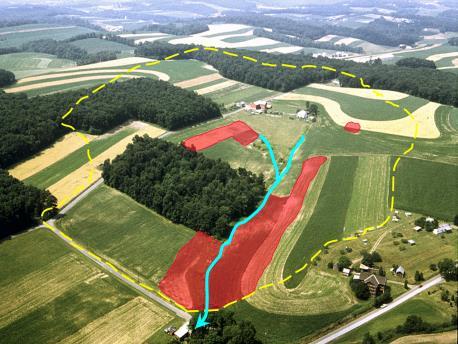
An aerial shot of the FD-36 watershed in south-central Pennsylvania (defined by the dashed white line), where soil chemistry, hydrologic, and agronomic research by USDA–ARS at University Park and Klingerstown locations identified areas of the watershed (in red) at great risk of contributing phosphorus to the stream (the blue line). This research was key to framing the application of the Phosphorus Index in Nutrient Management Planning.   See N.O. Nelson and A.L. Shober, “Evaluation of Phosphorus Indices after Twenty Years of Science and Development,” p. 1703. Photo: Andrew Sharpley.

Why Is It Important to Review the Phosphorus Index?

Since its inception nearly 20 years ago, the phosphorus (P) Index has morphed from an educational tool to a Best Management Practice targeting and implementation tool, a manure-scheduling tool, and in many cases, a regulatory tool.  A great deal of research has been conducted across the U.S. to derive, validate, and support components of the P Indexing concept, particularly those related to source factors.  As different versions of the P Index have emerged, ostensibly to account for local topography, hydrology, soils, land use, and individual state policies and agendas, so too have differences in the P management recommendations that are made using the P Index.  As a result, there are many variations in P Indices now in use as part of the NRCS 590 Nutrient Management Conservation Standard.  This variation is both a strength and weakness of the P Indexing concept.

Author

Andrew Sharpley, Professor, Division of Agriculture, University of Arkansas System.  Sharpley was one of a core group of scientists that back in the early 1990’s developed the scientific foundation of the Phosphorus Indexing approach.  Since then he has conducted extensive field research to justify source and transport factors included in Indices, which have been adopted in 49 of 51 States to guide nutrient management planning as part of the 590 Standard.  He was instrumental in changing USDA and US EPA nutrient management planning strategies away from single numeric soil phosphorus environmental thresholds to the Indexing approach for risk assessment of phosphorus management and land application.  In the last year, he coordinated a group of researchers and extension folks from diverse backgrounds to review and propose revisions to Phosphorus Indices in compliance with the 2011 590 Standard.

The author can be contacted at: sharpley@uark.edu

The authors are solely responsible for the content of these proceedings. The technical information does not necessarily reflect the official position of the sponsoring agencies or institutions represented by planning committee members, and inclusion and distribution herein does not constitute an endorsement of views expressed by the same. Printed materials included herein are not refereed publications. Citations should appear as follows. EXAMPLE: Authors. 2013. Title of presentation. Waste to Worth: Spreading Science and Solutions. Denver, CO. April 1-5, 2013. URL of this page. Accessed on: today’s date.

Phosphorus Concentrations Have Been Declining In The Illinois River: Was It Point Sources, Farm-Level Nutrient Management, Or What?

Waste to Worth: Spreading science and solutions logoWaste to Worth home | More proceedings….

Abstract

Elevated phosphorus concentrations in the Illinois River Watershed (IRW) have long been an environmental issue between the states of Arkansas and Oklahoma, which has led to the development of a watershed-reservoir model and future TMDL by the U.S. Environmental Protection Agency.  Here, we examine phosphorus concentrations from multiple sources, including the Arkansas Water Resources Center and the U.S. Geological Survey, to evaluate trends in flow-adjusted concentrations.   Flow-adjusted phosphorus concentrations have been decreasing in the Illinois River at Arkansas Highway 59, and this translates into decreases further downstream to Tahlequah, Oklahoma.  However, flow-adjusted concentrations in Flint Creek have been increasing over time until the last few years.  These decreases are tied to the reductions in effluent phosphorus, which have occurred over the last couple decades.  But, the application of poultry litter has also likely decreased within the IRW.  A nutrient mass balance of the Watershed Research and Education Center in Fayetteville, Arkansas showed that reduced litter applications and increased forage export (i.e., hay being removed from fields) can result in phosphorus export at the farm-scale.  The missing piece of this study would be understanding legacy phosphorus, and how this influences source apportionment and changes over time.

Authors

Brian Haggard, Arkansas Water Resources Center, haggard@uark.edu

Thad Scott, Crop, Soil and Environmental Sciences Department, Division of Agriculture, University of Arkansas System


The authors are solely responsible for the content of these proceedings. The technical information does not necessarily reflect the official position of the sponsoring agencies or institutions represented by planning committee members, and inclusion and distribution herein does not constitute an endorsement of views expressed by the same. Printed materials included herein are not refereed publications. Citations should appear as follows. EXAMPLE: Authors. 2013. Title of presentation. Waste to Worth: Spreading Science and Solutions. Denver, CO. April 1-5, 2013. URL of this page. Accessed on: today’s date.

What Happens When You Mix Chitosan and Poultry Litter?

Waste to Worth: Spreading science and solutions logoWaste to Worth home | More proceedings….

Abstract

The solubility of phosphorus (P) and low nitrogen(N):P ratio of poultry litter present environmental challenges when using this resource to supply nutrients to crops and forages.  Here, we explore the use of chitosan to reduce water extractable P (WEP) in poultry litter and potentially increase the N:P ratio.  Chitosan is derived from chitin, which is a waste product from the commercial shellfish industry; chitin is processed into chitosan through deacetylation, removing acetyl groups from this long-chained molecule.  Chitin has been successfully used in manure separation and flocculation in wastewater treatment processes, as well as immobilizing algae in wastewater streams to uptake nutrients. 

We performed a series a lab studies to evaluate how chitosan might reduce WEP, influence ammonia volatilization and potentially increase the N:P ratio of poultry litter.  Our experiments showed that chitosan was effective at reducing WEP content of poultry litter and increasing the N:P ratio, but ammonia volatilization might be increased under moist conditions.  We would like to take this from the lab to small plot and then field trials in the near future.

Authors

Brian Haggard, Arkansas Water Resources Center, haggard@uark.edu

I.M. Bailey, Formerly Biological Engineering Program, University of Arkansas, D.A. Zaharoff, Biomedical Engineering Department, University of Arkansas


The authors are solely responsible for the content of these proceedings. The technical information does not necessarily reflect the official position of the sponsoring agencies or institutions represented by planning committee members, and inclusion and distribution herein does not constitute an endorsement of views expressed by the same. Printed materials included herein are not refereed publications. Citations should appear as follows. EXAMPLE: Authors. 2013. Title of presentation. Waste to Worth: Spreading Science and Solutions. Denver, CO. April 1-5, 2013. URL of this page. Accessed on: today’s date.


The Role of Computer Models in Environmental Phosphorus Management

Waste to Worth: Spreading science and solutions logoWaste to Worth home | More proceedings….

Why Model Agricultural Phosphorus?

Computer models are excellent ways to integrate years of scientific research into decision tools that producers and policy makers can use to reduce the environmental impact of agricultural phosphorus. Models are playing more important roles in efforts to manage phosphorus at the farm and watershed scales, so it is increasingly important to make sure models are well developed to meet the needs of users, give reliable predictions, and are consistently updated to keep pace with scientific knowledge.

What Did We Do?

Our research over the past 10 years has concentrated on developing scientifically sound, reliable models that can be used to better manage agricultural phosphorus. This includes developing state-of-the-art models for soil phosphorus cycling and loss to the environment in surface runoff and leaching from soils, manures, and fertilizers. We have also concentrated on making sure models of different complexity, from daily processed-based models to annual empirical models, are based on the same principles and give similar predictions so there are a variety of model choices available to meet user needs.

What Have We Learned?

It is certainly possible to develop reliable, scientifically sound, phosphorus management models, as our research success demonstrates. The best model development requires interdisciplinary collaborations and excellent communication between experimentalists, model developers, and model users. Such a framework of interconnected experimentation and model development should symbiotically advance the science of agricultural P and environmental protection beyond the point that the two proceeding independently can achieve.

Future Plans

Model development research continues to make sure that available models are kept up to date with scientific knowledge and meet the needs of users concerning ease of use and data requirements.

Authors

Peter Vadas, Dairy Systems Scientist, USDA-ARS Dairy Forage Research Center,  peter.vadas@ars.usda.gov

Additional Information

More information can be found at: http://ars.usda.gov/Services/docs.htm?docid=21763


The authors are solely responsible for the content of these proceedings. The technical information does not necessarily reflect the official position of the sponsoring agencies or institutions represented by planning committee members, and inclusion and distribution herein does not constitute an endorsement of views expressed by the same. Printed materials included herein are not refereed publications. Citations should appear as follows. EXAMPLE: Authors. 2013. Title of presentation. Waste to Worth: Spreading Science and Solutions. Denver, CO. April 1-5, 2013. URL of this page. Accessed on: today’s date.

The Arkansas Discovery Farm Program: Connecting Science to the Farm

Waste to Worth: Spreading science and solutions logoWaste to Worth home | More proceedings….

Why Create the Arkansas Discovery Farm Program?

Agriculture in Arkansas is under increasing pressure to manage nutrients and sediment in an environmentally sustainable manner.  In many sectors of the farming community, this has created severe constraints to remaining economically viable and competitive in today’s global market place.  In northwest Arkansas, home to the nation’s second largest broiler poultry production, farmers have been under intense scrutiny and litigation over the last decade, due to downstream water users (i.e., Oklahoma) questioning the role of agriculture in water quality impairment.  Also, increasing national attention is being focused on reducing nutrients to the Gulf of Mexico, which will further increase the need of agricultural producers to increase nutrient efficiency while declining groundwater levels in crop producing areas of eastern Arkansas will increase the need for greater water efficiency.  The Arkansas Discovery Farm Program was initiated in 2009 to document the effectiveness of conservation practices on “real-world” private farms across the diverse forage, livestock, and row crop agricultural setting across the State.

What Did We Do?

We are monitoring runoff quality from seven farms as we are quantify sediment and nutrient losses from all major row crop and livestock commodities including rice, soybean, corn, cotton, poultry and beef cattle.  We are currently monitoring the quality of runoff from 19 fields using automated water quality samplers that are now equipped modems that contact us via cell phone when sampling is initiated.    On our row crop fields, we have increased our efforts to monitor irrigation water use and needs.  All fields are equipped with turbine-type irrigation flow meters that utilize dataloggers to automatically records flow data.  On two farms, we split fields in half and monitored evapotranspiration with atmometers (ET gages) and compared to our computer irrigation scheduler to calibrate the ET gages as an easier field method for irrigation scheduling.

What Have We Learned?

Due to the fact that we have been monitoring runoff since mid-2011 at the longest, we have limited reliable information to present.  As our first year, 2011 produced several severe flood-stage storms and 2012 provided a record breaking drought, it is difficult to quantify impact at this point.  While the water quality monitoring is a cornerstone, empowering agricultural producers to take ownership in finding solutions to minimize environmental impact is paramount to protecting voluntary efforts for the industry.  Our major findings to date have been the willingness of Arkansas farmers in general to embrace the Program, to be environmentally accountable for their actions, and to be proactive rather than reactionary.   

Future Plans

We have plans to develop another Discovery Farm in the litigated Illinois River Watershed, Northwest Arkanas.   While there is a great deal of interest in developing a commerical forestry Discovery Farm, a lack of potneital funding has limited those plans to date.  As we continue to collect data, we hope we can provide timely information on both economic and natural resource sustainability on behalf of Arkansas Agriculture to regulators, lawmakers and other decision makers. 

Authors

Andrew Sharpley, Professor, Division of Agriculture, University of Arkansas System, sharpley@uark.edu

Mike Daniels, Professor, Cooperative Extension, Division of Agriculture, University of Arkansas System

Neal Mays, Program Technician, Division of Agriculture, University of Arkansas System

Cory Hallmark, Program Technician, Cooperative Extension, Division of Agriculture, University of Arkansas System

Additional Information

http://discoveryfarms.uark.edu/

Acknowledgements

Arkansas Association of Conservation Districts, Arkansas Conservation Commission, Arkansas Natural Resource Conservation Service, Arkansas Farm Bureau


The authors are solely responsible for the content of these proceedings. The technical information does not necessarily reflect the official position of the sponsoring agencies or institutions represented by planning committee members, and inclusion and distribution herein does not constitute an endorsement of views expressed by the same. Printed materials included herein are not refereed publications. Citations should appear as follows. EXAMPLE: Authors. 2013. Title of presentation. Waste to Worth: Spreading Science and Solutions. Denver, CO. April 1-5, 2013. URL of this page. Accessed on: today’s date.

What We Feed Dairy Cows Impacts Manure Chemistry and the Environment

Waste to Worth: Spreading science and solutions logoWaste to Worth home | More proceedings….

Why Be Concerned with Feed Rations and Their Environmental Implications?

During the last part of the 20th century, animal manure management became an environmental concern. In response to these concerns, legislation was enacted to control manure management and the emission of undesirable gasses (e.g., methane, ammonia, nitrous oxide) from animal production systems. The purpose of this paper is to illustrate how mineral phosphorus (P) supplements, forage types and amounts, and the crude protein (CP) fed to lactating cows impact manure chemistry and the fate of manure nutrients in the environment.

What Did We Do?

Source-sink relationships have been used to illustrate relationships between feed nutrient sources (e.g., forms and concentrations of P and CP in lactating cows rations) and nutrient sinks (milk and manure), and relationships between manure nutrient sources (e.g., soluble P, urea N) and sinks [soil test P, runoff P, atmospheric ammonia, soil inorganic nitrogen (N), crop N] and the impact of these relationships on the environment.

What Have We Learned?

As mineral P concentrations in dairy rations increase, the excretion of total P and soluble P in manure also increases. The amount of cropland needed to recycle manure P and runoff of soluble P from cropland after manure application can be related back to the P excreted in manure, which in turn can be linked to the amount of mineral P in cow rations.  Likewise, the type and amount of CP and forage fed to dairy cows impact manure chemistry and manure N losses as ammonia, N cycling in soil, including plant N uptake. Ammonia emissions from dairy barns and soil after manure application can be related back to the urea N excreted by dairy cows in urine, which is linked to the types and concentrations of CP and forages in cow rations, and the concentrations of urea in milk (milk urea N, or MUN).  Our results demonstrate that profitable rations can be fed to satisfy the nutritional demands of healthy, high producing dairy cows, reduce manure excretion and therefore the environmental impacts of milk production.

Future Plans

We continue investigations on how the feeding of tannins to lactating dairy cows, and the use of MUN as a management tool  may enhance feed CP use efficiency (more feed CP transformed into milk, less excreted in manure) and reduce losses of ammonia, nitrates and nitrous oxide from dairy farms.

Authors

J. Mark Powell, Soil Scientist. USDA-ARS U.S. Dairy Forage Research Center, Madison, Wisconsin,  mark.powell@ars.usda.gov

Glen A. Broderick,  Dairy Scientist,  USDA-ARS U.S. Dairy Forage Research Center, Madison, Wisconsin

Additional Information

Powell, J.M. and Broderick, G.A. Transdisciplinary soil science research: Impacts of dairy nutrition on manure chemistry and the environment. Soil. Sci. Soc. Am. J. 75:2071–2078.

Powell, J.M. Alteration of Dairy Cattle Diets for Beneficial On-Farm Recycling of Manure Nutrients. pp 21-42  In: Applied Research in Animal Manure Management. Zhongqi H. (Ed.) Nova Science Publ. Inc.

Powell, J.M., Wattiaux, M.A., and Broderick, G.A. Evaluation of milk urea nitrogen as a management tool to reduce ammonia emissions from dairy farms. J. Dairy Sci. 94:4690–4694.


The authors are solely responsible for the content of these proceedings. The technical information does not necessarily reflect the official position of the sponsoring agencies or institutions represented by planning committee members, and inclusion and distribution herein does not constitute an endorsement of views expressed by the same. Printed materials included herein are not refereed publications. Citations should appear as follows. EXAMPLE: Authors. 2013. Title of presentation. Waste to Worth: Spreading Science and Solutions. Denver, CO. April 1-5, 2013. URL of this page. Accessed on: today’s date.

Alternative Poultry Litter Storage for Improved Transportation and Use As a Soil Amendment

Waste to Worth: Spreading science and solutions logoWaste to Worth home | More proceedings….

Abstract

Transportation of poultry litter out of nutrient limited watersheds such as the Illinois River basin (eastern Oklahoma) is a logical solution for minimizing phosphorus (P) losses from soils to surface waters. Transportation costs are based on mass of load and distance transported. This study investigated an alternative litter storage technique designed to promote carbon (C) degradation, thereby concentrating nutrients for the purpose of decreasing transportation costs through decreased mass. Poultry litter was stored in 0.90-Mg conical piles under semipermeable tarps and adjusted to 40% moisture content, tested with and without addition of alum (aluminum sulfate).

An additional study was conducted using 3.6-Mg piles under the same conditions, except tested with and without use of aeration pipes. Samples were analyzed before and after (8 wk) storage. Litter mass degradation (i.e., loss in mass due to organic matter decomposition) was estimated on the basis of changes in litter total P contents. Additional characterization included pH, total nutrients, moisture content, total C, and degree of humification. Litter storage significantly decreased litter mass (16 to 27%), concentrated nutrients such as P and potassium (K) and increased proportion of fulvic and humic acids. The addition of aeration pipes increased mass degradation relative to piles without aeration pipes. Nitrogen volatilization losses were minimized with alum additions. Increases in P and K concentrations resulted in greater monetary value per unit mass compared with fresh litter. Such increases translate to increased litter shipping distance and cost savings of $17.2 million over 25 yr for litter movement out of eastern Oklahoma.

Why Study Alternative Poultry Storage

Due to the specialization and integration of the modern poultry industry, poultry farms have the potential to import more nutrients than what is exported from the farm in the form of animal and plant products.  In the past, phosphorus (P) imported in poultry feed often remained on-farm in the form of poultry litter, a mixture of bedding material and manure. This litter was often land applied at rates to meet crop nitrogen (N) needs which resulted in soil (P) buildup on some farms.

Because the nutrient ratio in litter is different from that of plant nu­trient requirements, careful consideration must be taken when land applying to avoid over-application of certain nutrients, pri­marily P. If poultry litter land application is not properly managed, excess P application could degrade water quality through runoff into surrounding surface water resources. These concerns have led to environmental regulations, litigation, and successful efforts to move poultry litter outside of critical watersheds.  However, since poultry litter nutrients are not as concentrated as commercial fertilizer, transportation cost is the most limiting factor for exporting poultry litter away from nutrient sensitive watersheds.

The alternative litter storage technique described below promotes degradation of litter carbon, which appreciably reduces the total mass of the litter and also increases the phosphorus and potassium concentrations compared to fresh or normally stored litter.  The advantage of this process is that the final product (degraded litter) can be transported at a lower cost per lb of nutrients, or put another way, it can be transported greater distances before the transport cost exceeds manure value.

What Did We Do?

We developed a process for degrading litter, particularly organic C, with little monetary and labor inputs.  Decreasing litter mass and retaining nutrients means more efficient transport and application of litter.  In order for the process to be effective only two requirements are necessary: adjustment of litter dry matter to 0.60 (weight solids/total weight) and covering with a suitable tarp.  The process was designed to use little time, money, and effort compared to a traditional composting system that involves addition of bulking agents that would increase litter mass and dilute phosphorus concentration.

Step 1. Uniformly add enough water to decrease dry matter content to 0.60.  The amount of water (gallons) to be added per ton of litter is calculated as:

For example, poultry litter with a dry matter of 0.70 (30% moisture content) would require 57 gallons of water per ton of litter.  The water can be applied with a hose after the flow rate of the hose (in gallons per minute) is determined.  Knowing the total weight of litter to be treated and the necessary volume of water from the previous equation, the necessary “spray time” (in minutes) can be determined by:

For example, a 25 ton litter pile with 0.70 dry matter (from the previous example) would require 1,225 gallons of water that can be provided by spraying a hose with a flow rate of 20 gpm for 71 minutes.

Water can be applied as the litter pile is being mixed with a front end loader or while being dumped at a new location.  You could estimate the litter weight in a bucket load and apply the amount of water necessary for that amount of litter while it is slowly being dumped in forming the new pile.  Typical poultry litter at cleanout has a density of 35 lbs/ft3.  You could also apply water while litter is being directly poured out of a dump-bed.

Step 2. Cover the pile with a semi-permeable tarp.  We used a typical polyethylene tarp (6 mil thickness and 10 mesh) considered low to medium weight purchased from a local hardware store.  The purpose of the tarp is to prevent the pile from drying too quickly, allow some oxygen to diffuse into the pile (preventing anaerobic conditions), prevent rainfall contact, and reduce the amount of ammonia volatilization.  According to Oklahoma regulations all litter piles must be covered or bermed.

Step 3: Choose one of the following options:

Option 1:  Never turn or mix the litter and simply allow the pile to remain covered for two months.  Although this method is effective at degrading litter and reducing mass, research shows that the piles turned after one month will degrade more than piles not turned (Table 1).

Option 2: Mix the litter after one month using a front end loader or some type of heavy equipment.  This introduces more oxygen into the system and mixes the inner portion of the pile with the outer portion.  Re-cover the pile with the tarp and allow further degradation for an additional month.

Option 3: Construct a framework of perforated pipe within the pile (no pile turning).  For our 6 ton piles, we used 4 inch diameter perforated PVC pipe laid on the ground in the shape of a cross with a single vertical pipe extending from the center.  Litter was dumped directly on top of this pipe framework with the vertical pipe extending out from the top of the pile.  The tarp is still necessary for this process.  The perforated pipe system allows for greater aeration of the pile without the need for turning or mixing.  We found that this system resulted in greater litter degradation (i.e. mass reduction) compared to the static piles with no pipes (option 1; Table 1).

What Have We Learned?

Table 1.  Impact of the litter degradation storage process on percent mass reduction, nutrient content, and litter value after a two-month period.  Nutrient content is shown on a dry mass basis.  Litter value is expressed on both a dry and wet mass basis.

Litter Treatment Dry matter (w/w) % mass reduction N P2O5 K2O

Value

Dry

Value

Wet

Lb/lb —Lbs/ton— –$/ton–

Initial

0.66

88

82

82

144

111

 No turnover (option 1)

0.67

14.9

80

94

94

152

119

One month turnover (option 2)

0.65

19.6

80

103

100

160

123

Aeration pipes (option 3)

0.77

23.0

74

104

101

157

134

Economic Savings

As a result of the litter carbon degrading to carbon dioxide, the storage techniques are able to reduce litter mass from 15 to 23% and concentrate the nutrients (Table 1).  This concentration of nutrients increases litter value per ton.  Also notice that although the process involves adding water to reduce dry matter to 0.6, the litter does dry out to levels similar to the original litter.  The aeration pipes allowed the litter to dry more than the original litter.  This drying effect also increases the litter value on a wet weight basis.  Litter value was based on the concentration of N, P2O5, and K2O and current fertilizer prices.  Based on the value of the wet litter shown in Table 1, a standard tractor-trailer load (24 tons) of normal (non-degraded) litter is worth $2,664 while degraded litter from our research piles varied from $2,856-$3,216.  The higher economic value of the degraded litter means that it can be transported greater distances than normal litter before the transport cost exceeds the litter value (i.e. break even distance).  For example, assuming a purchase cost of $15/ton litter, $24/ton for loading, unloading, and application, and transport cost of $0.16/ton/mile, the normal litter can be transported 398 miles while degraded litter can move 444 to 525 miles.  If all poultry litter from Eastern Oklahoma was stored using these degradation techniques, the increased economic benefit would be about 10 million dollars after 5 years and about 32 million dollars after 25 years, compared to transporting normal litter (Figure 3).

The higher nutrient density (P2O5 and K2O) of the degraded litter will also reduce application costs since less litter will be required to bring soil test phosphorus concentrations to agronomic optimum levels.  In addition, degraded litter was more uniform in particle size, darker in color, and had less offensive odors compared to normal poultry litter.

Figure 2. Oklahoma economic benefit of transportation of degraded poultry litter resulting from an alternative storage technique, relative to fresh litter.

Poultry litter haulers and those receiving poultry litter will gain the most benefit from this process since haulers can transport more nutrients per load and the receivers need not purchase as much degraded litter as normal litter due to greater nutrient density.

Future Plans

Study the impact of land application of the degraded litter on crop growth and soil quality.

Authors

Chad J. Penn, associate professor of soil & environmental chemistry, Oklahoma State University; chad.penn@okstate.edu

Jeff Vitale, associate professor of agricultural economics, Oklahoma State University

Josh Payne, area animal waste management specialist, adjunct associate professor, Oklahoma State University

Additional Information

Penn, C.J., J. Vitale, S. Fine, J. Payne, J.G. Warren, H. Zhang, M. Eastman, and S.L. Herron.  2011.  Alternative poultry litter storage for improved transportation and use as a soil amendment.  J. Environ. Qual. 40:233-241.

http://pods.dasnr.okstate.edu/docushare/dsweb/Get/Document-8111/PSS-2268…

The authors are solely responsible for the content of these proceedings. The technical information does not necessarily reflect the official position of the sponsoring agencies or institutions represented by planning committee members, and inclusion and distribution herein does not constitute an endorsement of views expressed by the same. Printed materials included herein are not refereed publications. Citations should appear as follows. EXAMPLE: Authors. 2013. Title of presentation. Waste to Worth: Spreading Science and Solutions. Denver, CO. April 1-5, 2013. URL of this page. Accessed on: today’s date.

BFNMP$: A Tool for Estimating Feedlot Manure Economics

Waste to Worth: Spreading science and solutions logoWaste to Worth home | More proceedings….

Why Consider the Costs of Manure Transport in Nutrient Planning?

* Presentation slides are available at the bottom of the page.

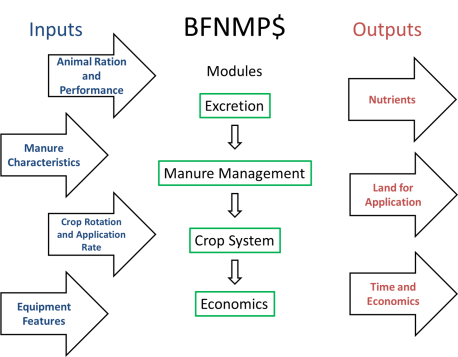
The Beef Feed Nutrient Management Planning Economics (BFNMP$) computer program can assist producers in understanding the impacts manure handling changes could have on their operation.  It calculates manure management economics based on animal nutrient intake, manure nutrient availability, land requirements for spreading, operating costs, and fertilizer value.  These values can be altered to fit individual operations.  The objective of this analysis was to use the BFNMP$ software tool to evaluate the effect of distillers grains inclusion, nitrogen (N) volatilization, and manure application rate on feedlot nutrient management plans.

The BFNMP$ software tool is organized into 4 modules with producers entering information about their operation and then viewing the results.  Outputs include nutrients produced, land needed for manure application, time the plan will take to implement, and economic implications.

What Did We Do?

This program was used to determine 1) impact of dietary N and P from traditional grain based diets compared to diets including 40% distillers grains (DG); 2) effect of different N volatilization (VOL) rates; 3) impact of changing manure application rates from N to P based and from 1 to 4 yr rates.  While comparing scenarios, all other factors in the model were constant.  These scenarios fed out 5,000 cattle per year in 100 hd pens from 341 to 591 kg with 144 d on feed.

What Have We Learned?

Increasing dietary N and P, with a 40% DG diet, increases excretion of these nutrients.  Capturing these nutrients in manure increases costs, but increases value at a greater rate.  Manure from cattle fed a traditional feedlot diet with 50% N VOL has a value of $21.53/animal ($14.45/Mg) based on inorganic fertilizer values.  Feeding a 40% DG ration results in manure worth $29.70/animal ($19.94/Mg).  Decreasing N VOL to 20% increases value of the manure to $26.55/animal ($17.83/Mg) and $37.11/animal ($24.93/Mg) for the grain based and DG diet, respectively.  Phosphorus based applications require about 3 times the acres of N based applications, but spreading on a N basis results in excess P buildup.  Spreading enough manure in 1 yr to meet crop P requirements for 4 yrs costs approximately the same as spreading manure every yr to meet N requirements.

Future Plans

The BFNMP$ program has been designed to aid feedlots in implementing a nutrient management plan.  This tool allows them to see the potential effects of changes before implementing them and promotes better utilization of valuable manure nutrients.

Authors

Andrea Watson, graduate student, University of Nebraska awatson3@unl.edu

Galen Erickson, professor, University of Nebraska

Terry Klopfenstein, professor, University of Nebraska

Rick Koelsch, assistant dean, extension and former professor, University of Nebraska

Ray Massey, professor, University of Missouri

Joseph Harrison, professor, Washington State University

Matt Luebbe, assistant professor, University of Nebraska

Additional Information

http://beef.unl.edu/reports 2006 Beef Report pg. 98; 2008 Beef Report pg. 59; 2012 Beef Report pg. 104

http://water.unl.edu/web/manure/software       website to download the software tool and user guide

Acknowledgements

Funding provided by USDA NRCS CIG Program – Decision Aid Tool to Enhance Adoption of Feed Management 592 (FMPS 592) – Contract No. 69-3A75-10-121.

The authors are solely responsible for the content of these proceedings. The technical information does not necessarily reflect the official position of the sponsoring agencies or institutions represented by planning committee members, and inclusion and distribution herein does not constitute an endorsement of views expressed by the same. Printed materials included herein are not refereed publications. Citations should appear as follows. EXAMPLE: Authors. 2013. Title of presentation. Waste to Worth: Spreading Science and Solutions. Denver, CO. April 1-5, 2013. URL of this page. Accessed on: today’s date.