
Reducing the Impacts of Poultry Litter on Water Quality by Developing Alternative Markets for Poultry Litter Biochar

Waste to Worth: Spreading science and solutions logoWaste to Worth home | More proceedings….

Abstract

Manure from confined animal operations is an environmental liability because of the potential for water and air pollution. The poultry industry in the Chesapeake Bay watershed is under increased regulatory scrutiny due to nitrogen and phosphorous inputs into the Bay. Although poultry litter (PL) is valued as a fertilizer, the cost of shipping the bulky material out of the watershed is prohibitive. One potential solution is to turn the excess litter into energy through pyrolysis. If a market can be developed for poultry litter biochar, more N and P could be removed from the Chesapeake Bay watershed.

Our overall program goals are to develop a comprehensive strategy to convert poultry litter from an environmental liability into an economic and ecological asset and to develop a comprehensive conceptual model for improving poultry litter waste management through market-driven alternatives. Our specific objectives are to characterize the properties and variability of biochar from a commercial poultry/ litter biochar producer, evaluate PL biochar for two potential commercial uses; greenhouse plant production and as an amendment for degraded mine soils.

Why Is It Important to Develop Alternative Markets for Biochar?
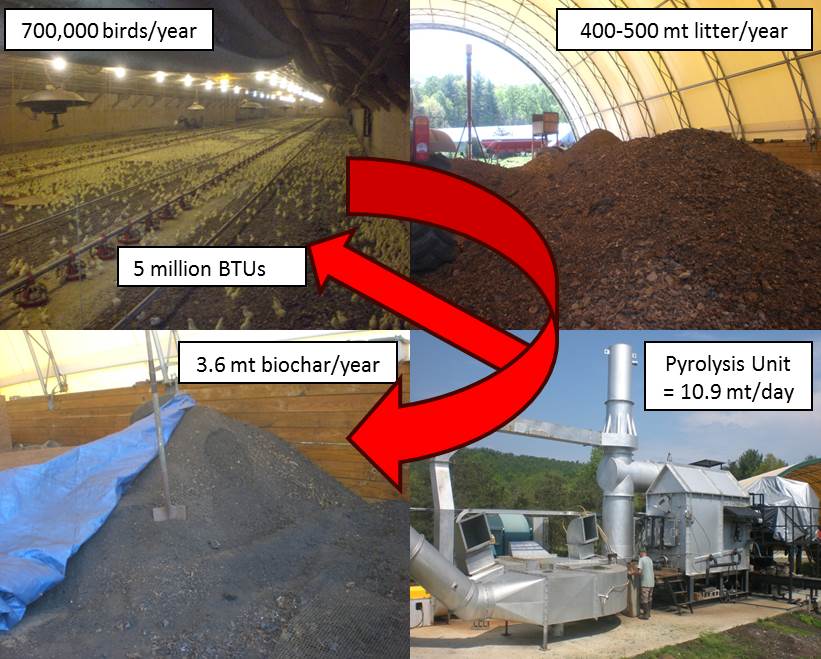
Figure 1. Our biochar supplier, Frye’s Poultry Farm in Wardensville, WV.

Excess phosphorus (P) in the Chesapeake Bay watershed has created water quality problems within the Bay. A major source of this P originates from confined animal feeding operations (CAFOs); within the West Virginia portion of the watershed, primarily in the form of poultry production. The lack of sufficient, suitable cropland on which to spread the manure from these operations has created the need to export P out of the watershed. One potential solution to this challenge may come from the gasification of poultry litter. Gasification produces energy and a carbonaceous byproduct (Figure 1) for which a number of applications have been suggested, including use as a soil amendment. Our long-term objectives are to determine the beneficial uses for a commercially produced poultry litter biochar (PLB) with the goal of generating a market for PLBs that will promote the transport of P out of the Bay watershed. In this work, we describe the particle size distribution and nutrient content of two different pyrolysis oven batch runs of poultry litter from our commercial producer (M-type and W-type).We describe effects of these PLB types on lettuce seed germination and seedling growth and its use as a substitute greenhouse media for cyclamen production.  We also describe the results of an experiment using PLB for mine soil reclamation and cellulosic biomass production.

What did we do?

M-Type and W-type PLBs were mechanically sieved into six size classes in duplicate and then extracted with dilute hydrochloric (0.05M) and sulfuric (0.05M) acids. Solution sodium (Na), potassium (K), calcium (Ca), magnesium (Mg) and P concentrations were determined and converted to mg (kg PLB)-1. Lettuce (Lactuca sativa var. Black Simpson) seed was planted into a commercial top soil amended with two rates of M-type biochar (3.18 g kg-1) and (9.09 g kg-1), some of which had been rinsed with water for 24 or 48 hours to remove salts, with no biochar and fertilizer controls, in two 8 x 8 Latin Square designs. In one Latin Square seedlings were thinned to two per cell and allowed to grow until root bound. Germination percent and dry mass were determined. The second PLB product (W-type) was used untreated as a substitute potting media for greenhouse cyclamen (Cyclamen persicum) production The treatments were a commercial mix, 1:1 peat:perlite + 64 g dolomitic lime or + 112 g W-type PLB. One of the products (M-type) was washed in tap water in an attempt to reduce salt content and then leached and unleached PLB (2.5 kg m-2) was used (lime and fertilizer controls) in a factorial experiment using switchgrass (Panicum virgatum) and Miscanthus sinensis transplants for mine soil reclamation.

What we have learned?

The M-type PLB had more, fine particles (<60 mesh) than did W-Type). The M-type fine particles (<60 mesh) had more Ca and K whereas the coarser W-type particles (>60 mesh) had more K. PLB did not have a significant effect on lettuce germination (> 85%) at either concentration or rinsing treatment. PLB treatments also had no effect on aerial biomass of lettuce yield. The inorganic fertilizer treatment was the only treatment with aerial biomass significantly different (higher) than the control. Cyclamen growth was initially slower, but by the end of the experiment, yields were equivalent. It is too soon to draw conclusions from the mine soil reclamation experiment.

Future plans

We will continue monitoring switchgrass and Miscanthus growth and mine soil property changes in response to biochar applications and are seeking additional disturbed soil sites for new experiments. Because biochar is known to sorb metal contaminants, we have initiated laboratory experiments to evaluate the effectiveness of biochar for the remediation of brownfield sites. We also have plans to determine the stability of biochar in a variety of soils and the effects of biochar applications on soil microbial communities and greenhouse gas emissions.

Authors

Louis M. McDonald, Professor, LMMcDonald@mail.wvu.edu

Andrew Burgess, Research Assistant Professor

Jeff Skousen, Professor

Joshua L. Cook, Graduate Student

Sven Verlinden

Walter E. Veselka, IV, Research Associate

James T. Anderson, Professor. Environmental Research Center, West Virginia University

Additional information

Anderson, J. T., C. N. Eddy, R. L. Hager, L M. McDonald, J. L. Pitchford, J. Skousen, and W. E. Veselka IV. 2012. Reducing impacts of poultry litter on water quality by developing markets for energy and mine land reclamation. Athens: ATINER’S Conference Paper Series, No: ENV2012-0069. 12pp. http://www.atiner.gr/papers/ENV2012-0069.pdf

Acknowledgements

Support for this project was provided by NOAA, NSF, blue moon fund, Frye Poultry Farms, and the Davis College of Agriculture, Natural Resources and Design and Environmental Research Center at West Virginia University.

The authors are solely responsible for the content of these proceedings. The technical information does not necessarily reflect the official position of the sponsoring agencies or institutions represented by planning committee members, and inclusion and distribution herein does not constitute an endorsement of views expressed by the same. Printed materials included herein are not refereed publications. Citations should appear as follows. EXAMPLE: Authors. 2013. Title of presentation. Waste to Worth: Spreading Science and Solutions. Denver, CO. April 1-5, 2013. URL of this page. Accessed on: today’s date.
Dissipation of Fine Particulates Downwind of Poultry Houses

Waste to Worth: Spreading science and solutions logoWaste to Worth home | More proceedings….

Abstract

Air emissions from animal feeding operations have become a growing concern for producers and their neighbors.  Much work has been done to quantify emission rates; however, little information has been provided about air quality downwind from these facilities.  This study investigates PM2.5 (particulate matter ≤ 2.5 µm in diameter) levels as they dissipate from the exhaust fans of selected commercial, tunnel-ventilated, broiler houses in Northeast Georgia. PM2.5 was measured in real time using aerosol monitors and from a time-integrated basis using cyclone samplers.  Data were taken over the last 4-weeks of a summer flock (considered a worst-case-scenario) and filtered to insure enough data was present at each distance and time.  Results indicate a rapid reduction in fine particulate concentration as the distance from the source increases.  When compared to nearby monitoring data, particulate levels appear to be near background levels at distances greater than 30 m (100 ft) from the exhaust fans.

Why Study PM 2.5 in Poultry Production?

Considerable work has been done on evaluation of particulate and ammonia concentrations inside poultry houses and emissions from those houses.  Less is known about how concentrations dissipate as they leave the houses. This is a concern for neighbors of production facilities as well as farm owners.  The objective of this study was to investigate PM2.5 concentrations in the air up to 152.5 m (500ft) away from tunnel-ventilated broiler houses and compare those levels to ambient conditions. 

What Did We Do?

The study was conducted on a four-house commercial broiler farm in Northeast Georgia, from July 18 through August 12, 2007.  The houses were orientated east to west with open pasture located on the east end (downwind) of the four houses. The investigation incorporated a study design to include conditions which favored maximum emission rates, including high temperatures (July, August) and sampling during the final four weeks of the 8-week broiler grow-out cycle. 

Real time (DustTrak 8520) and daily cumulative gravimetric (Triplex cyclone; BGI, model SCC 1.062) PM2.5 measurements were measured at locations as shown on Figure 1. Publicly available data taken by Georgia EPD [9] using a TEOM 1400ab sampler at a site in Athens, GA (approx.. 32 km east of the site) was also used as an additional “control site.” 

What Have We Learned?

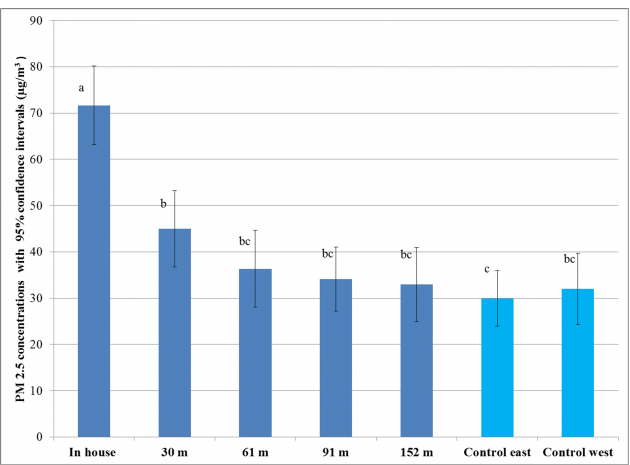
Particulate levels near poultry houses are elevated by emissions from the houses, however if we compare the readings on Figures 2a and 2b, we see that the largest single influence on the results was ambient conditions.  The downwind levels (2b) closely followed the ambient levels (2a). Similar results were seen for the daily gravimetric readings.  If we look at the average readings for the entire experiment at each distance from the house and compare those to in-house and ambient readings (Figure 3) we see a rapidly dropping influence on atmospheric particulate readings with no significant difference beyond 30 m from the houses.  While some of the measurements were above EPA’s ambient air standards, ambient conditions were also above the standards during those days.

Figure 2 PM 2.5 levels vs. distance from houses

Authors

John W Worley, Associate Professor, Poultry Science Department, University of Georgia jworley@uga.edu

Casey W Ritz1 Professor, Michael Czarick1,Sr. Public Service Associate, Brian D Fairchild1,Associate Professor, Luke P Naeher2 Associate Professor

1 Poultry Science Department, University of Georgia

2 Environmental Health Science, University of Georgia

Acknowledgements

The authors would like to acknowledge the contributions of Mr. Benjamin Hale and Mr. Adam Gray who did much of the field work including instrument calibration and lab analysis for this project and to Mr. Olorunfemi Adetona for his help in pulling together information for the document.  We would also like to thank the US Poultry and Egg Association for their financial support that enabled this research to be accomplished.


The authors are solely responsible for the content of these proceedings. The technical information does not necessarily reflect the official position of the sponsoring agencies or institutions represented by planning committee members, and inclusion and distribution herein does not constitute an endorsement of views expressed by the same. Printed materials included herein are not refereed publications. Citations should appear as follows. EXAMPLE: Authors. 2013. Title of presentation. Waste to Worth: Spreading Science and Solutions. Denver, CO. April 1-5, 2013. URL of this page. Accessed on: today’s date.
Ammonia Recovery from Livestock Wastewater with Gas Permeable Membranes

Waste to Worth: Spreading science and solutions logoWaste to Worth home | More proceedings….

Why Study Ammonia Recovery from Livestock Wastewater?

This presentation shows a novel system that uses gas-permeable membranes to capture and recover ammonia from liquid manure, reducing ammonia emissions from livestock operations, and recovering concentrated liquid nitrogen that could be sold as fertilizer.

What Did We Do?

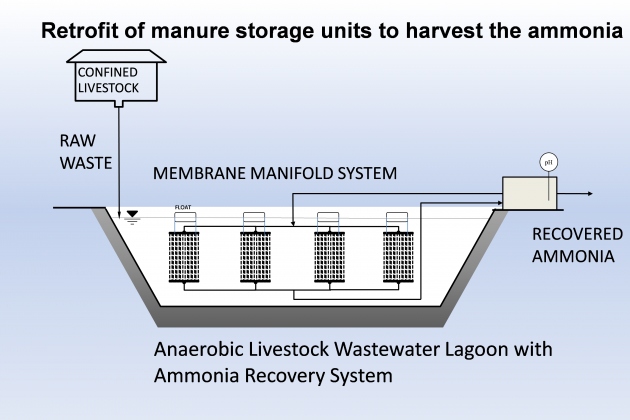
These systems use gas-permeable membranes as components of new processes to capture and recover the ammonia in liquid manures. The new process includes the passage of gaseous ammonia contained in the liquid manure through a microporous hydrophobic membrane and capture and concentration with circulating diluted acid on the other side of the membrane.   The membranes can be assembled in modules or manifolds.  For liquid manure applications, the membrane manifolds are submerged in the liquid and the ammonia is removed from the liquid manure in barn pits or storage tanks and lagoons before it goes into the air.

Cross-sectional diagram of ammonia capture using hydrophobic gas-permeable membrane.  Ammonia gas (NH3) in the liquid manure permeates through hydrophobic membrane walls with micron-sized pores, where it combines with the free protons (H+) in the acid solution to form non-volatile ammonium ions (NH4+).

What Have We Learned?

The concept was successfully tested using concentrated swine manure effluents containing 140 to 1,400 mg/L NH4-N. The use of gas-permeable membranes to remove ammonia from liquid manure was effective, and the rate of N recovery by the gas-permeable membrane system was higher with higher ammonia concentration in the manure.  While ammonia gas passed readily through the membrane pores, the soluble COD compounds did not pass. An average removal rate from 45 to 153 milligrams of ammonia per liter per day was obtained when ammonia concentrations in swine lagoon liquid ranged from 138 to 302 milligrams ammonia per liter.  The rate of ammonia recovery was also increased with increased pH of the wastewater. With a natural pH of 8.3, the rate of N recovery was about 1.2% per hour.  This rate was increased 10 times (to 13% per hour) at pH of 10 after alkali addition.  In another study, we immersed the membrane module into raw liquid manure that had 1,400 milligrams of ammonia per liter, and after 9 days, the total ammonia concentration decreased about 50 percent to 663 mg per liter. The gaseous ammonia in the liquid (or free ammonia) linked to ammonia emissions decreased 95 percent from 114.2 to 5.4 milligrams per liter. The same process was used in 10 consecutive batches of raw swine manure and ended up recovering concentrated nitrogen in a clear solution that contained 53,000 milligrams of ammonia per liter.  The new technology could help change on-farm nitrogen management: Livestock producers could use the technology to help meet air-quality regulations, save fuel, protect the health of livestock and their human caretakers, improve livestock productivity, and recover concentrated liquid nitrogen that can be re-used in agriculture as a valued fertilizer.

Diagram of ammonia recovery system using with gas permeable membranes

Recovery and concentration of ammonia from liquid manure using gas-permeable membrane system. Diagram and pictures show prototype testing, using the same stripping solution with repeated batches of liquid manure.

Future Plans

On-farm demonstration studies will be conducted in 2013-2014 in cooperation with Dr. John Classen, North Carolina State University, through an NRCS Conservation Innovation Grant (CIG) awarded in FY2012 “Ammonia recovery from swine wastewater with selective membrane technology”.  The project will demonstrate recovery of ammonia from liquid manure effluents using the gas-permeable technology in three different manure collection systems: under floor belt system, scraper system, and anaerobic digester.

USDA seeks a commercial partner to develop and market this invention (US Patent Appl. SN 13/164,363)  http://www.ars.usda.gov/business/docs.htm?docid=763&page=5

Authors

Matias Vanotti, USDA-ARS, Florence, South Carolina, matias.vanotti@ars.usda.gov

Matias Vanotti, Ariel Szogi,  Patrick Hunt

USDA-ARS, Coastal Plains Soil, Water, and Plant Research Center, Florence, SC

Additional Information

Livestock Waste Management 2.0: Recycling Ammonia Emissions as Fertilizer published in the November/December 2012 issue of Agricultural Research magazine  http://www.ars.usda.gov/is/AR/archive/nov12/livestock1112.htm

“Recovery of ammonia with gas permeable membranes” research update at USDA-ARS-CPSWPRC website  http://www.ars.usda.gov/Research/docs.htm?docid=22883#ammonia

Vanotti,M.B., Szogi,A.A.  “Systems and Methods for Reducing Ammonia Emissions form Liquid Effluents and for Recovering Ammonia”. US Patent Appl. SN 13/164,363,  filed June 20, 2011.  US Patent and Trademark Office, Washington, DC.

Vanotti, M.B., Szogi, A.A. 2010. “Removal and recovery of ammonia from liquid manure using gas-permeable membranes”. In: Proceedings of the 2010 American Society of Agricultural and Biological Engineers Annual International Meeting, June 20-23, 2010, Pittsburgh, Pennsylvania. 5 p. Paper No. 1008376.

The authors are solely responsible for the content of these proceedings. The technical information does not necessarily reflect the official position of the sponsoring agencies or institutions represented by planning committee members, and inclusion and distribution herein does not constitute an endorsement of views expressed by the same. Printed materials included herein are not refereed publications. Citations should appear as follows. EXAMPLE: Authors. 2013. Title of presentation. Waste to Worth: Spreading Science and Solutions. Denver, CO. April 1-5, 2013. URL of this page. Accessed on: today’s date.

Livestock GRACEnet

Waste to Worth: Spreading science and solutions logoWaste to Worth home | More proceedings….

Abstract

Livestock GRACEnet is a United States Department of Agriculture, Agricultural Research Service working group focused on atmospheric emissions from livestock production in the USA. The working group presently has 24 scientists from 13 locations covering the major animal production systems in the USA (dairy, beef, swine, and poultry). The mission of Livestock GRACEnet is to lead the development of management practices that reduce greenhouse gas, ammonia, and other emissions and provide a sound scientific basis for accurate measurement and modeling of emissions from livestock agriculture. The working group fosters collaboration among fellow scientists and stakeholders to identify and develop appropriate management practices; supports the needs of policy makers and regulators for consistent, accurate data and information; fosters scientific transparency and rigor and transfers new knowledge efficiently to stakeholders and the scientific community.  Success in the group’s mission will help ensure the economic viability of the livestock industry, improve vitality and quality of life in rural areas, and provide beneficial environmental services. Some of the research highlights of the group are provided as examples of current work within Livestock GRACEnet. These include efforts aimed at improving emissions inventories, developing mitigation strategies, improving process-based models for estimating emissions, and producing fact sheets to inform producers about successful management practices that can be put to use now.

Why Was GRACEnet Created?

The mission of Livestock GRACEnet is to lead the development of livestock management practices to reduce greenhouse gas, ammonia, and other emissions and to provide a sound scientific basis for accurate measurement and modeling of emissions.

What Did We Do?

The Livestock GRACEnet group is comprised of 24 scientists from 13 USDA-ARS locations researching the effects of livestock production on emissions and air quality.

Our goals are to:

  • Collaborate with fellow scientists and stakeholders to identify and develop appropriate management practices
  • Support the needs of policy makers and regulators for consistent, accurate data and information
  • Foster scientific transparency and rigor
  • Transfer new knowledge efficiently to stakeholders and the scientific community

Success in our mission will help to ensure the economic viability of the livestock industry, vitality and quality of life in rural areas, and provide environmental services benefits.

Authors

April Leytem, Research Soil Scientist, USDA-ARS april.leytem@ars.usda.gov

Additional Information

https://www.ars.usda.gov/anrds/gracenet/livestock-gracenet/


The authors are solely responsible for the content of these proceedings. The technical information does not necessarily reflect the official position of the sponsoring agencies or institutions represented by planning committee members, and inclusion and distribution herein does not constitute an endorsement of views expressed by the same. Printed materials included herein are not refereed publications. Citations should appear as follows. EXAMPLE: Authors. 2013. Title of presentation. Waste to Worth: Spreading Science and Solutions. Denver, CO. April 1-5, 2013. URL of this page. Accessed on: today’s date.

The Farm Manure to Energy Initiative: Using Excess Manure to Generate Farm Income in the Chesapeake’s Phosphorus Hotspots

Waste to Worth: Spreading science and solutions logoWaste to Worth home | More proceedings….

Abstract

Currently, all the Bay states are working to achieve nutrient reduction goals from various pollution sources.  Significant reductions in phosphorus pollution from agriculture, particularly with respect to phosphorus losses from land application of manure are needed to support a healthy aquatic ecosystem.  Producers in high-density animal agricultural production areas such as Lancaster County region of Pennsylvania, the Delmarva Peninsula, and the Shenandoah Valley region of Virginia, need viable alternatives to local land application in order to meet nutrient reduction goals.

Field demonstrations will be monitored to determine whether the technologies are environmental beneficial, and economically and technically feasible. Specific measures of performance include: reliability and heat distribution, in-house air quality, avoided propane or electricity use, costs to install and maintain, fertilizer and economic value of ash or biochar produced, air emissions, and fate of poultry litter nutrients. Technology evaluation results will be shared on a clearinghouse website developed in partnership with eXtension.

The Farm Manure to Energy Initiative is also supporting efforts to develop markets for nutrient rich ash and biochar co-products. Field trials using nutrient rich ash and biochar from poultry litter thermochemical processes for fresh market vegetable production are currently underway at Virginia Tech’s Eastern Shore Agricultural Research and Experiment Station.

Purpose

The Farm Manure to Energy Initiative is a collaborative effort to evaluate the technical, environmental, and economic feasibility of farm-scale manure to energy technologies in an effort to expand management and revenue-generating opportunities for excess manure nutrients in concentrated animal production regions of the Chesapeake Bay watershed.

What Did We Do?

The project team went through a comprehensive review process and identified three farm-scale, manure to energy technologies that we think have the potential to generate new revenue streams and provide alternatives to local land application of excess manure nutrients.  Installation and performance evaluation of two of these technologies on four host farms in the Chesapeake Bay region are underway. Partners have also completed a survey of financing options for farm-scale technology deployment and published a comprehensive financing resources guide for farmers in the Chesapeake Bay region.

What Have We Learned?

To date, we have not identified any manure to energy technologies that also provide alternatives to local land application of excess manure nutrients for liquid manures.  Thermochemical manure to energy technologies using poultry litter as a fuel source seem to show the most promise for offering opportunities to export excess nutrients from phosphorus hotspots in the Chesapeake Bay region. Producing heat for poultry houses is the most readily available energy capture option.  We did not identify any vendors with a proven approach to producing electricity via farm-scale, thermochemical manure to energy technologies. With respect to the fate of poultry litter nutrients, preliminary air emissions data indicates that most poultry litter nitrogen (greater than 98%) is converted to non-reactive nitrogen in the thermochemical process. Phosphorus and potash are preserved in the ash or biochar coproducts. Preliminary field trial results indicate that phosphorus in ash and biochar is bioavailable and can be used as a replacement for commercial phosphorus fertilizer, but bioavailability varied according to the thermochemical process.

Future Plans

We are currenty in the process of installing and measuring the performance of farm-scale demonstrations in the Chesapeake Bay region.  We are collaborating with the Livestock and Poultry Environmental Learning Center to develop a clearinghouse website for thermochemical farm-scale manure to energy technologies that will be hosted on the eXtension website.  Performance data from our projects will be shared on this website, which can also be used as a platform to share information about the performance of other farm-scale, thermochemical technology installations around the U.S. Technical training events using farm demonstrations as an educational platform will be hosted during the later half of the project. Additional field and row crop trials to demonstrate the fertilizer value of the concentrated nutrient coproducts are also planned using ash from farm demonstrations.

Authors

Jane Corson-Lassiter, USDA NRCS, Jane.Lassiter@va.usda.gov; Kristen Hughes Evans, Executive Director, Sustainable Chesapeake

Additional partners in the Farm Manure to Energy Initiative include: Farm Pilot Project Coordination, Inc., University of Maryland Center for Environmental Studies, University of Maryland Environmental Finance Center, Virginia Cooperative Extension, Lancaster County Conservation District, the Virginia Tech Eastern Shore Agricultural Research and Extension Center, National Fish and Wildlife Foundation, Chesapeake Bay Funders Network, Chesapeake Bay Commission, and International Biochar Institute.

Additional Information

www.sustainablechesapeake.org

www.fppcinc.org

Acknowledgements

Funding for this project is provided by a grant from the USDA Conservation Innovation Grant program, the National Fish and Wildlife Foundation via the U.S. EPA Innovative Nutrient and Sediment Reduction Program, the Chesapeake Bay Funders Network, as well as technology vendors and host farmers participating in the technology demonstrations.


The authors are solely responsible for the content of these proceedings. The technical information does not necessarily reflect the official position of the sponsoring agencies or institutions represented by planning committee members, and inclusion and distribution herein does not constitute an endorsement of views expressed by the same. Printed materials included herein are not refereed publications. Citations should appear as follows. EXAMPLE: Authors. 2013. Title of presentation. Waste to Worth: Spreading Science and Solutions. Denver, CO. April 1-5, 2013. URL of this page. Accessed on: today’s date.

Valuing Feedstocks for Anaerobic Digestion – Balancing Energy Potential and Nutrient Content

Waste to Worth: Spreading science and solutions logoWaste to Worth home | More proceedings….

Why Study the Interaction Between Energy and Nutrients for Digestion?

To improve the energy production and revenue generation, many farm digester operators are including off-farm feedstocks in the blend.  Off-farm feedstocks are raw materials with high carbon concentrations that can be degraded anaerobically.  Common off-farm feedstocks include food service or retail waste, food processing byproducts, residuals from biofuels production and FOG (fat, oil & grease) resulting from food preparation.  Typically, off-farm feedstocks have a higher energy potential when compared to manure.  Manures generally have biogas potential in the range of 280 to 500 L of biogas/kg of VS, compared to off-farm feedstocks which can range from 300 to 1,300 L of biogas/kg of VS [1].  In addition to the increased biogas production, revenue can also be generated from tipping fees collected for feedstock brought onto a farm.  The tipping fee is typically comparable to the cost of disposing of the material at a landfill or wastewater treatment plant. 

The purpose of this ongoing project is to evaluate the biogas potential and impact on nutrient management of off-farm feedstocks for anaerobic digestion.  

What Did We Do?

The Anaerobic Digestion Research and Education Center (ADREC) has carried out hundreds of biogas methane potential tests (BMP’s) over the past 5 years.  The purpose of the BMP is to evaluate if a feedstock is anaerobically degradable and predict the biogas production under ideal conditions.  As part of the biogas testing, many feedstocks were also characterized for their nutrient composition.

What Have We Learned?

While off-farm feedstocks do offer opportunities to improve the profitability of anaerobic digestion systems, operators must also consider the costs associated with bring material onto the farm.  Water contained in off-farm feedstock contributes to the manure volume and adds cost during land application.  Nutrients contained in feedstocks need to be measured and considered in the context of nutrient management planning.  In addition, the regulatory and record keeping requirements associated with off-farm feedstock should also be factored into any cost-benefit analysis.

Future Plans

ADREC is planning to continue the BMP evaluations as part its normal fee for service activities.

Authors

Dana Kirk, Specialist, Michigan State University, kirkdana@anr.msu.edu

Louis Faivor, Technician, Michigan State Univeristy

Additional Information

http://researchgroups.msu.edu/adrec/about


[1] KTBL.  2012.  Biogas Profitability Calculator.  http://daten.ktbl.de/biogas/showSubstrate.do?zustandReq=3#anwendung


The authors are solely responsible for the content of these proceedings. The technical information does not necessarily reflect the official position of the sponsoring agencies or institutions represented by planning committee members, and inclusion and distribution herein does not constitute an endorsement of views expressed by the same. Printed materials included herein are not refereed publications. Citations should appear as follows. EXAMPLE: Authors. 2013. Title of presentation. Waste to Worth: Spreading Science and Solutions. Denver, CO. April 1-5, 2013. URL of this page. Accessed on: today’s date.

Small and Backyard Poultry Flocks

Waste to Worth: Spreading science and solutions logoWaste to Worth home | More proceedings….

Abstract

Because of their size, it is possible to raise most poultry species (chickens, turkeys, ducks, geese, pigeon, etc.) with only a minimal amount of acreage. This has made them increasingly popular in rural, suburban, and urban areas throughout the United States. They are suitable for 4-H/classroom projects, backyard flocks, as well as small- and medium-sized production flocks. Many of those who have started raising poultry have limited experience with poultry production.

What Topics Will Be Covered In This Presentation?

Example of a small layer flock (3 Buff Orpingtons) in a backyard

An overview of the situation with small and backyard flocks with regards to waste management

What Did We Do?

Visits to different small and backyard flocks, as well as information provided during presentations and webinars.

What Have We Learned?

Poultry production in the US started out as small farm operations. Over the decades poultry production has evolved from farming to an industry. World War II created a huge demand for poultry products. As farm workers were drafted into the army production become more mechanized. After the war ended many of the returning soldiers did not return to a life on the farm. New urban markets for poultry products developed, furthering fueling the modernization of poultry production. Today we have come full circle. It is becoming more common to see small chicken flocks raised in backyard poultry flocks. Niche markets have also been developed for organic and pasture poultry production.

The front yard of a home with a backyard chicken flock

Although flock size is small, chickens kept in backyards still produce a considerable amount of manure that needs to be managed. Many backyard flock owners also raise their own vegetables and use the manure produced as a valuable fertilizer. For others, however, the manure can be allowed to accumulate and, when not properly stored, can become an odor nuisance. Pasture-raised poultry flocks, given sufficient acreage, spreads the manure over a large area reducing, or eliminating, odor problems.

For both backyard and confined small poultry flocks, composting of both manure and any dead birds has become common.

Future Plans

Use of composted manure as fertilizer for raised garden beds

In the 1950s more than 40 state colleges and universities had poultry science departments. Discoveries in nutrition, genetics, physiology, health and food science helped poultry production become an important food industry.  Today only 6 universities have poultry departments. With the loss of university poultry depeartments and retirmements of key extension people, there has been a loss of updated extension publications to provide guidance to small and backyard poultry flock owners. Since very little information is available addressing the management needs of these smaller poultry flocks, many producers have turned to outdated books as well as non-science-based and anecdotal information for their education needs. A new eXtension community of practice for small and backyard poultry has been developed to fill this information void.

Author

Dr. Jacquie Jacob; Poultry Extension Associate; University of Kentucky, 906 Garrigus Building; Lexington, KY; 40546-0215, jacquie.jacob@uky.edu

Additional Information

www.eXtension.org/poultry


The authors are solely responsible for the content of these proceedings. The technical information does not necessarily reflect the official position of the sponsoring agencies or institutions represented by planning committee members, and inclusion and distribution herein does not constitute an endorsement of views expressed by the same. Printed materials included herein are not refereed publications. Citations should appear as follows. EXAMPLE: Authors. 2013. Title of presentation. Waste to Worth: Spreading Science and Solutions. Denver, CO. April 1-5, 2013. URL of this page. Accessed on: today’s date.

Estimation of On-Farm Greenhouse Gas Emissions from Poultry Houses

Waste to Worth: Spreading science and solutions logoWaste to Worth home | More proceedings….

*Abstract

Much of the greenhouse gases (GHG) generated from the poultry industry is primarily from feed production. The poultry producer does not have control over the production and distribution of the feed used on the farm. However, they can control other emissions that occur on the farm such as emissions from the utilization of fossil fuels and from manure management. A series of studies were conducted to evaluate on-farm greenhouse gas emissions from broiler, breeder and pullets houses in addition to an in-line commercial layer complex. Data was collected from distributed questionnaires and included; the activity data from the facility operations (in the form of fuel bills and electricity bills), house size and age, flock size, number of flocks per year, and manure management system. Emissions were calculated using GHG calculation tools and emission factors from IPCC. The carbon dioxide, nitrous oxide and methane emissions were computed and a carbon footprint was determined and expressed in tonnes carbon dioxide equivalents (CO2e).

The results from the study showed that about 90% of the emissions from the broiler and pullet farms were from propane and diesel gas use, while only 6% of the total emissions from breeder farms were from propane and diesel gas use. On breeder farms, about 29% of GHG emissions were the result of electricity use while the pullet and broiler farms had only 3% emissions from electricity use. Emissions from manure management in the layer facility were responsible for 53% of the total emission from the facility, while electricity use represented 28% of the total emissions. The results from these studies identified the major sources of on-farm of GHG emissions. This will allow us to target these areas for abatement and mitigation strategies.

Why Study Greenhouse Gases on Poultry Farms?

Human activities, including modern agriculture, contribute to greenhouse gas (GHG) emissions (IPCC, 1996). Agriculture has been reported to be responsible for 6.3% of the GHG emissions in the U.S., of this 53.5% were a result of animal agriculture. Of the emissions from animal agriculture, poultry was responsible for only 0.6%. Much of the CO2e that is generated from the poultry industry is primarily from feed production, the utilization of fossil fuels and manure management (Pelletier, 2008; EWG, 2011). While the poultry producer does not have control over the production of the feed that is used on the farm, there are other GHG emissions that occur on the farm that are under their control. These emissions may be in the form of purchased electricity, propane used for heating houses and incineration of dead birds, diesel used in farm equipment which includes generators and emissions from manure management.

What Did We Do?

A series of studies were conducted to examine the GHG emissions from poultry production houses and involved the estimation of emissions from; broiler grow-out farms, pullet farms, breeder farms from one commercial egg complex. Data collection included the fuel and electricity bills from each farm, house size and age, flock size and number of flocks per year and manure management. The GHG emissions were evaluated using the IPCC spreadsheets with emission factors based on region and animal type. We separated the emissions based on their sources and determined that there were two main sources, 1. Mechanical and 2. Non-mechanical. After we determined the sources, we looked at what contributed to each source.

What Have We Learned?

When all GHG emissions from each type of operation was evaluated, the total for an average broiler house was approximately 847 tonnes CO2e/year, the average breeder house emission was 102.56 tonnes CO2e/year, pullet houses had a total emission of 487.67 tonnes CO2e/year, and 4585.52 CO2e/year from a 12 house laying facility. The results from this study showed that approximately 96% of the mechanical emissions from broiler and pullet houses were from propane (stationary combustion) use while less than 5% of these emissions from breeder houses were from propane use. The high emission from propane use in broiler and pullet houses is due to heating the houses during brooding and cold weather. Annual emissions from manure management showed that layer houses had higher emissions (139 tonnes CO2e/year) when compared to breeder houses (65.3 tonnes CO2e/year), broiler houses (59 tonnes CO2e/year) and pullet houses (61.7tonnesCO2e/year). Poultry reared in management systems with litter and using solid storage has relatively high N2O emissions but low CH4 emissions.We have learned that there is variability in the amount of emissions within each type of poultry production facility regardless of the age or structure of houses and as such reduction strategies will have to be tailored to suit each situation. We have also learned that the amount of emissions from each source (mechanical or non-mechanical) depends on the type of operation (broiler, pullet, breeder, or layer).

Future Plans

Abatement and Mitigation strategies will be assessed and a Poultry Carbon Footprint Calculation Tool is currently being developed by the team and will be made available to poultry producers to calculate their on-farm emissions. This tool will populate a report and make mitigation recommendations for each scenario presented. Best management practices (BMP) can result in improvements in energy use and will help to reduce the use of fossil fuel, specifically propane on the poultry farms thereby reducing GHG emissions, we will develop a set of BMP for the poultry producer.

Authors

Claudia. S.  Dunkley, Department of Poultry Science, University of Georgia; cdunkley@uga.edu

Brian. D. Fairchild, Casey. W. Ritz, Brian. H. Kiepper, and Michael. P. Lacy, Department of Poultry Science, University of Georgia


The authors are solely responsible for the content of these proceedings. The technical information does not necessarily reflect the official position of the sponsoring agencies or institutions represented by planning committee members, and inclusion and distribution herein does not constitute an endorsement of views expressed by the same. Printed materials included herein are not refereed publications. Citations should appear as follows. EXAMPLE: Authors. 2013. Title of presentation. Waste to Worth: Spreading Science and Solutions. Denver, CO. April 1-5, 2013. URL of this page. Accessed on: today’s date.

Combustion of Poultry Litter: A Comparison of Using Litter for On-Farm Space Heating Versus Generation of Electricity

Waste to Worth: Spreading science and solutions logoWaste to Worth home | More proceedings….

Abstract

This presentation will compare using litter as a replacement for LP gas for on-farm space heating with using litter to generate electricity. The comparison includes heating system efficiency, amount of LP off-set possible, value of plant nutrients in the litter, quantity and value of plant nutrients in the litter ash, impact of brokerage, and costs of producing the energy. It was concluded that using litter on-farm as a source of space heat and using the litter ash as fertilizer could provide a potential value of $48 per ton of litter. However, on-farm combustion of litter to produce electricity resulted in a loss of about – $3/ton of litter. Therefore, if a heating and ash management system can be implemented in a cost-effective manner use of litter to off-set 90% or more of the heating energy requirements would be the better of these two alternatives.

Why Is Energy Use Important in Poultry Production?

Modern poultry production requires substantial amounts of energy for space heating (propane/LP gas), ventilation, feed handling, and lighting. It was determined that annual LP gas consumption in broiler houses can range from 150 to 300 gallons of LP per 1000 square feet of floor space with an average of about 240 gal LP/1000 ft2 observed in South Carolina. Similarly, broiler production in South Carolina requires about 2326 kWh/1000 ft2 of house area. As a result, a 6-house broiler farm in SC uses about 30,240 gallons of LP and 293.076 kWh of electricity annually. The cost for energy for a 6-house farm is on the order of $57,456 per year for LP ($1.90/gal LP) and $35,169 per year for electricity ($0.12/kWh). Energy costs have more than doubled over the last decade and as a result producers are very interested in ways to reduce on-farm energy costs by using the energy contained in the litter. The objective of this study was to compare using litter as a replacement for LP gas for on-farm space heating with using litter to generate electricity.

What Did We Do?

Our analysis included heating system efficiency, amount of LP off-set possible, value of plant nutrients in the litter, quantity and value of plant nutrients in the litter ash, impact of brokerage, and costs of producing the energy.

What Have We Learned?

It was concluded that using litter on-farm as a source of space heat and using the litter ash as fertilizer could provide a potential value of $46 to $55 per ton of litter. However, on-farm combustion of litter to produce electricity resulted in a loss of about $3/ton of litter. Therefore, if a heating and ash management system can be implemented in a cost-effective manner use of litter to off-set 90% or more of the heating energy requirements would be the better of these two alternatives.

Future Plans

This information is being used in extension programs that target poultry producers.

Authors

Dr. John P. Chastain, Professor and Extension Agricultural Engineer,  School of Agricultural, Forestry, and Environmental Sciences, Clemson University, jchstn@clemson.edu

Additional Information

Chastain, J.P., A. Coloma-del Valle, and K.P. Moore. 2012. Using Broiler Litter as an Energy Source: Energy Content and Ash Composition. Applied Engineering in Agriculture Vol 28(4):513-522.

Acknowledgements

Support was provided by the Confined Animal Manure Managers Program, Clemson Extension, Clemson University, Clemson, SC.


The authors are solely responsible for the content of these proceedings. The technical information does not necessarily reflect the official position of the sponsoring agencies or institutions represented by planning committee members, and inclusion and distribution herein does not constitute an endorsement of views expressed by the same. Printed materials included herein are not refereed publications. Citations should appear as follows. EXAMPLE: Authors. 2013. Title of presentation. Waste to Worth: Spreading Science and Solutions. Denver, CO. April 1-5, 2013. URL of this page. Accessed on: today’s date.

Litter Generated Ammonia Captured by Activated Carbon Derived ffrom Broiler Litter

Waste to Worth: Spreading science and solutions logoWaste to Worth home | More proceedings….

Abstract

In 2011, the production rate of broilers was 8.6 billion with a value of $23.2 billion (USDA 2012).  Both CERCLA and EPCRA have reporting requirements for ammonia (NH3) of 100 lb of NH3/d or 18.3 tons/yr, a level that may affect large animal production facilities (NRC 2003). Although USEPA (2009) has provided an exemption for animal waste producing farms under CERCLA for reporting hazardous air emissions, it is expected that this exemption will be revoked once valid methodologies are established for monitoring. Two of the 24 sites in the NAEMS monitoring study reported similar NH3 emissions of 3.6 – 5.3 tons of NH3 per house per year (Burns et al. 2009, Heber 2010). Emissions of this level indicate a need for developing technologies that can reduce the NH3 levels produced by broiler operations. This research is focused on the use of broiler litter as activated carbon (BAC) to reduce aerial NH3 generated by litter, an opportunity to not only reuse the manure, but also treat the emissions from or within broiler houses. The objective of this study was to evaluate the efficacy of BAC to remove NH3 volatilized from litter samples in a laboratory acid-trap system. Preliminary studies using NH3/air mixture indicated that the BAC capacity to adsorb NH3 was approximately double that of Vapure 612, a commercial carbon. In the litter emission study, the BAC and Vapure performance was comparable. Breakthrough for both carbons occurred within 14 hours of the test start. At the end of the 3 day test, the NH3 emission for BAC was 75% of the litter only control, whereas, the Vapure emission was 64% of the control. The results of the study demonstrate the potential for a cyclical waste utilization strategy in using broiler litter activated carbon to capture NH3 volatilized from litter.

Why Study Ammonia and Poultry Litter?

Overall purpose of this study is to develop innovative solutions for animal waste reuse and minimize emissions from poultry operations. The specific objective of this phase of the study was to evaluate the efficacy of activated carbon from broiler litter (BAC) to remove NH3 volatilized from litter samples in a laboratory acid-trap system.

What Did We Do?

The broiler litter for producing the BAC was obtained from a commercial farm in Mississippi, where the original bedding was pine shavings.  The broiler litter as collected had a moisture content of 25 to 30%.  The commercial carbon, Vapure 612 carbon (Norit Americas, Marshall, Texas), is a steam activated coal-based carbon manufactured for use in the removal of odors, toxic vapors, irritants, and corrosive gases.  After completing initial adsorption tests with the two carbons using the NH3 and air mixture, litter samples were collected from a commercial Mississippi farm where the bedding origin was also pine shavings to perform the litter emission test.  Eleven flocks had previously been grown on the litter.  The pH and moisture content were 8.32 and 17.9% respectively. The litter samples were placed in the acid trap system described below to determine the capture capacity of the carbons for NH3 volatilized from the litter. 

Litter emissions and carbon efficacy were evaluated using 50 g fresh litter samples in the laboratory using a chamber acid trap (CAT) system. The CAT system provides a straightforward method for determining differences in NH3 evolution by capturing off-gases in H3BO3. Twelve air-tight chambers, 1000 ml each, receive humidified air from a single manifold.  Weighed litter samples were placed in each air tight chamber.  To assess litter NH3 generation, exhaust air from each chamber flowed through a series of two H3BO3 flasks at approximately 115 ml/min.  The solution from the two flasks was combined into a single sample and titrated with HCl as above.  The NH3 trapped in solution was reported as mg N recovered.  For estimating carbon column efficiency, the columns described above were loaded with BAC and Vapure carbons and placed in the exhaust flow between the chambers and acid traps.  The litter only, BAC and Vapure columns were randomly assigned to the chambers in the CAT system and each replicated three times.  All treatments were titrated each morning and afternoon at consistent times for the three day test period. 


Chamber acid-trap system for capturing NH3 in the laboratory:  a) litter in chamber, b) activated carbon column, and c) boric acid traps. 

What Have We Learned?

Preliminary studies using NH3/air mixture indicated that the BAC capacity to adsorb NH3 was approximately double that of Vapure 612, a commercial carbon. In the litter emission study, the BAC and Vapure performance was comparable. Breakthrough for both carbons occurred within 14 hours of the test start. At the end of the 3 day test, the NH3 emission for BAC was 75% of the litter only control, whereas, the Vapure emission was 64% of the control. The results of the study demonstrate the potential for a cyclical waste utilization strategy in using broiler litter activated carbon to capture NH3 volatilized from litter. 

Future Plans

The development of these activated carbons and char from broiler litter will provide an effective means of reuse that will not only reduce waste volume, but in turn comprehensively treat the emissions from the waste during bird production, storage, and land application of litter. We will conduct greenhouse gas adsorption studies to determine the efficacy of activated carbon and char to adsorb CO2, CH4, and N2O.

Additionally, our plan is to develop an outreach program to be presented to poultry farmers in the Southeast U.S. along with other stakeholders addressing poultry farm emission regulations and technologies for remediation through workshops, a webinar and professional conferences.

Authors

Kari Fitzmorris Brisolara, ScD, Associate Professor of Environmental and Occupational Health, Louisiana State University, Health Sciences Center, School of Public Health, 2020 Gravier Street, New Orleans, Louisiana kbriso@lsuhsc.edu

Dana M. Miles, PhD, USDA-ARS-Mississippi State, Genetics & Precision Agriculture Research Unit, P. O. Box 5367, Mississippi State, Mississippi, 39762 dana.miles@ars.usda.gov

Isabel M. Lima, PhD, USDA-ARS-SRRC, P.O. Box 19687, New Orleans, Louisiana 70179 isabel.lima@ars.usda.gov


The authors are solely responsible for the content of these proceedings. The technical information does not necessarily reflect the official position of the sponsoring agencies or institutions represented by planning committee members, and inclusion and distribution herein does not constitute an endorsement of views expressed by the same. Printed materials included herein are not refereed publications. Citations should appear as follows. EXAMPLE: Authors. 2013. Title of presentation. Waste to Worth: Spreading Science and Solutions. Denver, CO. April 1-5, 2013. URL of this page. Accessed on: today’s date.