Effect of Fractionation and Pyrolysis on Fuel Properties of Poultry Litter

Waste to Worth: Spreading science and solutions logoWaste to Worth home | More proceedings….

Abstract

Raw poultry litter has certain drawbacks for energy production such as high ash and moisture content, a corrosive nature, and low heating values. A combined solution to utilization of raw poultry litter may involve fractionation and pyrolysis. Fractionation divides poultry litter into a fine, nutrient-rich fraction and a coarse, carbon dense fraction. Pyrolysis of the coarse fraction would remove the corrosive volatiles as bio-oil, leaving clean char. This paper presents the effect of fractionation and pyrolysis process parameters on the calorific value of char and on the characterization of bio-oil. Poultry litter samples collected from three commercial poultry farms were divided into 10 treatments that included 2 controls (raw poultry litter and its coarse fraction having particle size greater than 0.85 mm) and 8 other treatments that were combinations of three factors: type (raw poultry litter or its coarse fraction), heating rate (30 or 10 °C/min), and pyrolysis temperature (300 or 500°C). After the screening process, the poultry litter samples were dried and pyrolyzed in a batch reactor under nitrogen atmosphere and char and condensate yields were recorded. The condensate was separated into three fractions on the basis of their density: heavy, medium, and light phase. Calorific value and proximate and nutrient analysis were performed for char, condensate, and feedstock. Results show that the char with the highest calorific value (17.39MJ/kg) was made from the coarse fraction at 300°C, which captured 68.71% of the feedstock energy. The char produced at 300°C had 42mg/kg arsenic content but no mercury. Almost all of the Al, Ca, Fe, K, Mg, Na, and P remained in the char. The pyrolysis process reduced ammoniacal-nitrogen (NH4-N) in char by 99.14% and nitrate-nitrogen (NO3-N) by 95.79% at 500°C.

Authors

Kaushlendra Singh, West Virginia University        Kaushlendra.Singh@mail.wvu.edu

L. Mark Risse*, K.C. Das, John Worley, and Sidney Thompson, University of Georgia


The authors are solely responsible for the content of these proceedings. The technical information does not necessarily reflect the official position of the sponsoring agencies or institutions represented by planning committee members, and inclusion and distribution herein does not constitute an endorsement of views expressed by the same. Printed materials included herein are not refereed publications. Citations should appear as follows. EXAMPLE: Authors. 2013. Title of presentation. Waste to Worth: Spreading Science and Solutions. Denver, CO. April 1-5, 2013. URL of this page. Accessed on: today’s date.


Process for Recovery of Phosphorus from Solid Manure

Waste to Worth: Spreading science and solutions logoWaste to Worth home | More proceedings….

Why Study Phosphorus Recovery?

Land application of manure in regions with intense confined livestock and poultry production is an environmental concern when land is limiting because it promotes soil phosphorus (P) surplus and potential pollution of water resources. A net accumulation of soil P results from the disproportion between lower nitrogen (N) and P ratio (N:P) in animal manure and the higher N:P ratio in harvested crops. Although manure can be moved off the farm, its transportation becomes less economical with increasing distances from the source. Thus, management alternatives to land application are needed to resolve agronomic P imbalances for more effective recycling of manure P.

Litter washed solids residue – Low P content

What Did We Do?

A treatment process, called “quick wash”, was developed for extraction and recovery of P from poultry litter and animal manure solids. In the quick wash process, P is selectively extracted from solid manure or poultry litter by using mineral or organic acid solutions. Following, P is recovered by addition of liquid lime and an organic poly-electrolyte to the liquid extract to form a calcium-containing P precipitate. The quick wash process generates two products: 1) washed solid residue, and 2) concentrated recovered P material.

What Have We Learned?

Recovered concentrated P material

The quick wash process selectively removes up to 80 % of the phosphorus from manure solids while leaving most of the nitrogen in the washed litter residue. Consequently, the washed solid residue has a more balanced N:P ratio for crop production and environmentally safe for land application. The concentrated  P recovered materials contained more than 90% of its phosphorus in plant available form. The use of recovered P can provide a recycled P source for use as crop fertilizer while minimizing manure P losses into the environment from confined animal production.

Future Plans

USDA granted an exclusive license of the invention to Renewable Nutrients, LLC (Pinehurst, NC); a centralized plant for treating poultry litter is planned to be built and operated by Renewable Nutrients in the Mid-Atlantic region.

Authors

Ariel A. Szogi, Research Soil Scientist, USDA-ARS Coastal Plains Soil, Water, and Plant Research Center,  Florence, SC. ariel.szogi@ars.usda.gov

Ariel A. Szogi, Matias B. Vanotti, Patrick G. Hunt – USDA-ARS Coastal Plains Soil, Water, and Plant Rsearch Center,  Florence, SC.

Additional Information

https://www.ars.usda.gov/is/pr/2008/080229.htm

https://www.frontiersin.org/articles/10.3389/fsufs.2018.00037/full

Szogi, A.A., Vanotti, M.B., Hunt, P.G., 2008. Process for removing and recovering phosphorus from animal waste. U.S. Patent and Trademark Office Application Serial No. 12/026,346.

Szogi, A.A., Vanotti, M.B., and Hunt, P.G. 2008. Phosphorus recovery from poultry litter. Trans. ASABE 51(5):1727-1734.

Szogi, A.A. and Vanotti, M.B., 2009. Prospects for phosphorus recovery from poultry litter. Bioresour. Technol. 100(22):5461-5465.

Szogi, A.A., Bauer, P.J., and Vanotti, M.B. Fertilizer effectiveness of phosphorus recovered from broiler litter. Agron. J. 102(2):723-727. 2010.

Acknowledgements

This work is part of USDA-ARS National Program 214: Agricultural and Industrial Byproducts; ARS Project 6657-13630-005-00D “Innovative Bioresource Management Technologies for Enhanced Environmental Quality and Value Optimization.”

The authors are solely responsible for the content of these proceedings. The technical information does not necessarily reflect the official position of the sponsoring agencies or institutions represented by planning committee members, and inclusion and distribution herein does not constitute an endorsement of views expressed by the same. Printed materials included herein are not refereed publications. Citations should appear as follows. EXAMPLE: Authors. 2013. Title of presentation. Waste to Worth: Spreading Science and Solutions. Denver, CO. April 1-5, 2013. URL of this page. Accessed on: today’s date.

The Arkansas Discovery Farm Program: Connecting Science to the Farm

Waste to Worth: Spreading science and solutions logoWaste to Worth home | More proceedings….

Why Create the Arkansas Discovery Farm Program?

Agriculture in Arkansas is under increasing pressure to manage nutrients and sediment in an environmentally sustainable manner.  In many sectors of the farming community, this has created severe constraints to remaining economically viable and competitive in today’s global market place.  In northwest Arkansas, home to the nation’s second largest broiler poultry production, farmers have been under intense scrutiny and litigation over the last decade, due to downstream water users (i.e., Oklahoma) questioning the role of agriculture in water quality impairment.  Also, increasing national attention is being focused on reducing nutrients to the Gulf of Mexico, which will further increase the need of agricultural producers to increase nutrient efficiency while declining groundwater levels in crop producing areas of eastern Arkansas will increase the need for greater water efficiency.  The Arkansas Discovery Farm Program was initiated in 2009 to document the effectiveness of conservation practices on “real-world” private farms across the diverse forage, livestock, and row crop agricultural setting across the State.

What Did We Do?

We are monitoring runoff quality from seven farms as we are quantify sediment and nutrient losses from all major row crop and livestock commodities including rice, soybean, corn, cotton, poultry and beef cattle.  We are currently monitoring the quality of runoff from 19 fields using automated water quality samplers that are now equipped modems that contact us via cell phone when sampling is initiated.    On our row crop fields, we have increased our efforts to monitor irrigation water use and needs.  All fields are equipped with turbine-type irrigation flow meters that utilize dataloggers to automatically records flow data.  On two farms, we split fields in half and monitored evapotranspiration with atmometers (ET gages) and compared to our computer irrigation scheduler to calibrate the ET gages as an easier field method for irrigation scheduling.

What Have We Learned?

Due to the fact that we have been monitoring runoff since mid-2011 at the longest, we have limited reliable information to present.  As our first year, 2011 produced several severe flood-stage storms and 2012 provided a record breaking drought, it is difficult to quantify impact at this point.  While the water quality monitoring is a cornerstone, empowering agricultural producers to take ownership in finding solutions to minimize environmental impact is paramount to protecting voluntary efforts for the industry.  Our major findings to date have been the willingness of Arkansas farmers in general to embrace the Program, to be environmentally accountable for their actions, and to be proactive rather than reactionary.   

Future Plans

We have plans to develop another Discovery Farm in the litigated Illinois River Watershed, Northwest Arkanas.   While there is a great deal of interest in developing a commerical forestry Discovery Farm, a lack of potneital funding has limited those plans to date.  As we continue to collect data, we hope we can provide timely information on both economic and natural resource sustainability on behalf of Arkansas Agriculture to regulators, lawmakers and other decision makers. 

Authors

Andrew Sharpley, Professor, Division of Agriculture, University of Arkansas System, sharpley@uark.edu

Mike Daniels, Professor, Cooperative Extension, Division of Agriculture, University of Arkansas System

Neal Mays, Program Technician, Division of Agriculture, University of Arkansas System

Cory Hallmark, Program Technician, Cooperative Extension, Division of Agriculture, University of Arkansas System

Additional Information

http://discoveryfarms.uark.edu/

Acknowledgements

Arkansas Association of Conservation Districts, Arkansas Conservation Commission, Arkansas Natural Resource Conservation Service, Arkansas Farm Bureau


The authors are solely responsible for the content of these proceedings. The technical information does not necessarily reflect the official position of the sponsoring agencies or institutions represented by planning committee members, and inclusion and distribution herein does not constitute an endorsement of views expressed by the same. Printed materials included herein are not refereed publications. Citations should appear as follows. EXAMPLE: Authors. 2013. Title of presentation. Waste to Worth: Spreading Science and Solutions. Denver, CO. April 1-5, 2013. URL of this page. Accessed on: today’s date.

Cellulose-Based Industrial Wastewater By-Product as Broiler Bedding Material

Waste to Worth: Spreading science and solutions logoWaste to Worth home | More proceedings….

Abstract

The increased cost and decreased availability of traditional poultry bedding material, such as pine shavings, has facilitated the need to identify alternative bedding materials for poultry growers. The objective of this study was to evaluate a cellulose by-product from the paper manufacturing industry on its comparability to pine shavings on broiler production performance standards and litter quality parameters.

The experimental design consisted of 25 pens (3.7 m2 each) containing 55 Cobb broilers (0.07 m2/bird) per pen.  Five treatments with five replicate pens per treatment were set up to evaluate varying levels of cellulose inclusion as bedding.  The five cellulose treatments consisted of 0% (Control, 100% pine shavings), 25%, 50%, 75% and 100% cellulose by-product.  The first phase of the experiment included litter moisture, litter pH, and footpad dermatitis (FPD) scores at Day 7.  At Day 7, the mean litter moisture (%) of the Control (23.9) and 25% (23.9) treatments were not significantly different from the 50% (16.9) treatment, but were significantly greater than the 75% (15.0) and 100% (14.8) treatments. At Day 7, the mean percentage (%) of birds with no footpad downgrades in the 100% (99) and 75% (95) treatments were not significantly different from the 50% (87) treatment, but were significantly greater than the 25% (76) and Control (66) treatments. An evaluation of litter moisture versus FPD scores produced a correlation coefficient of 0.73, indicating a strong cause-and-effect relationship between increasing litter moisture and incidence of FPD.

Based on phase one results, the cellulose by-product is at least comparable if not superior to pine shavings as a broiler bedding material based on litter moisture and subsequent  incidence of FPD during the brooding phase of broiler production.

Why Explore New Sources of Broiler Bedding?

Paper mill wastewater cellulose residuals are a solid waste accumulation concern for the paper manufacturing industry and for local municipalities.  Traditional bedding material supplies for the commercial broiler industry in the southeastern United States, namely pine wood shavings, has declined in availability with the drop in new housing starts and competition for the material from other wood product manufacturing and landscaping industries.  With the decline in availability comes an increase in cost of the remaining material that is available for broiler growers to utilize as bedding material.  The purpose of this study was to investigate the applicability of utilizing a cellulose-based wastewater by-product from a large paper manufacturing plant  as a bedding material for commercial broiler production housing.

What Did We Do?

Paper mill wastewater cellulose by-product (residual short fibers) was tested at the University of Georgia Poultry Research Center in Athens, Georgia, in a live-bird pen trial wherein the suitability of the wastewater material as a poultry bedding was determined by evaluating: 1) broiler performance as indicated by body weight gain, feed efficiency, and footpad (paw) scores,  and 2) material performance as influenced by bulk density, moisture content, ammonia evolution, and accumulation of compacted litter or “litter cake”.  The experimental design consisted of 25 pens (3.7 m2 each) containing 55 Cobb broilers (0.07 m2/bird).  Five treatments consisted of approximately 8 cm depth of 0% (Control, 100% pine shavings), 25%, 50%, 75% and 100% cellulose by-product with five repetitions.  The study was designed to replicate commercial conditions of stocking density and water delivery as closely as possible to compare the pine shaving control to the varying levels of cellulose inclusion.

What Have We Learned?

Following the 6-week  trial, wherein the broilers were raised to standard market age, it was determined that there were no significant differences in body weight or feed efficiency between the bedding treatments.  This would indicate that the cellulose material did not impede bird growth or performance.  The wastewater material did tend to compact or cake more readily than the pine shavings, though it was not indicative of any change within the final litter moisture content within each treatment.  An evaluation of litter moisture versus footpad score produced a correlation coefficient of 0.73, indicating a strong cause-and-effect relationship between increasing litter moisture and decreasing footpad quality. Early in the trial, footpad scores were significantly better within the higher level cellulose treatments than the control, though by the end of the trial there were no differences between the treatments.  No differences in ammonia generation were notable between the treatments.  The wastewater by-product is at least as comparable if not superior to pine shavings on the incidence of footpad dermatitis.  Final conclusions on the trial would indicate that the wastewater cellulose by-product is comparable to pine shavings as a bedding material for broiler production and would perhaps be best utilized as a blending product to reduce the amount of pine shavings needed for optimal bedding depth.  The initial raw material is high in moisture at over 50%, and will need to be preconditioned to a level below 20% total moisture before placement into broiler housing before it can be considered suitable for use as bedding.

Future Plans

Future plans will include assisting  the paper milling industry in preparing the by-product for commercial-scale field tests under standard production environmental conditions and to assess the economic potential for reduced bedding costs and improved sale of higher grade paws through use of the cellulose-based material.

Authors

C.W. Ritz, Professor, The University of Georgia, critz@uga.edu

B.H. Kiepper, Assistant Professor, The University of Georgia 

B.D. Fairchild, Professor, The University of Georgia


The authors are solely responsible for the content of these proceedings. The technical information does not necessarily reflect the official position of the sponsoring agencies or institutions represented by planning committee members, and inclusion and distribution herein does not constitute an endorsement of views expressed by the same. Printed materials included herein are not refereed publications. Citations should appear as follows. EXAMPLE: Authors. 2013. Title of presentation. Waste to Worth: Spreading Science and Solutions. Denver, CO. April 1-5, 2013. URL of this page. Accessed on: today’s date.

Alternative Poultry Litter Storage for Improved Transportation and Use As a Soil Amendment

Waste to Worth: Spreading science and solutions logoWaste to Worth home | More proceedings….

Abstract

Transportation of poultry litter out of nutrient limited watersheds such as the Illinois River basin (eastern Oklahoma) is a logical solution for minimizing phosphorus (P) losses from soils to surface waters. Transportation costs are based on mass of load and distance transported. This study investigated an alternative litter storage technique designed to promote carbon (C) degradation, thereby concentrating nutrients for the purpose of decreasing transportation costs through decreased mass. Poultry litter was stored in 0.90-Mg conical piles under semipermeable tarps and adjusted to 40% moisture content, tested with and without addition of alum (aluminum sulfate).

An additional study was conducted using 3.6-Mg piles under the same conditions, except tested with and without use of aeration pipes. Samples were analyzed before and after (8 wk) storage. Litter mass degradation (i.e., loss in mass due to organic matter decomposition) was estimated on the basis of changes in litter total P contents. Additional characterization included pH, total nutrients, moisture content, total C, and degree of humification. Litter storage significantly decreased litter mass (16 to 27%), concentrated nutrients such as P and potassium (K) and increased proportion of fulvic and humic acids. The addition of aeration pipes increased mass degradation relative to piles without aeration pipes. Nitrogen volatilization losses were minimized with alum additions. Increases in P and K concentrations resulted in greater monetary value per unit mass compared with fresh litter. Such increases translate to increased litter shipping distance and cost savings of $17.2 million over 25 yr for litter movement out of eastern Oklahoma.

Why Study Alternative Poultry Storage

Due to the specialization and integration of the modern poultry industry, poultry farms have the potential to import more nutrients than what is exported from the farm in the form of animal and plant products.  In the past, phosphorus (P) imported in poultry feed often remained on-farm in the form of poultry litter, a mixture of bedding material and manure. This litter was often land applied at rates to meet crop nitrogen (N) needs which resulted in soil (P) buildup on some farms.

Because the nutrient ratio in litter is different from that of plant nu­trient requirements, careful consideration must be taken when land applying to avoid over-application of certain nutrients, pri­marily P. If poultry litter land application is not properly managed, excess P application could degrade water quality through runoff into surrounding surface water resources. These concerns have led to environmental regulations, litigation, and successful efforts to move poultry litter outside of critical watersheds.  However, since poultry litter nutrients are not as concentrated as commercial fertilizer, transportation cost is the most limiting factor for exporting poultry litter away from nutrient sensitive watersheds.

The alternative litter storage technique described below promotes degradation of litter carbon, which appreciably reduces the total mass of the litter and also increases the phosphorus and potassium concentrations compared to fresh or normally stored litter.  The advantage of this process is that the final product (degraded litter) can be transported at a lower cost per lb of nutrients, or put another way, it can be transported greater distances before the transport cost exceeds manure value.

What Did We Do?

We developed a process for degrading litter, particularly organic C, with little monetary and labor inputs.  Decreasing litter mass and retaining nutrients means more efficient transport and application of litter.  In order for the process to be effective only two requirements are necessary: adjustment of litter dry matter to 0.60 (weight solids/total weight) and covering with a suitable tarp.  The process was designed to use little time, money, and effort compared to a traditional composting system that involves addition of bulking agents that would increase litter mass and dilute phosphorus concentration.

Step 1. Uniformly add enough water to decrease dry matter content to 0.60.  The amount of water (gallons) to be added per ton of litter is calculated as:

For example, poultry litter with a dry matter of 0.70 (30% moisture content) would require 57 gallons of water per ton of litter.  The water can be applied with a hose after the flow rate of the hose (in gallons per minute) is determined.  Knowing the total weight of litter to be treated and the necessary volume of water from the previous equation, the necessary “spray time” (in minutes) can be determined by:

For example, a 25 ton litter pile with 0.70 dry matter (from the previous example) would require 1,225 gallons of water that can be provided by spraying a hose with a flow rate of 20 gpm for 71 minutes.

Water can be applied as the litter pile is being mixed with a front end loader or while being dumped at a new location.  You could estimate the litter weight in a bucket load and apply the amount of water necessary for that amount of litter while it is slowly being dumped in forming the new pile.  Typical poultry litter at cleanout has a density of 35 lbs/ft3.  You could also apply water while litter is being directly poured out of a dump-bed.

Step 2. Cover the pile with a semi-permeable tarp.  We used a typical polyethylene tarp (6 mil thickness and 10 mesh) considered low to medium weight purchased from a local hardware store.  The purpose of the tarp is to prevent the pile from drying too quickly, allow some oxygen to diffuse into the pile (preventing anaerobic conditions), prevent rainfall contact, and reduce the amount of ammonia volatilization.  According to Oklahoma regulations all litter piles must be covered or bermed.

Step 3: Choose one of the following options:

Option 1:  Never turn or mix the litter and simply allow the pile to remain covered for two months.  Although this method is effective at degrading litter and reducing mass, research shows that the piles turned after one month will degrade more than piles not turned (Table 1).

Option 2: Mix the litter after one month using a front end loader or some type of heavy equipment.  This introduces more oxygen into the system and mixes the inner portion of the pile with the outer portion.  Re-cover the pile with the tarp and allow further degradation for an additional month.

Option 3: Construct a framework of perforated pipe within the pile (no pile turning).  For our 6 ton piles, we used 4 inch diameter perforated PVC pipe laid on the ground in the shape of a cross with a single vertical pipe extending from the center.  Litter was dumped directly on top of this pipe framework with the vertical pipe extending out from the top of the pile.  The tarp is still necessary for this process.  The perforated pipe system allows for greater aeration of the pile without the need for turning or mixing.  We found that this system resulted in greater litter degradation (i.e. mass reduction) compared to the static piles with no pipes (option 1; Table 1).

What Have We Learned?

Table 1.  Impact of the litter degradation storage process on percent mass reduction, nutrient content, and litter value after a two-month period.  Nutrient content is shown on a dry mass basis.  Litter value is expressed on both a dry and wet mass basis.

Litter Treatment Dry matter (w/w) % mass reduction N P2O5 K2O

Value

Dry

Value

Wet

Lb/lb —Lbs/ton— –$/ton–

Initial

0.66

–

88

82

82

144

111

 No turnover (option 1)

0.67

14.9

80

94

94

152

119

One month turnover (option 2)

0.65

19.6

80

103

100

160

123

Aeration pipes (option 3)

0.77

23.0

74

104

101

157

134

Economic Savings

As a result of the litter carbon degrading to carbon dioxide, the storage techniques are able to reduce litter mass from 15 to 23% and concentrate the nutrients (Table 1).  This concentration of nutrients increases litter value per ton.  Also notice that although the process involves adding water to reduce dry matter to 0.6, the litter does dry out to levels similar to the original litter.  The aeration pipes allowed the litter to dry more than the original litter.  This drying effect also increases the litter value on a wet weight basis.  Litter value was based on the concentration of N, P2O5, and K2O and current fertilizer prices.  Based on the value of the wet litter shown in Table 1, a standard tractor-trailer load (24 tons) of normal (non-degraded) litter is worth $2,664 while degraded litter from our research piles varied from $2,856-$3,216.  The higher economic value of the degraded litter means that it can be transported greater distances than normal litter before the transport cost exceeds the litter value (i.e. break even distance).  For example, assuming a purchase cost of $15/ton litter, $24/ton for loading, unloading, and application, and transport cost of $0.16/ton/mile, the normal litter can be transported 398 miles while degraded litter can move 444 to 525 miles.  If all poultry litter from Eastern Oklahoma was stored using these degradation techniques, the increased economic benefit would be about 10 million dollars after 5 years and about 32 million dollars after 25 years, compared to transporting normal litter (Figure 3).

The higher nutrient density (P2O5 and K2O) of the degraded litter will also reduce application costs since less litter will be required to bring soil test phosphorus concentrations to agronomic optimum levels.  In addition, degraded litter was more uniform in particle size, darker in color, and had less offensive odors compared to normal poultry litter.

Figure 2. Oklahoma economic benefit of transportation of degraded poultry litter resulting from an alternative storage technique, relative to fresh litter.

Poultry litter haulers and those receiving poultry litter will gain the most benefit from this process since haulers can transport more nutrients per load and the receivers need not purchase as much degraded litter as normal litter due to greater nutrient density.

Future Plans

Study the impact of land application of the degraded litter on crop growth and soil quality.

Authors

Chad J. Penn, associate professor of soil & environmental chemistry, Oklahoma State University; chad.penn@okstate.edu

Jeff Vitale, associate professor of agricultural economics, Oklahoma State University

Josh Payne, area animal waste management specialist, adjunct associate professor, Oklahoma State University

Additional Information

Penn, C.J., J. Vitale, S. Fine, J. Payne, J.G. Warren, H. Zhang, M. Eastman, and S.L. Herron.  2011.  Alternative poultry litter storage for improved transportation and use as a soil amendment.  J. Environ. Qual. 40:233-241.

http://pods.dasnr.okstate.edu/docushare/dsweb/Get/Document-8111/PSS-2268…

The authors are solely responsible for the content of these proceedings. The technical information does not necessarily reflect the official position of the sponsoring agencies or institutions represented by planning committee members, and inclusion and distribution herein does not constitute an endorsement of views expressed by the same. Printed materials included herein are not refereed publications. Citations should appear as follows. EXAMPLE: Authors. 2013. Title of presentation. Waste to Worth: Spreading Science and Solutions. Denver, CO. April 1-5, 2013. URL of this page. Accessed on: today’s date.
Case Study: Poultry Lagoon Closure in Texas

Waste to Worth: Spreading science and solutions logoWaste to Worth home | More proceedings….

Abstract

The closure of earthen lagoons associated with a caged egg-laying operation was used as a case study.  This case study presents information on the steps taken to close the lagoons, including topographic survey needs, analysis of sludge and wastewater at different times during the closure process, methods for excavating and removing the sludge, and the costs associated with the closure of earthen lagoons.  The sludge has a high fertilizer value for P2O5 and other micro- and macro-nutrients.  The cost of the closure for this case exceeded the expected cost for the earthwork for the construction of a new facility

Why Present a Case Study on Propoer Lagoon Closure?

Provide the steps taken to close the lagoons, including topographic survey needs, analysis of sludge and wastewater at different times during the closure process, methods for excavating and removing the sludge, and the costs associated with the closure of earthen lagoons.  These steps will hopefully assist others in the future closure of lagoons.

What Did We Do?

Performed closure of earthen lagoons for a caged egg-laying operation that existed for over 35 years in Gonzales County, Texas.  The 100 ft by 400 ft football field sized lagoon area with 5 – 12 ft deep sludge had accumulated approximately 20,000 cubic yards of sludge.  The photo below depicts the three lagoon areas (Infrared photograph of site depicting two lagoons and smaller wastewater storage area (USDA-NAPP, 1983).

Multiple different options for closure of the lagoon were evaluated.  Sampling in-situ materials to determine if the existing system had a realistic potential for seepage.  Detailed analysis of the sludge and wastewater were performed throughout the project.  A detailed survey of the site determined the existing volumes of sludge and wastewater.  Civil 3D and Eagle Point software programs assisted in development of a final grading plan for the site.

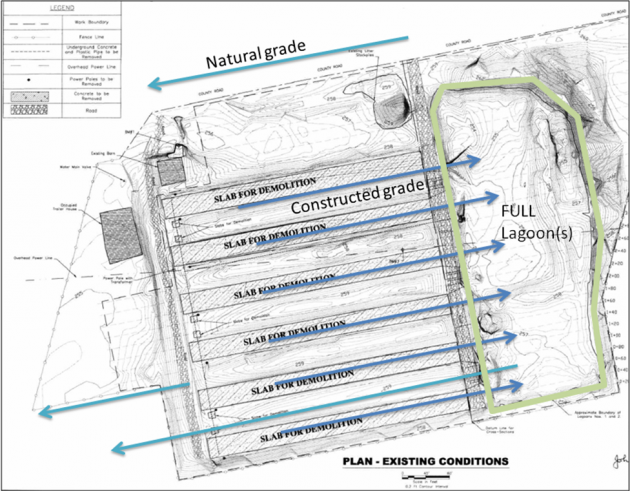
Construction drawings and specifications were developed to place the site into pre-existing conditions. The construction project was split into four phases:  Phase 1 – Sludge and Wastewater Removal; Phase 2 – Removal of Sludge to Nearby Agricultural Operation; Phase 3 – Demolition of Concrete Slabs and Final Grading; and Phase 4 – Establishing Vegetation on Site

Site plan generated for construction plans depicting the natural grade compared to the constructed grade of the poultry houses. (USDA-NRCS, Poultry Lagoon Closure Construction Drawings, March 2008)

Irrigation pump for the removal of wastewater (TSSWCB, 22 June 2009)

Use of field conveyor belts to stack sludge on-site.  (TSSWCB, 28 June 2009)

What Have We Learned?

Formal contracting potentially increases the cost of the project; however, observance of worker safety laws is more likely .  Initially this project was sent for bid as a turn key project consisting of 18,500 CY of sludge to be removed and land applied, removal of concrete slabs, placement of 27,000 CY of compacted earthfill, final grading and establishment of vegetative cover.  As part of the bid, the contractor was to secure a location for the sludge to be land applied or find another use for the sludge.  The bids received ranged from $1.8M up to $3M.  This level of funding was not available, so the project was split into different phases.  By breaking into phases, the cost of the project was reduced by over 75%.  Costs for application or hauling of sludge can be reduced by having an agreement in place prior to contracting.

The cost of the project was close to $250,000 for construction and sludge hauling without consideration of other costs, such as engineering design work, sample analysis, and staff time.  The earthwork associated with the construction of this site for a new facility with the excavation and placement of 27,200 CY of compacted earthfill would have been completed for approximately $70,000.

With flexible scheduling, it was possible to find a landowner that was willing to pay for the hauling and land application of sludge, which reduced the out-of-pocket expenses for the closure by more than $90,000.

The amount of Phosphorus present in the sludge was compared to the cost of commercial fertilizer.  As of February 2011, Rock Phosphate with 32% P2O5 was selling at $160/metric ton (Index Mundi, 11 June 2012), therefore P2O5  was $500 per metric ton.  Using the hauled weight of 12,100 tons with a moisture content of 25.9% and 5.66% P and a conversion factor of 2.29 for P to P2O5, there was 1,160 tons (1,054 metric tons) of P2O5.  At the rate of $500 /metric ton, the P2O5 in the sludge would have a value of $525,000.  There is additional fertilizer value for the other constituents that are not included.

Future Plans

This case study provides much needed data for the closure of similar operations across the United States.  The data collected will be used for future closures under the NRCS Environmental Quality Incentives Program (EQIP).  The construction specifications that were developed for this project can be adapted into general specifications for future closure projects.  Additional work is needed to compare the value of the sludge to a fertilizer value.  The potential for a portable pelletizing and bagging system for recycling sludge from lagoons warrants further research.

Authors

Catherine Nash, Water Resources Engineer, USDA – Natural Resources Conservation Service Catherine.nash@tx.usda.gov

Additional Information

“Case Study:  Closure of Earthen Lagoon”, An ASABE Meeting Presentation, Paper No. 1336921

Archived webinar  – Poultry Lagoon Closure – Case in Progress

Acknowledgements

Contributions from Texas Poultry Federation, Gonzales Soil and Water Conservation District, Texas State Soil and Water Conservation Board (TSSWCB), USDA – Natural Resources Conservation Service (NRCS), Texas Water Resources Institute, Farm Pilot Project Corporation, Inc. (FPPC) and others made this project possible. A special thanks to:  John Foster, TSSWCB, and James Grimm, Texas Poultry Federation, for initiating the project and keeping it moving forward;  Lee Munz, TSSWCB for assistance with surveying and taking the lead on his first construction project; John Mueller, NRCS for his support and guidance through the process; Ace Fairchild, NRCS, for his enthusiasm and support throughout the project; Wayne Gabriel, NRCS, for assistance with soils identification; Tom Beach, NRCS, for evaluating feasibility of other options for closure; Shawn Higgins for assistance, endurance and encouragement with the development of Engineering Drawings and Specifications.  Thanks to Gonzales County Soil and Water District Employees who helped throughout the project, including:  Jeremiah Ford, Abigail Lindsey, Shari Johnson, Jessi Goodson and Wain Fairchild.  Thanks to TSSWCB staff including: Lawrence Brown, Jeff Cerny, Amy Devereaux, TJ Helton, Dawna Winkler, and Kenny Zajicek.  Thanks to USDA-NRCS staff including:  James Davis, Andria Heiges, Jeff Porter, Doug Sharer, James Smith, and Millie Stevens.  Thanks to AgriLife Extension members:  Saqib Mukhtar, Biological and Agricultural Engineering Department; and Sam Feagley, Department of Soil and Crop Sciences.  Every person that was asked for assistance responded graciously and enthusiastically in a timely manner.

The authors are solely responsible for the content of these proceedings. The technical information does not necessarily reflect the official position of the sponsoring agencies or institutions represented by planning committee members, and inclusion and distribution herein does not constitute an endorsement of views expressed by the same. Printed materials included herein are not refereed publications. Citations should appear as follows. EXAMPLE: Authors. 2013. Title of presentation. Waste to Worth: Spreading Science and Solutions. Denver, CO. April 1-5, 2013. URL of this page. Accessed on: today’s date.

Development of an Acid Scrubber for Reducing Ammonia Emissions from Animal Rearing Facilities

Waste to Worth: Spreading science and solutions logoWaste to Worth home | More proceedings….

Abstract

Recent research has shown that over half of nitrogen excreted by chickens is lost into the atmosphere via ammonia volatilization before the litter is removed from poultry houses.  Large quantities of particulate matter and volatile organic compounds (VOCs) are also emitted from animal rearing facilities. During the past decade we have developed and patented an acid scrubber for capturing ammonia, VOCs and dust from air exhausted from poultry and swine barns.  The objectives of this project were; (1) to re-design the scrubber to improve the ammonia removal efficacy, (2) conduct full-scale testing of the scrubber under controlled conditions at various ventilation rates, (3) evaluate the cost, practicality and efficacy of various acids for scrubbing ammonia, and (4) install scrubbers on exhaust fans of poultry houses located in Virginia and Arkansas and measure the efficiency of ammonia removal from the exhaust air.  The efficiency of ammonia removal by the scrubber varied from 55-95%, depending on the type of acid used, air flow rate, and the internal scrubber configuration.  This technology could potentially result in the capture of a large fraction of the N lost from AFOs, while simultaneously reducing emissions of bacteria, dust, and odors, which would improve the social, economic, and environmental sustainability of poultry and swine production.

Purpose

The objectives of this project were; (1) to re-design our ammonia scrubber to improve the ammonia removal efficacy, (2) conduct full-scale testing of the scrubber under controlled conditions at various ventilation rates, and (3) evaluate the cost, practicality and efficacy of various acids for scrubbing ammonia.

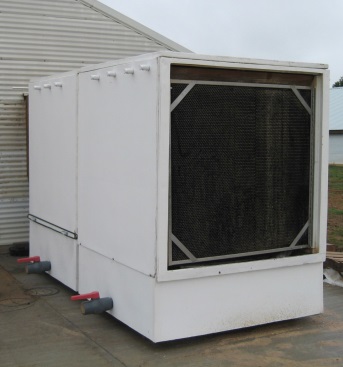
Acid scrubber developed by USDA/ARS in Fayetteville, AR, for reducing ammonia, dust and odor emissions from animal rearing facilities.

What Did We Do?

During the first year of this project the main task of our team was to re-design the ammonia scrubber developed and patented by Moore (2007).  A full scale prototype was constructed of wood and a series of tests were conducted to evaluate various configurations on air flow and static pressure drop in tests conducted in a machine shop.  The scrubber was connected to a 48” variable speed poultry fan.  Air flow was measured using a fan assessment numeration system (FANS unit).  Static pressure difference was measured using a Setra 2601MS1 differential pressure sensor.   The effects of slat angle, number and arrangement of slats, and thickness of cool cell material were evaluated. 

Following the initial testing a fiberglass mold was made and six scrubbers were constructed.  One of these was used to evaluate the effectiveness of water, strong acids, acid salts, and a neutral salt on scrubbing ammonia.  Anhydrous ammonia was metered out into a distribution system located within the fan at a sufficient rate to result in 25 ppm NH3 in the plenum between the fan and the dust scrubber.  Evaluations of each acid were made with the variable speed fan set at 60 and 40 Hz, which corresponded to air flows of approximately 8,000 and 5,000 cfm, respectively.  A stainless steel star sampler was used to take air samples from the plenum and from the air exhausted from the scrubber.  Ammonia concentrations were measured using a photoaccustic multigas analyzer (Innova 1412).  All personal involved in this testing wore respirators equipped with NH3 cartridges.  Three 2-hour trials were conducted with solutions of the following acids at both 40 and 60 Hz: alum, aluminum chloride, ferric sulfate, ferric chloride, sodium bisulfate, sulfuric acid, hydrochloric acid, phosphoric acid, and nitric acid. The effects of water and calcium chloride were also evaluated.   For these trials the amount of each acid added was equivalent to 2 liters of concentrated sulfuric acid.

In addition to measuring inflow and outflow ammonia levels, the mass accumulation of ammonia in both the dust and acid scrubber reservoirs was determined by analyzing the contents for ammonium using an auto-analyzer.  Twenty ml aliquots of the scrubber solution were taken at times 0, 1 and 2 hours for ammonia and pH measurements.  These data were used to validate that the difference in inlet and outlet ammonia were, in fact, due to accumulation of NH3 in the scrubber.  Notes were also taken on each chemical’s ease of use and potential for problems.  For example, some dry acids did not readily dissolve and some strong acids, like sulfuric acid, had very strong exothermic reactions.  Salts of aluminum and iron become aluminum and iron hydroxides at high pH which have the potential to clog cool cell material. 

Another performance issue that was monitored was the loss of fine droplets (mist) from the scrubber.  When dealing with high air volumes and small droplet sizes, there is a potential for mist to exit the system, resulting in not only the loss of N, but of the acid used to scrub NH3.  In order to measure mist loss, five 12.5 cm Whatman 42 filters were attached on a wire cage on the exhaust of the scrubber.  These filters were placed in a 50 ml centrifuge tub at the end of each trial and shaken with 25 ml of DDI water, which was analyzed for ammonium, along with sulfate, chloride, nitrate, or phosphate, depending on the acid used.

What Have We Learned?

Early on in this research we learned that two scrubbers (a dust scrubber and an acid scrubber) were needed rather than one.  If the dust isn’t removed from the exhaust air of poultry houses, then a large amount of the acid will be wasted neutralizing the dust.

We found that the relationship between slat angle and pressure drop was exponential and the angle that would maximize particle collisions on a wet surface while minimizing pressure drop was 45o.  We also found that as the number of rows of slats increased the effect on pressure drop was linear.   The final configuration chosen was eight rows of slats in the dust scrubber and three rows of slats in the chemical scrubber, followed by one or two 6” thick layers of cool cell material.    The pressure drop using this configuration was about 0.1” of water at 5,000 cfm and 0.3” of water at 8,000 cfm.

All of the acids scrubbed ammonium from air, whereas water and calcium chloride only worked for a very short period of time.  The iron (Fe) and aluminum (Al) compounds tended to work a little better than the other acid salts or the strong acids.  We believe this is due to Fe and Al compounds coating the cool cell material.  Although no difference was observed in the static pressure during these short tests, we believe Al and Fe hydroxides would eventually form and may clog the cool cells.  Due to the inherit danger in dealing with strong acids, we concluded that an acid salt that did not contain Al and Fe, such as sodium bisulfate, would be used for our research in the future.  This product is sold under the tradename PLT for a poultry litter treatment and is readily available to poultry growers. 

Future Plans

Four NH3 scrubbers will be attached to sidewall fans of a commercial broiler house located in Madison County, Arkansas.  The efficacy of these scrubbers for reducing ammonia, volatile organic compounds (VOCs), and particulate matter will be evaluated.  We will also measure the amount of sodium bisulfate, water and electricity used by the scrubbers, as well as the mass of nitrogen captured.  A cost-benefit analysis will be performed based on this data.  Data on the efficacy to scrub ammonia will also be conducted on farms in DE, VA, and PA.

Authors

Philip A. Moore, Jr., USDA/ARS, philipm@uark.edu

Rory Maguire, Virginia Tech

Mark Reiter, Virginia Tech

Jactone Ogejo, Virginia Tech

Robert Burns, University of Tennessee

Hong Li, University of Delaware

Dana Miles, USDA/ARS

Michael Buser, Oklahoma State University

Acknowledgements

This research was funding by USDA/ARS and by grants from USDA/NRCS and the National Wildlife Foundation.   The authors would like to thank the hard work and great ideas supplied by Scott Becton and Jerry Martin, without which this scrubber could not have been built.


The authors are solely responsible for the content of these proceedings. The technical information does not necessarily reflect the official position of the sponsoring agencies or institutions represented by planning committee members, and inclusion and distribution herein does not constitute an endorsement of views expressed by the same. Printed materials included herein are not refereed publications. Citations should appear as follows. EXAMPLE: Authors. 2013. Title of presentation. Waste to Worth: Spreading Science and Solutions. Denver, CO. April 1-5, 2013. URL of this page. Accessed on: today’s date.

White Meat-Green Farm: Case Study of Brinson Farms

Waste to Worth: Spreading science and solutions logoWaste to Worth home | More proceedings….

Abstract

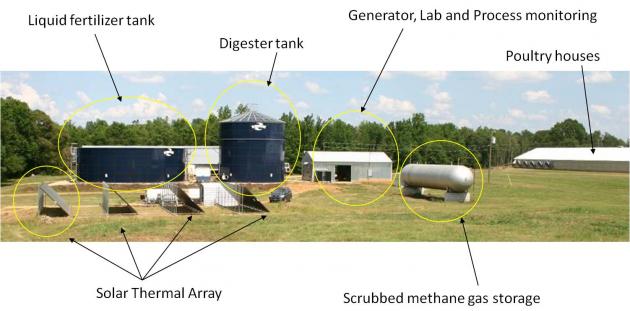
Comprehensive on-farm resource utilization and renewable energy generation at the farm scale are not new concepts.  However, truly encompassing implementation of these ideals is lacking.  Brinson Farms operates 10 commercial broiler houses.  The farm generates heat for its houses using biomass boilers and litter anaerobic digestion to produce methane.  Solar panels assist in heating process water for the boilers and digester.  Biomass feedstock includes litter as well as municipal yard wastes.  Liquid fertilizer is a product of the digester while residual solids are included in the farm’s composting operation.  The operator has used a futuristic approach to not only attain energy independence for the farm, but also to comprehensively utilize byproducts of production and other local “wastes”, diverting them from local landfills.  Considering the propane cost for a single winter flock has reached $66,000 and the annual electric bill may be $120,000, energy costs very much affect grower profitability.  This approach decreases the uncertainty in energy costs.  Brinson Farms provides a unique look into ensuring long-term farm sustainability in an environmentally friendly way and with a wide-ranging systems approach to management.

Purpose

The purpose of the renewable energy project was to implement an innovative, sustainable solution to manage poultry manure and other organic waste products using anaerobic digestion as well as to demonstrate the ability to effectively and economically reduce dependence on outside utilities.

What Did We Do?

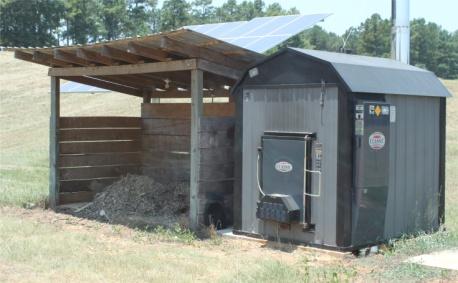
Brinson Farms demonstrates comprehensive utilization of local resources that have historically been viewed as wastes.  These organic materials (broiler litter, yard trimmings, storm damaged trees and waste vegetables) come from both the farm and the community.  Broiler litter and waste vegetables are anaerobically digested to produce methane.  The methane is then used in three ways: 1) to generate electricity for the farm; 2) in boilers to heat water used in the digestion process; and 3) in dual-fuel biomass boilers to heat water for heat exchange in the broiler houses when biomass sources are low. Two other significant products from the digester include liquid fertilizer (approximately 5-2-3) that is sold and residual solids that are incorporated into the farm’s composting facility.  Solar panels assist in heating water for the biomass boilers and the digester. The simple payback period for the on-farm poultry litter digester system is approximately 5 years.

Brinson Farms anaerobic digester complex.

What Have We Learned?

Brinson Farms provides a unique system to ensure long-term farm sustainability in an environmentally beneficial manner. Attributes of the integrated system include: 1) bio-based energy production; 2) reduced utility costs; 3) comprehensive litter utilization; 4) no need to land apply poultry litter; 5) production of high quality, organic liquid fertilizer; 6) production of a marketable soil amendment (compost);  and 7) diverting wastes from landfills.  The farm/community interface is mutually advantageous. The farm uses yard trimmings and trees for energy and as a compost substrate; the community has a free repository to dispose of the biomass, where otherwise it would have to pay landfill fees.

Biomass storage and boiler to heat broiler houses

Future Plans

Future plans include developing economic evaluations for each of the system components so that farmers can choose the renewable energy/value added process(es) that will best fit their local resources as well as short and long term financial plans.

Authors

Dana M. Miles, Chemical Engineer, USDA-ARS Genetics & Precision Agriculture Research Unit, Mississippi State, MS, dana.miles@ars.usda.gov

Additional Information

John Logan: johnlogan1@windstream.net;

Jeff Breeden: jbreeden@egesystems.com;

Eagle Green Energy: http://eaglegreenenergyinc.com/;

Arora, S. 2011. Poultry Manure: The New Frontier for Anaerobic Digestion. http://www.nrcs.usda.gov/Internet/FSE_DOCUMENTS/stelprdb1046769.pdf

Acknowledgements

The assistance of John Logan and Jeff Breeden to effectively describe the Brinson system is greatly appreciated.

The authors are solely responsible for the content of these proceedings. The technical information does not necessarily reflect the official position of the sponsoring agencies or institutions represented by planning committee members, and inclusion and distribution herein does not constitute an endorsement of views expressed by the same. Printed materials included herein are not refereed publications. Citations should appear as follows. EXAMPLE: Authors. 2013. Title of presentation. Waste to Worth: Spreading Science and Solutions. Denver, CO. April 1-5, 2013. URL of this page. Accessed on: today’s date.
Ammonia (NH3) Mitigation Using Electrolyzed Water Spray Scrubber

Waste to Worth: Spreading science and solutions logoWaste to Worth home | More proceedings….

Abstract

The objective of this research was to evaluate electrolyzed water as a solution for a lab-scale spray scrubber for removing NH3 from air. A one-stage spray scrubber was fabricated to treat 50 cfm (1.42 m3/min) of introduced mixed NH3-air with an approximate NH3 concentration of 20 ppm. The mixed air was blown, countercurrent, to the 5-ft vertical scrubber body using a fan. Eight scrubber design variables were studied including contact times, nozzle types and scrubber solutions. Three contact times were 0.3, 0.6 and 0.9 s.  The two narrow and standard nozzles sprinkled in a full-cone spray pattern but at different angles of 26ᴼ and 52ᴼ, respectively. The scrubber solutions variables tested were reverse osmosis (RO) water and two types of electrolyzed water (50 ppm of total chlorine) with pH = 9.0 and pH = 6.5. The 18 combinations of treatments were tested in three replications and statistically analyzed to investigate the objective. The result showed that all of the experiments were able to mitigate the NH3, but at different efficiencies. The maximum efficiency of 53% was acquired with the narrow nozzle, 0.9s contact time and electrolyzed water with pH = 6.5. Therefore, it was concluded that increasing the contact time, decreasing the pH of electrolyzed water and using the narrow angle, higher flow rate nozzle increased the scrubber efficiency.

Ammonia scrubbing experiments conducted in three replications

Why Study Ammonia Mitigation at Poultry Houses?

Ammonia (NH3) emissions from poultry houses are an environmental challenge because of the large volume of polluted ventilation air from the house’s exhaust fans. One idea for mitigation of NH3 was to developed and evaluate a lab-scale spray scrubber that used an electrolyzed water scrubber solution.

Lab-scale spray scrubber

What Did We Do?

A one-stage spray scrubber was fabricated to treat 50 cfm of mixed NH3-air with approximate NH3 concentration of 20 ppm. The mixed air was blown, countercurrent, to the 5-ft vertical scrubber body using a regular fan and implemented 8 variables including contact times, spray types and scrubber solutions. Three contact times for about 0.3, 0.6 and 0.9 second were applied by changing the elevation of the spray stage. Also, two types of spray nozzles were studied to determine the effect of droplet size and the spray flow rate. The nozzles sprinkled in the pattern of a full-cone spray but in different spray angles; narrow and standard with 26ᴼ and 52ᴼ spray angle, respectively. The applied scrubber solution variables were reverse osmosis (RO) water and two types of electrolyzed water (50 ppm of total chlorine) with pH = 9.0 and pH = 6.5. Thus, 18 scenarios conducted in three replications and statistically analyzed to investigate the objective.

What Have We Learned?

The results showed that the scrubber in all experiments was able to mitigate the NH3 with different efficiencies. The efficiencies were averaged among the replications. The maximum efficiency of 56% was acquired by the narrow nozzle, 0.9s contact time and electrolyzed water with pH = 6.5 scenario. Therefore, it was concluded that increasing the contact time, decreasing the pH of electrolyzed water and the type of nozzle had increased the efficiency of the scrubber.

Ammonia scrubbing experiments conducted in three replications

Future Plans

After the electrolyzed water scrubber design and operating ranges are better understood from these laboratory studies, this technology will then need to be demonstrated under field operating conditions.  Wet scrubbers designed based on knowledge gained from the laboratory studies can be placed in a trailer along with all necessary analysis equipment and moved to the site of an operating poultry building.  Findings from this research could also be applied to many other types of animal production facilities.

Authors

Gerald Riskowski, Professor, Biological & Agricultural Engineering Department, Texas A & M University, riskowski@tamu.edu

Amir M. Samani Majd, PhD candidate, Biological & Agricultural Engineering Department, Texas A & M University

Ahmad Kalbasi, Researcher, Biological & Agricultural Engineering Department, Texas A & M University

Saqib Mukhtar, Professor, Biological & Agricultural Engineering Department, Texas A & M University

The authors are solely responsible for the content of these proceedings. The technical information does not necessarily reflect the official position of the sponsoring agencies or institutions represented by planning committee members, and inclusion and distribution herein does not constitute an endorsement of views expressed by the same. Printed materials included herein are not refereed publications. Citations should appear as follows. EXAMPLE: Authors. 2013. Title of presentation. Waste to Worth: Spreading Science and Solutions. Denver, CO. April 1-5, 2013. URL of this page. Accessed on: today’s date.

The National Air Quality Site-Assessment Tool (NAQSAT)

Waste to Worth: Spreading science and solutions logoWaste to Worth home | More proceedings….

Abstract

The National Air Quality Site Assessment Tool (NAQSAT) has been developed for the voluntary use of livestock producers and their advisors or consultants. It is intended to provide assistance to livestock and poultry producers in determining the areas in their operations where there are opportunities to make changes that result in reduced air emissions. Air emissions research from livestock production systems is increasing every year. NAQSAT is based on the most accurate, credible data currently available regarding mitigation strategies for air emissions of ammonia, methane, volatile organic compounds, hydrogen sulfide, particulates, and odor.

From the NAQSAT home page users may watch a video explaining the tool, read an overview, study the user manual or select a species to start using the program.

Purpose

The National Air Quality Site Assessment Tool (NAQSAT) was developed for livestock producers who are interested in investigating opportunities to reduce air emissions from their livestock operation. The online tool is designed to provide farmers and their advisors air emissions information explicitly for their farm in a confidential setting. The tool may be run from any computer with internet access. All information entered into NAQSAT and the corresponding results remain confidential.

What Did We Do?

NAQSAT considers the air emissions from eight management categories; animal housing, feed and water, manure collection and transfer, manure storage, land application, mortality management, public perception and on-farm roads.

On the NAQSAT Effectiveness Results page the green area indicates the effectiveness of current management practices, the white area indicates the opportunity for improvement. At the end of each session users are encouraged to select “Print My Report” to receive a paper copy of all inputs that had been entered and a copy of the Effectiveness Results page for their records. 

Users of the tool are asked a series of questions under each of the eight management categories. Based on the responses to previously answered questions the program determines what additional questions need to be answered such that only questions pertaining to the operation currently being evaluated are asked. Pop-up pictures assist the user in determining the relative rating to select when questions require a visual evaluation of the existing practices.

NAQSAT addresses seven emissions of concern; odor, particulate matter (dust), ammonia (NH3), hydrogen sulfide (H2S), methane (CH4), volatile organic compounds (VOCs) and nitrous oxide (N2O) under each of the eight management categories. Within the results page the green area in each rectangle indicates the effectiveness of current management practices, the white area indicates the opportunity for improvement.

NAQSAT allows users to save and run different scenarios providing the opportunity to compare the results of implementing new management practices.

It is easy to save NAQSAT sessions and return at a later date to make adjustments or consider additional alternatives. Each “saved” user session of NAQSAT is stored under its own URL available only to the person or persons with access to that URL. Individual URLs remain available for a minimum of 30 days before they are removed from the host computer.

The tool’s results page does not provide emissions data and/or regulatory guidance. It does identify opportunities for reducing air emissions and the ability to evaluate which practices might have the most impact. NAQSAT was developed for voluntary and educational use. The tool is designed to be used by livestock and poultry producers, however, the results may be more valuable when NAQSAT is used in cooperation with agency personnel or private consultants that can provide follow-up with suggestions for mitigation practices.

What Have We Learned?

NAQSAT has been used by members of the tool’s development committee to address odor conflicts in Colorado and in Michigan. In each case the tool confirmed the farm management teams were using acceptable management practices to limit odors from the livestock operation. In both states the local and state agencies involved in the conflict resolution were appreciative of the information provided by the tool.

Authors

Gerald May, Educator, Michigan State University Extension, mayg@msu.edu

Additional Information

The NAQSAT on-line tool is currently available at: http://naqsat.tamu.edu/.  It is available at no cost from its host website (it does not download onto your computer). To assist first time users an overview of the tool, an informative video and a user’s manual are available on the NAQSAT home page.

Archived webinars:

Acknowledgements

Are there any organizations or individuals (besides the authors) that should be acknowledged?

Development of NAQSAT was partially funded by the USDA – NRCS Conservation Innovation Grant program. Over twenty partner organizations and universities contributed to the development of NAQSAT.

Partner universities:  Partner organizations:
Colorado State University C.E. Meadows Endowment
Iowa State University Colorado Livestock Association
Michigan State University Iowa Turkey Federation
Oregon State University Iowa Pork Producers
Penn State University Iowa Pork Industry Center
Purdue University Iowa State Univ. Experiment Station
Texas A&M University Michigan Milk Producers Association
University of California, Davis Michigan Pork Producers Association
University of Georgia Michigan State Univ. Extension
University of Maryland National Pork Board
University of Minnesota Nebraska Environmental Trust
University of Nebraska Western United Dairymen

The authors are solely responsible for the content of these proceedings. The technical information does not necessarily reflect the official position of the sponsoring agencies or institutions represented by planning committee members, and inclusion and distribution herein does not constitute an endorsement of views expressed by the same. Printed materials included herein are not refereed publications. Citations should appear as follows. EXAMPLE: Authors. 2013. Title of presentation. Waste to Worth: Spreading Science and Solutions. Denver, CO. April 1-5, 2013. URL of this page. Accessed on: today’s date.