Co-recovery of phosphorus from manure using acid precursors contained in other wastes.

Purpose

A new approach for recovering nutrients and value-added products from waste is to search for a synergistic effect by combining two or more wastes.  This work improved the recovery of phosphorus and proteins/amino acids abundant in swine manure by adding a second waste or product rich in sugars, such as molasses, fruit waste, or lactose waste.  The second waste rich in sugars acted as a natural acid generator that replaced purchased acids and lowered the overall recovery cost.

What Did We Do?

A new approach was developed to separate and recover concentrated phosphorus and proteins from animal waste (Vanotti and Szogi, 2019).  It was improved by adding a second waste or product containing sugars, such as molasses and fruit waste (Vanotti et al., 2020).  They could be used as a natural acid precursor that replaces purchased acids and lowers the overall cost of phosphorus and protein recovery.  In this study, the two model wastes were swine manure solids (source of extractable phosphorus and proteins) and peach waste (source of acid precursors).

What Have We Learned?

On a dry-weight basis, the swine manure solids contained high amounts of proteins (15.2%) and phosphorus (2.9%) available for extraction. It was shown that waste peaches, an abundant waste in the Southeastern USA with no cost except transportation, contain about 8% total sugars and can be used as an acid precursor to effectively extract phosphorus and proteins from swine manure (waste peaches were peaches that were too soft, had bad spots, or did otherwise not meet the grade at the Processing Plant for sale as fresh fruit). The waste peaches (Brix 7.7 deg) were added to the manure, and the combo received rapid fermentation (24-h) after adding an inoculum (Vanotti et al., 2020).  Adding fruit waste to the manure and rapid fermentation produced abundant natural acids – lactic acid, citric acid, and malic acid – that effectively solubilized the phosphorus in the manure (Fig. 1).  Further, the peach fermentation did not adversely affect the protein recovery from the manure.  A pH of about five or less is a valuable target to optimize the phosphorus and protein recovery from manure.  The target was successfully met using a variety of natural acid precursors (fructose, molasses, peaches, lactose). The phosphorus was precipitated with calcium or magnesium compounds, obtaining concentrated phosphate products with > 90% plant-available phosphorus. The proteins/amino acids in the manure were quantitatively recovered. Other fruits, vegetables, and food waste products also contain significant amounts of sugar, so this is not limited to only wasted peaches. It is contemplated that other sugar-containing agricultural by-products could be used in this process for the same purpose with minor adjustments for amounts depending on the sugar concentration and initial pH of the fruit or vegetable.

Fig. 1. Adding an acid precursor to the manure and rapid fermentation increased acidity and the phosphorus recovery from the manure, up to a plateau recovery (Vanotti et al., 2023).

Future Plans

Research will be presented showing consistent phosphorus extraction results obtained with swine manure and sugar beet molasses as the acid precursor, and with dairy manure and lactose waste as the acid precursor. USDA-ARS seeks a commercial partner to bring this technology to market.  For more information on commercialization, contact: Mrs. Tanaga Boozer, Technology Transfer Coordinator, USDA-ARS, OTT Southeast Area, tanaga.boozer@usda.gov

Authors

Presenting & corresponding author

Matias Vanotti, USDA-ARS, Matias.vanotti@usda.gov

Additional authors

Vanotti, M.B, Szogi, A.A., and Brigman, P.W.  USDA-ARS, Florence, SC

Moral, R. Miguel Hernandez University, Orihuela, Spain

Additional Information

Vanotti, M.B., Szogi, A.A. 2019. Extraction of amino acids and phosphorus from biological materials. US Patent 10,150,711. US Patent & Trademark Office.

Vanotti, M.B., Szogi, A.A., Moral, R. 2020. Extraction of amino acids and phosphorus from biological materials using sugars (acid precursors). US Patent 10,710,937. US Patent & Trademark Office.

Vanotti, M., Szogi, A., Moral, R., & Brigman, W. 2023 (November). Recovery of Value-Added Products from Swine Manure and Waste Peaches. In National Conference on Next-Generation Sustainable Technologies for Small-Scale Producers (NGST 2022) (pp. 38-42). Atlantis Press.

Acknowledgements

This research was part of USDA-ARS National Program 212, ARS Project 6082-12630-001-00D. Support by Mitsubishi Chemical Corporation, Japan, through ARS Project 58-6082-7-006-F, is also acknowledged.  Mention of trade names or commercial products in this article is solely for the purpose of providing specific information and does not imply recommendation or endorsement by the U.S. Department of Agriculture.


The authors are solely responsible for the content of these proceedings. The technical information does not necessarily reflect the official position of the sponsoring agencies or institutions represented by planning committee members, and inclusion and distribution herein does not constitute an endorsement of views expressed by the same. Printed materials included herein are not refereed publications. Citations should appear as follows. EXAMPLE: Authors. 2025. Title of presentation. Waste to Worth. Boise, ID. April 7-11, 2025. URL of this page. Accessed on: today’s date.
System for Treating Livestock Wastewater Using Electrochemistry to Recover the Nitrogen and Phosphorus

Purpose

Conservation and recovery of nitrogen (N) and phosphorus (P) from livestock, industrial, and municipal effluents are important for economic and environmental reasons.  Therefore, a need exists for improved systems and methods for N and P recovery from wastewater, especially by using fewer chemicals.  A new method was developed using electrochemistry to enhance the gasification and rate of ammonia capture by a gas-permeable membrane and the solubilization and the rate of phosphate capture using P-precipitating compounds.  The process was tested using liquid swine manure.  It recovered 86% of the ammonia and more than 93% of the phosphorus contained in the manure.

What Did We Do?

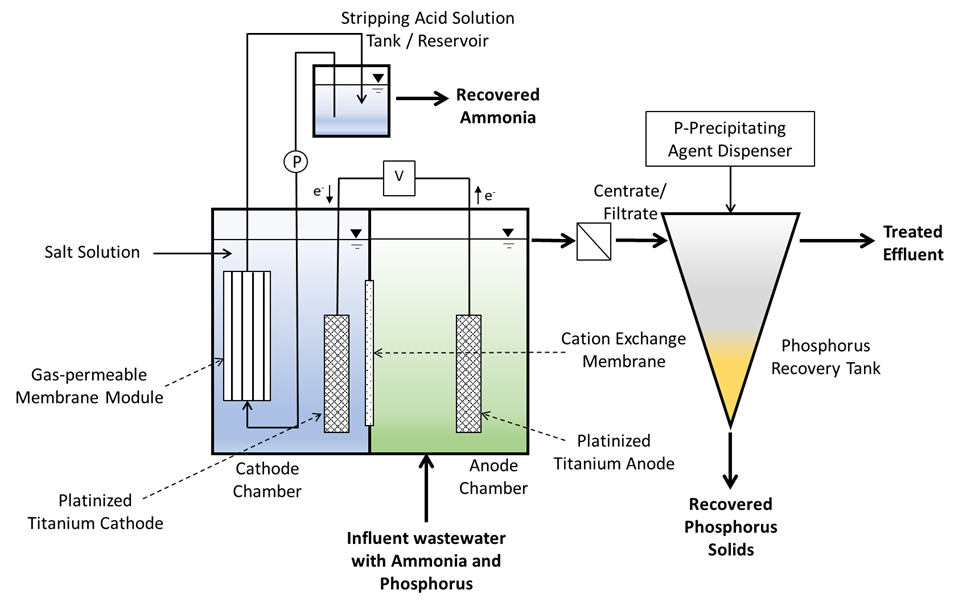
This work aimed to develop new technology for simultaneous N and P recovery that eliminates alkali chemicals used to increase pH for quick N capture using gas-permeable membranes (Vanotti and Szogi, 2015), and also eliminates acid chemicals used to solubilize the P in the manure before precipitation with P-precipitating agents (Szogi et al., 2018).  The new N and P recovery system used in this example is described by Vanotti et al., 2024. It has a cathode chamber, an anode chamber, a stripping acid solution tank, and a phosphorus recovery tank (Fig. 1).  The cathode chamber is fitted with a gas-permeable membrane manifold. The cathode chamber is fitted with a gas-permeable membrane manifold and contains a salt solution. The wastewater containing ammonia and phosphorus is pumped into the anode chamber. The ammonium (NH4) in the anode chamber permeates into the cathode chamber through a cation exchange membrane placed between chambers.  The cathode increases the pH of the liquid and accelerates the rate of passage of ammonia through the gas-permeable membrane into an acid-stripping solution contained in a stripping tank/ reservoir and recirculated through the membrane manifold in a closed loop. The wastewater in the anode chamber is acidified by H+ released by electrolysis in the anode.  The anode chamber effluent, with most of the P solubilized, is passed through a centrifuge or filter to separate suspended solids without phosphorus and liquid filtrate/centrate with phosphate. Phosphorus precipitating compounds used were MgCl2 and Ca(OH)2.   After rapid mixing, the phosphorus precipitates as a solid.  This precipitation proceeds quickly as a result of the previous removal of the carbonate alkalinity in the anode chamber, which interferes with phosphate precipitation.

Figure 1. Schematic diagram of an embodiment of a nitrogen (N) and phosphorus (P) recovery system using electrochemistry (Vanotti et al., 2024).

What Have We Learned?

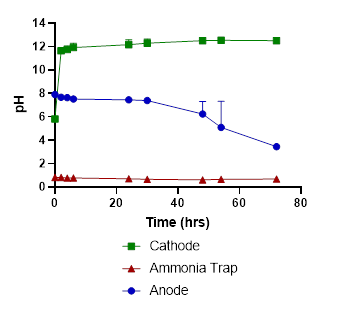
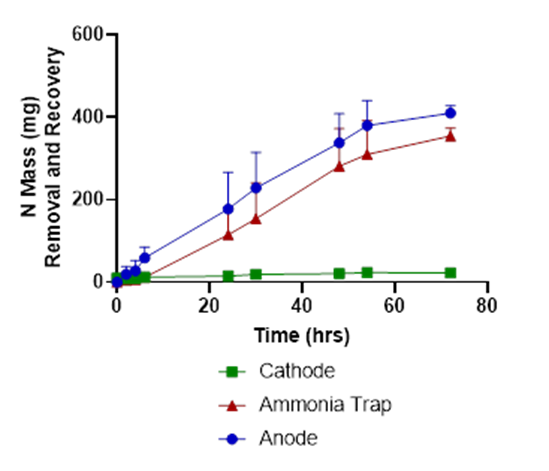
In tests with liquid swine manure, the pH in the cathode chamber was increased due to the electrochemical production of OH-, from 5.8 to 12.5 (Fig. 2).  The wastewater’s ammonia was removed from the anode chamber and recovered in the stripping acid solution with 86% recovery efficiency (Fig. 3).

Figure 2.  pH in anode chamber, cathode chamber, and stripping acid tank.  
Figure 2.  pH in anode chamber, cathode chamber, and stripping acid tank.
Figure 3.  Ammonia-N mass removal in anode chamber and ammonia-N mass recovery in cathode chamber and stripping acid tank.

The wastewater pH in the anode dropped from 7.9 to 3.5, and carbonate alkalinity dropped from 10750 mg/L to 0 mg/L (Figures 2 & 4).  The acid was produced by oxidation at the anode (2 H2O → O2 + 4 H+).  These conditions transformed the P from manure particles into soluble phosphates that were efficiently recovered in the phosphorus recovery tank.   For example, using the P-precipitating compound Ca(OH)2, the process recovered 93% of the total P in a P precipitate solid compared to only 4.6% in a control without electrochemical treatment (Fig. 5).  Using the P-precipitating compound MgCl2, the process recovered 95% of the total P in a P precipitate solid compared to only 6% P recovery in a control without electrochemical treatment (Fig. 5).

Figure 4. Reduction of carbonate alkalinity concentration occurring in the anode chamber. 
Figure 4. Reduction of carbonate alkalinity concentration occurring in the anode chamber.
Figure 5. Phosphorus is recovered in the solid precipitate using P-precipitating compounds Ca(OH)2 or MgCl2.  A) with a previous electrochemical step, and B) without an electrochemical step.  
Figure 5. Phosphorus is recovered in the solid precipitate using P-precipitating compounds Ca(OH)2 or MgCl2.  A) with a previous electrochemical step, and B) without an electrochemical step.

Future Plans

USDA-ARS seeks a commercial partner to bring this technology to market.  For more information on commercialization, contact: Mrs. Tanaga Boozer, Technology Transfer Coordinator, USDA-ARS, OTT Southeast Area, tanaga.boozer@usda.gov

Authors

Presenting & corresponding author

Matias Vanotti, USDA-ARS, Matias.vanotti@usda.gov

Additional authors

M.B. Vanotti, A.A. Szogi, P.W. Brigman, and S. Rawal, United States Department of Agriculture (USDA), Agricultural Research Service (ARS), Coastal Plains Soil, Water and Plant Research Center, Florence, South Carolina.

Additional Information

Szogi A.A., Vanotti, M.B., Shumaker, P.D. 2018.  Economic recovery of calcium phosphates from swine lagoon sludge using Quick Wash process and geotextile filtration. Frontiers in Sustainable Food Systems 2, 37, https://doi.org/10.3389/fsufs.2018.00037.

Vanotti, M.B., and Szogi, A.A. 2015. Systems and methods for reducing ammonia emissions from liquid effluents and recovering ammonia. U.S. Patent 9,005,333 B1. U.S. Patent and Trademark Office.

Vanotti, M.B., Szogi, A.A., Brigman, P.W., and Rawal, S. 2024. Systems for treating wastewater using electrochemistry. U.S. Patent Appl. 18/808,123. U.S. Patent and Trademark Office

Acknowledgements

This research was part of USDA-ARS National Program 212, ARS Project 6082-12630-001-00D. Mention of trade names or commercial products in this article is solely for the purpose of providing specific information and does not imply recommendation or endorsement by the U.S. Department of Agriculture.


The authors are solely responsible for the content of these proceedings. The technical information does not necessarily reflect the official position of the sponsoring agencies or institutions represented by planning committee members, and inclusion and distribution herein does not constitute an endorsement of views expressed by the same. Printed materials included herein are not refereed publications. Citations should appear as follows. EXAMPLE: Authors. 2025. Title of presentation. Waste to Worth. Boise, ID. April 711, 2025. URL of this page. Accessed on: today’s date.
Using ManureTech Decision-Support Tools to Aid in Manure System Selection

Purpose

The purpose of the ManureTech Decision-Support Tools (DST) for Dairy and for Swine is to assist farmers, consultants, and others in the dairy/swine industry in optimizing the management of manure from collection to land application. By providing data-driven recommendations based upon customizable inputs and priorities, the ManureTech DST help users make informed decisions about manure management systems in consideration of the economic, environmental, and operational needs of farm management.

What Did We Do?

A multi-state team has developed Excel-based decision-support tools for selecting technology and systems for managing manure on dairy and swine operations as part of a USDA NIFA-funded project.

During this workshop, participants will be introduced to the ManureTech DST for Dairy and the ManureTech DST for Swine and will be provided with hands-on training in using the decision-support tool for dairy.  Major aspects of the tools that will be addressed in the workshop include an introduction to the user interface; entering primary inputs; prioritization of economic, environmental, and operational metrics; and reporting of results, including the ranking of manure system scenarios.

What Have We Learned?

In terms of learning, this effort has provided the project team with a fuller grasp of the complex nature of manure management!  In terms of accomplishments, the team has assembled a tool that considers the multi-faceted benefits and challenges of various manure management systems and presents users with a ranked list of systems for consideration, which should help expedite and enhance system selection.  Users of the ManureTech DST can provide farm-specific weight to economic, environmental, and operational criteria which allows ManureTech DST to rank alternative manure management scenarios in close alignment with individual priorities.

This visual illustrates what a user of the ManureTech Decision-Support Tool sees when weighing economic, environmental, and operational priorities of a farm, so that the rankings of the manure management systems reflect these farm priorities.  In the illustrated case, the user preferences favor economic priorities over others.

Future Plans

Future plans include completing beta testing / pilot-testing of the ManureTech DST and conducting additional training on using the tool.  Over a longer-range timeframe, the team would like to add some additional specialized capabilities and functionality, as a phase II effort.

Authors

Presenting authors

    • Erin Scott, Project/Program Manager, University of Arkansas
    • Varma Vempalli, Wastewater Treatment Specialist, City of Meridian (ID)
    • Jacob Hickman, Systems Analyst, University of Arkansas
    • Rick Stowell, Extension Specialist in Animal Environment, University of Nebraska-Lincoln
    • Teng Lim, Extension Professor and Engineer, University of Missouri

Corresponding author

Rick Stowell, Extension Specialist in Animal Environment, University of Nebraska-Lincoln, Richard.Stowell@unl.edu

Additional authors

    • Erin Scott, Project/Program Manager, University of Arkansas
    • Jacob Hickman, Systems Analyst, University of Arkansas
    • Jennie Popp, Associate Dean and Professor, University of Arkansas
    • Varma Vempalli, Wastewater Treatment Specialist, City of Meridian (ID)
    • Greg Thoma, Director of Agricultural Modeling and Lifecycle Assessment, Colorado State University
    • Teng Lim, Extension Professor and Engineer, University of Missouri

Additional Information

The ManureTech DST and related articles can be accessed at Decision-Support Tools – Livestock and Poultry Environmental Learning Community.

Acknowledgements

The authors acknowledge funding from the USDA NIFA AFRI Water for Food Production Systems program, grant #2018-68011-28691.

The authors are solely responsible for the content of these proceedings. The technical information does not necessarily reflect the official position of the sponsoring agencies or institutions represented by planning committee members, and inclusion and distribution herein does not constitute an endorsement of views expressed by the same. Printed materials included herein are not refereed publications. Citations should appear as follows. EXAMPLE: Authors. 2025. Title of presentation. Waste to Worth. Boise, ID. April 711, 2025. URL of this page. Accessed on: today’s date.

Impacts of Swine Manure Application on Soil Properties in Continuous Corn Plot

Purpose

Land application of swine manure (SM) offers a practical approach to supplying nutrients to crop fields while enhancing soil organic carbon and micronutrient contents. This study is a part of a multi-state project evaluating the effects of SM land application on soil properties and corn yield in comparison to inorganic fertilizer (IF).

What Did We Do?

The experiment is conducted on a five-acre plot using randomized complete block design, consisting of three treatments [IF, SM, and SM+ Starter Fertilizer (SF)], over five years. The study aims to measure various soil properties (organic carbon, nitrogen content, bulk density, porosity, water holding capacity, soil respiration, pH, electrical conductivity, and soil macro- and micronutrient contents). Soil samples are collected from each plot at various depths (0-3, 3-6, 6-12,12-18, 18-24, 24-36 inches) to evaluate treatment effects over time.

What Have We Learned?

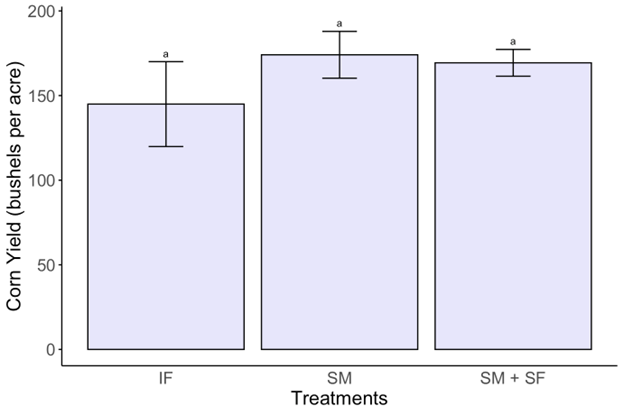
Although the study is still in its early stages, preliminary data show promising results for corn yield in the first year, with 144.96, 174.09, and 168.39 bushels per acre for the IF, SM and SM+SF treatments, respectively. While the differences were statistically non-significant (p = 0.32), the SM treatment achieved the highest yield. Soil compaction (measured using SHT-003 Soil Load Penetrometer) of the field was non-significant (p = 0.56) for the treatments. However, the highest soil compaction was observed with the inorganic fertilizer (11.86 Newton) treatment, followed by SM (11.07 Newton), and the lowest soil compaction with the SM + SF (10.99 Newton) treatment. These findings suggest that swine manure may have a positive impact on the corn yield and soil compaction.

Figure 1: Effects of SM, IF & SM+IF applications on corn yield(SM- Swine Manure, IF- Inorganic fertilizer, SM+SF: Swine manure + Starter Fertilizer)

(Data are presented as mean with standard error, bars with different letters denote significantly different at p<0.05)
Figure 1: Effects of SM, IF & SM+IF applications on corn yield
(SM- Swine Manure, IF- Inorganic fertilizer, SM+SF: Swine manure + Starter Fertilizer)
(Data are presented as mean with standard error, bars with different letters denote significantly different at p<0.05)

Furthermore, we observed significant differences (p < 0.05) in Soil Plant Analysis Development (SPAD, chlorophyll and nitrogen contents in leaves measured using Minolta Chlorophyll Meter) values among the treatments, with IF showing the highest value (52.37), followed by SM (48.15) and then the SM+SF (45.56).

Figure 2: Effects of SM, IF & SM+IF application on SPAD values(SM- Swine Manure, IF- Inorganic fertilizer, SM+SF: Swine manure + Starter Fertilizer, SPAD- Soil Plant Analysis Development)

(Data are presented as mean with standard error, bars with different letters denote significantly different at p<0.05)
Figure 2: Effects of SM, IF & SM+IF application on SPAD values
(SM- Swine Manure, IF- Inorganic fertilizer, SM+SF: Swine manure + Starter Fertilizer, SPAD- Soil Plant Analysis Development)
(Data are presented as mean with standard error, bars with different letters denote significantly different at p<0.05)

The electrical conductivity (measured using Hanna GroLine Soil EC Tester) of the soil was significantly influenced (p < 0.05) by the treatments. The highest electrical conductivity was observed with the application of SM (0.36) which is statistically similar to SM+SF (0.32) treatment, but significantly higher than the IF (0.22) treatment.

Fig. 3 Effects of SM, IF & SM+IF application on electrical conductivity (EC)(SM- Swine Manure, IF- Inorganic fertilizer, SM+SF: Swine manure + Starter Fertilizer, EC- Electrical Conductivity)

(Data are presented as mean with standard error, bars with different letters denote significantly different at p<0.05)
Fig. 3 Effects of SM, IF & SM+IF application on electrical conductivity (EC)
(SM- Swine Manure, IF- Inorganic fertilizer, SM+SF: Swine manure + Starter Fertilizer, EC- Electrical Conductivity)
(Data are presented as mean with standard error, bars with different letters denote significantly different at p<0.05)

Future Plans

We plan to take the growth parameters including plant height and chlorophyll content (SPAD) at regular intervals. Additionally, we intend to sample soil microbiome composition in the field. This year we harvested 6 rows per plot but starting next year, we will harvest 18 center rows per plot (out of 31) for yield measurement. We will also exclude 15 feet from both the northern and southern ends of each plot.

Authors

Presenting author

Ravi Raj Mishra, Graduate student, University of Missouri, Columbia

Corresponding author

Teng-Teeh Lim, Extension Professor, University of Missouri, Columbia, limt@missouri.edu

Additional author(s) (name, title, and affiliation for each)

Manobendro Sarker, Graduate student, University of Missouri, Columbia

Keywords

Swine Manure, Soil Health, Soil Properties, Starter Fertilizers

Acknowledgements

We acknowledge the National Pork Board for the funding and collaboration with South Dakota State University. Our sincere thanks also go to Manobendro Sarker, Moh Moh Thant Zin, and Rana Das from our research group, and the research farm team for their support in field operations.

The authors are solely responsible for the content of these proceedings. The technical information does not necessarily reflect the official position of the sponsoring agencies or institutions represented by planning committee members, and inclusion and distribution herein does not constitute an endorsement of views expressed by the same. Printed materials included herein are not refereed publications. Citations should appear as follows. EXAMPLE: Authors. 2025. Title of presentation. Waste to Worth. Boise, ID. April 711, 2025. URL of this page. Accessed on: today’s date.

Application of Manure on Growing Crops

Scheduling conflicts, equipment breakdowns, and wet field conditions can wreak havoc on spring manure application and planting schedules. This webinar will provide valuable insights into maximizing the efficiency and timing of manure application for growing crops, especially corn. By exploring innovative techniques for liquid manure application and the potential for in-season poultry litter application, participants will learn possible ways to navigate challenges in crop management while ensuring nutrient efficiency and maintaining crop yield and quality. This presentation was originally broadcast on January 17, 2025. Continue reading “Application of Manure on Growing Crops”

Impact of swine manure on soil health properties: A systematic review

Purpose

As the campaign to improve agricultural soil health has gained momentum among conservationists and researchers worldwide, a comprehensive assemblage of outcomes from manure and soil health-related research studies is important. Particularly, the identification of knowledge gaps is an important step to direct future research that informs soil health improvement outreach programs. A thorough review of data reporting the effects of swine manure on soil health properties that is applicable to agricultural producers is lacking. Although previous research studies have looked at the effects of manure on individual soil properties, there are conflicting conclusions. Livestock manure literature reviews fail to consider inconsistent methodologies between individual research studies and whether research is applicable to producers utilizing manure as amendments to improve soil health, and none of the reviews focus on swine manure or swine manure by-products. The objectives of this review were (a) to synthesize literature describing effects of swine manure on soil properties that affect soil health and (b) to identify knowledge gaps and research needs to further our understanding of this topic.

What Did We Do?

We conducted a systematic literature review based on peer-reviewed studies that evaluated the effect of swine manure on soil health properties. First, we identified studies using three criteria: species (swine, pig, hog), manure source (i.e., solid [SM] or liquid manure [LSM], compost, deep pack), and soil property (i.e., soil organic carbon [SOC], total nitrogen, soil pH, bulk density, available water capacity). Second, studies had to meet the following criteria in order to be included: (a) the studies were replicated field experiments, (b) manure was the only differing factor between or among treatments, and (c) data means of organically amended treatments and controls were included. In total, 40 peer-reviewed studies were included in this review.

What Have We Learned?

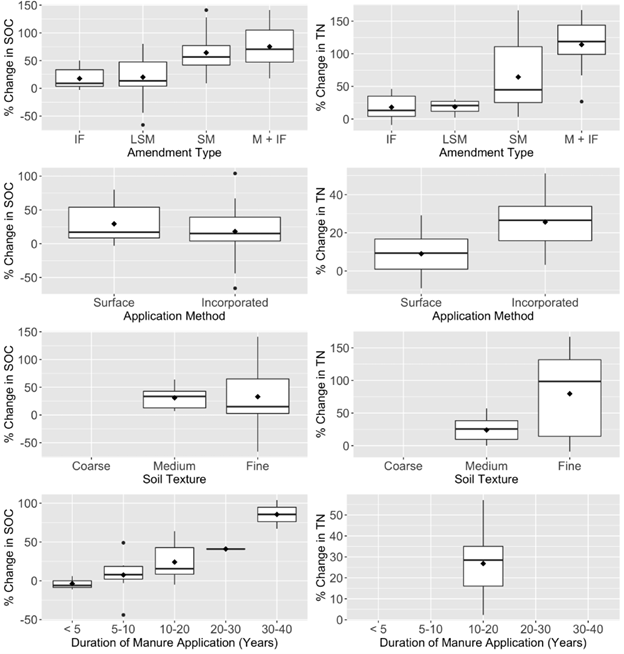
Recycling of manure locally prior to importing inorganic fertilizer (IF) has the potential to reduce nutrient imbalances and improve soil health. Based on this review, swine manure has the potential to add significant amounts of organic carbon to the soil and to improve soil health metrics. In general, the application of swine manure increases soil organic matter (SOM) and SOC, decreases soil bulk density, and increases microbial biomass carbon Soil organic carbon and total N tended to be highest when manure and inorganic fertilizer were applied to the field (Figure 1). Soil chemical properties did not seem to change much when manure was applied to the soil surface or incorporated into the topsoil. The duration of swine manure application (annually) did not seem to increase the percent change in most chemical properties; however, this could be due to a lack of data. The percent change in SOC did increase when the swine manure was applied for a longer time period (Figure 1), and we would expect to see a similar trend with SOM and total carbon if there were more data. Few articles had data on soil physical and biological properties. Depending on soil type, swine manure has the potential to increase available water holding capacity and saturated hydraulic conductivity. Although more research is needed, it can be inferred that swine manure additions increase microbial activity, which promotes healthier soils and better crop yields.

Figure 1: Average percent change in soil organic carbon (SOC) and total nitrogen (TN) based on amendment type, application method, soil texture, and duration of swine manure application. Black circles represent outlier data, and diamonds represent mean. IF = inorganic fertilizer; LSM = liquid swine manure; M + IF = manure (liquid and solid) plus inorganic fertilizer; SM = solid swine manure

Future Plans

Previous literature reviews failed to account for differences in methodologies between individual research studies and whether research is applicable to producers utilizing swine manure as amendments to improve soil health (i.e., unreasonable application rates of swine manure, overapplication of nutrients). The evaluation of the effect of swine manure on soil health properties is difficult to do based on current literature because (a) there are few comprehensive studies (i.e., only one study reported properties from chemical, physical, and biological categories) and (b) there are non-consistent research methodologies between studies. Therefore, we recommend redirecting research studies to demonstrate the value of manure to the suitability of agricultural cropping systems. Future swine manure research should include (a) a range of soil physical, chemical, and biological properties, (b) initial soil data prior to manure application, and (c) manure type, application method, application rate, total carbon and nitrogen of the manure, duration of swine manure application, and swine manure application timing. In addition, future research should also focus on the short- and long-term effects of a single application of manure to support an effort to identify optimal frequency of application for improving soil health. More research is also needed to compare the effects of manure and inorganic fertilizer additions on crop yield and soil health by balancing nitrogen, phosphorus, and potassium additions.

Authors

Jenifer L. Yost, Research Soil Scientist, USDA-ARS

Corresponding author email address

jenifer.yost@usda.gov

Additional authors

Amy M. Schmidt, Livestock Manure Management Engineer, University of Nebraska-Lincoln; Rick Koelsch, Livestock and Bio Environmental Engineer, University of Nebraska-Lincoln; Kevin Kruger, Research Support Scientist, University of Idaho; Linda R. Schott, Nutrient and Waste Management Extension Specialist, University of Idaho

Additional Information

For more information about this project, please check out our Open Access journal article. The citation for the journal article is:

Yost, J.L., Schmidt, A.M., Koelsch, R., and Schott, L.R. (2022). Effect of swine manure on soil health properties: A systematic review. Soil Science Society of America Journal.

https://doi.org/10.1002/saj2.20359

This research was presented at the ASA, CSSA, SSSA International Annual Meeting in Salt Lake City, Utah, in November of 2021. The link to the recorded presentation is found in the citation below:

Yost, J. L., Schmidt, A. M., Koelsch, R., & Schott, L. R. (2021). Impact of Swine Manure on Soil Health Properties: A Systematic Review [Abstract]. ASA, CSSA, SSSA International Annual Meeting, Salt Lake City, UT. https://scisoc.confex.com/scisoc/2021am/meetingapp.cgi/Paper/138180

Acknowledgements

This project was supported by funding from the National Pork Checkoff. The authors would also like to thank Meg Clancy and Drew Weaver for their assistance.


The authors are solely responsible for the content of these proceedings. The technical information does not necessarily reflect the official position of the sponsoring agencies or institutions represented by planning committee members, and inclusion and distribution herein does not constitute an endorsement of views expressed by the same. Printed materials included herein are not refereed publications. Citations should appear as follows. EXAMPLE: Authors. 2022. Title of presentation. Waste to Worth. Oregon, OH. April 18-22, 2022. URL of this page. Accessed on: today’s date.

The MAnure PHosphorus EXtraction (MAPHEX) System for Removing Phosphorus, Odor, Microbes, and Alkalinity from Dairy and Swine Manures

Abstract

Animal manures contain nutrients [primarily nitrogen (N) and phosphorus (P)] and organic material that are beneficial to crops. Unfortunately, for economic and logistics reasons, liquid dairy and swine manure tends to be applied to soils near where it is generated. Over time, P concentrations in soils where dairy manure is applied builds up, often in excess of crop demands. We previously (Church et al., 2016, 2017) and have subsequently built, a full-scale version of a MAnure PHosphorus EXtraction (MAPHEX) System capable of removing greater than 90 percent of the P from manures. While originally designed to remove phosphorus, we have also shown that the MAPHEX System was also capable of removing odor and microbes, and of concentrating alkalinity into a solid, economically transported form. We have also lowered daily operating costs by testing the effect of lower-cost chemicals as alternatives to ferric sulfate, and by showing that the diatomaceous earth (DE) filtering material can be recycled and reused. We are currently building a system capable of treating over 100,000 gallons of Dairy Manure per day. This system is planned to be operational for demonstrating starting summer 2022.

Purpose

Swine and dairy manures are typically in slurry form and contain nutrients [primarily nitrogen (N) and phosphorus (P)] and organic material that are beneficial to crops. Unfortunately, the concentrations of nutrients in both manures are too low to make transportation of bulk manures over large distances economically viable. Furthermore, since it must be transported in tanks, that transportation is inconvenient as well. Therefore, these manures tend to be applied to soils near where they are generated, and, over time, P concentrations in soils increase to the point that soil P concentrations are often in excess of crop demands. Furthermore, because of the implication that P runoff from agricultural operations plays an important role in eutrophication of streams and other water bodies, farmers are experiencing increasing pressures and regulation to not apply animal manures to those soils.

We previously reported on an invention that 1) is designed to be a solution to the P overloading that happens when unnecessary P is added to agricultural soils, 2) is scalable such that it can be used as a mobile system, and 3) has shown to be capable of removing greater than 90 percent of the P from a wide range of dairy manures, while retaining greater than 90% of the N in the final effluent for beneficial use by the farmer.

What Did We Do?

We subsequently built a full-scale version of a MAnure PHosphorus EXtraction (MAPHEX) System capable of removing greater than 90 percent of the P from manures and have tested it on dairy manures. We also focused our efforts on lowering the daily operating costs of the system by developing a method to recover and reuse the diatomaceous earth used in the final filtration step, and testing alternative, lower cost chemicals that can be used in the chemical treatment step. We also performed pilot-scale tests on swine manures.

What Have We Learned?

The full-scale MAPHEX System removed greater than 90% of P from a wide variety of dairy manures, while leaving greater than 90% of the N in the final effluent to be used beneficially to fertigate crops. The System was also shown to recover and concentrate alkalinity into a solid form on a farm that used greater amounts of lime during manure handling, remove 50% of the odor from dairy manure and to remove greater than 80% of Total coliforms and E. Coli. Furthermore, the System has not shown to alter the pH of the final effluent respective to raw manures as other treatment technologies can. We have lowered daily operating costs by testing the effect of lower-cost chemicals as alternatives to ferric sulfate, and by showing that the diatomaceous earth (DE) filtering material can be recycled and reused.

In pilot-scale swine testing, we found that the MAPHEX System can remove greater than 96% of the phosphorus in swine manures. This essentially P free effluent can be beneficially used for fertigation without further loading the receiving soils with P. Scaling up the pilot-scale testing has the potential to reduce swine manure storage volumes to allow for mitigation of overflow problems during large storms. Furthermore, the pilot-scale study suggests that capital equipment costs and treatment costs for swine manure would be lower than for treating dairy manure.

Future Plans

We are currently building a simplified version of the MAPHEX System that will be capable of treating over 100,000 gallons of dairy manure per day. This system is planned to be operational for demonstrating starting summer 2022. We plan to use this simplified version for demonstration tests, and use the results obtained to model the effects of using MAPHEX technology compared to conventional manure handling practices on two paired watersheds. We also plan to demonstrate the full-scale system on a wide range of swine manures with on-farm testing.

Author

Clinton D. Church, Research Chemist, USDA-ARS University Park, PA

Corresponding author email address

Cdchurch.h2o@netzero.com

Additional Information

Church, C. D., Hristov, A. N., Bryant, R. B., Kleinman, P. J. A., & Fishel, S. K. (2016). A novel treatment system to remove phosphorus from liquid manure. Applied Engineering in Agriculture, 32: 103 – 112. doi:10.13031/aea.32.10999

Church, C. D., Hristov, A. N., Bryant, R. B., & Kleinman, P. J. A. (2017). Processes and treatment systems for treating high phosphorus containing fluids. US Patent 9,790.110B2.

Church, C. D., Hristov, A. N., Kleinman, P. J. A., Fishel, S. K., Reiner, M. R., & Bryant, R. B. (2018). Versatility of the MAPHEX System in removing phosphorus, odor, microbes, and alkalinity from dairy manures: A four-farm case study. Applied Engineering in Agriculture, 34: 567 – 572. doi:10.13031/aea12632

Church, C. D., Hristov, A., Bryant, R. B., & Kleinman, P. J. A. (2019). Methods for Rejuvenation and Recovery of Filtration Media. USDA Docket Number 129.17. U.S. Patent Application Serial No. 62/548,23

Church, C. D., S. K. Fishel, M. R. Reiner, P. J. A. Kleinman, A. N. Hristov, and R. B. Bryant. 2020. Pilot scale investigation of phosphorus removal from swine manure by the MAnure PHosphorus Extraction (MAPHEX) System. Applied Engineering in Agriculture 36(4): 525–531. doi: 10.13031/aea13698

https://www.ars.usda.gov/people-locations/person/?person-id=40912

https://tellus.ars.usda.gov/stories/articles/mining-manure-for-phosphorus/

https://agresearchmag.ars.usda.gov/2016/dec/phosphorus/

https://jofnm.com/article-112-Packaging-phosphorus-for-the-future.html

https://lpelc.org/versatility-of-the-manure-phosphorus-extraction-maphex-system-in-removing-phosphorus-odor-microbes-and-alkalinity-from-dairy-manures/


The authors are solely responsible for the content of these proceedings. The technical information does not necessarily reflect the official position of the sponsoring agencies or institutions represented by planning committee members, and inclusion and distribution herein does not constitute an endorsement of views expressed by the same. Printed materials included herein are not refereed publications. Citations should appear as follows. EXAMPLE: Authors. 2022. Title of presentation. Waste to Worth. Oregon, OH. April 18-22, 2022. URL of this page. Accessed on: today’s date.
Industry Initiatives for Environmental Sustainability – a Role for Everyone

This webinar introduces current and future industry-based initiatives for environmental sustainability in the livestock and poultry sector, and how Livestock and Poultry Environmental Learning Community learners can play a critical role in their region. This presentation was originally broadcast on September 17, 2021. Continue reading “Industry Initiatives for Environmental Sustainability – a Role for Everyone”

Evaluation of current products for use in deep pit swine manure storage structures for mitigation of odors and reduction of NH3, H2S, and VOC emissions from stored swine manure

The main purpose of this research project is an evaluation of the current products available in the open marketplace for using in deep pit swine manure structure as to their effectiveness in mitigation of odors and reduction of hydrogen sulfide (H2S), ammonia (NH3), 11 odorous volatile organic compounds (VOCs) and greenhouse gas (CO2, methane and nitrous oxide) emissions from stored swine manure. At the end of each trial, hydrogen sulfide and ammonia concentrations are measured during and immediately after the manure agitation process to simulate pump-out conditions. In addition, pit manure additives are tested for their impact on manure properties including solids content and microbial community.

What Did We Do?

Figure 1. Reactor simulates swine manure storage with controlled air flow rates.

We are using 15 reactors simulating swine manure storage (Figure 1) filled with fresh swine manure (outsourced from 3 different farms) to test simultaneously four manure additive products using manufacturer recommended dose for each product. Each product is tested in 3 identical dosages and storage conditions. The testing period starts on Day 0 (application of product following the recommended dosage by manufacturer) with weekly additions of manure from the same type of farm. The headspace ventilation of manure storage is identical and controlled to match pit manure storage conditions. Gas and odor samples from manure headspace are collected weekly. Hydrogen sulfide and ammonia concentrations are measured in real time with portable meters (both are calibrated with high precision standard gases). Headspace samples for greenhouse gases are collected with a syringe and vials, and analyzed with a gas chromatograph calibrated for CO2, methane and nitrous oxide. Volatile organic compounds are collected with solid-phase microextraction probes and analyzed with a gas chromatography-mass spectrometry (Atmospheric Environment 150 (2017) 313-321). Odor samples are collected in 10 L Tedlar bags and analyzed using the olfactometer with triangular forced-choice method (Chemosphere, 221 (2019) 787-783). To agitate the manure for pump-out simulation, top and bottom ‘Manure Sampling Ports’ (Figure 1) are connected to a liquid pump and cycling for 5 min. Manure samples are collected at the start and end of the trial and are analyzed for nitrogen content and bacterial populations.

The effectiveness of the product efficacy to mitigate emissions is estimated by comparing gas and odor emissions from the treated and untreated manure (control). The mixed linear model is used to analyze the data for statistical significance.

What we have learned?

Figure 2. Hydrogen sulfide and ammonia concentration increased greatly during agitation process conducted at the end of trial to simulate manure pump-out conditions and assess the instantaneous release of gases. The shade area is the initial 5 minutes of continuous manure agitation.

U.S. pork industry will have science-based, objectively tested information on odor and gas mitigation products. The industry does not need to waste precious resources on products with unproven or questionable performance record. This work addresses the question of odor emissions holistically by focusing on what changes that are occurring over time in the odor/odorants being emitted and how does the tested additive alter manure properties including the microbial community. Additionally, we tested the hydrogen sulfide and ammonia emissions during the agitation process simulating pump-out conditions. For both gases, the emissions increased significantly as shown in Figure 2. The Midwest is an ideal location for swine production facilities as the large expanse of crop production requires large fertilizer inputs, which allows manure to be valued as a fertilizer and recycled and used to support crop production.

Future Plans

We develop and test sustainable technologies for mitigation of odor and gaseous emissions from livestock operations. This involves lab-, pilot-, and farm-scale testing. We are pursuing advanced oxidation (UV light, ozone, plant-based peroxidase) and biochar-based technologies.

Authors

Baitong Chen, M.S. student, Iowa State University

Jacek A. Koziel*, Prof., Iowa State University (koziel@iastate.edu)

Daniel S. Andersen, Assoc. Prof., Iowa State University

David B. Parker, Ph.D., P.E., USDA-ARS-Bushland

Additional Information

  • Heber et al., Laboratory Testing of Commercial Manure Additives for Swine Odor Control. 2001.
  • Lemay, S., Stinson, R., Chenard, L., and Barber, M. Comparative Effectiveness of Five Manure Pit Additives. Prairie Swine Centre and the University of Saskatchewan.
  • 2017 update – Air Quality Laboratory & Olfactometry Laboratory Equipment – Koziel’s Lab. doi: 10.13140/RG.2.2.29681.99688.
  • Maurer, D., J.A. Koziel. 2019. On-farm pilot-scale testing of black ultraviolet light and photocatalytic coating for mitigation of odor, odorous VOCs, and greenhouse gases. Chemosphere, 221, 778-784; doi: 10.1016/j.chemosphere.2019.01.086.
  • Maurer, D.L, A. Bragdon, B. Short, H.K. Ahn, J.A. Koziel. 2018. Improving environmental odor measurements: comparison of lab-based standard method and portable odour measurement technology. Archives of Environmental Protection, 44(2), 100-107.  doi: 10.24425/119699.
  • Maurer, D., J.A. Koziel, K. Bruning, D.B. Parker. 2017. Farm-scale testing of soybean peroxidase and calcium peroxide for surficial swine manure treatment and mitigation of odorous VOCs, ammonia, hydrogen sulfide emissions. Atmospheric Environment, 166, 467-478. doi: 10.​1016/​j.​atmosenv.​2017.​07.​048.
  • Maurer, D., J.A. Koziel, J.D. Harmon, S.J. Hoff, A.M. Rieck-Hinz, D.S Andersen. 2016. Summary of performance data for technologies to control gaseous, odor, and particulate emissions from livestock operations: Air Management Practices Assessment Tool (AMPAT). Data in Brief, 7, 1413-1429. doi: 10.1016/j.dib.2016.03.070.

Acknowledgments

We are thankful to (1) National Pork Board and Indiana Pork for funding this project (NBP-17-158), (2) cooperating farms for donating swine manure and (3) manufacturers for providing products for testing. We are also thankful to coworkers in Dr. Koziel’s Olfactometry Laboratory and Air Quality Laboratory, especially Dr. Chumki Banik, Hantian Ma, Zhanibek Meiirkhanuly, Lizbeth Plaza-Torres, Jisoo Wi, Myeongseong Lee, Lance Bormann, and Prof. Andrzej Bialowiec.


The authors are solely responsible for the content of these proceedings. The technical information does not necessarily reflect the official position of the sponsoring agencies or institutions represented by planning committee members, and inclusion and distribution herein does not constitute an endorsement of views expressed by the same. Printed materials included herein are not refereed publications. Citations should appear as follows. EXAMPLE: Authors. 2019. Title of presentation. Waste to Worth. Minneapolis, MN. April 22-26, 2019. URL of this page. Accessed on: today’s date.


Sidedressing Corn: Swine Manure via Dragline Hose Produces Yields Comparable to Synthetic Fertilizer

Spring in the upper Midwest can be short, resulting in challenges for producers to apply manure and plant crops in a timely manner to maximize yield. This results in a significant       amount of manure applied in the fall after the crop is harvested. Fall applied manure has ample time to mineralize and leave the root zone before next season’s crop can utilize the nutrients. These nutrients can end up in rivers and other freshwater bodies decreasing water quality. Sidedressing manure in growing crops could provide producers with another window of opportunity to apply their manure, maximize nutrient uptake efficiency, and protect water quality. The summer of 2018 was the start of a two-year, on-farm study researching the effectiveness of sidedressing slurry swine manure to corn via dragline hose. The swine manure was compared to sidedressed anhydrous ammonia, 32% urea ammonium nitrate (UAN), and a  control that received no additional nitrogen at the time of sidedressing.

What we did

Corn was planted May 7th with a 12-row planter equipped to apply an in-furrow and top dressed liquid fertilizer. The total fertilizer applied at planting was 40.7 lbs of nitrogen (N), 19.8 lbs of P2O5 phosphorus (P), and 14.4 lbs of sulfur (S) per acre.

Sidedressing the nitrogen sources

We sidedressed all treatments on June 4-5 with 140 pounds of available N, except the control which had no additional N applied. All the equipment applied nutrients between 30-inch rows and fit a 12-row planter to match up on odd rows.

  • Anhydrous ammonia treatment = 12-row toolbar and tractor were supplied by the farmer.
  • Finishing hog manure dragline hose treatment = The toolbar for the dragline hose sidedress was supplied by Bazooka Farmstar. The toolbar is a coulter till 28-foot bar with 30-inch spacing.
  • UAN treatment = The tool bar for the UAN sidedress application was provided by a local farmer.
  • Control treatment = The control treatment did not receive any fertilizer at sidedress.
Swine manure slurry being applied via dragline hose and Bazooka Farmstar sidedress bar.

Soil data collection methods

Soil nitrate and ammonium samples were taken 5 times through the growing season, approximately every 4 weeks, to track nitrogen in the soil profile. Soil sample depths were 0-6, 6-12, and 12-24 inches from the soil surface. Soil

Two foot soil sampling with tractor probe.

samples were taken from the middle of the interrow, 7.5 inches from both sides of the middle of the inter row and in the middle of the row. This sample method assured soil samples would be representative of the soil profile since banded fertilizer can skew results.

Yield data collection methods

Yield was harvested October 6th by a combine with a 6-row head. The combine took the middle 12 rows of the 24-row treatment reducing the side effects from neighboring treatments. A calibrated weigh wagon measured the weight of each combine pass which was calculated to find yield in bushels per acre for every sample.

What we have learned

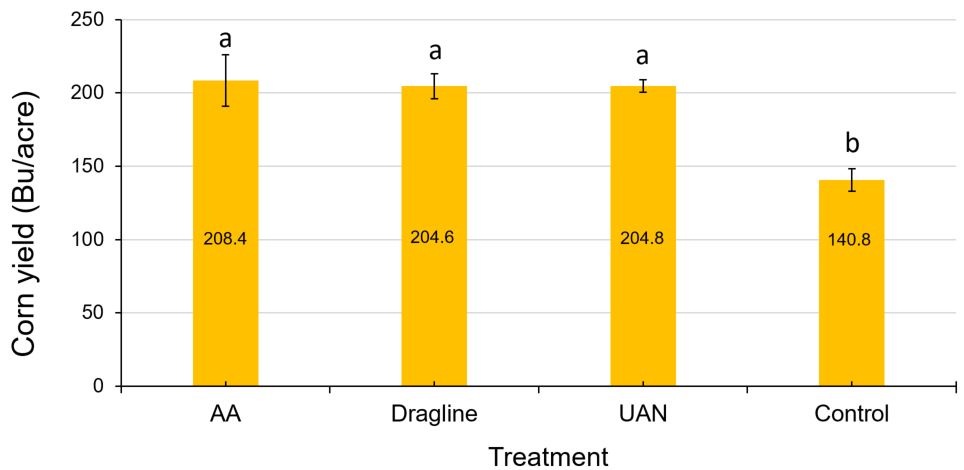
First year data revealed all sidedressed nitrogen sources significantly increased corn yields over the control but were otherwise statistically similar (Figure 1).

Figure 1. Yield data from 2018 manure sidedress trial in bushels per acre. AA=anhydrous ammonia, UAN=urea ammonium nitrate, Control=received no additional N at sidedress, and Dragline=swine manure slurry applied via dragline hose.

When we analyzed the soil inorganic nitrogen by each date differently, nitrogen concentrations between treatments were only statistically different on the soil sample date of June 15th (Figure 2) This soil sample date was ten days after the sidedress application on June 4th.  All other soil nitrogen sample dates are not statistically different between treatments and even the control.  

Figure 2. Total soil inorganic N (ammonium and nitrate) by treatment and sample date.

Statistics have not yet been run on the whole plant nitrogen content data in the graph below but numerically there doesn’t seem to be a difference in nitrogen content between the three sidedress treatments but a difference from the control (Figure 3).

Figure 3. Percent nitrogen in harvest grain, R6 cobbs, and R6 stover between treatments.

Future plans

The first year of data was collected during the 2018 growing season and a second year of data will be collected in the summer of 2019. This study aims to evaluate the effectiveness of sidedressed swine manure slurry compared to traditionally used synthetic fertilizers. Since we have seen promising results this first year an additional study that could follow this experiment would be a direct comparison of fall applied swine manure and sidedressed swine manure. This information would help us understand the efficiency of sidedressing compared to fall application. Soil samples from this study would also illustrate the difference in mineralization and nitrogen movement between fall-applied and sidedressed swine manure slurry.    

Authors

  • Chris Pfarr, M.S. student in the Land and Atmospheric Sciences Program, University of Minnesota, pfarr025@umn.edu
  • Melissa Wilson, Ph.D., Assistant Professor and Extension Specialist, Department of Soil, Water, and Climate, University of Minnesota, mlw@umn.edu

Additional information

Acknowledgements  

This project was partially funded by the Minnesota Soybean Research and Promotion Council and the Minnesota Pork Board.

The authors are solely responsible for the content of these proceedings. The technical information does not necessarily reflect the official position of the sponsoring agencies or institutions represented by planning committee members, and inclusion and distribution herein does not constitute an endorsement of views expressed by the same. Printed materials included herein are not refereed publications. Citations should appear as follows. EXAMPLE: Authors. 2019. Title of presentation. Waste to Worth. Minneapolis, MN. April 22-26, 2019. URL of this page. Accessed on: today’s date.