
Purpose
An NRCS Conservation Innovation Grant (CIG) state-wide study examining soil health is underway. Seventeen farms across the state of Utah are incorporating various soil health practices and are comparing them to their conventional practices (no soil health treatment). Mini zero-tension lysimeters (12” diameter) were installed at two of the locations in northern Utah (Cache Valley), to collect leachate. Cache Valley has a semi-arid climate with warm summers and cold winters. The soil type on both farms is a Lewiston sandy loam. Both of these farms apply manure and are incorporating cover crops as part of their soil health management. The fields are irrigated. Leachate is being collected to evaluate the impact of cover crops on nutrient leaching. Other scientists are examining various soil health parameters, such as bulk density, soil carbon tests, water infiltration, etc.
Leachate is being collected bi-weekly throughout the growing season, and as late as possible into the winter. Leachate samples are being analyzed for available N (ammonia and nitrate/nitrite), and dissolved phosphorus on a Lachat Auto-Analyzer using Methods 10-10701-2-A, 10-107-04-1-A, and 10-115-01-1-A, respectively. Deep soil cores are also being collected to a depth of 5 feet and will be analyzed for nitrogen and phosphorus.
What Did We Do?
Mini zero-tension lysimeters were installed in the spring of 2023. In year 1, both farms (GS and JC) planted corn with a cover crop (rye, clover, vetch, brassica mix) being interseeded at ~ the V5 stage. Due to the short growing season, cover crop establishment early in the season, before canopy cover, is needed to get adequate cover crop growth in the fall. In year 2, the GS Farm began transitioning to alfalfa. Oats were planted in the spring and terminated for a late summer/early fall alfalfa planting. Three-way grass will be interseeded into alfalfa in the spring of 2025 for the soil health treatment. In year 2, the JC Farm missed the window for getting the cover crop interseeded into the corn crop. There was no soil health treatment in effect for the 2024 growing season on the JC Farm.
Leachate is being collected bi-weekly throughout the growing season, and as late as possible in the winter. Leachate samples are being analyzed for available N (ammonia and nitrate/nitrite), and dissolved phosphorus on a Lachat Auto-Analyzer using Methods 10-10701-2-A, 10-107-04-1-A, and 10-115-01-1-A, respectively. Deep soil cores are also being collected to a depth of 5 feet and will be analyzed for nitrogen and phosphorus.
What Have We Learned?
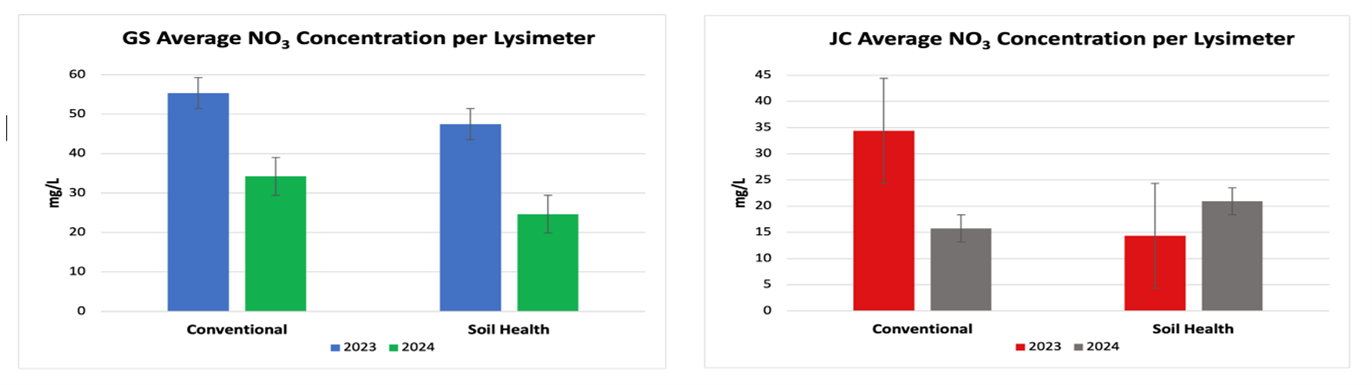
On the GS Farm, the leachate from the soil health treatment had, on average, a lower nitrate concentration. There was also less leachate produced, and less total nitrate going past the soil root zone. On the JC Farm in 2023, the soil health treatment also produced leachate with a lower nitrate concentration than their conventional treatment. There was also less total leachate produced and less total nitrate loss when cover crops were interseeded into the corn in 2023. Those results disappeared in 2024 when a cover crop was not planted. Even with the cover crop, the leachate (on average) exceeded the drinking water standard for nitrate concentration. The application of manure in the spring likely contributed to this loss.


Future Plans
This study will continue for three more years. The goal is to verify and demonstrate practices that improve soil health and minimize environmental impacts.
Authors
Presenting & Corresponding author
Rhonda Miller, Professor, Utah State University, rhonda.miller@usu.edu
Additional authors
Katie Hewitt, Graduate Student, Utah State University; Bruce Miller, Professor, Utah State University
Acknowledgements
Funding provided by NRCS CIG Grant “Utah Soil Health Partnership On-Farm Trials” – Agreement Number NR223A750013G009
The authors are solely responsible for the content of these proceedings. The technical information does not necessarily reflect the official position of the sponsoring agencies or institutions represented by planning committee members, and inclusion and distribution herein does not constitute an endorsement of views expressed by the same. Printed materials included herein are not refereed publications. Citations should appear as follows. EXAMPLE: Authors. 2025. Title of presentation. Waste to Worth. Boise, ID. April 7-11, 2025. URL of this page. Accessed on: today’s date.