Wisconsin Professional Manure Applicator Education

Why Look at Manure Applicator Educational Programs?

Based on 2013 statistics, Wisconsin has a dairy herd of 1.2 million cows that produce 12,000,000,000 gallons of manure and waste water. Custom manure haulers in Wisconsin handle an estimated fifty percent of the dairy manure and forty per cent of all livestock manure generated in Wisconsin. Because custom manure applicators are a critical component of nutrient management plan (NMP) implementation, University of Wisconsin Extension initiated manure hauler education across the state in the early 1990’s. In 2000, the applicators sought UW – Extension advisory support in forming the Professional Nutrient Applicators Association of Wisconsin (PNAAW). This began a long term relationship between UW – Extension and the professional applicators in Wisconsin and across the upper Midwest.

Following a needs assessment of the industry, the board of directors of PNAAW expressed an interest in a voluntary training and certification program. The overall goal of the training was to educate the custom manure haulers and their employees in safe handling and application practices, spill response, regulations and nutrient management. Road safety, neighbor relations, and confined space safety education modules were added later.

What did we do?

In March of 2002, the board of directors of the PNAAW and a group of Michigan manure applicators independently approached Extension in each state to initiate a voluntary certification and training program. Over the next 5 months, applicators and Extension staff examined the 5 existing manure applicator certification programs and created the program currently in use in Wisconsin, Illinois and Michigan.
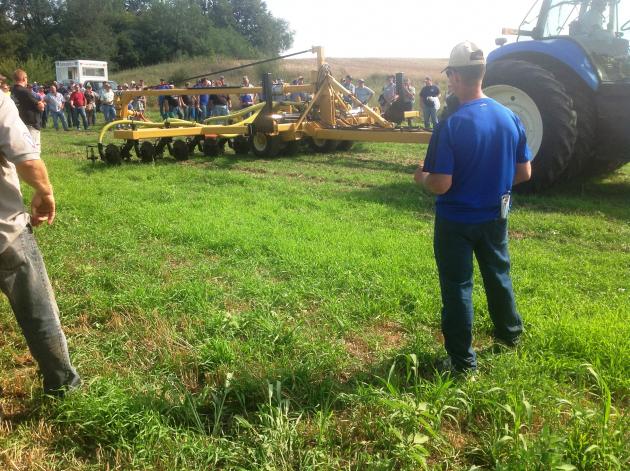
Field photo 2012

Manure expo 2012, checking out a new dragline applicator.

The UW – Extension Nutrient Management Team’s Custom Manure Hauler Workgroup joined with Extension faculty in Illinois and Michigan to develop a three-state certification program with three levels of training/certification. The certification includes a partnership with the insurance industry to provide a market-based incentive to participate. Business and employee management issues are addressed during an annual multi-state regional symposium coordinated by UW-Extension.

Certification: The program is segmented into three certification levels. Firms must meet level 1 requirement to gain level 2, and meet level 2 requirements to achieve level 3.

  • Level 1: Requires each employee to be trained and tested on spill response techniques, state specific regulations (including CAFO regulations) and common sense application techniques. Firms that document compliance are eligible for a 10% vehicle liability premium reduction. Training is ~3 hours in length and is completed annually.
  • Level 2: Requires crew supervisors and business owners to attend 6 hours of continuing education over a 2 year period. Classes are offered at field days and the annual conference. Once a firm has achieved Level 2, they may conduct Level 1 training in-house.
  • Level 3: Develop and implement an EMS (Environmental Management System). The EMS requires the firm to document their process and ensure all employees know their job responsibilities. Insurance auditors will evaluate each firm’s EMS annually to insure compliance. Premium reductions include 10-40% on vehicle liability and 50% on environmental liability.

Not your typical Wisconsin “boat” show. PNAAW 2014 manure boat agitation demonstration, organized with UW-Extension.

All certification levels also require that the firm complete the PNAAW Performance Standards Checklist at least once per year.

Membership in the state’s applicator association is required for certification, as certification is granted by the association and not by Extension. Each state association may also require additional performance standards, such as documentation of equipment calibration, to grant certification.

One area of continuing education began in 2002, when UW – Extension with permission from Wisconsin Department of Natural Resources (WDNR), conducted manure spill response training using actual manure. The basic educational focus was containing, controlling, cleaning up, and then meeting reporting requirements of a spill. Since 2002, 20 live action demonstrations have occurred. Training has expanded to include calibrating of manure equipment and determining manure application rate per acre.

What have we learned?

PNAAW requested that Extension assist in filling an educational need not met by current farm shows – being able to compare different manure agitation and application equipment side by side in the field (using actual manure) to help determine which best meets individual needs. The result was the first Manure Expo in August 2001, which drew 432 people from 5 states and Canada.

The Manure Expo has grown to an annual 2-day educational and demonstration event. 2015 is the 13th Expo; the event has been hosted by Extension and custom applicators in Wisconsin, Michigan, Minnesota, Ohio, Iowa, Missouri, Nebraska, and Pennsylvania in the US and Guelph, Ontario, Canada. An average Expo will draw over 1,000 people from industry, university, farm, and application professionals.
PNAAW 2014

PNAAW 2014

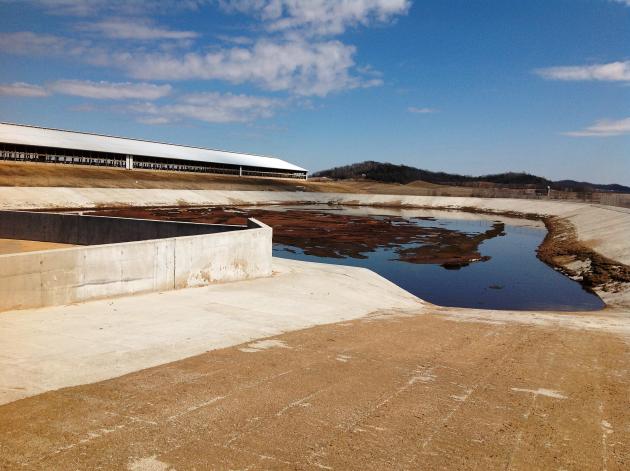
The pit before the boat demonstration begins 2014.

The voluntary certification program has saved Wisconsin and Michigan over $100,000 annually because regulatory mandates require state finances for staff and office to run mandated programs. In addition to the sharing of curriculum in multiple Midwestern universities the training and educational sessions are a success in the formation/enhancement of three state associations in Michigan (now inactive), Pennsylvania, and Indiana/Ohio.

Applicator and industry partnerships contributed to a multi – state agriculture weight study based at the Minnesota DOT/University of Minnesota, MN Road Research Center. Over $640,000 was pooled from applicators and Applicator Associations (WI, MI, MN, IA, and OH), industry and agencies to fund research on the impact of larger manure hauling and agriculture equipment on pavement.

Custom manure applicators are a key component in the environmental application of manure. The Wisconsin Department of Agriculture, Trade, and Consumer Protection (DATCP) has tracked crop acres managed with a NMP. In 2004, 0.7 million crop acres were managed using a NMP; in 2014 the NMP managed acres increased to 2.58 million acres in Wisconsin.

Future Plans

Each year a new need will arise. Education will be provided for employee relations, business planning, family/work balance and the need to review new technology. A few projects that began in 2014: manure boat agitation field day and precision manure application. Education will be developed in the future as a need arises from the manure application industry.

Authors

Richard Halopka, CCA, Clark County UW-Extension Crops & Soils Agent richard.halopka@ces.uwex.edu

George Koepp, Columbia County UWEX Agriculture Agent, Jerry Clark,Chippewa County UWEX Crops/Soils Educator, Ted Bay, Grant County UWEX Crops/Farm Management Agent, Kevin Erb, UWEX Conservation Professional Devp. & Training Cord., Becky Larsen, UW Biowaste Specialist, Jim Leverich, UW On Farm Research, Kim Meyer, UW Arlington ARS, Cheryl Skjolaas, UW Agriculture Safety Specialist

Additional information

In 2014, over 400 custom manure applicators in Wisconsin were certified in at least one level of the program. Eight PNAAW member application firms revised their level 3 status in 2013 and are saving $44,000 annually on pollution insurance policies, while PNAAW firms achieving level 1 and level 2 certification reduced pollution insurance policies premiums by an additional $78,000 per year.

The collaboration of PNAAW, University of Wisconsin Extension, University of Wisconsin Specialists, WDNR, DATCP and UW – Extension County Agents has provided the foundation of a proactive approach to education and training, leading to problem solving results from a knowledgeable application industry.
https://www.facebook.com/pages/category/Nonprofit-Organization/Professional-Nutrient-Applicators-Association-of-Wisconsin-2223955430983054/  

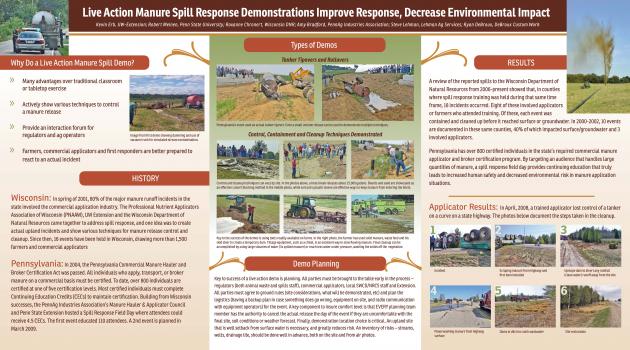
2009 U.S.A. water quality poster, manure spills

2009 U.S.A. water quality poster, manure spills

Bulletin for manure spill response developed by UW-Extension nutrient management team PNAAW workgroup.

The authors are solely responsible for the content of these proceedings. The technical information does not necessarily reflect the official position of the sponsoring agencies or institutions represented by planning committee members, and inclusion and distribution herein does not constitute an endorsement of views expressed by the same. Printed materials included herein are not refereed publications. Citations should appear as follows. EXAMPLE: Authors. 2015. Title of presentation. Waste to Worth: Spreading Science and Solutions. Seattle, WA. March 31-April 3, 2015. URL of this page. Accessed on: today’s date.

The Natural Farming Concept: A New Economical Waste Management for Small Family Swine Farms


Why Look at Inoculated Deep Litter Systems?

The most critical issue facing livestock and other small family operations nationwide is the development and implementation of cost effective pollution prevention technology. Our livestock producers, especially swine, continue to seek a best management practice (BMP) that is effective, economical, and practical, and in compliance with new US EPA laws. The Department of Health, Natural Resource Conservation Service, Hawaii Soil and Water Conservation Districts and the Cooperative Extension Service have been working diligently to address both federal and state waste management compliance needs of the local pork producer. As a result, the industry currently implements effluent irrigation, composting, deep litter technology, lagoon storage and solid separation as possible solutions for on-farm nutrient management. Unfortunately, due to new and revised EPA regulations, which now include nuisance odor and vector components, many of these strategies no longer meet federal criteria for BMPs.

In 2006, a system of waste management, with the potential to be implemented as a BMP under federal regulations, was discovered in Korea during a visit to the Janong Natural Farming Institution. The concepts of naturally collected micro-organisms, green waste deep litter, and a piggery design with strategic solar and wind positioning was being practiced in several countries in Asia and the Pacific Basin. Over the past six years, these concepts have been tested in Hawaiʻi to provide small swine farms with another BMP that is in compliance with current EPA regulations.

What did we do? 

For the past six years, the Extension Service has been touring many hog farms and conducting numerous educational seminars on the Inoculated Deep Litter System (IDLS). The number of IDLS piggery operators has increased dramatically due to farmers coming out of retirement, producers retrofitting and replacing their wash-down swine operations as well as new farmers trying their hand at raising hogs. A major factor of the great interest toward the IDLS piggery is the minimal labor and time to operate the system compared to the traditional style of raising hogs with daily wash downs of the pig pens. Other important factors include the concept of collected micro-organisms, a layering of the deep litter green waste system, and designing piggery housing with strategic solar and wind positioning to keep the facility cool and dry. The success of the IDLS system is exemplified by the following: 1) Low maintenance since litter pens never have to be cleaned, 2)has no odor or ve ctor problems if managed correctly and 3) development of cost effective housing.

What have we learned? 

IDLS incorporates four components: 1) self-collected, site-specific (or indigenous) micro-organisms (IMOs), 2) green waste, 3) natural ventilation, and 4) facility positioning relative to sunlight. The livestock facility is kept dry with natural ventilation and sunlight, which promotes proper fermentation of the pen litter (combination of green waste and livestock waste) thus preventing nuisance fly breeding and odors generated by proliferation of undesirable organisms.

Solar positioning. The building’s foundation is positioned from north to south, with the south end serving as the entrance to the facility. This takes advantage of maximizing sunlight traveling east to west, which provides adequate ultraviolet light, heating, and drying. Sunlight and ventilation help to promote drying, thus preventing liquid accumulation (from livestock waste, watering nipples or troughs, rain) in the litter, which deters the fermentation process from turning anaerobic, and eliminates conditions ideal for odor and fly breeding. (Note: orientation applies to the Northern Hemisphere and positioning should be reversed for application in the Southern Hemisphere.)

Natural ventilation. The building is designed with a high (14 ft H), vented roof, and walls (10 ft H) which have openings to the outside. Cool trade winds are allowed to blow through the building, forcing warm air to rise and be eliminated through the vented roof. This helps to dissipate heat generated from microbial fermentation in the litter, keeps the litter dry through constant air movement, and cools the facility during the hot season. During the rainy season, simple roll-down siding can be installed to keep rain out.

Deep Litter. In order to fulfill EPA regulations that require an impervious bottom to all waste handling facilities, there must be either a concrete slab or a thick (30 mil) plastic liner as the base of the building. Green waste, with a minimum depth of 4 feet, is then strategically layered to start the IDLS. The first layer consists of roughly a half foot of cinders mixed with bio-char (not charcoal briquettes). The second layer consists of 2 feet of cut logs. Logs should be at least 3 to 4 feet long and can range in diameter from 2” or more (larger, longer logs deter pigs from rooting them to the surface). The third layer is comprised of either leaves or fronds covered with assorted green waste. The next step is too lightly spread about one pound of IMO-4 and soil to every 50 square feet of surface area in the IDLS pen. For example, a 100 sq ft pen will require 2 pounds of IMO-4 applied in the third layer. The final step is to add about a half foot of sawd ust. Two weeks before introducing animals into the pens, activate the microbes once with a mist spray of lactic acid bacteria (LAB) and fermented plant Juice (FPJ). You can add animals to the pen once you smell a yeasty odor in the litter, a sign that the microbes have been activated and are at work in the pen.

Micro-organisms: The only micro-organisms used are self-collected by the producer from the specific site of the facility. The profile of indigenous micro-organisms may vary greatly from place to place, from windward to leeward coasts, and even between neighboring properties. The initial, one-time misting with lactic acid bacteria (LAB) and fermented plant juice (FPJ) activates the microbes to increase in numbers. To learn how to make these activators, please attend a Natural Farming Input-Making class, or contact the Hawaiʻi Cooperative Extension Service (mduponte@hawaii.edu).

LAB and FPJ: These are self-made inputs. Go to CTAHR website for free publication

Future Plans 

Adaptation of concept overcome a major hurdle when the IDLS piggery became cost sharable with the federal government on November 15, 2012 and deemed a best management practice. Hog farmers who practice the IDLS are eligible in entering into a cost-share agreement with the U.S. Department of Agriculture (USDA) for Environmental Quality Incentive Program (EQIP) assistance and may file an application at any time and will further enhance the participation in the IDLSTo date nearly 50 retrofitted or new operations have been established in Hawaii. The IDLS has been introduced and being practiced in 11 states, Micronesia and various countries of the world. Future plans include implementing the technology to large scale operations, making of feed utilizing other natural farming techniques and evaluating the compost for organic plant propagation. The system is currently being tested with Poultry Production

Author   

Michael DuPonte, Extension Agent University of Hawaii at Manoa, College of Tropical Agriculture and Human Resources (CTAHR). mduponte@hawaii.edu

Additional information 

Publications

H. Park and M.W. DuPonte., 2010., How to Cultivate Indigenous Microorganisms, Biotechnology, CTAHR., June, BIO-9.

M. DuPonte and D. Fischer., Most Frequently Asked Questions on the IDLS Piggery, The Natural Farming Concept A New Economical Waste Management Stem for the Small Family Swine Farms in Hawaii., 2012., Livestock Management., Sept. , LM-23

D. M. Ikeda, Weinert Jr., E., Chang K.C.S., Mc Ginn, J.M., Miller S., Keliihoomalu, and DuPonte, M.W., 2013., Natural Farming: Fermented Plant Juice, Sustainable Agriculture, CTAHR., July, SA-7.

S. Miller, Ikeda, D.M., Weinert Jr., E., Chang K.C.S., Mc Ginn, J.M., Keliihoomalu, and DuPonte, M.W., Natural Farming: Lactic Acid Bacteria, Sustainable Agriculture, CTAHR., August, SA-8.

Acknowledgements      

Kang Farms of Kurtistown, Hawaii, David Fischer (NRCS), Justin Perry III (NRCS) and Lehua Wall (CTAHR)

The authors are solely responsible for the content of these proceedings. The technical information does not necessarily reflect the official position of the sponsoring agencies or institutions represented by planning committee members, and inclusion and distribution herein does not constitute an endorsement of views expressed by the same. Printed materials included herein are not refereed publications. Citations should appear as follows. EXAMPLE: Authors. 2015. Title of presentation. Waste to Worth: Spreading Science and Solutions. Seattle, WA. March 31-April 3, 2015. URL of this page. Accessed on: today’s date.

Fertilizer Value of Swine Manure: A Comparison of a Lagoon and a Deep Pit Slurry System

Why Compare Liquid and Slurry Systems for Pig Production?

Since 2000 the cost of fertilizer has more than doubled. According to information provided by the USDA Economic Research Service (2013), the national average price per pound of N has increased between 2000 and 2012 by a factor of 2.6. Over the same time period, phosphate price increased by a factor of 2.8, and potassium price increased by a factor of 4.0. As a result, fertilizer costs now contribute 30% to 40% of the annual variable costs to grow many cereal grains. Table 1. Fertilizer priceDuring the same time period environmental regulations have greatly decreased the construction of swine finishing facilities that use liquid manure handling systems that require the use of a lagoon or storage pond. In response to these economic and regulatory realities, some swine production companies are considering the use of deep pit slurry systems instead of an outdoor lagoon or storage. Benefits of the deep pit slurry system include the exclusion of rainfall, reduction in storage visibility, and conservation of valuable major plant nutrients (N, P, K) for the purpose of reducing production costs for feed grains. The objective of this presentation is to compare the fertilizer value of the manure produced from swine finishing barns that use a liquid manure handling with a treatment lagoon, and swine finishing barns that store manure below slotted floors in pits.
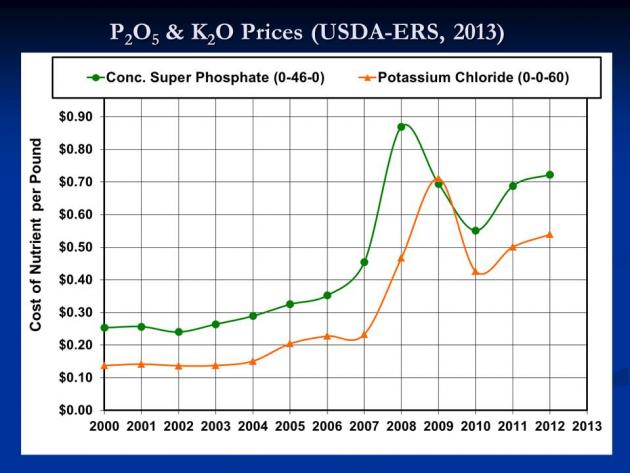
Table 2. Fertilizer priceWhat did we do?

Plant nutrient content and volume data were collected from a swine finishing farm that used a lagoon treatment system. The system was designed to provide storage of manure, anaerobic treatment of volatile solids, and storage for sludge for 3520 pigs. Treated lagoon surface water (total solids = 0.5%) was recycled through the four buildings to provide water to remove manure from the building using a pull-plug, pit-recharge design. Lagoon surface water was applied to nearby cropland annually to provide all major plant nutrients using traveling gun irrigation. Data were also collected concerning the plant nutrient content of lagoon sludge, and sludge volumes were estimated using the ASABE Standard (2011).

Image of barnThe realized value of swine manure was calculated for using lagoon water, and sludge to provide all or a portion of the N, P2O5, K2O used by corn based on typical crop needs. Only the portion of plant nutrients that met the recommendations was assigned value. No value was assigned to major plant nutrients applied in excess of plant uptake. The value was assigned based on price data obtained from USDA-ERS (2013). The prices used were $0.71/lb of N, $0.69/lb of P2O5, and $0.50/lb of K2O.

Two application rates were calculated for lagoon water. The first rate was to provide the N needs for corn and the second was to provide the P2O5 needs of the crop. The pounds of N, P2O5, and K2O applied per acre were determined and the value of the nutrients that met the fertilization rates was calculated.

Lagoon sludge (total solids = 10%) contained 4 times as much P2O5 as plant available N (PAN) per 1000 gallons (47.3 lb P2O5/1,000 gal vs 11.7 lb PAN/1,000 gal). Therefore, the only sludge application rate used was the rate needed to meet the fertilizer recommendation for P2O5. The realized value of the sludge was determined in the same way as for lagoon water.

Diagram lagoon system for finishing swineWhen lagoon water was applied to supply the N needs of one field, and sludge was applied to meet the P2O5 needs of another field the realized value of swine manure was $5.69 per hog-space per year. Application of lagoon water and sludge to meet the P2O5 needs of corn increased the annual value of manure to $6.64 per hog-space.

The analysis was repeated for the same size farm using volume and nutrient data for deep pit barns that provided 1 year of storage for swine slurry (total solids = 7.5%). The realized economic value of deep pit slurry was also calculated based on application of slurry, using direct injection, to meet the N and P2O5 needs of corn with the same price assumptions as for the lagoon system. The results indicated that spreading deep pit slurry based on the agronomic rate for N provided a realized manure value of $24.35/hog-space/yr. Application of slurry based on the agronomic rate for P2O5 yielded a manure value of $28.95/hog-space/year.

What have we learned?

Treatment lagoons were originally designed to provide treated water used to remove manure from flush or pit-recharge swine buildings. However, little consideration was given to the value of the N lost or the value of P and K. Essentially, lagoons provided the treatment needed for recycled flush or pit-recharge systems, but they wasted nitrogen that could be used to off-set fertilizer costs.

Over the last decade, fertilizer prices have increased greatly, and continue to fluctuate. As a result, the nutrients lost by manure treatment are now viewed as a valuable input for production of feed grains.

Using a deep pit barn eliminated the need for manure treatment and allowed plant nutrients to be stored until needed. It was estimated that a deep pit slurry system would allow a producer to increase nutrient value per hog-space by a factor of 4.3 from $6.68 to $28.95/hog-space per year. On a 4-house farm that provided housing for 3520 hogs the annual manure value may be as high as $101,920 per year.

Future Plans

The results from this study are being used to develop extension programs for swine producers. Information is being used to help plan farms and to encourage integration of swine and feed grain production.

Author

John P. Chastain, Ph.D., Professor and Extension Agricultural Engineer, Clemson University jchstn@clemson.edu

Additional information

Reference Cited

ASABE (2011). ANSI/ASAE EP403.4 FEB2011 Design of Anaerobic Lagooons for Animal Waste Management. In ASABE STANDARDS. ASABE, 2950 Niles Rd., St. Joseph, MI 49085-9659.

USDA-ERS (2013). Fertilizer Use and Price. United States Department of Agriculture, Economic Research Service. Available at: http://www.ers.usda.gov/data-products/fertilizer-use-and-price.aspx.

Acknowledgements

Support for this work was provided by the Confined Animal Manure Management Program of Clemson Extension, Clemson University, Clemson, SC.

The authors are solely responsible for the content of these proceedings. The technical information does not necessarily reflect the official position of the sponsoring agencies or institutions represented by planning committee members, and inclusion and distribution herein does not constitute an endorsement of views expressed by the same. Printed materials included herein are not refereed publications. Citations should appear as follows. EXAMPLE: Authors. 2015. Title of presentation. Waste to Worth: Spreading Science and Solutions. Seattle, WA. March 31-April 3, 2015. URL of this page. Accessed on: today’s date.


Converting Manure, Food Wastes and Agricultural Production Wastes into Bio-Secure Fertilizer, feed, and/or beeding


Purpose

To find a way to completely eliminate bio-hazards in manure, food wastes, municipal sludge, and agricultural production wastes.

What did we do? 

We adapted existing dry extrusion technology to bio-hazard agricultural wastes. To test the hypothesis we developed [ Dry Extrusion Technology can be adapted to convert bio-degradable hazardous wastes into Bio-Secure class “A” fertilizer, feed, and/or bedding more economically, with less environmental impact, greater sustainability, and in less time with a smaller foot print]

Once we proved our Hypothesis we further developed the process to allow the technology to be utilized in a large stationary plant suitable for a large waste generator and in a portable plant that can be used to assist smaller waste generators, such as, most agricultural producers and smaller municipalities.

What have we learned? 

Our tests showed that we could validate our hypothesis by:

1) utilizing finely ground dry agricultural production wastes, mixed with the wet food and manure to reduce the moisture content of the wet wastes to a level compatible to the requirements of the dry extruder,
2) The Dry extruder effectively sterilized the wastes by high temperature, high pressure inside the extruder, and sudden drop in atmospheric pressure inside the cell walls of all the materials when exiting the Dry Extruder, thereby destroying the cell walls of not only the bio-mass materials but also of all micro organisms ova, and pathogens inside the final product.

Future Plans 

Develop new niche markets for agricultural waste generators by adding additional value to their wastes.

Authors

Joe E. Busby joebusby@wfeca.net 

Moses Braxton, Bill Ansley, William Andrews, Duncan Nesbit, and Dr. Carm Parkhurst

Acknowledgements

Insta Pro International, North Carolina State University

The authors are solely responsible for the content of these proceedings. The technical information does not necessarily reflect the official position of the sponsoring agencies or institutions represented by planning committee members, and inclusion and distribution herein does not constitute an endorsement of views expressed by the same. Printed materials included herein are not refereed publications. Citations should appear as follows. EXAMPLE: Authors. 2015. Title of presentation. Waste to Worth: Spreading Science and Solutions. Seattle, WA. March 31-April 3, 2015. URL of this page. Accessed on: today’s date.

Wood Chip Pad Winter Feeding Area as a New Livestock Manure Management System

Purpose

Over-wintering beef cattle on pastures in the Eastern half of the USA has been shown to increase runoff, sediment loss and nutrient transport. Traditional barn lot winter feeding areas, or ‘sacrifice’ areas, for beef cattle can be a significant source of nutrient and sediment pollution. Sustainable and affordable approaches are needed that effectively control manure nutrients during the winter feeding period, while ensuring a healthy and comfortable animal environment. The use of woodchips as a surface material for areas used to hold cattle during wet periods is practiced on a limited basis in Ireland, Scotland, and New Zealand. The application of this simple technology in the cool Eastern part of the US that has a humid climate, has potential to improve animal comfort and health, protect winter pastures, and reduce the environmental impact of winter feeding and loafing areas.

Figure 2. Woodchip Pad Profile

What did we do?

Beef cattle producers in United Kingdom, Ireland and New Zealand have shown a positive conservation effect using out wintering pads constructed with wood chips, allowing the pastures to be destocked. Out Wintering Pads (OWPs) are outside loafing areas for cattle. OWPs are typically constructed adjacent to a concrete feeding area and a watering facility. The OWP design allows for 150 square feet per cow. The chip size is critical for proper functioning of the manure storage system. Use of fist to palm sized chips are recommended to allow dung to filter into the pad. Smaller chips can be used but will need to be renewed sooner. Manure is worked down below the surface of the pad by the cattle’s hoof action. Initial depth of chips needs to be no less than 12 -15 inches deep. The site must be prepared with a drainage system using drain pipes every 10 feet to prevent moisture accumulation within the OWP (Figure 2). This effluent must be managed with a storm water retention pond and vegetated filter strip.

Figure 1. Initial woodchip pad developed in West VirginiaWhat have we learned?

Two woodchip-surfaced heavy use areas have been installed and monitored in West Virginia. The first was installed on a private farm with a cow/calf enterprise in Northern WV during 2011 (Figure 1).

The design criteria were adopted from a guidance document developed by the Irish Department of Agriculture and Food. This wood chip pad was placed adjacent to a USDA NRCS roofed winterfeeding area and roofed manure storage. Woodchip quality was determined and temperature and precipitation monitoring occurred for a 23 month period including two winter stocking periods. Effluent water quality grab samples were taken during that monitoring period. A second chip pad was constructed in WV on the West Virginia University (WVU) Animal Science Experiment Station Farm during 2014. This area consists of two loafing paddocks, one constructed with single species white oak wood chips and the other with mixed hardwood chips made up primarily of mixed yellow-poplar and oak. Bench scale columns with various configurations of thermally treated wood chips were evaluated in 2014.

Column Study Setup

  • PVC pipe (8-inches in diameter) columns
  • Runoff water was collected from the waste water storage tank at WVU’s Animal Science Farm
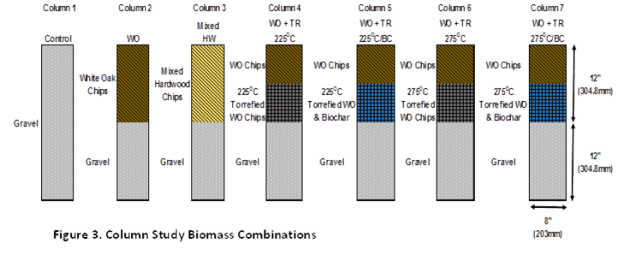
  • Gravel placed in each of the columns to a height of 12 inches (304.8mm) and then each column was packed with 12 inches (304.8mm)  of varying media (Figure 3)

Figure 3. Column study biomass combinations

  • Three rain events (1cm, 2cm, and 3cm) (with 96 hours between events) were passed through the columns
  • Each of the columns were then cleaned and re-packed and subjected to waste water to a depth of 18 inches (459 mm) for 48 hours
  • Pre- and post-water samples were collected to test for phosphorous (P), ammonia, and Total Kjeldahl nitrogen (TKN) 

Biomass Media Performance – Rain Events

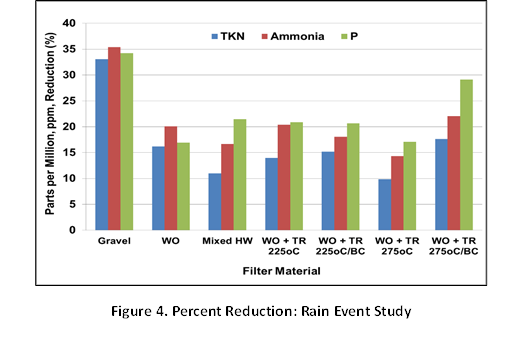
  • Mixed hardwood chips had superior P concentration reduction compared to white oak chips, but lower Total TKN reduction (Figure 4)
  • Gravel outperformed the biomass media filters (Figure 4)
  • Of the biomass media, the WO + TR 275OC/BC media showed the highest % reduction of P, TKN, and Ammonia (Figure 4)

Biomass Media Performance – 48 Hour Hold

  • White oak chips had better TKN reduction than mixed hardwood chips, but lower P reduction  (Figure 5)
  • Mixtures containing biochar resulted in greater pollutant reductions than torrified treatments without biochar (Figure 5)
  • The WO + TR 275C/BC media showed the highest % reduction of TKN and Ammonia, but not the highest P % reduction (Figure 5)

Figure 4. Percent Reduction: Rain Event Study

Figure 5. Percent Reduction: 48 Hour Hold Study.

The biomass mixes that have demonstrated the best performance are being added as treatments in small cell areas on the WVU woodchip heavy use area. The treatment cells are being monitored for runoff flow amounts and water quality.

Future Plans  

Further research is needed to determine optimum chip species and chip size for moisture retention and nutrient capture capabilities. Development of complimentary systems to treat the effluent produced from periods of runoff are needed as vegetated treatment areas may not function well during the winter when WV soils are typically saturated and runoff occurs instead of infiltration.

Authors     

Tom Basden, Extension Specialist, West Virginia University tom.basden@mail.wvu.edu

Joshua Faulkner, UVM and David DaVallance, WVU

Additional information             

Tom Basden 1060 Agricultural Sciences Building Morgantown WV 26506

The authors are solely responsible for the content of these proceedings. The technical information does not necessarily reflect the official position of the sponsoring agencies or institutions represented by planning committee members, and inclusion and distribution herein does not constitute an endorsement of views expressed by the same. Printed materials included herein are not refereed publications. Citations should appear as follows. EXAMPLE: Authors. 2015. Title of presentation. Waste to Worth: Spreading Science and Solutions. Seattle, WA. March 31-April 3, 2015. URL of this page. Accessed on: today’s date.

Markets for Composted Agricultural Waste

Why Consider Composting Manure?

Enforcement of nutrient management regulation has forced Maryland farms and agricultural facilities to adopt new waste management practices. Few options exist that are financially sustainable. Regulatory agencies witnessed the unexpected consequence of closing small and mid-sized farms who could not afford to institute new waste management technologies. To counter that consequence, Maryland Department of Agriculture offered grants to subsidize the development of innovative technology and business practices. These new systems and business models had to offer both financial and environmental sustainability.

What Did We Do?

The first step in this project (supported by the Maryland Department of Agriculture, 2014) was to identify the biological make up and characteristics of the stable waste both before and after processing. We measured nutrient content and form (N, P, K), porosity, moisture absorption and C: N ratio. By understanding what the material consisted of pre-processing, we were able to determine what effects different controls during processing would have on the end product. As an example, when using stable waste for bedding re-use the material is run through the composting system as quickly as possible. A shorter composting period with auger mixing technology allowed the biological activity to breakdown the manure balls, support the transformation of the waste nutrients and yet protect the integrity of the shavings for second use. Related: Managing Manure on Horse Farms

Next, the local markets were studied:

    • Soil types and needs: compost to add porosity, water retention, nutrients to soil
    • Weather patterns and created needs: compost added for water retention, binding material to diminish run off
    • Population centers for urban market: compost for landscape needs, potting medium
    • Rural character for on farm market: compost for nutrient replacement, bedding re-use
    • Cost of operations on local farms: cost of bedding, cost of disposal, cost of landscape material, cost of synthetic or imported fertilizer
    • Wholesale market needs: compost for distribution centers (Scotts products), soil specialty companies, land reclamation sites, Department of Transportation needs, green house growers

Identifiable, viable market channels to move the processed stable waste were necessary components of a business model.  Uses for the processed waste were identified both on site and off site.

On site uses were identified as:

    • Land application: field enhancement
    • Bedding re-use
    • Landscape use
    • Improved footing arenas
    • Land reclamation
    • Pelletized for heat systems
Off site uses were identified as:

    • Soil amendment
    • Land reclamation
    • Potting Medium
    • Food Waste Bulking agent
    • Whole sale distribution centers
    • Soil Specialty companies

What Did We Learn?

Data was gathered and studied from equine facilities with existing composting operations to illustrate what the benefits and challenges can be. IOS Ranch on Bainbridge Island Washington is a sustainably designed 7.5 acre property that supports 20-25 stalled horses. The design concentrates the structures, indoor arena, stall, office and supporting buildings, so there could be surrounding pasture turn out and an outdoor arena. The facility was paying high waste disposal fees. Their decision to bring composting technology to the farm was an effort to eliminate disposal fees and diminish their bedding cost through bedding re-use. However, once the system was installed a local landscaper visited the site and saw value in the compost. The material is now sold for $30/yard wholesale and $45/yard retail to local landscapers and gardeners. With the price of shavings for bedding delivered at $7.50/yard the business decision to sell the compost was an obvious one. The property was formerly a gravel pit with large areas of exposed pit run. Once realizing the value of the compost for land application, the owner spread on the exposed areas greatly improving grass performance in the turnout fields. This farm was saving $100-$140/day producing compost because of the reduced disposal fees plus profits from marketing, allowing for a breakeven on investment in 3 years.

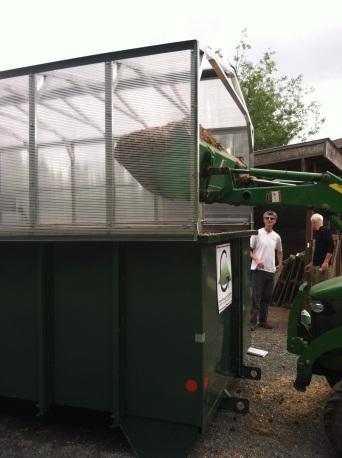
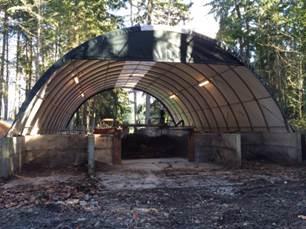
manure composting operation on horse farm manure composting operation on horse farm manure composting operation on horse farm

Joint Base Myer Henderson Hall hosted a pilot project for composting of food waste on remote contingency bases. On this base the Army’s Caisson horses are housed in a 50+ stall barn. After the pilot was completed the in vessel composting system will revert to the base for processing the stable waste. The base has the choice of bedding re-use or using the compost for landscape needs on base and/or in the adjacent Arlington National Cemetery. Outside contractors were supplying the base with compost at nearly $400,000 per year. The project could pay for itself in the first year. Thorough lab analysis showed the compost to be consistently of high quality, pathogen free, and weed seed free.

army base horse manure composting photos

Currently two sites in Maryland are being studied; one an equine rescue facility housing 50-80 horses, and the other a dairy with 240 head. The use of composted stable waste as a peat moss replacement will bring value to the equine and dairy farms and to the large, local greenhouse industry. Currently 80% of the peat moss used in Maryland is imported from Canada. The farms selected are large enough that they can produce enough material for bedding re-use (savings of nearly 20% of operating budget) and/or sell the material to wholesale buyers. The composting material from both sites show the favorable attributes of peat moss, porosity and moisture retention. Blending can alter the nutrient levels to what the market needs by using the more nutrient rich dairy waste. The collection of compost and blending can be done on on site or at an off site location in cooperation with other local farms, this may help meet larger volume needs of wholesale buyers.

horse manure composting operation in Maryland horse manure composting operation in Maryland horse manure composting operation in Maryland

Future Plans

The Maryland projects are both two years in duration with continual data gathering and recording. The next step is the location and operation of a collection yard for multiple local farms to send their processed stable waste. Such a yard allows for mixing to meet differing market needs and the creation of large quantities of homogenous product for local greenhouse growers.

Authors

Mollie Bogardus, owner, Aveterra and representative of Green Mountain Technologies, Inc. mollie@compostingtechnology.com

Additional Information

http://news.maryland.gov/mda/press-release/2014/08/15/mda-awards-1-million-for-innovative-manure-management-technologies-demonstration-projects-in-howard-frederick-and-worcester-counties-recognized/

Acknowledgements

Dr. Pat Millner, USDA Beltsville, Research Microbiologist is lead researcher and mentor on these projects in Maryland.

The authors are solely responsible for the content of these proceedings. The technical information does not necessarily reflect the official position of the sponsoring agencies or institutions represented by planning committee members, and inclusion and distribution herein does not constitute an endorsement of views expressed by the same. Printed materials included herein are not refereed publications. Citations should appear as follows. EXAMPLE: Authors. 2015. Title of presentation. Waste to Worth: Spreading Science and Solutions. Seattle, WA. March 31-April 3, 2015. URL of this page. Accessed on: today’s date.

Modeling water movement in beef cattle bedded manure pack


Why Examine Moisture Content of a Manure Pack?

Bedded manure is a valuable fertilizer source because it contains essential macronutrients (nitrogen (N), phosphorus (P), and potassium (K)) for crop production. Previous research with beef cattle bedded manure packs demonstrated that water-soluble macronutrients accumulated toward the bottom of the packs with water movement. Thus, predicting water movement in bedded manure helps to estimate nutrient composition throughout the bedded pack. This work presents a development of a process-based model of vertical water movement that considers percolation and diffusion as the main processes of water and vapor movements in bedded manure packs. Evaporation from the top zone to the atmosphere was considered a process of convective mass transfer. The model predicts the change in moisture content of the different zones in the bedded manure and assists in estimating nutrient composition.

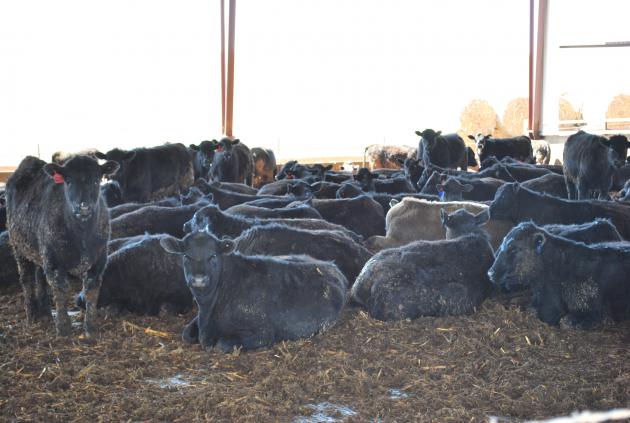
cattle loafing on a bed pack in their barnWhy Study Moisture Movement In a Bedded Pack?
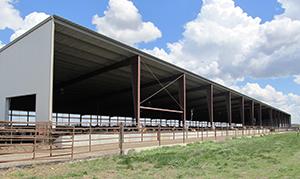

Beef cattle producers that raise cattle in complete confinement, such as mono-slope or hoop barns, may apply bedding material to manage moisture and improve the environment for the animals. Some producers let the manure and bedding accumulate to form a bedded manure pack, which is compacted by cattle activity. The bedded manure contains valuable nitrogen (N), phosphorus (P), and potassium (K) that are essential for crop production and soil sustainability. Depending on temperature, bedding material, and storage time of the bedded pack, the concentration of water-soluble N, P and K compounds may increase in the bottom of the bedded pack where water accumulates. Thus, understanding and predicting water movements within the bedded manure is important to estimate fertilizer N-P-K content and distribution in the bedded manure.

What did we do?

The processes considered in this process-based model include evaporation, percolation, diffusion of water vapor and diffusion of liquid water for vertical water movement. The model by Seng et al. (2012) for static compost piles and a modified version of the Integrated Farm System Model (not yet released) by Rotz et al. (2014) for bedded manure were reviewed and compared. Ultimately, the model needs to be adaptable to estimate the water content of the pack over time for different environmental conditions, bedding materials, and storage times at varying depths within the bedded pack. Data for model calibration and validation were gained through laboratory-scale experiments by Ayadi et al. (in review).

What have we learned?

Percolation and liquid water diffusion are considered the main processes for vertical water movement between layers in the bedded manure. Evaporation occurs from the surface of the top zone of the bedded pack. The rates of percolation and liquid water diffusion are depth-specific and their rates therefore vary. The modified version of the Integrated Farm System Model (IFSM) is more adaptable to data gained through laboratory-scale experiments. Overall, IFSM is more applicable to producer-available data and thus more applicable to predict water movement for bedded manure packs in real-life conditions.

Future Plans

After predicting water movements in the bedded manure, the model will be used to estimate N, P and K movement through the different zones of the bedded manure pack as well as gaseous emission (ammonia and nitrous oxide) from the bedded pack surface. The final overall model will be a calculator that estimates fertilizer N-P-K content and value and ammonia and nitrous oxide emissions of the bedded manure packs from confined beef cattle facilities with respect to temperature, bedding material, storage time and depth of the bedded pack.

Authors

Erin Cortus, Ph. D., Assistant Professor, South Dakota State University, Brookings, SD

Ferouz Ayadi, M.S., Graduate Student, South Dakota State University, Brookings, SD; Mindy Spiehs, Ph. D., Animal Scientist, USDA‐ARS Meat Animal Research Center, Clay Center, NE

Additional information

References

Ayadi, F. Y., M. J. Spiehs, E. L. Cortus, and D. N. Miller. In review. Physical, chemical and biological properties of different depths and ages of simulated beef bedded manure packs. Transactions of the ASABE.

Rotz, C.A., Corson, M.S., Chianese, D.S., Montes, F., Hafner, S.D., Bonifacio, H.F., Coiner, C.U., 2013a.

The Integrated Farm System Model Reference Manual, Version 4.1. USDA-Agricultural Research Service. Avaialble at: http://www.ars.usda.gov/sp2UserFiles/Place/80700500/Reference%20Manual.pdf

Seng, B., H. Kaneko, K. Hirayama, and K. Katayama-Hirayama. 2012. Development of water movement model as a module of moisture content simulation in static pile composting. Environmental Technology 33(15):1685-1694.

Acknowledgements

The support and assistance of Henry F. Bonifacio with the simulation of water movements in the bedded pack manure is very much appreciated. This project and all associated reports and support materials were supported by the Sustainable Agriculture Research and Education (SARE) program, which is funded by the U.S. Department of Agriculture- National Institute of Food and Agriculture (USDA-NIFA). Any opinions, findings, conclusions or recommendations expressed within do not necessarily reflect the view of the SARE program or the U.S. Department of Agriculture. USDA is an equal opportunity provider and employer. The mention of trade names or commercial products in this publication is solely for the purpose of providing specific information and does not imply recommendation or endorsement by the USDA.

The authors are solely responsible for the content of these proceedings. The technical information does not necessarily reflect the official position of the sponsoring agencies or institutions represented by planning committee members, and inclusion and distribution herein does not constitute an endorsement of views expressed by the same. Printed materials included herein are not refereed publications. Citations should appear as follows. EXAMPLE: Authors. 2015. Title of presentation. Waste to Worth: Spreading Science and Solutions. Seattle, WA. March 31-April 3, 2015. URL of this page. Accessed on: today’s date.

Particulate matter from open lot dairies and cattle feeding: recent developments

The research community is making good progress in understanding the mechanical, biochemical, and atmospheric processes that are responsible for airborne emissions of particulate matter (PM, or dust) from open-lot livestock production, especially dairies and cattle feedyards.  Recent studies in Texas, Kansas, Nebraska, Colorado, California, and Australia have expanded the available data on both emission rates and abatement measures. Although the uncertainties associated with our estimates of fugitive emissions are still unacceptably high, we have learned from our recent experience with ammonia that using a wide variety of credible measurement techniques, rather than focusing on one so-called “standard” technique, may be the better way to improve confidence in our estimates.  Whereas the most promising control measures for gaseous emissions continue to be dietary strategies  with management of corral-surface moisture a close second for particulate matter, corral-surface management and moisture management play comparable roles, depending on the mechanical strength of soils and the availability of water, respectively.  The cost per unit reduction of emitted mass attributable to these abatement measures varies as widely as the emissions estimates themselves, so we need to intensify our emphasis on process-based emissions research to (a) reduce the variances in our emissions estimates and (b) mitigate the contingency of prior, empirically based estimates.  As a general rule, although cattle feedyard emission factors may be thought a reasonable starting point for estimating emissions from open-lot dairies, such estimates should be viewed with suspicion.

Purpose          

Document the state of the art of particulate-matter (PM) emissions from open-lot livestock facilities, including emission fluxes and abatement measures.

What did we do?

We conducted (a) field research at commercial, open-lot livestock facilities in the southern High Plains and (b) an up-to-date review of the latest literature concerning primary particulate matter emission fluxes and the abatement measures appropriate to the source type. Field research included time-resolved concentration measurements upwind and downwind of the livestock facilities during the hottest, driest times of the year (in the case of dairy emissions) and throughout the year (in the case of beef feedyards); and a 5-month evaluation of stocking density manipulation using electric cross-fences that preserve optimum bunk space for beef cattle on feed. The literature review surveyed research findings from anywhere in the world that were published in refereed journals as recently as March 2015 concerning the same topics.

What have we learned?

Increasing the stocking density of fed beef cattle as compared to the industry-wide average during hot, dry weather suppresses dust emissions to a measurable and reasonably consistent degree. Concentrations of PM measured downwind of open-lot dairies vary throughout the day, though to a lesser degree and at lower overall concentrations than those measured downwind of nearby beef cattle feedyards, likely reflecting (a) the comparatively lower intensity of the dairy animal’s physical activity and (b) the greater diurnal uniformity of animal-activity patterns in dairies as compared to those in cattle feedyards. Stocking density manipulation does not appear likely to influence dairy dust emissions to the same degree as it influences feedyard dust emissions. Our confidence in emission-flux estimates from these open-lot systems suffers from a lack of methodological diversity; that confidence would be greatly bolstered by the deployment of measurement techniques that differ from the standard inverse-dispersion-modeling paradigm. The integrated horizontal flux (IHF) approach to emissions estimation, which we are now testing at a cattle feedyard in the Texas Panhandle, will provide some corroborating evidence that will allow us to narrow the range of PM flux estimates in the research literature, a range that now spans more than an order of magnitude when expressed on a per-animal-unit basis.

Future Plans

We will continue long-term, ground-level monitoring of time-resolved PM concentrations at a commercial cattle feedyard in the Texas Panhandle; continue our ongoing tests of the IHF flux-estimation technique; and evaluate eye-safe lidar as a path-averaging monitoring technology for the intermediate path lengths (50-300m) that will permit experimental discrimination of concentration data downwind of adjacent pen areas featuring different dust-abatement measures.

Authors    

Brent Auvermann, Professor, Texas A&M AgriLife Extension Service b-auvermann@tamu.edu

K. Jack Bush and Kevin R. Heflin, Research Associates, Texas A&M AgriLife Research

Additional information              

6500 Amarillo Blvd. West, Amarillo, TX 79106-1796, (806)670-8081 (cell)

Acknowledgements      

USDA-NIFA Contract Nos. 2010-34466-20739 and 2009-55112-05235; Texas A&M AgriLife Research; JBS Five Rivers Cattle Feeding; Texas Air Research Center; Texas Cattle Feeders Association

The authors are solely responsible for the content of these proceedings. The technical information does not necessarily reflect the official position of the sponsoring agencies or institutions represented by planning committee members, and inclusion and distribution herein does not constitute an endorsement of views expressed by the same. Printed materials included herein are not refereed publications. Citations should appear as follows. EXAMPLE: Authors. 2015. Title of presentation. Waste to Worth: Spreading Science and Solutions. Seattle, WA. March 31-April 3, 2015. URL of this page. Accessed on: today’s date.

Cattle Performance and Comfort In Different Types of Housing Systems

monoslope beef barnThese presentations were recorded at the Beef Facilities Conference and focused on cattle comfort and performance with four different barns. The accompanying papers are in pages 27-37 of the written proceedings.

Comparing Open Lot, Partially Covered, and Monoslope (Completely Covered) Systems

Robbi Pritchard, South Dakota State University (SDSU)

When SDSU rebuilt their cattle feeding facilities, the decision was made to compare three different systems: 

  • earthen lots with no overhead roof
  • lots that are partially roofed
  • a monoslope bedded barn in which the entire facility is covered

The feedlot manager tracked feed deliveries, cattle performance, carcass characteristics, and labor inputs for each system for two years. The results of that are presented in the video to the right.

Comparing Hoop Buildings and a Semi-Confinement Facility for Beef Cattle Production

Dan Loy and Shawn Shouse, Iowa State University

The design of beef facilities have evolved over time. The presenters review changes they have seen as the use of both types of facilities has increased. Research data from a University farm compared animal performance, carcass characteristics, feed conversion, and mud score.

Lastly, the presenters discussed the effect of pen density on cattle fed in bedded hoop barns.

Use of Rubber Mats in Slatted-Floor Buildings

Russ Euken, Iowa State University

Rubber mats represent a significant investment. This presentation examines research into animal performance and behavioral indicators of animal comfort when using rubber mats versus uncovered concrete slatted floors. Some of the research cited also compared to bedded systems.

Related: Virtual tour of a slatted floor beef barn with rubber mats

Acknowledgements

This page was developed as a part of the Mono-Slope Air Quality Research project funded by Agriculture and Food Research Initiative Competitive Grant no. 2010-85112-20510 awarded to South Dakota State University, USDA ARS U.S. Meat Animal Research Center, Iowa State University, and University of Nebraska – Lincoln from the USDA National Institute of Food and Agriculture. For more information about the research study, contact Erin Cortus erin.cortus@sdstate.edu or Mindy Spiehs mindy.spiehs@ars.usda.gov. For more about the outreach and extension, contact Beth Doran doranb@iastate.edu. project partner logos - South Dakota State University, USDA-ARS, Iowa State University, and University of Nebraska - Lincoln

Manure Management Facilities and Structures for Small Farms

Waste to Worth: Spreading science and solutions logoWaste to Worth home | More proceedings….

Farms large and small deal with similar manure storage issues. Jean Bonhotal of the Cornell Waste Management Institute discusses some of these issues. Siting of livestock waste areas requires many considerations. Other things to be mindful of include various pad types for outdoor manure storages, structures for indoor and outdoor storage, and composting concerns.

Author

Jean Bonhotal, Cornell Waste Management Institute jb29@cornell.edu

Additional Information

Cornell Waste Management Institute http://cwmi.css.cornell.edu/

The authors are solely responsible for the content of these proceedings. The technical information does not necessarily reflect the official position of the sponsoring agencies or institutions represented by planning committee members, and inclusion and distribution herein does not constitute an endorsement of views expressed by the same. Printed materials included herein are not refereed publications. Citations should appear as follows. EXAMPLE: Authors. 2013. Title of presentation. Waste to Worth: Spreading Science and Solutions. Denver, CO. April 1-5, 2013. URL of this page. Accessed on: today’s date.