
Purpose
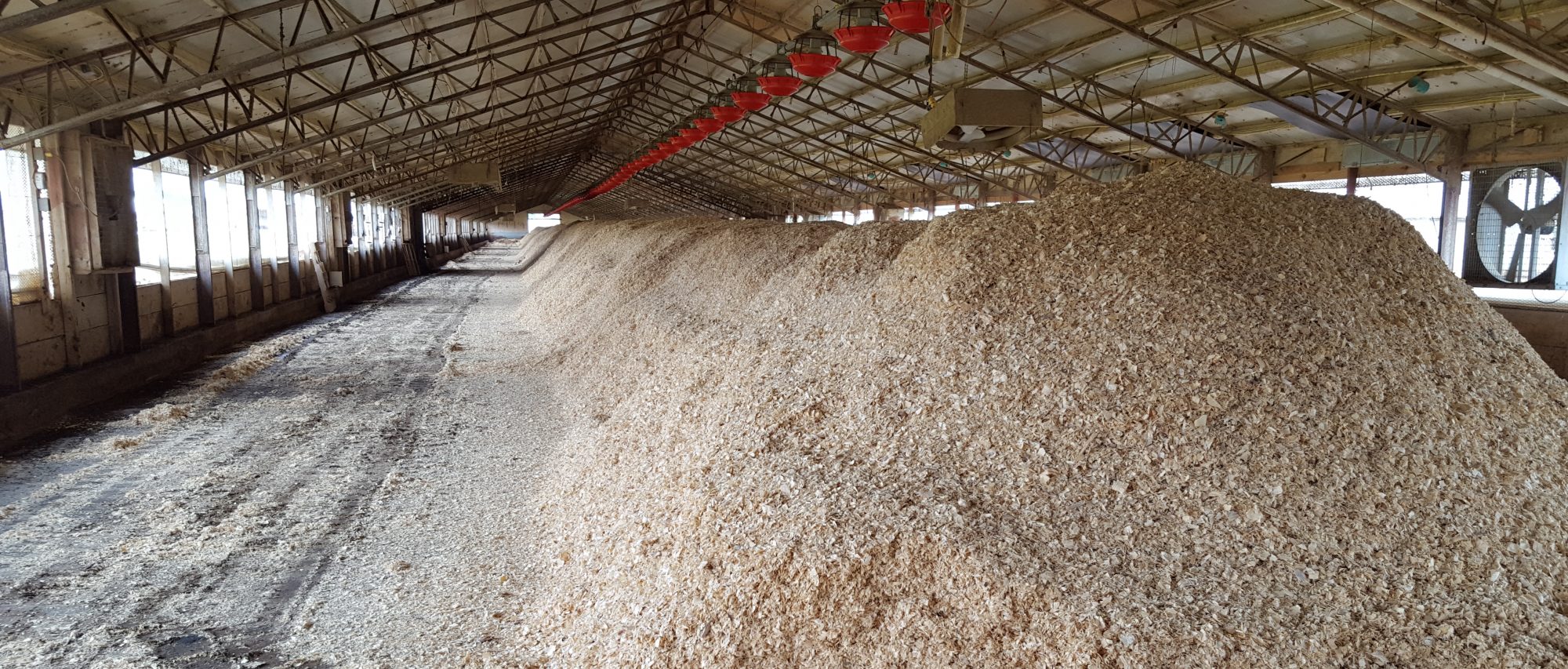
Manure is a tremendously valuable nutrient source. Not all the nitrogen (N) in manure is plant-available at land application. Organic N is released into plant-available forms over multiple years. Inorganic N availability depends on the application method and timing, with more plant-available N from manure when injected in the spring than when surface applied in fall. A manure N crediting system was developed in New York in the late 90s that credits N from manure based on manure’s composition and application timing and method. With advances in farm management, the manure that dairy farms are land-applying now may be very different from the manure sources used to develop that crediting system. The Value of Manure project was initiated by the New York On-Farm Research Partnership in 2022 to update New York’s manure crediting system. Over multiple years, the project evaluates different manure sources, application methods, and timings that commercial farms now use. Additionally, we are documenting the impact of manure on yield beyond what can be obtained with inorganic fertilizer only.
What Did We Do?
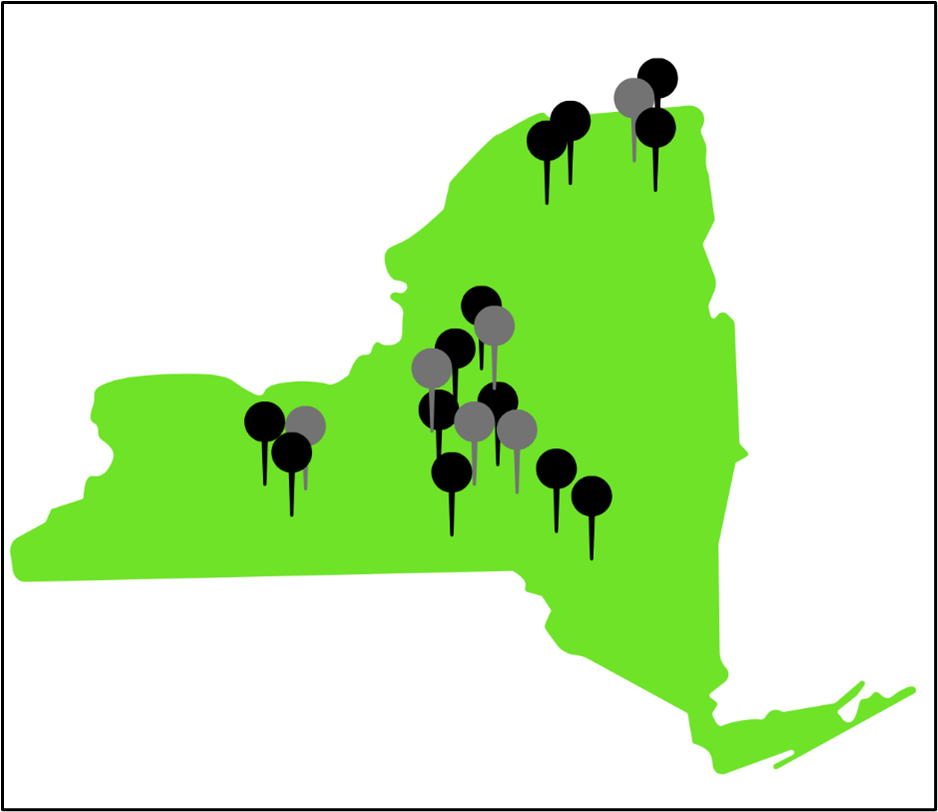
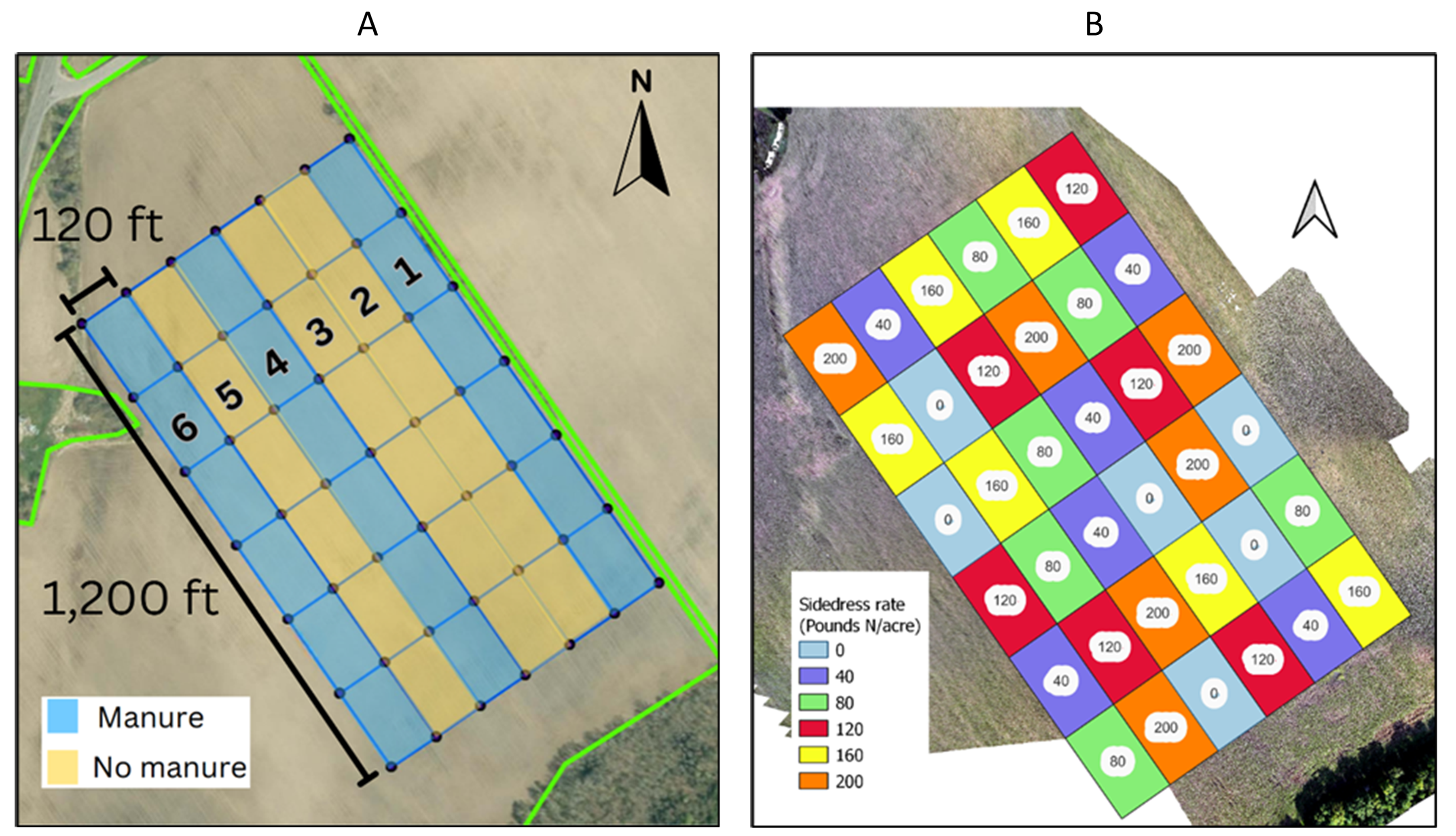
Nineteen trials were implemented on commercially farmed corn fields across New York between 2022 and 2024 (Figure 1). Each trial had three strips that received manure and three that did not, for a total of six strips per trial (Figure 2a). Five “carryover” trials received manure in the spring of year 1, and we tested manure N and yield benefits in the second year after application. Manure was applied and tested in the same year in all the other trials. Soil type, dairy manure type (digestate, separated liquids, untreated, etc.), application rate, and application methods (broadcasted, injected, etc.) varied across trials (see our “What’s Cropping Up?” extension articles in the Additional Information section for more details).
When corn was at the V4-V6 stage each strip was divided into six sub-strips (Figure 2b), and subplots were sidedressed at a rate usually ranging from 0 to 200 pounds N/acre. Sidedress rates were trial-specific, based on the expected N requirement of each field according to the Nitrogen Guidelines for Field Crops in New York. In each trial, we measured manure nutrient composition, general soil fertility, Pre-Sidedress Nitrate Test (PSNT), Corn Stalk Nitrate Test (CSNT), yield, and forage quality.
What Have We Learned?
In the three years of the project, we have documented how manure offsets fertilizer needs and “bumps” yields. Yield responses to manure and fertilizer N vary by location and year, influenced by field past management (manure history, crop rotation, etc.) and weather.
-
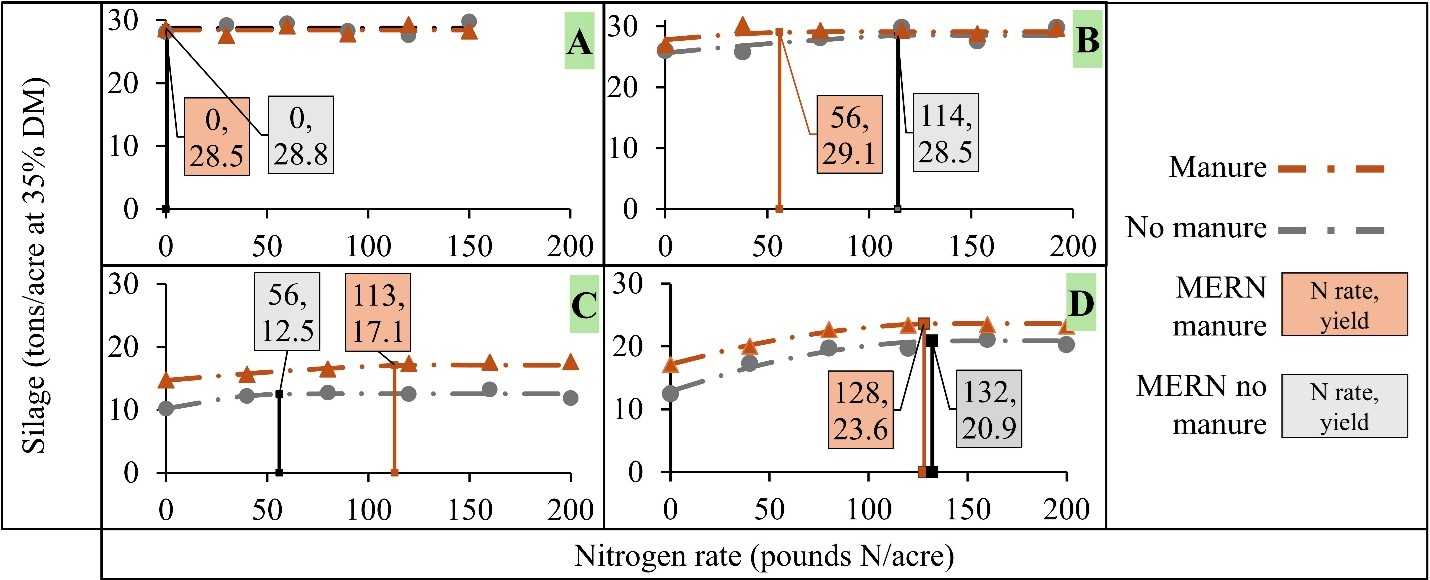
- We observed no yield response to manure or sidedress N application in three trials (Figure 3A, Table 1 trial A). That was likely due to high N credits from past manure applications. Yet those trials were among the highest-yielding ones and had excessive CSNT results.
- At the Most Economical Rate of N (MERN, the N rate that maximizes economic return), manure replaced inorganic N fertilizer in six trials by lowering sidedress fertilizer needs (Figure 3B, Table 1 trial B). In the manure strips for these trials, yields at MERN were higher than the yields at the MERN of the no-manure plots.
- In three trials manure applications increased yields to such elevated levels (2.3 to 4.6 tons/acre), that it also increased the crop’s need for fertilizer N (Figure 3C, Table 1 trial C).
- Significant yield bumps due to manure application were documented in fourteen trials. These yield bumps were also present in all five “carry-over” trials, where we saw that manure applied in year 1 benefited yields in the second year after application (Figure 3D, the carryover study of Figure 3C trial, Table 1 trial D).
| Trial | No manure MERN | Manure MERN | Manure-induced yield increase |
| ————- pounds N/acre ————- | tons/acre | ||
| A | 0 | 0 | 0 |
| B | 114 | 56 | 0.6 |
| C | 56 | 113 | 4.6 |
| D * | 132 | 128 | 2.7 |
| *Note: Trial D was a carryover study where manure was applied in the spring of 2023 and we tested its value for 2024 corn. | |||
Future Plans
To re-evaluate the current N crediting system and learn how to predict and take into account yield bumps, the Value of Manure project requires the addition of more trials beyond the nineteen trials completed so far. Thus, the Value of Manure Project will continue in 2025. We will be testing additional manure types and application methods in various soil types and weather conditions and follow up with several sites to determine carryover benefits into the third year after application.
Authors
Presenting author
Juan Carlos Ramos Tanchez, On-Farm Research Coordinator, Nutrient Management Spear Program, Cornell University
Corresponding author (name, title, affiliation)
Quirine M. Ketterings, Professor, Cornell University, qmk2@cornell.edu
Additional authors
Kirsten Workman, Nutrient Management and Environmental Sustainability Specialist, PRO-DAIRY and Nutrient Management Spear Program, Cornell University; Carlos Irias, Master Student, Nutrient Management Spear Program, Cornell University.
Additional Information
-
- Project website: http://nmsp.cals.cornell.edu/NYOnFarmResearchPartnership/Value_of_Manure.html
- 2024 results: https://blogs.cornell.edu/whatscroppingup/2025/03/04/manure-continues-to-offset-nitrogen-fertilizer-needs-and-increase-corn-silage-and-grain-yields-value-of-manure-project-2024-update/
- 2023 results: https://blogs.cornell.edu/whatscroppingup/2024/03/28/manure-can-offset-nitrogen-fertilizer-needs-and-increase-corn-silage-yield-value-of-manure-project-2023-update/
- 2022 results: https://blogs.cornell.edu/whatscroppingup/2023/02/15/manure-can-offset-nitrogen-fertilizer-needs-and-increase-corn-silage-yield-value-of-manure-project-2022-update/
Acknowledgements
We thank the farms participating in the project and their collaborators for their help in establishing and maintaining each trial location, and for providing valuable feedback on the findings. This project has been funded by Northern New York Agricultural Development Program, New York Farm Viability Institute, New York Department of Environmental Conservation, New York Department of Agriculture and Markets, Dairy Management Inc., and the Foundation for Food & Agricultural Research.
The authors are solely responsible for the content of these proceedings. The technical information does not necessarily reflect the official position of the sponsoring agencies or institutions represented by planning committee members, and inclusion and distribution herein does not constitute an endorsement of views expressed by the same. Printed materials included herein are not refereed publications. Citations should appear as follows. EXAMPLE: Authors. 2025. Title of presentation. Waste to Worth. Boise, ID. April 7–11, 2025. URL of this page. Accessed on: today’s date.