
Evaluation of a Solid-Liquid Manure Separation Barn

Proceedings Home W2W Home w2w17 logo

Purpose

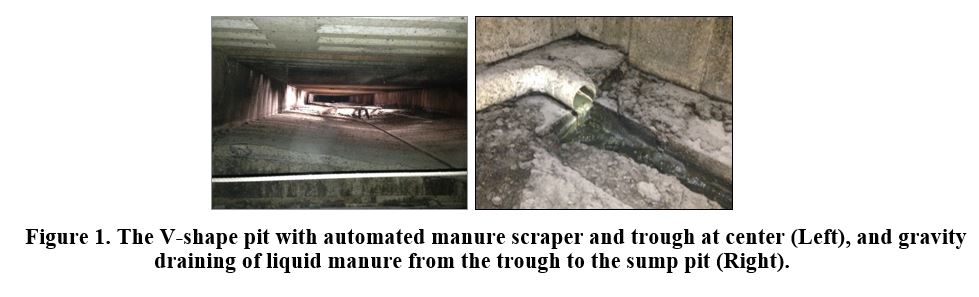
This paper documents an on-going evaluation of an existing, full-scale solid/liquid separator barn for the potential of improved manure nutrient conservation and management, water recycling, including cost and handling implications. The barn has V-shaped pit floor to drain liquid manure, and automated scrapers to collect solid manure frequently. The finishing barn was built to improve indoor air quality, and improve manure handling and land application of nutrients.

What did we do?

  1. Collected monthly manure samples (both solid and liquid manure samples) at the commercial barn starting in September, 2016. The collected samples were analyzed for important manure nutrients, pH, and moisture content.
  2. Monitored daily liquid manure production by measuring the water level fluctuation in the receiving pit, using a liquid pressure data logger (U20L-04, HOBO Water Level, Onset Computer Corporation, Bourne, MA). A new pressure gauge with two sensors was then added to allow simultaneous measurement of atmospheric pressure to improve accuracy.
  3. Monitored accumulation of solid manure, by measuring dimensions of the manure pile during each sampling event. A camera was purchased and installed at the storage shed to take hourly photos of the storage pile.
  4. Conducted filtration pilot tests using water and salty water and a bench-scale cross-flow treatment system, capable of various filtration options including reverse osmosis.
  5. Conducted settling/pre-treatment tests of the liquid manure samples, by storing liquid manure in individual jars and periodically characterizing settling of manure solids and duration needed before the high-pressure filtration.Figure 1. The V-shape pit with automated manure scraper and trough at center (Left), and gravity draining of liquid manure from the trough to the sump pit (Right).

What have we learned?

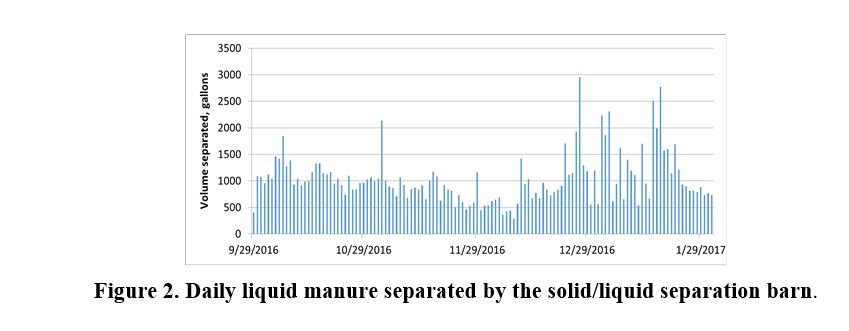
Battery-operated gauges were able to closely monitor the water level, liquid manure flow, and operation of the pump, and the dual-sensor gauge was much easier in data analysis and downloading. The daily liquid manure level fluctuated significantly during the first six months of monitoring, which could be due to differences in animal size and occurrence of barn washing. Solid manure samples collected in the current project had higher moisture contents than the four samples collected in 2014, meaning the solid/liquid separation barn was not as effective in separating solids and liquids as in 2014.  But, the settling tests suggest a settling basin could be designed to pre-treat the liquid manure stream before a water extraction process.

Figure 2. Daily liquid manure separated by the solid/liquid separation barn

Future Plan

A year’s worth of data will be collected, and manure nutrient flows of the solid and liquid portions will be quantified. The team will also characterize and compare the barn and management costs (relative to a typical deep-pit barn), practicality, and costs of the use of filtration and reverse osmosis. Will provide pork producers information on potential for the solid/liquid separation barn and filtration process to improve nutrient management, land application, and water conservation.

Corresponding author, title, and affiliation

Teng Lim, Associate Professor, Agricultural Systems Management, University of Missouri

limt@missouri.edu

Other authors

Joshua Brown, Graduate Research Assistant; and Joseph M. Zulovich, Assistant Professor; Agricultural Systems Management, University of Missouri.

Additional information

Teng Lim, limt@missouri.edu

Acknowledgements

The authors would like to thank the National Pork Board and University of Missouri Extension for financial support, and the farm management team for their help with the project.

Phosphorus Recovery from Anaerobic Swine Lagoon Sludge Using the Quick Wash Process

Proceedings Home W2W Home w2w17 logo

Purpose

Long term and significant accumulation of sludge in anaerobic swine lagoons reduces its storage volume and ability to treat waste. Usually, excess accumulation of lagoon sludge is removed using pump or dredge. The dredged sludge is then land applied at agronomic rates according to its nutrient content.

The accumulation of phosphorus (P) in the sludge requires the largest area of land application based on crop agronomic requirements. Therefore, nutrient management plans may limit application to crop or pastureland near the animal facility to avoid P build up in excess of soil and crop assimilative capacities. Although dewatered sludge can be moved off the farm, transportation becomes less economical with increasing distances. An option is to extract and recover P in a concentrated form for its economical transfer to P-deficient croplands, for use as fertilizer.

What did we do?

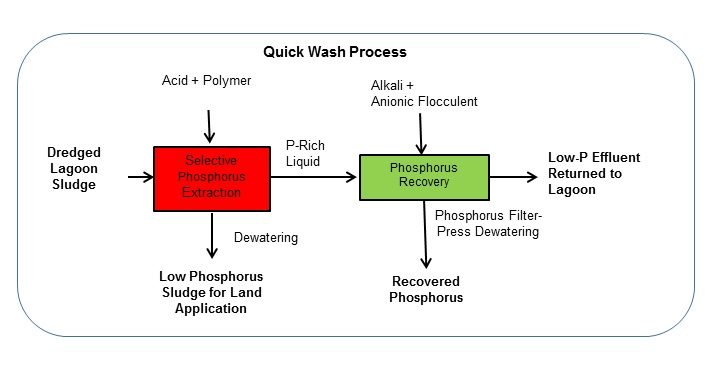
A patented treatment process, called Quick Wash (QW), developed by USDA-ARS for extraction and recovery of P from animal manure solids was tested for recovery of P from anaerobic swine lagoon sludge. With the QW process,Chart of Quick Wash Process P was extracted in solution from dredged sludge by mixing with sulfuric acid prior to dewatering using polymer enhanced mechanical solid-liquid separation. After that, P was recovered by addition of liquid lime and an anionic flocculent to the separated liquid extract to form a calcium-containing P precipitate. The QW process generated two solid products: 1) sludge solids low in P; and 2) a concentrated P material.

What have we learned?

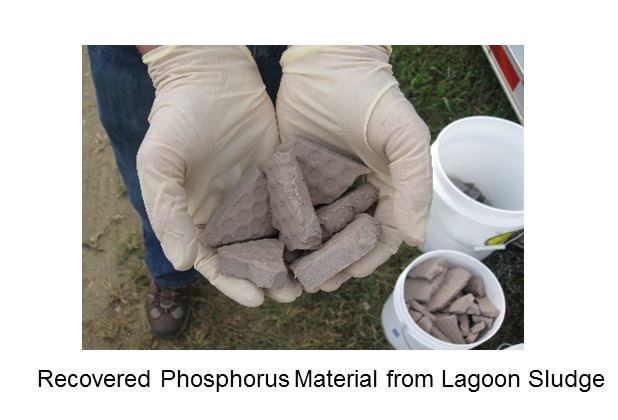
Picture of recovered phophorus material from lagoon sludge

While most of the nitrogen and carbon was left in the washed sludge solids, the QW process extracted and recovered as much as 90 % of the P from sludge. From results of a pilot field test, the P grade of the recovered phosphate was in the range of 24.0% – 30.5 % P2O5. The inclusion of this process in a lagoon sludge management plan offers producers an opportunity to locally land-apply the low-P sludge as a carbon-rich soil amendment and recover P as a valuable product for export from the farm.

Future Plans

USDA granted an exclusive license of the invention to Renewable Nutrients, LLC (Pinehurst, NC) to commercialize in the U.S the process for P recovery from animal and municipal waste streams. Renewable Nutrients is developping commercialization plans for the Quick Wash process that will include the operating and equipment costs of phosphorus recovery from dredged lagoon sludge.

Corresponding author, title, and affiliation

Ariel A. Szogi, Research Leader, USDA-ARS Coastal Plains Soil, Water, and Plant Research Center, Florence, SC.

Corresponding author email

ariel.szogi@ars.usda.gov

Other authors

Matias B. Vanotti; and Paul D. Shumaker – USDA-ARS Coastal Plains Soil, Water, and Plant Research Center, Florence, SC.

Additional information

https://www.renewablenutrients.com/

Acknowledgements

This work is part of USDA-ARS National Program 212; ARS Project 6082-12630-001-00D “Improvement of Soil Management Practices and Manure Treatment/Handling Systems of the Southern Coastal Plain.”

A Quantitative Assessment of Beneficial Management Practices to Reduce Carbon and Reactive Nitrogen Footprints of Dairy Farms in the Great Lakes Region

w2w17 LogoProceedings Home | W2W Home 

Purpose 

Assessing and improving the sustainability of dairy production is essential to secure future food production. Implementation of Beneficial Management Practices (BMPs) can reduce carbon and reactive nitrogen footprints of dairy farms. BMPs can and have been developed for different farm components, including feed, manure management and field cultivation practices. It is practically and economically infeasible to empirically test all combinations of BMPs at a whole farm scale. We therefore use whole-farm process-based models to assess the impact of several Beneficial Management Practices (BMPs) on carbon and reactive nitrogen footprints of dairy farms in the Great Lakes region. Specifically the aim of this study is to evaluate the influence of Beneficial Management Practices (BMPs) on carbon, reactive nitrogen and phosphorus footprints of dairy farms in the Great Lakes region.

What did we do? 

1. Baseline farms

We developed two baseline model farms, a small 150 cow herd farm and a large 1500 cow herd farm, that are thought to be representative for current dairy farming practices in the Great Lakes region, particularly Wisconsin and New York State (Table 1). The two baseline dairy farms were developed based on individual team members’ expertise and a consultation with external experts (Dane County Conservationists, Madison, Wisconsin). For the 1500 cow farm, the baseline scenario was partly based on a previously-studied commercial dairy farm in NY state. Since this commercial dairy farm already employs some BMPs (e.g. anaerobic digestion as BMP in manure management), the farm was ‘downgraded’ to derive the baseline.

Table 1. Description of the baseline farms

2. Beneficial Management Practices

Farm-specific BMPs were developed for three farm components, i.e. “Feed”, “Manure Management & Storage” and “Field management”. These BMPS were developed based on expert judgement and are expected or known to reduce whole-farm GWPs.

To ensure a meaningful integration of BMPs and a consistent comparison of whole-farm BMPs to the baseline and to each other, we used the following set of rules (per farm type): i) Total cultivated area was fixed (areas of individual crops can vary per scenario); ii) Herd size was fixed; iii) Milk production was allowed to float, however, only if the production increased (no decreases in milk production); iv) Purchases of crops and protein mixes were minimized as far as possible.

Table 2. Individual BMPs for the 1500 and 150 cow farm

3. Process model simulation

The Integrated Farm System Model (IFSM4.3) was used to simulate the two baseline farms (i.e. 1500 cow farm in NY and 150 cow farm in WI) and all the individual BMPs. IFSM was used as a baseline model. The other process-based models, that is DNDC, APEX and CNCPS, were used to check IFSM predictions.

4.Whole-farm mitigation strategy

The individual BMPs were analyzed in terms of potential reduction in carbon and reactive nitrogen footprint. The best performing individual BMPs were combined into a whole-farm mitigation strategy and this whole-farm mitigation strategy was subsequently modeled in IFSM.

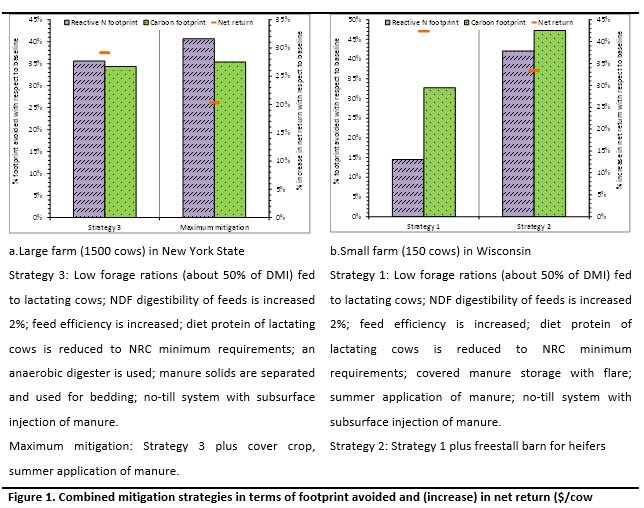
Figure 1. Combined mitigation strategies in terms of footprint avoided and (increase) in net return ($/cow

What have we learned? 

A comparison of model simulations of feed BMPs to the baseline shows that an integrated feed BMP (low forage, corn silage:alfalfa 3:1, ~2% NDF digestibility, reduced protein 14%, added fat, increased feed efficiency) can potentially reduce carbon and reactive nitrogen footprints with ~20% and ~24%, respectively, while remaining cost effective (18% increase in net return in $/cow), for both farm sizes.

For the small farm, replacing the bedded-pack barn with a free stall barn for the heifers, substantially reduces the carbon and the reactive nitrogen footprint with 12% and 11%, respectively. The manure management BMP ‘sealed with flare’ provides the largest potential reduction in carbon footprint for both farms (11% – 20%), primarily through a mitigation of CH4 emissions from manure storage.

Field management BMPs only provide a minimal reduction in carbon footprint (~3%), however, the field BMP ‘no-till with injection’ substantially reduces the reactive N footprint (~16%) for both farm sizes. This reduction is primarily achieved by a reduction in ammonia volatilization.

Based on the results for the individual BMPs, two combined whole-farm mitigation strategies were developed per farm and simulated in IFSM (Figure 1). For both the large farm and the small farm, the integrated whole-farm BMPs show an overall potential to reduce carbon and reactive nitrogen footprints with 33% to 37% and 15% to 42% respectively, simultaneously increasing milk production and the net return per cow with 10% to 12% and 20% to 42%, respectively.

This analysis suggests that BMPs can be applied to reduce greenhouse gas emissions and reactive nitrogen losses without sacrificing productivity or profit to the farmer.

Future Plans    

Future research plans include a further comparison and analysis of IFSM predictions with predictions from other process models, including CNCPS, APEX, and ManureDNDC. In addition, we will assess the impact of climate change on the reactive nitrogen and carbon footprint of the baseline farms and the developed whole-farm mitigation strategies.

Corresponding author, title, and affiliation         

Karin Veltman, PhD, University of Michigan, Ann Arbor

Corresponding author email    

veltmank@umich.edu

Other authors   

Alan Rotz, Joyce Cooper, Larry Chase, Richard Gaillard, Pete Ingraham, R. César Izaurralde, Curtis D. Jones, William Salas, Nick Stoddart, Greg Thoma, Peter Vadas, Olivier Jolliet

Additional information                

Veltman et al. (2017) Comparison of process-based models to quantify nutrient flows and greenhouse gas emissions associated with milk production. Agricultural Ecosystems and Environment, 237, 31–44

DairyCAP project, www.sustainabledairy.org, aims to reduce the life cycle environmental impact of dairy production systems in the US.

Acknowledgements       

This material is based upon work that is supported by the National Institute of Food and Agriculture, U.S. Department of Agriculture, under award number 2013-68002-20525. Any opinions, findings, conclusions, or recommendations expressed in this publication are those of the author(s) and do not necessarily reflect the view of the U.S. Department of Agriculture.

The authors are solely responsible for the content of these proceedings. The technical information does not necessarily reflect the official position of the sponsoring agencies or institutions represented by planning committee members, and inclusion and distribution herein does not constitute an endorsement of views expressed by the same. Printed materials included herein are not refereed publications. Citations should appear as follows. EXAMPLE: Authors. 2017. Title of presentation. Waste to Worth: Spreading Science and Solutions. Cary, NC. April 18-21, 2017. URL of this page. Accessed on: today’s date.

Assessment of Coordinated Anaerobic Digestion of Dairy Manure


Proceedings Home | W2W Home w2w17 logo

Purpose            

Improving the economic feasibility of anaerobic digestion projects for processing dairy manure.

What did we do? 

We completed a study that evaluated the economics of dairy manure granulation as means to export phosphorus from P-sensitive watersheds. To achieve this goal we developed a techno-economic optimization model that considers all dairy farms within the watershed simultaneously to determine the minimum break-even price for the granulated manure.

A second study was developed to assess the economics of anaerobic digestion using a techno-economic optimization model. We incorporated different revenue sources (power sale, methane destruction credits, renewable energy certificates (RECs) and tipping fee (if co-substrate is available). The model evaluated the project feasibility over ranges of values for technical and economic parameters to quantify the project resilience to uncertainty in process conditions.

What have we learned? 

The results from the first study indicated that multi-farm participation can significantly improve feasibility and overall economics of manure granulation. Herd sizes were found to be a critical parameter in deciding whether a farm can economically participate in coordinated management. For manure granulation projects, liquid-solid separation followed by transportation of separated solids was always more economical than transporting raw manure from satellite farm to central processing facility. In the second study, electricity sale price was found to be the key parameter that determines the feasibility of anaerobic digesters. The hub-spoke configuration, where a large central farm hosts the digester and smaller surrounding farms contribute to it was found to be the most favorable arrangement. The size of the hub farm was critical to the feasibility of the project. Similarly, transportation distance was a critical factor that constrained the extent of cooperative digesters.

Future Plans    

The information generated from these studies is being written into peer-review publications and factsheets to share insights of collaborative manure management with a wider audience.We are currently expanding the model by adding the option for manure transportation via pipelines. Furthermore, we are also incorporating additional biogas utilization technologies,i.e., natural gas sale over pipelines and also the utilization of power/heat on-site in manure upgrading and processing.

Corresponding author, title, and affiliation        

Troy M. Runge, Associate Professor, University of Wisconsin-Madison

Corresponding author email    

trunge@wisc.edu

Other authors   

Mahmoud A. Sharara, Rebecca Larson

Additional information

1. http://www.are.wisc.edu/

2. Sharara, Mahmoud, Apoorva Sampat, Laura W. Good, Amanda S. Smith, Pamela Porter, Victor M. Zavala, Rebecca Larson, and Troy Runge. “Spatially explicit methodology for coordinated manure management in shared watersheds.” Journal of Environmental Management 192 (2017): 48-56.

3. Sharara, Mahmoud, Qiang Yang, Thomas L. Cox, and Troy Runge. “Techno-economic assessment of dairy manure granulation.” In 2016 ASABE Annual International Meeting, p. 1. American Society of Agricultural and Biological Engineers, 2016.

Acknowledgements       

This work is based on research supported by the USDA National Institute of Food and Agriculture for its financial support (USDANIFABRDI Grant No. 2012-10006-19423) and funding from Dane County, Wisconsin under Award Number 12486.

Gypsum as a Best Management Practice for Reducing P loss from Agricultural Fields


Proceedings Home W2W Home w2w17 logo

Purpose

Phosphorus loss from agricultural fields fertilized with poultry litter may contribute to eutrophication of nearby rivers, lakes, and streams. It has been suggested that gypsum can be used as a soil amendment to reduce P loss from these fields. Also, a new USDA-NRCS National Conservation Practice Standard 333 “Amending Soil Properties with Gypsum Products” has recently been created to promote conservation through gypsum use.

What Did We Do?

Field studies were conducted to evaluate the influence of gypsum on reducing P loss from both hayfields and row crops fertilized with poultry litter. Simulated rainfall was created to evaluate the effectiveness of gypsum on reducing P loss in successive runoff events occurring after poultry litter applications during the growing season.

What Have We Learned?

Results showed that gypsum can reduce the loss of dissolved P with surface water runoff from both hayfields and row crop systems. In addition, applying gypsum to grass buffer strips at the edge of an agricultural field could also be an effective management practice for P loss reduction. Gypsum reduced dissolved P loss in successive runoff events after poultry litter application regardless of timing, suggesting that the effect is persistent and will not diminish over a growing season. These findings suggest that gypsum use as a soil amendment has promise for reducing P loss from agricultural fields.   

Future Plans

Future plans are to determine the most effective gypsum rate needed to reduce P loss from both row crop and hayfields systems.

Corresponding author (name, title, affiliation)

Dexter B. Watts, Research Soil Scientist, USDA-Agricultural Research Service located at the National Soil Dynamics Laboratory in Auburn, AL

Corresponding author email address  

Dexter.Watts@ars.usda.gov

Other Authors 

H. Allen Torbert, Research Soil Science, USDA-Agricultural Research Service located at the National Soil Dynamics Laboratory in Auburn, AL.

Additional Information

Watts, D.B., J.B. Hess, S.F. Biligili, H.A. Torbert, J.L. Sibley, and J.D. Davis. 2017. Flue gas desulfurization gypsum; Its effectiveness as an alternative bedding material for broiler production. Journal of Applied Poultry Research. 26:50-59.

Watts, D.B., G.B. Runion, and K.S, Balkcom. 2017. Nitrogen fertilizer sources and tillage effects on cotton growth, yield and fiber quality. Field Crops Research. 201:184-191.

Watts, D.B., and H.A. Torbert. 2017. Influence of three application yearly application yearly application of FGD gypsum and poultry litter on surface water runoff. Soil Science. 182:18-27.

Torbert, H.A., R.L. Chaney, and D.B. Watts. 2017. Potential adherence of FGD gypsum to forage as a consideration for excessive ingestion by ruminants. Journal of Environmental Quality. doi:10.2134/jeq2016.07.0279 (In Press).

Watts, D.B., and H.A. Torbert. 2016. Influence of FGD gypsum on reducing soluble P in successive runoff events from a Coastal Plain Bermudagrass Pasture. Journal of Environmental Quality. 45:1071-1079.

Watts, D.B. and W.A. Dick. 2014. Sustainable uses of FGD gypsum in agricultural Systems. J. Environ. Qual. 43:253-262.

Chen, L., D. Kost, Y. Tian, X. Guo, D.B. Watts, D. Norton, R.P. Wolkowski, and W.A. Dick. 2014. Effects of gypsum on heavy metals in soils and earthworms. J. Environ. Qual. 43:263-272.

Torbert, H.A. and D.B. Watts. 2014. Impact of FGD Gypsum application on water quality in a Coastal Plain soil. J.  Environ. Qual. 43:273-280.

Watts, D.B. H.A. Torbert, and C.C. Mitchell. 2013. Gypsum use to reduce P loss for agricultural fields. Alabama Experiment Station Publication. Bulletin no: 680 availiable at http://aurora.auburn.edu/bitstream/handle/11200/44267/Gypsum%20Bulletin_2013.pdf?sequence=2

             Watts, D.B. and H.A. Torbert. 2009. Impact of gypsum applied to buffer strips on reducing
              soluble P in surface water runoff. J. Envron. Qual. 38:1511-1517.

The authors are solely responsible for the content of these proceedings. The technical information does not necessarily reflect the official position of the sponsoring agencies or institutions represented by planning committee members, and inclusion and distribution herein does not constitute an endorsement of views expressed by the same. Printed materials included herein are not refereed publications. Citations should appear as follows. EXAMPLE: Authors. 2017. Title of presentation. Waste to Worth: Spreading Science and Solutions. Cary, NC. April 18-21, 2017. URL of this page. Accessed on: today’s date.

Gas-Permeable Membrane Selection Methodology for Wastewater Treatment and Resource Recovery


Proceedings Home W2W Home w2w17 logo

Purpose 

The use of gas-permeable membranes in wastewater treatment and resource recovery has become an increasingly prevalent research topic. Many of the membranes used for such purposes are expanded PTFE (ePTFE or Teflon), but the specifications, characteristics, and performance under certain conditions of these materials vary widely. In spite of these property differences, we found no documented process or suggested membrane specifications by which one membrane product can be selected over another for a given removal or recovery goal in wastewater. Research we reviewed in this area mostly describe examples of different applications.

Collection of ammonia from waste streams, especially with high concentrations such as animal manures, offers several benefits such as reduction of air pollution precursors, prevention of water pollution, and transformation into higher-value products.

What did we do? 

Tests were selected to evaluate the performance and durability of four different hydrophobic, gas-permeable membranes specific to the application under consideration—ammonia recovery from wastewater—but can be used with slight modification for testing recovery of other compounds of interest.

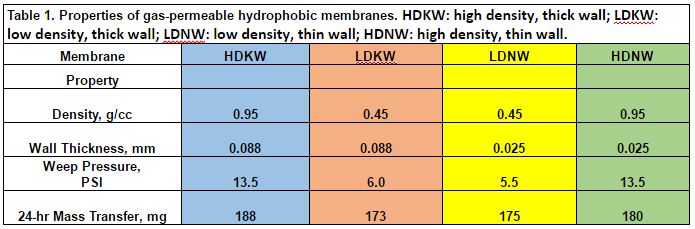
The four Teflon membranes selected differed in material density and wall thicknesses, specifications important for variability in handling, durability, and mass transfer (HDKW: high density, thick wall; LDKW: low density, thick wall; LDNW: low density, thin wall; HDNW: high density, thin wall). Membrane specifications and properties are provided in Table 1. The different membranes were examined in this study spanned across several trials. Experimentation reared data on different membranes’ weep pressure, as well as the airflow rate through the membranes as a function of applied pressure to the membrane. Data were also collected on the rate of transfer of ammonia from the gas phase across the membrane into the aqueous phase over a 24-hour period.

Table 1. Properties of gas-permeable hydrophobic membranes.

I. Weep Pressure Test

The weep pressure is that pressure at which the membrane loses its hydrophobicity and allows liquid to pass. Results are used to estimate the maximum differential pressure the membrane can withstand without compromising membrane integrity. This test of each membrane material was completed in triplicate using prepared sections of each of the four membrane materials. Membranes were first soaked in 0.1 mM sulfuric acid for 24 hours. A section of each membrane material was connected at the end of a column of vinyl tubing and filled with the 0.1 mM H2SO4 solution at a pressure of 0.5 PSI. Pressure was increased by 0.5 psi increments every 24 hours by applying air pressure through a manifold. Pressure was increased until a drop of liquid was found weeping from one or more of the membranes.

II. Air Flow Test

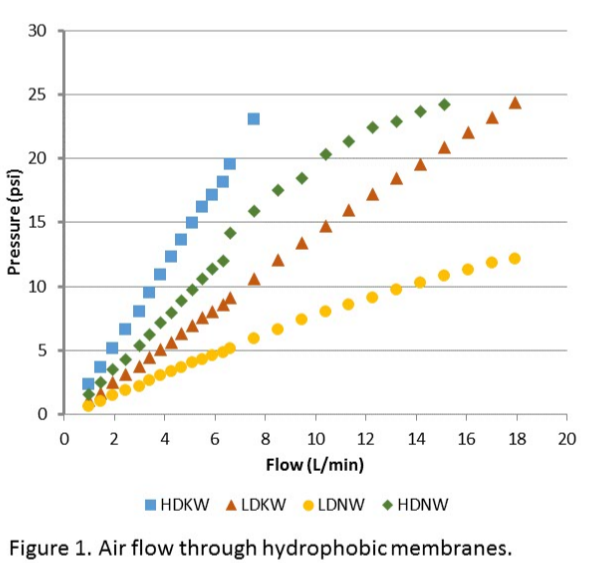
We determined the resistance to airflow through each membrane as an indication of the relative resistance of the various membranes to mass transfer of gas molecules of interest. A section of each of the four materials were connected to a compressed air source through a flow meter and pressure gauge. The pressure was recorded as the airflow rate was increased incrementally to 25 PSI, well past the maximum weeping pressure, or until the flow rate seemed to taper off. The procedure was repeated three times using the same section of each membrane material. The results are shown in Figure 1.

Figure 1. Air flow through hydrophobic membranes

III. Mass Transfer Test (Gas to Liquid Exchange)

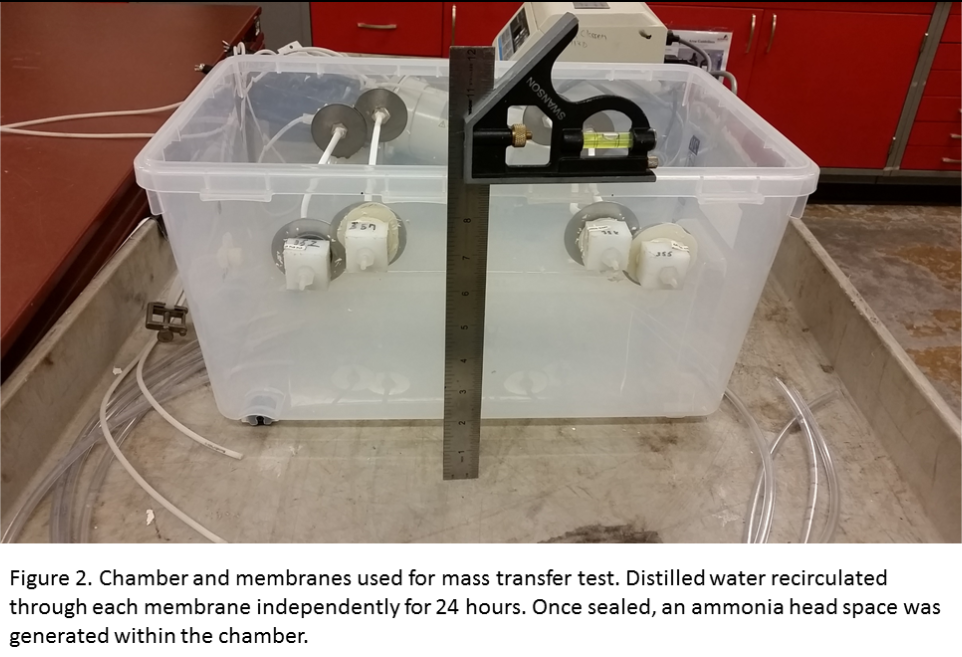
A final test was conducted to estimate if the differences in membrane composition and performance of earlier tests impact the mass transfer of the gas of interest across the membrane. A single section of each of the four membrane materials was installed through bulkhead fittings as shown in Figure 2 into a chamber such that deionized (DI) water could be circulated through each individual membrane while all four membranes were exposed to the same NH3 concentration inside the chamber. NH4Cl was combined with NaOH inside the chamber to produce NH3 gas.

Figure 2. Chamber and membranes used for mass transfer test

What have we learned? 

The results of the mass transfer experiments revealed there are only small differences in ammonia transfer rates among the different membranes, leaving the membrane selection to rely on other results. The weep pressure of the low density membranes was lower than that of the high density membranes but was sufficient to avoid backwards movement of the two fluid phases. The higher airflow rate and lower pressure of the low density thin walled material was the determining factor in selecting this membrane. From these tests, this membrane will survive handling and installation and will provide little resistance to ammonia transfer from wastewater.

Future Plans   

The experiments and conclusions involved in this study are some of the first of their kind for this application, therefore leaving much research to still be done surrounding membrane selection for other material recovery processes. Data gathered in this particular study can serve as a guideline for further research pertaining to optimal membrane characteristics for the recovery of target products from effluent.

Corresponding author, title, and affiliation        

Jacqueline Welles, Undergraduate Research Assistant, Biological and Agricultural Engineering, North Carolina State University

Corresponding author email    

jswelles@ncsu.edu

Other authors   

Elizabeth Gordon, Undergraduate Research Assistant, Biological and Agricultural Engineering, North Carolina State University John J. Classen, Ph.D., Associate Professor, Biological and Agricultural Engineering, North Carolina State University Mark Rice, E

Additional information              

Primary author: Jacqueline Welles – North Carolina State University

Email: jswelles@ncsu.edu

Lead investigator: John Classen, PhD, North Carolina State University

Email: john_classen@ncsu.edu

Acknowledgements       

Funding for this project was provided by NRCS CIG Award Number 69-3A75-12-183. The authors are grateful for the analytical work of the BAE Environmental Analysis Laboratory, Dr. Cong Tu, manager.

An Overview of a USDA Coordinated Agricultural Project on Dairy Production Climate Change Mitigation


Proceedings Home W2W Home w2w17 logo

Purpose           

The purpose of this presentation is to outline the components and products of a USDA coordinated agricultural project focusing on dairy production systems in the Great Lakes region.

What did we do?          

We have conducted research that includes measurement, modeling, and life cycle assessment for dairy production systems to improve sustainability at the farm level.  The largest component of this grant was an assessment of best management practices to reduce greenhouse gas emissions. This project also included developing outreach materials and programs for extension and educational purposes.

What have we learned?             

There are a number of strategies throughout the dairy production system that can reduce greenhouse gas emissions.  There is significant variability in climate, location, dairy system design among other aspects that require different management strategies in order to reduce the net impact of dairy systems to climate change.

Future Plans    

The project will be completed in the near future which includes finalizing modeling and life cycle assessments as well as extension and education materials. Beyond the project lifetime, future plans are to expand access to the models developed for expansion and use by other researchers. In addition, there are ongoing initiatives to educate stakeholders with the information produced from the project.

Corresponding author, title, and affiliation        

Matt Ruark, Associate Professor, University of Wisconsin-Madison

Corresponding author email   

mdruark@wisc.edu

Additional information             

sustainabledairy.org

Acknowledgements

This material is based upon work that is supported by the National Institute of Food and Agriculture, U.S. Department of Agriculture, under award number 2013-68002-20525. Any opinions, findings, conclusions or recommendations expressed in this publication are those of the author(s) and do not necessarily reflect the view of the U.S. Department of Agriculture.

Assessment of Condensed Distillers Solubles (CDS) and Wet Distillers Grains (WDG) as Sources of Phosphorus Fertilizer for Corn and Wheat

Proceedings Home W2W Home w2w17 logo

Purpose

Some farmers in North Dakota are showing growing interest in applying coproducts from ethanol production, as sources of nutrients for crop production, especially corn and wheat. The majority of these coproducts are used as livestock feedstuff, but sometimes, due to a combination of factors, ethanol plants have a surplus of condensed distillers solubles (CDS) and wet distillers grain (WDG). Under those circumstances, the price of CDS and WDG can drop significantly, and due to their nutrient content, it might make financial sense to use them as a source of nutrients for crop production instead of commercial fertilizers. Cognizant of current low market prices of wheat and corn, farmers are seeking effective and less expensive sources of nutrients for their crops. Farmers also like the concept of recycling the nutrients exported in the corn kernels back into the soil in the form of CDS and WDG.

What Did We Do?

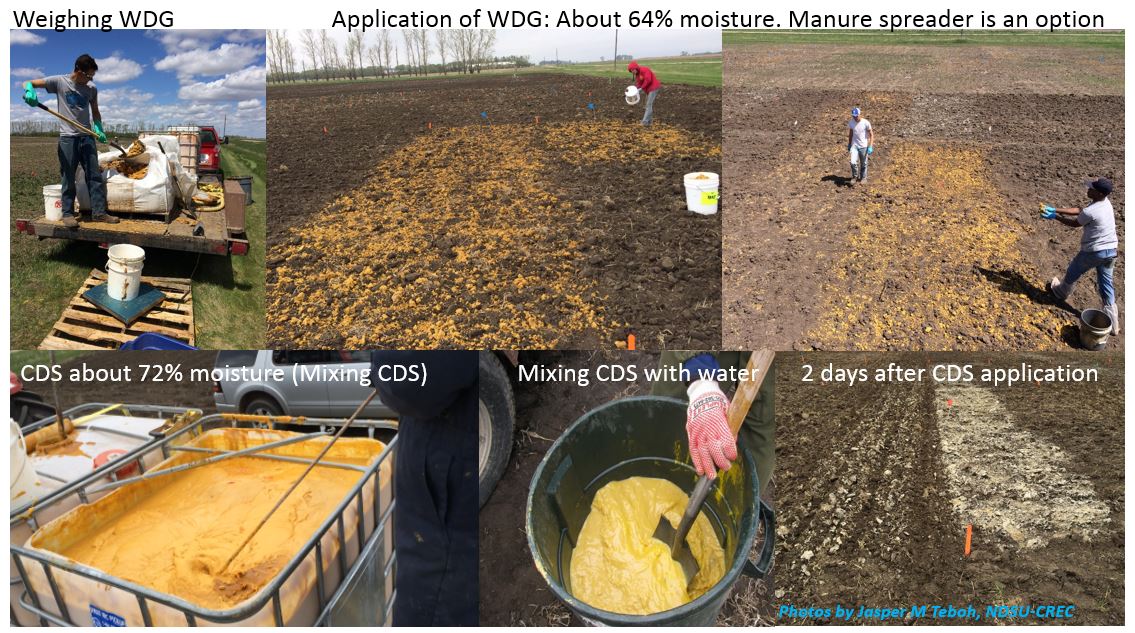
We conducted studies in Carrington (2015 and 2016) and Fairmount (2015), ND. We assessed the impact of CDS and WDG compared to triple super phosphate (TSP) fertilizer as sources of phosphorus (P), on grain yield and quality of corn (2015 and 2016) at rates of 0, 40, 80, 120 lbs P2O5/ac, and wheat (2016) at rates of 0, 40, 80 lbs P2O5/ac. Treatments were surface applied and incorporated. CDS was mixed with water to facilitate application. The check (0 lbs P) and TSP treatments received recommended N as urea.

Slides of weighing, applying, and mixing WDG

What Have We Learned?

In 2015, corn yields from CDS treatments were consistently greater than yields from WDG and TSP at each P level at Carrington. Corn did not respond to P application at Fairmount. In 2016, corn yields were significantly greater for WDG treatments than for CDS and TSP, which produced similar yields. Wheat yields and protein were also significantly higher for WDG compared to TSP. Therefore, CDS and WDG can be valuable sources of P and other nutrients for grain crops in North Dakota.

Future Plans

We will continue assessing the P fertilizer value of CDS and WDG for corn and wheat in 2017. A separate study will assess in-furrow treatments with CDS. Finally, we will assess soil residual effects from CDS and WDG application to soil on subsequent crops, as well as potential economic implications for farmers.

Authors

Jasper M Teboh, Research Soil Scientist, NDSU – Carrington Research Extension Center

Jasper.Teboh@ndsu.edu

Other Authors

Joel Ransom, Extension Agronomist – Cereal Crops, NDSU – Department of Plant Sciences

Szilvia Yuja, Research Soil Specialist, NDSU – Carrington Research Extension Center

J. Paulo Flores, Precision Ag Specialist, NDSU – Carrington Research Extension Center

Additional Information

Please contact me with questions at Jasper.Teboh@ndsu.edu or by phone at 701-652-2951 (Ext 109).

Results from this research were first presented at the ASA/SSSA/CSSA 2016 annual conference in Phoenix and is accessible at:

https://scisoc.confex.com/crops/2016am/webprogram/Paper100533.html

A summary of findings was later presented on the NDSU – Carrington REC blog at

https://www.ag.ndsu.edu/CarringtonREC/center-points/distillers-grains-impacted-yields-of-corn-and-spring-wheat-when-used-as-a-source-of-p

Acknowledgements

The authors are grateful to the North Dakota Corn Council, and North Dakota Agricultural Products Utilization Commission for funding the corn and wheat projects, respectively. Our gratitude also to Tharaldson Ethanol (Casselton, ND) especially Mr. Keith Finney and Mr. Brad Kjar; Mr. Greg LaPlante, Mr. Chad Deplazes (Research Specialist at NDSU), CREC technicians, staff, and students for field support.

The authors are solely responsible for the content of these proceedings. The technical information does not necessarily reflect the official position of the sponsoring agencies or institutions represented by planning committee members, and inclusion and distribution herein does not constitute an endorsement of views expressed by the same. Printed materials included herein are not refereed publications. Citations should appear as follows. EXAMPLE: Authors. 2017. Title of presentation. Waste to Worth: Spreading Science and Solutions. Cary, NC. April 18-21, 2017. URL of this page. Accessed on: today’s date.

The Value of Cover Crops in Dairy Production Systems


Proceedings Home W2W Home w2w17 logo

Purpose           

The purpose of this research was to identify trade-offs among soil erosion, soil health, and crop production when using cover crops with manure application.Continuous corn silage cropping systems in Wisconsin leads to overall removal of N from the system unless manure is applied. However, this cropping system allows for the planting of cover crops or a winter silage crop post harvest, which may lead to increases in soil N over time. Cover crops are valuable in these corn-silage based rotations as they also provide ground cover after harvest and can reduce N leaching after fall manure application. 

What did we do? 

The cropping system investigated was a continuous corn silage system with fall manure application. The experiment was a randomized complete block split-plot design where the whole plot treatments were no cover, rye as a cover (chemically terminated) or as a forage (harvested) crop and the split plot treatment was depth.The objective of this study was to determine the effect of cover cropping on potentially mineralizable nitrogen (PMN) over a growing season using a 7-day anaerobic incubation (2015 and 2016 season), a long-term aerobic incubation (2015 season), and N uptake by corn. 

What have we learned? 

There were no statistical differences in short-term PMN among cover crop treatments at any time point in 2015 or 2016. However, the cover crop treatments led to a yield reduction compared to no cover crop use in both years. Thus, our study showed significant effects of cover cropping on agronomic factors like corn yield and N uptake but these same differences were not measurable in the soil N.

Future Plans    

This work will continue to evaluate the long-term effects of cover crop use on soil health.

Corresponding author, title, and affiliation       

Matthew Ruark, University of Wisconsin-Madison

Corresponding author email 

mdruark@wisc.edu

Other authors   

Jaimie West, Kavya Khrishnan, Kevin Shelley

Additional information          

ruarklab.soils.wisc.edu

extension.soils.wisc.edu

Acknowledgements

This material is based upon work that is supported by the National Institute of Food and Agriculture, U.S. Department of Agriculture, under award number 2013-68002-20525. Any opinions, findings, conclusions or recommendations expressed in this publication are those of the author(s) and do not necessarily reflect the view of the U.S. Department of Agriculture.

The authors are solely responsible for the content of these proceedings. The technical information does not necessarily reflect the official position of the sponsoring agencies or institutions represented by planning committee members, and inclusion and distribution herein does not constitute an endorsement of views expressed by the same. Printed materials included herein are not refereed publications. Citations should appear as follows. EXAMPLE: Authors. 2017. Title of presentation. Waste to Worth: Spreading Science and Solutions. Cary, NC. April 18-21, 2017. URL of this page. Accessed on: today’s date.

Utilization of Woody Biomass and Manure as Agricultural Soil Amendments in Nebraska


Proceedings Home W2W Home w2w17 logo

Purpose 

While Eastern Redcedar are native to Nebraska and much of the Central U.S., the ability of these trees to thrive in many soils and under a broad range of climatic conditions has contributed to their designation as an invasive species. Cedar tree proliferation negatively impacts agriculture by reducing groundwater availability, compromising grazing land, impeding forage production for cattle, and altering surface water flows. Agricultural crop and livestock producers depend on affordable access to water, healthy and productive soils, and quality grazing land to remain profitable. Land treatment practices that return organic matter to soil improve soil health, which in turn positively impacts crop productivity, soil water holding capacity, soil fertility, and grazing land forage quality and productivity. This project is investigating the use of two readily available by-products in Nebraska, livestock manure and cedar tree wood chips,  as amendments on agricultural land to improve soil productivity metrics. The overall goal of this project is to demonstrate a value-added use for woody biomass to offset the cost of tree management activities and encourage landowner management of cedars.

What did we do? 

Crop year 2016 was the first year of the Woody Biomass and Manure Project. Six treatments were applied to 12-m x 10-m plots within cooperators’ fields following the 2015 harvest:

1. woody biomass (WB1), 6 ton/ac

2. woody biomass (WB2), 12 ton/ac

3. woody biomass with liquid N (WBLN), 6 ton/ac

4. woody biomass with swine manure (WBSM), 6 ton/ac

5. woody biomass with cattle manure (WBCM), 6 ton/ac

6. control (Cont), no amendments

Manure and liquid nitrogen treatments received less than 30 lbs ac-1 of N in the fall. The experiment is a completely randomized block design with four replications of each treatment, for a total of 24 plots, at each of the sites. Since the plots were established within existing crop fields, the producers were encouraged to continue their current management strategies. Both sites were irrigated, and fertilizer was applied uniformly across all plots using the pivot throughout the growing season.

Soil was sampled for chemical and biological properties in the spring and fall of 2016 and sent to a commercial lab for analyses. Rye was sampled by hand harvesting 0.25 square feet from four locations within each plot for a total of 1 square foot. Corn was sampled by hand harvesting six plants from each plot. Stand counts were also completed. WATERMARK sensors were installed at three depths (1, 2, and 3 ft) in two replications of four treatments (WBCM, WB1, WB2, Cont) at both sites. Additionally, temperature sensors were installed at a depth of 1 ft. A total of 16 plots were monitored (8 plots per site with 2 replications of 4 treatments).

What have we learned? 

Soil biological and chemical characteristics have not been affected during the first year. There were no differences in the amount or type of soil microbes due to treatment. WBCM and WBLN had greater soil nitrate than WB1 and WBSM early in the spring. Additionally, WBCM had greater soil K than the other treatments. Other than these two instances, there were no differences in organic matter, pH, and macronutrients. However, this is not surprising since measurable changes in soil properties typically occur over many years and manure application rate was relatively low. More importantly, though, is that microbial populations were not decreased by the cedar mulch.

Cedar mulch applications did not decrease biomass yield of corn and rye when applied with nitrogen. In fact, in the rye, WBLN had the greatest biomass yields followed by WBCM, WB1, WBSM, and Cont. WB2 had the lowest rye biomass, which was probably due to nitrogen tie-up by the wood chips due to the initially higher C:N ratio. There was no treatment effect for corn biomass or stand counts.

At the site planted to corn at a depth of one foot, the three woody biomass treatments monitored (WB1, WB2, and WBCM) were significantly wetter and cooler than the control from mid-June until mid-July. WBCM was also wetter at a depth of two feet than the control. Unfortunately, due to rodent activity, statistical analyses at the rye site and other times of the growing season are not possible. The differences in soil moisture and temperature are probably due to shading and the physical barrier to evaporation that the wood chips supply. The increased soil moisture under the woody biomass treatments could reduce irrigation.

Future Plans  

In order to apply for competitive funding, we need more supporting data. We are going to increase monitoring of soil moisture and temperature, so that three replications of all six treatments are monitored at both sites. Additionally, a greenhouse study will be conducted to provide water quality data and rate of decomposition of the wood chips.

Corresponding author, title, and affiliation       

Linda Schott, Extension Graduate Research Assistant, University of Nebraska-Lincoln

Corresponding author email   

linda.rae.schott@gmail.com

Other authors   

Amy Schmidt, Assistant Professor, University of Nebraska-Lincoln; Amy Timmerman, Associate Extension Educator, University of Nebraska-Lincoln; Adam Smith, Assistant Forester, Nebraska Forest Service

Additional information               

More information can be found at: manure.unl.edu

Acknowledgements       

This project is funded by the Nebraska Forest Service. We would like to thank the Middle Niobrara Natural Resource District, especially Mike Murphy, Travis Connot, and Zach Peterson, for their assistance to this project. We would also like to thank the Nebraska Forest Service, especially Richard Woollen, Adam Smith, and Heather Nobert, for their assistance to this project. Additionally, this project would not be possible without our two farmer cooperators, Leonard Danielski and Greg Wilke.