Evaluating the Impact of Ammonia Emissions from Equine Operations on the Environment


Proceedings Home W2W Home w2w17 logo

Purpose 

In the United States, animal agriculture is the largest source of ammonia (NH3) emissions that are a major air and water pollutant contributing to eutrophication, soil acidity, and aerosol formation that can impair atmospheric visibility and human health. Ammonia volatilization occurs when excess crude protein (CP) is fed and excreted as urinary nitrogen, primarily as urea. Information regarding NH3 emissions from equine operations is limited. It is generally understood that air quality in stables can adversely affect both horse and human health, however, the effects of different housing systems and nutritional management of horses on air quality have received little investigation.

What did we do? 

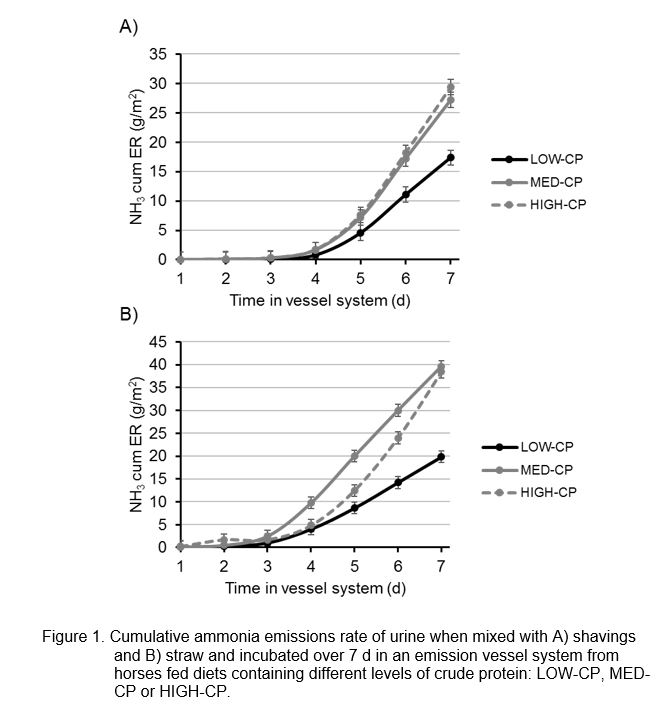
In the first study, 9 mature horses were used in a 3 X 3 replicated Latin square design study to determine the effects of dietary CP concentrations on potential NH3 losses from feces and urine. Horses were fed 3 diets formulated using bahiagrass and Tifton-85 bermudagrass hays and a commercial vitamin mineral supplement. The 3 diets differed in dietary CP concentration and were labelled as: LOW-CP, MED-CP, and HIGH-CP (10.6, 11.5 and 12%, respectively). Total collection of feces and urine was conducted over 3 days. For in-vitro determination of NH3 concentrations, urine samples were pooled and mixed with either wheat straw or wood shavings, while fecal samples were pooled and mixed with wheat straw. Ammonia emission by these samples was measured using a vessel emission system with an airflow rate (2.5 L min-1) at 20°C over a 7-d period. Concentration of NH3 in each vessel was measured using a photoacoustic multi-gas analyzer. Temperature, airflow rate and NH3 concentration in each vessel were used to calculate NH3 emission rate (ER).

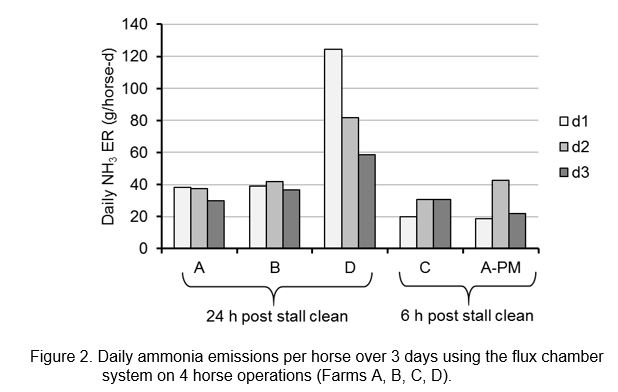
The objective of the second study was to determine air emissions from 4 Mid-Atlantic equine operations as affected by housing type and feeding practices. A questionnaire was administered to respective farm managers to record facility and individual stall dimensions, daily cleaning practices, and feeding practices. Farm A was a University riding stable, Farm B was a University breeding farm, Farm C was a racehorse training facility, and Farm D was a Standardbred breeding facility. At least 4 stalls were chosen in each facility based upon location within barn to quantify NH3 concentrations. Body weight, breed, age, class of horse, exercise schedule, and time spent in the stall were recorded for the horses in the selected stalls. For analysis of NH3 concentration, air samples were collected from stall floors using a dynamic flux chamber and concentrations measured using a photoacoustic NH3 analyzer. To achieve a representation of NH3 emitted from stall surfaces, 5 locations were selected and measurements taken at approximately the same time each day. Temperature, airflow rate and a weighted concentration of NH3 in the flux chamber were used to calculate NH3 emissions.


Figure 1 Cumulative ammonia emissions rate of urine when mixed with A) shavings and B) straw and incubated

Figure 2. Daily ammonia emissions per horse over 3 days using the flux chamber system on 4 horse operations

What have we learned? 

When measuring NH3 concentrations and calculating the ER in-vitro, urinary-N was the main source of NH3 volatilized from equine manure, potentially due to the high urea-N concentration in the urine. Cumulative fecal NH3 emissions ranged from 19.7 to 39.8 mg/m2 and contributed only a small amount in comparison to the NH3 lost from urine. While dietary CP intake did not influence NH3 emissions, cumulative emissions tended to be higher when horses consumed more CP. Urinary NH3 emissions were greater when mixed with wheat straw compared to wood shavings. This study shows there may be a relationship between dietary CP intake and potential NH3 losses from equine urine under laboratory conditions. When estimating NH3 emissions on the 4 equine operations, greater dietary CP intake was associated with increased urinary NH3 volatilization. Daily CP intake ranged from 149-211 % above NRC CP requirement. Estimated NH3 emissions from facilities ranged from 18.5 to 124 g d-1 horse-1 and were similar to emissions previously reported from other large livestock species. Differences in NH3 emissions could be due to several factors including cleaning practices and ventilation rate. These studies provide a better understanding of the impact equine operations are having on atmospheric NH3 levels.

Future Plans    

Future research will aim to quantify NH3 emissions from entire equine operations as well as accounting for diurnal, seasonal and regional fluxes in NH3. In addition, there is interest to determine how protein quality will affect NH3 emissions from horse urine.

Corresponding author, title, and affiliation        

Jessie Weir, University of Florida

Corresponding author email   

jessie23@ufl.edu

Other authors   

Hong Li, Assistant Professor, University of Delaware; Lori K. Warren, Associate Professor, University of Florida; Erica Macon, Graduate Student, Middle Tennessee State University; Carissa Wickens, Extension Equine Specialist, University of Florida

Additional information               

Additional information regarding these projects is available by contacting Jessie Weir (jessie23@ufl.edu), or Carissa Wickens (cwickens@ufl.edu). 

The authors are solely responsible for the content of these proceedings. The technical information does not necessarily reflect the official position of the sponsoring agencies or institutions represented by planning committee members, and inclusion and distribution herein does not constitute an endorsement of views expressed by the same. Printed materials included herein are not refereed publications. Citations should appear as follows. EXAMPLE: Authors. 2017. Title of presentation. Waste to Worth: Spreading Science and Solutions. Cary, NC. April 18-21, 2017. URL of this page. Accessed on: today’s date.

Manure Treatment and Natural Inactivation of Porcine Epidemic Diarrhea Virus in Soils

Proceedings Home W2W Home w2w17 logo

Purpose

The porcine epidemic diarrhea virus (PEDv) outbreak in North America has substantially impacted swine production, causing nearly 100% mortality in infected newborn piglets. Because manure may remain a source of reinfection, proper manure management practices to limit outbreaks need to be developed and evaluated. Two laboratory studies simulating manure pit treatment with increasing amounts of quicklime were conducted to determine PEDv susceptibility to increasing pH. Additionally, two laboratory soil incubation studies contrasting manure liming, multiple soil types, and two antecedent soil moistures were conducted over several months with incubation conditions mimicking the climates in Minnesota, Missouri, and Oklahoma to determine whether current manure application practices reduce the potential for PEDv reinfection via manure-amended soil. Quantitative PCR and live swine bioassays were used to enumerate PED virus and to determine whether manure and soil samples contained infectious PEDv.

What did we do?

Quicklime-Manure Slurry Incubations: An initial short-term manure slurry study was conducted on fresh PEDv-positive manure slurry collected in 2015 from the shallow pit of a commercial swine facility in southeast Nebraska. Manure was sampled prior to treatment (0 h) and then distributed among glass beakers (250 mL) to accommodate triplicates of three treatments: liming to pH 10, liming to pH 12, and unlimed manure. Following pH adjustment, aliquots of each sample were collected at 1 and 10 h, immediately neutralized with 10 mM HCl and stored at -80°C for subsequent analysis. In a second manure slurry incubation, triplicate PEDv-positive manure samples collected from a commercial swine operation in south central Nebraska site in December 2016 were mixed in equal portion (w:v) with distilled water to mimic manure slurry consistency observed in swine production pit storages. Quicklime was added stepwise (0.25 g addition) to each manure slurr! y sample with continuous stirring to gradually increase manure slurry pH. After each addition of quicklime, pH was measured and an aliquot of manure slurry was collected for subsequent quantitative PCR PEDv enumeration and infectivity in a pig bioassay.

Long-term manure and soil incubation. Initial tests determined appropriate initial soil moisture contents (representing a ‘dry’ and ‘moist’ soil condition) and manure:soil ratios (1 g slurry:3 g soil) to best represent the manure:soil within an injection furrow when slurry is injected into soil, and appropriate liming source (ag lime vs. quicklime). PEDv-positive manure slurry collected from a commercial swine operation in southeast Nebraska was divided between two 3-L containers, one for limed treatment (LIME) and the other for the control, or no-lime, treatment (CNL). Quicklime (30 g) was added to one 3 L portion (equivalent to an application of 80 lbs. quicklime per 1000 gallons of slurry) to achieve a final pH of 12. Both treated and untreated slurry stocks were incubated at room temperature for 24 hours. Distilled water was added to two soils, a silty clay loam (pH 7.0) and a loamy fine sand (pH 6.9), to attain 10% and 30% water holding capacity! (dry and moist soil condition). Thirty grams (dry weight) of soil was apportioned to multiple 50 mL screw top conical tubes and a cavity was made in the center of the soil by pressing a 10 mL pipet tip into the soil. Ten mL of slurry (LIME or CNL) were then added to each soil tube via pipet. Four replicate tubes were immediately frozen at -80°C for each combination of soil, moisture, and manure treatment to represent initial soil application (day 0). The tubes were loosely capped and placed into one of three incubators operated independently throughout the trial to simulate soil temperatures between November 1 and May 1 at one of three geographic locations: southern Minnesota, northern Missouri, and central Oklahoma (Figure 1). Twenty replicate tubes were created for each combination of soil, moisture, incubation, and manure treatment, and a set of four tubes were collected for each treatment combination on days 30, 60, 90, 120 and 150 of the incubation and immediately transfer! red to a -80°C freezer for storage.

Molecular detection and quantification of PEDv. Prior to analysis, soil and manure samples were removed from -80°C storage and allowed to thaw at room temperature. The RNA in each sample was extracted using the RNA PowerSoil Total RNA Isolation kit (Mo Bio, Carlsbad, CA). PEDv was detected in samples by reverse transcription and quantitative polymerase chain reaction (RT-qPCR).

Swine bioassay. To confirm that conditions yielding a PCR negative result actually inactivated the PED virus and rendered the manure non-infectious, a live pig bioassay was conducted with the limed and non-limed manure slurry samples from the initial short-term manure slurry incubation (quicklime addition). Fifteen pigs, approximately 21 days old, were sourced from a high-health facility whose dams tested negative for PEDv antibodies and virus by PCR. Piglets were tested for PEDv upon arrival and confirmed negative. Piglets were randomly assigned to individual housing in BSL-2 rooms at the University of Nebraska-Lincoln Life Sciences Annex as follows: control (3 piglets), pH 10 (6 piglets), and pH 12 (6 piglets), and allowed to acclimate for three days. Each pig was then administered a 10-mL oral gavage of manure slurry: three piglets in the control room received one of the three un-limed slurry samples; six piglets in the pH 10 room received one of the six limed (pH 10) sl! urry samp les (three limed for 1 h and three limed for 10 h); and six pigs in the pH 12 room received one of the six limed (pH 12) slurry samples (three limed for 1 h and three limed for 10 h). Piglets were monitored for fecal shedding of PEDv for four days until control animals began to demonstrate clinical signs of PEDv infection, at which time all piglets were humanely euthanized. Fecal swabs, and duodenum, ileum, jejunum, and cecum samples were collected from each animal and fixed in formalin. All fecal and tissue samples were analyzed for the presence of detectable PED virus by immunohistochemistry and PCR.

PEDv, log # g soil

What have we learned?

Manure Slurry Incubation: Manure limed to pH 10 and pH 12 for 1 and 10 h yielded no detectable PEDv RNA. Live swine bioassay results confirmed that these samples were not infective while control samples resulted in PEDv infection of piglets. These results indicate that a final manure slurry pH of 10 (equivalent to 50 lbs. of quicklime added to 1000 gallons manure slurry) is sufficient to reduce PEDv RNA to an undetectable concentration after 1 hour of contact time. All pigs receiving limed manure (pH 10 or 12 maintained for 1 or 10 h) during the live swine bioassay tested negative for PEDv infection while control pigs (un-limed treatment) all tested positive for PEDv infection (Figure 1). The pig bioassay results confirmed that the PCR assay is a reliable predictor for the presence of infectious PEDv in these matrices and that lime addition to achieve pH 10 for just one hour is sufficient to deactivate the virus in stored manure.

Soil Incubations: At the completion of the long-term (150-day) soil incubation, a subset of the frozen samples (LIME and CON soil samples collected on day 0 and 30) was selected for RNA extraction and qPCR analysis. The qPCR results from days 0 and 30 yielded no detectable PEDv RNA in either the limed or un-limed manure-amended soils (Figure 1). Furthermore, manure-amended soils did not differ from soil-only controls even though PEDv RNA was still detectable in the original manure slurry at high concentrations. No differences in PEDv abundance were detected on either day when initial soil moisture (10% vs 30% water holding capacity), incubation condition (MN vs. MO vs. OK), or soil type (silty clay loam and loamy fine sand) were varied. For these soils, the concentration of PEDv in limed or un-limed manure decreased immediately to a non-detectable level. These results indicate that manure-amended soil with pH 6.9 or greater is not a vector for transmission of the PED virus.

A consistent finding from all of the studies is that pH of media (slurry or soil) strongly influences PED virus survival.

Future Plans

Additional studies are underway to identify the lowest pH at which the PED virus is rendered non-infectious in slurry manure.

Corresponding author, title, and affiliation

Amy Millmier Schmidt, Assistant Professor, Departments of Biological Systems Engineering and Animal Science, University of Nebraska – Lincoln

Corresponding author email

aschmidt@unl.edu

Other authors

Stevens, E., A. Schmidt, D. Miller, J.D. Loy and V. Jin

Additional information

Dr. Amy Millmier Schmidt, corresponding author, can also be reach at (402) 472-0877.

Acknowledgements

Funding for this research was provided by the National Pork Board. Gratitude is extended to Ashley Schmit for assistance with laboratory activities and animal care. Special thanks to the Nebraska pork producers who granted access to their farms for collection of PEDv-positive manure.

USDA-NRCS Conservation Practice Standard: Amending Soil Properties with Gypsum Products


Proceedings Home W2W Home w2w17 logo

The US Department of Agriculture National Resource Conservation Service is tasked with providing support to preserve the nation’s natural resources.  They provide farmers with financial and technical assistance to voluntarily put conservation practices on the ground by promoting methods to preserve and improve natural resources and promoting Best Management Practices for environmentally sound farm production.  The NRCS uses technical guides or “Conservation Practice Standards”, which contain technical information about the conservation of soil, water, air, and related plant and animal resources, as the primary scientific references for this process.  Recently, the NRCS has developed a new national conservation practice standard for the use of gypsum to improve soil resources.  This presentation will discuss the specifics of this standard and the particular relevance to animal waste management.

The NRCS national conservation practice standards entitled “Amending Soil Properties with Gypsum Products” has the following definition: using gypsum- (calcium sulfate dihydrate) derived products to change the physical and/or chemical properties of soil.  The standard outlines the use of gypsum for four different purposes, two of which are directly related to animal waste management.  These two purposes are: 1) Improve surface water quality by reducing dissolved phosphorus concentrations in surface runoff and subsurface drainage, and 2) Improve water quality by reducing the potential for pathogens and other contaminants from moving from areas of manure and biosolids application.  The specific guidance provided in the standard for these two purposes will be discussed.  There are also concerns regarding gypsum use in agriculture which are addressed in the standard.  The guidance regarding these concerns will also be discussed.  Within NRCS, the promotion of Best Management Practices for the natural resource conservation is handled on a state by state bases.  This allows each state to focus on the issues that are most important for their specific region.  An update of the current activities of the NRCS for financial and technical assistance in regards to gypsum use will be discussed.    

Author

H. Allen Torbert

The authors are solely responsible for the content of these proceedings. The technical information does not necessarily reflect the official position of the sponsoring agencies or institutions represented by planning committee members, and inclusion and distribution herein does not constitute an endorsement of views expressed by the same. Printed materials included herein are not refereed publications. Citations should appear as follows. EXAMPLE: Authors. 2017. Title of presentation. Waste to Worth: Spreading Science and Solutions. Cary, NC. April 18-21, 2017. URL of this page. Accessed on: today’s date.


Results of Nutrient Recovery System Installed on Large Scale Dairy Operation After 2-years of Operation


Proceedings Home W2W Home w2w17 logo

*Do not make slides downloadable

Purpose 

For centuries, farmers have disposed of manure by simply spreading it on the land. It is a natural fertilizer. Today, that practice is no longer considered the best solution. Field spreading is now understood to contribute to a growing global problem of the pollution of water, soil, and air. Consequently, U.S. dairy farmers face increased fiscal and operational pressure from the progression of ever tightening environmental regulations. Conventional handling of manure also imposes a number of operational challenges (limitations for storage, land application and irrigation, settlement in lagoons, high manure hauling costs, etc.) and typically requires a relatively large land base to allow adequate nutrient management.

In Indiana, a dairy that was daily producing thousands of tons of livestock waste was investigating how technology could capture the valuable nutrients remaining in their cow manure after it had gone through the farm’s anaerobic digestion process. Their goal was to convert the manure/digestate into a nutrient rich cake that could be easier managed and made into fertilizer, and the liquid clean enough to be used unrestricted for land application.

The farm’s key operational deliverables were 1) to reduce the manure’s handling and transportation costs, 2) allow for precision applications of the processed manure as carbon-based fertilizer and 3) allow for re-use of nutrient reduced liquid for field irrigation.

What did we do? 

The dairy farm chose to implement a nutrient recovery technology from Trident Processes LLC. The technology separates the manure/digestate into three fractions: 1) cellulosic fiber, 2) a concentrated cake of nutrient enriched solids, and 3) water with about 1% remaining solids.

Trident’s turn-key system, consisting of different mechanical and chemical components, processes the manure and diverts each separated fraction into their separate spaces. Sensors and programmable controls (PLC) allow for smooth operation, requiring minimal operator attendance. The entire system can be monitored, controlled and diagnosed remotely.

The manure is fed into the system following the digestion process. The initial step is the extraction of the large fiber, which is done via a rotary screen conditioner. The wetted material separates, with the effluent water and fine solids sifting down through the screen while the larger fiber is retained. This step is critical as it ensures the fine particles, which contain the nutrients, are sent down stream for further treatment.

FIBER: The extracted fiber is sent to a screw press for further dewatering. This renders it as a 30% dry cellulosic fiber biomass that is ideal for recycling as cow bedding or other biomass use. Any liquid squeezed from the fiber is diverted to join the fine solids stream.

SOLIDS: The effluent water and solids are sent to a dissolved air flotation (DAF) tank. Polymerization ensures effective flocculation of the feedstock, resulting in a concentration of the nutrient rich particles that float to the surface. The sludge formed on the surface is skimmed off the top and gravity fed into a multi-disc press for second-stage dewatering. The press gently dewaters and thickens the recovered solid/nutrient sludge into a 25% solids, nutrient rich cake.

WATER: The final effluent water, now nutrient reduced, contains less than 1.2% solids and is sent to the lagoon for storage. The water is then reused for irrigation through efficient pivot systems or as operational water on the farm.

What have we learned? 

By implementing Trident’s Nutrient Recovery System, the farms’ objectives have been met and/or exceeded. After running for nearly two years the system is producing the following statistics:

• Fully automated operation requiring about 1 hr/shift for operator attendance (visual checks)

• 98% system uptime

• Polymer costs: $0.06 – $0.08/day/cow

• Reduction of handling and irrigation costs: $ 0.01/gal (conventional) vs $0.003/gal (center pivot)

• $250,000/yr electrical power savings with MD Press vs. centrifuge

• 73,000+ ton/yr nutrient cake produced

• 81% P, 70% organic N (54% TKN), and 20% K is the average nutrient capture rate

• 1% (max.) solids in the effluent water sent to lagoons

• 99% Suspended solids captured

Future Plans 

Dairy farm: A fertilizer plant will go live in the near future, allowing the farm to sell their concentrated nutrients to the plant as feedstock for custom fertilizer production.

Technology provider: 2nd Phase effluent treatment to capture and retain the solid and nutrient fraction of the existing process, allowing to meet stream discharge standards and comply with BOD / COD levels. Bench scale testing is completed. Farm scale pilot testing is scheduled to run from March 2017-December 2017.

Corresponding author, title, and affiliation       

Richard Shatto (Senior Partner at Point Nexus Consulting), Frank Engel (Director Marketing at KPD Consulting Ltd.)

Corresponding author email 

frank.engel@kpdconsulting.ca

Additional information 

https://youtu.be/PvaTGmyws-w (Carl Ramsey’s presentation at Indiana Dairy Forum)

http://www.progressivedairy.com/topics/manure/prairie-s-edge-dairy-on-pa… (Progressive Dairyman article)

http://tridentprocesses.com/documents/case-study-trident-nutrient-recove… (Newtrient case study)

https://are.wisc.edu/manure-processing/ (manure management project with University of Wisconsin)

http://www.foodqualityandsafety.com/article/nutrient-recovery-improves-s… (Nutrient Recovery Improves Sustainability article in Food Quality & Safety Magazine)

Acknowledgements       

Carl Ramsey, Environmental Manager at Prairie’s Edge Dairy Farm

Soil Net LLC, Dr. Aicardo Roa (strategic partner for chemical separation process)

Leap Tech, R.C. Ludke (strategic partner for automation)

Intake and Digestibility of Nutrients, Manure Production, and Nitrogen Excretion as Affected by Nonfiber Carbohydrate Sources and Rumen Degradable Protein Levels in the Diet of Dairy Cows


Proceedings Home W2W Home w2w17 logo

Purpose           

This study was to determine the effects of nonfiber carbohydrate (NFC) sources and rumen degradable protein (RDP) levels in diet on apparent total-tract nutrient digestibility, manure production and nitrogen (N) excretion in dairy cows.

What did we do?         

Eighteen mid-lactation multiparous Holstein cows were used in this split-plot study. Cows were randomly assigned to 9 or 11% RDP (16.5% crude protein (CP) for all diets, dry matter (DM) basis) as main plots and cows within each RDP level were further assigned to 3 NFC treatments, including (DM basis): 10% dextrose (D), 5% dextrose, 5% purified starch (DS), and 10% purified starch (S). Each period lasted 4 weeks and samples were collected during the fourth week.

What have we learned? 

There was no NFC x RDP interaction for response variables. Intake (kg/d) responded linearly for DM (24.3, 24.2, and 22.6), organic matter (22.7, 22.6, and 21.1), CP (4.0, 3.9, and 3.7), and neutral detergent fiber (7.0, 6.9, and 6.5) for D, DS and S, respectively (all P < 0.01). Same pattern was observed for the amount of nutrient digested, but apparent total-tract digestibility (%) was unaffected by dietary treatments, averaging 70.4, 71.8, 72.2, and 41.9 for DM, organic matter, CP and neutral detergent fiber, respectively. Fecal DM excretion (kg/d) was 7.2, 7.2, and 6.7 for D, DS, and S, respectively (P = 0.02), but urine volume (29.3 L/d) and urine N (254 g/d) were not affected. However, fecal N (180, 179, and 173 g/d) decreased, and N use efficiency (100x Milk N/N intake; 26.9, 27.4, and 29.3 %) increased linearly as starch in diet increased. There was no dietary effect on milk protein production (173 g/d). In this study, the substitution of starch for dextrose in the diet reduced DM and nutrient intake, did not alter digestibility, but reduced fecal DM and N excretions.

Future Plans   

Future studies will further look into the effect of carbohydrate and nitrogen in diet on nutrient use efficiency, manure excretion, as well as methane emission in dairy cows.

Corresponding author, title, and affiliation      

Michel Wattiaux, Professor, Department of Dairy Science, University of Wisconsin-Madison

Corresponding author email  

wattiaux@wisc.edu

Other authors  

Fei Sun, PhD candidate, Department of Dairy Science, University of Wisconsin-Madison -Matias Aguerre, Assistant Professor, Department of Animal and Veterinary Sciences, Clemson University

Additional information               

Fei Sun is the presenting author of this presentation and can be contacted for questions regarding this study via fei.sun@wisc.edu

Acknowledgements      

This study was funded by the Dairy Coordinated Agricultural Project

Continuous Response Measurement: A Tool to Assess the Effectiveness of Agricultural GHG Mitigation Messaging among Extension Educators


Proceedings Home W2W Home w2w17 logo

Purpose           

The purpose of this paper is to demonstrate the feasibility of using the Continuous Response Measurement (CRM) tool together with focus group discussion among CRM users to evaluate the effectiveness of Extension education videos that feature controversial subject matter. In this case, CRM was employed to measure live audience perception and response while viewing a video titled “Mitigation of Greenhouse Gases in Animal Agriculture” produced by the USDA NIFA sponsored Animal Agriculture in a Climate Change project.

What did we do? 

The CRM technique (or dial testing) was employed to assess response from 32 Cooperative Extension agents and NRCS technical service providers at the October 2016 ‘Cattle & Climate Conversations Workshop’ held in Denver, Colorado. Participants represented multiple states in the U.S. Southwest with expertise and clientele involved in cattle production. Each participant used a small hand-held dial to continuously evaluate the mitigation video (shown in two 15-minute segments) and rate their agreement with the statement “This is effective at encouraging adoption of mitigation techniques.” Following the CRM activity, participants took part in a focus group discussion to provide qualitative feedback on the video. A sample of “critical moments” in the video were replayed and participants provided explanation and feedback into why these moments elicited strong positive or negative responses. Texas A&M AgriLife Extension, with funding by USDA NIFA Competitive Grant 2011-67003-30206, contracted with the Texas Tech University College of Media and Communication to conduct the CRM activity, forum discussion, and to prepare the final report.

What have we learned? 

In many ways, cooperative extension agents and NRCS technical service providers serve as information gatekeepers to ensure that local agriculture producers and clientele within their service area receive scientifically-valid, researched-based, objective information on a range of relevant issues. They are also keenly sensitive to how educational content (and particularly those that involve controversial topics) will be perceived by clientele. The CRM technique with focus group discussion is an effective tool for generating both quantitative and qualitative data that can be used to improve audience perception and increase receptivity.

The CRM activity elicited several interesting ‘positive’ and ‘negative’ responses as participants viewed the mitigation video. For example, participants indicated positive responses as the video featured actual agricultural producers, when economic benefits were mentioned along with mitigation strategies, and during footage of working field technology. Conversely, interview footage of academic experts “offering redundant or unnecessary information”, dense charts and illustration with no succinct benefits, and explicit references to “climate change” coincided with the most negative responses.

During focus group discussions, participants offered several constructive suggestions to improve the overall message and perception. Recommendations included shortening the video to shorter segments, eliminating repetitive information (particularly among academic experts), tailoring content to specific types of production (e.g., pasture-based cattle production, feedlot cattle production) and region, and featuring agricultural producers using a technology with a relevant success story including economic benefits.

Future Plans   

While the CRM technique provides important and useful insight into audience perception of existing educational content, this tool offers great benefit to Extension educators during product development. Future projects should consider CRM and focus group testing as a means to evaluate the effectiveness of educational content for intended audiences, thereby improving the overall perception and usefulness of the final product. A Journal of Extension article with more information on this CRM activity is currently being drafted.

Corresponding author, title, and affiliation      

David W. Smith, Extension Program Specialist, Texas A&M AgriLife Extension Service

Corresponding author email   

davidsmith@tamu.edu

Other authors  

Saqib Mukhtar, University of Florida IFAS/Extension; Glenn Cummings, Texas Tech University; Coy Callison, Texas Tech University

Additional information               

Full paper to be submitted to Journal of Extension April 2016.

Acknowledgements      

Funding for this effort provided by USDA-NIFA Competitive Grant 2011-67003-30206. Special thanks to the Texas Tech University College of Media and Communication.


The authors are solely responsible for the content of these proceedings. The technical information does not necessarily reflect the official position of the sponsoring agencies or institutions represented by planning committee members, and inclusion and distribution herein does not constitute an endorsement of views expressed by the same. Printed materials included herein are not refereed publications. Citations should appear as follows. EXAMPLE: Authors. 2017. Title of presentation. Waste to Worth: Spreading Science and Solutions. Cary, NC. April 18-21, 2017. URL of this page. Accessed on: today’s date.

Integrating Small Scale Digestion Systems in Developing Regions


Proceedings Home W2W Home w2w17 logo

Purpose           

People in developing countries regularly lack access to energy or their energy source is not reliable. Low cost anaerobic digestion systems have the potential to provide methane to be used in a variety of end uses. Unfortunately, many low cost systems are not evaluated and it is unclear if they are living up to the expectations of the end users or those that are promoting or financially supporting their installation.

What did we do? 

We have evaluated multiple small scale anaerobic digestion systems in Uganda and Bolivia to assess their energy production potential, impact of digestate as a fertilizer (using plot studies), pathogen reduction through the digester, and impact to kitchen air quality when biogas stoves replace firewood. Based on feedback we have also designed, tested and implemented a low cost separation system for handling digestate to recycle separated liquids and improve handling of solids. We have also modified an absorption chiller to run on biogas and are in the process of wider spread adoption and evaluation.

What have we learned? 

Throughout this assessment we have learned that many institutional level digestion systems in developing countries are not meeting the biogas demands of the end users. While they like the improved cooking time and reduced air quality impacts in the kitchen, only small households are producing enough gas to realize many of these benefits. Biogas poses a reduction in PM2.5 (fine particulates) within kitchens when compared to firewood stoves. However, when any amount of firewood is used in the kitchens (when there is not enough biogas), much of this benefit is lost. Therefore it is critical to improve the biogas production of these systems.

Maize plot trials show that compared to control plots digestate applied in any form (slurry or separated solids) significantly improves yields. When compared to inorganic fertilizer applications the grain yields are statistically similar but the stover yields increase significantly. End users show a preference for using the separated solids and the reduction in water needed to operate the systems. While these benefits seem appealing, there may be concern for the risks associated with pathogens in the digestate when applied to food crops. While digesters showed a significant reduction in pathogen related to the system retention time, pathogen remained in the effluent and must be handled properly to limit transfer to food and the human health risks after ingestion.

Increasing the end use of biogas beyond cooking to chillers has shown great potential for implementation and has high demand for end users. Systems have been able to provide cooling at multiple locations for extended periods with low biogas demands. Additional materials are needed to provide end users with guidance on troubleshooting and operation.

Future Plans    

Based on the results of these studies we are moving forward with farmer trials of the digestate to assess end user issues and motivations. In addition, we are currently designing a low cost heating system to improve biogas production efficiency in order to meet end user needs or decrease the size of digesters. Finally we are working on an evaluation of chiller biogas needs and providing training on all aspects of the digestion systems.

Corresponding author, title, and affiliation      

Rebecca Larson, Assistant Professor at the University of Wisconsin-Madison

Corresponding author email    

rebecca.larson@wisc.edu

Other authors   

A. McCord, Associate Director at University of Wisconsin-Madison, Vianney Tumwesige, CEO at GreenHeat Uganda, Dorothy Lsoto at W2E Uganda

Additional information              

http://www.greenheatinternational.com/

http://www.waste2energyltd.com/

McCord, A.I., S.A. Stefanos, V. Tumwesige, D. Lsoto, A. Meding, A. Adong, J.J. Schauer, and R.A. Larson. 2017. Biogas and the impacts of fuel choice on institutional kitchen air quality in Kampala, Uganda. Indoor Air. In Review, revisions requested.

McCord, A.I., S.A. Stefanos, V. Tumwesige, D.T. Lsoto, M. Kawala, J. Mutebi, I. Nansubuga, and R.A. Larson. 2017. Anaerobic digestion and public sanitation in Kampala: risks and opportunities. In Review.

Reducing Greenhouse and Ammonia Emissions from Manure Systems


Proceedings Home W2W Home w2w17 logo

Purpose             

Dairy manure systems produce greenhouse gas and ammonia emissions that contribute to climate change. There are many potential practices and management strategies that can reduce these emissions which can conserve nutrients and reduce environmental impacts. This work assesses different processing strategies, additives, and manure storage covers to reduce emissions from dairy manure systems.

What did we do? 

We completed three laboratory/field trials to assess emissions from manure systems. The first trial was to assess the greenhouse gas and ammonia emissions during storage and land application of manure that was processed with solid separation and digestion in combination with solid separation. A second trial assessed emissions and manure characteristics from storage with various commercial additives. The third study assessed ammonia emissions from digested manure storages with various biomass covers including raw wood, steam treated wood, and biochar produced from wood and corn cobs.

What have we learned? 

The results from the study indicate that separation and digestion result in significant reductions in greenhouse gas emissions. However, as expected, ammonia emissions following digestion are increased due to increased nitrogen mineralization. Results also indicate that separation alone had a similar impact to greenhouse gas emissions, but did not further reduce emissions following digestion. Commercially available products that are designed to be added to manure storages had little to no impact on emissions or manure characteristics for the conditions present in this study. Lastly, biochar was capable of reducing ammonia emissions significantly when applied as a cover. Although the biochar was capable of sorbing ammonical nitrogen, the results indicate that the physical barrier on the manure surface was the primary driver for the reduction in ammonia emissions.

Future Plans    

Following the outcomes of this work, information is being added to a dairy manure life cycle assessment to determine larger system wide impacts from changes in management practices or the inclusion of a processing system. In addition, work is being conducted to look at potential benefits that may be gained over a number of impact factors when manure management systems are optimized with other waste management systems from the municipal sector.

Corresponding author, title, and affiliation        

Rebecca Larson, Assistant Professor, University of Wisconsin-Madison

Corresponding author email    

rebecca.larson@wisc.edu

Other authors   

M.A. Holly, Agricutural Engineer at USDA ARS, J.M. Powell, Soil Scientist at USDA ARS, H. Aguirre-Villegas, Assistant Scientist at University of Wisconsin-Madison

Additional information 

Holly, M.A., R.A. Larson, M. Powell, M. Ruark, and H. Aguirre-Villegas. 2017. Evaluating greenhouse gas and ammonia emissions from digested and separated manure through storage and land application. Agriculture, Ecosystems & Environment, 239:410-419. http://www.sciencedirect.com/science/article/pii/S0959652616321953

Holly, M.A. and R.A. Larson. 2017. Effects of Manure Storage Additives on Manure Composition and Greenhouse Gas and Ammonia Emissions. Transactions of the ASABE, Accepted in Print.

Holly, M.A. and R.A. Larson. 2017. Evaluation of Biochar, Activated Biochar, and Steam Treated Wood as Dairy Manure Storage Covers for Ammonia Mitigation. In Review.

Acknowledgements       

This material is based upon work that is supported by the National Institute of Food and Agriculture, U.S. Department of Agriculture, under award number 2013-68002-20525. Any opinions, findings, conclusions or recommendations expressed in this publication are those of the author(s) and do not necessarily reflect the view of the U.S. Department of Agriculture.


The authors are solely responsible for the content of these proceedings. The technical information does not necessarily reflect the official position of the sponsoring agencies or institutions represented by planning committee members, and inclusion and distribution herein does not constitute an endorsement of views expressed by the same. Printed materials included herein are not refereed publications. Citations should appear as follows. EXAMPLE: Authors. 2017. Title of presentation. Waste to Worth: Spreading Science and Solutions. Cary, NC. April 18-21, 2017. URL of this page. Accessed on: today’s date.

Using Wet Scrubber to Reduce Ammonia Emission from Broiler Houses


Proceedings Home W2W Home w2w17 logo

Purpose 

Research on mitigating the effects of animal feeding operations (AFOs) on air quality in the US has made great strides in recent years. Development of cost-effective air emission mitigation and assessing the effectiveness of these technologies is urgently needed to improve our environmental performance and to help producers address increasing regulatory pressures. Scrubbers have been shown to be a powerful tool in reducing ammonia (NH3), dust and odor emissions. An affordable two-stage acid scrubber was developed by USDA ARS for treating exhaust air and can easily be installed onto the exhaust fans of existing poultry facilities. A field project was conducted to evaluate the efficiency of the acid scrubber under field conditions on three broiler farms, two located in Delaware (DE) and one located in Pennsylvania (PA).

What did we do? 

The two-stage scrubbers were installed on the minimum fans of three farms that were using different practices and settings. One farm used 36” minimum fans and reused existing litter throughout the project while an organic farm used a 36” minimum fan, but used new bedding materials for every flock. The third scrubber was installed on a research farm with a 24” minimum fan and used litter. Sodium bisulfate was used as the acid agent. Ammonia concentration and airflow rate through each fan were continuously measured. Scrubber liquid samples were analyzed to calculate the efficiency of each scrubber. Acid, water and electricity consumption of each scrubber were recorded over multiple flocks and seasons.

What have we learned?              

The mean NH3 capturing efficiencies of the three scrubbers for the three sites were 31.3, 34.3 and 11.0 %, respectively. The low efficiency (11%) of one scrubber was due to high NH3 emission rate and inadequate acid solution in the scrubber (the solution at this site was checked and replaced weekly whereas the solution at the other two sites were checked daily). For every kg NH3 captured, the average water, sodium bisulfate and electricity consumption at the three sites were 0.23 m3, 15.10 kg and 43.74 kWh, respectively.

Future Plans 

Based on the field experiences of running the three scrubbers, several recommendations are suggested: 1) increase fan run time to compensate for air flow loss due to high pressure drop, 2) add insulation on drain valves, 3) heat fresh water line and add a heater in pump boxes, 4) clean dust scrubber at least twice per flock for houses with used litter, 5) replace acid solution more frequently toward end of the flock for best performance, 6) add a storage tank for spent liquid if the growers do not have crops or pasture to apply to, and 7) add an automatic acid dosing system to reduce labor requirement and improve scrubber performance.

Corresponding author, title, and affiliation        

Hong Li, Assistant Professor, University of Delaware

Corresponding author email    

hli@udel.edu

Other authors   

Chen Zhang, Philip Moore, Michael Buser, Cathleen J. Hapeman, Paul Patterson, Gregory Martin, Jerry Martin

Additional information              

Zhang, Chen, Hong Li , Philip A Moore , Michael Buser, Cathleen J. Hapeman, Paul Patterson, Gregory Martin. 2016. ASABE Annual International Conference. Paper number 2461008; Orkando,Florida, July 17 – July 20.

Acknowledgements       

This study was partially supported by funds from USDA-NRCS Conservation Innovation Grant Program (Award No. NRCS 69-3A75-12-244), University of Delaware, Penn State University, Oklahoma State University, University of Maryland, and USDA-ARS. The cooperation and assistance of the collaborating producer is also acknowledged.


The authors are solely responsible for the content of these proceedings. The technical information does not necessarily reflect the official position of the sponsoring agencies or institutions represented by planning committee members, and inclusion and distribution herein does not constitute an endorsement of views expressed by the same. Printed materials included herein are not refereed publications. Citations should appear as follows. EXAMPLE: Authors. 2017. Title of presentation. Waste to Worth: Spreading Science and Solutions. Cary, NC. April 18-21, 2017. URL of this page. Accessed on: today’s date.

Monetizing Environmental Benefits Associated with Dairy Manure Management Systems that Include Anaerobic Digestion – Challenges, Opportunities, and Values


Proceedings Home W2W Home w2w17 logo

Purpose 

A large agricultural lender reported in August 2016 that the current 20-month milk price low is not part of the typical three-year milk price cycle (which is marked by a year where the milk price is below the cost of production, followed by a year of recovering prices, and ending with a year where prices are well above the cost of production) that has been taking place since the late 1990’s, but rather is a correction of the dairy industry. That same report stated, that at the conclusion of the correction, milk prices will be more in-line with those of the early 2000’s, when the cost of production, on average, was close to the milk price, albeit with some variation. Overall, it is predicted to be a deviation from the recent three-year cycle pattern. To survive, dairy farms of the future will be compelled to even more carefully evaluate capital investments, including advanced manure treatment technologies, to assess their returns, both tangible and non-tangible, as they address regulatory and society-based environmental concerns.

Estimating the value of greenhouse gas reductions will be important to farms anticipating efforts to regulate carbon emissions in the future or to take advantage of carbon credits. Recognizing the value of water quality can also inform manure management system decisions. An economic value may help when comparing alternatives that have off-setting impacts across air and water environments.

What did we do? 

This effort attempted to look at the economic values of the environmental benefits that a manure management system can provide, focusing specifically on greenhouse gas (GHG) reductions (both direct and indirect), air quality improvements, and water quality improvements. The resulting values can then be used as additional inputs in manure management system decisions on the farm. The U.S. EPA has put an economic value on the “Social Cost of Carbon”, which was incorporated into the process of putting a value on a manure treatment system. Careful nutrient recycling impacts GHG emissions and also yields societal benefits from water quality improvements downstream. Reductions of both phosphorous and nitrogen concentrations in water bodies can be valued for the impact on drinking water treatment, habitat changes, and recreational use.

What have we learned?            

Through a rigorous process, we have been able to show the positive impact that anaerobic digestion systems (ADS) in New York State (NYS) can have on GHG reductions; the relevant work is presented in the accompanying paper. We learned that a focused outreach effort is needed to show multiple target audiences the possible GHG reduction values for NYS farms and to explain policy ideas that would help achieve reductions on-farm, therefore contributing to the State’s ambitious renewable energy and GHG reduction goals.

Future Plans  

Future plans in this area include continued work in quantifying the environmental benefits of anaerobic digestion (AD) and in collaborating with our industry and State partners to find ways to monetize those benefits. Immediate plans include 1) a day-long program to expose and educate key NYS legislators and government officials on the benefits of farm-based ADS and the need to find ways to pay for these benefits, and 2) collecting data from additional farm-based ADS for use in further validating or changing the assumptions needed to develop reduction values.

Corresponding author, title, and affiliation      

Curt Gooch, Dairy Environmental Systems and Sustainability Engineer, Cornell University

Corresponding author email 

cag26@cornell.edu

Other authors   

Peter Wright, Cornell University

Additional information               

http://www.manuremanagement.cornell.edu/