-
- Identifying the Source of Pathogen Contamination of Water
- Pathogen Reduction in Anaerobic Digestion of Manure
- Potential Routes for Pathogen Transport to Water
- Atomization Treatment to Improve Air Quality in a Swine Concentrated Animal Feeding Operation (CAFO)
- Characterizing Ammonia Emissions from Swine Farms in Eastern North Carolina – Part II. Potential Environmentally Superior Technologies for Waste Treatment
- Mitigation of Odor and Pathogens from CAFOs with UV/TIO2: Exploring Cost Effectiveness
- Best Management Practices (BMPs) to Prevent Manure Pathogen Movement to Water Resources
- Manure and Compost Utilization on Fruit and Vegetable Crops
- Recommended Reading on Water-borne Pathogens and Risks Related to Livestock or Poultry Manure
- What Do the Experts Say? Frequently Asked Questions Related to Pathogens and Livestock or Poultry Production
- Grazing Management for Water Quality Protection
Improving Pasture Utilization by Optimizing Horse Preference
Purpose
Differences in preference, defined as the behavioral response of an animal to plants when a choice is given, affects not only animal utilization of forage species, but forage persistence and yield if preferred species are repeatedly grazed. Horses are known to be selective grazers, when compared to other livestock. Forage yield is an important criteria when selecting grasses for productive pastures, especially for highly selective livestock like horses. The objectives of this research were to evaluate preference and yield of cool-season perennial and annual cool-season grasses while grazed by horses.
What did we do?
Research was conducted in 2010 through 2014 in St. Paul, Minnesota. Four adult stock-type horses rotationally grazed two separate experiments. Cool-season perennial grasses were planted in replicated monocultures and grazed each month during the growing season (April through October). Cool-season perennial grasses inlcuded tall fescue, meadow fescue, quackgrass, smooth bromegrass, meadow bromegrass, reed canarygrass, perennial ryegrass, timothy, Kentucky bluegrass, creeping foxtail, and orchardgrass. Cool-season annual grasses were planted each spring and fall in replicated monocultures and grazed in May and June (spring planting) and September and October (fall planting). Cool-season annual grases included winter wheat, annual ryegrass, spring barley, spring wheat, and spring oat.
Prior to grazing, grasses were measured for yield. Immediately after grazing, horse preference was determined by visually assessing percentage of forage removal on a scale of 0 (no grazing activity) to 100 (100% of vegetation grazed). Following grazing, manure was removed, and remaining forage was mowed to 3 inches and allowed to re-grow. Plots were hand-weeded, fertilized according to soil analysis and irrigated if necessary.
What have we learned?
 |
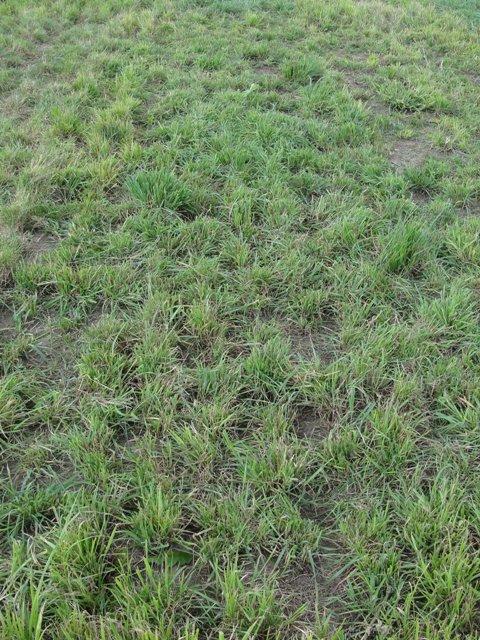 |
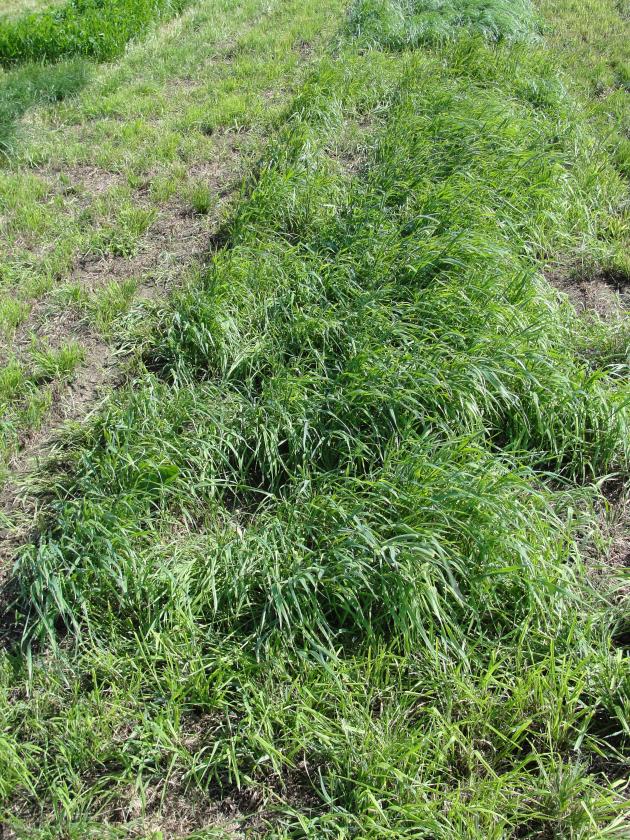
Figures 1 and 2. Kentucky bluegrass, timothy (photos 1 and 2) Left: pre-grazed timothy and right: post-grazed timothy), and meadow fescue were the most preferred perennial cool-season grasses with most grazing events removing > 60% of the forage, while meadow bromegrass, creeping foxtail, reed canarygrass, and orchardgrass were less preferred, with removals of < 50% of the forage (P ≤ 0.0027).
Kentucky bluegrass, timothy (Figures 1 and 2), and meadow fescue were the most preferred perennial cool-season grasses with most grazing events removing > 60% of the forage, while meadow bromegrass, creeping foxtail, reed canarygrass, and orchardgrass were less preferred, with removals of < 50% of the forage (P ≤ 0.0027). Quackgrass, tall fescue, perennial ryegrass, and smooth bromegrass were moderately preferred by horses. Orchardgrass produced the highest yield with ≥10.1 t/ha, while creeping foxtail, smooth bromegrass, and timothy produced the lowest yield with ≤ 8.7 t/ha (P = 0.0001). Quackgrass, perennial ryegrass, reed canarygrass and meadow bromegrass yielded moderately well.
 |
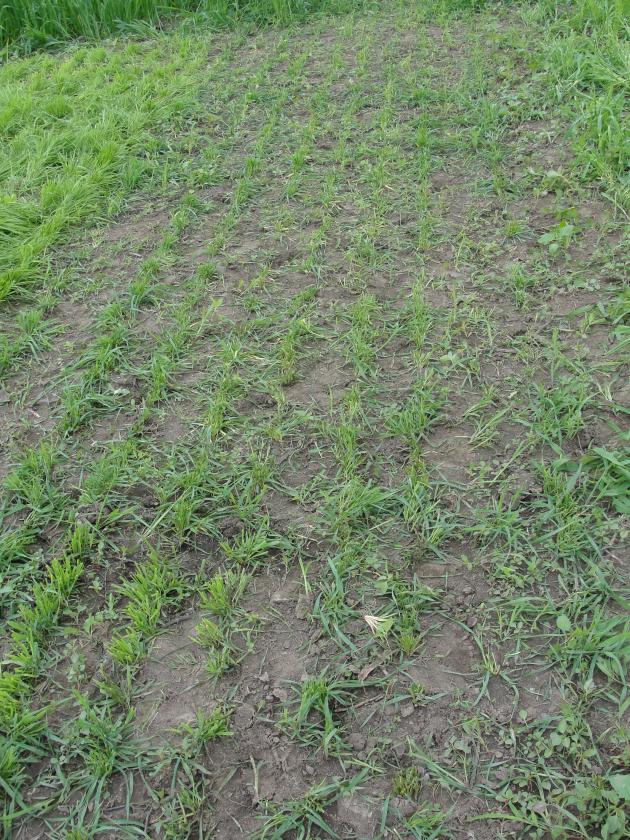 |
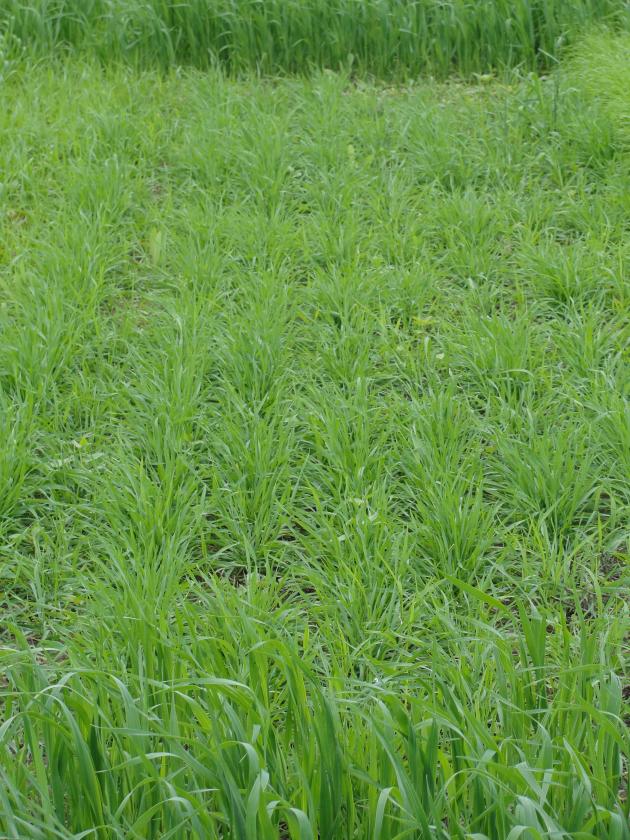
Figures 3 and 4. Winter wheat (photos 3 and 4) Left: pre-grazed winter wheat and right: post-grazed winter wheat) was the most preferred annual cool-season grass with a removal of 93%, while oat was least preferred with a removal of 22% (P < 0.001).
Winter wheat (Figures 3 and 4) was the most preferred annual cool-season grass with a removal of 93%, while oat was least preferred with a removal of 22% (P < 0.001). Oat and spring wheat yielded the highest with ≥ 3.91 t/ha while winter wheat yielded the least at 1.91 t/ha (P < 0.001). This information will aid owners and professionals when choosing pasture species that maximize horse preference and forage yield.
Future Plans
Future equine grazing research should focus on evaluating horse preference and yield of cool-season grass mixtures. Research should also focus on evaluating horse preference and yield of alternative forages.
Authors
Krishona Martinson, Associate Professor, University of Minnesota krishona@umn.edu
Amanda Grev, Graduate Research Assistant, University of Minnesota; Deavan Catalano Graduate Research Assistant, University of Minnesota; Michelle Schultz, Graduate Research Assistant, University of Minnesota; and Craig Sheaffer, Professor, University of Minnesota
Additional information
Allen, E., C. Sheaffer, K. Martinson. 2013. Forage Nutritive Value and Preference of Cool-Season Grasses Under Horse Grazing. Agronomy Journal. 105: 679-684.
Allen, E., C. Sheaffer, K. Martinson. 2012. Yield and Persistence of Cool-Season Grasses Under Horse Grazing. Agronomy Journal. 104: 1741–1746.
Grev, A.M., K.L. Martinson, and C.C. Sheaffer. 2014. Yield, forage nutritive value, and preferences of spring planted annual grasses under horse grazing. Journal of Animal Science. 92; pg. 34.
The authors are solely responsible for the content of these proceedings. The technical information does not necessarily reflect the official position of the sponsoring agencies or institutions represented by planning committee members, and inclusion and distribution herein does not constitute an endorsement of views expressed by the same. Printed materials included herein are not refereed publications. Citations should appear as follows. EXAMPLE: Authors. 2015. Title of presentation. Waste to Worth: Spreading Science and Solutions. Seattle, WA. March 31-April 3, 2015. URL of this page. Accessed on: today’s date.
Reducing Hay Waste Associated with Outdoor Feeding of Adult Horses
Why Be Concerned with Hay Waste On Horse Farms?
Hay is commonly fed to horses and is usually the largest and most expensive dietary component for adult horses. Hay waste can occur during both storage and feeding, and can add up to ≥ 40%, depending on forage type, storage method, environment, and storage length. Horses are commonly fed large round-bales and small square-bales in outdoor paddocks; however, no research exists to characterize hay waste. The objectives were to determine hay waste and economics of small square-bale and large round-bale feeders when used in outdoor feeding of adult horses. Related: Managing Manure on Horse Farms
What did we do?
Large round- and small-square bale hay feeders were evaluated during two separate studies. 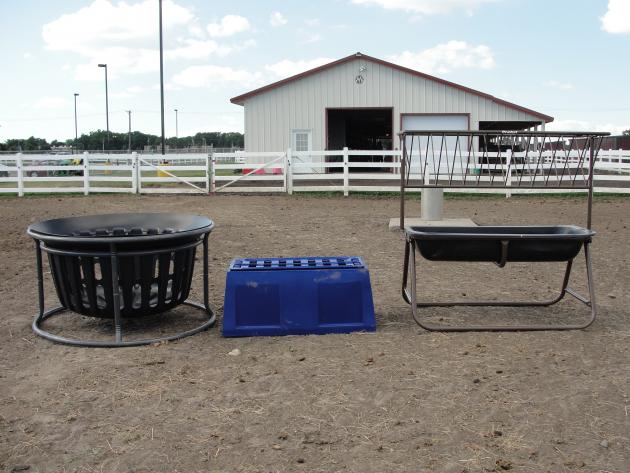 Nine round-bale feeders, were tested, including the Cinch Net ($147; Cinch Chix LLC), Cone ($1,195*; Weldy Enterprises; model R7C), Covered Cradle ($3,200; SM Iron Inc.), Hayhut ($650; Hayhuts LLS), Hay Sleigh ($425; Smith Iron Works Inc.), Ring ($300; R & C Livestock), Tombstone ($250; Dura-Built), Tombstone Saver ($650; HiQual), Waste Less ($1,450; JSI Innovations LLC), and a no-feeder control (Figure 1). Twenty-five mature horses were used to form five groups of five horses. Each feeder was placed on the ground in an outdoor dirt paddock. The groups of horses fed in rotation for four days, and every fourth day, groups were rotated to a different paddock. Waste hay (hay on the ground outside of the feeder) and orts (hay remaining inside the feeder) were collected daily. Percent hay waste was calculated as the amount of hay waste divided by the amount of hay fed minus orts. The number of months to repay the feeder cost (payback) was calculated using hay valued at $200/ton, and improved efficiency over the no-feeder control.
Three small square-bale feeders were tested, including a hayrack ($280; Horse Bunk Feeder and Hay Rack, Priefert Manufacturing), slat feeder ($349; The Natural Feeder), basket feeder ($372; Equine Hay Basket, Tarter Farm and Ranch Equipment), and a no-feeder control (Figure 1). Two feeders of each type were placed in separate, outdoor, dirt paddocks. Twelve adult horses were divided into four similar herds of three horses each and were rotated through the four paddocks, remaining in each paddock for a period of seven days. Grass hay was fed at 2.5% of the herd bodyweight split evenly between two feedings. Waste hay (hay on the ground outside of the feeder) and orts (hay remaining inside the feeder) were collected before each feeding. Percent hay waste was calculated as the amount of hay waste divided by the amount of hay fed minus orts. The number of months to repay the feeder cost (payback) was calculated using hay valued at $200/ton, and improved efficiency over the no-feeder control.
What have we learned?
No injuries were observed from any feeder types during the data collection period.
Hay waste differed between round-bale feeder designs. Mean percent waste was: Waste Less, 5%; Cinch Net, 6%; Hayhut, 9%; Covered Cradle, 11%; Tombstone Saver, 13%; Tombstone, Cone and Ring, 19%; Hay Sleigh, 33%; and no-feeder control, 57%. All feeders reduced waste compared to the no-feeder control. Feeder design affected payback. The Cinch Net paid for itself in less than 1 month; Tombstone and Ring, 2 months; Hayhut and Tombstone Saver, 4 months; Hay Sleigh, 5 months; Waste Less, 8 months; Cone, 9 months; and Covered Cradle, 19 months.
Hay waste was different between small square-bale feeder designs. Mean hay waste was 1, 3, 5 and 13% for the slat, basket, hayrack and no-feeder control, respectively. All feeders resulted in less hay waste compared with the no-feeder control. Feeder design also affected payback. The hayrack, basket, and slat feeders paid for themselves in 11, 10, and 9 months, respectively.
Future Plans
Future research investigating hay waste associated with outdoor feeding of adult horses should focus on different forage types and the optimum number of horses per feeder. Related: Small Farm Environmental Stewardship
Authors
Krishona Martinson, Associate Professor, University of Minnesota krishona@umn.edu
Amanda Grev, Research Assistant, University of Minnesota; Emily Glunk, Assistant Professor, Montana State University; William Lazarus, Professor, University of Minnesota; Julie Wilson, Executive Director, Minnesota Board of Veterinary Medicine; and Marcia
Additional information
Grev, A.M., E.C. Glunk, M.R. Hathaway, W.F. Lazarus, and K.L. Martinson. 2014. The effect of small square-bale feeder design on hay waste and economics during outdoor feeding of adult horses. Journal of Equine Veterinary Science. 34: 1,269-1,273.
Martinson, K., J. Wilson, K. Cleary, W. Lazarus, W. Thomas and M. Hathaway. Round-bale Feeder Design Affects Hay Waste and Economics During Horse Feeding. 2012. J. Anim. Sci. 90: 1047–1055.
Acknowledgements
The large round-bale feeder research was funded by a grant from the MN Horse Council and manufacturer fees. The small-square bale feeder research was funded by a grant from the American Quarter Horse Foundation.
The authors are solely responsible for the content of these proceedings. The technical information does not necessarily reflect the official position of the sponsoring agencies or institutions represented by planning committee members, and inclusion and distribution herein does not constitute an endorsement of views expressed by the same. Printed materials included herein are not refereed publications. Citations should appear as follows. EXAMPLE: Authors. 2015. Title of presentation. Waste to Worth: Spreading Science and Solutions. Seattle, WA. March 31-April 3, 2015. URL of this page. Accessed on: today’s date.
2016 Webcasts Approved for ARPAS Continuing Education Units
These webcasts have been approved for 1 continuing education unit (each) as part of the American Registry of Professional Animal Scientists (ARPAS) program. To receive CEUs, view a live or archived webcast, complete an evaluation (if available), and contact ARPAS, 217-356-5390 to have the credit applied to your CEU balance. Repeat this process for each webcast being utilized for CEUs.
2016 Webcasts
The following webcasts require Flash Player (already installed on 98% of browsers) to view. You can go to the archive page and download power point slides and other resources even if you do not have Flash Player installed.
- Pathogens 101: Manure and Veterinary Pathogens of Concern, Who are they and what do they do? December 16, 2016
- A Nutrient Management Training Course for Farmers: A Vermont Case Study November 18, 2016
- U.S. EPA Nutrient Recycling Challenge September 23, 2016
- Manure Safety and Transport August 19, 2016
- Drone Use in Animal Agriculture June 17, 2016
- Implementation and Experiences of NAQSAT Around the US May 20, 2016
- MANURE ENTOMOLOGY: Manure Management That Won’t “Bug You” April 15, 2016
- Antibiotic Resistance and Animal Agriculture March 25, 2016
- Construction and Maintenance of a Manure Pond – Part 2 February 19, 2016
- Construction and Maintenance of a Manure Pond – Part 1 January 22, 2016
More Webcasts…
- Topics include: Manure Apps, Gypsum Bedding, Livestock Housing, Tile Drained Lands, Micro Manure Management, Horse Manure Composting, Uses of Biochar, Thermal Manure-to-Energy Systems, Mortality Management during Avian Influenza, Communication Pathways, Communicating During Controversy. More…
- Topics include: Capturing Nutrients, Manure as a biofuel, Water Quality Index, Liquid manure nutrients, Carbon credits, Bioaerosols, WOTUS, Biosecurity, Mortality composting, Whole Farm Nutrient management, Winter manure application, Next generation activities. More…
2013 Webcasts
- Topics include: Risk Management, Waste to Worth, Mono-slope beef barns and research results, Bioavailability of Phosphorus, Capturing Nutrients. More…
2012 Webcasts
- Topics include: Biofilters, The 4Rs, Microbes, Life-Cycle Assessments, Carbon Footprints, Nitrates, Adaptive Nutrient Managment, Chesapeake Bay, Emergency Management. More…
2011 Webcasts
- Topics include: Top-dressing manure, Chesapeake Bay, Soil Health, Reducing Odor Risk, Anaerobic Digestion, NMP implementation, NAEMS, Lagoon Closure, Manure Economics, 2011 NPDES CAFO rule. More…
2010 Webcasts
- Topics include: Cover Crops, Vegetative Environmental Buffers, Mortality Composting, Manure Spills, NAQSAT, Manure on No-Till, SPCC, Ammonia Emissions. More…
2009 Webcasts
- Topics include: Feeding Strategies, Carbon Footpring, Conserving Nitrogen, AFO Inspection, Mortalities, Air Emissions, Grazing Management. More…
2008 Webcasts
- Topics include: Market Based Conservation, Antibiotics and Hormones, Dry Manure Housing Systems, Ammonia, Small Farms, Regulations, Manure Management Planner Software. More…
2007 Webcasts
- Topics include: Integrated Nutrient Management, Manure Application to Legumes, Value of Manure in Land Application, Smithfield Project, Value Added Processing of Manure, Manure Treatment Technologies, Value of Manure in Energy Generation, Vegetative Treatment Systems, and Innovative Manure Treatment Technologies. More…
2006 Webcasts
- Topics include: CNMP Core Curriculum, Pathogens, EPA CAFO Regulations. More…
Having Trouble?
If you experience difficulty in viewing webcasts, please visit our webcast troubleshooting page:
Greenhouse Gases and Agriculture (Self Study Lesson)

This is a self-guided learning lesson about greenhouse gases (GHG) and their connections to livestock and poultry production. It is useful for self-study and for professionals wishing to submit continuing education credits to a certifying organization. Anticipated time: 60 minutes. At the bottom of the page is a quiz that can be submitted and a score of 7 out of 10 or better will earn a certificate of completion. (Teachers/educators: visit the accompanying GHG curriculum materials page)
Module Topics
- Why does climate change?
- How does US agriculture to compare to other industries and worldwide agriculture?
- What greenhouse gases (GHG) are emitted by livestock and poultry farms?
- What are mitigation and adaptation strategies
What is Climate Change?
Download and read “Why Does Climate Change?” (PDF; 8 pages). Includes basics and terminology about natural and man-made drivers of climate change.
US Agriculture Comparisons to Other Industries and Worldwide Agriculture
Watch this short video “Agriculture and Greenhouse Gases: Some Perspective” (5 minutes). This also includes some very good reasons why farmers, ranchers, and ag professionals should care about the topic of climate change, regardless of political stances on solutions.
Greenhouse Gases Emitted by Livestock, Poultry. and Other Agricultural Activities
Watch this short video discussing the most important gases produced through livestock, poultry, and cropping activities on farms and ranches. (8 minutes)
Review the following fact sheet:
- Greenhouse Gas Emissions from Livestock and Poultry (you can also create a printer-friendly version)
Mitigation and Adaptation
Watch this short video “Carbon, Climate Change, and Controversy” by Marshall Sheperd, University of Georgia (4 minutes)
Watch this video on “Mitigation and Adaptation: Connections to Agriculture” (13 minutes)
Quiz
When you have completed the above activities, take this quiz. If you score at least 7 of 10 correct, you will receive a certificate of completion via email. If you are a member of an organization that requires continuing education units (CEUs), we recommend that you submit your certificate to them for consideration as a self-study credit (each individual organization usually has a certification board that decides which lessons are acceptable). Go to quiz….
American Registry of Professional Animal Scientist (ARPAS) members can self-report their completion of this module at the ARPAS website.
Acknowledgements
Author: Jill Heemstra, University of Nebraska-Lincoln
Building Environmental Leaders in Animal Agriculture (BELAA) is a collaborative effort of the National Young Farmers Educational Association, University of Nebraska-Lincoln, and Montana State University. It was funded by the USDA National Institute for Food and Agriculture (NIFA) under award #2009-49400-05871. This project would not be possible without the Livestock and Poultry Environmental Learning Community and the National eXtension Initiative.
Navigating Agriculture through the Water-Energy-Food Symposium

The Navigating Agriculture through the Water-Energy-Food Symposium was held in Austin, TX on November 19, 2015. The symposium was organized by David Smith (dwsmith@tamu.edu).
The videos listed below are in the same order as they appear in the embedded playlist to the right. The direct link to each video is provided if you wish to go directly to a presentation.
Opening Remarks
There is a lot that cannot be predicted, but we need to plan nonetheless. Government’s role is to be in the background and ensure that social justice needs are met. https://youtu.be/iT27yd37bIo
Texas State Rep. Tracy O. King, District 80, Chairman—House Agriculture and Livestock Committee, Member—Natural Resources Committee
Water-energy-food nexus—applications for agriculture communities
The Nexus Platform Tool allows users to examine the water gap in Texas. Planners are looking at different scenarios in order to anticipate bottlenecks and needs and prepare to meet those challenges or take advantage of opportunities. https://youtu.be/0N38ooLKJsA
Dr. Rabi Mohtar, Texas Engineering Experiment Station Endowed Professor, Texas A&M University; Founding Director of Qatar Environment and Energy Research Institute
Water supply & demand – trends and challenges for the Southwest
This presentation examined the Ogallala Aquifer (which is 40% of all water use in Texas) and the anticipated strategies to meet needs of different users such as agriculture and municipalities. https://www.youtube.com/watch?v=CphzrKOX6UE
Dr. Robert Mace, Deputy Executive Director, Texas Water Development Board
Value of water to agricultural communities
In addition to the Ogallala Aquifer, there are two deeper ones including Edwards-Trinity and Dockum (Santa-Rosa). All are part of the High Plains Water District, an organization that has undergone extensive planning and outreach efforts. They have developed a tool to look at each permitted well in the district and its characteristics. The presenter also discussed the groundwater rights of land owners and the “water-neutral” business model adopted by some and the potential for this to attract new business in water-limited areas. https://youtu.be/DHtR-d_AUoA
Jason Coleman, P.E. General Manager, High Plains Water District
The shale boom—Impacts for agriculture production and producers
The nature of the oil business is often that there are “booms” in local areas when reserves are discovered or when prices make a particular resource worth developing. This presentation discusses some of the activity in the U.S. and especially Texas and how the industry has evolved technologically. The need for long-term planning to leverage these resources into long-standing infrastructure and development for community is also highlighted. https://youtu.be/HZibOjAfGb4
Dr. Thomas Tunstall, Research Director, The University of Texas at San Antonio, Institute for Economic Development
The future of renewable energy and agriculture
This presentation discusses the overall energy needs of the U.S.and creative ways that energy needs can be evened out at grid-scale decision levels that involve very local (domestic water heater or electric car) ways to “store” excess energy and use it when needed. These types of decisions could reduce the needs for new power plant construction or need to bring a plant online for short periods of time for peak demand. As agriculture on on the “edges” of the grid, it could be part of the areas where change is likely to happen first. https://youtu.be/6QrXKOLmEZ8
Dr. Wendell Porter, P.E., Lecturer, Agricultural & Biological Engineering Department, University of Florida
Global market impacts and implications for local farms and ranches
What is the world view of agriculture and markets? Policy, exports, population growth (demand), currency values, and the potential impacts on U.S. agriculture and on Texas are presented. https://youtu.be/QQnYpIdpRls
Dr. James W. Richardson, Regents Professor & AgriLife Research Senior Faculty Fellow, Co-Director Agriculture & Food Policy Center, Department of Agricultural Economics, Texas A&M University
Innovation and technology applications for agriculture production
What is the role of technology in food production? This presentation looks at sensors, autonomous vehicles, data communication and analysis, and innovative practices that protect natural resources. https://youtu.be/4r40cMU9IGQ
Dr. Reza Ehsani, Associate Professor of Agricultural & Biological Engineering, University of Florida, Citrus Research & Education Center
Turning climate change into opportunities for agricultural producers
Climate change and the accompanying changes in weather are fairly important to agricultural producers. This presentation discusses the improvements in predicting changes in weather and climate and how it can be used in planning for different scenarios in agricultural production. https://youtu.be/5oVaZdzcS18
Dr. John Nielsen-Gammon, Regents Professor of Atmospheric Sciences, Texas A&M University, Texas State Climatologist
The rapidly evolving legal and regulatory framework for agriculture producers
This presentation breaks down the land resources available and discusses water policy that can or will affect agriculture. Topics include “Waters of the U.S.” (surface water), ground water and surface water resources, and the tension between private land ownership and the need to regulate usage of water (especially ground water). There are also differences (and sometimes contradictions) between local and state or federal rules. https://youtu.be/N7tRiC702Mw
Jim Bradbury, Attorney, James D. Bradbury, PLLC, Austin & Fort Worth, Texas
Educating tomorrow’s nexus thinkers
How do we reach young people on their own terms (especially as digital ‘natives’) to pass on the important knowledge and context they will need to advance science, policy and education? This generation is increasingly urban, worldly, socially conscious, and disconnected from direct food production. How do we especially highlight the connections of food, water, and energy? https://youtu.be/_Pumw9uRDTI
Dr. Christopher T. Boleman, Assistant Director and State Leader for 4-H Youth Development, Texas A&M AgriLife Extension Service, College Station, Texas
Acknowledgments
The symposium was part of the Animal Agriculture in a Changing Climate project that was funded by USDA NIFA under award # 2011-67003-30206 For more on the project and to discover resources for educators and professionals in addition to these videos, visit http://lpelc.org/animal-ag-climate-change/
Nutrient Management Proceedings Waste to Worth 2013
W2W13 proceedings | Waste to Worth home
On this page: Farm Nutrient Management | Silage | Tile Drainage | Grazing | Phosphorus
Beef | Horse | Pig | Poultry
Beef | Horse | Pig | Poultry
Farm Nutrient Management
| Decision Support Tools | Farming Systems |
|
Protecting Puget Sound Using Manure Application Risk Management |
Environmental Footprints of Beef At the Meat Animal Research Center The Discovery Farms: Helping Farmers Take Control of Water Quality |
| Adopting Positive Practices | |
|
Nutrient Management Standards–Making Them Work Where We Work Adoption Trends of Nutrient Related Practices (Canada) |
Will Spreading Bans Reduce Manure Runoff Events? |
Silage Pile Leachate
Silage Runoff Characterization
Treatment of Silage Runoff with Vegetated Filter Strip
Tile Drainage
Grazing animals
Managing Creek Pastures for Improved Water Quality
Feeding Cattle Without the Feedlot
Balancing Earth, Air and Fire in the Kansas Flint Hills
Phosphorus
| Phosphorus | |
|
Designing Structures to Remove Phosphorus from Drainage |
Using Excess Manure to Generate Income in the Chesapeake |
By Species
| Beef | Horse |
|
Environmental Footprints of Beef At the Meat Animal Research Center |
Efficient Utilization of Equine Manure
|
| Pig | Poultry |
|
Influence of Swine Manure on Methanogens and Denitrifiers in Soils |
Blue Flame Boiler on Windview Farm in Snyder County, Pennsylvania
The Blue Flame boiler was installed by Total Energy Solutions on Windview Farm in Snyder County, PA, in 2015 as a demonstration project for the Farm Manure-to-Energy Initiative. This technology has the longest track record for using poultry litter as a fuel in the Chesapeake Bay region.
The boiler installed in 2015 was designed to deliver 1.5 to 2.0 MBtu/hr of heat to poultry housing via hot water. It replaced an earlier Blue Flame boiler that had been running on the farm for several years and improved the hot water distribution system.
The Farm
Windview Farm, owned by Mac Curtis, produces antibiotic-free broiler chickens. Since 2010, he has been using a boiler manufactured by Blue Flame to generate heat from the 400 tons of poultry litter that are produced on the farm every year.
Performance Evaluation
The Blue Flame boiler was evaluated for technical, environmental, and financial performance. An overview of the findings is available in the main body of the 2016 Final Report. Details are in Appendix D.
The report includes an evaluation of air emissions from this and other systems, as well as the potential for transporting and marketing the ash co-product as a crop fertilizer.
Related: Introduction to Thermal Technologies…
More Manure-Based Energy Case Studies
 This case study was funded by the National Fish and Wildlife Foundation (NFWF), the USDA, U.S. EPA, and Chesapeake Bay Funders Network. The views and conclusions contained in materials related to the Farm Manure-to-Energy Initiative are those of the authors and should not be interpreted as representing the opinions or policies of NFWF, the USDA, U.S. EPA, or Chesapeake Bay Funders Network. Mention of trade names or commercial products does not constitute endorsement by project funders.
Video Resources on Animal Agriculture, Manure, and Environmental Stewardship
The embedded spreadsheet lists several collections of livestock and poultry related video resources that are a combination of archived webinars, field video, or recorded conference presentations. In most cases, you can search the collection by using its search function (YouTube channels) or by using your browser’s “find” function to location a key word or phrase.
The stewardship-focused topics in these collections these are wide-ranging: manure treatment, anaerobic digestion, grazing management, soil health, air quality and odors, greenhouse gases and climate, animal welfare, pathogens, regulations, and much more. The cover all sizes of farms and all species of food animals (beef, dairy, pig, poultry, sheep and goats) as well as horses.
Most of these resources are freely available to use in educational or non-commercial programs with proper attribution. It is always a good idea to contact the person listed if you utilize the resources so they are aware the resources are useful (and continue to produce them) and to provide written permission.
If you are aware of additional videos or collections that should be added to the list, visit the spreadsheet and add the requested information.
If you have questions, contact Jill Heemstra, Nebraska Extension.
2015 Webcasts Approved for ARPAS Continuing Education Units
These webcasts have been approved for 1 continuing education unit (each) as part of the American Registry of Professional Animal Scientists (ARPAS) program. To receive CEUs, view a live or archived webcast, complete an evaluation (if available), and contact ARPAS, 217-356-5390 to have the credit applied to your CEU balance. Repeat this process for each webcast being utilized for CEUs.
2015 Webcasts
The following webcasts require Flash Player (already installed on 98% of browsers) to view. You can go to the archive page and download power point slides and other resources even if you do not have Flash Player installed.
- Communicating Science Amidst Controversy December 18, 2015
- Pathways for Effective Information Transfer Between Manure Management Professionals November 20, 2015
- Mortality Management Options During an Avian Influenza Outbreak October 16, 2015
- Thermal Manure-to-Energy Systems for Farms: Technical and Environmental Feasibility September 18, 2015
- Agronomic and Environmental Uses of Biochar (Part 2) August 21, 2015
- Agronomic and Environmental Uses of Biochar (Part 1) July 17, 2015
- Horse Manure Composting: Specific Steps to Start or Improve the Process June 19, 2015
- Micro Manure Management May 22, 2015
- Manure and Nutrient Management in Tile Drained Lands April 17, 2015
- Novel Livestock Housing March 6, 2015
- Waste to Worth Preview: Gypsum Bedding Risks and Rewards February 27, 2015
- Mobile Manure Apps January 16, 2015
More Webcasts…
- Topics include: Capturing Nutrients, Manure as a biofuel, Water Quality Index, Liquid manure nutrients, Carbon credits, Bioaerosols, WOTUS, Biosecurity, Mortality composting, Whole Farm Nutrient management, Winter manure application, Next generation activities. More…
2013 Webcasts
- Topics include: Risk Management, Waste to Worth, Mono-slope beef barns and research results, Bioavailability of Phosphorus, Capturing Nutrients. More…
2012 Webcasts
- Topics include: Biofilters, The 4Rs, Microbes, Life-Cycle Assessments, Carbon Footprints, Nitrates, Adaptive Nutrient Managment, Chesapeake Bay, Emergency Management. More…
2011 Webcasts
- Topics include: Top-dressing manure, Chesapeake Bay, Soil Health, Reducing Odor Risk, Anaerobic Digestion, NMP implementation, NAEMS, Lagoon Closure, Manure Economics, 2011 NPDES CAFO rule. More…
2010 Webcasts
- Topics include: Cover Crops, Vegetative Environmental Buffers, Mortality Composting, Manure Spills, NAQSAT, Manure on No-Till, SPCC, Ammonia Emissions. More…
2009 Webcasts
- Topics include: Feeding Strategies, Carbon Footpring, Conserving Nitrogen, AFO Inspection, Mortalities, Air Emissions, Grazing Management. More…
2008 Webcasts
- Topics include: Market Based Conservation, Antibiotics and Hormones, Dry Manure Housing Systems, Ammonia, Small Farms, Regulations, Manure Management Planner Software. More…
2007 Webcasts
- Topics include: Integrated Nutrient Management, Manure Application to Legumes, Value of Manure in Land Application, Smithfield Project, Value Added Processing of Manure, Manure Treatment Technologies, Value of Manure in Energy Generation, Vegetative Treatment Systems, and Innovative Manure Treatment Technologies. More…
2006 Webcasts
- Topics include: CNMP Core Curriculum, Pathogens, EPA CAFO Regulations. More…
Having Trouble?
If you experience difficulty in viewing webcasts, please visit our webcast troubleshooting page: