Do We Know the Carbon Footprint of the Pork Industry?

green stylized pig logoA carbon footprint is a total of all the greenhouse gas emissions (GHG) from a process or industry. A life cycle assessment (LCA) is the process used to figure out what GHG emissions will be included in the footprint. More technically, it is systematic way of looking at a product’s complete life cycle and calculating a “footprint”.  In addition to carbon footprints, there are efforts to calculate land, water, and other environmental footprints.

Below are highlights from several different reports that looked at the carbon footprint of the pork industry on a national and international scale. A comparison between different ways to raise pigs was also highlighted.

Snapshot of the Present Time

On a national scale, a report on the National Life Cycle Carbon Footprint Study for Production of Swine in the U.S. was conducted and published in 2011.

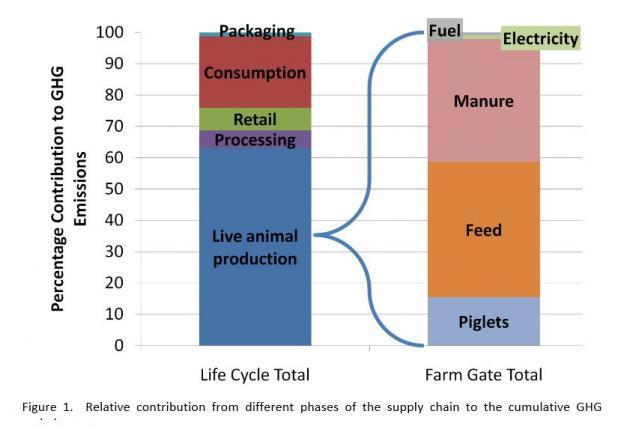
The report concluded that the carbon footprint to prepare and consume a 4 oz serving of pork was ~2.5 lbs of carbon dioxide equivalents. Figure 1 (below) from that report shows the relative breakdown of the industry’s estimated greenhouse gas emissions:

  • Live animal production made up 62.1% of the emissions. That is further broken down and presented in second column (right).
  • Processing – 5.6%
  • Retail – 7.54%
  • Consumption – 23.5% including refrigeration, cooking, and methane from food waste in landfill
  • Packaging (1.3%);

Life cycle assessment of pork production in the U.S.

Comparison Over 50 Years of Production

Another example of an industry-wide analysis, this one comparing over time, is a “50-year comparison of the carbon footprint of the U.S. swine herd 1959 – 2009” (29 pp; PDF). The pork industry overall emits more total greenhouse gases than 50 years ago, but actually emits much less per pound of pork produced because of improvements in efficiency.

From that publication:

The U.S. swine industry produces pigs far more efficiently today (2009) than in 1959. The number of hogs marketed has increased 29% (87.6 million in 1959 to 112.6 million in 2009 after removing market hogs imported directly to harvest) from a breeding herd that is 39% smaller. The efficiency gain is even more impressive when measured against the total dressed carcass weight harvested. Dressed carcass yield leaving the farm has nearly doubled in 50 years from 12.1 billion pounds to 22.8 billion pounds. This increase in productivity has resulted in an increase of 2,231 pounds (2.5x) of carcass harvested annually per sow – year. Today, it takes only five hogs (breeding and market) to produce the same amount of pork that  required eight hogs in 1959.

Comparing Different Ways of Raising Pigs

An example of an LCA that looks at different types of systems is “Life-cycle assessment of commodity and niche swine operations“. (informal Q&A and journal article both available). From the journal article (bottom of page 5):

High-profitability operations have consistently lower impacts compared to low-profitability operations for both commodity and deep-bedded niche piglet production.

Global Assessment from Backyard to Industrial Systems

On an international scale, the report “Greenhouse gas emissions from pig and chicken supply chains” was published in 2013. This study looked at all scales of farms from backyard pigs to industrial production (large confinement operations). Over the entire scale, they estimated that the carbon footprint of pork for every kg (~2.2 lbs) of pig carcass weight has an emissions intensity of 6.1 kg of carbon dioxide equivalent.

This report found that backyard systems, especially in some parts of the world, have low emissions, largely due to by-product or “second-grade” feeds. Industrial pig systems tended to have more emissions intensity than backyard systems, with the emissions from liquid/slurry manure management systems being a big reason. From the conclusion of the report:

When drawing any conclusions about scope for improvement, the following points should be borne in mind: (a)differences in emission intensity may reflect differences in production systems that have arisen over time to enable the system to perform better within a given context, e.g. to make them more profitable, or resilient; (b) focusing on a single measure of efficiency (in this case GHG emissions per kg of output) can lead to positive and negative side effects on, for instance, biodiversity, water quality and animal welfare; (c) reducing GHG emissions is not the only objective producers need to satisfy, as they also need to respond to changing economic and physical conditions.

How Do Carbon Footprints Compare?

It is very important to note that when looking at data and numbers generated from different reports like these, the carbon footprints are difficult to compare unless they use the same LCA. Presenting carbon footprints from different LCA’s is an “apples to oranges” comparison. Only when the same LCA is used, can they be an “apples to apples” comparison.

Additional Information

Acknowledgements

Authors: Amy Carroll, University of Arkansas and Jill Heemstra, University of Nebraska jheemstra@unl.edu

This information is part of the program “Integrated Resource Management Tool to Mitigate the Carbon Footprint of Swine Produced In the U.S.,” and is supported by Agriculture and Food Research Initiative Competitive Grant no. 2011-68002-30208 from the USDA National Institute of Food and Agriculture. Project website.

Carbon Footprint, Life Cycle Assessment and the Pork Industry

green stylized pig logoAnimal agriculture in the U.S. contributes approximately 3.5% of all man-made greenhouse gases (GHGs). If you look at pork production, it accounts for just 0.34% of all emissions. (Source: U.S. EPA Greenhouse Gas Inventory released April, 2015).

When you total up all the GHG emissions from a particular activity or process, it is called a carbon footprint. The procedure used to decide which GHG emissions are included in this total is a life-cycle assessment (LCA).

What Is a Carbon Footprint and How Is It Used?

A carbon footprint gives you a snapshot in time of the GHGs produced by the activity or process being evaluated. The number generated is especially useful for comparing different processes or different times.

Some reasons a farm, company, or industry would calculate a carbon footprint include:

  • Identifying “hot spots” in the system to prioritize areas where reductions can be made
  • Creating a baseline measure for comparing over time
  • Looking at “what-if” scenarios and comparing different options to see how each affects GHG emissions

What Goes Into a Life Cycle Analysis?

In order to be able to compare carbon footprints of different farms or different industries, the life-cycle analysis (LCA) needs to use the same parameters. To do this, many people rely upon standardized procedures such as those created by the International Organization for Standardization.

For the pork industry, the pork supply chain is broadly divided into eight stages:

  • feed production;
  • live animal production;
  • delivery to processor;
  • processing;
  • packaging;
  • distribution;
  • retail;
  • consumption/disposal.

The most important thing to remember is that if you compare two or more carbon footprints to each other, the LCA used needs to be the same. If you try to compare footprints generated using different LCAs, you will not get a true comparison.

For more information

Authors: Jill Heemstra, Nebraska Extension and Rick Fields, University of Arkansas

Acknowledgements

This information is part of the program “Integrated Resource Management Tool to Mitigate the Carbon Footprint of Swine Produced In the U.S.,” and is supported by Agriculture and Food Research Initiative Competitive Grant no. 2011-68002-30208 from the USDA National Institute of Food and Agriculture. Project website.

What Is an Environmental Foot Print? (Ecological Footprint)

green stylized pig logoThe Cambridge dictionary defines environmental footprint as:

the effect that a person, company, activity, etc. has on the environment, for example the amount of natural resources that they use and the amount of harmful gases that they produce

Also referred to as an ecological footprint, this is a measure that attempts to consider multiple impacts of an activity rather than focus on a single one. In relation to the swine industry, this foot print takes into account the results of carbon, water, land and air footprints of pig farming.

Related: Evaluating the environmental footprint of pork production

How do you bring all of these different pieces together? In 2011, the U.S. National Pork Board and many land grant researchers launched a project to develop a science-based decision tool called Pig Production Environmental Footprint Calculator (PPEFC). The PPEFC has the ability to calculate (estimate) impact to greenhouse gas emissions, costs, land use, and water consumption across the pork production chain, including feed formulation and crop production. The combined analysis of all of these factors allows identification of potential ecologically and economically feasible production practices for pork producers.

One of the pieces of this project is developing an environmental footprint, cost, and nutrient database of the US animal feed ingredients and integrating it with the calculator. The calculator is built upon cradle-to-farm gate life-cycle assessment (LCA) of pork production combined with the US National Resource Council (NRC) swine nutrient requirements models (NRC 2012), farm operation inputs, and animal feed database. Farm operation inputs include: barn characteristics, utilities, manure management, dead animal disposal, and farm operation costs. For a description of the inputs, visit this conference presentation at LCA Foods 2014.

Additional Information

Factsheets: What is a water footprint? | What is a land footprint? | What is a carbon footprint?

Pig Production Environmental Footprint Calculator (National Pork Board).

Animal agriculture and:

Acknowledgements

Author: Amy Carroll, University of Arkansas

Reviewers: Jill Heemstra, University of Nebraska; Karl Vandevender, University of Arkansas

This information is part of the program “Integrated Resource Management Tool to Mitigate the Carbon Footprint of Swine Produced In the U.S.,” and is supported by Agriculture and Food Research Initiative Competitive Grant no. 2011-68002-30208 from the USDA National Institute of Food and Agriculture. Project website.

Exploring Interactions Betwen Agricultural Decisions and Greenhouse Gas Emissions Using Swine Production

green stylized pig logoThe materials on this page are an interactive lab designed to introduce students (high school level) to pig farming and the connections between management decisions  and the greenhouse gas emissions. It also includes information on the economic implications of those decisions. Background information and activities are provided in a graphical (visual) format. Part one can be a stand-alone activity or prepare students for part two.

You can download each of the files individually using the links below or download the entire lab (134 pages – PDF format). The information contains references to Arkansas agriculture and swine production in some areas, but the information is still applicable in other states.

What do you know about swine and greenhouse gases?

This one page (PDF format) fact sheet (including a fun short quiz) can be utilized as part of this lab or as a stand-alone handout to stimulate discussion. Download factsheet

Part One Activity  – The Basics

This section includes five files that introduce the basic concepts of greenhouse gases, swine production systems, and glossary of swine production terms. This activity utilizes both text and graphical presentation of concepts and emphasizes information comprehension. Download Part One

  • Resource information – lesson plan and background information. This includes three aspects of swine management systems including feed management, housing management, and manure management.
  • Farm management system graphics – a visual aid to depict how each individual practice/component contributes to the building of a given pig farm system.
  • Farm flashcards – brief description and graphical rendering of various swine farm components
  • Lab report form – several structured questions designed to
  • Farm management option guide (FMOG)*

*The FMOG also doubles as a scenario key for the completion of Part 2.

Part Two Activity – Challenging

This section provides more in-depth information on swine production systems and greenhouse gases. It provides insight into management obstacles faced by pig farmers in balancing carbon footprints, available resources, producer goals, and legal compliance. This critical-thinking activity is meant to be completed in small groups. Download Part Two

  • Resource information – lesson plan and background information.
  • Farm management option guide FMOG
  • Three scenarios – each covers manure, feed, and housing
  • Flashcards – including health and feed, housing, manure

Acknowledgements

Authors: Rick Fields and Karl Vandevender, University of Arkansas. For questions about these materials, contact Rick at rfields@uaex.edu

This information is part of the program “Integrated Resource Management Tool to Mitigate the Carbon Footprint of Swine Produced In the U.S.,” and is supported by Agriculture and Food Research Initiative Competitive Grant no. 2011-68002-30208 from the USDA National Institute of Food and Agriculture. Project website.

Animal Agriculture, Manure Management, and Water Quality

This module is an overview of animal agriculture in the U.S. and how industry trends have affected manure management. Because the primary use of manure is land application as a plant fertilizer, the module addresses nutrient management and surface water quality impacts. The module also covers regulatory requirements and efforts to manage and reduce risks of manure nutrients reaching water.

Part I – Manure Management and Water Quality

1. Animal Agriculture Trends

Economic pressures and consumer demands have driven a trend toward consolidation in the animal agriculture industry. This has changed the way manure is collected and stored. Virtual tours of layer hen, pig, beef, dairy, and broiler sectors are included.

2. Manure Collection and Storage

Animal feeding operations collect and store manure in several ways with the largest differences being between those that handle manure as a “solid” and those that handle manure as a “slurry” or “liquid”.

3. Land Application of Manure Nutrients

Land application of manure requires specialized equipment and technologies that continue to evolve. This equipment and technology must be combined with nutrient management planning to ensure manure applications are from the right source, at the right rate and time, using the right methods, and in the right place.

4. Water Quality and Manure

Improperly managed manure can negatively impact water quality. This section focuses primarily on surface water and nutrients but other topics are briefly introduced.

5. Clean Water Act Requirements

Some animal feeding operations are regulated under the National Pollutant Discharge Elimination Program (NPDES). The NPDES program is part of the Clean Water Act.

6. Planning for Stewardship

As new information, tools, and resources become available, farmers have opportunities to continually improve environmental stewardship and manage risks related to manure and water quality.

Part II – Conservation

7. The Importance of Conservation In Animal Agriculture

Learn about how USDA NRCS promotes conservation practices and why conservation is so important to protect water quality.

8. Conservation Practices Commonly Used On Animal Agriculture Farms

This section highlights manure management, land and pasture management, and mortality management practices available for animal ag producers to practice conservation on their farm.

Acknowledgements Part I

These materials were developed by the Livestock and Poultry Environmental Learning Center (LPELC) with funding from the U.S. Environmental Protection Agency and with input from the Natural Resources Conservation Service, National Cattlemen’s Beef Association, National Milk Producers Federation, National Pork Board, United Egg Producers, and U.S. Poultry and Egg Association.

Many people contributed time, expertise, video, or images for the production of the three videos produced in this module.

  • Animal agriculture trends and manure management – Tetra Tech, Inc.; Mark Risse, University of Georgia; Leslie Johnson, University of Nebraska; Tom Hebert, Bayard Ridge Group; Bill Couser, Couser Cattle.
  • Manure nutrient management – Tom Hebert, Bayard Ridge Group; Tetra Tech, Inc.; Mary Berg, North Dakota State University; Mario de Haro Marti, University of Idaho; Mark Risse, University of Georgia; Leslie Johnson and Rick Koelsch, University of Nebraska; Bill Couser, Couser Cattle.
  • Managing manure to protect water quality – Tetra Tech, Inc.; Mark Risse, University of Georgia; Leslie Johnson, University of Nebraska; Tom Hebert, Bayard Ridge Group; Bill Couser, Couser Cattle.

For questions on these materials, contact Jill Heemstra, jheemstra@unl.edu. All images in this module, unless indicated otherwise, were provided by Jill.

Acknowledgements Part II

These materials were developed by the Livestock and Poultry Environmental Learning Center (LPELC) and Eastern Research Group, Inc. with funding from the USDA Natural Resources Conservation Service through an interagency agreement with the U.S. Environmental Protection Agency.

For questions on these materials, contact Jill Heemstra, jheemstra@unl.edu. All images in this module, unless indicated otherwise are courtesy USDA NRCS.

Farm Manure-to-Energy Initiative in the Chesapeake Region Report January 2016

From 2012-2015, the Farm Manure-to-Energy Initiative conducted a study of thermal, farm-scale systems that produce energy from poultry litter. The technologies were installed on working farms in the Chesapeake region, in places where manure management is especially important for protecting water quality. The technologies were evaluated for technical, environmental, and financial performance. This report details the findings.

Download the full report and appendices. (252 pages; PDF)

Download a section of the report:

  1. Executive Summary (6 pages)
  2. Main Body of the Report (26 pages)
  • Background and Objectives
  • Process: Getting Projects on the Ground
  • Performance Evaluation
  • Summary of Results
  • Fertility Value and Market Potential of Poultry Litter Co-Products
  • Summary of Lessons Learned
  • Communicating Results
  • Summary and Next Steps
  1. Appendix A: Technical Performance Global Re-Fuel
  2. Appendix B: Technical Performance Ecoremedy ® Gasifier
  3. Appendix C: Technical Performance LEI Bio-Burner 500
  4. Appendix D: Technical Performance Total Energy Blue Flame Boiler
  5. Appendix E: Air Emissions and Permit Compliance
  6. Appendix F: Nutrient Availability from Poultry Litter Co-Products
  7. Appendix G: Nutrient Balance: Fate of Nitrogen and Phosphorus Nutrients
  8. Appendix H: Financial Assessment of the Farm Manure-to-Energy Initiative
  9. Appendix I: North Carolina State University’s Pyrolysis Technology

Research Summaries


E. coli diversity in livestock manures


Cook, K.L., Bolster, C.H., Ayers, K.A., Reynolds, D.N. 2011. Escherichia coli diversity in livestock manures and agriculturally impacted stream waters. Current Microbiology. 63(5):439–449.

Summary

Escherichia coli (E. coli) is a dominant intestinal commensal organism, an important fecal indicator bacterium (FIB), a pathogen and a target for microbial source tracking (MST). Strain level differences (genotypic and phenotypic) influence E. coli fate and transport and therefore have important implications for its validity as an FIB and for MST. The goals of this study were to (1) determine the diversity of E. coli in manures from livestock and stream-water samples taken following dry and wet weather events; (2) determine the profile of virulence-associated genes and; (3) evaluate the effect of strain level differences on the attachment and transport of E. coli. To evaluate diversity, 1346 E. coli isolates were obtained from three livestock species and seventeen stream-water samples. We found that many E. coli strains isolated from water sources had DNA fingerprints that were significantly different than those from stream-water in a predominantly agricultural area. Furthemore, significant differences were also seen between E. coli isolates from stream-water samples taken following wet and dry weather events. Wide diversity in the attachment efficiency of E. coli isolates from different sources occurred and those differences corresponded with the occurrence of virulence factors often correlated with adhesion. These findings underscore the genetic variation inherent to this important indicator organism. The influence of diversity on genetic exchange and the concomitant effect on the organisms’ fitness and adaptation to in situ environmental conditions require further investigation. The resultant issues for purposes of modeling, source tracking and risk assessment require careful consideration in future research studies.

Transport behaviors of E. coli

Bolster, C.H., Cook, K.L., Marcus, I.M., Haznedaroglu, B.Z., Walker, S.L. 2010. Correlating Transport Behavior with Cell Properties for Eight Porcine Escherichia coli Isolates. Environmental Science and Technology. 44(13):5008–5014.

Summary

Infiltration of fecal material into the subsurface can result in the contamination of ground water supplies by pathogenic microorganisms such as bacteria, viruses, and protozoa, thereby posing a threat to public health. To assess whether a ground water source is at risk for fecal contamination, agencies responsible for monitoring water supplies generally test for the presence of nonpathogenic as indicator organisms. One of the most commonly used indicator organisms in ground water systems is E coli. To improve our understanding of the mechanisms controlling E. coli movement in the environment, we conducted a set of transport studies to better understand the factors that control E. coli attachment to sediment surfaces. For quartz sand we found that E .coli attachment, and thus transport, was controlled by the surface charge of the cell. For Fe-coated sand a mild correlation between cell width and attachment was observed. These findings will help improve our understanding of the mechanisms controlling E .coli in the environment.

Broiler litter application and E. coli

Sistani, K.R., Torbert III, H.A., Way, T.R., Bolster, C.H., Pote, D.H., Warren, J.G. 2009. Broiler Litter Application Method and Runoff Timing Effects on Nutrient and Escherichia coli Losses from Tall Fescue Pasture. Journal of Environmental Quality. 38(3):1216-1223

Summary

Over two-thirds of the total U.S. Broiler chicken production is located in the southeastern United States, which is a major segment of the farm economy in the region. Poultry litter is generally surface applied to pastures and hay fields year-round to supply plant nutrients, particularly nitrogen (N) and phosphorus (P). Runoff from litter-applied land has the potential to transport nutrients and pathogenic microorganisms to nearby surface water. Proper land application of animal manure is critical to water quality in watersheds with significant livestock numbers. With regard to permanent pasture systems, inability to incorporate waste materials leads to increased nutrient concentration such as phosphorus, nitrogen, copper, and zinc and pathogenic microorganisms near the soil surface. Currently, broadcasting is a common method of litter application on soil in many parts of U.S. The objectives of this study were (i) to compare the effect of broiler litter application method on nutrient and E. coli losses in runoff from tall fescue pasture in the Appalachian Plateau, and (ii) to determine the impact of antecedent time (time between litter application and the first runoff event) on nutrient and E. coli losses. Inorganic N and E. coli concentrations in runoff were significantly greater from broadcast litter application than subsurface litter application, while fertilizer treatment had runoff with greater NH4-N but smaller NO3-N than litter application treatments. The loss of total phosphorus, NO3-N, and total suspended solids from broadcast litter application was 83.5%, 64%, and 68% greater than subsurface litter application, respectively. About 81% of the runoff total phosphorus concentration was in the form of dissolved reactive phosphorus for both litter-application methods.

Methods to reduce pathogen loads following application of broiler litter

Brooks, J.P., McLaughlin, M.R., Adeli, A., Miles, D.M. 2012. The effect of poultry manure application rate and AlCl3 treatment on bacterial fecal indicators in runoff. Journal of Water and Health. 10:619-628.

Summary

Land application of poultry litter is a beneficial method of using this fertilizer source. It can provide high levels of N and organic C. However, the protection of water sources following land application of any fertilizer is necessary since many of the US surface water supply has been compromised due to the presence of fecal bacteria like Escherichia coli (E. coli) or anoxic, a condition in which the presence of nutrient runoff can lead to conditions which kill fish. The purpose of this study was to determine a suitable fecal indicator for poultry litter runoff following large-scale rain events. A previous greenhouse study determined that there are other poultry-litter fecal indicators more suitable for runoff than traditional indicators such as E. coli; this study confirms those results and found that of all treatments receiving poultry litter, two indicators proved to be useful. Over a two year period, field plots were land applied with various combinations of poultry litter or inorganic fertilizers and rained upon with an artificial rain maker. The results suggested that Clostridium perfringens and staphylococci were more useful as an indicator of poultry litter horizontal movement than all others. This persisted for up to 30 days following land application of poultry litter. The presence of these two indicators may signal a change for regulators and environmental monitors when investigating poultry litter fecal pollution.

Risk assessment of pathogens in manure

Brooks, J.P., McLaughlin, M.R., Gerba, C.P., Pepper, I.L. 2012. Land application of manure and class B biosolids: an occupational and public quantitative microbial risk assessment. Journal of Environmental Quality. 41:2009-2023.

Summary

The land application of wastes, such as wastewater treatment plant biosolids and manures, has been practiced for years and serves as a method to dispose and treat these wastes. The presence of bacterial, viral, and parasitic pathogens in these wastes can further complicate issues and reduce public confidence in their disposal. Typically the concern and hence the regulations governing their land application and use have revolved around controlling nutrient runoff and public contact with these microbial pathogens. The recent foodborne outbreaks involving bacterial and viral pathogens has brought into question the use of these wastes and potential for public exposures. To properly assess the use of these wastes a quantitative microbial risk assessment was conducted comparing the use of manure and municipal biosolids using current pathogen data and simulating potential public exposures following a variety of exposures ranging from fresh food crop consumption to aerosol exposures. A comparison of the risks demonstrated that public health risks are relatively low during non-intentional exposures such as fresh food crop or aerosol exposures and fall below the USEPA recommended annual 1 per 10,000 risk of infection. Only exposures in which intentional consumption of soil contaminated with fecal matter yielded risks which were greater. Risks were far below occupational exposures for the most part and demonstrated that risks between the two types of wastes were similar. Infectious risks from biosolids were greater from viral pathogens, while bacterial pathogens presented the greatest risks from manure. This study demonstrated that given typical conditions, the risk of infection from land application and use of either of these types of wastes are acceptable given time between application and exposures.

Microorganisms in dairy wastewater

Dungan, R.S., Leytem, A.B. 2013. The characterization of microorganisms in dairy wastewater storage ponds. Journal of Environmental Quality. 42:1583-1588.

Summary

Idaho is the third largest dairy state in the United States. With over 500,000 milk cows, a vast quantity of solid and liquid manure is generated, much of which is land applied. Given the fact that cattle feces contain a variety of microorganisms, we undertook a study using a culture-independent approach (i.e. no cultivation) to characterize microbial communities in wastewaters from south-central Idaho. After the microbial DNA was extracted from the wastewaters, it was amplified and then a sequence library was created for identification of putative matches. In general, the dairy wastewaters contained a variety of microorganisms affiliated with the domains Archaea and Bacteria. However, a statistical analysis of the data revealed that an insufficient number of sequences were obtained to sufficiently characterize microbial diversity at the species level. Despite this limitation, the results from our study enhanced our understanding of microbial species and communities in dairy wastewaters more so then if culture-dependent techniques were utilized.

Bioaerosols and open-freestall dairy operations

Dungan, R.S. 2012. Use of a culture-independent approach to characterize aerosolized bacteria near an open-freestall dairy operation. Environment International. 41(2012):8-14.

Summary

Animal manures are known to harbor a variety of pathogens that can potentially be transmitted to humans in the form of airborne particles. In this study, air samples were collected downwind from a 10,000 cow open-freestall dairy and nearby fields being sprinkler irrigated with wastewater. Nucleic acids (DNA) were extracted from the air samples, then a highly conserved gene was sequenced for bacterial identification. Of the 191 gene sequences, none were affiliated with bacteria known to be pathogenic to healthy humans. Our results suggest that there is a low incidence of airborne bacterial pathogens immediately downwind from the dairy and wastewater irrigation sites.
Archived Pathogen Pages

Question or concerns, contact John Brooks (john.brooks@ars.usda.gov)