Manure Management Practices for Mitigation of Gaseous Emissions from Naturally Ventilated Dairy Barns


How Does Management Impact Ammonia, Hydrogen Sulfide & Greenhouse Gases In Dairy Barns?

Emissions of pollutant gases from dairy barns are dependent on manure retention time in the barn and the quality of flushing water (for manure-flush systems). Strategies for mitigating air emissions from barns thus are a function of manure management either via optimal flushing or scraping, and pretreatment of flushing water.

What did we do?      

Ammonia (NH3), hydrogen sulfide (H2S), and greenhouse gases (CO2, CH4, and N2O) emissions, under different manure collection strategies, from a naturally ventilated dairy barn housing about 850 lactating Holstein cows were measured using an on-site real-time monitoring system. The manure collection strategies evaluated included: (i) altering manure-flushing frequency, (ii) alternating flushing and scraping to remove manure, and (iii) manure solids separation system via centrifugation of the flush water.

What have we learned?

Doubling flushing frequency (every 3 h flushing) did not significantly affect NH3 emission (25.5 g cow-1 d-1) compared to the normal every 6 h flushing (24.5 g cow-1 d-1) but reduced CO2 emission by 7.3%. On the hand, H2S, CH4, and N2O emissions were 1.3, 176% and 18.5% higher at the 3-h flushing schedule than at the normal 6-h flushing schedule. Flushing at half the frequency (every 12 h) reduced H2S, CO2, and CH4 by 59.4, 19.8 and 28.5%, respectively. Alternating manure flushing and manure scraping (or vacuuming) every 6 h, decreased CO2, CH4, and N2O emissions by 13.0, 7.8 and 19.5% compared to normal 6-h manure flushing alone. Use of centrifuged water for manure flushing significantly improved emissions mitigations more than all other strategies. Emissions of all the five gases decreased by 43.0 % for NH3, 37.3 % for H2S, 1.2% for CO2, 3.7% for CH4, and 51.7 % for N2O under the latter practice.

Future Plans  

Evaluation of other manure management practices which have not previously or adequately been tested at full-scale facilities or operations.

Authors

P.M. Ndegwa, Associate Professor, Biological Systems Engineering, Washington State University, PO Box 646120, Pullman, WA 99164, USA ndegwa@wsu.edu

H.S Joo, G.M. Neerackal, X. Wang; Department of Biological Systems Engineering, Washington State University, Pullman, WA.; and J.H. Harrison; Department of Animal Sciences, Washington State University, Puyallup, WA.

Additional information

• Joo H., P. Ndegwa, G. Neerackal, X. Wang, J. Harrison, J. Neibergs. 2013. Effects of manure management on ammonia, hydrogen sulfide, and greenhouse gases emissions from naturally ventilated dairy barns. ASABE Annual International Conference. Paper number 131593447; Kansas City, Missouri, July 21 – July 24. (doi: http://dx.doi.org/10.13031/aim.20131593447).

• Neerackal, G.M., H.S. Joo, P.M. Ndegwa, J.H. Harrison. 2014. Manure-pH management for mitigating ammonia emissions from manure-flush dairy barns. ASABE and CSBE/SCGAB Annual International Meeting. Paper number 1892636; Montreal, Quebec, Canada, July 13-17.

Acknowledgements      

This study was partially supported by funds from USDA-NRCS-CIG program (Grant No. 69-3A75-11-210), and Washington State University Agricultural Research Center. The cooperation and assistance of the collaborating producer is also acknowledged.

The authors are solely responsible for the content of these proceedings. The technical information does not necessarily reflect the official position of the sponsoring agencies or institutions represented by planning committee members, and inclusion and distribution herein does not constitute an endorsement of views expressed by the same. Printed materials included herein are not refereed publications. Citations should appear as follows. EXAMPLE: Authors. 2015. Title of presentation. Waste to Worth: Spreading Science and Solutions. Seattle, WA. March 31-April 3, 2015. URL of this page. Accessed on: today’s date.
Anaerobic Digestion Projects: Environmental Credits 101

Several renewable natural gas (RNG) projects are either recently completed or on the books as potential new projects. With such a new business model, Washington State University, in concert with State officials embarked on a feasibility study to investigate costs/revenues as well as project consideration, hurdles and options for production of RNG as compared to an industry standard combined heat and power (CHP) model. The feasibility study was for an existing dairy anaerobic digestion project located near the Yakima Valley of Washington State.  

What Are Some of the Benefits of Anaerobic Digestion?

One of the major advantages of anaerobic digestion (AD) is the environmental benefits that accompany the technology. AD systems mitigate greenhouse gas (GHG) emissions, can contribute to reducing nutrient export from dairies to surface and ground water, can reduce the risk of pathogen spread, and can improve air quality. In the field of economics, many of these types of environmental benefits and harms fall into the realm of market externalities. Externalities are outputs of a production process that are “external” to the producers’ decision-making process, such as methane emitted from a manure lagoon. A common way governments have attempted to reduce harmful environmental externalities is through emissions regulations. An alternative way to mitigate negative externalities that we have seen in recent years has been the formation of markets for environmental attributes. This induces producers to internalize the environmental costs and benefits of production. Existing environmental markets contribute revenue gains to AD adopters, and with further development have the potential to result in even larger revenue gains for AD projects.

What did we do?

We explored available and potential environmental credits that could be available to AD projects and classified them by environmental attribute. These include carbon credits, renewable energy / fuel credits, tax and utility credits, and nutrient credits. We present examples of types of these environmental credits and their impacts on AD project profitability under various scenarios. We further discuss questions of eligibility and considerations for project developers and managers in the context of positioning for future environmental credit opportunities.

Table 1: Available sources of environmental revenues for anaerobic digester owners based on combined heat and power (CHP) or compressed natural gas (CNG) generation.

AD Methane Use Environmental Credit Market Price Yearly Revenue $/Head Market Price Yearly Revenue $/Head Market Price Yearly Revenue $/Head
    Low Scenario Medium Scenario High Scenario
Combined Heat & Power Carbon Credit $10/tCO2e $42.13 $15/tCO2e $63.19 $20/tCO2e $84.25
REC $2.00/MWh $3.08 $4/MWh $6.16 $8/MWh $12.32
Compressed Natural Gas Carbon Credit $10/tCO2e $42.13 $15/tCO2e $63.19 $20/tCO2e $84.25
RIN $0.005/Mbtu $158.34 $0.01/Mbtu $316.68 $0.02/Mbtu $633.36
LCFS $12/tCO2e $380.02 $24/tCO2e $760.04 $48/tCO2e $1,520.07

What have we learned?

Environmental crediting options are highly variable both in terms of the types and mechanisms for the credit and their availability across space (jurisdiction) and time. History indicates there is likely to be continued variability and limited predictability for environmental crediting. Economic analyses show that AD projects can be profitable under many different scenarios, but is most sustainable when it allows for multiple revenues from electricity or renewable fuel, fiber products, nutrients, and carbon credits for avoided methane emissions. Environmental incentives like carbon credits and RFS credits (i.e., RIN) have a significant contribution to the profitability of an AD project, particularly when the project produces renewable natural gas.

Products AD-Combined heat and power (CHP) AD-Boiler AD-Renewable natural gas

Table 2: Net present values of alternative anaerobic digester (AD) systems given different revenue streams.

Energy1 -$2.1 million NA -$4.8 million
Energy, and fiber and nutrients $4.8 million $1.3 million $1.5 million
Energy, fiber and nutrients and environmental incentives2 $8.0 million $3.6 million $4.1 million
Note: NA – means not applicable for AD-Boiler Project because it does not produce electricity.
1Energy refers to electricity produced by the AD-CHP and AD-Boiler Projects, and electricity and renewable natural gas produced by the AD-RNG Project.
2Environmental incentives include the: Washington Energy Initiative, Renewable Energy Certificates, and carbon credits.

Future Plans

We will be publishing a Fact Sheet through WSU Extension providing more detailed discussion of environmental credits for AD projects. This fact sheet is part of an Anaerobic Digestion Systems Manual under development with support from USDA NIFA.

Authors

Chad Kruger, Director, WSU CSANR cekruger@wsu.edu

Greg Astill, Graduate Student WSU Econ; Suzette Galinato, Research Associate, WSU IMPACT Center; Craig Frear, Assistant Professor, WSU Biological Systems Engineering; Georgine Yorgey, Associate in Research, WSU CSANR; Jim Jensen

Additional information

Coppedge, B., G. Coppedge, D. Evans, J. Jensen, E. Kanoa, K. Scanlan, B. Scanlan, P. Weisberg and C. Frear. 2012. Renewable Natural Gas and Nutrient Recovery Feasibility for DeRuyter Dairy: An Anaerobic Digester Case Study for Alternative Off-take Markets and Remediation of Nutrient Loading Concerns within the Region. A Report to Washington State Department of Commerce. <http://csanr.wsu.edu/publications/deRuyterFeasibilityStudy.pdf>.

Galinatto, S.P., C.E. Kruger, and C.S. Frear (2015). Anaerobic Digester Project and System Modifications: An Economic Analysis. WSU Extension Publications EM090

Acknowledgements

The preparation of this fact sheet was funded by the WSU ARC Biomass Research Program, and USDA National Institute of Food and Agriculture Award #2012-6800219814.

The authors are solely responsible for the content of these proceedings. The technical information does not necessarily reflect the official position of the sponsoring agencies or institutions represented by planning committee members, and inclusion and distribution herein does not constitute an endorsement of views expressed by the same. Printed materials included herein are not refereed publications. Citations should appear as follows. EXAMPLE: Authors. 2015. Title of presentation. Waste to Worth: Spreading Science and Solutions. Seattle, WA. March 31-April 3, 2015. URL of this page. Accessed on: today’s date.

Improving Estimation of Enteric Methane Emissions from Dairy and Beef Cattle: A Meta-Analysis


Purpose

The enteric methane emissions from dairy and beef cattle are considered as a major contributor of greenhouse gases emissions in U.S. Since enteric methane emission represents an unproductive loss of dietary energy, one of the predominant methane emission estimation procedures are driven by first estimating daily gross energy intake (GEI) by individual animals and then multiplying it by an estimate of “methane conversion factor (Ym)”, which is in the range of 4–10% of GEI. The IPCC Tier 2 enteric methane emission estimation procedures are driven by first estimating daily and annual gross energy consumption by individual animals within an inventory class which are then multiplied by an estimate of CH4 loss per unit of feed (Ym). The extent to which feed energy is converted to CH4 depends on several interacting feed and animal factors. It is important to examine the influences of feed properties and animal attributes on Ym. Such influences are important to better understand the microbiological mechanisms involved in methanogenesis with a view to designing emission abatement strategies, as well as to identify different values for Ym according to animal husbandry practices. The search for influences of feed properties and animal attributes on Ym is not sufficiently documented and sometimes equivocal. There is considerable room for improvement in the IPCC Tier 2 prediction in Ym. As more data are collected, a meta-analysis may better determine the influential variables. The objective of this study was to conduct a systematic literature review and meta-analysis in order to identify and quantify the sources of the variability and uncertainty in reported Ym values, and in particular the influence of feed and animal properties upon Y

What did we do?

Multiple strategies were undertaken to identify potentially eligible studies to be included in the meta-analysis. The inclusion criteria were: the study must have reported measured CH4 emission data which can be expressed in the form of Ym; and the study must be published in a peer reviewed journal in English. The selected studies were distributed to a group of trained analysts for data extraction. Standard data extraction sheets were developed for consistency. As a result of the data review and extraction processes, a meta-analysis dataset was created. The dataset for the meta-analysis included all control treatment means at various common feed and animal combinations. Some studies provided treatment means at different conditions; in these cases, more than one treatment means (data points) were extracted from one study. Treatment means for special feed additive treatments were not included. Data across studies were analyzed statistically using the MIXED procedures of SAS (SAS for Windows, Version 9.3, SAS Institute, Cary, NC). Model development was conducted in a meta-analytical manner by treating study effect as random. The numbers of animals contributing to each treatment mean were used as a weighting variable. Various processes were used to test for confounding terms. Significant effects were declared at P < 0.05.

What have we learned?

The literature search efforts yielded a total of 75 peer reviewed studies that provided measured enteric CH4 emissions from beef or dairy cattle operations, which were expressed as Ym. These studies included 184 treatment means at various animal and feed combinations.The CH4 emission rates expressed in g/animal/day were positively related with weight of animal (P<0.01), and they showed a bimodal distribution, which could be due to the weight difference between dairy and beef cattle. The CH4 emission rates expressed in Ym, or g/kg DMI were more close to have a normal distribution, and they have much less variation compared with CH4 emission rates expressed in g/animal/day. The Ym values were significantly affected by feeding style (grazing vs. housed, P<0.01) and cattle type (dairy vs. beef, P<0.01), and an interaction of feeding style and cattle type was observed (P<0.01). The Ym for beef had large variation than the Ym for dairy cattle. Grazing beef had the largest mean value of Ym. For housed cattle, no significant difference was observed between beef and dairy (P=0.54).Forage content in diet significantly affect the Ym values (P<0.01), while effect of geography region was not significant at 0.05 level (P=0.06). For grazing cattle, significant higher Ym was observed for beef cattle as compared to dairy cattle (7.9% vs. 6.1%, P=0.02). The effect of diet forage content on Ym could be explained by the feed digestibility. It was found Ym was negatively related with the general energy intake (GEI) of cattle per kg of body weight (P<0.01), or the OM digestibility of feed (P=0.01). The higher the OM digestibility of feed, the higher GEI per kg of body weight, and the lower the Ym value. The OM digestibility of feed and the GEI per kg of body weight were positively related with each other and may not be independent. When both of them were included in the model of Ym, only the OM digestibility of feed was significant. A model was obtained for estimating Ym from the OM digestibility of feed. The reported fat content in diet ranged from 18 to 64 g per kg of dry matter. The Ym value was negatively related with the fat content in diet. Although the effect was not statistically significant in this meta-analysis (P=0.31), it confirmed the hypothesis that increasing fat content in diet can potentially result in reduced CH4 emission. The effect of lactation status on Ym was examined for dairy cattle, including both grazing and housed animals. Lactating dairy cattle tend to have lower Ym than dry one (6.5% vs. 7.0%). However, the effect was not statistically significant (P=0.32). The days in milk for lactating dairy cattle showed no significant effect on Ym values (P=0.39).

Future Plans

  1. Identify research gaps in estimation of Ym values in literature. Quantify the uncertainties and highlight the main source of variation.
  2. Refine the Ym estimation model.
  3. Based on the results, develop suggestions or guidelines to improve feed efficiency and to reduce carbon footprint per unit of product

Authors

Zifei Liu, Assistant professor, Kansas State University zifeiliu@ksu.edu

Yang Liu, Xiuhuan Shi

Additional information

http://www.bae.ksu.edu/~zifeiliu/

The authors are solely responsible for the content of these proceedings. The technical information does not necessarily reflect the official position of the sponsoring agencies or institutions represented by planning committee members, and inclusion and distribution herein does not constitute an endorsement of views expressed by the same. Printed materials included herein are not refereed publications. Citations should appear as follows. EXAMPLE: Authors. 2015. Title of presentation. Waste to Worth: Spreading Science and Solutions. Seattle, WA. March 31-April 3, 2015. URL of this page. Accessed on: today’s date.
Renewable Natural Gas – Economics


Can We Approach Anaerobic Digestion Differently?

Anaerobic digestion (AD) system installations are costly and projects vary significantly depending on local circumstance. One possible business model proposed to improve the economic performance of AD systems is to use the biogas as renewable natural gas (RNG) rather than heat and electricity. Washington State University partnered with state agencies and a private project developer to study the feasibility of adding RNG to an existing commercial AD project in the Yakima Valley of Washington State.

What did we do?

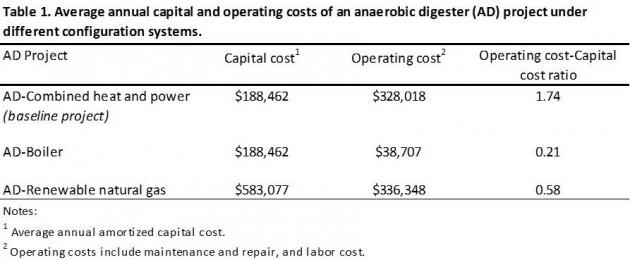
We examined three alternative AD system modifications: (a) combined heat and power, which is the baseline system; (b) boiler as a substitute for combined heat and power; and (c) renewable natural gas infrastructure. Our primary objective was to highlight the findings of a case study (Coppedge et al., 2012), particularly the identification of various factors that may affect the feasibility of an AD project. We answered the following questions:

  1. What is the importance of the relative difference of an AD project’s operating cost with respect to its capital cost?
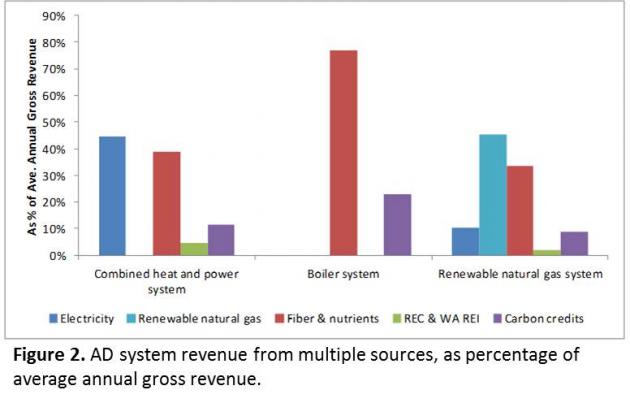
  2. How do different end-uses for biogas (e.g., heat, electricity, renewable natural gas for pipeline or transportation fuel) affect the profitability of a digester project?
  3. How important is revenue from fiber and nutrient co-products to digester profitability?
  4. How important are environmental payments (Renewable Energy Certificates, Renewable Fuel Standards credit, carbon credits) to digester profitability?

This presentation focuses on questions 2 and 4 – end-uses for biogas and environmental payments tied to the alternative renewable energy options.

What have we learned?          

RNG offers promising opportunities. When available and potential renewable fuel credits are added to the commodity price of RNG, the AD project with this system can generate more net returns than with a combined heat and power system (baseline). Furthermore, if renewable fuel is sold as transportation fuel in the retail compressed natural gas market, the renewable natural gas system is more profitable than the baseline system with or without the addition of environmental incentives.Table 1. Average annual operating and capital costs of an anaerobic digester project under different configuration systems


Figure 2. AD system revenue from multiple sources, as percentage of average annual gross revenue.

Future Plans  

We have published a fact sheet (forthcoming) through WSU Extension providing a synthesis of the economic evaluation from the main feasibility study. This fact sheet (EM090E) is part of an Anaerobic Digestion Systems Manual under development with support from USDA NIFA.

Authors      

Chad Kruger, Director, WSU CSANR cekruger@wsu.edu

Suzette Galinatto, Research Associate @ WSU IMPACT Center; Craig Frear, Assistant Professor @ WSU Biological Systems Engineering

Additional information

Coppedge, B., G. Coppedge, D. Evans, J. Jensen, E. Kanoa, K. Scanlan, B. Scanlan, P. Weisberg and C. Frear. 2012. Renewable Natural Gas and Nutrient Recovery Feasibility for DeRuyter Dairy: An Anaerobic Digester Case Study for Alternative Off-take Markets and Remediation of Nutrient Loading Concerns within the Region. A Report to Washington State Department of Commerce. <http://csanr.wsu.edu/publications/deRuyterFeasibilityStudy.pdf>.

Galinatto, S.P., C.E. Kruger, and C.S. Frear (2015). Anaerobic Digester Project and System Modifications: An Economic Analysis. WSU Extension Publications EM090E.

Acknowledgements      

This project was supported by the WSU ARC Biomass Research Program, and USDA National Institute of Food and Agriculture Award #2012-6800219814.

The authors are solely responsible for the content of these proceedings. The technical information does not necessarily reflect the official position of the sponsoring agencies or institutions represented by planning committee members, and inclusion and distribution herein does not constitute an endorsement of views expressed by the same. Printed materials included herein are not refereed publications. Citations should appear as follows. EXAMPLE: Authors. 2015. Title of presentation. Waste to Worth: Spreading Science and Solutions. Seattle, WA. March 31-April 3, 2015. URL of this page. Accessed on: today’s date.
Digested Solids – Forms, Markets and Trends


Are Digested Solids a Viable Product?

Anaerobic digesters for U.S. livestock operations are becoming more complex. A study of livestock-based digesters in 2003 found they were built largely to meet on-farm needs for power or gas. Digester residuals were mostly land applied as nutrients for crop production. A few used fibrous solids as animal bedding (King, 2003). In recent years, more livestock-based digester projects have been built by third-party developer/managers. Projects increasingly employ a systems approach, where individual product streams are managed in concert for greatest profit by the project manager. This approach holds the promise that digestate residuals, especially fiber solids, will no longer be neglected, but instead play a larger role in offsetting weak performance in energy revenues.

What did we do?

Looking closely at dairy-based digesters, the solids recovered after separation from the digester eflluent have unique characteristics. Most notably, these solids tend to be fibrous with high cellulose, hemicellulose, and lignin content. Digestion also reduces pathogenic contaminants, volatile solids, odor, and viable weed seeds (MacConnell, 2010). These qualities can be influenced by the makeup of an animal’s feed and the use of co-digestion feedstocks, such as municipal or industrial wastes or other agricultural manures or byproducts

Table 1 shows the characteristics of dairy AD solids compared to raw manure and raw separated solids (MacConnell, 2010).

Table 1. Fiber Characteristics

Table 1.

As is. In bulk. Sold to a wholesale buyer—this is the easiest way to sell digested dairy fiber. Through a combination of literature search and expert interviews, this presentation looks at the methods project managers might use to add more value to their digested fiber.

What have we learned?

Composting. Perhaps the most basic way to add value to digested dairy fiber is simply to apply basic compost processing methods—aerating the material under controlled conditions for sufficient time to reduce odor and stabilize the organic matter. While already low in pathogens, hot composting practices can give additional assurance of pathogen reduction. In co-digestion situations, screening the material to remove contaminants and assure consistency and uniformity is desired. Even wholesale buyers will pay more for material that is already composted (King 2003)

Processing to compete – replacing peat. Because of its physical similarity, researchers have explored using digested dairy fiber as a direct replacement for peat moss in nursery and horticulture mixes. WSU was an early source of research and growth trials on such uses. Their research showed that with minimal post-digestion treatment, amended digested dairy fiber performed as well or better than peat in soilless mixes. (MacConnell, 2007, and Kruger, 2008) In 2007, Organix, a Washington company, announced the first shipments of RePeat, using their patent-pending FibreRite production system. Since then several new varieties of these peat replacements have hit the market nationwide, under such brands as Magic Dirt, EnerGro, and MooFiber.

Organic certification. Organic gardening and food production is growing rapidly in Washington state and around the nation. Getting an organic certification for organic matter and nutrients that have been digested and composted will add significant value to the final product (King, 2003).

Branding and marketing for retail. Moving away from bulk and wholesale are the next steps in moving material up the value chain. However, putting product in bags and selling into retail markets requires significant investments in packaging, branding, marketing and sales. This is like adding an additional business onto the back end of a digester project and demands its own feasibility analysis.

Vermicomposting. Using earthworms, especially redworms, to further process fiber solids and excrete earthworm castings, produces another specialty soil product. Vermicomposts and earthworm castings are well-known and appreciated in some growers in some markets. They are often used as a small additive in specialty soil mixes to allow the use of “earthworm castings” on the list of ingredients. Two commercial examples of vermicompost production lie on opposite coasts—Sonoma Valley Worm Farm in California and Worm Power in New York. Sonoma Valley Worm Farm direct markets high-quality vermicompost to a variety of growers throughout their region, with special emphasis on vineyards. Worm Power topped 2 million pounds of production in 2012 and signed an agreement with Rochester, NY-based Harris Seeds to market its vermicompost products regionally.

Specialty products produced from the separated fiber materials are another area of interest. Perhaps the best known of such products are the biodegradable planting nursery pots sold as Cow Pots by the Fruend Dairy Farm in Connecticut.

Biochar. This is another specialty product from a fledgling industry that fits in niche markets. It could be used to process digested fiber. It has received a strong research focus in the Pacific Northwest. The value of biochar in landscape or agricultural uses is still being studied, though at present it appears to have less to do with agronomic benefit, than on measured benefits for carbon sequestration and the value given to these benefits through carbon credits or other mechanisms (Galinato, 2011). On the other hand, replacing biochar for conventional forms of activated carbon for filtering stormwater or wastewaters shows some promising results and is getting a lot of attention.

Future Plans      

We will continue to evaluate methods to add value and publish the full results in a Anaerobic Digestion technology brief on this topic.

Authors        

Jim Jensen, Sr. Bioenergy & Alt Fuel Specialist, Washington State University Energy Program jensenj@energy.wsu.edu

Craig Frear, Chad Kruger, and Georgine Yorgey, Center for Sustaining Agriculture and Natural Resources, Washington State University

Additional information  

References:

Galinato, S., Yoder, J., Granatstein, D., 2011. The economic value of biochar in crop production. Energy Policy.

King, 2003. Study to Evaluate the Price and Markets for Residual Solids from a Dairy Cow Manure Anaerobic Digester—Final Report, King County Solid Waste, Seattle, WA.

Kruger, Chad, et.al., 2008. High-quality fiber and fertilizer as co-products from anaerobic digestion. Journal of Soil and Water Conservation.

MacConnell, C.B., Collins, H.P., 2007. Utilization of re-processed anaerobically digested fiber from dairy manure as a container media substrate. Proceedings of the International Symposium on Growing Media, Nottingham, UK.

MacConnell, C., Frear, C., Liao W., 2010. Pretreatment of AD-treated fibrous solids for value-added container media market, Center for Sustaining Agriculture and Natural Resources, Pullman, WA.

Acknowledgements      

This research was supported by funding from USDA National Institute of Food and Agriculture, Contract #2012-6800219814; Biomass Research Funds from the Washington State University Agricultural Research Center; and the Washington State Department of Ecology, Waste 2 Resources Program.

The authors are solely responsible for the content of these proceedings. The technical information does not necessarily reflect the official position of the sponsoring agencies or institutions represented by planning committee members, and inclusion and distribution herein does not constitute an endorsement of views expressed by the same. Printed materials included herein are not refereed publications. Citations should appear as follows. EXAMPLE: Authors. 2015. Title of presentation. Waste to Worth: Spreading Science and Solutions. Seattle, WA. March 31-April 3, 2015. URL of this page. Accessed on: today’s date.
 

Food Waste and Food Processing Waste for Renewable Energy Production


Purpose *          

This high efficient and low-cost eggshell catalyst could make the process of biodiesel production economic and fully ecologically friendly. The ecologically friendly and economic process could effectively reduce the processing cost of biodiesel, making it competitive with petroleum diesel.

What did we do? 

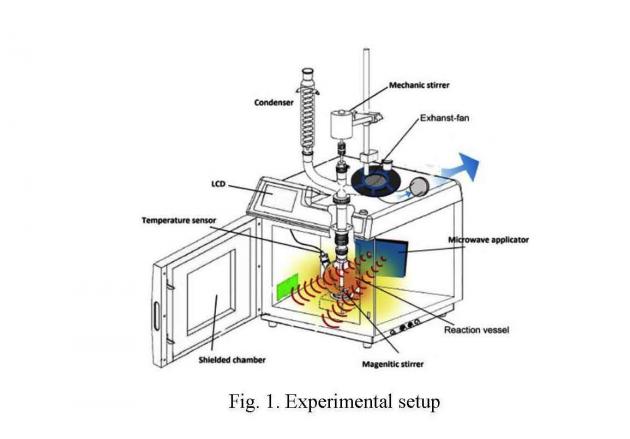
The acid value of Jatropha oil was more than 2 mg of KOH g-1. The methanol, sodium hydroxide (NaOH), and sodium methoxide (CH3-ONa) were high-performance liquid chromatography (HPLC) grade. The experimental setup is shown in Fig. 1.

Fig. 1. Experimental setup

A microwave synthesis reactor (NN-S235, Panasonic Co., Ltd., Taiwan), equipped with a mechanical stirrer and a condenser (LC-10, Hi-point Co., Ltd, Taiwan) was used for microwave reactions. The stirrer was operated at 600 rpm with a magnetic nucleus. Various catalysts (CH3ONa and NaOH), reaction times (1–6 min), methanol to oil molar ratios (3–15), and reaction powers (200–750 W) were tested. The analytic method of methyl ester content in this study followed Taiwan CNS15051 (Chinese National Standards). A GC (gas chromatography; GC-6890, Agilent, USA) system equipped with a FID (flame ionization detector) was used to determine methyl ester content.

What have we learned? 

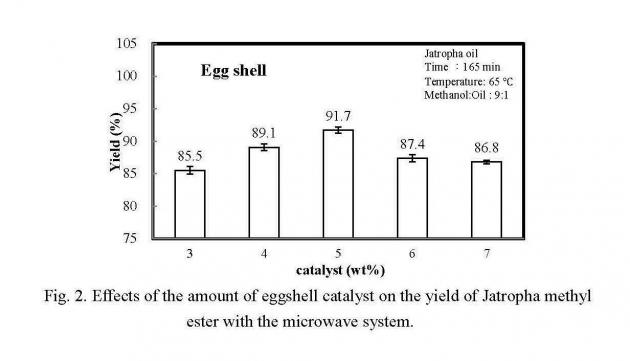
Experiments were carried out using different catalysts in order to investigate their influence on the methyl ester yield. The microwave system was operated with a reaction time of 165 min, microwave power of 750 W, and methanol to oil molar ratio of 9. eggshell and oystershell were used as the catalysts. The fractions of the catalysts were 3, 4, 5, 6, and 7 wt%.

Fig. 2. Effects of the amount of eggshell catalyst on the yield of Jatropha methyl ester with the microwave system

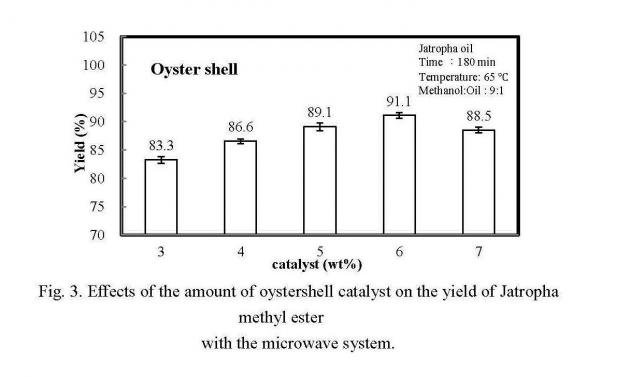
As shown in Fig. 2, the yields of methyl ester were 85.5%, 89.1%, 91.7%, 87.4%, and 86.8% for 3, 4, 5, 6, and 7 wt% eggshell catalysts, respectively. The best performances were with 5 wt% eggshell catalysts. Comparing the eggshell as catalyst, operational condition addition of 6 wt% oystershell catalysts as shown in Fig. 3, the reaction time was 180 min, reaction temperature was 65 ℃, and the methanol-to-oil ratio was 9:1.

Fig. 3. Effects of the amount of oystershell catalyst on the yield of Jatropha methyl ester with the microwave system.

The results indicated that the catalysts derived from eggshells showed yield better than oystershell for biodiesel production.These results indicate that although excess catalyst might increase the biodiesel yield, the amount of glycerin also increased due to saponification, causing a reduction in biodiesel yields.

Future Plans 

High active, reusable solid catalyst was obtained by just calcining eggshell and oytershell. Calcined eggshell and oytershell exhibited high activity towards the transesterification of jatropha oil with methanol to produce biodiesel. The method of reusing eggshell waste and oystershell to prepare catalyst could recycle the waste, minimizing contaminants, reducing the cost of catalyst, and making the catalyst environmentally friendly. This high efficient and low-cost eggshell catalyst could make the process of biodiesel production economic and fully ecologically friendly. Future, the ecologically friendly and economic process could effectively reduce the processing cost of biodiesel, making it competitive with petroleum diesel.

Authors   

Yuan-Chung Lin, Prof. at Inst. Environ. Eng., National Sun Yat-Sen University. Taiwan Deputy Executive Officer at Environ. Protec. & Safety Center yuanchung.lin@gmail.com

Syu-Ruei Jhang1, Yuan-Chung Lin*, Chin-En Chen, Po-Ming Yang, Shang-Cyuan Chen, I-Wei Wang

Additional information                

Yuan-Chung (Oliver) Lin Ph.D.

Prof. at Inst. Environ. Eng., National Sun Yat-Sen University. Taiwan

Deputy Executive Officer at Environ. Protec. & Safety Center

TEL: +886-7-5252000 ext 4412

+886-7-5254412

FAX: +886-7-5254412

Cell: +886-935795228

yclin@faculty.nsysu.edu.tw

yuanchung.lin@gmail.com

The authors are solely responsible for the content of these proceedings. The technical information does not necessarily reflect the official position of the sponsoring agencies or institutions represented by planning committee members, and inclusion and distribution herein does not constitute an endorsement of views expressed by the same. Printed materials included herein are not refereed publications. Citations should appear as follows. EXAMPLE: Authors. 2015. Title of presentation. Waste to Worth: Spreading Science and Solutions. Seattle, WA. March 31-April 3, 2015. URL of this page. Accessed on: today’s date.


Measuring nitrous oxide emissions from a Wisconsin dairy forage cropping system

Nitrous oxide emitted from cropland constitutes a significant component of the agricultural sector’s overall greenhouse gas footprint. In order to accurately evaluate mitigation strategies, predict impacts, and model system behavior under future climate scenarios, it is essential to have access to flux measurements collected under regionally relevant conditions of soil, weather, and management strategies. As part of the Climate Change Mitigation and Adaptation in Dairy Production Systems of the Great Lakes Region USDA Coordinated Agricultural Project, we are measuring nitrous oxide flux from a typical dairy forage rotation in south-central Wisconsin. The rotation consists of one year of corn and three years of alfalfa, receiving liquid dairy manure fertilization in corn and alfalfa establishment years. Fluxes have been tracked over two growing seasons, and comparisons are possible between years as well as between phases of the rotation. Ultimately this data will be used to calibrate models for use in footprinting and benchmarking efforts and in predicting future productivity and resilience of dairy-based systems.

Author

Collier   Sarah     smcollier@wisc.edu        University of Wisconsin-Madison

The authors are solely responsible for the content of these proceedings. The technical information does not necessarily reflect the official position of the sponsoring agencies or institutions represented by planning committee members, and inclusion and distribution herein does not constitute an endorsement of views expressed by the same. Printed materials included herein are not refereed publications. Citations should appear as follows. EXAMPLE: Authors. 2015. Title of presentation. Waste to Worth: Spreading Science and Solutions. Seattle, WA. March 31-April 3, 2015. URL of this page. Accessed on: today’s date.

Livestock grazing in a changing climate: Implications for adaptive management


How Could Climate Change Impact Grazing Livestock?

Predictions that global population will reach nine billion persons by the mid-21st century, combined with the rising middle class in Asia, increases the demand for animal protein production.  Concurrent with the increasing human population is the continued directional rise in atmospheric carbon dioxide (CO2) which just passed the 400 parts per million volume level. Projections are that this concentration will increase to 550 parts per million volume by the end of the 21st century.  Increases in greenhouse gases (like CO2) can lead to 1) increasing temperatures, 2) influencing patterns and amounts of precipitation, 3) raising the sea level and 4) increasing the acidity of oceans.  For vegetation, increases in CO2 atmospheric concentrations result in greater water use efficiency, changes in species composition with “weedy” and “invasive” plants benefiting at the expense of native species, enhanced aboveground primary production, and lower forage quality.  The predicted warmer air temperatures and associated longer growing seasons (i.e., earlier start of spring and later falls) should lead to an increased frequency and intensity of wildfires, as well as greater pest abundance and spread of disease.  As the frequency and intensity/severity of extreme events (e.g., droughts) increases, animal heat stress is expected to become more problematic leading to reduced animal performance and as a result less livestock production.

Related: See the other presentations in this Western Region symposium (cattle selection, policy, climate hubs, ag outlook)

What Is Adaptive Management?

Although livestock managers have historically dealt with drought conditions (e.g., Dust Bowl year of the 1930s, the mid 1950s drought, and the 1988 drought), current efforts associated with the dry years of the early 21st century demonstrate that there is a need for adaptive management to increase resiliency of the rangeland vegetation and sustainability of rural communities and economies.  Adaptive management necessitates that 1) adjustments are made when temporally appropriate (both within and across years), 2) experiential and experimental knowledge is blended to provide sufficient capacity for flexibility with predicted long-term droughts that are more intense/severe, as well as “flash” droughts like the one experienced across a wide swath of the US in 2012, and 3) spatial and temporal variability are embraced rather than looked at as negatives. Key for livestock managers is how to increase flexibility in management to adapt to increasing weather variability associated with a changing climate.  For many managers, matching animal management with intrinsically high inter- and intra-annual variability in forage production is difficult due to inherent maintenance of herd genetics and the lack of a proactive national drought policy.  For example, although a majority (60%) of ranchers in Wyoming have a drought management plan, that still leaves 4 in ten ranchers without a pre-plan to shape management decisions when drought occurs (Kachergis et al. 2014). 

Proactive (i.e., preparation) and reactive (i.e., response) drought management strategies are showcased in Figure 1 (per Kachergis et al. 2014). 

Figure 1.  Proactive and reactive drought management strategies employed by Wyoming ranchers (from Kachergis et al. 2014).

Figure 1.  Proactive and reactive drought management strategies employed by Wyoming ranchers (from Kachergis et al. 2014).

Proactive strategies embrace 1) reserve forage supply and/or 2) varying stocking rate with forage supply, whereas reactive strategies address 1) reducing forage demand, 2) increasing forage supply and/or 3) increasing income, often from off-ranch sources or governmental drought declaration financial assistance.  For proactive strategies, grassbanking, incorporating yearling livestock into the enterprise, and using seasonal weather predictions to adjust stocking rate are all practices that are currently limited in use (< 30% of the managers), but have high potential to increase drought management flexibility.  This is important to managers as 40% of the ranchers surveyed in Wyoming thought that drought would be more influential in their management plans in the future compared to the past (Kachergis et al. 2014).  For dealing with the temporal variability of forage production for livestock grazing, managers can implement adaptive management to 1) manage for reserve forage through conservative stocking rates and grassbanking, 2) match cattle numbers to forage availability by proactively developing enterprise capacity to quickly remove/add grazing animals, or add forage quickly through leasing land, purchasing feed or implementing regional risk reduction strategies such as cooperative arrangements with managers in other regions of the US to move cattle, and 3) understand sources and scales of variability at the ranch/landscape/regional levels due to soils, topography and rainfall.

Related: Agricultural Environmental Management Systems

Author

Justin D. Derner

USDA-Agricultural Research Service, Rangeland Resources Research Unit, Cheyenne, WY USA 82009

Literature Cited

Kachergis, E., J. D. Derner, B. B. Cutts, L. M. Roche, V. T. Eviner, M. N. Lubell, and K. W. Tate. 2014. Increasing flexibility in rangeland management during drought. Ecosphere 5:1-14.

The authors are solely responsible for the content of these proceedings. The technical information does not necessarily reflect the official position of the sponsoring agencies or institutions represented by planning committee members, and inclusion and distribution herein does not constitute an endorsement of views expressed by the same. Printed materials included herein are not refereed publications. Citations should appear as follows. EXAMPLE: Authors. 2015. Title of presentation. Waste to Worth: Spreading Science and Solutions. Seattle, WA. March 31-April 3, 2015. URL of this page. Accessed on: today’s date.
The Dairy Manure Biorefinery


Why Consider Additional Technologies with Anaerobic Digestion?

Some dairy farms have experimented with “add-on” technologies to enhance the value of the products generated from anaerobic digesters to improve economics and address other environmental and management concerns. This effort has intensified in recent years, as prices paid for electricity continue to fall. This trend is making it more difficult to justify the installation of new digesters or maintain active anaerobic digestion (AD) projects based on electricity sales alone. 

What did we do?

Based on ten years of research and extension within the field of dairy digesters, we are proposing that the concept of a dairy manure biorefinery can be useful to focus ongoing research and commercialization efforts (Figure 1). A biorefinery integrates a core biomass conversion process (in this case, AD, converting manure and in many cases other organic substrates) with additional downstream technologies. These combined technologies generate multiple value-added products including fuels, electricity, chemicals, and other products (NREL, 2009). Most add-on technologies relevant to dairy facilities have been modified from technologies used in the wastewater treatment and oil and gas industries. 

What have we learned?

Ongoing research and commercialization efforts by our team and others aim to:

  • Adapt technologies to fit the economic and other constraints of dairy digesters.
  • Increase efficiency and reduce costs by maximizing the complimentary nature of technologies (e.g. waste heat from one process is used in another process).

Specific add-on technologies that are continuing to evolve within the biorefinery context include:

Biogas Upgrading to remove impurities from biogas (primarily carbon dioxide, hydrogen sulfide, and water vapor).

Output: Purified biogas that can be used as a transportation fuel (e.g. liquefied natural gas) or injected directly into natural gas piplelines.

Additional social and economic benefits: Renewable fuel can reduce demand for fossil fuels, and can often receive economic credits (e.g. renewable identification numbers, low carbon fuel standard)

Fiber Upgrading to process the fiber that is removed from AD effluent.

Output: Upgraded fiber can be sold as a higher-value soil amendment in the horticultural industry

Additional social and economic benefits: Fiber can replace use of non-renewable resource (peat moss) by horticultural industry

Nutrient Recovery to strip nitrogen (N) and phosphorus (P) from anaerobic digester effluent.

Outputs: Soil amendment products that can be sold offsite where nutrients are needed

Additional social and economic benefits: Reductions in N and P applied to nearby fields, and reduced effluent hauling distances/costs for land application due to lower nutrient concentration in effluent

Water Recovery to generate “recycled” water using advanced technologies

Output: Water that can be used for animal drinking, or as dilution water for the AD facility

Additional social and economic benefits: Reduces consumption of fresh water, a limited resource, and reduces costs for land-application of AD effluent

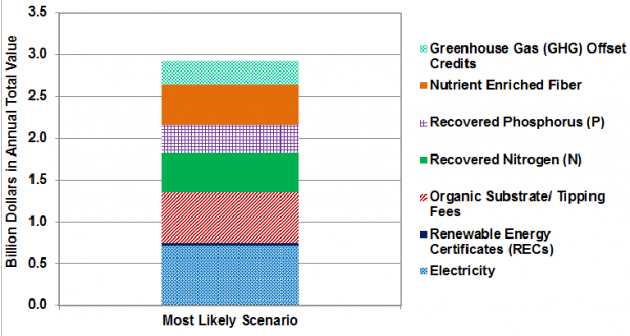
Overall Potential Impact. Improving economics and addressing other critical issues for dairy producers (e.g. nutrient issues) has the potential to advance farm-based AD adoption significantly beyond its current 244 farms. It has been estimated that a mature bio-refinery industry based on AD on large U.S. dairy farms could create an estimated bio-economy of nearly $3 billion that complements the production of milk and dairy products (ICUSD, 2013).

Figure 1. Stepwise depiction of the process

Figure 2. Total likely value added by most likely scenario

Authors

Georgine Yorgey (presenting author)a, Craig Frearb, Nick Kennedya, Chad Krugera, Jingwei Mab, and Tara Zimmermana

a Center for Sustaining Agriculture and Natural Resources, Washington State University

b Department of Biological Systems Engineering, Washington State University

Future Plans

An extension document describing this concept and the add-on technologies in additional detail is being prepared. This document is part of a series of extension documents on Dairy AD Systems, being prepared by the authors and other colleagues at Washington State University. In addition, ongoing work and collaborations by our team are seeking to investigate, evaluate, and improve individual technologies and the linkages amongst them.

Additional Information

ICUSD, 2013. National market value for anaerobic digestion products. Report to Innovation Center for US Dairy, August 2013.

Acknowledgements

This research was supported by USDA National Institute of Food and Agriculture, contract #2012-6800219814; and Biomass Research Funds from the Washington State University Agricultural Research Center.

The authors are solely responsible for the content of these proceedings. The technical information does not necessarily reflect the official position of the sponsoring agencies or institutions represented by planning committee members, and inclusion and distribution herein does not constitute an endorsement of views expressed by the same. Printed materials included herein are not refereed publications. Citations should appear as follows. EXAMPLE: Authors. 2015. Title of presentation. Waste to Worth: Spreading Science and Solutions. Seattle, WA. March 31-April 3, 2015. URL of this page. Accessed on: today’s date.

Evaluation of a Continuously-Mixed Farm-Based Anaerobic Co-Digestion System Following the U.S. EPA Protocol for Quantifying and Reporting on the Performance of Anaerobic Digestion Systems for Livestock Manures – Final Project Results

This paper compliments another paper proposed for this conference “Lifecycle analysis of greenhouse gas (GHG) emissions from a New York State dairy farm anaerobically co-digesting manure and food waste.”

Purpose 

New York State’s largest manure-based anaerobic co-digestion facility was evaluated continuously for a 2-year period following the U.S. EPA Protocol for quantifying and reporting on the performance of anaerobic digestion systems for livestock manures. Overall, we assessed and determined the system’s performance with respect to the: 1) conversion of biomass to biogas, 2) conversion of biogas to useful energy, and 3) system’s economics. The information developed by this project can be used to compare performance information developed from other manure-based anaerobic digestion systems. Related: Treatment Technologies for Livestock Manure

What did we do? 

After initial system evaluation and monitoring plan development, the farm was visited monthly for 24 months to collect data. In addition to the digester influent and effluent samples taken during each monthly sampling date, on-site measurements were taken and data were manually recorded from equipment and plant logs. A particularly important log, were the imported feedstocks brought on-site for inclusion to the AD. This log recorded the date and time feedstock was delivered, the type of feedstock, and the volume delivered. The specific data collected/measured are shown in Table 1.

Table 1. Data collected/measured on-site at each sampling date.

Item
1. Date and time of readings
2. Methane (CH4), Carbon dioxide (CO2), Oxygen (O2), and Hydrogen sulfide (H2S) concentrations in biogas after digester
3. CH4, CO2, O2, and H2S concentrations in biogas after bio-scrubber
4. Engine-generator set run time
5. Cumulative electricity purchased and sold
6. Daily animal populations since previous sampling event
7. Logs of imported feedstocks
8. Problems occurred during period

Further, data (Table 2) from the system’s supervisory, control, and data acquisition (SCADA) unit were downloaded, compiled and analyzed for each period. SCADA data were generated from an array of sensors and meters originally installed by the company that designed and built the digester, i.e., Bigadan A/S.

Table 2. Data obtained from the SCADA system for each period.

Parameter

1. Total influent to pasteurization
2. Food waste to pasteurization
3. Manure to pasteurization
4. Biomass from pasteurization to digester
5. Effluent digester to storage tank
6. Biogas production digester
7. Biogas to generator
8. Generator electrical energy output
9. Generator thermal energy recovered
10. Digester vessel upper temperature
11. Digester vessel lower temperature

Overall, digester influent and effluent samples were collected with the goal of obtaining representative samples. To do this, grab samples were collected directly from both the digester influent and effluent lines over a period of approximately 30 min during a pumping sequence, to develop a 5-gallon composite, master-sample. The entire volume of this sample was then agitated using a paint mixer powered by a portable electric drill until visibly determined to be homogenized. A 1-liter composite sample was immediately taken and stored on ice, and subsequently frozen before being sent for laboratory analysis. Samples were taken in this fashion approximately every 30 days over the 24-month monitoring period. Additionally, samples coming from the raw manure receiving tank and from the combined imported feedstocks tank were also obtained for two sampling dates at the beginning of the monitoring project to characterize the individual influent streams to the digester.

All samples collected during the 24-month monitoring period were sent for analysis to Certified Environmental Services’ (CES) laboratory in Syracuse, NY, approved by the New York State Department of Health, Environmental Laboratory Approval Program (NYSDOH-ELAP #11246). All samples were analyzed in triplicate for: total solids (TS), total volatile solids (VS), chemical oxygen demand (COD), pH, and total volatile acids as acetic acid (TVFA). In addition, the following nutrients were determined in triplicate: total phosphorus (TP), ortho-phosphorus (OP), total Kjeldahl nitrogen (TKN), ammonia-nitrogen (NH3-N) and potassium (K). CES followed the appropriate testing methods outlined in Table 3 for each parameter measured.

Table 3. Standard analytical methods used by CES laboratory for sample analyses.

Parameter Standard
Total Solids (TS) EPA 160.3
Total Volatile Solids (VS) EPA 160.4
Fixed Solids (FS) EPA 160.4
Volatile Acid as Acetic Acid (TVFA) SM18 5560C
Chemical Oxygen Demand (COD) SM18 5220B
pH SW846 9045
Total Kjeldahl Nitrogen (TKN) EPA 351.4
Ammonia-Nitrogen (NH3-N) SM18 4500F
Organic-Nitrogen (ON) By subtraction: TKN – NH3-N
Total Phosphorous (TP) EPA 365.3
Ortho Phosphorous (OP) EPA 365.3
Total Potassium (K) EPA SW 846 6010

Methane (CH4), carbon dioxide (CO2), hydrogen sulfide (H2S), and oxygen (O2) concentration in biogas, were measured on-site during monthly visits using a Multitec 540 (Sewerin GmbH, Germany), a portable hand-held gas measuring device equipped with infra-red/electrochemical sensors.

What have we learned? 

For the entire monitoring project, an average of 1,891±62 lactating cows per day from Synergy Dairy contributed manure to the digester. The average daily loading rate of the digester was 80,408±19,266 gal, where the average percent of imported waste (mostly food-grade residues) co-digested with manure was 25±6% on a volume-to-volume (v/v) basis. The average reduction of organic matter thru the monitoring project was 42% with respect to the influent, while 75% of the odor-causing volatile fatty acids were reduced. In comparison, a previous monitoring study reported by the authors in five manure-based co-digestion operations showed a reduction in organic matter and volatile acids between 36% and 53% and 85% and 91%, respectively. The average daily digester biogas production for the entire monitoring project was 495±78 ft3 per 1,000 lbs of total influent added to the digester, or 173±34 ft3 per cow contribut ing to the digester. The engine-generator set produced an average of 23±7 MWh of electricity per day, from which the average daily parasitic load of the AD system was 3±1 MWh, accounting for approximately 14% of the electricity generated by the plant. Overall, the average capacity factor and online efficiency of the anaerobic digester system during the entire monitoring project were 0.66±0.22 and 80±23%, respectively. The electrical energy generated translated into an overall thermal conversion efficiency of 42±4%. Also, an additional 13±5% of the total energy in the biogas was recovered by the engine as hot water. Thus, an overall 55% (electrical + thermal) of the total energy contained in the input biogas was recovered by the engine-generator set during the monitoring project.

The majority of the challenges experienced by the Synergy AD system were of mechanical origin, whereas 20% were related to the biological process; only 8% of the downtime was due to scheduled systems maintenance. Some of the problems were related to the extreme cold conditions experienced in the Northeast during the period from December 2013 to February 2014. According to NOAA’s National Climatic Data Center, this period was the 34th coldest for the contiguous 48 states since modern records began in 1895, with an average temperature of 31.3F, 1.0F below the 20th century average (NOAA, 2014).

Future Plans 

This manure-based anaerobic digester is the 8th New York State digester we have extensively monitored and reported on. Near-term future planned work includes monitoring a lower cost horizontal plug flow digester on a 2,000-cow farm. This digester uses high density polyethylene (HDPE) material heat welded together as the digester vessel.

Authors

Curt Gooch, Senior Extension Associate, Cornell PRO-DAIRY Program cag26@cornell.edu

Rodrigo Labatut

Additional information 

A full report, written for the project sponsor, can be found on the Cornell PRO-DAIRY dairy environmental systems website, https://prodairy.cals.cornell.edu/environmental-systems/.

Acknowledgements

First and foremost, we wish to thank the Synergy Dairy Farm, Synergy Biogas, and CH4 Biogas for their collaborative efforts that made this project possible. We also like to thank the project sponsor, the Wyoming County (New York) Industrial Development Agency.

The authors are solely responsible for the content of these proceedings. The technical information does not necessarily reflect the official position of the sponsoring agencies or institutions represented by planning committee members, and inclusion and distribution herein does not constitute an endorsement of views expressed by the same. Printed materials included herein are not refereed publications. Citations should appear as follows. EXAMPLE: Authors. 2015. Title of presentation. Waste to Worth: Spreading Science and Solutions. Seattle, WA. March 31-April 3, 2015. URL of this page. Accessed on: today’s date.