How Can Algae Be Used to Manage Nutrients in Pig Manure?

green stylized pig logoUsually when people see the words “algae” and “manure” in the same paragraph, it is usually a negative take on the effects of manure nutrients on water. When excess nutrients are transported to water bodies (from lawn fertilizer, municipal waste treatment plants, manure and/or commercial crop fertilizer) algae use those nutrients and grow rapidly. When the nutrients are no longer sufficient for growth, the algae begins to die and decompose. This depletes oxygen in the water, which can lead to fish kills and other problems for aquatic life.

The same characteristics of algae that can make it a nuisance also make it an innovative way to treat wastewater when grown in an engineered system. The fact that the algae are able to utilize the nutrients within the water to multiply and grow rapidly can be exploited within a managed system to create a potential source of biomass, and serve as a biological mechanism to remove nutrients. The sustained biological activity of algae can also add dissolved oxygen to the water, potentially reducing the direct emissions of methane and nitrous oxide (greenhouse gases) from volatilization of stored manure. Current research is exploring the use of harvested algae as an animal feed, source of biofuel (algal oil production), or biomass in thermal energy production.

For more information:

Author: Rick Field, University of Arkansas and Jill Heemstra, University of Nebraska

Acknowledgements

This information is part of the program “Integrated Resource Management Tool to Mitigate the Carbon Footprint of Swine Produced In the U.S.,” and is supported by Agriculture and Food Research Initiative Competitive Grant no. 2011-68002-30208 from the USDA National Institute of Food and Agriculture. Project website.

Does Manure Solid-Liquid Separation Reduce Greenhouse Gas Emissions on Swine Farms?

green stylized pig logoThere is some research suggesting that separating swine manure into solids and liquids can slightly reduce greenhouse gas (GHG) emissions emitted from the manure itself. It is not likely to be significant enough for separation to be a viable strategy by itself.

The primary reason to use solid-liquid manure separation is to prepare manure for further treatment in a system that can:

  1. generate energy (such as anaerobic digestion, thermal technologies, etc.)
  2. produce products for re-use on a farm (such as bedding for dairy cows),
  3. generate compost or fertilizer.

Any of these options can reduce the GHG emissions or carbon footprint of a farm by replacing fossil-fuel intensive inputs.

For more information

Authors: Rick Fields, University of Arkansas and Jill Heemstra, University of Nebraska jheemstra@unl.edu

Acknowledgements

This information is part of the program “Integrated Resource Management Tool to Mitigate the Carbon Footprint of Swine Produced In the U.S.,” and is supported by Agriculture and Food Research Initiative Competitive Grant no. 2011-68002-30208 from the USDA National Institute of Food and Agriculture. Project website.

What Is Gasification of Manure?

green stylized pig logoWhen looking at ways to improve the environmental impact of pig production, renewable energy generation is a popular topic. One such technology, gasification, is a series of chemical reactions (see image at bottom) that involve heating a suitable organic material in a controlled, low-oxygen environment to the point that the hydrocarbons (simple organic compounds that contain only hydrogen and carbon) are converted to synthesis gas (‘syngas’). Syngas is composed of hydrogen and carbon monoxide with smaller amounts of methane and carbon dioxide, all of which can be collected and utilized for heat and energy generation.

This manure treatment technology also produces mineral-rich bio-char and ash. Since this bio-char is less bulky than raw manure (and contains most, if not all, of the nutrients) it is much easier to handle and more cost effective to transport long distances. This can be beneficial in areas where nutrients are becoming concentrated on crop fields and contributing to water quality problems. The use of bio-char as a topically applied  soil amendment is currently being  explored for its potential at reducing ionization and thus aiding in the retention of nutrients by impeding chemical transformations and volatilization.

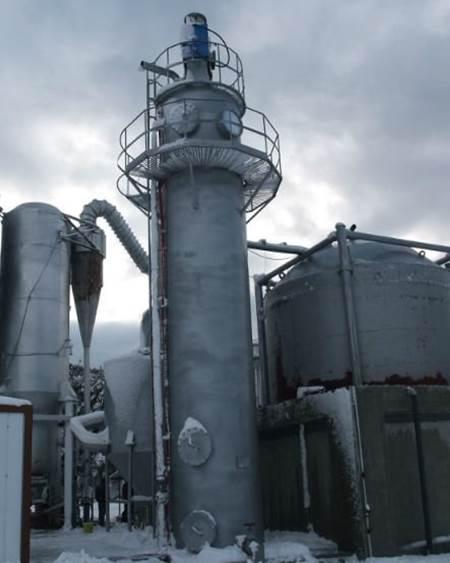
a two ton per hour fluidized bed biomass gasifierMany different organic materials can be used in gasification; wood, plant residues, certain types of manufacturing or household waste, and manure, among other biomass sources. Standard gasification systems utilizes materials that are dry (not pump-able) like beef feedlot manure, poultry litter, or manure that has undergone solids separation. Pig or dairy cattle manure tends to be a wet material and either require drying or a system designed to handle materials like these – wet gasification systems.  Related: Different types of manure gasification systems.

For more information:

chemical representing thermochemical conversion of manure to energy and other products

Image above provided by Dr. Samy Sadaka, University of Arkansas

Authors: Rick Fields, University of Arkansas and Jill Heemstra, University of Nebraska jheemstra@unl.edu

Acknowledgements

This information is part of the program “Integrated Resource Management Tool to Mitigate the Carbon Footprint of Swine Produced In the U.S.,” and is supported by Agriculture and Food Research Initiative Competitive Grant no. 2011-68002-30208 from the USDA National Institute of Food and Agriculture. Project website.

Do We Know the Carbon Footprint of the Pork Industry?

green stylized pig logoA carbon footprint is a total of all the greenhouse gas emissions (GHG) from a process or industry. A life cycle assessment (LCA) is the process used to figure out what GHG emissions will be included in the footprint. More technically, it is systematic way of looking at a product’s complete life cycle and calculating a “footprint”.  In addition to carbon footprints, there are efforts to calculate land, water, and other environmental footprints.

Below are highlights from several different reports that looked at the carbon footprint of the pork industry on a national and international scale. A comparison between different ways to raise pigs was also highlighted.

Snapshot of the Present Time

On a national scale, a report on the National Life Cycle Carbon Footprint Study for Production of Swine in the U.S. was conducted and published in 2011.

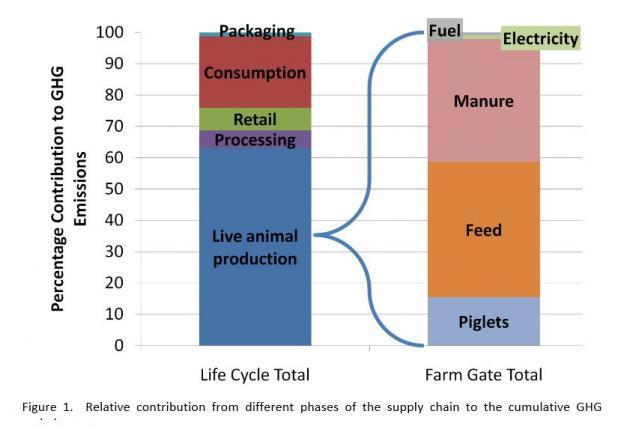
The report concluded that the carbon footprint to prepare and consume a 4 oz serving of pork was ~2.5 lbs of carbon dioxide equivalents. Figure 1 (below) from that report shows the relative breakdown of the industry’s estimated greenhouse gas emissions:

  • Live animal production made up 62.1% of the emissions. That is further broken down and presented in second column (right).
  • Processing – 5.6%
  • Retail – 7.54%
  • Consumption – 23.5% including refrigeration, cooking, and methane from food waste in landfill
  • Packaging (1.3%);

Life cycle assessment of pork production in the U.S.

Comparison Over 50 Years of Production

Another example of an industry-wide analysis, this one comparing over time, is a “50-year comparison of the carbon footprint of the U.S. swine herd 1959 – 2009” (29 pp; PDF). The pork industry overall emits more total greenhouse gases than 50 years ago, but actually emits much less per pound of pork produced because of improvements in efficiency.

From that publication:

The U.S. swine industry produces pigs far more efficiently today (2009) than in 1959. The number of hogs marketed has increased 29% (87.6 million in 1959 to 112.6 million in 2009 after removing market hogs imported directly to harvest) from a breeding herd that is 39% smaller. The efficiency gain is even more impressive when measured against the total dressed carcass weight harvested. Dressed carcass yield leaving the farm has nearly doubled in 50 years from 12.1 billion pounds to 22.8 billion pounds. This increase in productivity has resulted in an increase of 2,231 pounds (2.5x) of carcass harvested annually per sow – year. Today, it takes only five hogs (breeding and market) to produce the same amount of pork that  required eight hogs in 1959.

Comparing Different Ways of Raising Pigs

An example of an LCA that looks at different types of systems is “Life-cycle assessment of commodity and niche swine operations“. (informal Q&A and journal article both available). From the journal article (bottom of page 5):

High-profitability operations have consistently lower impacts compared to low-profitability operations for both commodity and deep-bedded niche piglet production.

Global Assessment from Backyard to Industrial Systems

On an international scale, the report “Greenhouse gas emissions from pig and chicken supply chains” was published in 2013. This study looked at all scales of farms from backyard pigs to industrial production (large confinement operations). Over the entire scale, they estimated that the carbon footprint of pork for every kg (~2.2 lbs) of pig carcass weight has an emissions intensity of 6.1 kg of carbon dioxide equivalent.

This report found that backyard systems, especially in some parts of the world, have low emissions, largely due to by-product or “second-grade” feeds. Industrial pig systems tended to have more emissions intensity than backyard systems, with the emissions from liquid/slurry manure management systems being a big reason. From the conclusion of the report:

When drawing any conclusions about scope for improvement, the following points should be borne in mind: (a)differences in emission intensity may reflect differences in production systems that have arisen over time to enable the system to perform better within a given context, e.g. to make them more profitable, or resilient; (b) focusing on a single measure of efficiency (in this case GHG emissions per kg of output) can lead to positive and negative side effects on, for instance, biodiversity, water quality and animal welfare; (c) reducing GHG emissions is not the only objective producers need to satisfy, as they also need to respond to changing economic and physical conditions.

How Do Carbon Footprints Compare?

It is very important to note that when looking at data and numbers generated from different reports like these, the carbon footprints are difficult to compare unless they use the same LCA. Presenting carbon footprints from different LCA’s is an “apples to oranges” comparison. Only when the same LCA is used, can they be an “apples to apples” comparison.

Additional Information

Acknowledgements

Authors: Amy Carroll, University of Arkansas and Jill Heemstra, University of Nebraska jheemstra@unl.edu

This information is part of the program “Integrated Resource Management Tool to Mitigate the Carbon Footprint of Swine Produced In the U.S.,” and is supported by Agriculture and Food Research Initiative Competitive Grant no. 2011-68002-30208 from the USDA National Institute of Food and Agriculture. Project website.

What Greenhouse Gases Are Emitted by Pig Farms?

green stylized pig logoIn 2014, all man-made sources of greenhouse gas (GHG) emissions in the U.S. were estimated to be 6,870.5 MMT CO2e (millions of metric tons carbon dioxide equivalent). Agriculture was estimated to be responsible 8.3% of those emissions (573.6 MMT CO2e per year). When looking specifically at animal agriculture, all different species together emit an estimated 243.4 MMT CO2e/year, which is 3.5% of all U.S. emissions. The pork industry is estimated to have emitted 26.6 MMT CO2e or 0.34%. (Source: US EPA Greenhouse Gas Inventory 2015)

The two areas where the swine industry produced measurable contributions to agricultural emissions include:

  • Enteric fermentation – the release of gases during normal digestion by animals. Pigs release approximately 2.4 MMT CO2e of the of the 164.3 MMT CO2e produced by all livestock and poultry in the U.S.
  • Manure management – pig farms are estimated to  release 24.2 MMT CO2e of the 78.7 MMT CO2e produced by all animal manure systems in 2014.

Manure management is planned using a total system approach. Animal manure management systems involve six basic functions: production, collection, transfer, storage, treatment and utilization.  The first five out of those six make up the manure management number above. Utilization (usually by land application to crop fields) is instead categorized within “Agricultural soil management”. The greenhouse gases emitted from manure systems include methane and nitrous oxide which form as manure decomposes. 

When all of the GHGs emitted during a particular activity or process are added together, it is the carbon footprint.  The standardized procedure to calculate carbon footprints is a life cycle analysis or LCA.  

Related: Carbon Footprint, Life Cycle Analysis and the Pork Industry

For more information:

Authors: Jill Heemstra, University of Nebraska-Lincoln and Rick Fields, University of Arkansas

Acknowledgements

This information is part of the program “Integrated Resource Management Tool to Mitigate the Carbon Footprint of Swine Produced In the U.S.,” and is supported by Agriculture and Food Research Initiative Competitive Grant no. 2011-68002-30208 from the USDA National Institute of Food and Agriculture. Project website.

Animal Agriculture, Manure Management, and Water Quality

This module is an overview of animal agriculture in the U.S. and how industry trends have affected manure management. Because the primary use of manure is land application as a plant fertilizer, the module addresses nutrient management and surface water quality impacts. The module also covers regulatory requirements and efforts to manage and reduce risks of manure nutrients reaching water.

Part I – Manure Management and Water Quality

1. Animal Agriculture Trends

Economic pressures and consumer demands have driven a trend toward consolidation in the animal agriculture industry. This has changed the way manure is collected and stored. Virtual tours of layer hen, pig, beef, dairy, and broiler sectors are included.

2. Manure Collection and Storage

Animal feeding operations collect and store manure in several ways with the largest differences being between those that handle manure as a “solid” and those that handle manure as a “slurry” or “liquid”.

3. Land Application of Manure Nutrients

Land application of manure requires specialized equipment and technologies that continue to evolve. This equipment and technology must be combined with nutrient management planning to ensure manure applications are from the right source, at the right rate and time, using the right methods, and in the right place.

4. Water Quality and Manure

Improperly managed manure can negatively impact water quality. This section focuses primarily on surface water and nutrients but other topics are briefly introduced.

5. Clean Water Act Requirements

Some animal feeding operations are regulated under the National Pollutant Discharge Elimination Program (NPDES). The NPDES program is part of the Clean Water Act.

6. Planning for Stewardship

As new information, tools, and resources become available, farmers have opportunities to continually improve environmental stewardship and manage risks related to manure and water quality.

Part II – Conservation

7. The Importance of Conservation In Animal Agriculture

Learn about how USDA NRCS promotes conservation practices and why conservation is so important to protect water quality.

8. Conservation Practices Commonly Used On Animal Agriculture Farms

This section highlights manure management, land and pasture management, and mortality management practices available for animal ag producers to practice conservation on their farm.

Acknowledgements Part I

These materials were developed by the Livestock and Poultry Environmental Learning Center (LPELC) with funding from the U.S. Environmental Protection Agency and with input from the Natural Resources Conservation Service, National Cattlemen’s Beef Association, National Milk Producers Federation, National Pork Board, United Egg Producers, and U.S. Poultry and Egg Association.

Many people contributed time, expertise, video, or images for the production of the three videos produced in this module.

  • Animal agriculture trends and manure management – Tetra Tech, Inc.; Mark Risse, University of Georgia; Leslie Johnson, University of Nebraska; Tom Hebert, Bayard Ridge Group; Bill Couser, Couser Cattle.
  • Manure nutrient management – Tom Hebert, Bayard Ridge Group; Tetra Tech, Inc.; Mary Berg, North Dakota State University; Mario de Haro Marti, University of Idaho; Mark Risse, University of Georgia; Leslie Johnson and Rick Koelsch, University of Nebraska; Bill Couser, Couser Cattle.
  • Managing manure to protect water quality – Tetra Tech, Inc.; Mark Risse, University of Georgia; Leslie Johnson, University of Nebraska; Tom Hebert, Bayard Ridge Group; Bill Couser, Couser Cattle.

For questions on these materials, contact Jill Heemstra, jheemstra@unl.edu. All images in this module, unless indicated otherwise, were provided by Jill.

Acknowledgements Part II

These materials were developed by the Livestock and Poultry Environmental Learning Center (LPELC) and Eastern Research Group, Inc. with funding from the USDA Natural Resources Conservation Service through an interagency agreement with the U.S. Environmental Protection Agency.

For questions on these materials, contact Jill Heemstra, jheemstra@unl.edu. All images in this module, unless indicated otherwise are courtesy USDA NRCS.

Greenhouse Gases and Agriculture (Self Study Lesson)

This is a self-guided learning lesson about greenhouse gases (GHG) and their connections to livestock and poultry production. It is useful for self-study and for professionals wishing to submit continuing education credits to a certifying organization. Anticipated time: 60 minutes. At the bottom of the page is a quiz that can be submitted and a score of 7 out of 10 or better will earn a certificate of completion. (Teachers/educators: visit the accompanying GHG curriculum materials page)

Module Topics

  1. Why does climate change?
  2. How does US agriculture to compare to other industries and worldwide agriculture?
  3. What greenhouse gases (GHG) are emitted by livestock and poultry farms?
  4. What are mitigation and adaptation strategies

What is Climate Change?

Download and read “Why Does Climate Change?” (PDF; 8 pages). Includes basics and terminology about natural and man-made drivers of climate change.

US Agriculture Comparisons to Other Industries and Worldwide Agriculture

Watch this short video “Agriculture and Greenhouse Gases: Some Perspective” (5 minutes). This also includes some very good reasons why farmers, ranchers, and ag professionals should care about the topic of climate change, regardless of political stances on solutions.

Greenhouse Gases Emitted by Livestock, Poultry. and Other Agricultural Activities

Watch this short video discussing the most important gases produced through livestock, poultry, and cropping activities on farms and ranches. (8 minutes)

Review the following fact sheet:

Mitigation and Adaptation

Watch this short video “Carbon, Climate Change, and Controversy” by Marshall Sheperd, University of Georgia (4 minutes)

Watch this video on “Mitigation and Adaptation: Connections to Agriculture” (13 minutes)

Quiz

When you have completed the above activities, take this quiz. If you score at least 7 of 10 correct, you will receive a certificate of completion via email. If you are a member of an organization that requires continuing education units (CEUs), we recommend that you submit your certificate to them for consideration as a self-study credit (each individual organization usually has a certification board that decides which lessons are acceptable). Go to quiz….

American Registry of Professional Animal Scientist (ARPAS) members can self-report their completion of this module at the ARPAS website.

Acknowledgements

Author: Jill Heemstra, University of Nebraska-Lincoln

Building Environmental Leaders in Animal Agriculture (BELAA) is a collaborative effort of the National Young Farmers Educational Association, University of Nebraska-Lincoln, and Montana State University. It was funded by the USDA National Institute for Food and Agriculture (NIFA) under award #2009-49400-05871. This project would not be possible without the Livestock and Poultry Environmental Learning Community and the National eXtension Initiative.

Video Resources on Animal Agriculture, Manure, and Environmental Stewardship

The embedded spreadsheet lists several collections of livestock and poultry related video resources that are a combination of archived webinars, field video, or recorded conference presentations. In most cases, you can search the collection by using its search function (YouTube channels) or by using your browser’s “find” function to location a key word or phrase.

The stewardship-focused topics in these collections these are wide-ranging: manure treatment, anaerobic digestion, grazing management, soil health, air quality and odors, greenhouse gases and climate, animal welfare, pathogens, regulations, and much more. The cover all sizes of farms and all species of food animals (beef, dairy, pig, poultry, sheep and goats) as well as horses.

Most of these resources are freely available to use in educational or non-commercial programs with proper attribution. It is always a good idea to contact the person listed if you utilize the resources so they are aware the resources are useful (and continue to produce them) and to provide written permission.

If you are aware of additional videos or collections that should be added to the list, visit the spreadsheet and add the requested information.

If you have questions, contact Jill Heemstra, Nebraska Extension.

Biosecurity for Livestock and Poultry Manure Management

Most biosecurity plans are meant to protect animal and human health by preventing the spread of bacteria or other pathogens. Indirectly, effective biosecurity practices can reduce the likelihood of multiple or catastrophic mortalities which is an issue of environmental concern. While not usually discussed under the umbrella of “biosecurity”, manure handling should not be ignored when considering your plan. Related: Manure Pathogens

Avian Influenza | Swine PEDv | Pumping & Land Application | Inspectors | Mortalities | Recommendations by Species

Avian Influenza Resources

Since 2015, millions of birds have either died or had to be euthanized because of highly pathogenic avian influenza (HPAI). The approved methods of disposal for large-scale (catastrophic) mortalities include: burial, incineration, and composting.

PEDv (Porcine Epidemic Diarrhea virus) Resources

The swine industry has experienced significant losses as a result of PEDv, which can be transmitted through contact with manure of infected pigs. It is possible to move the virus between farms on vehicles, pumps, manure handling equipment, clothing, or any other item that comes in contact with manure and is not thoroughly disinfected between farms/fields. The low amount of viral exposure required to cause illness means that even tiny amounts of residual manure pose significant biosecurity risks.

Preventing Manure Pathogen Dispersal Between Farms or Field

Restricting access of off-farm equipment and personnel involved in manure pumping or manure application and thorough cleaning of equipment between farms are among the recommendations to follow to reduce risks of spreading manure-borne pathogens.

    • North Dakota State Biosecure Nutrient Management. This fact sheet does an especially nice job describing how to manage and clean equipment used in manure handling around the farm.
    • The National Pork Board released fact sheets on Biosecure Manure Pumping Procedures for farmers (pg 20), commercial manure haulers (pg 22), and land owners (pg 20).
    • The Maryland Department of Agriculture developed a brochure related to transporting manure and set out some guidelines to prevent the spread of pathogens.

Biosecurity for Inspectors or Technical Service Providers

What should regulatory inspectors do when traveling between farms to prevent the spread of disease? What requests can farmers make of inspectors to protect their farm biosecurity?

Biosecure Mortality Management

One of the best collections on composting animal mortalities comes from the Cornell Waste Management Institute. Check out their sections on health and safety and animal mortality composting for research on pathogen destruction and other safety considerations.

The following fact sheet was developed in response to the PEDv (porcine epidemic diarrhea virus), although these guidelines should be effective for reducing the risks related to other pathogens. It focuses on the use of rendering as the main mortality disposal method. Biosecure Mortalities Removal (pg 10)

Farmer & Farm Worker Biosecurity Resources

The following resources are not focused on managing manure but give a great overview of the larger biosecurity issue and practices on livestock and poultry farms.

Swine

farm worker in a confined swine barn
This farm worker follows the farm biosecurity protocol and is wearing coveralls and boots that are cleaned and laundered on-site.

Poultry

Dairy

Beef Cattle

Goats and Sheep

Smartphone Apps for Manure Management

Waste to Worth: Spreading science and solutions logoWaste to Worth home | More proceedings….

graph

The home screen of the Manure Calculator app.

Abstract

Technology is driving many exciting possibilities in agriculture. The increase in use of smartphones, tablets, and other mobile devices is changing the way people consume information and interact with each other. One exciting opportunity is to utilize smartphone apps to make farm record keeping easier.  With that in mind, two apps were created for livestock and poultry farms, “Manure Calculator” and “Manure Monitor”.

Why Create Apps for Livestock and Poultry Environmental Stewardship?

Concerns about the digital divide and access to technology often mean that educators try to ensure educational materials are available in paper or other common formats. The creation of apps seems like a tool that would be available only to a select group. The reality is that mobile technologies are leapfrogging the traditional use of computers or laptops and many are gaining access to digital information through mobile devices of their own or those accessed through an adviser or educator. We believe that mobile apps have potential to actually increase the reach of credible, research-based information to audiences that may be underserved through traditional educational outreach.

One of the problems with record-keeping is that these are seen as an ‘add-on’ or additional chore beyond what a farmer would normally do. Incorporating records or planning processes into mobile devices can lower this inconvenience factor since users usually keep their mobile devices with them all the time and are comfortable using them.

Last, but not least, farmers are becoming more aware of the need to communicate their actions and stewardship ethics to audiences not familiar with agriculture. Social media, blogs, and crowdsourcing sites (like Reddit or Wikipedia) make it more possible than ever for farmers to interact with people that have questions or are skeptical about certain farming practices. Keeping records or developing plans on a mobile device makes it easier to share actions and activities and potentially counteract negative or misleading information that is circulated through the same media.

graph

Home screen for the Manure Monitor app.

What Did We Do?

“Manure Calculator” has three sections. 1) calculate the amount of manure spread (calibrate your spreader) 2) calculate the amount of nutrients applied by using either your own manure test or using book values and 3) calculate the economic value of that manure. The app keeps a history of past entries and allows the user to email a single entry or an entire history to themselves for record keeping purposes. The value section was based on an existing spreadsheet from the University of Nebraska. The book values section was based on the ASABE 384.2 Manure Production and Characteristics standard.

Future Plans

We believe that two of the concerns for app development are:

1) The cost to develop apps. When looking at such a specific topic as manure management or environmental records, the cost is usually the first question asked by other educators or agency staff and it can be substantial. Our plan is to make this app code available to others that would like to customize or build on the app for their clientele (specific species or specific state). This will hopefully lower the cost of development for others AND lead to app versions that are more useful to farmers. It is also important to recognize that creating both of these apps was actually less expensive than funds needed to develop some of the traditional educational modules in this same project.

2) Integration into software. We believe apps can be even more useful if they provide a simple way to enter data into software being used for comprehensive planning or record keeping procedures. Software companies interested in integrating these apps into data entry will be welcomed.

Author

Jill Heemstra, University of Nebraska jheemstra@unl.edu

Acknowledgements

This program originated thanks to funding from the USDA National Institute for Food and Agriculture (NIFA) Beginning Farmer and Rancher Development Program (BFRDP) under award #2009-49400-05871. This project is a joint effort between University of Nebraska, Montana State University, Livestock and Poultry Environmental Learning Center and the National Young Farmers Educational Association (NYFEA).

App developer: Jeff Abele from Move Creative http://movecreative.com

We would like to thank the following people for their feedback and reviews of the apps:

Leslie Johnson, Charles Shapiro, William Kranz, Larry Howard, and Rick Koelsch, University of Nebraska; Mark Risse and Melony Wilson, University of Georgia; Laura Pepple, University of Illinois; Amanda Douridas, Ohio State University; Thomas Bass, Montana; Saqib Mukhtar, Texas AgriLife Extension; Rhonda Miller, Utah State University; and many others.

The authors are solely responsible for the content of these proceedings. The technical information does not necessarily reflect the official position of the sponsoring agencies or institutions represented by planning committee members, and inclusion and distribution herein does not constitute an endorsement of views expressed by the same. Printed materials included herein are not refereed publications. Citations should appear as follows. EXAMPLE: Authors. 2013. Title of presentation. Waste to Worth: Spreading Science and Solutions. Denver, CO. April 1-5, 2013. URL of this page. Accessed on: today’s date.