Manure Spreader Calibration Field Days for Confined Animal Facility Operators in South Carolina

Waste to Worth: Spreading science and solutions logoWaste to Worth home | More proceedings….

Abstract

Confined Animal Facility Operators in South Carolina either utilize the manure they produce directly on their own land or sell the manure to be used on another farm.  The application of this manure is regulated by SC Regulation R.61-43, which provides application setback requirements, nutrient application rates, and other information pertaining to the utilization of the manure as a nutrient source.  One requirement of this regulation is that growers must calibrate their spreader equipment once each year in order to provide an accurate application of the manure.  Spreader calibration field days were developed for both liquid and solid manure application systems and held in multiple locations around South Carolina.  The poster will detail the methods used, the amount of grower interaction and participation, and the number or growers attending and utilizing this program.

Authors

Bryan Smith, Clemson University Cooperative Extension Service               wsmth@clemson.edu

Brian L. Beer, M.S., Area Extension Agent – Livestock, Clemson Extension Service, Lee van Vlake, M.S., Area Extension Agent – Livestock, Clemson Extension Service


The authors are solely responsible for the content of these proceedings. The technical information does not necessarily reflect the official position of the sponsoring agencies or institutions represented by planning committee members, and inclusion and distribution herein does not constitute an endorsement of views expressed by the same. Printed materials included herein are not refereed publications. Citations should appear as follows. EXAMPLE: Authors. 2013. Title of presentation. Waste to Worth: Spreading Science and Solutions. Denver, CO. April 1-5, 2013. URL of this page. Accessed on: today’s date.

South Carolina’s Confined Animal Manure Manager Program

Waste to Worth: Spreading science and solutions logoWaste to Worth home | More proceedings….

Abstract

In 1998 the South Carolina Legislature enacted regulation R.61-43, titled “Standards for the Permitting of Agricultural Animal Facilities.”  This regulation provides requirements on Confined Animal Facility location and permitting, facility management, vector control, mortality disposal, manure application and storage, and a number of other topics.  A portion of this regulation stipulates that Clemson University shall provide training in the management of confined animal facilities and the proper application and utilization of manure produced from these facilities.  The poster will detail the major points of the regulation and the development and presentation of the Confined Animal Manure Manager program in South Carolina to over 1,500 growers to date.

Authors

Bryan Smith, Clemson University Cooperative Extension Service               wsmth@clemson.edu

Jesse Adams III, M.S., Area Extension Agent – Livestock, Clemson Extension Service (ret.), Brian L. Beer, M.S., Area Extension Agent – Livestock, Clemson Extension Service, John P. Chastain, Ph.D., Professor and Extension Agricultural Engineer, Clemson University, Julie D. Helm, DVM, Livestock-Poultry Health Division, Clemson University, Stephen T. Henry, M.S., Environmental Engineer, USDA-NRCS, Tonya O’Cain, Agricultural Compliance Manager, SCDHEC, Lee van Vlake, M.S., Area Extension Agent – Livestock, Clemson Extension Service


The authors are solely responsible for the content of these proceedings. The technical information does not necessarily reflect the official position of the sponsoring agencies or institutions represented by planning committee members, and inclusion and distribution herein does not constitute an endorsement of views expressed by the same. Printed materials included herein are not refereed publications. Citations should appear as follows. EXAMPLE: Authors. 2013. Title of presentation. Waste to Worth: Spreading Science and Solutions. Denver, CO. April 1-5, 2013. URL of this page. Accessed on: today’s date.

Staying Ahead of the Curve: How Farmers and Industry Are Responding to the Issue of Climate Change

Waste to Worth: Spreading science and solutions logoWaste to Worth home | More proceedings….

Why Is This Topic Important?

Several farmers, ranchers, and industry groups are leading the way on the issue of climate change. 

What Will Be Learned In This Presentation?

These panelists will share how their farm or industry is responding to climate change, what factors are driving their decision to make changes, and the impact of climate change on long-term planning. This moderated session will encourage audience questions and facilitate exchange of ideas on how the agriculture industry can meet this challenge.

Presenters

David Smith, Southwest Region Coordinator Animal Agriculture and Climate Change Project, Texas A&M University dwsmith@ag.tamu.edu and Liz Whitefield, Western Region Coordinator, Washington State University

  • Jamie Burr –  Tyson Foods, Chair National Pork Board Environment Committee
  • Abe Collins – cattle grazier, Cimarron Farm, Regenerative Farmscaping consultant, Board Member Soil Carbon Coalition
  • Paul Helgeson – Sustainability Director with Gold’n Plump Chicken
  • Bryan Weech, Director Livestock & MTI Commodity Lead, World Wildlife Fund
  • Andy Werkoven – dairyman and anaerobic digester co-owner, Werkhoven Dairy Inc., 2012 winner of US Dairy Sustainability Award


Feasibility of Installation of Anaerobic Digesters at Cattle Operations and Demonstration of a Decision Support Tool

Waste to Worth: Spreading science and solutions logoWaste to Worth home | More proceedings….

Abstract

An online decision support tool for determining feasibility of anaerobic digestion has been developed (http://www.erams.info/AD_feasibility/). This decision support tool is specifically targeted to cattle operations in the arid west and provides general information on anaerobic digestion (AD), recommendations on the technical and economic feasibility of AD based on producer provided information on management practices, recommendations on appropriate AD technology based on user defined criteria for the system, guidance on technology provider selection, and required maintenance for operation of an AD system. The goal of the tool is to enable and empower producers to make informed decisions about AD based on unbiased information rather than relying on the biased information often provided by technology providers. In this workshop, the drivers for technical and economic feasibility for on farm AD installation will be discussed and the online decision support tool will be demonstrated.

Why Look at Anaerobic Digestion for Cattle Operations?

Anaerobic digestion is a waste management tool with many advantages, including generation of energy for on-site use. However, careful consideration must be given regarding technical and economic feasibility for installation on cattle operations. A web-based decision tool has been developed to provide technical and economic guidance to producers on feasibility of on-farm anaerobic digestion (http://www.eramsinfo.com/erams_beta/AD_feasibility/).

Home Page of Web-based Decision Support Tool

What Did We Do?

Based on commonalities found from feasibility studies conducted throughout the state of Colorado, a web-based decision tool has been developed to provide technical and economic guidance to producers on feasibility of on-farm anaerobic digestion (http://www.eramsinfo.com/erams_beta/AD_feasibility/)

What Have We Learned?

For use of conventional anaerobic digestion technology at dairy facilities, manure should be collected on concrete by scraping or flushing. Anaerobic digestion of manure collected on dry lots is not feasible with conventional technology.  Economics are favorable when on-site energy use is high and the energy produced by the digester is primarily used on-site.

Future Plans

We will continue to develop and improve the existing web-based tool. We are also working on developing an anaerobic digestion technology suitable for dry lot collected manure.

Authors

Sybil Sharvelle, Assitant Professor, Colorado State University, Department of Civil and Environmental Engineering, sybil.sharvelle@colostate.edu

Jeffrey Lasker, Research Assistant, Colorado State University

Lucas Loetscher, Research Assistant, Colorado Sate University

Additional Information

http://www.eramsinfo.com/erams_beta/AD_feasibility/


The authors are solely responsible for the content of these proceedings. The technical information does not necessarily reflect the official position of the sponsoring agencies or institutions represented by planning committee members, and inclusion and distribution herein does not constitute an endorsement of views expressed by the same. Printed materials included herein are not refereed publications. Citations should appear as follows. EXAMPLE: Authors. 2013. Title of presentation. Waste to Worth: Spreading Science and Solutions. Denver, CO. April 1-5, 2013. URL of this page. Accessed on: today’s date.

Effect of Manure Handling and Incorporation on Steroid Movement In Agricultural Fields Fertilized With Beef Cattle Manure

Waste to Worth: Spreading science and solutions logoWaste to Worth home | More proceedings….

Why Study Manure Land Application and Steroids?

Manure generated from concentrated animal feeding operations may serve as a source of steroids in surface water and adversely impact the development of aquatic ecosystems. The objectives of this research were to determine the amount of steroids and metabolites in manure from beef cattle production pens, and runoff from crop production fields.

What Did We Do?

Heifers were treated with zeranol, trenbolone acetate, and 17b-estradiol implants and fed melengestrol acetate, while a second group was not treated with growth promoters. Manure was sampled in the pens during feeding, run-off was collected during rainfall events, after feeding manure was collected, and either composted or stockpiled overwinter. In the  following summer both composted and stockpiled manure was spread on a field, with plots subjected three tillage practices. Following application, two rainfall simulation events were conducted: one day (1 DAT) and one month later (30 DAT) to determine the effects of rainfall timing, manure handling (treated compost, untreated compost, treated stockpile and untreated stockpile) and tillage (no-till, moldboard plow+disk and disk) on the runoff losses of steroids.

What Have We Learned?

Simulated rainfall apparatus.

Results from the manure composting showed reduction in steroid concentrations over stockpiling for some compounds in manure samples such as 4-androstenedione, a-zearalenol, and progesterone, though not for all steroids. Very low concentrations of steroids were found in most runoff samples, approaching or below detection limits. Considering only detection frequency, fewer runoff samples showed traces of steroids on the 1 DAT in comparison to the 30 DAT simulations.  The amount of  rainfall  before runoff was initiated was affected by tillage, and was different for the 1 DAT and 30 DAT events. A second year’s study with a smaller set of treatments, and use of a surrogate estrogen applied at known mass showed that disking significantly reduced runoff losses of the steroids. Runoff risk is affected by the storm event needed to initiate runoff, and also the time since manure application.

Soil during rain simulation and tube to take runoff to collection point.

Future Plans

From both the steroid runoff and general manure applications risk perspectives, how the soil receives rainfall changes during the first month after tillage. Therefore, this process needs to be investigated more closely and models predicting runoff have to take these changes into account.

Authors

Charles A. Shapiro, Professor, Department of Agronomy and Horticulture, University of Nebraska-Lincoln, Haskell Agricultural Laboratory, Concord, NE cshapiro@unl.edu

Sigor Biswas, Research Assistant, William L. Kranz, Associate Professor, David P. Shelton, Professor, Simon J. van Donk, Assistant Professor, Biological Systems Engineering; Daniel D. Snow, Associate Professor, Schol of Natural Resources; Shannon L. Bartelt-Hunt, Assistant Professor, Tian C. Zhang, Professor, Civil Engineering; Terry L. Mader, Professor, Animal Science, University of Nebraska-Lincoln; David D. Tarkalson, Soil Scientist, USDA-ARS, Kimberly-ID. 

Additional Information

Bartelt-Hunt, S., D. Snow, W. Kranz, T. Mader, C. Shapiro, S. van Donk, D. Shelton, D. Tarkelson, and T.C. Zhang. 2012. Effect of growth promotants on the occurrence of steroid hormones on feedlot soils and in runoff from beef cattle feeding operations. Environ. Sci. Technol. 46(3): 1352-1360.

Biswas, S., C. A. Shapiro, W. L. Kranz, T. L. Mader, D. P. Shelton, D.D. Snow, S. L. Bartell-Hunt, D. D. Tarkalson, S. J. van Donk, T. C. Zhang, S. Enslay. Current knowledge on the environmental fate, potential impact and management of growth promoting steroids used in the US beef cattle industry. J. of Soil and Water Cons. (In press, July 2013 issue).

Acknowledgements

This research was funded by US-EPA Science to Achieve Results (STAR) grant R833423.


The authors are solely responsible for the content of these proceedings. The technical information does not necessarily reflect the official position of the sponsoring agencies or institutions represented by planning committee members, and inclusion and distribution herein does not constitute an endorsement of views expressed by the same. Printed materials included herein are not refereed publications. Citations should appear as follows. EXAMPLE: Authors. 2013. Title of presentation. Waste to Worth: Spreading Science and Solutions. Denver, CO. April 1-5, 2013. URL of this page. Accessed on: today’s date.

The Role of Drainage Depth and Intensity on Hydrology and Nutrient Loss in the Northern Corn-Belt

Waste to Worth: Spreading science and solutions logoWaste to Worth home | More proceedings….

Why Are We Concerned About Nutrient Loss and Tile Drainage?

Water management in the crop root-zone is crucial to successful crop growth and production. Irrigation, surface, and subsurface drainage—and other practices—are routinely implemented throughout the world to improve crop productivity and working conditions of the soil. Water management practices also impact the environmental footprint of agricultural systems by affecting the flow of water, nutrients, sediment, and other constituents through field, farms, and watersheds. Water management practices for agriculture in the Midwestern US should be designed with both profitability and the environment in mind. The design of subsurface (tile) drainage systems has traditionally been more a matter of how much drainage one can afford, rather than the aforementioned objectives. The relationship among subsurface drainage design characteristics (depth, spacing, layout), farm profitability, and environmental impact are not well known at the farm scale. Thus, drainage system design may fail to meet one or more of these important objectives. This presentation will examine the effects of subsurface drainage system design criteria on productivity, profitability, and the environment, using the soils and climatic conditions of the northern corn-belt (southern Minnesota).

Check Out These Other Presentations About Tile Drainage

Swine Manure Timing & Subsurface Drainage

Tile Drainage Field Day

Use of Filters in Drainage Control Structures

New Technologies for Drainage Water Management

Authors

Gary Sands, University of Minnesota      grsands@umn.edu

Dario Canelon, University of Minnesota; Mike Talbot, University of Minnesota


The authors are solely responsible for the content of these proceedings. The technical information does not necessarily reflect the official position of the sponsoring agencies or institutions represented by planning committee members, and inclusion and distribution herein does not constitute an endorsement of views expressed by the same. Printed materials included herein are not refereed publications. Citations should appear as follows. EXAMPLE: Authors. 2013. Title of presentation. Waste to Worth: Spreading Science and Solutions. Denver, CO. April 1-5, 2013. URL of this page. Accessed on: today’s date.

The Arkansas Discovery Farm Program: Connecting Science to the Farm

Waste to Worth: Spreading science and solutions logoWaste to Worth home | More proceedings….

Why Create the Arkansas Discovery Farm Program?

Agriculture in Arkansas is under increasing pressure to manage nutrients and sediment in an environmentally sustainable manner.  In many sectors of the farming community, this has created severe constraints to remaining economically viable and competitive in today’s global market place.  In northwest Arkansas, home to the nation’s second largest broiler poultry production, farmers have been under intense scrutiny and litigation over the last decade, due to downstream water users (i.e., Oklahoma) questioning the role of agriculture in water quality impairment.  Also, increasing national attention is being focused on reducing nutrients to the Gulf of Mexico, which will further increase the need of agricultural producers to increase nutrient efficiency while declining groundwater levels in crop producing areas of eastern Arkansas will increase the need for greater water efficiency.  The Arkansas Discovery Farm Program was initiated in 2009 to document the effectiveness of conservation practices on “real-world” private farms across the diverse forage, livestock, and row crop agricultural setting across the State.

What Did We Do?

We are monitoring runoff quality from seven farms as we are quantify sediment and nutrient losses from all major row crop and livestock commodities including rice, soybean, corn, cotton, poultry and beef cattle.  We are currently monitoring the quality of runoff from 19 fields using automated water quality samplers that are now equipped modems that contact us via cell phone when sampling is initiated.    On our row crop fields, we have increased our efforts to monitor irrigation water use and needs.  All fields are equipped with turbine-type irrigation flow meters that utilize dataloggers to automatically records flow data.  On two farms, we split fields in half and monitored evapotranspiration with atmometers (ET gages) and compared to our computer irrigation scheduler to calibrate the ET gages as an easier field method for irrigation scheduling.

What Have We Learned?

Due to the fact that we have been monitoring runoff since mid-2011 at the longest, we have limited reliable information to present.  As our first year, 2011 produced several severe flood-stage storms and 2012 provided a record breaking drought, it is difficult to quantify impact at this point.  While the water quality monitoring is a cornerstone, empowering agricultural producers to take ownership in finding solutions to minimize environmental impact is paramount to protecting voluntary efforts for the industry.  Our major findings to date have been the willingness of Arkansas farmers in general to embrace the Program, to be environmentally accountable for their actions, and to be proactive rather than reactionary.   

Future Plans

We have plans to develop another Discovery Farm in the litigated Illinois River Watershed, Northwest Arkanas.   While there is a great deal of interest in developing a commerical forestry Discovery Farm, a lack of potneital funding has limited those plans to date.  As we continue to collect data, we hope we can provide timely information on both economic and natural resource sustainability on behalf of Arkansas Agriculture to regulators, lawmakers and other decision makers. 

Authors

Andrew Sharpley, Professor, Division of Agriculture, University of Arkansas System, sharpley@uark.edu

Mike Daniels, Professor, Cooperative Extension, Division of Agriculture, University of Arkansas System

Neal Mays, Program Technician, Division of Agriculture, University of Arkansas System

Cory Hallmark, Program Technician, Cooperative Extension, Division of Agriculture, University of Arkansas System

Additional Information

http://discoveryfarms.uark.edu/

Acknowledgements

Arkansas Association of Conservation Districts, Arkansas Conservation Commission, Arkansas Natural Resource Conservation Service, Arkansas Farm Bureau


The authors are solely responsible for the content of these proceedings. The technical information does not necessarily reflect the official position of the sponsoring agencies or institutions represented by planning committee members, and inclusion and distribution herein does not constitute an endorsement of views expressed by the same. Printed materials included herein are not refereed publications. Citations should appear as follows. EXAMPLE: Authors. 2013. Title of presentation. Waste to Worth: Spreading Science and Solutions. Denver, CO. April 1-5, 2013. URL of this page. Accessed on: today’s date.

Next Generation Technology Swine Waste-to-Energy Project

Waste to Worth: Spreading science and solutions logoWaste to Worth home | More proceedings….

Abstract

* Presentation slides are available at the bottom of the page.

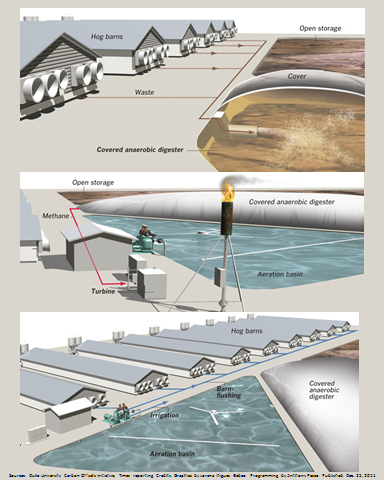
The Loyd Ray Farms project is the first swine waste project in the State of North Carolina to generate and transfer renewable energy credits (RECs) to a public utility.  Utilizing an anaerobic digester as primary treatment, this waste treatment system is designed to meet the Environmental Performance Standards set forth by NC law for new and expanded swine facilities through the use of nitrification/denitrification and further treatment. The system implemented at this farm utilizes anaerobic digester technology to turn raw animal waste into biogas.  The biogas is used to fuel a microturbine, generating electricity to power the environmental treatment system, and about half of the farm. Related: Manure value & economics

The farm is a finishing swine operation that houses approximately 9,000 pigs near Yadkinville, NC.  The concept for this approach was conceived by the team in 2006, followed by economic and performance modeling, permitting, and construction of the commercial-scale system.  The project was commissioned on May 27, 2011.  Funding for construction was provided by Duke Energy and Duke University, with support from USDA-NRCS and the NC Division of Soil and Water Conservation.  Google provides operational funding support in exchange for a portion of the carbon offsets created.

Loyd Ray Farms is the only innovative Swine waste system in North Carolina that generates Renewable Energy Credits for an electric utility,  which generates enough power for  the treatment system and has enough surplus electricity to power about half of the farm.  Cavanaugh collaborated in this study with Duke University, Duke Energy,  and Google with funding from NC Soil & Water Conservation and USDA/Natural Resources Conservation Service.

Forefront: Tatjana Vujic of Duke University views the meter readings

The project began as a conversation about greenhouse gas emissions, sources for renewable energy, and sustaining the state’s swine industry among Duke Energy, Duke University, Google, and Cavanaugh.  That conversation led to a project that is getting attention around the world, for its successes in combining strategies to address the concerns for generating renewable energy from agricultural sources, sustaining agriculture, and addressing farming’s relationship to climate change.

The system’s goals: generating about 500 megawatt-hours of electricity annually, reducing greenhouse gas emissions equivalent to 5,000 tons of carbon dioxide annually, reducing ammonia and odor emissions from the farm, and improving the quality of treated wastewater on the farm.”

Is Manure to Energy Important?

We will discuss the successes and challenges in partnered efforts by farmers, electric utilities, and other stakeholders in the marrying of renewable energy generation with enhanced environmental treatment and green house gas emissions reduction, including the economics of such effort.

What Did We Do?

Waste generated by the animals is flushed into an anaerobic digester where bacteria consume the waste and respire energy-rich biogas.  The biogas fuels a microturbine that generates electricity, and excess gas is flared.  After digestion, the liquid waste is further treated to achieve the Environmental performance Standards set forth by North Carolina for Innovative Swine Waste Treatment Systems.

The process by which the stakeholders came together in a partnership, the technologies and approaches selected, and the successes/challenges that can be gleaned for advancing future projects.  The Loyd Ray Farms project is the first Swine Waste-to-Energy project in the State of North Carolina to place RECs on the North Carolina Utilities Commission REC Tracking System, and is the first swine farm in North Carolina to transfer RECs to Duke Energy.  Coupling techniques to improve the environmental treatment system employed at the farm, the Loyd Ray Farm project is also the first ‘Innovative Swine Waste Treatment System’ permitted that utilizes an anaerobic digester as a primary form of waste treatment.

Presenters

William G. “Gus” Simmons, Jr., P.E. Cavanaugh & Associates, P.A., gus.simmons@cavanaughsolutions.com

Gus Simmons, lead designer, M. Steve Cavanaugh, Jr., and Marvin Cavanaugh, Sr. during the commissioning of the system.  Cavanaugh developed the concept for Duke University in an effort to create a cost-effective solution that converts swine waste into renewable energy while achieveing a superior level of waste treatment and a reduction in the carbon footprint created by the conventional waste management system.

Gus Simmons, P.E., is the Director of Engineering at Cavanaugh & Associates, a consulting firm specializing in stewardship through innovation.  An NC State University graduate with a BS in Biological & Agricultural Engineering, Gus  has worked for a major agricultural producer where he was Director of Environmental Affairs and Engineering Services, managing engineering and construction for facilities in the US and Europe.  Gus has designed, permitted, and managed over 5,000 acres of wastewater irrigation in NC, and thousand of acres of wastewater irrigation in the Western US. He has assisted many municipalities and private entitites with the development and implementation of reclaimed water systems and reuse irrigation systems, and has actively participated in alternative wastewater management strategies for the NC Pork Industry.  His recent sucessess include the engineering design of an anaerobic digester for animal waste to energy project in Yadkinville, NC which has gained world-wide recognition for its successes in generating RECs and greenhouse gas credits.

Additional Information

The authors are solely responsible for the content of these proceedings. The technical information does not necessarily reflect the official position of the sponsoring agencies or institutions represented by planning committee members, and inclusion and distribution herein does not constitute an endorsement of views expressed by the same. Printed materials included herein are not refereed publications. Citations should appear as follows. EXAMPLE: Authors. 2013. Title of presentation. Waste to Worth: Spreading Science and Solutions. Denver, CO. April 1-5, 2013. URL of this page. Accessed on: today’s date.

Measuring Greenhouse Gas and Nitrogen Gaseous Losses When Comparing Bulking Agents Used to Compost Separated Hog Solids

Waste to Worth: Spreading science and solutions logoWaste to Worth home | More proceedings….

Why Study Composting Separated Manure Solids?

This research is evaluating management options for conventional hog producing facilities in regions of Manitoba that will have insufficient land base for sustainably applying raw slurry manure when manure application regulations switch from nitrogen based to phosphorus based rates. Producers are being encouraged to use solid-liquid separation, such as centrifugation, to remove the phosphorus rich solid fraction so that it can be transported and applied further away where there is a phosphorus deficiency. However, the resulting separated hog solids (SHS) product is still odorous and prone to nitrogen losses through ammonia volatilization. Therefore, it has been suggested that composting the SHS before it is applied is a beneficial management practice that would allow producers to capitalize on agricultural and environmental benefits such as reduced odours, stabilization of minerals, application of a homogeneous product, and acts as a multi-beneficial soil conditioner. However, the low starting C:N of 15:1 and small particle size of SHS make it a unique and challenging product to compost in windrows, a common form of large production on-farm composting. The SHS must be combined with a bulking agent that allows adequate nutrient balance for decomposition as well as a porous structure. Therefore, this project is comparing wood shavings (WS) and wheat straw (WHT) as bulking agents to evaluate which is the better management practice based upon minimizing greenhouse gas emissions and additional nitrogen gas losses as well as overall quality of the mature compost. 

LI-8100a automated flux chamber

What Did We Do?

Starting in October 17, 2012 we created two windrows containing SHS, one with wood shavings as a bulking agent and one with wheat straw. The materials were mixed in a feed mixer to produce a homogeneous mixture with the initial starting parameters shown in Table 1. The windrows were turned once a week for the first four weeks with a Backus windrow turner.

Gas emissions were measured with the use of the highly innovative technology of the LI-8100a automated chamber system (LICOR BioSciences) and Fourier Transform Infrared spectroscopy (FTIR) multi-gas analyzer (Gasmet DX4015). By combining these two instruments it has the advantage of nearly continuous unattended data collection and simultaneous measurement of greenhouse gases (carbon dioxide, methane, nitrous oxide) and additional nitrogen gases (ammonia, nitrous dioxide, and nitrogen monoxide). There were four automated chambers on each windrow; a flux measurement was taken every half hour, alternating between the two windrows. Flux emissions were calculated using linear regression analysis.

Table 1. Initial starting parameters for the two windrows

Initial In-process Compost

Starting C:N

Starting Moisture %

Starting Bulk Density (kg/m3)

Starting pH

WHT + SHS

32.5

63.70

170.5

6.86

WS + SHS

35.5

60.45

350

6.5

The temperature, % oxygen, and moisture content of the windrows were recorded to identify when the compost needed to be turned and to track the composting process and relate it to the gases emitted.

Backhus compost windrow turner

What Have We Learned?

In September 2011 we conducted a trial that used straw as a bulking agent but found the contact between the separated hog solids and straw was poor due to the difference in particle size allowing for large pore spaces and the waxy texture of straw. The porous structure made it difficult to maintain moisture in the compost windrow and when water was added some of the separated hog solids actually “washed off”.  In the winter, the windrow wasn’t big enough or it was too porous that it did not insulate well so self heating stopped and the pile froze in January. These problems slowed the decomposition process and resulted in compost with straw pieces still visible.

For this trial we decided to try using wood shavings as an alternative bulking agent, because wood shavings have a smaller particle size which we predicted would result in better contact with the separated hog solids and a less porous structure allowing better insulation against the weather (water loss in the summer, heat loss in the winter). Additionally, it is expected that wood shavings are also beneficial in reducing ammonia losses.

However, during this trial we experienced much wetter and cooler conditions compared to the year before, so we did not have to add water to the windrows. This was beneficial for the windrow with straw because the moisture content did not decline resulting in a steady rate of decomposition during the first month of composting noted by continuous CO2 emissions. Eventually the moisture content became too high creating anaerobic conditions and the production of CH4 after the second and fourth turnings. NO2 emissions were also detected during the same time as CH4, indicating some aerobic respiration occurring. After CO2 emissions reduced there was a small amount of N2O and NO measured.

The windrow with wood shavings took a little longer to start producing CO2 because it became anaerobic from the start. CH4 was produced much early and at higher emission rates compared to the windrow with the straw as a bulking agent. N2O, NO, and NO2 were emitted at the same time as CH4, indicating there were anaerobic and aerobic pockets throughout the windrow. N2O emissions continued after CO2 emissions declined.

Composting in the winter

After the windrows had been in the active stage of composting for three months, the temperature within the windrows gradually declined and both windrows froze up in early January.

We are currently in the process of calculating the ammonia flux determinations. Due to the nature of ammonia it is prone to absorbtion reactions on the surface of the LI-8100a and FTIR systems’ tubing. The surface reactions cause a time delay for the FTIR to analyze the concentration compared to the other gases. Thus, this gas requires a different time interval to calculate the flux.

Future Plans

A common problem with using chamber measurements on compost windrows is underestimation of gas emissions from chambers placed on the top of the windrow when high winds blow through the windrow horizontally, reducing the “chimney effect”. Having the ability to collect gas emission data at such a high frequency using the LI-8100a automated chamber and FTIR system allows us to identify when gases emissions may be underestimated due to wind. The next step is to determine if we can correlate the wind speed and direction with under estimation of gas losses.  

Authors

Jolene Rutter, MSc. Candidate, University of Manitoba, Jolene_rutter@hotmail.com

Mario Tenuta, Canada Research Chair in Applied Soil Ecology, University of Manitoba

Matt Gervais, Soil Ecology Field Technician, University of Manitoba

Acknowledgements

Western Economic Diversification Canada, Manitoba Pork Council, Manitoba Horticultural Productivity Enhancement Centre, Manitoba Rural Adaptation Council, NSERC, National Center for Livestock and the Environment, University of Manitoba Soil Ecology Laboratory, Glenlea Research Farm, Prairie Agricultural Machinery Institute, Compo-stages, Puratone


The authors are solely responsible for the content of these proceedings. The technical information does not necessarily reflect the official position of the sponsoring agencies or institutions represented by planning committee members, and inclusion and distribution herein does not constitute an endorsement of views expressed by the same. Printed materials included herein are not refereed publications. Citations should appear as follows. EXAMPLE: Authors. 2013. Title of presentation. Waste to Worth: Spreading Science and Solutions. Denver, CO. April 1-5, 2013. URL of this page. Accessed on: today’s date.
Organic Mulches in Ginseng Production

Waste to Worth: Spreading science and solutions logoWaste to Worth home | More proceedings….

Abstract

During ginseng production, pesticides are intensively applied to the fields, creating risks to farm workers health and the environment. To reduce pest infestation, and consequently pesticide loading, organic mulches with potential disease suppressive properties were investigated as replacements for the conventional straw mulch. A four year study was initiated as ginseng is usually harvested after four years in Wisconsin. The results after one year are being presented. Anaerobic digestate solids (dairy manure feedstock) and vermicompost (grain feedstock) were applied at rates of  1/2″ or 1″ per plot, prior to planting (fall) and/ or in the spring  prior to germination. Soil samples were obtained one month following planting to determine seed damage by pest infestation; germination rates were calculated in the spring. Fewer seeds were damaged by pests in the plots with anaerobic digestate (AD) solids mulch compared to the vermicompost plots, and were similar to the controls. Germination rates for certain vermicompost and AD solids plots were equivalent to the controls. AD solids and vermicompost mulch showed beneficial results after the first year of this experiment.

Authors

Jonathan Rivin, University of Wisconsin Extension            jonathan.rivin@uwsp.edu


The authors are solely responsible for the content of these proceedings. The technical information does not necessarily reflect the official position of the sponsoring agencies or institutions represented by planning committee members, and inclusion and distribution herein does not constitute an endorsement of views expressed by the same. Printed materials included herein are not refereed publications. Citations should appear as follows. EXAMPLE: Authors. 2013. Title of presentation. Waste to Worth: Spreading Science and Solutions. Denver, CO. April 1-5, 2013. URL of this page. Accessed on: today’s date.