Dissipation of Fine Particulates Downwind of Poultry Houses

Waste to Worth: Spreading science and solutions logoWaste to Worth home | More proceedings….

Abstract

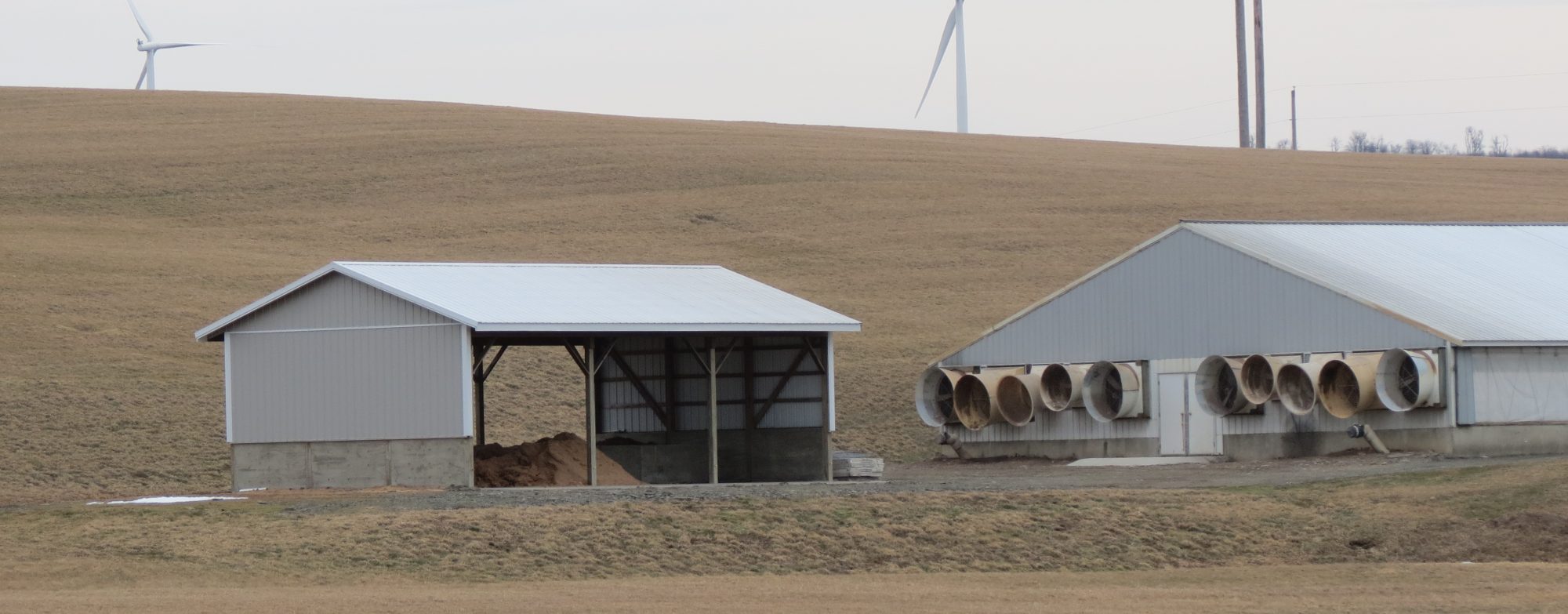
Air emissions from animal feeding operations have become a growing concern for producers and their neighbors.  Much work has been done to quantify emission rates; however, little information has been provided about air quality downwind from these facilities.  This study investigates PM2.5 (particulate matter ≤ 2.5 µm in diameter) levels as they dissipate from the exhaust fans of selected commercial, tunnel-ventilated, broiler houses in Northeast Georgia. PM2.5 was measured in real time using aerosol monitors and from a time-integrated basis using cyclone samplers.  Data were taken over the last 4-weeks of a summer flock (considered a worst-case-scenario) and filtered to insure enough data was present at each distance and time.  Results indicate a rapid reduction in fine particulate concentration as the distance from the source increases.  When compared to nearby monitoring data, particulate levels appear to be near background levels at distances greater than 30 m (100 ft) from the exhaust fans.

Why Study PM 2.5 in Poultry Production?

Considerable work has been done on evaluation of particulate and ammonia concentrations inside poultry houses and emissions from those houses.  Less is known about how concentrations dissipate as they leave the houses. This is a concern for neighbors of production facilities as well as farm owners.  The objective of this study was to investigate PM2.5 concentrations in the air up to 152.5 m (500ft) away from tunnel-ventilated broiler houses and compare those levels to ambient conditions. 

What Did We Do?

The study was conducted on a four-house commercial broiler farm in Northeast Georgia, from July 18 through August 12, 2007.  The houses were orientated east to west with open pasture located on the east end (downwind) of the four houses. The investigation incorporated a study design to include conditions which favored maximum emission rates, including high temperatures (July, August) and sampling during the final four weeks of the 8-week broiler grow-out cycle. 

Real time (DustTrak 8520) and daily cumulative gravimetric (Triplex cyclone; BGI, model SCC 1.062) PM2.5 measurements were measured at locations as shown on Figure 1. Publicly available data taken by Georgia EPD [9] using a TEOM 1400ab sampler at a site in Athens, GA (approx.. 32 km east of the site) was also used as an additional “control site.” 

What Have We Learned?

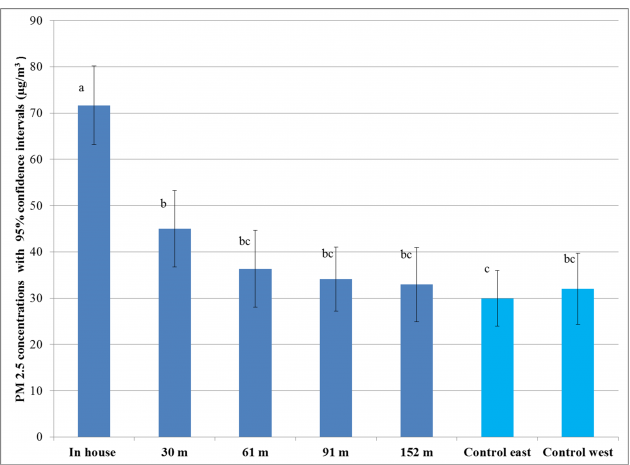
Particulate levels near poultry houses are elevated by emissions from the houses, however if we compare the readings on Figures 2a and 2b, we see that the largest single influence on the results was ambient conditions.  The downwind levels (2b) closely followed the ambient levels (2a). Similar results were seen for the daily gravimetric readings.  If we look at the average readings for the entire experiment at each distance from the house and compare those to in-house and ambient readings (Figure 3) we see a rapidly dropping influence on atmospheric particulate readings with no significant difference beyond 30 m from the houses.  While some of the measurements were above EPA’s ambient air standards, ambient conditions were also above the standards during those days.

Figure 2 PM 2.5 levels vs. distance from houses

Authors

John W Worley, Associate Professor, Poultry Science Department, University of Georgia jworley@uga.edu

Casey W Ritz1 Professor, Michael Czarick1,Sr. Public Service Associate, Brian D Fairchild1,Associate Professor, Luke P Naeher2 Associate Professor

1 Poultry Science Department, University of Georgia

2 Environmental Health Science, University of Georgia

Acknowledgements

The authors would like to acknowledge the contributions of Mr. Benjamin Hale and Mr. Adam Gray who did much of the field work including instrument calibration and lab analysis for this project and to Mr. Olorunfemi Adetona for his help in pulling together information for the document.  We would also like to thank the US Poultry and Egg Association for their financial support that enabled this research to be accomplished.


The authors are solely responsible for the content of these proceedings. The technical information does not necessarily reflect the official position of the sponsoring agencies or institutions represented by planning committee members, and inclusion and distribution herein does not constitute an endorsement of views expressed by the same. Printed materials included herein are not refereed publications. Citations should appear as follows. EXAMPLE: Authors. 2013. Title of presentation. Waste to Worth: Spreading Science and Solutions. Denver, CO. April 1-5, 2013. URL of this page. Accessed on: today’s date.

Affecting Change Through Collaboration: An Industry-Driven Approach

Waste to Worth: Spreading science and solutions logoWaste to Worth home | More proceedings….

The efforts related to Colorado’s Rocky Mountain National Park are voluntary, yet there are nitrogen reduction targets, or milestones, established over five year increments out to the year 2032. If a milestone is not met, mandatory controls could follow. How can the proactive emissions reduction efforts being taken by livestock and crop producers today be recognized or credited should mandatory controls be required at some future date? For example, could an agriculture certainty framework (used more for water quality protection/nutrient runoff) be used to validate actions being taken today for air quality purposes? How might an ag certainty program work and what partners should be at the table? Are there other approaches that states are using or researching that Colorado should consider?

During the session, presenters will speak to:

  • a meteorological Early Warning System that is being developed in Colorado to alert livestock producers in advance of an upslope weather event. What methods of messaging the alerts would be most successful, and what other applications (or sectors) might a meteorological Early Warning System be used for?
  • why it is important for producers (crop and livestock) to adopt BMPs and voluntary controls to address the problem of Nitrogen Deposition in Rocky Mountain National Park and what has been done so far in this regard.
  • agriculture, and specifically livestock agriculture’s, engagement in doing our part to sustain and improve the environment in which we operate.

Even though it is too early to make any conclusions as to the success of the proactive approach (i.e., voluntary measures versus regulatory controls) or to the extent that current state air quality plans or best management practices are having on nitrogen deposition in the park, the presentation is intended to share some of the challenges and achievements, to date, of this particular stakeholder-driven approach.

Presenters

Phyllis Woodford is the program manager of the Environmental Agriculture Program at the Colorado Department of Public Health & Environment. Phyllis has worked for the department 18 years and during this time has worked to educate the department on agriculture’s unique issues related to environmental concerns and the need for science-based solutions. She has a master’s degree in Environmental Policy & Management from the University of Denver and a BS in Criminal Justice from Kent State University. Prior to working for the State of Colorado, Phyllis served as a legislative assistant to an Ohio congressman in Washington, D.C.

Phyllis I. Woodford
Division of Environmental Health and Sustainability
Colorado Department of Public Health and Environment
4300 Cherry Creek Drive South
Denver, CO 80246-1530

Phone: 303-692-2978
Fax: 303-782-4969
E-mail: phyllis.woodford@state.co.us


Bill Hammerich has served as the Chief Executive Officer of the Colorado Livestock Association (CLA) for the past ten years. He grew up on a cattle and farming operation in Western Colorado and after graduating from high school he attended Colorado State University where he graduated with a degree in Agricultural Economics. Following graduation he began his working career with Monfort of Colorado, then Farr Feeders and was with the Sparks Companies before joining CLA in 2002.

His time spent in the cattle feeding industry provided him not only with an understanding of how to feed cattle but also the importance of protecting and sustaining the environment in which one operates. Such a background has served Bill and the CLA staff well as they represent a diversified CLA membership in addressing those environmental issues with which the livestock industry has to deal. Bill and his wife Sabrina live in Fort Morgan, Colorado and have two grown children, Justin and Jessica.


Jon Slutsky and his wife, Susan Moore, are first generation dairy farmers and have owned and operated La Luna Dairy in Northern Colorado since 1981.  Currently they milk 1300-1400 cows at their farm near Wellington. They have one adult daughter.  Jon is a native of New York; however he grew up and attended school in Southern California. He graduated from the University of California-Riverside with a bachelor’s degree in biology in 1972.  As general manager of the dairy, Jon oversees the management of the farm including 2600 cows and calves and 26 employees.
In order to add to the dairy data base and body of knowledge and assist in making good BMPs available to the industry, the farm has a policy of giving access as frequently as possible to animal and environmental researchers in the university community. The dairy tries to be a strong member of the local business and agricultural communities. Jon represents the dairy and the industry locally as a board member of the Wellington Area Chamber of Commerce, the Larimer County Agricultural Advisory Board, and the Colorado Livestock Association.  He also serves on several other committees as time permits.

Jon was a member of the  Colorado Air Quality Control Commission from 2007 to 2012 and is currently a member of the Colorado Water Quality Control Commission.


The authors are solely responsible for the content of these proceedings. The technical information does not necessarily reflect the official position of the sponsoring agencies or institutions represented by planning committee members, and inclusion and distribution herein does not constitute an endorsement of views expressed by the same. Printed materials included herein are not refereed publications. Citations should appear as follows. EXAMPLE: Authors. 2013. Title of presentation. Waste to Worth: Spreading Science and Solutions. Denver, CO. April 1-5, 2013. URL of this page. Accessed on: today’s date.

Presentation Slides

Diet, Tillage and Soil Moisture Effects on Odorous Emissions Following Land Application of Beef Manure


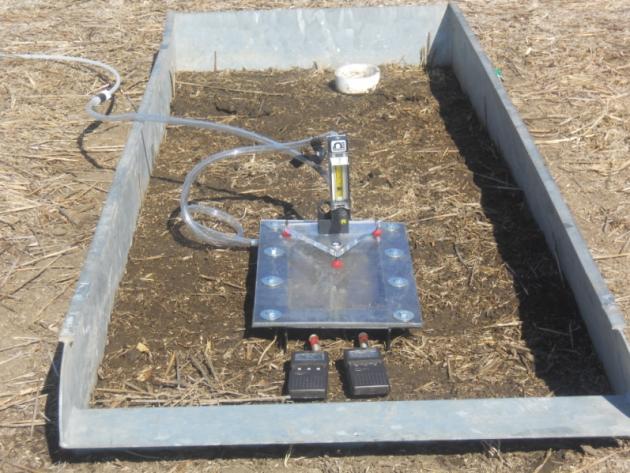
Figure1.  Gas sampling equipment used during the study.

Waste to Worth: Spreading science and solutions logoWaste to Worth home | More proceedings….

Abstract

Little information is currently available concerning odor emissions following land application of beef cattle manure. This study was conducted to measure the effects of diet, tillage, and time following land application of beef cattle manure on the emission of volatile organic compounds (VOC).

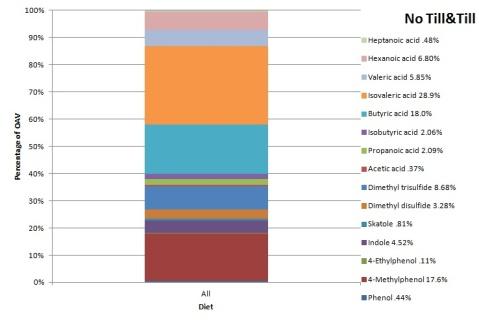
Each of the experimental treatments which included tillage (broadcast or disked) and diet (0, 10, or 30% wet distillers grain (WDGS)) were replicated twice. A 5-m tandem finishing disc was used to incorporate the manure to a depth of approximately 8 cm.  Small plots (0.75 m x 2.0 m) were constructed using 20 cm-wide sheet metal frames. A flux chamber was used to obtain air samples within the small plots at 0, 1, 2, 6, and 23 hours following manure application. The flux of fifteen VOC including fatty acids, aromatic compounds, and sulfur containing compounds were measured. Based on odor threshold, isolavleric acid, butyric acid, and 4-methylphenol provided 28.9%, 18.0%, and 17.7%, respectively, of the total measured odor activity. Heptanic acid, acetic acid, skatole, 4-methyphenol, and phenol each contributed less than 1% of the total odor activity. Dimethy disulfide (DMDS) and dimethyl trisulfide were the only measured constituents that were significantly influenced by diet.

DMDS values were significantly greater for the manure derived from the 30% WDGS diet than the other manure sources. No significant differences in DMDS values were found for manure derived from diets containing 0% and 10% WDGS. Tillage did not significantly affect any of the measured VOC compounds. Each of the VOC was significantly influenced by the length of time that had expired following land application. In general, the smallest VOC measurements were obtained at the 23 hour sampling interval.  Diet, tillage, and time following application should each be considered when estimating VOC emissions following land application of beef cattle manure.

Why Study Factors Affecting Manure Application Odors?

Measure the effects of diet, tillage and soil moisture on odor emissions follow land applied beef manure.

Figure 2.  Relative contribution of odorant to the total odor activity.

What Did We Do?

Twelve plots were established across a hill slope. Treatments were tillage (broadcast or disked) and diet (0%, 10%, or 30% WDGS).  Beef manure was applied at 151 kg N ha-1 yr-1.  Gas samples were collected using small wind tunnels and analyzed using a TD-GC-MS. (Fig. 1).  VOC samples were collected at 0, 1, 2, 6, and 23 hours following manure application.  A single application of water was applied and the gas measurement procedure was repeated. The effects of tillage, diet, test interval, and the sample collection time on VOC measurements were determined using ANOVA (SAS Institute, 2011).

What Have We Learned?

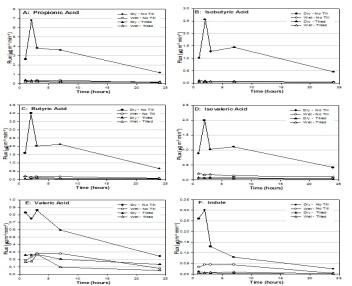
Isovaleric acid, butyric acid, and 4-methylphenol accounted for 28.9%, 18.0%, and 17.7%, respectively of the total odor activity (Fig. 2). Dimethyl disulfide (DMDS) and dimethyl trisulfide (DMTS) emissions were significantly increased by the 30 % WDGS diet. The flux increase for DMDS was over 4 times greater for the 30% WDGS diets. Tillage did not significantly affect any of the measured VOC compounds. The largest propionic, isobutric, butyric, isovaleric, and valeric acid measurements occurred with no-tillage under dry condition (Fig. 3A-E). Generally, measured values for these constituents were significantly greater at the 0, 1, 2, and 6 hour sampling intervals than at the 23 hour interval (Fig. 3A-E). The larger emissions for no-till, dry conditions may be due to the drying effect resulting when the manure was broadcast on the surface.  As the manure begins to dry, the water soluble VOCs are released from solution.  The tilled and wet conditions would reduce its release of VOC due to the increased moisture conditions.

Figure 3. Flux values for propionic, isobutyric, butyric, isovaleric , valeric acid and indole as affected by tillage, soil moisture, and time.

Future Plans

Additional studies are planned to quantify the moisture and temperature effect on odorous emissions.

Authors

Bryan L. Woodbury, Research Agricultural Engineer, USDA-ARS,  bryan.woodbury@ars.usda.gov

John E. Gilley, Research Agricultural Engineer, USDA-ARS;

David B. Parker, Professor and Director, Commercial Core Laboratory, West Texas A&M University;

David B. Marx, Professor Statistics, University of Nebraska-Lincoln;

Roger A. Eigenberg, Research Agricultural Engineer, USDA-ARS

Additional Information

http://www.ars.usda.gov/Main/docs.htm?docid=2538

Acknowledgements

We would like to thank Todd Boman, Sue Wise, Charlie Hinds and Zach Wacker for their invaluable help on making this project a success.

The authors are solely responsible for the content of these proceedings. The technical information does not necessarily reflect the official position of the sponsoring agencies or institutions represented by planning committee members, and inclusion and distribution herein does not constitute an endorsement of views expressed by the same. Printed materials included herein are not refereed publications. Citations should appear as follows. EXAMPLE: Authors. 2013. Title of presentation. Waste to Worth: Spreading Science and Solutions. Denver, CO. April 1-5, 2013. URL of this page. Accessed on: today’s date.

The Discovery Farms Model: The Impact of Helping Farmers Take Control of Water Quality Management

Waste to Worth: Spreading science and solutions logoWaste to Worth home | More proceedings….

Abstract

Many states conduct water quality monitoring projects and within the past decade, sub-watershed and whole farm water quality monitoring has gained more traction as a preferred method to understand runoff and nutrient loading behavior.  The one aspect of these projects that has evolved is the level of partnering.  Partnering not just with technical and academic groups but fully partnering and involving the landowner or resource manager.  The Discovery Farms model is a great example of a fully partnered, adaptive management water quality monitoring project that began in Wisconsin and has grown to formally include North Dakota, Minnesota and Arkansas.  The main objective of the Discovery Farms projects is to fully engage producers in the identification and if necessary the reduction of nutrient and sediment losses from a variety of agriculture farming systems by collecting runoff data from real, working farms.  The program is founded on the belief that farmers who are engaged, educated and empowered with actual on-farm information will use the data to address water quality concerns.  The concept has demonstrated successes and is gaining interest around the country from producers and their commodity organizations.

This workshop will share experiences, successes, the principals of operation and key tasks needed to develop and implement Discovery Farms programs.  Among the four states; edge of field, tile drainage and feedlot monitoring is being conducted for a diverse set of agricultural production systems.  The purpose of the workshop is two-fold: 1) to provide guidance and advice to help other States develop plans and partnerships with stakeholder groups to build Discovery Farms programs in their respective States, and 2) allow participating farmers the opportunity to share what they have learned from the monitoring done on their farms and how they have reacted to that new knowledge.

Authors

Ron Wiederholt, North Dakota State University ron.wiederholt@ndsu.edu

Mike Daniels, Univ of Arkansas, Andrew Sharpley, Univ of Arkansas, Dennis Frame, Univ of WI-Madison, Warren Formo, Minnesota Discovery Farms


The authors are solely responsible for the content of these proceedings. The technical information does not necessarily reflect the official position of the sponsoring agencies or institutions represented by planning committee members, and inclusion and distribution herein does not constitute an endorsement of views expressed by the same. Printed materials included herein are not refereed publications. Citations should appear as follows. EXAMPLE: Authors. 2013. Title of presentation. Waste to Worth: Spreading Science and Solutions. Denver, CO. April 1-5, 2013. URL of this page. Accessed on: today’s date.

A recording is not available of Doyla Johannes (a North Dakota farmer) who is an active participant in the North Dakota Discovery Farms program, but his slides are below:

Impacts of the Michigan Agriculture Environmental Assurance Program

Waste to Worth: Spreading science and solutions logoWaste to Worth home | More proceedings….

Abstract

The Michigan Agriculture Environmental Assurance Program (MAEAP) is a holistic approach to environmental protection. It helps farmers evaluate their entire operation, regardless of size or commodity, and make sustainable management decisions balancing society’s needs, the environment, and economics. MAEAP is a partnership effort that aims to protect natural resources and build positive communities by working with farmers on environmentally responsible agricultural production practices.

To become MAEAP verified, farmers must complete three comprehensive steps: educational seminars, an on-farm risk assessment, and development and implementation of an action plan addressing potential environmental risks. The Michigan Department of Agriculture and Rural Development (MDARD) conducts an on-farm inspection to verify program requirements related to applicable state and federal environmental regulations, including the Generally Accepted Agricultural and Management Practices (GAAMPs). MAEAP benefits Michigan by helping to protect the Great Lakes by using proven scientific standards to improve air, water, and soil quality. Annual phosphorus reduction through MAEAP is over 340,451 pounds per year which is enough to grow almost 85,104 tons of algae in lakes and streams.  Farming is an environmentally intense practice and the MAEAP-verification process ensures farmers are making choices that balance production and environmental demands. The measures aimed at protecting air, soil, water, and other environmental factors mean that MAEAP-verified farmers are committed to utilizing farming practices that protect Michigan’s natural resources.

Purpose

The Michigan Agriculture Environmental Assurance Program (MAEAP) is an innovative, proactive program that assists farms of all sizes and all commodities voluntarily prevent or minimize agricultural pollution risks. MAEAP is a collaborative effort of farmers, Michigan Department of Agriculture and Rural Development, Michigan Farm Bureau, commodity organizations, universities, conservation districts, conservation groups and state and federal agencies. MAEAP teaches farmers how to identify and prevent environmental risks and work to comply with state and federal environmental regulations. Farmers who successfully complete the three phases of a MAEAP system (Farmstead, Cropping or Livestock) are rewarded by becoming verified in that system.

What Did We Do?

To become MAEAP-verified, farmers must complete three comprehensive steps: educational seminars, a thorough on-farm risk assessment, and development and implementation of an action plan addressing potential environmental risks. The Michigan Department of Agriculture and Rural Development (MDARD) conducts an on-farm inspection to verify program requirements related to applicable state and federal environmental regulations, including the Generally Accepted Agricultural Management Practices. To retain MAEAP verification, a farm must repeat all three steps including MDARD inspection every three years.

Local MAEAP farm verified in the Cropping System

What Have We Learned?

The MAEAP program is positively influencing Michigan producers and the agriculture industry. Annually, an average of 5,000 Michigan farmers attend an educational session geared toward environmental stewardship and MAEAP verification. To date, over 10,000 farms are participating with over 1,500 MAEAP verifications. On a yearly basis, over $1.2 million is spent for practice implementation by producers working towards MAEAP verification. In 2012; the sediment reduced on MAEAP-verified farms could have filled 28,642 dump trucks (10 yards each), the phosphorus reduced on MAEAP farms could have grown 138,056 tons of algae in surface waters, and the nitrogen reduced on MAEAP farms could have grown 45,515 tons of algae in surface waters.

An example of the partnership between MAEAP and Michigan Farm Bureau

Future Plans

Michigan Governor Rick Snyder has taken a vested interest in the value of the MAEAP program. In March of 2011, Governor Snyder signed Public Acts 1 and 2 which codify MAEAP into law. This provides incentives and structure for the MAEAP program. It is a goal of Governor Snyder’s to have 5,000 farms MAEAP-verified by 2015. Most importantly, through forward thinking MAEAP strives to connect farms and communities, ensure emergency preparedness and protect natural resources.

Authors

Jan Wilford, Program Manager, Michigan Department of Agriculture & Rural Development – Environmental Stewardship Division,    wilfordj9@michigan.gov

Shelby Bollwahn, MAEAP Technician – Hillsdale Conservation District

shelby.bollwahn@mi.nacdnet.net

Additional Information

www.maeap.org – MAEAP Website

http://michigan.gov/mdard/0,4610,7-125-1567_1599_25432—,00.html – MDARD MAEAP Website

http://www.facebook.com/mimaeap – MAEAP Facebook Page

Acknowledgements

MDARD MAEAP Program Office Communications Department

Michigan Farm Bureau

Michigan Association of Conservation Districts

Hillsdale County Farm Bureau

Hillsdale Conservation District

Handout version of the poster (8.5 x 11; pdf format)

The authors are solely responsible for the content of these proceedings. The technical information does not necessarily reflect the official position of the sponsoring agencies or institutions represented by planning committee members, and inclusion and distribution herein does not constitute an endorsement of views expressed by the same. Printed materials included herein are not refereed publications. Citations should appear as follows. EXAMPLE: Authors. 2013. Title of presentation. Waste to Worth: Spreading Science and Solutions. Denver, CO. April 1-5, 2013. URL of this page. Accessed on: today’s date.

BFNMP$: A Tool for Estimating Feedlot Manure Economics

Waste to Worth: Spreading science and solutions logoWaste to Worth home | More proceedings….

Why Consider the Costs of Manure Transport in Nutrient Planning?

* Presentation slides are available at the bottom of the page.

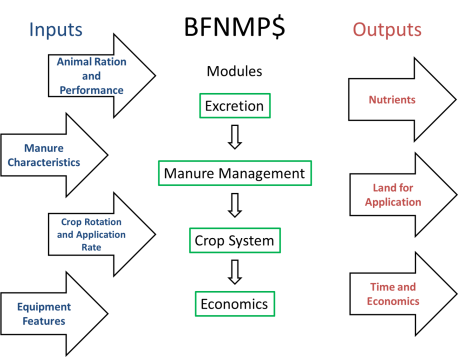
The Beef Feed Nutrient Management Planning Economics (BFNMP$) computer program can assist producers in understanding the impacts manure handling changes could have on their operation.  It calculates manure management economics based on animal nutrient intake, manure nutrient availability, land requirements for spreading, operating costs, and fertilizer value.  These values can be altered to fit individual operations.  The objective of this analysis was to use the BFNMP$ software tool to evaluate the effect of distillers grains inclusion, nitrogen (N) volatilization, and manure application rate on feedlot nutrient management plans.

The BFNMP$ software tool is organized into 4 modules with producers entering information about their operation and then viewing the results.  Outputs include nutrients produced, land needed for manure application, time the plan will take to implement, and economic implications.

What Did We Do?

This program was used to determine 1) impact of dietary N and P from traditional grain based diets compared to diets including 40% distillers grains (DG); 2) effect of different N volatilization (VOL) rates; 3) impact of changing manure application rates from N to P based and from 1 to 4 yr rates.  While comparing scenarios, all other factors in the model were constant.  These scenarios fed out 5,000 cattle per year in 100 hd pens from 341 to 591 kg with 144 d on feed.

What Have We Learned?

Increasing dietary N and P, with a 40% DG diet, increases excretion of these nutrients.  Capturing these nutrients in manure increases costs, but increases value at a greater rate.  Manure from cattle fed a traditional feedlot diet with 50% N VOL has a value of $21.53/animal ($14.45/Mg) based on inorganic fertilizer values.  Feeding a 40% DG ration results in manure worth $29.70/animal ($19.94/Mg).  Decreasing N VOL to 20% increases value of the manure to $26.55/animal ($17.83/Mg) and $37.11/animal ($24.93/Mg) for the grain based and DG diet, respectively.  Phosphorus based applications require about 3 times the acres of N based applications, but spreading on a N basis results in excess P buildup.  Spreading enough manure in 1 yr to meet crop P requirements for 4 yrs costs approximately the same as spreading manure every yr to meet N requirements.

Future Plans

The BFNMP$ program has been designed to aid feedlots in implementing a nutrient management plan.  This tool allows them to see the potential effects of changes before implementing them and promotes better utilization of valuable manure nutrients.

Authors

Andrea Watson, graduate student, University of Nebraska awatson3@unl.edu

Galen Erickson, professor, University of Nebraska

Terry Klopfenstein, professor, University of Nebraska

Rick Koelsch, assistant dean, extension and former professor, University of Nebraska

Ray Massey, professor, University of Missouri

Joseph Harrison, professor, Washington State University

Matt Luebbe, assistant professor, University of Nebraska

Additional Information

http://beef.unl.edu/reports 2006 Beef Report pg. 98; 2008 Beef Report pg. 59; 2012 Beef Report pg. 104

http://water.unl.edu/web/manure/software       website to download the software tool and user guide

Acknowledgements

Funding provided by USDA NRCS CIG Program – Decision Aid Tool to Enhance Adoption of Feed Management 592 (FMPS 592) – Contract No. 69-3A75-10-121.

The authors are solely responsible for the content of these proceedings. The technical information does not necessarily reflect the official position of the sponsoring agencies or institutions represented by planning committee members, and inclusion and distribution herein does not constitute an endorsement of views expressed by the same. Printed materials included herein are not refereed publications. Citations should appear as follows. EXAMPLE: Authors. 2013. Title of presentation. Waste to Worth: Spreading Science and Solutions. Denver, CO. April 1-5, 2013. URL of this page. Accessed on: today’s date.

Inhibition Of Total Gas Production, Methane, Hydrogen Sulfide, And Sulfate-Reducing Bacteria From In Vitro Stored Swine Manure Using Condensed Tannins

Waste to Worth: Spreading science and solutions logoWaste to Worth home | More proceedings….

Abstract

Management practices from large-scale swine production facilities have resulted in the increased collection and storage of manure for off-season fertilization use.  Odor produced during storage has increased the tension among rural neighbors and among urban and rural residents, and greenhouse gas emissions may contribute to climate change.  Production of these compounds from stored manure is the result of microbial activity of the anaerobic bacterial populations present during storage.  We have been studying the bacterial populations of stored manure to develop methods to reduce bacterial metabolic activity and production of gaseous emissions, including the toxic odorant hydrogen sulfide produced by sulfate-reducing bacteria.  Quebracho and other condensed tannins were tested for effects on total gas, hydrogen sulfide, and methane production and levels of sulfate-reducing bacteria in in vitro swine manure slurries.  Quebracho condensed tannins were found to be most effective of tannins tested, and total gas, hydrogen sulfide, and methane production were all inhibited by greater than 90% from in vitro manure slurries.  The inhibition was maintained for at least 28 days.  Total bacterial numbers in the manure were reduced significantly following addition of quebracho tannins, as were sulfate-reducing bacteria.  These results indicate that the condensed tannins are eliciting a collective effect on the bacterial population, and the addition of quebracho tannins to stored swine manure may reduce odorous and greenhouse gas emissions.

Why Would We Want to Inhibit Gas Production of Stored Manure?

Develop methods for reducing odor and emissions from stored swine manure.

What Did We Do?

Tested the effects of addition of condensed tannins to in vitro swine manure slurries on  production of total gas, hydrogen sulfide, methane, and on the levels of hydrogen sulfide-producing sulfate reducing bacteria.

What Have We Learned?

Addition of condensed tannins to in vitro swine manure slurries reduces production of total gas, with quebracho condensed tannins being the most effective.  0.5% w/v Quebracho condensed tannins reduced total gas, hydrogen sulfide, and methane by at least 90% over a minimum of 28 days.  Levels of sulfate reducing bacterial were also significantly reduced by addition of the tannns.  This technique should assist swine producers in lowering emission and odors from stored manure.

Future Plans

We are interested in scaling up the testing to on-farm sites and also testing the tannins for reducing foaming from manure storage pits.

Authors

Terence R. Whitehead, Research Microbiologist, USDA-ARS-National Center for Agricultural Utilization Research, Peoria, IL 61604, terry.whitehead@ars.usda.gov

Cheryl Spence, USDA-ARS-National Center for Agricultural Utilization Research, Peoria, IL 61604

Michael A. Cotta, USDA-ARS-National Center for Agricultural Utilization Research, Peoria, IL 61604

Additional Information

Whitehead, T.R., Spence, C., and Cotta, M.A.  Inhibition of Hydrogen Sulfide, Methane and Total Gas Production and Sulfate-Reducing Bacteria in In Vitro Swine Manure Slurries by Tannins, with Focus on Condensed Quebracho Tannins. (2012) Appl. Microbiol. Biotech. http://link.springer.com/article/10.1007/s00253-012-4562-6/fulltext.html

Development and Comparison of SYBR Green Quantitative Real-Time PCR Assays for Detection and Enumeration of Sulfate-Reducing Bacteria in Stored Swine Manure.  (2008) J. Appl. Microbiol. 105: 2143-2152.  http://onlinelibrary.wiley.com/doi/10.1111/j.1365-2672.2008.03900.x/pdf

USDA-ARS-NCAUR Bioenergy Research Unit Home Page: http://ars.usda.gov/main/site_main.htm?modecode=36-20-61-00


The authors are solely responsible for the content of these proceedings. The technical information does not necessarily reflect the official position of the sponsoring agencies or institutions represented by planning committee members, and inclusion and distribution herein does not constitute an endorsement of views expressed by the same. Printed materials included herein are not refereed publications. Citations should appear as follows. EXAMPLE: Authors. 2013. Title of presentation. Waste to Worth: Spreading Science and Solutions. Denver, CO. April 1-5, 2013. URL of this page. Accessed on: today’s date.

Nutrient Management on Small Farms

Waste to Worth: Spreading science and solutions logoWaste to Worth home | More proceedings….

Why Should Small Farms Be Concerned About Manure Management?

The USDA defines a small farm as any operation with gross sales less than $250,000 per year.  A small farm might have 50-100 dairy cows in the Midwest or Northeast, it could be a 30–ewe flock of pasture raised sheep, or a 100 head sow herd or 10 head of beef cows and calves on a retirement farm; or even a flock of laying hens in a residential area.  This definition includes both commercial and hobby farms. 

Many small farm owners do not realize the value of the manure produced on their farms.  Manure is often disposed offsite or stored indefinitely on the farm, if manure is spread on farm a nutrient management plan may or may not be in place.  Small farms have fewer animals and often several animal species on the same farm. There may be limited acreage and/or a lack of equipment for spreading manure. Financial resources may be lacking, but lower cost solutions for manure management may exist.  Small farmers may not be aware of potential critical areas on the farm (sensitive water bodies, erosion, neighbor concerns, manure storage), and they may not understand the idea of nutrient balance. 

The following principles may help small farmers who develop nutrient management programs:

  1. Appropriate manure storage should be located at least 100 feet from water bodies, wetlands, etc.;
  2. Animal access to water bodies, wetlands, etc. should be controlled;
  3. Manure should be applied according to a nutrient management plan that balances nutrient content in the manure with crop nutrient requirements and uptake and optimizes beneficial use of nutrients from manure and bedding; and
  4. Minimize odors from manure storage and application areas.  The Livestock Poultry Environmental Learning Center has a series of Small Farms fact sheets; http://www.extension.org/pages/8890/lpes-curriculum-small-farm-fact-sheet

Authors

Michael Westendorf, Rutgers, The State University of New Jersey westendorf@aesop.rutgers.edu

Additional Information

LPES Curriculum Small Farm Fact Sheets http://www.extension.org/pages/8890/lpes-curriculum-small-farm-fact-sheet.

The authors are solely responsible for the content of these proceedings. The technical information does not necessarily reflect the official position of the sponsoring agencies or institutions represented by planning committee members, and inclusion and distribution herein does not constitute an endorsement of views expressed by the same. Printed materials included herein are not refereed publications. Citations should appear as follows. EXAMPLE: Authors. 2013. Title of presentation. Waste to Worth: Spreading Science and Solutions. Denver, CO. April 1-5, 2013. URL of this page. Accessed on: today’s date.

Combination of Borax and Quebracho Condensed Tannins Treatment to Reduce Hydrogen Sulfide, Ammonia and Greenhouse Gas Emissions from Stored Swine Manure

Waste to Worth: Spreading science and solutions logoWaste to Worth home | More proceedings….

Abstract

Livestock producers are acutely aware for the need to reduce gaseous emissions from stored livestock waste and have been trying to identify new technologies to address the chronic problem.  Besides the malodor issue, toxic gases emitted from stored livestock manure, especially hydrogen sulfide (H2S) and ammonia (NH3) are environmental and health hazards for humans and animals and under scrutiny by the Environmental Protection Agency for regulatory control of concentrated animal farm operations (CAFOs). 

These odorous and toxic gases are produced by bacteria during the fermentation of the stored manure.  Sulfate reducing bacteria convert sulfate (SO4) to sulfide (H2S) during the fermentation.  During storage of swine manure, about 60% of NH3 nitrogen is also loss.  If NH3 loss can be prevented, the fertilizer value of swine manure would improve and reduce the need for additional commercial nitrogen fertilizer.

There are very few technologies available to reduce H2S, NH3 and greenhouse gas emissions from stored livestock manure, which meet the criteria of being: inexpensive, safe for farmers and animals, and environmentally sustainable. Previous research has shown that borax and quebracho condensed tannin are effective in inhibiting H2S production in stored swine manure. The present research demonstrates that a combination of borax and quebracho condensed tannin is highly effective in reducing all gaseous emissions (H2S, NH3, CO2, CO, N2O and CH4) and in retaining more nitrogen in swine manure. Lesser amounts of borax and quebracho condensed tannin are needed when combined to achieve a similar reduction in H2S production to using much larger amounts of either product alone. 

Phytotoxicity studies show that the level of tolerance of crops to borax-tannin combination treated swine manure is:  alfalfa > corn > wheat > soybean >> dry beans.  Quebracho condensed tannin does not appear to be toxic to crops.

Why Study Tannins?

Develop methods for reducing emissions from stored swine manure.

What Did We Do?

Tested the effects of addition of combinantions of borax and quebracho condensed tannins to swine manure slurries on  production of gaseous emissions and more retaining nitrogen in the manure.

What Have We Learned?

Addition of various combinations of borax and quebracho condensed tannins to swine manure slurries was highly effective in reducing all gaseous emissions (H2S, NH3, CO2, CO, N2O, and CH4) and in retaining more nitrogen in swine manure.  Lesser amounts of borax and tannin are needed when combined to achieve  a similar reduction in H2S production to using much larger amounts of either product alone.   Phytotoxicity studies show that the level of tolerance of crops to borax-tannin combination treated swine manure is:  alfalfa > corn > wheat > soybean >> dry beans. 

Future Plans

We are interested in transferring this research to on-farm sites.

Authors

Melvin Yokoyama, Professor, Dept. of Animal Science, Michigan State University, E. Lansing, MI 48824, yokoyama@msu.edu

Terence R. Whitehead, Research Microbiologist, USDA-ARS-National Center for Agricultural Utilization Research, Peoria, IL 61604

Cheryl Spence, USDA-ARS-National Center for Agricultural Utilization Research, Peoria, IL 61604

Michael A. Cotta, USDA-ARS-National Center for Agricultural Utilization Research, Peoria, IL 61604

Donald Penner, Dept. of Crops and Soil Sciences, Michigan State University, E. Lansing, MI 48824

Susan Hengemuehle, Dept. of Animal Science, Michigan State University, E. Lansing, MI 48824

Janis  Michael, Dept. of Crops and Soil Sciences, Michigan State University, E. Lansing, MI 48824

Additional Information

Whitehead, T.R., Spence, C., and Cotta, M.A.  Inhibition of Hydrogen Sulfide, Methane and Total Gas Production and Sulfate-Reducing Bacteria in In Vitro Swine Manure Slurries by Tannins, with Focus on Condensed Quebracho Tannins. (2012) Appl. Microbiol. Biotech. http://link.springer.com/article/10.1007/s00253-012-4562-6/fulltext.html

Development and Comparison of SYBR Green Quantitative Real-Time PCR Assays for Detection and Enumeration of Sulfate-Reducing Bacteria in Stored Swine Manure.  (2008) J. Appl. Microbiol. 105: 2143-2152.  http://onlinelibrary.wiley.com/doi/10.1111/j.1365-2672.2008.03900.x/pdf

USDA-ARS-NCAUR Bioenergy Research Unit Home Page: http://ars.usda.gov/main/site_main.htm?modecode=36-20-61-00


The authors are solely responsible for the content of these proceedings. The technical information does not necessarily reflect the official position of the sponsoring agencies or institutions represented by planning committee members, and inclusion and distribution herein does not constitute an endorsement of views expressed by the same. Printed materials included herein are not refereed publications. Citations should appear as follows. EXAMPLE: Authors. 2013. Title of presentation. Waste to Worth: Spreading Science and Solutions. Denver, CO. April 1-5, 2013. URL of this page. Accessed on: today’s date.

Anaerobic Digestion of Finishing Cattle Manure

Waste to Worth: Spreading science and solutions logoWaste to Worth home | More proceedings….

Purpose

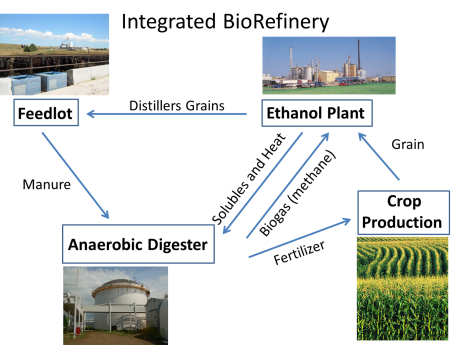
The concept of utilizing feedlot manure in an anaerobic digester to power an ethanol plant, which then produces feed for cattle, has been called a closed loop system.  In this system inputs are minimized and outputs are used by another component.  This research looked at differences in manure quality within this system.  Trial 1 considered incorporating distillers grains into the cattle diet and the effects on methane potential of the manure.  For this system to be utilized by the feedlot industry in Nebraska, the manure collected for anaerobic digestion must be collected from soil-based open feedlot pens which account for over 95% of the feedlot cattle raised in Nebraska.  Trial 2 addressed the methane potential of open-lot feedlot manure and its feasibility for anaerobic digestion.

An integrated biorefinery utilizes distillers grains for cattle feed and cattle manure for biogas generation to power an ethanol plant.  This system has been referred to as a “closed loop” system due to energy recycling within the segments.

What Did We Do?

Seven continuously stirred anaerobic digesters were used to compare degradation of manure from 2 cattle diets (Trial 1) and 2 cattle housing methods (Trial 2).  In Trial 1 manure was collected from confinement cattle on a control diet with 82.5% dry rolled corn or 40% of the corn was replaced with wet distillers grains plus solubles (WDGS), a byproduct of the ethanol industry.  For Trial 2, manure was collected from cattle in complete confinement or soil-based open feedlot pens with all cattle on a similar byproduct diet.  In both trials, organic matter (OM) degradation and methane production was measured for digesters on each treatment.  In Trial 1, samples of effluent removed from the digesters were also used to identify differences in microbial community structure (Eubacterial and Archaeal) due to treatment.

What Have We Learned?

Trial 1.  Organic matter degradation was slightly improved for manure from cattle fed WDGS (P = 0.10).  Methane production was 0.137 L/g OM fed for WDGS manure and 0.116 L/g OM fed for the corn-based diet (P = 0.05).  Microbial communities identified using 454-pyrosequencing revealed structuring of the microbial community based on diet (P < 0.001).  This suggests that the microbial food chain that contributes to methane production is greatly influenced by the diet fed to cattle, and dietary manipulation may provide opportunities to increase or decrease methane production from cattle manure.

Trial 2.  Manure collected from open-lot pens had an OM content of 26% compared to 88% for manure from complete confinement.  This resulted in decreased methane production and OM degradation (P < 0.01) for digesters fed open-lot manure.  However, methane was produced from open-lot manure suggesting that if ash buildup can be avoided open lot manure may be a viable feedstock for anaerobic digestion.

Future Plans

We are currently exploring new technologies that may enhance the use of open lot manure in anaerobic digestion.  We are also identifying key microbes involved in methane production in order to better understand how things such as cattle diet affect methane production.

Authors

Andrea Watson, graduate student, University of Nebraska awatson3@unl.edu

Samodha Fernando, assistant professor, University of Nebraska

Galen Erickson, professor, University of Nebraska

Terry Klopfenstein, professor, University of Nebraska

Additional Information

A summary of these trials is available at beef.unl.edu/reports; 2013 Beef Report pg. 98-99.

Acknowledgements

Funding provided by Nebraska Center for Energy Sciences Research

The authors are solely responsible for the content of these proceedings. The technical information does not necessarily reflect the official position of the sponsoring agencies or institutions represented by planning committee members, and inclusion and distribution herein does not constitute an endorsement of views expressed by the same. Printed materials included herein are not refereed publications. Citations should appear as follows. EXAMPLE: Authors. 2013. Title of presentation. Waste to Worth: Spreading Science and Solutions. Denver, CO. April 1-5, 2013. URL of this page. Accessed on: today’s date.