
Proceedings Home | W2W Home 
Purpose
Many of the antimicrobials administered to livestock are excreted in manure where they may undergo natural breakdown, become more tightly associated with the manure and soil, or become mobilized in wastewater/runoff. Both liquid and solid manure is usually applied to nearby crop fields as a manure fertilizer, recycling the nutrients in the manure. Public concerns about the overuse of antimicrobials leading to greater antibiotic resistance and potentially greater risk for human health have led to new regulations limiting the use of antimicrobials in animal production. However, there are several significant research questions that need to be explored in order to determine how important the links are between antimicrobial use in livestock production and increased antibiotic resistance in humans.
One important issue involves how important soil processes (decomposition, nutrient transformation, and gas emissions) could be altered by antimicrobial compounds in manures and wastewater. In a previous study at a cattle feedlot in central Nebraska, we found typical antimicrobial concentrations in feedlot runoff at low part per billion (ppb) levels and were detected infrequently (<20% of the time). One exception, monensin, was usually detected with an average concentration of 87 ppb and peak concentrations above 200 ppb. Adding complexity to this issue is that soils may experience a variety of conditions ranging from fully aerobic, to denitrifying (using nitrate as a terminal electron acceptor), to anaerobic, and a diverse variety of microbes may predominate in these various conditions. How might soil functions be affected under a range of conditions experiencing differing concentrations of antibiotic? Are there clear very high concentration thresholds that completel! y inhibit specific soil functions? The purpose of this study was to determine the effects of three common livestock antibiotics at multiple concentrations on decomposition, nutrient transformation, and gas production in pasture soil under aerobic, denitrifying, and anaerobic conditions.
What did we do?
A soil slurry incubation study was conducted with pasture soil where runoff from a nearby cattle feedlot was occasionally applied. Monensin, sulfamethazine, and lincomycin were amended (0, 5, 500, and 5000 ppb) to mason jars and serum bottles containing soil and simulated cattle feedlot runoff. The mason jars were flushed with air (aerobic) while serum bottles were flushed with nitrogen gas (anaerobic). Denitrifying conditions were established initially in a subset of anaerobic serum bottles which were supplemented with nitrate (100 mg NO3-N L-1). All antimicrobial amendments and conditions were replicated in triplicate and incubated at 20°C. Headspace gas composition and decomposition products were both measured using gas chromatography and monitored over several weeks.
What have we learned?
Soil processes were generally affected only at the highest antibiotic concentrations, which are 10x greater than observed levels in feedlot runoff. Furthermore, the effects on soil processes depended upon the antibiotic tested (Table 1). Monensin, a broad-range antimicrobial, had the greatest effect on a number of processes. At highest monensin concentrations tested (5000 ppb), both aerobic and anaerobic decomposition (including denitrification) were affected as shown by greater VFA concentrations and low to no gas production (CO2, N2O, and CH4). Even at 500 ppb, monensin had some effect—CO2, N2O, and CH4 gas production were reduced. Sulfamethazine at 5000 ppb inhibited full denitrification (no N2O produced), but there was no effect on other gases or VFA. At 500 ppb sulfamethazine, N2O production was reduced by half. Lincomycin’s only observable effect was lower (0.5x) N2O production at the 5000 ppb level under denitrification conditions.
These results show important soil processes can be blocked by high levels of antibiotics found in animal manures, but inhibition depends upon the antibiotic. A general antimicrobial like monensin affected microbial processes far more than antimicrobials with a specific mode of action. The highest antibiotic levels evaluated were 5 to 10 times higher than levels found in animal manures, so soils are likely not impacted under normal conditions where manures mixed and distributed into soils. Antibiotic breakdown in the soil further helps reduce the potential for antibiotics to build up in the soils.
Future Plans
These incubations only assessed the effect of a one-time dose of antimicrobials. Future studies will examine how longer soil exposures affect soil processes. Additional studies will also compare how soils that have different manure exposure histories (cattle feedlot soil with heavy exposure versus protected prairie soils with very low manure exposure) would react to higher levels of antimicrobials.
Corresponding author, title, and affiliation
Dan Miller, Microbiologist, USDA-ARS
Corresponding author email
Other authors
Matteo D’Alessio, Postdoctoral Researcher, Nebraska Water Center; Dan Snow, Director of Services, Water Sciences Laboratory
Additional information
151 Filley Hall, UNL East Campus, Lincoln, NE 68583
Ph: 402-472-0741
https://dl.sciencesocieties.org/publications/csa/pdfs/61/8/4?search-result=1
The authors are solely responsible for the content of these proceedings. The technical information does not necessarily reflect the official position of the sponsoring agencies or institutions represented by planning committee members, and inclusion and distribution herein does not constitute an endorsement of views expressed by the same. Printed materials included herein are not refereed publications. Citations should appear as follows. EXAMPLE: Authors. 2017. Title of presentation. Waste to Worth: Spreading Science and Solutions. Cary, NC. April 18-21, 2017. URL of this page. Accessed on: today’s date.
 Farmers and ranchers are becoming increasingly aware of the importance of soil quality/health to the productivity and sustainability of their agricultural system. Research and field observations have demonstrated that carefully managed manure applications can contribute to improved soil quality with limited environmental and social risks. However, a comprehensive assemblage of outputs and conclusions from research studies, field trials, soil labs databases, and other sources has never been developed. Therefore, the purpose of the initiative, Manure & Soil Health: Understanding and Advancing the State of the Science, is to assemble current knowledge on this topic, make it available to those influencing manure and land management decisions, and use it to inform and facilitate future research and service needs. The intent of the roundtables is to improve our understanding of: current knowledge, critical and emerging issues for which there are knowledge gaps, and information needs of farmers and their advisors.
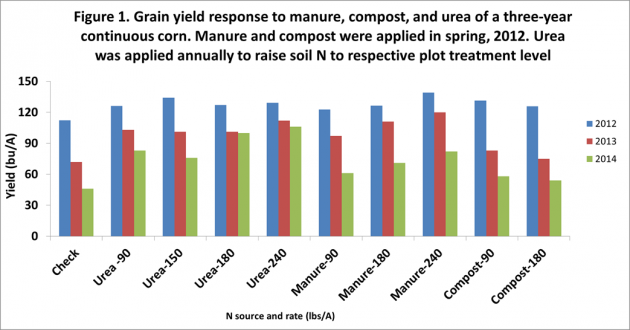 This study measured in situ relative soil N mineralization rates (flux) during three growing seasons of continuous no-till (2013 and 2014) corn in Carrington, ND. We applied fresh (FM) and composted beef feedlot manure (CM) only once in spring 2012 at N rates of 90, 180, and 240lbs/A as FM, and 90 and 180lbs as CM. These rates were applied based on the calculation that 50% of N from FM and 25% of N from CM, would be available the first year. Other treatments were urea at 90, 150, 180, and 240lbs N/A, plus a check at 0lbs/A. In 2013 and 2014 urea was applied to respective plots, based on soil test, to raise the N levels to the respective 2012 N levels. We used the randomized complete block design with four replicates. Three replicates were used to measure soil N (NO3- + NH4+) mineralization rates bi-monthly with Plant Root Simulator probes (PRS™), from the urea fertilized and manured plots at the 0, 90 and 180lb levels at 4-6 leaf growth stage. Four pairs of PRS™ probes were buried in the top 6 inches near corn roots and replaced every two weeks for four sampling dates. We measured yields, protein content, and N uptake.
 Yields were generally low in all three years of this study, well below the average for this region. Bi-monthly N mineralization was significantly higher as N increases with urea as N source during the early sampling dates (Figures 2 and 3) and subsequently declined to similar levels as the manure treatments. It is therefore possible that the plants benefited from higher early uptake of N from urea up to the early stages of peak corn N uptake but not enough to produce significantly higher yields than the manure treatments. Analysis of variance showed no significant treatment effects for yields in 2012 (α = 0.05) but grain protein differences were significant. These differences were observed only between the check and 180 lbs N in 2012. The highest mean grain yield was recorded with the 90 lbs N treatment where, the residual soil N at planting was just 33 lbs. The protein level was also significantly higher than the check and CM plot that received 180 lbs N in 2012, and with a soil residual N prior to 2013 planting, at 35 lbs. Each year, grain yields responded positively to N rates (applied as urea) and residual N levels from FM but not with CM. Since corn was grown for three continuous years, unsurprisingly yields declined with years of production since N was not applied to the FM and CM treatments after first application in year one. Similarly, yield decline was observed with urea over the three years but not as steep as the FM and CM treatments. The FM at 240 lbs N, and urea at 180 and 240 lbs treatments produced significantly higher grain protein than the check in 2012 (data not shown). Lower N mineralization and very likely, lower N availability was observed with the CM treatments especially at 180 lbs N, which consistently scored the lowest mean yield and protein in 2013 and 2014. Grain yields were consistently higher at 90 lbs N than 180 lbs N with the CM treatment.
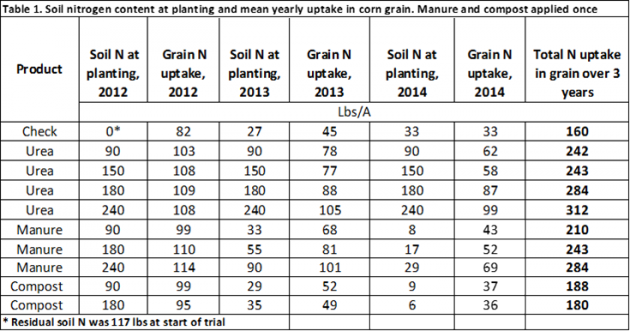
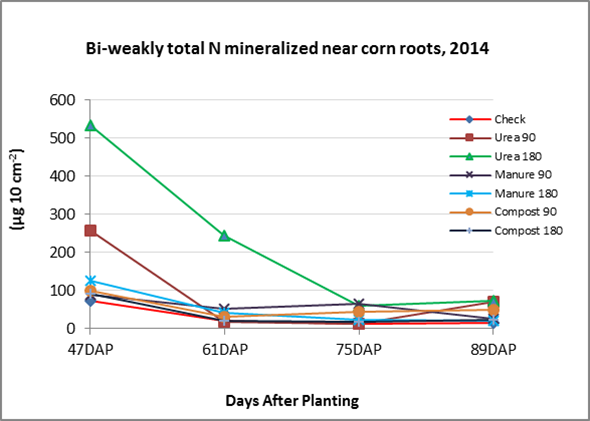 Summer droughts of 2012 and 2013 at this site and possibly, factors associated with continuous corn production (e.g. disease, temporal N immobilization) compounded the effects of urea treatments even though N uptake was consistently higher with urea. Total N taken up in corn grains from the FM and CM treatments increased with N rates but decreased with time (Table 1). From this study, corn grains took up more N from the plots treated with FM than the CM over the three-year period of the study. Subsequent changes in soil conditions such as moisture, N leaching, temperature, can sometimes limit the efficiency of inorganic fertilizer uses, and favoring low cost alternative uses such as manure especially if the prevailing conditions enhance N mineralization from manure or soil organic matter. Based on N input plus soil N status at the beginning of planting every year, corn N uptake efficiency was in the order: Check>FM>CM>Urea, with efficiency decreasing at higher N rates. The minimum proportion of grain N uptake by any treatment to the single highest N uptake for any urea-N treatment (considered as a reference) in a given year, was 42% for the check in 2013.