
Whole Farm Nutrient Balance

What is Whole Farm Nutrient Balance?

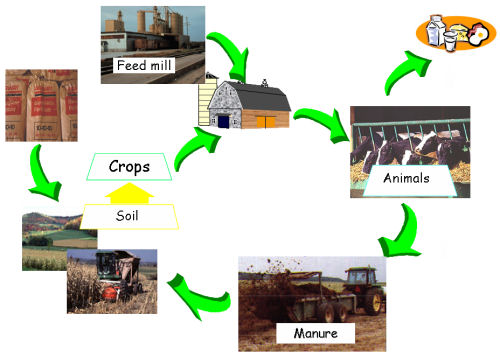
Nutrient management is a process of planning for manure and fertilizer applications to individual crop fields. Whereas whole farm nutrient balance considers the location and flow of nutrients onto, within and off the entire farm. Whole farm nutrient balance involves taking a step back and also comparing the amount of nitrogen (N), phosphorus (P), and potassium (K) and other nutrients entering the farm as purchased feed, fertilizer, animals etc. with the amount of nutrients leaving the farm as milk, animals, crops, manure exports to other farms, etc. Such a comparison can help in determining the economic and environmental impacts of nutrient management on dairy and livestock farms.

A comparison of the flows of nutrients onto and off dairy and livestock farms results in whole farm nutrient balance assessment. This balance is usually calculated from records of the nutrient-containing materials coming onto the farm (feed, fertilizer, purchased animals) and those leaving the farm in the form or products (milk, meat, eggs, crops, etc.). Balances can be expressed as percentage remaining, lbs/acre remaining or, for dairy farms, as lbs remaining per unit milk produced. For an example, see the Cornell Whole Farm Nutrient Balance Software or other such tools.

An estimate of the whole farm nutrient balance can also be determined from the density of livestock on the farm. Animal Density is usually estimated from the number of animal units per acre. (See box below)

Animal Density=Animal Units (AU)/Acre on an annualized basis,

  • AU=1000 lb live weight/A
  • Acres=acres available for manure application
  • Annualized=days our of 365 animals are on the farm producing manure

Animal Density=AU/Acre*(Days/365)

Go to the Animal_density_Calculator (Excel file)

Source: Doug Beegle, Pennsylvania State University.

Why Is the Whole Farm Nutrient Balance Important?

When the inflow of nutrients is greater than the outflow, annual losses and/or accumulation of nutrients will occur. The whole farm nutrient balance can indicate the potential for non-point source pollution from nutrients on the farm which can help to target management efforts to minimize the impact of nutrients on the environment. As such, the assessment of a farm’s nutrient mass balance can assist producers in determining the need for and identification of management practices that can reduce nutrient imports or enhance exports such as off site movement of manure, manure treatment, feed ration adjustments, land purchases and herd size adjustments to land acres. Knowing a farm’s nutrient balance is especially useful for farms looking at expansion or costly upgrades of equipment and buildings to ensure the long term sustainability of the farm.

The whole farm nutrient balance brings a number of important characteristics of the farm to the forefront that can optimize the economics of manure management while minimizing the environmental impacts from manure nutrients. Some of these are summarized in the table below.

The economics of nutrient management are often linked to the whole farm nutrient balance. For example, most people assume that improved nutrient management will always result in a positive economic return for the farm, but in fact, on many of the farms with a high potential for nutrient pollution, the economics of improved nutrient management to protect the environment will be costly. For farms that have excess nutrients the goals become maximizing safe utilization of nutrients and developing a strategy for removing excess nutrients from the farm. Examples of different nutrient management strategies based on nutrient balance can be seen by selecting the appropriate link in the table below.

Characteristics of Farms Based on Manure Nutrient Balance
Manure Nutrient Balance Deficit Balanced Excess
Animal Density* Low (<1.25 AU/A) Medium (1.25-2.25 AU/A) High (>2.25 AU/A)
Feed Source (% Off Farm) <50% 50-80% >80%
Land for Manure Application Adequate Limited Inadequate
Manure Management Strategy Deficit Balance Strategies Nutrient Balance Strategies Excess Nutrient Strategies
Economics of Nutrient Management Positive Neutral Negative
Non-point Source Pollution Potential Low Low to High High

*For P balance assessment, animal densities shown here should be halved.

Recommended Resources for Calculating Whole Farm Nutrient Balance

Excess Nutrients Management Goal = Reduce the Excess

  • Remove manure nutrients from the farm
  • Reduce the animal density
  • Manage nutrients remaining on the farm based on nutrient balance.
  • Example tactics:
    • Sell manure
    • Give manure away
    • Acquire more land
    • Reduce animal numbers

“In Balance” Management Goal = Maximize Safe Use of Manure Nutrients

  • Manage manure based on nutrient balance
  • Manage nutrients so that over time inputs balance outputs
  • Example tactics:
    • Spread manure on legumes
    • Don’t incorporate manure. Note: This strategy is currently sustainable but will likely change if air emissions need to be reduced.
    • Increase intensity of cropping system
    • Detailed plan needed

Deficient Management Goal = Maximize Efficient Use of Manure Nutrients

  • Manage based on expected crop response to manure nutrients.
  • Manage nutrients to increase yields or decrease purchased inputs.
  • Example tactics:
    • Spread manure in the spring as near to the time of crop utilization as practical
    • Use cover crops to conserve nutrients from fall and winter applied manure
    • Incorporate manure immediately to conserve nitrogen
    • Spread manure on N requiring crops
    • Don’t spread manure on legumes – they don’t need the N
    • Spread manure on fields with low P & K soil test levels

Page Manager: Douglas Beegle, Penn State University

Software and Web-Based Resources for Nutrient Management

Why Utilize Tools for Nutrient Planning?

The process of nutrient management planning can be complex and time consuming. Doing a good job requires:

  • collecting and organizing extensive information about a farm;
  • making a diverse series of decisions and calculations about crops, fertilizer and manure management; and
  • communicating the completed plan to a multiple audiences including the farmer.

There is an expanding list of web-based and personal-computer-based tools that can help nutrient management planners write effective nutrient management plans. Some of these tools help with a specific element of the nutrient management process where others perform multiple parts of the process.

The objective of this page is to show some of the diversity in software tools that may be useful to nutrient management planners. The listing is not and cannot be comprehensive and will focus on tools that have a national audience. Some state-specific tools are included if they provide a particularly unique service or approach.

There are many state-specific tools. If you see a helpful resource on this site you may want to search for an analogous program developed in your region or state that may have more relevant supporting data integrated into the program. Links to state-specific nutrient management pages may be listed on State Specific Manure Nutrient Management Information.

Data Collection and General Information

  • Google Map provides aerial view of areas of interest and driving directions. A good place to get started.
  • University of Missouri National Data Finder. Download spatial and soils data needed to run RUSLE2, MMP and SNMP for any location in the U.S. Includes selected soils data and black and white georeferenced aerial photos (DOQ’s). Clip areas up to 10,000 acres.
  • University of Missouri Animal Feeding Operation Site Assessment Tool (AFO SITE): Available only for Missouri. Web-based application that produces a detailed site assessment evaluating the sites suitability for an animal feeding operation.
  • Web Soil Survey. Download tabular and spatial soils data for U.S. counties. Whole county data sets sent in an email.
  • NRCS Geospatial Gateway provides access to a diverse set of spatial layers. Cannot clip to area of interest so file sizes typically too large to download over the internet.
  • USDA National Agricultural Imagery Program provides georeferenced aerial photography of agricultural land taken during the growing season. The imagery is available for download as mosaicked DOQQ’s either individually or as compressed county images.

Nutrient Balance Calculators

Whole farm nutrient balance looks at all nutrient imports and exports on a farm and can be a useful tool to evaluate the nutrient status of a farm. Are there too many nutrients? Is the farm nutrient deficient?

  • University of Nebraska Nutrient Balance Calculator. A spreadsheet based calculator. The web site includes links to good supporting information.
  • Cornell University Nutrient Balance Calculator. A spreadsheet based calculator. The web site includes links to good supporting information.

Nutrient Management Software

This software helps the user through the many steps of completing a nutrient management plan. Many states have there own software including NC, NY, VA, and WI.

  • Purdue’s Manure Management Planner. The most complete multi-state software for writing nutrient management plans. Includes state-specific fertilizer recommendations, manure nutrient availability calculations and generates plans that meet national standards for USDA-NRCS and EPA. Automated links to SNMP for geographic information and to the record keeping program WinMax. A free stand alone program available for 34 states.

Economics of Manure Management

What is manure worth? This can be a complicated question to answer. These tools provide some help in making economic decisions about manure.

  • Feed Nutrient Management Planning Economics (FNMP$): a comprehensive program connecting feed ration characteristics, manure storage type and cropping systems impacts on the value of manure as a fertilizer. FNMP$ estimates: 1) manure nutrients, 2) land requirements, 3) labor and equipment application time, and 4) costs and value for land application. Spreadsheet-based program. Instructions for program.
  • University of Missouri Manure Value Spreadsheet A spreadsheet-based calculator of the fertilizer value of manure based on manure test results, crop fertilizer recommendations and fertilizer prices.
  • University of Minnesota What Is Manure Worth? spreadsheet.

Other Tools and Resources

  • Spatial Nutrient Management Planner (SNMP): an ArcView 3.x program that facilitates delineating farm fields, mapping setbacks and soil test levels and calculating field sizes and spreadable acres. Available for all states. Links automatically to MMP. An ArcView 9.x version to be released soon.
  • Revised Universal Soil Loss Equation ver. 2 (RUSLE(2)): Used by USDA-NRCS to estimate edge-of-field erosion losses. Complicated to get started and not fully intuitive to use. The good news is that it will soon be fully integrated into MMP.
  • NRCS eFOTG (electronic Field Office Technical Guide: This is not software, but this website has links to conservation standards such as Nutrient Management (590) and Waste Utilization (633) for every state. Search in section IV under “Conservation Practices”.
  • Phosphorus Index: There is no national P index. Instead individual states have developed P indexes that meet the needs of their state. Look for information about the P index through the state NRCS office or Land Grant University.
  • Animal Waste Management (AWM) software: Facilitates sizing of manure storage facilities for animal feeding operations. Estimates the volume of manure, waste water and solids generated by animals in confinement. Does not address state-specific requirements. Some states have state-specific programs. To view a tutorial on using this software, see Animal Waste Management Software Training Video

If there is web page or software program you would like to have included on this webpage please contact John Lory.

Author: John Lory, University of Missouri, loryj@missouri.edu
Reviewers: Rick Koelsch, University of Nebraska and Rich Meinert, University of Connecticut

Manure Application to Soybeans

During the last decade, the number and size of confined animal feeding operations has continued to increase. In the Midwest, corn is the primary recipient of liquid manure from these facilities. However, while the density of production animals has continued to increase, the corn acreage available for manure application has not. To avoid over-application of manure to corn land, producers are pursuing other crops such as soybeans and alfalfa as alternative crops to receive manure.

Why Consider Applying Manure to Legumes?

The justification often applied for manure use on legumes is their ability to reduce N fixation when a readily available N source such as manure is applied. In addition, crops such as soybeans and alfalfa can utilize the phosphorus and potassium applied with the manure, thus reducing the costs of commercial fertilizer. For example, a 60 bushel/acre soybean crop in Iowa may remove up to 228 lbs of nitrogen, 48 lbs of phosphorus (P2O5), and 90 lbs of potassium (K2O) per acre. More…

While there may be some economic, practical, and environmental reasons to apply manure to both corn and legumes such as soybeans and alfalfa there are also some disadvantages of such practices. Issues related to manure use on alfalfa will be discussed in Manure Application to Alfalfa. Here, we discuss manure use for soybeans.

Effects of Manure Application to Soybeans

One area of concern is related to the environmental consequences of manure application to row crops such as soybeans, and specifically concerns about nitrate losses through subsurface drainage systems. Relative to environmental considerations, it should be noted that application of manure on corn residue prior to soybeans may have some benefit compared to application of the manure prior to corn on soybean residue since sufficient soil residue cover may be maintained with injection into cornstalks. In addition, there are questions on whether there are any negative impacts of manure application on soybean yields.

Subsurface drainage throughout much of the Midwest U.S. accelerates nitrate loss to downstream waterbodies. (Photo courtesy of the USDA-NRCS)

Yield Impacts

Several studies have been performed in the Midwest region of the U.S. resulting in positive yield increases related to liquid swine manure application on soybeans. However, there is no single conclusion as to why an increase in yield occurs. The studies identify yield increases from manure as the potential result of in-field initial nitrate, P, K, or other nutrient deficiencies. So, manure provided the nutrients that were deficient resulting in a yield increase and offsetting costs for purchased fertilizer. However, not in all cases was the yield increase sufficient to overcome application costs.

In addition to potential environmental concerns some studies have noted rare occurrences of reductions in soybean yield when manure is applied prior to soybeans and higher occurrences of common soybean diseases. A Minnesota study recommended that application of manure be avoided on fields with a history of white mold due to potential yield suppression due to manure application. Others have noted that manure application prior to soybeans can increase certain soybean diseases, specifically Pythium and Phytophthora damping off and Phytophthora root rot.

Another precaution that has been raised relative to liquid swine manure application to soybeans is that soybean seed germination and emergence can be sensitive to salts, so that if manure is applied close to planting time, there is a potential for injury especially if the soybean is planted into the manure or very near the manure.

Environmental Impacts

There have been few studies that have documented the environmental impacts of manure application to soybeans. A Minnesota study in the 1990’s evaluated the impact of liquid swine manure application on nodulating and non-nodulating soybeans. They found that applying manure at greater nitrogen rates than needed for maximum soybean yields did not adversely affect soybean yield. However, they found that application of nitrogen from the liquid swine manure increased post harvest soil nitrate levels. They also found greater increases in soil nitrate levels early in the growing season than post harvest.

Nitrogen

Manure application rates supplying from 0 to 446 lb N/acre in 89 lb N/acre increments were used in the study. Post-harvest soil nitrate levels were on average 37.7 lb N/acre (0-48 in) when no manure was applied and increased to 39.9, 44.4, 51.0, and 60.0 lb N/acre at applied nitrogen application rates of 50, 100, 150, and 200 lb N/acre, respectively. So, at an applied nitrogen application rate of 100 lb N/acre which might be about one-half of crop removal (soybean) the post-harvest soil nitrate was increased by about 15% compared to when no manure was applied.

Two drainage water quality studies in Iowa have evaluated the impact of liquid swine manure application to both corn and soybeans within a corn-soybean rotation. For a four-year study (2001-2004) at the Gilmore City research site in Pocahontas County, applying liquid swine manure at the rate of 150 lb N/acre (total nitrogen) before both corn and soybeans did not increase either corn or soybean yields compared to a rate of 200 lb N/acre of manure applied every other year before corn. In addition, the total of 300 lbs (two years of 150 lb N/acre) versus the 200 lb N/acre two-year-rate resulted in nitrate-N concentrations in tile drainage increasing on average from 17 to 23 mg/L, a 35% increase that was statistically significant.

For a six-year study (2001-2006) at the ISU Northeast Iowa Research Farm, applying liquid swine manure at the rate of 150 lb N/acre (total nitrogen) before corn and 200 lb N/acre (total nitrogen) before soybeans increased corn and/or soybean yields slightly some years (on average 3 and 2 bu/acre for corn and soybeans, respectively) compared to 150 lb N/ac of manure applied every other year before corn. The total of 350 (one year of 150 lb N/acre and one year of 200 lb N/acre) versus the 150 lb N/acre two-year-rate resulted in nitrate-N concentrations in tile drainage increasing on average from 21 to 38 mg/L, an 81% increase.

Both of these studies applied a relatively high nitrogen rate to the soybeans, but at these rates when liquid swine manure was applied every year in a corn-soybean rotation there was an increase in nitrate-nitrogen concentrations in the subsurface drainage water. However, it is unknown what direct water quality risk there would be with lower application rates specifically at rates ranging from 100-125 lb N/acre to soybeans. While the results discussed above were for studies on tile drained soils it is expected that there would be similar risks on non-tile drained soils relative to nitrate concentrations moving below the crop root zone.

Phosphorus

The application of manure to both corn and soybean, as noted above, could increase the risk of nitrate loss. Additionally the annual application of manure could increase the buildup phosphorus which could be of concern mainly from a surface runoff perspective. Considering a 60 bu/acre soybean crop the phosphorus removal (P2O5) might be 48 lb/acre and the potassium removal (K2O) might be 90 lb/acre, and a 200 bu/acre corn crop might remove 75 lb/acre of phosphorus (P2O5) and 60 lb/acre of potassium (K2O). This might result in a two-year removal of 123 lb/acre of phosphorus (P2O5) and 150 lb/acre of potassium (K2O).

Applying liquid swine manure at a nitrogen application rate of 150 lb N/acre to corn and 100 lb N/acre to soybeans (250 lb N/acre in two year rotation) might result in an overall phosphorus application of 172 lb/acre and an overall potassium application of 194 lb/acre (using values for liquid swine manure from a grow-finish operation (wet/dry). More… These application rates could be a long-term concern relative to phosphorus build up since crop removal might be 123 lb/acre for phosphorus with a phosphorus application of 172 lb/acre. A phosphorus buildup could have implications relative to the phosphorus index.

Pros, cons, and recommendations for manure application to soybeans

Pros

  • Manure can supply phosphorus (P), potassium (K) and other nutrients;
  • Manure application on cornstalks can provide greater crop residue cover and lower erosion potential when injected or incorporated into cornstalks instead of soybean stubble on erosive land;
  • Manure application to soybeans can provide flexibility in application plans; and
  • Manure application to soybeans may improve soybean yields in some case.

Cons

  • Manure application to soybeans has the risk to increase nitrate in the soil profile which may increase the risk of nitrate loss;
  • Manure application to both corn and soybeans at an N rate for both crops could lead to a buildup of phosphorus; and
  • Manure application to soybeans under certain conditions may increase the risk of soybean diseases which could negatively impact yield.

Recommendations

  • Limit manure application to soybeans to a rate that compensates for N that would not be fixed by the soybean – this may be in the range of 100 lb N /acre;
  • Possibly limit manure application to soybeans to rates that fulfill the P and/or K requirements of the soybean crop or two-year corn-soybean rotation; and
  • Avoid manure applications when there is low crop utilization (i.e. fall applications).

Additional Resources

Author: Matt Helmers, Iowa State University Reviewers: Rick Koelsch, University of Nebraska, Quirine Ketterings, Cornell University and John Lory, University of Minnesota

Manure Application to Legumes

Legume crops can provide a means of utilizing significant quantities of manure nitrogen, phosphorus, and potassium. Sequestering manure nitrogen and phosphorus in harvested legume crops should minimize the environmental risk of manure nutrients. Economic value will be realized from phosphorus and potassium but not from nitrogen since legume crops can supply their own nitrogen needs by fixing nitrogen from the air. However, if nitrogen is available in the soil, legumes will generally harvest this nitrogen first. The following articles discuss the benefits and challenges of applying manure on legumes:

  • Manure Application to Alfalfa by John A. Lory, University of Missouri. Alfalfa has many characteristics that make it a desirable crop for manure applications. However there are significant challenges in managing manure on alfalfa.
  • Manure Application to Soybeans by Matt Helmers, Iowa State University. A 60 bushel/acre soybean crop in Iowa may remove up to 228 lbs of nitrogen, 48 lbs of phosphorus (P2O5), and 90 lbs of potassium (K2O) per acre. While there may be some economic, practical, and environmental reasons to apply manure to soybeans, there are also some disadvantages of such practices.
  • Webcast Presentation discusses the ban Iowa is phasing in for manure application to soybeans. The web cast discusses what we currently know about managing manure applications to legume crops and the potential impacts on water quality. The presenters are Jim Baker and Matt Helmers, Iowa State University, Steve Herbert, University of Massachusetts and Charles Shapiro, University of Nebraska.

Author: Matt Helmers, Iowa State University and John Lory, University of Manure Reviewers: Rick Koelsch, University of Nebraska

Alfalfa can serve as an excellent use of manure nutrients if manure is applied without the quality of the alfalfa stand. Photo: Stephen Herbert, University of Massachusetts.

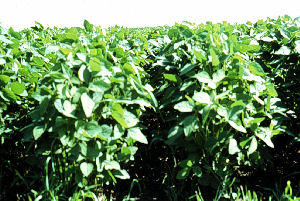
Soybeans can utilize significant manure nutrients, but there are potential environmental challenges for protecting groundwater and tile drain water quality. Photo: Stephen Herbert, University of Massachusetts

Manure Application to Alfalfa

Reasons to Apply Manure to Alfalfa

  • Alfalfa requires high phosphorus (P) and potassium (K) soil fertility and has a high demand for these nutrients.
  • Alfalfa can benefit from the micronutrients in manure, particularly boron.
  • Alfalfa removes large amounts of nitrogen (N) and K from the field when harvested as hay.
  • Alfalfa has the ability to draw down nitrate levels within its root zone.
  • Forages like alfalfa have low erosion, nutrient runoff and nutrient leaching potential.
  • Alfalfa offers opportunities for manure application throughout the year.

Challenges In Applying Manure to Alfalfa

  • Poorly timed applications can damage the alfalfa stand through physical damage to plants.
  • Manure applications can increase weed competition particularly in mixed grass-alfalfa stands.
  • Alfalfa is a legume so has no requirement for applied N limiting manure nutrient value.
  • Manure can be an unbalanced fertilizer (i.e. does not exactly match crop needs for all nutrients) so applying manure based on N often results in the build up of excess P and K in the soil.
  • Manure applications at the end of stand life can result in soil N supply in excess of the following crop needs potentially increasing N losses to water and the atmosphere.

Alfalfa Corn Rotation

Alfalfa is predominantly grown in alfalfa-corn rotations associated with dairy production. The alfalfa stand can last five years or more and then the field is rotated to corn for two to three years before returning to alfalfa. In these systems the crop rotation has the dual role of utilizing the fertilizer value of manure and providing a place to apply manure to prevent overflow of manure storage facilities.

One challenging characteristic of alfalfa-corn rotations is the relatively low demand for external inputs of N. Alfalfa, as a legume crop, fixes the N it needs and typically requires no N applications to maximize yield. Residual benefits from the N fixed by alfalfa will provide most of the N needed by first-year corn following alfalfa and frequently reduce N needs in the second-year crop following alfalfa. See state-specific recommendations on the N value of an alfalfa stand to the subsequent crop. In most states the only significant fertilizer N need in alfalfa-corn rotations is on second- and third-year corn following alfalfa.

The best opportunity to maximize the value of manure in alfalfa-corn rotations is to apply manure to second- and third-year corn following alfalfa to at rates that meet N needs of corn. In this system all the N, P and K fertilizer value will be realized. Manure eliminates the need to purchase N, P and K fertilizer for corn and any excess P and K reduces fertilizer need of the following alfalfa crop.

Manure on established alfalfa can increase yields. In this study, swine slurry (4.5% dry matter) was surface-applied to alfalfa at four rates (0, 300, 450 and 600 kg/ha/year) in 1994 and 1995. Manure was applied four times per year typically a few days after cutting. Alfalfa yield was increased in the years of application and the two years following application. Reference: Ceotto, E and P. Spallacci. 2006. Pig slurry applications to alfalfa: Productivity, solar radiation utilization, N and P removal. Field Crops Res. 95:135-155.

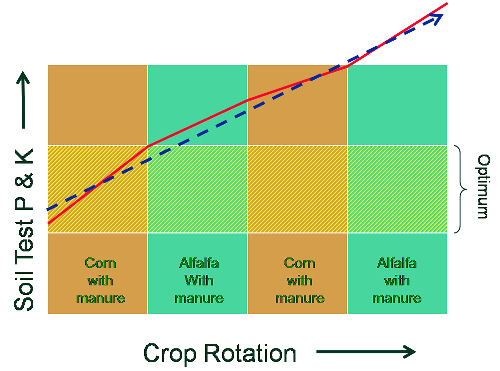
Farmers benefit from maximizing manure applications to this portion of the rotation but there are limitations. The optimal timing of application is limited to a relatively short period in spring prior to planting and early in crop growth. There also typically is not enough land in second- and third-year corn following alfalfa to utilize all manure produced by the farm. Consequently dairy farmers frequently are looking for opportunities to apply manure on the alfalfa phase of alfalfa-corn rotations. However, this can result in a steady buildup of P and K in the soil.

Repeated applications of manure to meet both the nitrogen need of corn and the nitrogen removal capacity of alfalfa can excessively raise soil test P and K levels. Use nutrient management planning to balance manure application rates with rotation P and K needs. Manure on second- or third-year corn following alfalfa has the added benefit that the crop needs N. Figure from D. Beegle, The Pennsylvania State University.

image:Crop rotation 1.jpg image:Crop rotation 2.jpg

cc2.5 manure nutrient mgmt group

Opportunities to Apply Manure on Alfalfa

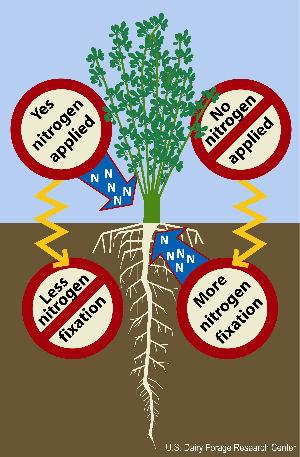
A prerequisite to making smart decisions about applying manure on alfalfa requires an understanding of the impact of applied N on alfalfa stands. Alfalfa has the capacity to fix N from the atmosphere to meet its needs. Each ton of harvested alfalfa can contain 50 pounds of N and in low N-supply soils most of this N will be derived from N fixation. Total N fixation can reach hundreds of pounds of N per acre per year. There is an energy benefit to the alfalfa plant to use N from the soil in preference to fixing N from the atmosphere. Alfalfa plants that have access to alternative N supplies will reduce N fixation and preferentially use the alternative N supply. This buffering process means manure applications that meet alfalfa N need will not lead to over-application of N. Such applications are not economically beneficial because there is no yield value to the applied N. But there is no water quality cost from applying this N even though the alfalfa does not need it.

There are three potential opportunities to apply manure on alfalfa:

  1. Preplant applications.
  2. Application to established productive stands.
  3. Post production applications prior to destroying the stand.

The first two strategies can be conditionally recommended as long as farmers are aware of the limitations and challenges of manure applications during these periods of alfalfa production. The final strategy, post production applications, cannot be recommended because manure applied at this time is likely to lead to potential increases in N loss.

Preplant Applications

Preplant manure applications for alfalfa can meet P and K requirements of manure for the first years of production. The application rate is limited by the lower yield and N demand during alfalfa establishment. Care must be taken insure that the seed is not in direct contact with fresh manure through injection or incorporation of manure. The N in the manure can promote weed competition during establishment. It also can promote lodging of oats if oats are used as a nurse crop for establishing alfalfa.

Application to Established Stands

Manure applications to established stands can provide needed P, K and boron. Alfalfa also provides windows of opportunity for manure application through the whole growing season. High yielding alfalfa has a high capacity to buffer high amounts of manure N. The primary concern with manure applications to established alfalfa is damage to the stand from the manure. Alfalfa plants can be damaged by high salt or ammonia concentration in the manure, by physical damage to the crowns by manure application equipment or by water deficits induced by high salt concentrations in the manure. The greatest danger is from slurry or solid manure that is applied with large manure spreaders. Lagoon water from unagitated lagoons typically posses less risk because nutrient and salt concentrations are lower. Another concern is manure may increase competition from grass or weeds if they are present in the stand.

diagram

Legumes like alfalfa have the capacity to buffer applications of manure N. When manure is applied alfalfa fixes less nitrogen. Figure used with permission from US Dairy Forage Research Center. cc2.5 John Lory

To minimize potential damage to the stand:

  • Make sure application equipment breaks up large lumps of solid manure and applies manure in a uniform pattern on the field.
  • Limit manure application rates. High rates increase potential for stand damage.
  • Apply manure immediately after cutting alfalfa and before budding on the alfalfa crowns. The alfalfa plant is less vulnerable to salt damage when no green leaves are showing. This is particularly important for surface applications of slurry.
  • When using manure that has a high potential to damage the stand apply to older stands that have a high grass or weed component. Mistakes with manure applications on these stands are less costly.

Applications at or Near the End of Stand Life

Applications at or near the end of stand life cannot be recommended because they lead to applications that exceed N utilization capacity of the rotation. Farmers frequently want to apply manure to alfalfa in the fall just prior to killing the stand. Manure applications at this stage occur after alfalfa N demand. It is really an application that will supply the subsequent crop with N; typically there is limited need for added N in the crop following alfalfa. Under these conditions manure applications will easily lead to excess N in the soil profile. Such conditions promote N losses to water and air resources.

Other resources

There are excellent extension publications further detailing the opportunities and challenges of managing manure for alfalfa. These include:

Recommendations

  • In alfalfa-corn rotations maximize manure value by applying to second- and third-year corn following alfalfa.
  • Applications to established alfalfa stands are conditionally recommended to meet P, K and boron needs. Manure N will have no value but alfalfa can buffer applied N minimizing over application concerns.
  • If manure is applied based on N need of the corn and N uptake by alfalfa, excess P and K buildup can be a problem. Therefore, try to balance P and K over the whole rotation.
  • Steps need to be taken to minimize potential damage to established alfalfa stands particularly when applying slurry or solid manure.

Author: John A. Lory, University of Missouri

Land Application of Manure Nutrients

Is manure application to cropland…

A source of organic matter that improves soil quality and reduces soil erosion and runoff?   OR   A source of pathogens that limit the beneficial uses of surface water?

A means of recycling essential nutrients for crop production and reducing use of energy intensive fertilizers?   OR   A source of nutrients polluting surface and ground water?

A means of recycling and sequestering carbon in the soil?   OR   A source of gaseous emissions creating nuisance and air quality concerns?

manure spreaderManure Benefits and Risks Depend on Location, Amount, and Timing

These above statements can all be true. Manure is a desirable plant fertilizer and has positive impacts on soil and soil health, but management decisions during land application influence the relative environmental benefit or risk resulting from manure. Timing, location, and amount of manure applied all must be carefully considered.

  • Manure application at amounts that match the nutrient requirements of harvested crops is the foundation of protecting water quality.
  • Preferred timing must balance multiple factors including timing of crop uptake of nutrients and probability of rainfall events following manure application.
  • Location must consider site specific field characteristics that influence environmental risks. Related Information: LPES Curriculum Lesson 33 and Lesson 34 include details on site selection.

Nutrient Management Plans

A nutrient management plan (NMP) is a document that spells out rate, timing, location, and other manure and fertilizer application factors.  The two nutrients that are watched most closely, relative to water quality, are phosphorus and nitrogen.

An NMP for any farm generally follows the same outline. Regulated or permitted operations will have the most specific requirements. In some states, even small farms are required to develop NMPs. There is a great deal of technical assistance available for developing  NMPs from extension, agencies, and private consultants. In some areas, cost-share assistance may be available. There are also many software tools available; one example is the Manure Management Planner Software. Since every state is different, it is recommended to look for state-specific resources and requirement before developing your NMP.

Amount of Manure to Apply

One of the first steps in developing an NMP is to estimate the amount of manure produced on a farm. Some other important pieces of information include: nutrient content as determined by a manure test (Related information: Sampling Manure) and the availability of nitrogen from that manure (consult your state extension service to obtain calculations on nitrogen availability appropriate for your area). Last, but not least, it is important to calibrate manure application equipment to ensure that you know how much manure was actually applied to each field.

Location, Location, Location

Manure application should be set back from wells, streams, lakes, sinkholes, or other environmentally sensitive features. Most states have rules dictating exactly how farm this setback should be.

Tile-drained fields should also receive special consideration with regard to manure application. If manure is applied while soils are saturated or right before a rainfall event, the manure may preferentially flow through tile drainage to water bodies.

Related Information: Manure Application in No-Till and the controversial topic of Manure Application to Legumes

Timing Manure Application

Manure application in spring, shortly before crops are planted, is generally recommended as it allows a short window where nutrients are prone to leaching or runoff. When manure is applied to fruit or vegetable crops, this recommendation may differ.

Manure application during crop growth will closely match nutrient needs, but can be destructive to the growing crop. One way to avoid crop damage is to apply liquid effluent through irrigation systems. (Also see Ohio research on top-dressing liquid swine manure to wheat and side-dressing on corn).

Applying manure in the fall, after the main crop is harvested, is a common practice and helps ensure manure storage structures are emptied before winter–reducing the chances of a overflow. Given the high price of fertilizer and the increased awareness of water quality, more farmers are following fall manure application with a cover crop.

Winter manure application is a controversial topic in many areas. Manure applied to snow-covered or frozen soils may be more likely to runoff under some conditions. Winter applications should only be made in order to prevent a manure storage overflow and should be done in low-risk areas with little slope or potential for runoff to water.

Evaluating if Nutrient Management Is Working

Whole Farm Nutrient Balance (WFNB) is a way to evaluate if the farm is currently accumulating more nutrients than are being exported from the farm. If this analysis is repeated from time to time, the trend can tell if a farm’s efforts are working or not. This website includes a dairy example and a swine example of WFNB.

Related information: Snap-Shot Assessments of Nutrient Use on Dairy Farms

Impacts of Feed Management or Manure Storage

Regional Topics

Economic Value of Manure for Land Application

Page Manager: Becky Larson, University of Wisconsin ralarson2@wisc.edu and Nichole Embertson, Whatcom Conservation District nembertson@whatcom.com
Reviewers: Rick Koelsch, University of Nebraska, Doug Beegle, Pennsylvania State University, Ron Wiedreholdt, North Dakota State University.

Photo: CC 2.5 Rick Koelsch

Calculating Manure Application Rate

How much manure can I apply to this field? is a common question when developing a nutrient management plan for the upcoming year. This type of planning allows a farmer to ensure there is enough crop land available to adequately use manure nutrients, plan for manure storage emptying, or estimate commercial fertilizer needs to take advantage of lower pricing. Manure is a very good source of nutrients for plants and organic matter for soils. These nutrients have significant value if managed properly. This page describes the information needed to make these calculations. While the process may seem complicated, it is not difficult and provides an easy template to follow in future years.

How Many Nutrients Will the Crop Use?

The starting point for determining manure application is to calculate the amount of nutrients, especially nitrogen (N) and phosphorus (P), expected to be used by that year’s crop. To find the values recommended for your area, do a web search for “crop nutrient uptake” or “crop nutrient removal” plus your state’s name. If your search turns up empty, contact your local extension service for assistance. The following pieces of information are usually needed to use your state crop nutrient tables.

  • What is the crop to be grown?
  • What is the soil type in the field? (Not needed in all states.)
  • What is the expected yield for this crop?

A realistic yield can be determined by taking the 5-year average yield for this field and crop and add 10% (some states may recommend a different factor to add) to account for improvements in hybrids and farming techniques. If the 5-year average includes a disaster or exceptionally low yield due to hail, flooding, or similar situation, remove that year from the calculation. The crop nutrient uptake tables for your state will usually provide a factor to calculate nutrient need of the crop based on the expected yield.

Nitrogen Credits from Legumes and Past Manure Application

Organic-nitrogen from past legume crops or past manure applications continues to mineralize into crop-available nitrate-nitrogen for several years. To estimate how much nitrogen will become available from past manure or compost applications, see “Estimating Crop Nutrient Availability of Manure and Other Organic Nutrient Sources“. Legume credits recommended for your state can be found by doing a web search for “legume credit” plus your state name.

What Level of Plant Available Nutrients Are Already Present In the Soil?

In addition to organic-nitrogen that may be already present in soils, there may be plant-available nitrate-nitrogen already present. The best way to determine this is to do a soil nitrate test. To find recommended procedures and labs in your state, do a web search for “soil testing” plus your state name.

Phosphorus and potassium form past manure applications are mostly plant-available right away. If overapplied year after year (as can be the case with a field that receives repeated manure applications) the levels will build up over time. For phosphorus, this is a concern because of the potential for runoff to water. In some states, soils with extremely high phosphorus levels may be off-limits for further manure application (due to the relatively high phosphorus content of manure in comparison to nitrogen). Most states have developed a phosphorus index which is a risk management tool for avoiding fields or situations with greater potential for phosphorus runoff to water. If you are concerned that some of your fields fall into this category, see “What is the P Index?

How Many Nutrients Are In the Manure?

Manure is highly variable from farm to farm. The nutrient content changes based on how is the manure collected, stored, and treated. It also varies by animal species. When doing pre-season planning, the best indicator of nutrient content in the manure is to look at past manure tests from your own farm. If you are doing your nutrient planning close to the time manure will be land-applied, then sampling manure in your storage will provide good information. As a last resort, planning can be done using “book values” or averages based on research and testing done in your state (do a web search for “manure book values” plus your state name).

It is impossible for plants to use applied nutrients with 100% efficiency, regardless if source is animal manures or commercial fertilizers. Studies have shown that nutrient use efficiency for nitrogen ranges from 30% to 75%, and is dependent on the crop, the specific nutrient, weather, and many other environmental factors. The goal of a nutrient management planner and waste applicator is to obtain the best use of the manure nutrients. This requires intensive management.

Nutrient Management Planning

Nutrient management guidance is typically done at the state level. General guidance may be available at a regional or national level from USDA Natural Resources Conservation Service (NRCS). You can also seek the advice of a local expert who is with the Cooperative Extension Service, land grant institution, state department of agriculture, or the state regulatory agency to obtain manure nutrient generation values relevant to the area, specieds, and system you are working with.

Tables that offer production volumes for manure as well as manure nutrient concentration are available for planning purposes, but should not be used to determine application rates on a daily basis. Frequent manure sampling is the only way to make a good assessment of manure nutrient value. Then, with data that relates to loss potential as it relates to manure application method and timing, one can make good recommendations as to appropriate application rates that assure maximum crop use efficiency and minimize losses.

Author: Karl Shafer, North Carolina State University

How Do I Participate in a Webinar?

It is strongly recommended that first-time viewers complete Step 1 several days or weeks before a webinar.

Step 1: Test Your Software

To test your software and connection speed, go to our LPELC Meeting Test Room. This room will be slightly different than the actual webinar room, but should allow you to:

    • install a small program that allows the webinar to work
    • test the controls in the room
    • find the chat box so you can ask questions during the webinar

If you are unable to connect to the testing room, contact your IT staff or our webinar coordinator.

Step 2: Connect to the webinar

On the scheduled day and time (about 15 minutes before the webinar begins), connect to the virtual meeting room through our Live Webinar Information page. Fill out the registration information when prompted.. If you want to download the power point presentations, and view other resources, go to the Live Webinar Information page.

Step 3: Participate in the webinar

The following is a list of the controls you have during the webinar:

    • View participant list
      • Raise Hand – notifies host
      • Rename – change your name that is seen in the participant list
    • Chat
    • Q&A – this is where you have the opportunity to ask questions of the presenters.
    • Leave Meeting

Slurry Manure Collection and Handling Systems

Slurry manure is typically generated in systems where little or no bedding is added to the excreted manure/urine. Slurry manure is typically between 5% and 15% solids. It is “thicker” than liquid manure, but cannot be stacked or handled the same way as solid manure. Some common system for handling and storage of slurry manure are described in this article.

Collecting Slurry Manure

Slotted Floor

The simplest manure collection arrangement for slurry manure is the slotted or perforated floor over a manure collection tank. In this scenario excreted manure simply falls through openings in the floor on which the animals stand and collects in a tank below.

Slotted floors above a manure tank are a simple means of collecting slurry manure.

Scrapers

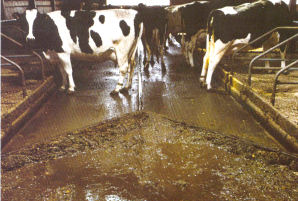
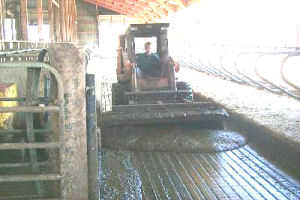
Slurry manure can also be collected using scrapers. In this case the manure is usually confined in an alley (dairy freestall barn) or gutter under slats (swine confinement building). A scraper moves along the length of the alley or gutter and deposits the slurry manure in a reception pit or tank at the end.

Mechanical or tractor-mounted tire scrapers can be used to collect slurry manure in a dairy freestall barn.

no description no description

Vacuum

Another type of slurry manure collection device utilizes a vacuum to “suck” slurry manure from a concrete surface and deposit it into a tank. This approach eliminates the need to pump the slurry manure into a tank or wagon.

Labor is reduced when a suction or vacuum is used to collect slurry manure from a concrete alley.

Slurry Pumps

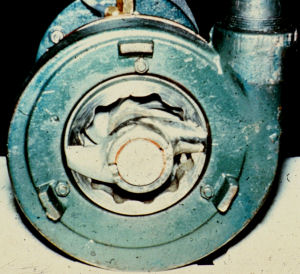
Slurry manure has fluid properties that allow it to be moved by pumps that are specially designed to handle thick fluids containing solids and stringy material. Slurry manure pumps are designed with open-type impellers and usually have cutting or chopping devices at the inlet to the impeller to minimize plugging problems. Low-pressure/high volume slurry pumps are used to fill tankwagons and move manure in other applications where higher pressures are not required. High-pressure slurry pumps are used to move manure through long pipelines and provide the needed pressure for land application in crop fields.

Slurry pumps have open impellers and cutter/chopper blades designed to handle manure with high solids content.

Low-pressure/high volume slurry manure pumps are used to quickly fill manure tankwagons.

High pressure slurry manure pumps can move manure long distances through pipelines to field application equipment.

Transporting Slurry Manure

Tankwagons

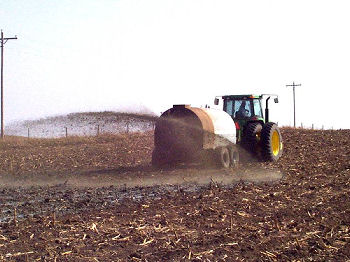
Tankwagons can be used to transport or move slurry manure from one point to another, usually from a manure storage facility to a crop field. Tankwagons are available in a variety of sizes from small (1,000 gallons) to quite large (12,000 gallons). Tankwagons typically serve the dual function of transporting slurry manure to a crop field and spreading or injecting the manure into the soil for crop nutrient uptake.

Large tankwagons allow producers to empty manure storage facilities quickly with less labor.

Pipelines

Since slurry manure has fluid properties it can be pumped through pipelines from storage to crop field as an alternative to hauling with a tankwagon. Pumping is a “continuous flow” process whereas hauling is necessarily a “batch” process. Hence pumping can offer significant advantages over hauling in moving large amounts of manure in shorter lengths of time. Tankwagons are generally used to move manure over longer distances although pipelines have been used for distances up to five miles.

Rigid aluminum irrigation pipe has been used for pumping slurry manure in the past. However the labor advantages of using flexible “layflat” tubing for pumping make this type of pipeline more attractive in many cases. Long lengths of this tubing can be stored on reels and placed overland with much less labor than is required with rigid tubing.

Flexible hose or tubing requires less labor for a manure pipeline than rigid pipe.

Slurry Manure Land Application

Field or land application of slurry manure requires that the application devices place the manure in the proper location and at the proper rate for good nutrient management practices. Devices which inject or incorporate manure into the soil are generally preferred since the following advantages are associated with this practice.

  1. Odor is reduced
  2. More nutrients are retained
  3. Runoff potential is reduced

Injection units place manure into the soil to reduce odor, conserve nutrients and minimize runoff.

Some injection units are designed for sod with minimal surface disturbance.

Authors: Charles Fulhage and Joe Harner

Photos: CC 2.5 Charles Fulhage or Joe Harner

Manure as a Source of Crop Nutrients and Soil Amendment

What Is Manure Worth Compared to Commercial Fertilizer?

Animal manure is considered an agricultural commodity that can be utilized as a fertilizer source for pastureland, cropland and hay production. Manure is recognized as an excellent source of the plant nutrients nitrogen (N), phosphorus (P) and potassium (K). In addition, manure returns organic matter and other nutrients such as calcium, magnesium and sulfur to the soil, building soil fertility and quality.

Any financial valuation of manure would be dependent on the market value of the N, P, K, and other plant nutrients that the manure is replacing, organic matter as a soil amendment, and the nutrient needs of the crops and fields receiving the litter.

The nutrient content of manure will vary depending on animal type and diet, type and amount of bedding, manure moisture content, and storage method. For more information, see the Clemson University publication Livestock Manure Production Rates and Nutrient Content.

Buyers and sellers should have a lab analysis to determine moisture and nutrient concentration of the manure. Generally speaking, liquid manures will contain a lower nutrient content than solid manures, due to the dilution effect. Assuming all nutrients are needed by the crop, higher manure nutrient content corresponds to higher manure value. Higher values help to offset transportation and handling costs.

truck

CC2.5 LPELC

Manure Composition

Nitrogen in Manure

Nitrogen in manure is found in the organic and inorganic forms. The organic form (slow release) slowly mineralizes providing plant-available N, while inorganic forms (fast release) consist primarily of NH4-N and are immediately plant available. However, inorganic forms are also susceptible to loss through ammonia volatilization during storage and field application. Promptly incorporating the manure into the soil can reduce these N losses. Due to the slow release organic form and potential losses of the inorganic form, not all of the N is available to the crops during the year of application. Nitrogen that is expected to be available to the plant has value as a fertilizer. The N which is lost to the environment or which is not available to the crop in the year it is needed or subsequent years does not have value. The guide “Fertilizer Nutrients in Animal Manure” provides information on the amount of N expected to be available in the 1st year and subsequent years from various manure sources:

Phosphorus and Potassium in Manure

Phosphorus and Potassium in manure are mostly present in the inorganic form. This means that P and K are similar to commercial fertilizer in that they are readily available for plant uptake. Most nutrient management plans are based on a P-Index or P-threshold which may limit manure application on some fields. Therefore, the value of these nutrients is based on crop nutrient needs as determined by a soil test and yield goal.

Micronutrients in Manure

Other nutrients such as calcium (Ca), magnesium (Mg) and sulfur (S) may be found in manure and are beneficial to the soil if a deficiency exists. Both Ca and Mg create an added value by producing a liming effect when added to the soil.

Organic Matter

Organic matter, primarily undigested feed and bacteria in the feces, increases infiltration of water, increases water holding capacity, enhances retention of nutrients, reduces wind and water erosion and promotes the growth of beneficial organisms when added to the soil. Although the value of organic matter is hard to quantify, higher quality soils are associated with increased yields and higher economic returns.

Manure As a Plant Fertilizer

Because manure is not a balanced fertilizer, some plant nutrient needs may be met while other nutrients may be under- or over-supplied. Any nutrient that is undersupplied by a manure application could incur a subsequent fertilizer application cost which would, in effect, lower the net value of the manure. Any nutrient that is oversupplied by a manure application would not have immediate value because it was not needed by the crop.

Additional Links

Authors: Josh B. Payne, Oklahoma State University and John Lawrence, Iowa State University

Reviewers: Ray Massey, University of Missouri and Kelsi Bracmort, NRCS