Many people are concerned about greenhouse gases and climate change. The carbon footprint of animal agriculture is an issue being used by many to encourage people to eat less meat. What is the true footprint of US animal production? How does production efficiency impact the numbers? This presentation was originally broadcast on July 31, 2009. More…Continue reading “Carbon Footprint of Animal Agriculture Webcast”
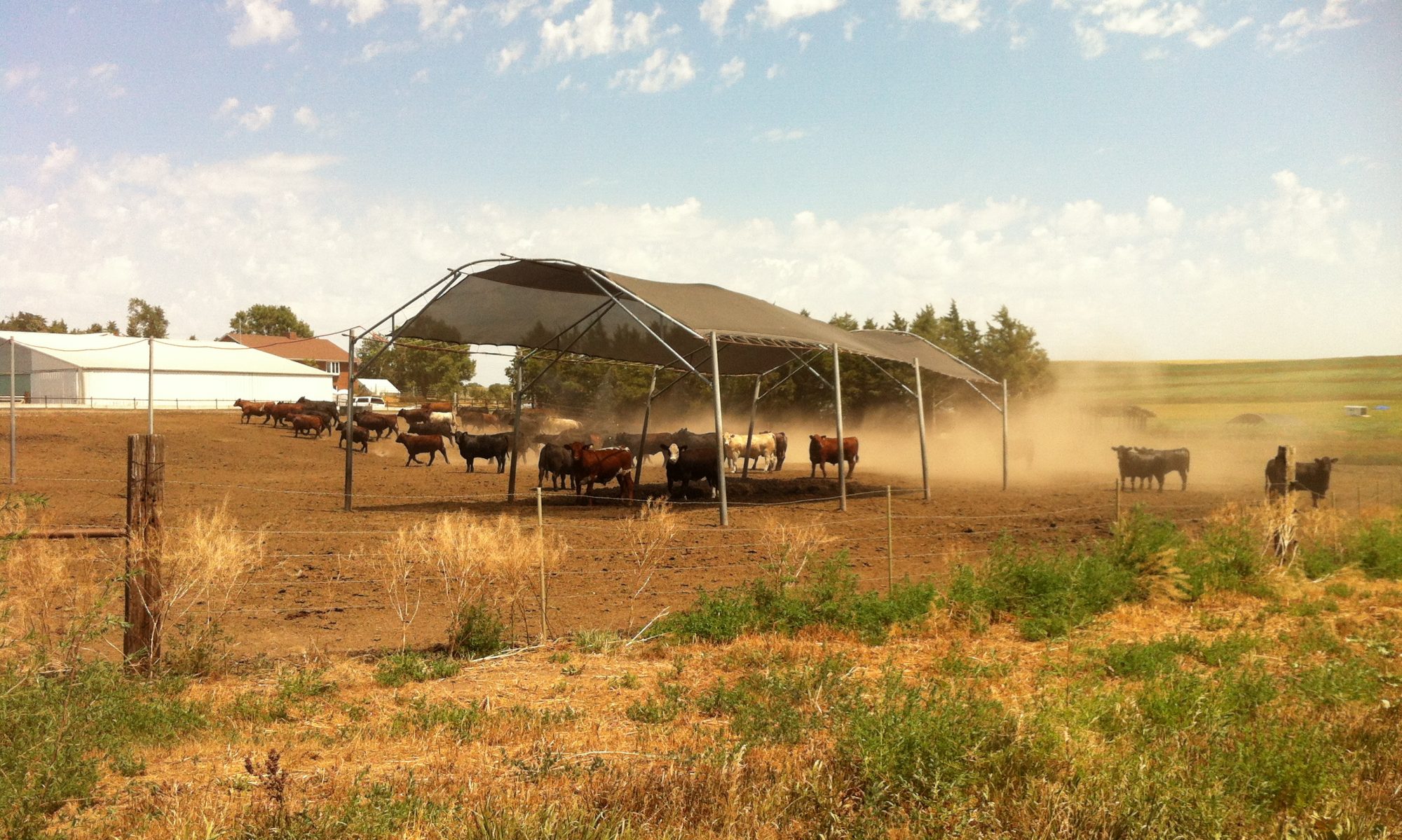
Air emissions from animal animal feedlots are sources of many different emissions including particulate matter (dust).
The materials on this page were developed to assist educators and professors who wish to include dust and particulate emissions and their control as a topic in their classrooms or educational programs.
Sharon L. P. Sakirkin, Texas AgriLife Research; Ronaldo Maghirang, Kansas State University; Steve Amosson, Texas AgriLife Extension Service; Brent W. Auvermann, Texas AgriLife Extension Service and Texas AgriLife Research
These materials were developed by the Air Quality Education in Animal Agriculture (AQEAA) project with with financial support from the National Research Initiative Competitive Grant 2007-55112-17856 from the USDA National Institute of Food and Agriculture.
For questions about the materials on this page contact Dr. Kevin Janni, University of Minnesota (kjanni@umn.edu). For questions about the AQEAA project, contact Dr. Rick Stowell, Unviersity of Nebraska (rstowell2@unl.edu).
If you have presentations, photos, video, publications, or other instructional materials that could be added to the curricula on this page, please contact Dr. Janni or Jill Heemstra (jheemstra@unl.edu).
How do researchers measure air emissions from open lots? What are they learning about ammonia, hydrogen sulfide, and particulate matter (dust) emissions? This presentation was originally broadcast on March 27, 2009. Continue reading “Air Emissions From Cattle Feedyards and Dairies”
Hydrogen sulfide gas (H2S) is produced from animal manures under anaerobic conditions. Hydrogen sulfide is an odorant and is known as an indoor air pollutant where it can reach toxic, and even lethal, concentrations. But is it more than just an odorant at normal outdoor concentrations? This presentation was originally broadcast on September 19, 2008. More…Continue reading “Hydrogen Sulfide, How Serious an Outdoor Air Quality Concern”
Ammonia is rapidly becoming an issue of great importance to animal agriculture. Find out why it is a concern and learn more about the effectiveness of best management practices for reducing ammonia losses to the atmosphere. This presentation was originally broadcast on June 27, 2008. More…Continue reading “Ammonia, The Air-Water Interface”
Manage Cookie Consent
To provide the best experiences, we use technologies like cookies to store and/or access device information. Consenting to these technologies will allow us to process data such as browsing behavior or unique IDs on this site. Not consenting or withdrawing consent, may adversely affect certain features and functions.
Functional
Always active
The technical storage or access is strictly necessary for the legitimate purpose of enabling the use of a specific service explicitly requested by the subscriber or user, or for the sole purpose of carrying out the transmission of a communication over an electronic communications network.
Preferences
The technical storage or access is necessary for the legitimate purpose of storing preferences that are not requested by the subscriber or user.
Statistics
The technical storage or access that is used exclusively for statistical purposes.The technical storage or access that is used exclusively for anonymous statistical purposes. Without a subpoena, voluntary compliance on the part of your Internet Service Provider, or additional records from a third party, information stored or retrieved for this purpose alone cannot usually be used to identify you.
Marketing
The technical storage or access is required to create user profiles to send advertising, or to track the user on a website or across several websites for similar marketing purposes.