Manure Treatment Technologies for Mitigating Air Emissions

Reprinted, with permission, from the proceedings of: Mitigating Air Emissions From Animal Feeding Operations Conference.

Manure Treatment Technologies to Mitigate (Reduce) Air and Odor Emissions

Manure Amendments for Mitigating Air Emissions

Reprinted, with permission, from the proceedings of: Mitigating Air Emissions From Animal Feeding Operations Conference.

Manure Amendments for Air Emission Mitigation

Technologies for Mitigating Ammonia Emissions from Animal Agriculture

Reprinted, with permission, from the proceedings of: Mitigating Air Emissions From Animal Feeding Operations Conference.

Land Application

Treatment of Air

Treatment of Manure or Litter

Diet Modification

Siting and General Management Strategies

Biofilter and Scrubber Technologies for Mitigating Air Emissions from Animal Agriculture

Reprinted, with permission, from the proceedings of: Mitigating Air Emissions From Animal Feeding Operations Conference.


Biofilters and Scrubbers for Air Emission Mitigation in Animal Agriculture

Manure Use for Fertilizer and Energy: June 2009 Report to Congress

Animal manure can be used as a fertilizer, and it can improve soil quality. Manure can also be used as a feedstock for energy production. But excessive concentrations of manure, either in storage or in land application, can create environmental risks, and farmers are facing increased regulation of their manure management practices.

This web page summarizes the findings of an USDA Economic Research Service publication, Manure Use for Fertilizer and for Energy : June 2009 Report to Congress.

What Is the Issue with Animal Manure?

The Food, Conservation, and Energy Act of 2008 directed the Department of Agriculture (USDA) to prepare a study that would evaluate the role of animal manure as a source of fertilizer, and its other uses. The study was to provide:

  1. determination of the extent to which animal manure is utilized as fertilizer in agricultural operations by type (including species and agronomic practices employed) and size;
  2. an evaluation of the potential impact on consumers and on agricultural operations (by size) resulting from limitations being placed on the utilization of animal manure as fertilizer; and
  3. an evaluation of the effects on agriculture production contributable to the increased competition for animal manure use due to bioenergy production, including as a feedstock or a replacement for fossil fuels.
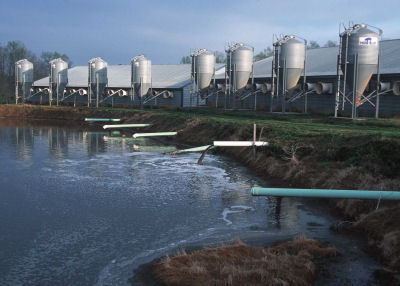
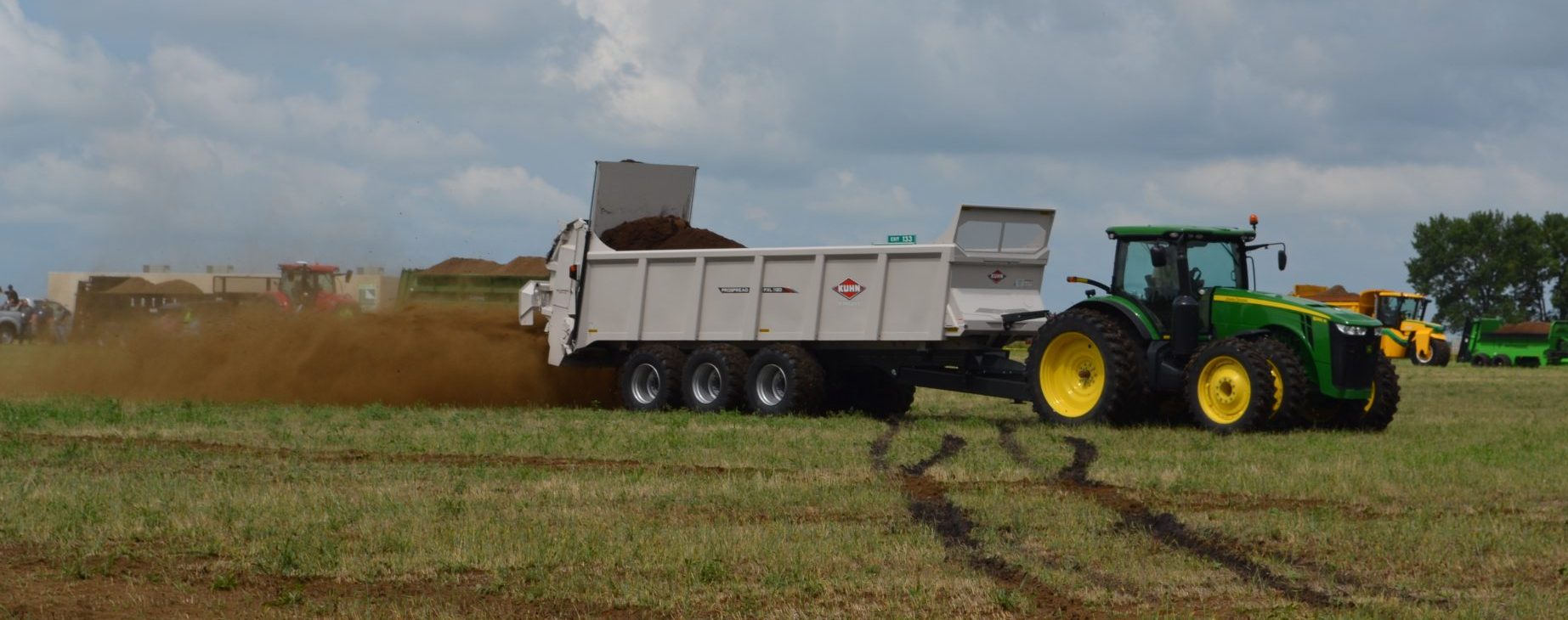
Livestock manure has value as a fertilizer and as an energy source. Photo courtesy USDA NRCS.

Animal manure is used as a crop fertilizer and soil amendment, but it can pose environmental risks when stockpiled or applied in excessive amounts. Federal, State, and local governments have responded to the environmental risks with regulations and conservation programs, and some State and local governments have also initiated lawsuits against livestock operations, claiming damages to water resources from manure. Efforts to comply with regulations impose costs on certain livestock operations and will likely lead to changes in manure use on those operations.

There is also increasing interest in using manure for energy production. Methane can be captured from the biogas in manure and burned for electricity generation, while manure can also be burned directly as a feedstock in combustion processes. This report assesses current patterns of use of manure as fertilizer and evaluates the likely impacts of emerging environmental regulations on manure use. The report also assesses current efforts to use manure for energy production and evaluates the impact of bioenergy investments on manure’s use as fertilizer.

What Did the Study Find?

Manure Nutrient Use

About 15.8 million acres of cropland, equivalent to about 5 percent of all U.S. cropland, are fertilized with livestock manure. Corn, which is planted on about one-quarter of U.S. cropland, accounts for over half of the land receiving manure. Patterns of manure use are driven by the agronomic needs of crops and by transport costs, which limit the distance that manure can be moved and create close links between types of livestock and certain crop commodities. Each favors the application of manure to corn.

Most manure applied to corn comes from dairy and hog operations. Manure from poultry and cattle feedlot operations is drier and less costly to transport, and is therefore often removed from the farm and shipped to other operations. Because broiler production is concentrated in the southern United States, crops like peanuts and cotton rely heavily on broiler manure when they use manure fertilizers.

The value of nutrients in this manure will vary with supply and demand. Photo courtesy Rick Koelsch, University of Nebraska.

Large livestock operations are increasingly required to have nutrient management plans, which require balancing nutrient applications with the nutrient utilization of crops. Compliance with the plans can raise farm costs. Estimated costs vary sharply with the degree to which excess manure needs to be disposed of and the willingness of nearby farmers to accept manure for application to their cropland. A low willingness to accept among nearby farmers means that livestock producers will need to transport excess manure much farther for crop application. With a limited willingness to accept manure (defined as 20 percent of nearby farmers), we estimated that production costs, including those for manure management, would likely rise by 2.5-3.5 percent for large operations.

Such increases are unlikely to alter the emerging structure of livestock production, where large operations have substantial cost advantages over small operations. They are also unlikely to lead to substantial declines in production and consumption; the resulting percentage retail price changes would be less than the cost changes noted above because farm costs are only a fraction of retail costs, and retail demand for meat and milk is relatively insensitive to price changes. As a result, expanded regulation through nutrient management plans will likely lead to wider use of manure on cropland, at higher production costs, with little impact on the size structure of farming operations.

Manure-to-Energy Use

Manure-to-energy projects are not currently in widespread use. Digester systems, including those planned or in construction, cover less than 3 percent of dairy cows and less than 1 percent of hogs. The single operating combustion plant utilizes litter from 6.6 percent of U.S. turkey production, while an idled plant in California could utilize manure from about 3 percent of fed cattle.
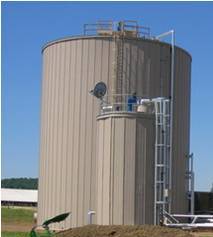
This anaerobic digester produces energy from livestock manure. Photo courtesy Bill Lazarus, University of Minnesota.

Manure-to-energy projects may allow farmers to realize benefits from avoided purchases of electricity, from selling electricity, or from selling manure to generating plants, but few realize enough savings to justify the expense. But because such projects use existing resources, they could provide society with benefits if manure replaces newly mined fossil fuels in energy production, and if methane, a greenhouse gas, can be captured. Those societal benefits have led to proposals to support manure-to-energy projects through State utility mandates (to purchase electricity from farms and to invest in renewable production sites), through subsidies for capital costs, and through direct subsidies and credits for energy production. Expanded support could lead to a substantial growth of energy applications for manure.

Currently envisioned manure-to-energy projects are not likely to impose substantive constraints on the use of manure as fertilizer. Many of the nutrients that are beneficial to crop growth remain after energy production. Nitrogen, phosphorus, and potassium nutrients remain in the effluent of the digester process, to be spread on fields. Combustion processes do consume the nitrogen nutrients in manure, but leave phosphorus and potassium in an ash residue that, because of its concentrated form, is less costly to transport than raw manure. In addition, manure-to-energy projects function in markets for fertilizer and energy, and will be most economic in those areas in which the acquisition costs of manure are lowest. In turn, manure acquisition costs will be lowest where manure is in excess supply, with the least value as fertilizer.

Additional Reading About Manure for Fertilizer and Energy

Author

James MacDonald, chief of the Agricultural Structure and Productivity branch in USDA’s Economic Research Service, Resource and Rural Economics Division, macdonal@ers.usda.gov
Liquid Manure Storage Treatment Options, Including Lagoons

A vital component of liquid livestock and poultry manure collection and handling systems is storage capacity for the collected manure and associated material(flush water, wasted feed, etc.). This manure storage capacity is typically in the form of under-floor pits or outside storage tanks or ponds and/or treatment lagoons. These structures accumulate collected wastes and allow the waste management system operator to move away from a “daily scrape (collect) and haul” situation. This reduces time and labor needed for final disposition (either land application or off-farm “value-added” processing) of these manure accumulations.

What Is a Liquid Manure System?

“Liquid” livestock manure collection and handling systems are actually “fluid” livestock manure collection and handling systems. These systems are selected based upon the consistency or “thickness” of the manure and its flow characteristics. Manure flow characteristics are highly dependent on “solids content” or “percent solids” of the manure volume.

Liquid manure storage volume size depends on the amount of time in a year that is not available for land application or other manure utilization strategies. This is the design storage period. Land application time depends on growing season of the target crop(s) and local weather. Manure storage volume should be emptied by the end of the design storage period to be able to hold the expected amount of manure accumulation during the next storage period.

Earthen storage structure with artificial liner (from Proper Lagoon Management to Reduce Odor and Excessive Sludge Accumulation).

This web page deals with two general categories of liquid systems:

  • Pits or slurry systems for storage only
  • Lagoons with both slurry/wastewater storage and treatment (see National Center White Paper summary, Manure Management Strategies).

Types of Manure

“As-excreted” livestock manure moisture content changes as it moves through the collection process into storage. Liquid collection and handling systems add waste drinking water, wash water, flush water, rain, and stormwater runoff, lowering solids content below the 15% level typically used to define “solid” manure. A manure volume of 5 to 15% solids is “slurry” manure, with consistency and flow characteristics similar to thick chocolate malt. Manure volumes with 0 to 5% solids content have consistency and flow characteristics similar to water.

What Is the Difference Between Storage and Storage With Treatment?

Contrasting storage and storage w/treatment, a manure containment structure which is emptied at the end of the storage period is essentially a storage structure. A lagoon has storage volume but will also have a permanent pool for residual treatment volume that provides a bacterial seed bed for continual bacterial action at an elevated level. This permanent pool is not considered in the design of a structure used for storage alone. Essentially whatever goes into a properly managed storage structure is what is pumped out. A lagoon, however, is designed to promote decomposition of organic matter entering the lagoon. For this reason, a lagoon is much larger than a storage pond.

Management of Lagoons

A manure containment structure which is not emptied at the end of the storage period is being operated as a lagoon, whether designed that way or not. Storage operated in this manner becomes a smelly, overloaded lagoon. Generally, when agitation is used to put settled or floating solids into suspension before pumping out the effluent, or the slurry, the structure is being operated as storage.

Digested solids do accumulate in a lagoon and should be removed once every ten or more years, or as specified by the system design to restore residual treatment volume. In rare circumstances, particular to specific lagoons approaching this restoration point, some engineers recommend some agitation during normal pumpout to remove some of this accumulation. Routine pumping from the storage volume portion of a lagoon involves only wastewater (<5% solids) and requires no agitation.

Related Web Pages

Recommended Educational Resources

National Center for Manure and Animal Waste Management white paper summary, Manure Management Strategies published by North Carolina State University. A two page Executive Summary is available. The full white paper can be ordered from Midwest Plan Service, Iowa State University.

Page Managers: Ted Tyson, Auburn University, tysontw@auburn.edu and Saqib Mukhtar, Texas A&M University, mukhtar@tamu.edu .

Vermicomposting Animal Manure

Worm Composting

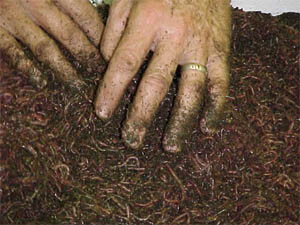
Vermicomposting is a process that relies on earthworms and microorganisms to help stabilize active organic materials and convert them to a valuable soil amendment and source of plant nutrients. Earthworms will consume most organic materials, including animal manure, agricultural crop residues, organic byproducts from industries, yard trimmings, food preparation scraps and leftovers, scrap paper, and sewage sludge.

Of the more than 4,000 species of earthworms, only half a dozen are used for vermicomposting worldwide. The earthworm species most frequently used for vermicomposting is Eisenia fetida, which is commonly called Red Wiggler.

The red wiggler worm is frequently used for vermicomposting.


How To Choose A Vermicomposting System

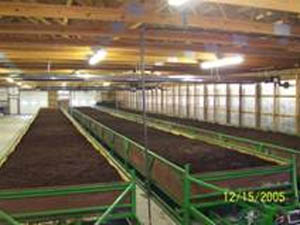
A variety of methods may be used to process large volumes of organic residuals with earthworms, ranging from land and labor-intensive techniques to fully automated high-tech systems. Types of systems include windrows, beds, bins, and automated raised bioreactors. Choosing which vermicomposting system to use will depend upon:

  • Amount of feedstock to be processed
  • Funding available
  • Site and space restrictions
  • Climate and weather
  • State and local regulatory restrictions
  • Facilities and equipment on hand
  • Availability of low-cost labor

Swine Manure Vermicomposting, Vermicycle Organics, Tarboro, NC


Dairy Manure Vermicomposting, Worm Power, Geneseo, NY


What Are the Advantages In Using Vermicompost?

Earthworm casts are covered with mucus from their intestinal tract; this layer provides a readily available carbon source for soil microbes and leads to a flush of microbial activity in fresh casts. Vermicompost improves soil structure, reduces erosion, and improves and stabilizes soil pH. In addition, vermicompost increases moisture infiltration in soils and improves its moisture holding capacity.

Plant growth is significantly increased by vermicompost, whether it is used as a soil additive, a vermicompost tea, or as a component of horticultural soilless container media. Vermicompost causes seeds to germinate more quickly, seedlings to grow faster, leaves grow bigger, and more flowers, fruits or vegetables are produced. These effects are greatest when a smaller amount of vermicompost is used—just 10-40 percent of the total volume of the plant growth medium in which it is incorporated. Vermicompost also decreases attacks by plant pathogens, parasitic nematodes and arthropod pests.

Turnips: 0%, 10%, 20% vermicompost by volume added to field plots, Biological & Agricultural Engineering, NC State University


Recommended Reading About Vermicomposting

Author: Rhonda Sherman, North Carolina State University

Research Summary: Turnip Response to Vermicompost

Research Purpose

Vermicomposting separated swine solids is a way to reduce odor and pathogens in a product that can be used off site as a nutrient source and soil amendment. The solid separation system removes a portion of the nutrient and organic loads from the liquid waste stream prior to entering the lagoon system while the vermicomposting process stabilizes the nutrients and organics that are diverted from the lagoon, making it easier to find off-farm uses for the product.

The goal of this project was to demonstrate the usefulness of vermicompost in an agronomic setting. If crop growth can be enhanced without increasing nitrogen or phosphorus runoff pollution, then the vermicompost product can be evaluated further for economic efficiency. In the same manner, if nitrogen or phosphorus pollution can be decreased without reducing crop growth or quality, the product is also in a position for further evaluation.

Activities

We grew turnips in small plots with either 0, 10 or 20% vermicompost (by volume) mixed into the top 0.3 m of soil; nitrogen fertilizer was added to half of the plots. The experiment was repeated over four growing periods in two different soil types. Runoff from each plot was measured and analyzed for nutrients, solids, copper and zinc. Plant biomass was harvested at maturity. Both wet and dry weights were determined.

What We Have Learned

Plant biomass increased with the addition of vermicompost while the volume of runoff decreased. None of the pollution parameters were affected by inorganic fertilizer and only the mass of phosphorus and zinc in the runoff showed an effect of adding vermicompost.

The mass of zinc in runoff decreased but the mass of phosphorus increased because of the degradation activity of microorganisms and earthworms in the vermicomposting process would be expected to break down organic matter and release nutrients. Phosphorus, needed in smaller quantities than nitrogen, would be applied in excess and would end up in soil solution and runoff. Mass of nitrogen in run off was not affected by vermicompost addition, suggesting that the greater biomass growth did not come at the expense of additional nitrogen in runoff.

Examples of typical appearance of turnips with different amounts of vermicompost: 0%, 10%, 20%. Biological & Agricultural Engineering, NC State University.


Why is This Important?

This project demonstrated the usefulness of using vermicompost in a specific agronomic instance. Turnip growth was enhanced, runoff volume was reduced and pollutants in runoff were generally not greater than control plots of the same soil type. In phosphorus sensitive fields, any addition of manure based products must be used with caution.

For More Information

Contact john_classen@ncsu.edu or (919) 515-6800.

Classen, J.J., J.M. Rice, and R. Sherman, 2007. The Effects of Vermicompost on Field Turnips and Rainfall Runoff. Compost Science and Utilization 15(1): 34-39

By John Classen, Mark Rice and Rhonda Sherman, NC State University

This report was prepared for the 2008 annual meeting of the regional research committee, S-1032 “Animal Manure and Waste Utilization, Treatment and Nuisance Avoidance for a Sustainable Agriculture”. This report is not peer-reviewed and the author has sole responsibility for the content.

Research Summary: Evaluation of a Synthetic Tube Dewatering System for Animal Waste Pollution Control

Research Purpose

The objective of this field study was to evaluate the performance of a Geotube® dewatering system under field conditions by quantifying the mass removal efficiency of solids, nutrients, and metals from well-mixed dairy-lagoon slurry dewatered by this system.

Activities

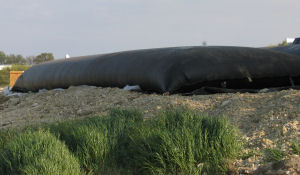
A Geotube dewatering system was set-up to treat the lagoon slurry mix from the primary lagoon of a 2000-head lactating cow open-lot dairy (Fig. 1). After two synthetic tubes were filled to a height of approximately 1.5 m with the slurry mixture (Fig. 1), the pumping of effluent ceased and tubes were left to dewater for six months. During the pumping of slurry mix into tubes, both alum and polymer were added.

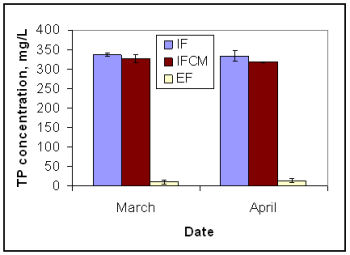
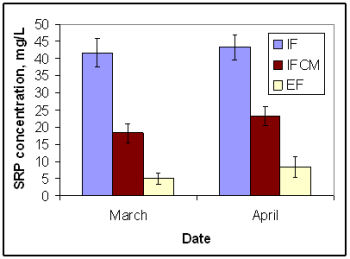
Slurry samples were collected before pumping it into the system (hereafter influent, IF), after mixing it with alum and polymer (hereafter IFCM), and effluent (hereafter EF) samples were collected as it ‘drained’ out of the system. Additionally, residual solids (RS) samples were also collected after both tubes had dewatered for six months. Samples were analyzed for solids, nutrients and metals following EPA and standard analytical methods.

Figure 1. Geotube® dewatering system: before (L) and after (R) filling with effluent.


Geotube dewatering system before filling Geotube dewatering system filled


What We Have Learned

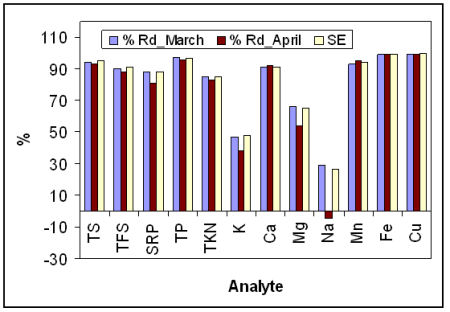
This system effectively removed high percentage of total phosphorus (TP), 97% (Fig. 2) and soluble reactive phosphorus (SRP), 88% (Fig. 3), well above 50% reduction goal set by the phosphorus Total Maximum Daily Loads (TMDLs) for the North Bosque River in east central Texas.

Geotube® also successfully filtered solids (95%) from the lagoon slurry. This system was less effective in removing K (<50%) (Fig. 3), since K is highly soluble.

Geotube® dewatering system successfully reduced Ca, Mn, Fe, and Cu concentration by 91, 60, 99, and 99%, respectively (Fig. 3). However, this system was not highly effective in removing Na (<26%) from dairy lagoon slurry (IF).

Figure 2. Average total phosphorus (TP) concentration at different sampling date


Figure 3. Average soluble reactive phosphorus (SRP) concentration at different sampling date.


Figure 4. Average % reduction (Rd) and separation efficiency (SE) of effluent constituents using Geotube® dewatering system.


Why is This Important?

Water quality degradation due to phosphorus (P) contribution as a non-point source (NPS) pollutant from effluent and manure applied to waste application fields (WAFs) is a major concern in the Bosque River watershed in east central Texas. Geotube® dewatering system can be used as one of the best management pactices to minimize pollution from dairy effluent to be applied to field, but it must address the disposal of solids and costs.

For More Information

Contact mukhtar@tamu.edu or (979)458-1019. For more information, refer to the following publication.

Mukhtar, S., L. A. Lazenby, S. Rahman. 2007. Evaluation of a synthetic tube dewatering system for animal waste pollution control. Applied Engineering in Agriculture 23(5): 669-675

Authors: Saqib Mukhtar and Shafiqur Rahman, Texas A&M University

This report was prepared for the 2008 annual meeting of the regional research committee, S-1032 “Animal Manure and Waste Utilization, Treatment and Nuisance Avoidance for a Sustainable Agriculture”. This report is not peer-reviewed and the author has sole responsibility for the content.

Protocol for Determining the Cost/Benefit of a Manure Storage Lagoon Cover

Do Manure Storage Covers Pay?

A protocol was developed to determine the cost/benefit of installing a cover over a manure storage structure. Included are a discussion on the cost and selection of the cover, a procedure to determine the feasibility of biogas production and capture, the technique to estimate the dilution of the slurry resulting from precipitation, and tools to estimate ammonia emissions, thereby predict the increase in nitrogen content and the savings from reduced fertilizer hauling. By considering the combination of all of these factors, the payback period can be calculated.

Current Activity

The protocol has been developed and a case study was performed. A manuscript is in preparation.

What We Have Learned

Techniques to identify the items that determine the cost and benefit have been researched and refined for the protocol. Based on a sensitivity analysis a crucial benefit is the savings associated with keeping precipitation out of the manure thus avoiding extra hauling costs. As a result, relatively short payback periods can be realized.

Why is This Important

One of the most common practices to store manure is the use of open storage structures. Numerous problems for farmers are created by the open structure including ammonia loss, methane emissions, odor complaints, and increased hauling of manure slurry. Covering a lagoon offers substantial environmental benefits and can save farmers money.

a lagoon cover recently installed on a dairy farm

For More Information

Steve Safferman
Michigan State University
Biosystems Engineering
202 Farrall Hall
East Lansing, MI 48824

This report was prepared for the annual meeting of the regional research committee, S-1032 “Animal Manure and Waste Utilization, Treatment and Nuisance Avoidance for a Sustainable Agriculture”. This report is not peer-reviewed and the author has sole responsibility for the content.