
Pathways for Effective Manure Nutriment Management Information Sharing and Education Between Agriculture Professionals: A South Dakota Pilot Test


Why Look at Barriers in Nutrient Management Information Flow?


The issue of manure nutrient management has been the subject of controversy and new policies in recent years as the non-point source discharge of nutrients and bacteria is substantial if manure is not managed properly. Unfortunately, there are barriers between organizations and individuals that prevent the flow of important, timely information between audience types and limits the impact and usefulness of research results. These barriers may be in the form of institutional language differences, job descriptions, or a mismatch between information outputs and inputs.

What did we do?

A national team of researchers, Extension specialists, consultants and government staff developed a survey to quantify the role, programming, and barriers to information flow between organizations and individuals regarding manure nutrient management. The electronic survey was disseminated via cooperating agencies, organizations and personal contacts to technical service providers, producers, university personnel, regulatory personnel, private sales or service enterprises and other professionals who contribute to manure nutrient management in South Dakota. Respondents were asked to indicate the relevance of information sources (inputs), information products (outputs) and collaborators (links), as well as barriers to their use. The relevance selections were transformed into scalar data and an analysis of variance was performed on the average relevance scores to test for differences based on input/output/link type and organization type.

What have we learned?

There were 139 surveys started, and 80 surveys completed. Data from partially completed surveys were, however, included in the analysis. The main categories of self-identified respondents were NRCS (n=36), Producers (n=29), University personnel (n=15) and Regulatory personnel (n=9). The remaining categories respondents were grouped into an Other category (n=22). The average relevance score for each of the information sources, information products and collaborations listed in the survey were consistent (no significant difference between organization types). As sources of information, consultation, eXtension and field days were ranked most relevant, with classroom and social media being least relevant. Similarly, consultation, field days and eXtension were ranked the most relevant means of sharing information; social media was ranked least relevant. Barriers to information sources and products were specific to the activity or product. The select ion “No barriers to use” was not an indicator of relevance. All organization types deemed producers the most relevant collaborator, followed by state, university and federal agencies.

Future Plans

The South Dakota-based survey was a pilot test for a nationwide survey being conducted in 2015. From feedback and data review, the survey has been refined and shortened to elicit the key input, output and collaborator data. With the national data in hand later in 2015, the project team looks forward to linking information producers and users in effective pathways for manure nutrient management information transmission, and ultimately, adoption.

Authors

Erin Cortus, Assistant Professor and Environmental Quality Engineer at South Dakota State University erin.cortus@sdstate.edu

Nichole Embertson, Nutrient Management Specialist, Sustainable Livestock Production Program, Whatcom Conservation District; Jeffrey Jacquet, Assistant Professor, Sociology and Rural Studies, South Dakota State University

Additional information

Anyone interested in participating on the Pathways Project team are invited to contact Erin Cortus (erin.cortus@sdstate.edu) or Nichole Embertson (NEmbertson@whatcomcd.org).

Acknowledgements

The nationwide team who contribute to and guide the Pathways project are gratefully acknowledged. Funding provided through the South Dakota SARE Mini-Grant Program supported data collection and analysis for the survey pilot test.

The authors are solely responsible for the content of these proceedings. The technical information does not necessarily reflect the official position of the sponsoring agencies or institutions represented by planning committee members, and inclusion and distribution herein does not constitute an endorsement of views expressed by the same. Printed materials included herein are not refereed publications. Citations should appear as follows. EXAMPLE: Authors. 2015. Title of presentation. Waste to Worth: Spreading Science and Solutions. Seattle, WA. March 31-April 3, 2015. URL of this page. Accessed on: today’s date.

 

Western Region Symposium on Animal Agriculture in a Changing Climate March 31, 2015

These presentations were from the Western Region Symposium on Animal Agriculture in a Changing Climate at the Waste to Worth Conference, Seattle WA. 3/31/2015.

Climate Change Impacts On Western Livestock

Lara Whitely-Binder is an outreach specialist with the University of WA’s Climate Impact’s Group.  Her presentation describes the Western U.S regional climate outlook and projected impacts to agriculture. She examines the impacts (some positive, some negative) on water supply, changes in yield, rangeland fire risk and forage quality, and milk and beef production.

Livestock Grazing In a Changing Climate: Implications for Adaptive Management

Justin Derner, PhD is a Rangeland scientist with the USDA-ARS in Cheyenne, WY, and the director of the Northern Plains Climate Hub in Ft. Collins, CO. This presentation discusses livestock grazing in a changing climate and the implications for adaptive management on rangelands. Adaptive management is a process by which a manager is constantly evaluating the system and making adjustments to reduce risks and uncertainty. View Dr. Derner’s proceedings paper for the conference.

USDA Northwest Region Climate Hub Update

Bea Van Horne, PhD is with the USDA Forest Service and the director of the USDA for the Pacific Northwest Regional Climate Hub. She gave an update of the Pacific Northwest Climate Hub.  Climate change is expected to have significant impacts on agriculture. The climate hubs aim to deliver region-specific information and serve as a clearinghouse for providing science-based information to agricultural managers.

Beef Cattle Selection and Management For Adaptation To Drought

Megan Rolfe, PhD is an assistant professor in animal science department at Oklahoma State University and a beef extension specialist for the state of Oklahoma. The presentation discusses her program’s research findings on beef cattle selection and management for adaptation to drought. She discusses areas such as water intake, quality and quantity of available water, and animal performance and carcass characteristics under water restriction.

Adopting Policies and Priorities to Encourage Climate-Smart Agricultural Practices

Susan Capalbo is Professor and Department Head of Applied Economics at Oregon State University. She gave an presentation discussing ways to encourage the ag community to adopt practices and policy makers to create policies that are beneficial in terms of climate and food production.

Acknowledgements

This page was developed as part of a project “Animal Agriculture and Climate Change” an extension facilitation project to increase capacity for ag professionals. It was funded by USDA-NIFA under award # 2011-67003-30206. If you have questions about any of the topics or have problems with links, contact Crystal Powers cpowers2@unl.edu or Jill Heemstra jheemstra@unl.edu.

For questions about the AACC project, contact Rick Stowell rstowell2@unl.edu or Crystal Powers.

Global Climate Change – What Does It Mean For Us?

Climatologists are seeing noticeable patterns in data that points toward future weather that will be more extreme and extreme more often. In this presentation, Gary McManus, the State Climatologist for Oklahoma, discusses the basics of climate science, the trends and more. The lecture focuses on Oklahoma and the Southern Plains; however most of the information is relevant nationally.

This presentation was recorded at the “Climate and Cattle Workshop” held in November, 2014 in Stillwater, OK.

Introduction and Trends in Climate

Climate Science: The Basics

What is the greenhouse effect and what are the physics of this phenomenon?

Observational Data

What are we measuring that indicates climate is changing? What are some of nature’s indicators?

Climate Projections

How confident are climatologists in predicting future patterns? Where are there uncertainties?

Download links – Educational Resources

If you need to download a copy of a segment, submit a request.

Acknowledgements

This material was developed through support from the USDA National Institute for Food and Agriculture (NIFA) under award #2011-67003-30206.

The project wishes to gratefully acknowledge Mr. McManus for presenting at the workshop and allowing us to record the lecture. David Smith, Texas A&M dwsmith@tamu.edu and Dr. Saqib Mukhtar organized the workshop.

A Novel Multiple Staged Leachbed Digestion System for the Treatment of Dry-lot Feedlot and Dairy Manures

A multiple staged digestion system capable of digesting drylot manures is currently under development. The system is currently being validated at the pilot scale with three 1.5 cubic meter batch reactors. The system shows promise with various animal manure wastes as well as other common waste products. The first stage of the process is a dry digestion leachbed process in which the hydrolysis of solid waste products is optimized. The liquid leachate produced by the first stage is then transferred to a storage tank where the leachate is accumulated before use in the last stage. The last stage is optimized for methanogenesis and consists of a high rate methane reactor. 

What Have We Learned?

This configuration of system components lends itself to a variety of potential advantages for regional digestion of animal wastes. Wastes of various solids contents can be segregated into the appropriate reactors, with high solids wastes placed in the first stage, moderate solids in the second stage, and primarily soluble wastes can be sent straight to the last stage. This inherent substrate flexibility could enable the construction of regional digesters capable of treating a wide array of wastes. As the solid wastes are dry digested dewatering at the end of the process is less challenging and leads the production of a high nutrient content soil amendment. 

Future Plans

 Plans are currently in the works to begin scaling this pilot system to build a 100-500kw on farm digester system. 

Author

Lucas Loetscher  lloetscher@gmail.com   Colorado State University

The authors are solely responsible for the content of these proceedings. The technical information does not necessarily reflect the official position of the sponsoring agencies or institutions represented by planning committee members, and inclusion and distribution herein does not constitute an endorsement of views expressed by the same. Printed materials included herein are not refereed publications. Citations should appear as follows. EXAMPLE: Authors. 2015. Title of presentation. Waste to Worth: Spreading Science and Solutions. Seattle, WA. March 31-April 3, 2015. URL of this page. Accessed on: today’s date.

Measuring Nitrous Oxide and Methane Emissions from Feedyard Pen Surfaces; Experience with the NFT-NSS Chamber Technique

Why Study Nitrous Oxide and Methane at Cattle Feedyards?

Accurate estimation of greenhouse gas emissions, including nitrous oxide and methane, from open beef cattle feedlots is an increasing concern given the current and potential future reporting requirements for GHG emissions. Research measuring emission fluxes of GHGs from open beef cattle feedlots, however, has been very limited. Soil and environmental scientists have long used various chamber based techniques, particularly non-flow-through – non-steady-state (NFT-NSS) chambers for measuring soil fluxes. Adaptation of this technique to feedyards presents a series of challenges, including spatial variability, presence of animals, chamber base installation issues, gas sample collection and storage, concentration analysis range, and flux calculations.

What did we do? 

Following an extensive review of the literature on measuring emissions from cropping and pasture systems, it was decide to adopt non-flow-through – non-steady-state (NFT-NSS) chambers as the preferred measurement methodology. However, the use of these NFT-NSS chambers had to be adapted for use in conditions of beef cattle feedyards and open corral dairies.

What have we learned? 

Trials of various techniques for sealing the chamber to the manure surface including piling soil/manure around the chamber and various weighted skirts were trial, however no technique was as good at sealing the chamber as a metal ring driven 50-75 mm into the underlying substrate.

Chamber bases could potentially injure animal in the pen and/or animal could disturb the measurement installation, so measurements were only conducted in recently vacated pens.

Gas samples were drawn from a septa in the chamber cap using a 20 ml polyethylene syringe and immediately injected into a 12 ml evacuated exetainer vial for transport, storage and analysis. Trials of alternative vials led to sample loss and contamination issues.

Gas samples were analyzed using a gas chromatograph equipped with ECD, FID and TCD detectors for nitrous oxide, methane and carbon dioxide determination, respectively.

The metal rings or bases must be installed at least 24 and preferably 48 hours before measurements are commenced as the disturbance caused when installing the bases will result in a temporarily enhanced emission flux.

Ten, 20 cm dia chambers constructed from PVC pipe caps are deployed in a pen and yield a reasonable approximation of the average emission fluxes from the pen.

The range of gas concentrations measured in the chamber at the end of a 30 minute deployment was up to 2 orders of magnitude greater than that typically measured in cropping systems research. This required careful choice of calibration gas concentrations and calibration of the gas chromatograph. The response of the ECD detector used for determining N2O concentration may not be linear over the entire range experienced.

The rate of increase in concentration in the chamber is often curvilinear in form and a quadratic approach was adopted for determination of the flux rate.

Future Plans 

On-going studies are quantifying N2O and CH4 flux rates from pen surfaces in a cattle feedlots under varying seasonal conditions; further work is identifying contributing factors.

Authors

Kenneth D. Casey, Associate Professor at Texas A&M AgriLife Research, Amarillo TX kdcasey@ag.tamu.edu

Heidi M. Waldrip, Research Soil Scientist at USDA ARS CPRL, Bushland TX; Richard W. Todd, Research Soil Scientist at USDA ARS CPRL, Bushland TX; and N. Andy Cole, Research Soil Scientist at USDA ARS CPRL, Bushland TX;

Additional information 

For further information, contact Ken Casey, 806-677-5600

Acknowledgements

Research was partially funded from USDA NIFA Special Research Grants

The authors are solely responsible for the content of these proceedings. The technical information does not necessarily reflect the official position of the sponsoring agencies or institutions represented by planning committee members, and inclusion and distribution herein does not constitute an endorsement of views expressed by the same. Printed materials included herein are not refereed publications. Citations should appear as follows. EXAMPLE: Authors. 2015. Title of presentation. Waste to Worth: Spreading Science and Solutions. Seattle, WA. March 31-April 3, 2015. URL of this page. Accessed on: today’s date.

Relative Mineralization Rates of Manure and Effect on Corn Grain Yield and N Uptake


Why Is It Important to Study Availability of Manure Nitrogen?

Application of fresh and composted manure as a fertilizer source in corn production has long been a useful practice in many sustainable crop production systems especially when phosphorus, and not nitrogen (N), is the primary nutrient of interest. But when manure is applied as the primary source of N, despite several agronomic advantages associated with manure use, there is a high risk of ground water pollution, and often times, would produce lower yields and grain protein than inorganic fertilizers. Nitrogen mineralization and availability from manure is difficult to predict. Therefore estimating the amount of crop N uptake that may be attributed to manure applied in the same year or to its residual impact, can be a useful approach towards quantifying a supplementary quantity of inorganic N fertilizer with the manure.

What did we do?

yield response to manureThis study measured in situ relative soil N mineralization rates (flux) during three growing seasons of continuous no-till (2013 and 2014) corn in Carrington, ND. We applied fresh (FM) and composted beef feedlot manure (CM) only once in spring 2012 at N rates of 90, 180, and 240lbs/A as FM, and 90 and 180lbs as CM. These rates were applied based on the calculation that 50% of N from FM and 25% of N from CM, would be available the first year. Other treatments were urea at 90, 150, 180, and 240lbs N/A, plus a check at 0lbs/A. In 2013 and 2014 urea was applied to respective plots, based on soil test, to raise the N levels to the respective 2012 N levels. We used the randomized complete block design with four replicates. Three replicates were used to measure soil N (NO3- + NH4+) mineralization rates bi-monthly with Plant Root Simulator probes (PRS™), from the urea fertilized and manured plots at the 0, 90 and 180lb levels at 4-6 leaf growth stage. Four pairs of PRS™ probes were buried in the top 6 inches near corn roots and replaced every two weeks for four sampling dates. We measured yields, protein content, and N uptake.

What have we learned?

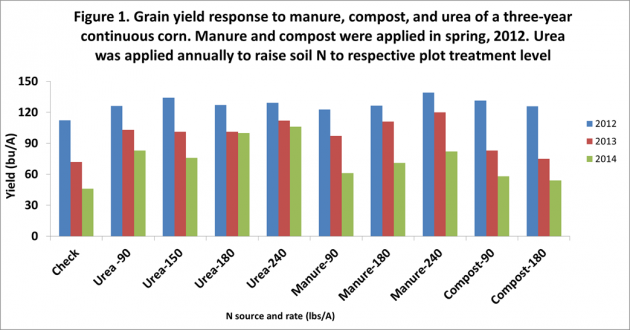
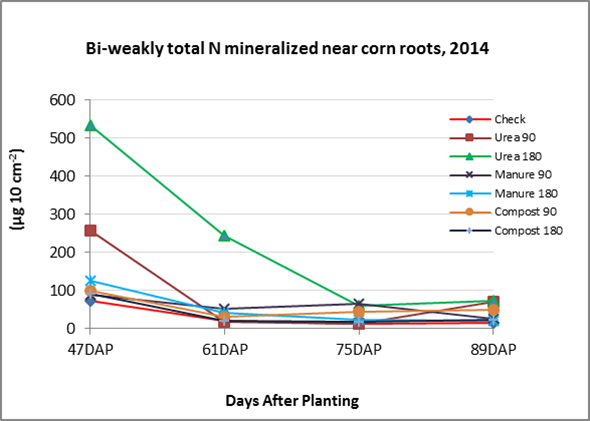
N mineralized near corn roots, 2014Yields were generally low in all three years of this study, well below the average for this region. Bi-monthly N mineralization was significantly higher as N increases with urea as N source during the early sampling dates (Figures 2 and 3) and subsequently declined to similar levels as the manure treatments. It is therefore possible that the plants benefited from higher early uptake of N from urea up to the early stages of peak corn N uptake but not enough to produce significantly higher yields than the manure treatments. Analysis of variance showed no significant treatment effects for yields in 2012 (α = 0.05) but grain protein differences were significant. These differences were observed only between the check and 180 lbs N in 2012. The highest mean grain yield was recorded with the 90 lbs N treatment where, the residual soil N at planting was just 33 lbs. The protein level was also significantly higher than the check and CM plot that received 180 lbs N in 2012, and with a soil residual N prior to 2013 planting, at 35 lbs. Each year, grain yields responded positively to N rates (applied as urea) and residual N levels from FM but not with CM. Since corn was grown for three continuous years, unsurprisingly yields declined with years of production since N was not applied to the FM and CM treatments after first application in year one. Similarly, yield decline was observed with urea over the three years but not as steep as the FM and CM treatments. The FM at 240 lbs N, and urea at 180 and 240 lbs treatments produced significantly higher grain protein than the check in 2012 (data not shown). Lower N mineralization and very likely, lower N availability was observed with the CM treatments especially at 180 lbs N, which consistently scored the lowest mean yield and protein in 2013 and 2014. Grain yields were consistently higher at 90 lbs N than 180 lbs N with the CM treatment. N mineralized near corn roots, 2014Summer droughts of 2012 and 2013 at this site and possibly, factors associated with continuous corn production (e.g. disease, temporal N immobilization) compounded the effects of urea treatments even though N uptake was consistently higher with urea. Total N taken up in corn grains from the FM and CM treatments increased with N rates but decreased with time (Table 1). From this study, corn grains took up more N from the plots treated with FM than the CM over the three-year period of the study. Subsequent changes in soil conditions such as moisture, N leaching, temperature, can sometimes limit the efficiency of inorganic fertilizer uses, and favoring low cost alternative uses such as manure especially if the prevailing conditions enhance N mineralization from manure or soil organic matter. Based on N input plus soil N status at the beginning of planting every year, corn N uptake efficiency was in the order: Check>FM>CM>Urea, with efficiency decreasing at higher N rates. The minimum proportion of grain N uptake by any treatment to the single highest N uptake for any urea-N treatment (considered as a reference) in a given year, was 42% for the check in 2013.
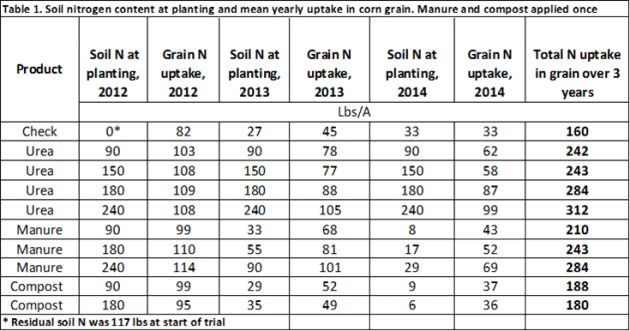
soil nitrogen at planting and mean yearly uptake in corn grain

Future Plans

Relative contribution of nitrogen from the fresh and composted manure treatments and residual N will be used to estimate the percentage of N coming from these treatments over a three-year period. This will be used to establish new studies to assess different levels of fertilizer N to apply with manure to improve on the grain protein content and yields.

Authors

Jasper M Teboh, Soil Scientist, Carrington Research Extension Center, North Dakota State University Jasper.Teboh@ndsu.edu

Szilvia Zilahi-Sebess, and Ezra Aberle

Additional information

More detailed results from 2013 can be found in the North Dakota Corn Growers 2013 Annual Report at: www.ndcorn.org/uploads/useruploads/annual_report.pdf

Acknowledgements

North Dakota Corn Growers Association, Western Ag Innovations, Mr. Ron Wiederholt, Mr. Blaine G Schatz (Director, CREC)

The authors are solely responsible for the content of these proceedings. The technical information does not necessarily reflect the official position of the sponsoring agencies or institutions represented by planning committee members, and inclusion and distribution herein does not constitute an endorsement of views expressed by the same. Printed materials included herein are not refereed publications. Citations should appear as follows. EXAMPLE: Authors. 2015. Title of presentation. Waste to Worth: Spreading Science and Solutions. Seattle, WA. March 31-April 3, 2015. URL of this page. Accessed on: today’s date.

Use of zilpaterol hydrocholoride to reduce odors and gas production from the feedlot surface when beef cattle are fed diets with or without ethanol byproducts

Purpose

Many malodorous compounds emitted from the feedlot surface of beef finishing facilities result from protein degradation of feces and urine (Mackie et al., 1998; Miller and Varel, 2001, 2002). The inclusion of wet distillers grain with solubles (WDGS) in beef finishing diets has been shown to increase nitrogen excretion (Spiehs and Varel, 2009; Hales et al., 2012) which can increase odorous compounds in waste (Spiehs and Varel, 2009). Zilpaterol hydrochloride (ZH) is a supplement fed to cattle for a short period of time (21 days) near the end of the finishing phase to improve efficiency of lean gain. Improvements in feed efficiency and lean tissue accretion potentially decrease nitrogen excretion from cattle. Therefore, the use of ZH in feedlot diets, especially those containing WDGS, may reduce the concentration of odorous compounds on the feedlot surface. The objective of this study was to determine if the addition of ZH to beef f inishing diets containing 0 or 30% WDGS would decrease odor and gas production from the feedlot surface.

What did we do?

Sixteen pens of cattle (25-28 cattle/pen) were used in a 2 x 2 factorial study. Factors included 0 or 30% WDGS inclusion and 0 or 84 mg/steer daily ZH for 21 d at the end of the finishing period. Each of the four following treatment combinations were fed to 4 pens of cattle: 1) finishing diet containing 0% WDGS and 0 mg ZH, 2) finishing diet containing 30% WDGS and 0 mg ZH, 3) finishing diet containing 0% WDGS and 84 mg/animal daily ZH and 4) finishing diet containing 30% WDGS and 84 mg/animal daily ZH. A minimum of 20 fresh fecal pads were collected from each feedlot pen on six occasions. Samples were mixed within pen and a sub-sample was placed in a small wind-tunnel. Duplicate samples for each pen were analyzed. Odorous volatile organic compounds were collected on sorbent tubes and analyzed for straight-chain fatty acids, branched-chain fatty acids, aromatic compounds, and sulfide compounds using a thermal desorption-gas chromatograph-mass spectrometry (Aglient Technologies, Inc, Santa Clara, CA). Ammonia (NH3) production was measured using a Model 17i Ammonia Analyzer (Thermo Scientific, Franklin, MA), and hydrogen sulfide (H2S) was measured using a Model 450i Hydrogen Sulfide Analyzer (Thermo Scientific, Franklin, MA).

What have we learned?

Inclusion of ZH in beef finishing diets was effective in lowering the concentration of total sulfides, total branched-chain fatty acids, and hydrogen sulfide from fresh cattle feces. Inclusion of 30% WDGS to beef feedlot diets increased the concentration of odorous aromatic compounds from feces. Ammonia concentration was not affected by the inclusion of either WDGS or ZH in the finishing diet. Producers may see a reduction in odorous emissions when ZH are fed to beef finishing cattle.

Table 1. Effect of ZH and WDGS inclusion in beef feedlot diets on concentration of odorous volatile organic compounds from cattle feces

Future Plans

Additional research is planned to evaluate the use of β-agonists, such as ZH, with moderate and aggressive implant strategies. These implants may further improve feed efficiency and lean gain, thereby potentially reducing excess nutrient excretion and odorous emissions. Evaluation odorous emissions from the feedlot surface when ZH are fed is also needed.

Authors

Mindy J. Spiehs, USDA, ARS, U.S. Meat Animal Research Center, Clay Center, NE mindy.spiehs@ars.usda.gov

Kristin E. Hales, USDA, ARS, U.S. Meat Animal Research Center, Clay Center, NE

Additional information

Mention of trade names or commercial products in their article is solely for the purpose of providing specific information and does not imply recommendation or endorsement by the USDA. USDA is an equal opportunity provider and employer.

Literature cited

Hales, K. E., N. A. Cole, and J. C. MacDonald. 2012. Effects of corn processing method and dietary inclusion of wet distillers grains with solubles on energy metabolism, carbon-nitrogen balance, and methane emissions of cattle. J. Anim. Sci. 90:3174-3185.

Mackie, R. I., P. G. Stroot, and V. H. Varel. 1998. Biochemical identification and biological origin of key odor components in livestock waste. J. Anim. Sci. 76:1331-1342.\

Miller, D. N. and V. H. Varel. 2001. In vitro study of the biochemical origin and production limits of odorous compounds in cattle feedlots. J. Anim. Sci. 79:2949-2956.

Miller, D. N. and V. H. Varel. 2002. An in vitro study of manure composition on the biochemical origins, composition, and accumulation of odorous compounds in cattle feedlots . J. Anim. Sci. 80:2214-2222.

Spiehs, M. J. and V. H. Varel. 2009. Nutrient excretion and odorant production in manure from cattle fed corn wet distillers grains with solubles. J. Anim. Sci. 87:2977-2984.

Acknowledgements

The authors wish to thank Alan Kruger and Elaine Ven John for assistance with data collection.

The authors are solely responsible for the content of these proceedings. The technical information does not necessarily reflect the official position of the sponsoring agencies or institutions represented by planning committee members, and inclusion and distribution herein does not constitute an endorsement of views expressed by the same. Printed materials included herein are not refereed publications. Citations should appear as follows. EXAMPLE: Authors. 2015. Title of presentation. Waste to Worth: Spreading Science and Solutions. Seattle, WA. March 31-April 3, 2015. URL of this page. Accessed on: today’s date.

Volatile Organic Compound (VOC) Emissions from Beef Feedlot Pen Surface as Affected by Within Pen Location, Moisture, and Temperature

Purpose

Determine the effects of moisture, temperature and within pen location on odorous emissions from pen surfaces generated from cattle fed a diet containing 30% wet distillers grain plus soluble (WDGS). This work is focused on developing precision practices for mitigating odor.

What did we do?

A laboratory study was conducted to determine effects of pen location, moisture, and temperature on emissions of volatile organic compounds (VOC). Feedlot surface material (FSM) was obtained from pens where cattle were fed a diet containing 30% wet distillers grain plus soluble (WDGS). The FSM were collected from the bunk, drainage, and mound areas within three feedlot pens. The FSM were mixed with water to represent dry, wet, or saturated conditions and then incubated at temperatures of 5, 15, 25 and 35ºC. A wind tunnel and TD GC/MS were used to quantify emissions of eight volatile fatty acids (VFA), five aromatics and two volatile sulfur compounds (VSC).

graph showing experiment results. Contribution to total odor activity value (OAV) for each feedlot pen location, moisture condition, and temperature. All within treatment odor activity values sum to 100%.What have we learned?

Evaluation of emissions as affected by the specified environmental conditions was performed on individual compounds which were normalized using an odor activity value (OAV). When the odor compounds were normalized with respect to their activity value, many of the measured compounds contributed minimally to the overall odor activity. Approximately 10% of the OAV was contributed by three VFAs and one aromatic (4-methylphenol) compound. The VSC contributed the most with 87.3% of the total OAV.

More than half of the OAV occurred at the base of the mound with the bunk and drainage contributing approximately equally to the remainder. The frequent wetting and drying cycles occurring near the base of the mound may contribute to a more diverse microbial population when compared with the chronically wet to saturated conditions existing behind the feed bunk.

The addition of water significantly increased the OAV. Approximately 92% of the OAV was accounted for by wet and saturated conditions. In general, the addition of water decreased emissions of VFA and aromatics, and increased the emission of sulfides. Two possible causes were offered. First, the greater solubility of the VFA and aromatics allowed them to be retained in the solution fraction of the FSM and not be emitted. Second, the addition of water results in an anaerobic environment and reducing conditions, which are conducive to production of VSC.

Temperature significantly affected OAV with over 60% of the total OAV occurring at 35ºC. The 35ºC temperature increased each odor compounds with the impact being the greatest for VSCs. It appears from this study, odor emissions are greatest during warm (i.e. > 25ºC) wet periods and from specific location within the pen.

Future Plans

Understanding the spatial variability of odor emission is important in the development of cost-effective management practices. Based on the results from this investigation, field-scale studies will be conducted to develop precision odor mitigation practices.

Authors

Bryan L. Woodbury, Agricultural Engineer, USDA-ARS, U.S. Meat Animal Research Center, Clay Center, NE bryan.woodbury@ars.usda.gov

John E. Gilley, Agr. Eng, USDA-ARS. David B. Parker, Prof., Life, Earth and Environ. Sci., West Texas A&M University. David B. Marx, Prof, Statistics, Univ. of NE. Roger A. Eigenberg, Agr. Eng., USDA-ARS, U.S.

Additional information

http://www.ars.usda.gov/Main/docs.htm?docid=14337

https://www.agupdate.com/todaysproducer/news/local/with-feedlot-manure-it-pays-to-be-precise/article_015b6db8-a234-582d-8c0e-04b99cf0f730.html

The authors are solely responsible for the content of these proceedings. The technical information does not necessarily reflect the official position of the sponsoring agencies or institutions represented by planning committee members, and inclusion and distribution herein does not constitute an endorsement of views expressed by the same. Printed materials included herein are not refereed publications. Citations should appear as follows. EXAMPLE: Authors. 2015. Title of presentation. Waste to Worth: Spreading Science and Solutions. Seattle, WA. March 31-April 3, 2015. URL of this page. Accessed on: today’s date.

Identify and Synthesize Methods to Refine Phosphorus Indices from Three Regional Indexing Efforts

Purpose

This project was started to work with regional CIG projects to calibrate and harmonize Phosphorus Indices across the U.S., demonstrate their accuracy in identifying the magnitude and extent of phosphorus loss risk, and provide suggestions to refine or improve existing Indices. This research is important to provide consistency among state Phosphorus Indices and their subsequent recommendations.  

What did we do?

We will combine and compare results from each of the four regional and state Phosphorus Index CIG-funded projects, in order to synthesize, summarize, and describe the science-based information and lessons learned from the individual Phosphorus Index assessment projects (i.e., Chesapeake Bay Watershed, Heartland Region, Southern States and Ohio Lake Erie Basin) and build a harmonized framework that yields consistent Phosphorus-based risk assessment across the U.S. by doing this, we plan to ensure that the refinement of Phosphorus Indices is grounded in the best available science, reflects local environmental and agronomic conditions, anticipates impacts to water quality and farm management, and provides consistent recommendations within and across varied physiographic regions of the U.S.

What have we learned?

Despite the success of the Phosphorus Index concept in state-level nutrient management planning strategies as part of the NRCS 590 Standard, there remain concerns about the effectiveness of the Indexing approach for attaining water quality goals. Different versions of the Phosphorus Index have emerged to account for regional differences in soil types, land management, climate, physiographic and hydrologic controls, manure management strategies, and policy conditions. Along with this development, differences in Phosphorus Index manure management recommendations under relatively similar site conditions have also emerged. To date, we have learned that the individual projects with slightly differing objectives have shown there to be a paucity of field measured runoff, against which to reliably compare Index performance. Thus, several off-the shelf and pre-calibrated models (e.g., APEX) were tested to provide adequate phosphorus runoff information to validate Indices. Use of off-the-shelf models can provide unreliable estimates of phosphorus runoff, while calibrate models can provide more reliable estimates when given adequate site information.

Future Plans

It is planned to have extend the research for one more year to the end of 2016 to continue model assessment, compile field runoff databases, conduct statistical and uncertainty analyses, and compile cross project findings.

Authors

Andrew Sharpley, Distinguished Professor, Division of Agriculture University of Arkansas System sharpley@uark.edu

Deanna Osmond, Professor and Soil Science Department Extension Leader; David Radcliff, Professor; Peter Kleinman, Research Leader; Doug Beegle, Distinguished Professor of Agronomy; John Lory, Associate Professor of Extension; and Nathan Nelson, Professor.

Additional information

Sharpley, A.N., D. Beegle, C. Bolster, L. Good, B. Joern, Q. Ketterings, J. Lory, R. Mikkelsen, D. Osmond, and P. Vadas. 2011. Revision of the 590 Nutrient Management Standard: SERA-17 Recommendations. Southern Cooperative Series Bulletin No. 412. Published by SERA-IEG-17, Virginia Tech. University, Blacksburg, VA. Available at https://sera17dotorg.files.wordpress.com/2015/02/590-sera-17-recommendations.pdf 2011.

Sharpley, A.N., D. Beegle, C. Bolster, L. Good, B. Joern, Q. Ketterings, J. Lory, R. Mikkelsen, D. Osmond, and P. Vadas. 2011. Revision of the 590 Nutrient Management Standard: SERA-17 Supporting Documentation. Southern Cooperative Series Bulletin No. 412. Published by SERA-IEG-17, Virginia Tech. University, Blacksburg, VA. Available at https://sera17dotorg.files.wordpress.com/2015/02/590-sera-17-recommendations.pdf

Sharpley, A.N., D.G. Beegle, C. Bolster, L.W. Good, B. Joern, Q. Ketterings, J. Lory, R. Mikkelsen, D. Osmond, and P.A. Vadas. 2012. Phosphorus indices: Why we need to take stock of how we are doing. J. Environ. Qual. 41:1711-1718.

Osmond, D.L., A.N. Sharpley, C. Bolster, M. Cabrera, S. Feagley, B. Lee, C. Mitchell, R. Mylavarapu, L. Oldham, F. Walker, and H. Zhang. 2012. Comparing phosphorus indices from twelve southern USA states against monitored phosphorus loads from six prior southern studies. J. Environ. Qual. 41:1741-1750.

The authors are solely responsible for the content of these proceedings. The technical information does not necessarily reflect the official position of the sponsoring agencies or institutions represented by planning committee members, and inclusion and distribution herein does not constitute an endorsement of views expressed by the same. Printed materials included herein are not refereed publications. Citations should appear as follows. EXAMPLE: Authors. 2015. Title of presentation. Waste to Worth: Spreading Science and Solutions. Seattle, WA. March 31-April 3, 2015. URL of this page. Accessed on: today’s date.


Factors Affecting Nitrous Oxide Emissions Following Subsurface Manure Application

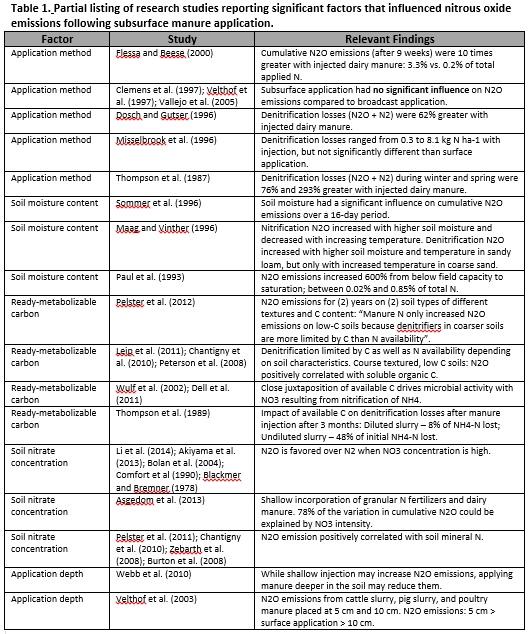
[Abstract] Subsurface manure application is theoretically susceptible to greater denitrification losses and nitrous oxide (N2O) emissions compared to surface application methods – primarily attributed to manure being placed in a more anaerobic environment. A review of field studies suggest N2O emissions typically range from 0.1% to 3% of total applied N from subsurface application methods, but there is considerable variation in emissions depending on pre- and post-application soil moisture conditions, readily-available carbon content in manure compared to background levels in soil, localized nitrogen form and oxygen concentration at the application site, and application depth. This paper will summarize peer-reviewed literature of field studies that quantify N2O emissions subsequent to subsurface manure application and identify the most prominent determining factors cited by authors.

Why Study Nitrous Oxide Emissions of Manure?

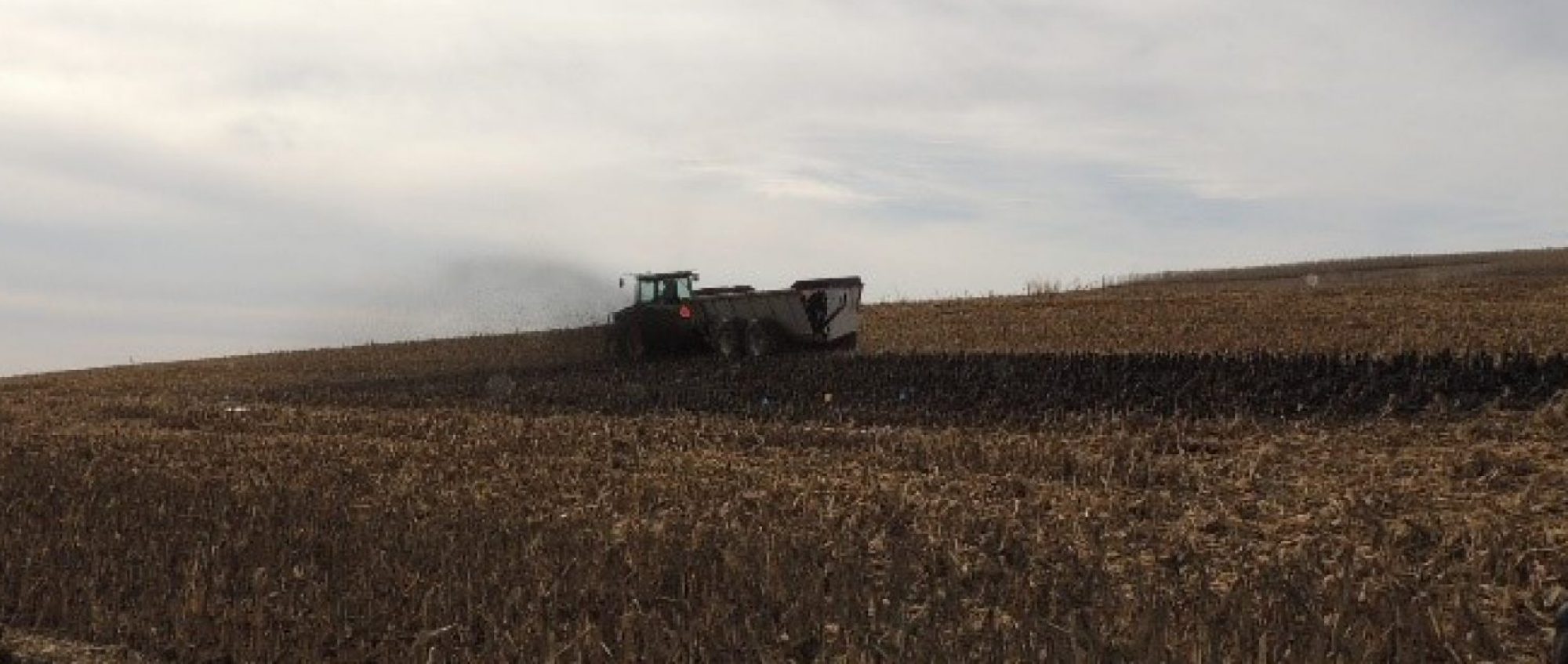
Ammonia abatement efficiencies of up to 90 percent have been documented with subsurface application and incorporation of animal manures compared to conventional surface application methods. While reducing ammonia emissions has positive implications for air and water quality, a portion of the nitrogen conserved may come at the expense of increased nitrous oxide emissions produced during denitrification and nitrification processes in the soil. As a greenhouse gas 300 times more potent than carbon dioxide at trapping heat, nitrous oxide has been linked to anthropogenic climate change and depletion of stratospheric ozone. Release of nitrous oxide from agriculturally-productive soils into the atmosphere also represents a loss of crop nutrients. Understanding the circumstances and manageable factors that contribute to nitrous oxide formation in soils subsequent to manure application is important for retaining crop nutrients and preventing greenhouse gas emissions.

What did we do?

A literature review was performed to investigate the factors that contribute to nitrous oxide emissions following subsurface application of animal manure to both grassland and arable land, compare results from different application techniques, and examine the conditions and circumstances that lead to nitrous oxide emissions.

What have we learned?

Several studies demonstrate significant increases in nitrous oxide emissions (from 0.1 to 3 percent) attributable to factors including increasing soil moisture content, high concentrations of readily-available carbon in manure substrate, increased nitrate concentration in soil, shallow application depth, high soil temperature, and ambient conditions during and immediately following application (table 1). Other studies show no difference in nitrous oxide emissions as compared to surface application methods. Reasons that subsurface application techniques will not necessarily result in greater nitrous oxide emissions were: 1) the length of the diffusion path from the site of denitrification to the soil surface may lead to a greater portion of denitrified nitrogen being emitted as nitrogen gas; 2) the soil moisture conditions and aeration level at the time of application may not be suitable for increased nitrous oxide production; 3) prior to manur e application, soils may already contain readily-metabolizable carbon and mineral nitrogen, thus any increase in nitrous oxide emission following application may not have a significant impact; and 4) weather events subsequent to manure application may effect soil moisture content and water-filled-pore-space, thereby affecting nitrous oxide emissions. Several studies document nitrous oxide emissions due to subsurface application methods (including manure incorporation and shallow injection) but research comparing nitrous oxide emissions from different subsurface application techniques and application depth is limited. Lack or absence of data in literature about manure chemistry, nitrogen application rates, application technique or method, as well as soil and atmospheric conditions during and after application made it more difficult to draw specific conclusions on factors affecting nitrous oxide emissions from subsurface-applied manure.

Further research is needed to determine the environmental and economic tradeoffs of implementing subsurface manure application methods for abatement of NH3 considering different future greenhouse gas emissions and market scenarios. Recent work suggests a link between denitrifier community density, organic C, and N2O emissions. Characterization of these biological mechanisms and identification of genetic markers for key enzymes should continue, particularly with respect to various subsurface manure application techniques, different manure types and N application rates, soil types, environmental conditions, and soil chemistry. Subsurface application depth plays an important role in determining the proportion of N2O to N2 emitted during denitrification; however, the number of field studies that examine the impact of application depth is limited. More research is needed to determine optimal manure application depth as influenced by soil type, soil chemistry, timing of application, and vegetative cover. Finally, future research on subsurface manure application will allow existing and future prediction models to improve estimation of annual N2O emissions at landscape scale and airshed levels. Refinement of greenhouse gas inventories, including N2O emissions from agricultural production systems, will assist agriculture producers, scientists, and policy makers in making informed decisions on greenhouse gas emission mitigation.

research articles reporting factors of Nitrous Oxide

Future Plans

Future agricultural greenhouse gas regulations and/or carbon market incentives have potential implications for agricultural producers, including the method and timing of manure application. Controlled, replicated, and well-documented research on subsurface manure application and subsequent nitrous oxide release is critical for estimating the costs and benefits of different manure application techniques.

Authors

David W. Smith, Extension Program Specialist, Texas A&M AgriLife Extension DWSmith@ag.tamu.edu

Dr. Saqib Mukhtar, Professor and Associate Department Head for Extension, Texas A&M AgriLife Extension

Additional information

The publication ‘Estimation and Attribution of Nitrous Oxide Emissions Following Subsurface Application of Animal Manure: A Review’ has been accepted for publication in Transactions of the ASABE.

Acknowledgements

Funding for this effort provided by USDA-NIFA grant No. 2011-67003-30206.

The authors are solely responsible for the content of these proceedings. The technical information does not necessarily reflect the official position of the sponsoring agencies or institutions represented by planning committee members, and inclusion and distribution herein does not constitute an endorsement of views expressed by the same. Printed materials included herein are not refereed publications. Citations should appear as follows. EXAMPLE: Authors. 2015. Title of presentation. Waste to Worth: Spreading Science and Solutions. Seattle, WA. March 31-April 3, 2015. URL of this page. Accessed on: today’s date.