
Managing Manure Nutrients Curriculum Materials

Managing manure and manure nutrients is one of the most visible aspects of environmental stewardship for many farms. The materials on this page developed for use in classrooms and extension programs, and for self-study by farmer, and ag professionals.

Agriculture Professionals and Farmers

These materials were used to create a self study module which includes the option to receive a certificate upon successful completion of the quiz.

    • Manure Nutrients: Water, Regulations, and Nutrient Management Plans (NMPs) (50 minutes)

Teachers and Educators

Teachers and extension staff are welcome to download these materials and utilize them in your classroom or programs. To preview the materials before downloading, scroll below the table. View Lesson Plan.

If you utilize these materials please take 3 minutes and tell us if they are helpful. Thank you!! Go to survey…

Check out more educational modules available on livestock and poultry environmental stewardship.  These modules have been cross-referenced to the National AFNR career content cluster standards.

Lesson Plan

Clicking a link in this column will download all files in that section/row as a .zip file, except where noted.

Download individual items using links in these columns
Fact
Sheet*
Video(s)
.mp4
Jeopardy
game
.ppt
Review
Q&A
.docx
1. Nutrient Management Planning
(6 files; 22MB)
PDF DOCx

Nutrient plan (2MB) Manure plan (18MB)

Nutrient
planning
17 questions
2. Nutrient Regulations
(5 files; 12MB)
PDF DOCx Regulations (10MB) Regs &
Water
Quality
8 questions
3. Water Quality & Nutrients
(5 files; 26MB)
PDF DOCx  Water (24MB) 11 questions
4. Manure Storage, Agitation & Handling
(5 files; 26MB)
PDF DOCx Storage (24MB) Storage &
Safety
10 questions
5. Safety (Manure Gases)
(5 files; 65MB)
PDF DOCx Gases (MB) 17 questions
6. Liquid and Solid Manure Application
(7 files; 65 MB)
Note: due to size, the “Surface Application” video is not in the ZIP file and needs to be downloaded separately.
PDF DOCx Surface Application (47MB) Liquid Manure (23MB) GPS (20MB) N Stabilizers (19MB) Application 10 questions
7. Spreader Calibration
(3 files; 27MB)
PDF Calibration (27MB) n/a 2 questions
8. Spill Response
(5 file; 26MB)
PDF DOCx Spills (23MB) Spills & Public Relations 10 questions
9. Public Relations
(4 file; 20MB)
PDF DOCx Public Image (16MB) n/a

*Use the .pdf format if you wish to print the fact sheets and use as-is. Use the .docx format if you want to edit the fact sheet.

Preview 1-3: Nutrient Management Planning, Regulations, Water Quality

Note: the activity preview only shows four (of 52) slides. The links (blue text) do not function in this preview, but they will work when you download the .ppt version.

For Additional Information

Preview 4-6: Manure Storage, Safety, Manure Application

For Additional Information

Preview Sections 7-9

For Additional Information

Acknowledgements

Authors:

    • Jerry Clark, Jerome.Clark@wisc.edu, University of Wisconsin-Madison, Division of Extension, Chippewa and Eau Claire Counties
    • Carl Duley, University of Wisconsin-Madison, Division of Extension, Buffalo County, Carl.Duley@wisc.edu
    • Ted Bay, University of Wisconsin-Madison, Division of Extension, Grant County
    • Dave Lucinani, University of Wisconsin-Madison, Division of Extension, dluciani@wisc.edu

Reviewers: USDA NRCS staff

Building Environmental Leaders in Animal Agriculture (BELAA) is a collaborative effort of the National Young Farmers Educational Association, University of Nebraska-Lincoln, and Montana State University. It was funded by the USDA National Institute for Food and Agriculture (NIFA) under award #2009-49400-05871. This project would not be possible without the Livestock and Poultry Environmental Learning Center the National eXtension Initiative, National Association of County Ag Agents (NACAA), National Association of Agriculture Education (NAAE), Farm Credit Services of America, American Registry of Professional Animal Scientists (ARPAS), and Montana FFA Association.
Greenhouse Gases and Animal Agriculture Curriculum Materials

Greenhouse gases and their contributions to climate change are some of the most studied topics in animal agriculture right now. What greenhouse gases are emitted by agriculture? How much is emitted in comparison to other industries?

Farmers, Ranchers, and Ag Professionals

Check out the self-study module “Greenhouse Gases and Agriculture“. When completed, you can receive a certificate or submit your completion for continuing education credits.

Teachers, Extension

The following materials were developed for teachers and educators to use in their classrooms and programs. The target age range is high school, jr. college and beginning farmer groups.

  • Instruction Guide (Lesson Plan): Includes links to additional information, connections to national agriculture education standards (AFNR Career Content Cluster Standards), application to Supervised Agricultural Experience (SAE) projects, activity and science fair ideas, sample quiz/review questions, and enrichment activities. PDF format (0.5 MB; best if you want to use it as-is) | RTF format (60 MB; best if you want to modify the file)
  • Presentation – 33 slides, Powerpoint 97-2003 format. Annotated. Preview in Slideshare | Download (14 MB)

Acknowledgements

Author: Jill Heemstra, University of Nebraska

Reviewers: Crystal Powers, University of Nebraska; David Schmidt, University of Minnesota; Liz Whitefield, Washington State University

Building Environmental Leaders in Animal Agriculture (BELAA) is a collaborative effort of the National Young Farmers Educational Association, University of Nebraska-Lincoln, and Montana State University. It was funded by the USDA National Institute for Food and Agriculture (NIFA) under award #2009-49400-05871. This project would not be possible without the Livestock and Poultry Environmental Learning Center and the National eXtension Initiative.

Cayuga County Manure Digester Virtual Tour

Anaerobic digestion is a manure treatment system that produces biogas. There are many benefits of digestion such as reductions in: odor, pathogens, and greenhouse gases (climate change). Producing biogas from manure yields useful by-products.  The economics of digestion are dependent on state energy policies and co-digestion of off-farm wastes to generate revenue.

Cayuga County Regional Digester (New York)

This virtual tour highlights the Cayuga County Soil & Water Conservation District regional digester. This facility receives manure from multiple dairy farms. The regional digester model allows smaller farms (not large enough to build their own digester) or large farms unwilling to take on the complex management of a digester to participate.sign

For more information: Cornell case study (technical details) | NRCS Newsletter (construction photos and funding information)

  • Type of digester: Pressure differential (hydraulic mix)
  • Facility began operation: March, 2012
  • Feedstocks: dairy manure, food wastes, brown fat

How Does This Anaerobic Digester Work?

The hydraulic mix or pressure differential digester type is common in Europe, but is unique in the United States. The video below explains how the material moves through the digester.

Step By Step Through The Facility

Even though we refer to this facility as an “anaerobic digester” there are actually many pieces required to make this system work. The digester is one part. The presentation below works through the entire facility.

barn

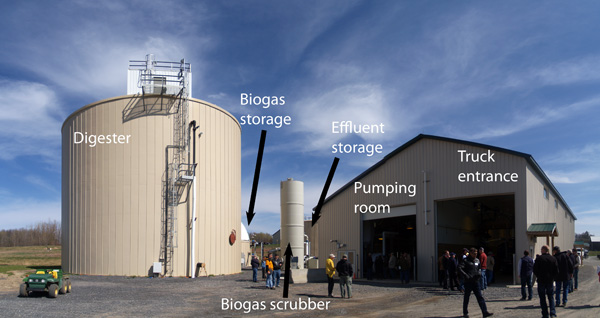
The digester tank (photo above: left) has a capacity of one million gallons. It is estimated that 40-43,000 gallons will be added to the digester per day when it reaches full production capacity. The trucks carrying raw (undigested) manure from the farms enter on the right side of the building (photo above:right) and the manure is pumped into a holding tank (not visible in photo) and mixed with food waste.

To see the captions in the slideshow, select “full screen” (lower right side of the slide) and then click on show info (upper right corner). You can also visit this photo set at: http://www.flickr.com/photos/manure/sets/72157629690139615/

In the News

This digester has been in the news as the price of power has dropped and the financial side of the operation less viable.

  • Digester is shut down to re-evaluate business plan (Jan. 2015) More…
  • California company to take over Cayuga digester (June, 2015) More…

Recommended Reading on Anaerobic Digestion

Acknowledgements:

Author: Jill Heemstra, University of Nebraska Extension
Reviewers: Thomas Bass, Montana State University, David Schmidt, University of Minnesota and Liz Whitefield, Washington State University

A big thank you goes to the Cornell University dairy manure management team for organizing the 2012 “Got Manure?” conference that included a real life tour on which we were able to obtain the media for this virtual tour.

This virtual tour was created by the LPELC Beginning Farmer team through funding from the USDA National Institute for Food and Agriculture (NIFA) Beginning Farmer and Rancher Development program under award #2009-49400-05871

What are the necessary components for composting animal mortalities?

For active decomposition of animal carcasses, compost microorganisms require a source of nitrogen (N) (dead livestock or birds), carbon (C) (straw, corn stalks, shavings, litter, etc.), oxygen, water and elevated temperatures. An ideal C:N ratio should fall between 15:1 to 35:1. Oxygen (air) can be introduced when turning the compost. If proper moisture is not supplied, the organisms cannot survive. Ideally, moisture content should range from 45-55%, or wet enough when the compost is squeezed to leave your hand feeling moist, without actually forming drops of water. When all components are present in the correct ratio, the compost pile heats naturally, destroying most pathogens while microbial activity degrades the carcasses.

Resources:

Check out the other video FAQs on carcass management

Author: Joshua Payne, Oklahoma State University

Reviewers: Shafiqur Rahman, North Dakota State University and Jean Bonhotal, Cornell University

Developing an Environmental Policy Statement for a Farm or Ranch Curriculum Materials

An environmental policy statement (EPS) is a proactive way to communicate about your farm, ranch or agribusiness environmental stewardship ethic. At first glance, this might seem like a “feel good” exercise with little practical value. However, experience has shown that farmers and ranchers are quick to identify ways they can use the policy statement for their operation. The exercise stimulates conversations that many farm operators have not previously initiated with family or employees.

What Is an Environmental Policy Statement (EPS)?

Example Policy Statement
Jones Family Farms is a diversified operation with poultry, cattle and alfalfa hay production. The farm employs its husband and wife owners on a full-time basis and two employees on a part-time basis. Jones Family Farm is located near a small housing development along a busy highway; therefore our relationship with our neighbors and community is an important aspect of our operations. We will strive to maintain a neat and professional appearance on our farmstead. Poultry litter applications will be made to our hay ground with consideration to potential impacts on neighbors.We are committed to compliance with all pertinent environmental laws and regulations; we are committed to continually improving conservation practices and environmental management that will benefit our farm’s value for future generations. Our profitability depends upon maintaining efficient long-term productivity. We also seek to: 1) To manage riparian areas in such a way that provides wildlife habitat and protects water quality and 2) To improve soil quality by minimizing erosion and building organic matter through calculated use of our poultry litter resources.

An EPS consists of several specific statements. These reflect a general description of the operation and its most important environmental issues. The EPS also communicates commitments to regulatory compliance, continual improvement and stewardship. While these statements appear to be prescribed, there is a great deal of room for an operation to personalize and create an EPS that reflects their individual values and goals.

An environmental policy statement (EPS) is one piece of an environmental management system (EMS). An EMS is a systematic approach to environmental decision making. It seeks to formalize processes and procedures and integrate all of the different aspect of a farm operation into a single coherent plan. More about EMS is available at Agriculture Environmental Management Systems.

Farmers, Ranchers, and Agribusiness

Step 1. Download the worksheets and complete the activities. Example policy statements are included.
Step 2. To receive a certificate of completion (optional), fill out the online form.

Teachers, Extension, Consultants

For the classroom or educational programs:

  • Instruction Guide: (PDF format) (RTF format; 13 MB ) Is a lesson plan with connections to national agriculture education standards (AFNR Career Content Cluster Standards), application to Supervised Agricultural Experience (SAE) projects and FFA contents, sample quiz/review questions, sample evaluation form, and more.
  • Download Presentation Slides (See embedded slide show below for a preview of this file).
  • Resource packet. (PDF format) (RTF format; 14 MB)Includes templates and worksheets, examples, and a discussion guide

The PDF version is best if you want to use the files “as-is”. The RTF format is best if you want to edit or customize the materials.

Acknowledgements

Authors: Jill Heemstra, University of Nebraska and Thomas Bass, Montana State University <tmbass@montana.edu>

Reviewers: Mary Catherine Barganier, NYFEA; Shannon Arnold, Montana State University; Elizabeth Burns Thompson, Drake Ag Law student; Lyle Holmgren, Utah State University; Paul Hay, University of Nebraska

Building Environmental Leaders in Animal Agriculture (BELAA) is a collaborative effort of the National Young Farmers Educational Association, University of Nebraska-Lincoln, and Montana State University. It was funded by the USDA National Institute for Food and Agriculture (NIFA) under award #2009-49400-05871. This project would not be possible without the Livestock and Poultry Environmental Learning Community the National eXtension Initiative, National Association of County Ag Agents (NACAA), National Association of Agriculture Education (NAAE), Farm Credit Services of America, American Registry of Professional Animal Scientists (ARPAS), and Montana FFA Association.

Educational Modules: Building Environmental Leaders in Animal Agriculture (BELAA)

These modules can be used for self-study but also include instructional materials (presentation slides, handouts, quizzes, other activities) that can be utilized by teachers or extension staff/faculty in their programs.

National Ag Education Standards

  • BELAA-AFNR Alignment Matrix (a guide to all of the modules developed in this project and the areas where they align with the Agriculture, Food, and Natural Resources career cluster content standards)

Modules

Self-Study Units

These following self-study units were primarily developed for the Environmental Leaders Award Program. However, anyone is welcome to complete them and request a certificate of completion.

Whole Farm Nutrient Balance

For most of the U.S. livestock (and poultry) industry, nutrients in manure represent the single largest threat to water quality. Thus, choices made relative to the management of nutrients within a livestock or poultry operation are absolutely critical to protecting water quality. This lesson discusses the concept of “whole farm” nutrient balance as an indicator of potential risks a particular operation can pose in contributing to excess release of nutrients to water.

It is estimated that this module will require one hour to read and complete the quiz.

Step 1. Download Lesson 2: Whole Farm Nutrient Balance (PDF file; 34 pages)
Step 2. Take the quiz. This is a 10-question, multiple-choice quiz. If you score at least 7 out of 10, you will receive a certificate of completion by email.

Manure Spills and Emergency Planning

The topics covered in these five short videos are: causes and case studies of spills, considerations for solid manure, and simple steps and technologies to prevent spills. Each of the speaker’s presentation slides are available for download as notes.

It is estimated that this module will require 75-80 minutes to watch and complete the quiz.

Step 1. View the presentations at Manure Spills and Emergency Planning. (It is recommended that you download and print the presentation slides for each of the four presenters). You can watch each individual segment separately or use the “view entire presentation” link toward the bottom of the page.
Step 2. Take the quiz. This is a 10-question, multiple-choice quiz. If you score at least 7 out of 10, you will receive a certificate of completion by email.