
Wisconsin Professional Manure Applicator Education

Why Look at Manure Applicator Educational Programs?

Based on 2013 statistics, Wisconsin has a dairy herd of 1.2 million cows that produce 12,000,000,000 gallons of manure and waste water. Custom manure haulers in Wisconsin handle an estimated fifty percent of the dairy manure and forty per cent of all livestock manure generated in Wisconsin. Because custom manure applicators are a critical component of nutrient management plan (NMP) implementation, University of Wisconsin Extension initiated manure hauler education across the state in the early 1990’s. In 2000, the applicators sought UW – Extension advisory support in forming the Professional Nutrient Applicators Association of Wisconsin (PNAAW). This began a long term relationship between UW – Extension and the professional applicators in Wisconsin and across the upper Midwest.

Following a needs assessment of the industry, the board of directors of PNAAW expressed an interest in a voluntary training and certification program. The overall goal of the training was to educate the custom manure haulers and their employees in safe handling and application practices, spill response, regulations and nutrient management. Road safety, neighbor relations, and confined space safety education modules were added later.

What did we do?

In March of 2002, the board of directors of the PNAAW and a group of Michigan manure applicators independently approached Extension in each state to initiate a voluntary certification and training program. Over the next 5 months, applicators and Extension staff examined the 5 existing manure applicator certification programs and created the program currently in use in Wisconsin, Illinois and Michigan.
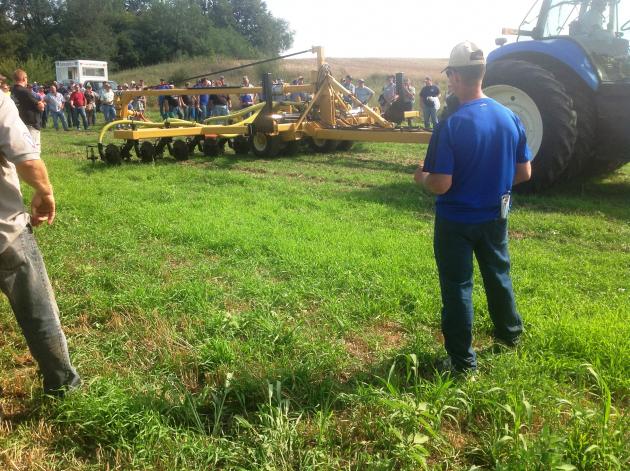
Field photo 2012

Manure expo 2012, checking out a new dragline applicator.

The UW – Extension Nutrient Management Team’s Custom Manure Hauler Workgroup joined with Extension faculty in Illinois and Michigan to develop a three-state certification program with three levels of training/certification. The certification includes a partnership with the insurance industry to provide a market-based incentive to participate. Business and employee management issues are addressed during an annual multi-state regional symposium coordinated by UW-Extension.

Certification: The program is segmented into three certification levels. Firms must meet level 1 requirement to gain level 2, and meet level 2 requirements to achieve level 3.

  • Level 1: Requires each employee to be trained and tested on spill response techniques, state specific regulations (including CAFO regulations) and common sense application techniques. Firms that document compliance are eligible for a 10% vehicle liability premium reduction. Training is ~3 hours in length and is completed annually.
  • Level 2: Requires crew supervisors and business owners to attend 6 hours of continuing education over a 2 year period. Classes are offered at field days and the annual conference. Once a firm has achieved Level 2, they may conduct Level 1 training in-house.
  • Level 3: Develop and implement an EMS (Environmental Management System). The EMS requires the firm to document their process and ensure all employees know their job responsibilities. Insurance auditors will evaluate each firm’s EMS annually to insure compliance. Premium reductions include 10-40% on vehicle liability and 50% on environmental liability.

Not your typical Wisconsin “boat” show. PNAAW 2014 manure boat agitation demonstration, organized with UW-Extension.

All certification levels also require that the firm complete the PNAAW Performance Standards Checklist at least once per year.

Membership in the state’s applicator association is required for certification, as certification is granted by the association and not by Extension. Each state association may also require additional performance standards, such as documentation of equipment calibration, to grant certification.

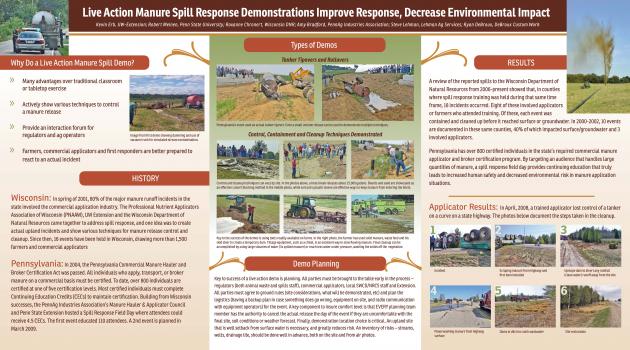
One area of continuing education began in 2002, when UW – Extension with permission from Wisconsin Department of Natural Resources (WDNR), conducted manure spill response training using actual manure. The basic educational focus was containing, controlling, cleaning up, and then meeting reporting requirements of a spill. Since 2002, 20 live action demonstrations have occurred. Training has expanded to include calibrating of manure equipment and determining manure application rate per acre.

What have we learned?

PNAAW requested that Extension assist in filling an educational need not met by current farm shows – being able to compare different manure agitation and application equipment side by side in the field (using actual manure) to help determine which best meets individual needs. The result was the first Manure Expo in August 2001, which drew 432 people from 5 states and Canada.

The Manure Expo has grown to an annual 2-day educational and demonstration event. 2015 is the 13th Expo; the event has been hosted by Extension and custom applicators in Wisconsin, Michigan, Minnesota, Ohio, Iowa, Missouri, Nebraska, and Pennsylvania in the US and Guelph, Ontario, Canada. An average Expo will draw over 1,000 people from industry, university, farm, and application professionals.
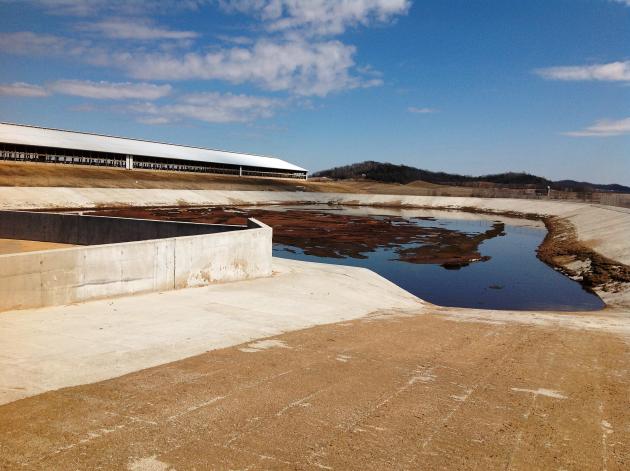
PNAAW 2014

PNAAW 2014

The pit before the boat demonstration begins 2014.

The voluntary certification program has saved Wisconsin and Michigan over $100,000 annually because regulatory mandates require state finances for staff and office to run mandated programs. In addition to the sharing of curriculum in multiple Midwestern universities the training and educational sessions are a success in the formation/enhancement of three state associations in Michigan (now inactive), Pennsylvania, and Indiana/Ohio.

Applicator and industry partnerships contributed to a multi – state agriculture weight study based at the Minnesota DOT/University of Minnesota, MN Road Research Center. Over $640,000 was pooled from applicators and Applicator Associations (WI, MI, MN, IA, and OH), industry and agencies to fund research on the impact of larger manure hauling and agriculture equipment on pavement.

Custom manure applicators are a key component in the environmental application of manure. The Wisconsin Department of Agriculture, Trade, and Consumer Protection (DATCP) has tracked crop acres managed with a NMP. In 2004, 0.7 million crop acres were managed using a NMP; in 2014 the NMP managed acres increased to 2.58 million acres in Wisconsin.

Future Plans

Each year a new need will arise. Education will be provided for employee relations, business planning, family/work balance and the need to review new technology. A few projects that began in 2014: manure boat agitation field day and precision manure application. Education will be developed in the future as a need arises from the manure application industry.

Authors

Richard Halopka, CCA, Clark County UW-Extension Crops & Soils Agent richard.halopka@ces.uwex.edu

George Koepp, Columbia County UWEX Agriculture Agent, Jerry Clark,Chippewa County UWEX Crops/Soils Educator, Ted Bay, Grant County UWEX Crops/Farm Management Agent, Kevin Erb, UWEX Conservation Professional Devp. & Training Cord., Becky Larsen, UW Biowaste Specialist, Jim Leverich, UW On Farm Research, Kim Meyer, UW Arlington ARS, Cheryl Skjolaas, UW Agriculture Safety Specialist

Additional information

In 2014, over 400 custom manure applicators in Wisconsin were certified in at least one level of the program. Eight PNAAW member application firms revised their level 3 status in 2013 and are saving $44,000 annually on pollution insurance policies, while PNAAW firms achieving level 1 and level 2 certification reduced pollution insurance policies premiums by an additional $78,000 per year.

The collaboration of PNAAW, University of Wisconsin Extension, University of Wisconsin Specialists, WDNR, DATCP and UW – Extension County Agents has provided the foundation of a proactive approach to education and training, leading to problem solving results from a knowledgeable application industry.
https://www.facebook.com/pages/category/Nonprofit-Organization/Professional-Nutrient-Applicators-Association-of-Wisconsin-2223955430983054/  

2009 U.S.A. water quality poster, manure spills

2009 U.S.A. water quality poster, manure spills

Bulletin for manure spill response developed by UW-Extension nutrient management team PNAAW workgroup.

The authors are solely responsible for the content of these proceedings. The technical information does not necessarily reflect the official position of the sponsoring agencies or institutions represented by planning committee members, and inclusion and distribution herein does not constitute an endorsement of views expressed by the same. Printed materials included herein are not refereed publications. Citations should appear as follows. EXAMPLE: Authors. 2015. Title of presentation. Waste to Worth: Spreading Science and Solutions. Seattle, WA. March 31-April 3, 2015. URL of this page. Accessed on: today’s date.

Grid Soil Sampling to Guide Manure Application

Why Consider Grid Sampling for Manure Application?

Grid soil sampling for phosphorus and potassium can identify areas in fields with nutrient deficiencies and other areas with sufficient or excess nutrients. Nutrient maps can be used to define areas for manure application or exclusion, using supplemental fertilizer where manure is not applied or does not meet the crop requirements. The overall effect is to increase the fertilizer-replacement value of the manure, conserving its use for nutrient deficient fields and field areas. Related: LPELC Manure Nutrient Management

Each of the case studies was conducted on a Minnesota farm and presents the method to:

  • determine crop nutrient needs
  • create manure application and exclusion zones from nutrient maps
  • estimate the value of manure under whole-field vs zoned application, and
  • evaluate practices to reduce off-site soil and nutrient loss for the specific field analyzed.

Videos

The case studies do not discuss variable rate manure application, but do assume capability for supplemental fertilizer application, with or without variable rates.

For More Information

https://portal.nifa.usda.gov/web/crisprojectpages/0099228-agricultural-impacts-on-water-quality.html

Les Everett, Agronomist, University of Minnesota Water Resources Center evere003@umn.edu

How do you calibrate a manure spreader?

Calibrating a manure spreader is critical to ensure that the appropriate rate of manure nutrients is being applied to a field. For some livestock operations, this practice may be a required practice as part of their permit. Calibration will differ depending on the equipment and type of manure being applied.

If you know the capacity of the spreader, you need to determine the width of each pass and the distance it takes to empty the spreader to determine the rate of application. A measuring wheel is a useful tool and can often be borrowed from a local Cooperative Extension or Natural Resources Conservation Service (NRCS) office. After you have determined both of those measurements, use the charts in the publication linked below to determine application rate.

If the capacity of the manure spreader is unknown and solid manure is being spread, you can use a process that involves setting out plastic sheets or tarps of known size and driving the manure spreader over them and weighing the amount of manure that is collected on the sheets. A 22-square-foot tarp is a convenient size because the net weight of the manure on the sheet will be equal to the application rate in tons per acre. A step-by-step guide on making these calculations for other size tarps is available in the publication linked below.

For more, including specifics on calibrating solid, liquid, and irrigation manure equipment, visit Calibrating Manure Application Equipment.

Author: Jill Heemstra, University of Nebraska Extension Educator

A Review of Manure Injection to Control Odor and Ammonia Emissions During the Land Application of Manure Slurries

Reprinted, with permission, from the proceedings of: Mitigating Air Emissions From Animal Feeding Operations Conference.

The proceedings, “Mitigating Air Emissions from Animal Feeding Operations”, with expanded versions of these summaries can be purchased through the Midwest Plan Service.

This Technology is Applicable To:

Species: Swine, Dairy, Beef
Use Area: Land Application
Technology Category: Management (manure injection/incorporation)
Air Mitigated Pollutants: Odor, Ammonia

System Summary

Manure slurry injection provides a significant reduction in land application odor and ammonia emissions release when compared to conventional manure surface broadcasting. Release of odor and ammonia during land application can be reduced by more than 90% compared to conventional application methods (Ohio State University, 2007). Manure can be successfully injected in both conventional tillage and no-till systems with currently available equipment. Additionally, slurry tanker wagons currently used for broadcast application can also be retrofitted with Injection tool bars.

Research by Hanna et al., (2000) compared the odor and ammonia emissions from various types of manure injection techniques to slurry that was surface applied (broadcasted). Odor and ammonia tests were run for both fall and spring slurry application. Ammonia was below the detection limit (0.2 ppm) for all but two (measured at 0.6 and 1.3 ppm) of the 72 samples taken. Broadcast application required approximately four to five times more fresh air dilutions than injection to reach the odor threshold (the level at which the odor can no longer be detected) indicating much lower odor release associated with injection.

Applicability and Mitigating Mechanism

  • Injection tools create sub-surface cavities
  • Slurry is injected into the cavity directly behind the tool
  • Injection minimizes slurry exposure to air reducing odor and ammonia volatilization
  • Injection can be used with all slurry and liquid manures

Limitations

  • Injection systems are not currently commercially available for solid manures
  • Injection can require up to 30% more tractor horsepower than broadcast
  • Injection may not be desirable when the producer does not want the soil or crop root system disturbed (forages, pasture/sod)
  • Injection equipment requires more maintenance than broadcast equipment

Cost

Generally, injection is more costly than broadcast application. Injection requires more tractor horsepower and more equipment (injection tool bars). Because tool bars are pulled through the soil, wear and maintenance is greater with injection systems. Cost increases as application rate decreases and distance from the manure storage site increases. The increase in cost as application rate decreases is due to wear on the application equipment. At lower application rates, field speed is increased causing wear (and eventually maintenance) on the equipment to increase. At a 5,500 gallons per acre application rate, commercial drag hose injection cost is currently $.014/gal compared to $.0085/gal for broadcast (Puck, 2008).

Authors

Ross Muhlbauer1, Jeremy Puck2, Ben Puck2, Robert Burns1, 1Iowa State University, 2 Puck Custom Enterprises
Point of Contact:
Ross Muhlbauer, rmuhlbar@iastate.edu

The information provided here was developed for the conference Mitigating Air Emissions From Animal Feeding Operations Conference held in May 2008. To obtain updates, readers are encouraged to contact the author.

Effect on Residue Cover and Crop Yield of Manure Incorporation Equipment

Reprinted, with permission, from the proceedings of: Mitigating Air Emissions From Animal Feeding Operations Conference.

The proceedings, “Mitigating Air Emissions from Animal Feeding Operations”, with expanded versions of these summaries can be purchased through the Midwest Plan Service.

This Technology is Applicable To:

Species: Swine, Dairy, Beef
Use Area: Land Application
Technology Category: Management (manure injection/incorporation)
Air Mitigated Pollutants: Odor, Hydrogen Sulfide

System Summary

Injection or incorporation application treatments other than broadcast almost always reduce odor during and immediately after application and have a neutral or beneficial effect on crop yield. Although the amount of odor reduction among various injection and incorporation treatments may be similar, the level of surface residue cover reduction is different. For land areas where erosion is a concern operating an application system with no more than an appropriate amount of soil and residue disturbance should be strongly considered. Costs of using injection or incorporation equipment are on the order of $0.001 to $0.003 per gallon applied depending on the type of equipment and annual volume applied. Additional application costs for using injection or incorporation equipment even in the upper end of this range are typically not greater than the cost of a secondary tillage pass. The choice of injection or incorporation style should be strongly influenced by balancing the needs for odor control, residue cover maintenance, and fertilizer placement for the subsequent crop.

Applicability and Mitigating Mechanism

  • Odor is reduced with minimal soil contact
  • Residue cover protects soil prone to erosion
  • Tillage and fertility placement may be beneficial depending on conditions
  • Greater options on flatter fields

Limitations

  • Fragile residue cover is strongly affected by equipment type and usage
  • Reduced residue cover may accelerate erosion
  • Drawbar power required may be increased
  • Needs of odor control, erosion control, and fertilizer placement should be considered

Cost

Factors affecting costs include the initial cost of the application toolbar, annual usage rate, and increased tractor power requirement to pull the injection device. Calculated costs are associated with either a custom annual application volume of 20 million gallons or private application volume of 3 million gallons, 5- (custom) or 15- (private) year equipment life, and application with a double-disc or narrow knife system. Costs of using a double-disc or narrow knife application toolbar are in the range of $0.001 and $0.002 per gallon, respectively, for the higher-volume custom applicator example. Costs are $0.0015 and 0.003 per gallon, respectively, for the lower-volume private applicator example. Costs of using additional tractor power are roughly one-third to one-half of total costs at the smaller annual application volume, but over three-fourths of costs at the higher application volume. Diesel fuel was valued at $3 per gallon. If the pass of a field tillage implement is eliminated (e.g., strip tillage) because of application, costs of injection or incorporation may be balanced by savings in the cost of the tillage pass.

Authors

H. Mark Hanna1, Steven K. Mickelson1, Steven J. Hoff11Iowa State University
Point of Contact:
H. Mark Hanna, hmhanna@iastate.edu

The information provided here was developed for the conference Mitigating Air Emissions From Animal Feeding Operations Conference held in May 2008. To obtain updates, readers are encouraged to contact the author.]

Technologies for Mitigating Ammonia Emissions from Animal Agriculture

Reprinted, with permission, from the proceedings of: Mitigating Air Emissions From Animal Feeding Operations Conference.

Land Application

Treatment of Air

Treatment of Manure or Litter

Diet Modification

Siting and General Management Strategies

Spreading Manure on Horse Farms

Equipment For Handling and Applying Manure On Small Farms

A tractor and a manure spreader are needed to ensure proper field application of stored manure. Some small farms may be able to utilize small ground-drive spreaders that can be pulled behind an all-terrain vehicle or pickup instead of a tractor. Pull-type spreaders are traditionally used, although truck-mounted spreaders are sometimes used on larger farms.

Solid manure can be removed from storage using front-end loaders, scrapers, or other handling equipment. Small or limited-resource farms can get by with equipment as simple as a wheelbarrow and pitch fork. The size of the equipment influences the time required to load, haul, and spread manure. For more information see Nutrient Planning on Small Farms.

Environmental Considerations When Spreading Manure

Manure should not be spread where and when there is any risk for water pollution, such as near streams, ponds, wells or other waterbodies. Your local soil and water conservation district or Natural Resources Conservation Service office can also help identify if additional special protection areas exist on farmland and bordering properties.

Stored manure should be applied to the soil in a thin layer to speed drying and discourage fly breeding. Spreading incompletely composted manure on horse pastures should be avoided due to the risk of infecting pastures with internal parasites. Manure should be spread at agronomic rates (rates equal to or less than plants will use in a year). When stockpiled manure is spread on crop fields, the application may not meet the total needs of the crop. Each source of horse manure will vary, especially when different bedding sources are used. Typically, a ton of horse manure will contain eleven pounds of nitrogen, two pounds of phosphorous, and eight pounds of potassium. Average values are given in the table below and can help to determine the number of acres needed to properly apply the horse manure. Refer to your local Cooperative Extension office to get a list of laboratories that will do manure analysis.

Nutrient Content of Horse Manure
Manure Percent Solids Nitrogen – N Phosphorus – P2O5 Potassium – K2O
(tons/year) % (lb./year) (lb./year) (lb./year)
9.1 22.0 102 40 84

When Should Manure Be Land Applied?

Spring is the preferred time to apply manure. Forage or hay crops generally provide the greatest flexibility in planning land application operations. Cool season grasses can generally utilize manure nutrients from early spring to late fall, and application equipment generally does not adversely affect the crop regardless of its growth stage. However, spreading manure on wet soils should be discouraged as it leads to soil compaction and tearing of the top soil.

Manure Nutrient Availability

When spread, not all nutrients in manure are immediately available for plant use. The amount of nitrogen available is a function of the percentage of nitrogen in the manure, whether or not it is incorporated in the soil, and the rate of organic matter decomposition of the manure. Nitrogen availability (during the first growing season) will range from 35% of the total nitrogen when manure is spread on the soil surface to 60% when immediately incorporated into the soil. Availabilities of phosphorus from phosphate (P2O5) and potassium from potash (K2O) are commonly set at 80% and 90% of totals, respectively. For links to publications that include more detailed information and formulas for estimating nutrient availability from manure see Manure Nutrient Management Educational and Informational Resources.

Manure Containing Wood Shavings or Sawdust May Require Additional Management

Horse manure often has an additional consideration when it comes to nutrient availability. Sawdust or wood shavings are high-carbon materials that require a great deal of nitrogen to break down. This process can tie up available nitrogen, rendering it unavailable to plants or crops. A fact sheet on how to manage horse manure that contains wood shavings or sawdust is Horse Manure Management: The Nitrogen Enhancement System.

Too Much Manure?

In situations where land application is not an option or the farm has more manure than can be appropriately utilized, the producer will need to consider Off-Farm Manure Disposal options.

Additional Information

Author: Michael Westendorf, Department of Animal Sciences, Rutgers, The State University of New Jersey

Calibration of Manure Application Equipment

In order to beneficially apply nutrients contained in animal manure to crops and to protect the environment, it is necessary to calibrate land application equipment. In addition, many states require calibration of manure application equipment on a regular basis via regulations and permitting requirements. Records of calibration results may be a requirement of your permit.

Calibration Procedures Will Vary

Depending on the type of manure or the type of equipment being used to apply manure, there are different calibration procedures to follow. See the following pages for information on specific procedures.

Calibrating Manure Application Equipment Makes Economic and Environmental Sense

Proper calibration of manure application equipment is necessary to insure that field application rates are consistent with nutrient management plans. As nutrient plans have attempted to more accurately balance nutrient supplied by manure and fertilizer and crop requirements, calibration is also critical to avoid under applying nutrients and reducing yields.

Properly calibrated and operated equipment will help eliminate:

  • ponding or runoff of manure into waterways
  • leaching of nutrients and pathogens into shallow groundwater
  • accumulation of nutrients or metals in the soil
  • reduced crop yields from insufficient nutrients

Manure is a valuable resource that should be applied in an ecological and environmentally sensitive manner. As the value of the nutrients in manure increases due to increases in commercial fertilizer cost, calibration of manure application equipment becomes even more important.

Other good reasons to calibrate are to monitor equipment performance changes over time (wear and tear) so that timely maintenance is performed, and to troubleshoot any equipment operational problems. Calibration should be done annually even if regulatory requirements require less frequent calibration. Also, it is a critical to re-calibrate when the consistency or liquid content of the waste changes considerably as changes in material characteristics can change the performance of the application equipment.

Tractor

cc2.5 Garry Grabow

Important Considerations for Calibrating Manure Application Equipment

Calibration of equipment used to land apply manure considers two aspects:

  1. the amount of manure (nutrients) applied, and
  2. how uniformly the manure is applied over the field.

Some nutrient management plans may be based upon nitrogen limited application, while other will be based on phosphorus limited plans; regardless it is critical to know the amount and uniformity of applied manure. Depending upon the equipment used, calibration will involve field measurement of flow or unloading rates, equipment speed and settings, operating pressure, application width, and application overlap.

Manure application equipment can be categorized into three types:

Application equipment varies depending upon the type of manure, e.g. lagoon liquid, poultry litter, or fresh manure. Calibration of each type of equipment will vary in which measurements are required and how application rate and uniformity are quantified and assessed.

Recommended Educational Resources

Author: Garry Grabow, North Carolina State University
Reviewers:Marsha Mathews, University of California-Davis, Rick Koelsch, University of Nebraska, and Doug Beegle, Pennsylvania State University

Calibrating Solid Manure Application Equipment

Why should you calibrate solid manure spreaders? Simple, because you should know how much manure was applied to your fields. Combined with a manure testing program, you can calculate the amount of manure nutrients that were applied. This can save money on commercial fertilizer purchases AND improve water quality. Related: Calibrating liquid manure spreaders and irrigation equipment.

What Can Cause Manure Application Rates to Change?

Solid spreaders can have poor uniformity if operated improperly, so proper operation and calibration of these types of systems are critical. The system needs to be recalibrated if any of the following are changed:

  • Tractor speed
  • Gate opening (and spinner settings for spinner spreaders)
  • RPM
  • Width of spread
  • Manure characteristics
  • Wind
  • Slope
  • Operator (experience and consistency)

It is helpful to know the capacity and setting ranges available with solid spreaders. Solid spreader capacity is noted in the manufacturer’s specifications and may be listed in tons, cubic feet or cubic yards. Capacity is normally listed in struck level (flush with top of unit) height but may also be rated in “heaped” load.

This video shows how tarps that are laid out and manure spread on them can be collected and weighed. it was produced with smaller farms in mind, but the concepts and procedures apply to equipment of all sizes. Produced by: Rutgers University Cooperative Extension.

What Are the Steps in Calibrating Solid Manure Spreaders?

This video shows a process for weighing the  manure spreader and measuring the area over which manure was applied. The worksheet referenced is Know How Much You Haul Produced by the University of Wisconsin Cooperative Extension.

Tarp Method

Normally calibration of solid spreaders will involve collecting the discharged manure in a tarp to determine application rate and collecting manure in a series of pans laid across the travel path to assess spread pattern, uniformity and to adjust pass width. Click on the following link for an illustration of the procedure for this method. (Source: Rick Koeslch, University of Nebraska). Manure density is normally determined to allow conversion from volume to weight (e.g. tons) applied.

Weighing the Spreader

If manure spreader capacity can be weighed, then the only field measurements required are distance traveled to empty the spreader and width of spread pattern (or distance you move laterally with each pass through the field). From that information, a fairly simple estimate of application rate can be made.

Moisture content of manure has a large impact on manure density and actual spreader capacity. When calibrating, it is important to correctly interpret the nutrient analysis reports provided by the analytical lab. Some analyses report manure nutrient concentration at the moisture content submitted. Other analysis reports may give the nutrient analysis at a moisture content that is different than either the sampled material or the material to be applied. For accurate calibration, match moisture content of manure samples with moisture content of the manure being spread.

Adjustments to achieve the proper application rate and uniformity include adjusting travel speed, gate openings and hammer clearance, and adjusting spinners for spinner spreaders. Narrowing the effective width (pass distance) generally increases application uniformity but also increases application rate.


Types of Solid Manure Application Equipment

Manure is generally handled as a solid at a solids content of 20% or more. Solid manure spreaders come in various types. Spinner spreaders use spinning disks at the rear of the unit to propel the manure, box spreaders use a paddle and/or auger to discharge manure from the rear of the unit, and side discharge spreaders typically use augers and flailing hammers to “throw” the manure out the side of the unit. Spinner spreaders are used to apply poultry litter and are widely used as commercial fertilizer applicators. Side discharge units can handle materials with a wide range of moisture contents. Rear discharge spreaders are commonly used with scraped manure solids from open lots and manures with significant bedding.

Recommended Educational Resources

Author: Garry Grabow, North Carolina State University
Reviewers: Marsha Mathews, University of California-Davis, Rick Koelsch, University of Nebraska, Doug Beegle, Pennsylvania State University

Calibrating Liquid Manure Application Equipment

Types of Liquid Manure Application Equipment

Liquid manure application equipment includes tankers (sometimes called honey-wagons) and hose-drag (also referred to as drag-hose) systems. Depending upon the type of liquid application system being calibrated, calibration may require weighing the tanker, recording the time to empty a load, measuring application spread width and length and/or recording equipment speed. Also, with some calibration methods, determination of manure density is required.

Related: Calibrating solid manure spreaders and irrigation equipment.

Important Factors For Making Calibration Calculations

Normally calibration requirements are specific to the equipment, i.e. one piece of equipment needs only to be calibrated once during the calibration interval, often annually. However, it is a good idea to calibrate equipment that may be used under different conditions. For instance, adding more hose to a hose-drag system when moving from one field to the next can increase friction loss and alter manure flow rates though the applicator. It may also be valuable to calibrate for multiple travel speeds, each representing a different application rate. This allows one to select an application rate that most closely matches the nutrient requirements of individual fields or crops.

It is important to select the calibration procedure that is consistent with your manure analysis. For instance some analysis reports nutrients in a weight per volume measure (e.g. pounds per thousand gallons) while some analysis is provided on a weight per weight basis (e.g. pounds per ton). Calibration of liquid tanker spreaders can be done by weighing a load or knowing the capacity (volume) of the spreader as specified by the manufacturer. Conversion between volume and weight may be done by determining the manure density.

By knowing the spreader capacity, distance traveled to empty the spreader, and width of spread pattern (or distance you move laterally with each pass through the field), a fairly simple estimate of application rate can be made. This should be repeated several times to determine an average application rate each manure source. The speed of the tractor can be varied to adjust the application rate to achieve the planned application rate(s). The general procedure for calibrating a liquid manure tanker spreader is illustrated in the following file Liquid Spreader Calibration.

Hose drag type systems are calibrated by measuring tractor speed, flow rate of the manure through the system and effective width (distance between passes). These factors allow conversion to volume of manure over area applied, e.g. gallons per acre.

Calibration of hose-drag (drag-hose) equipment requires measurement of (a.) tractor speed, (b.) spread width (We in illustration) and (c.) flow through the hose. Photo: Garry Grabow, All Rights Reserved.

Recommended Educational Resources

Author: Garry Grabow, North Carolina State University Reviewers: Marsha Mathews, University of California-Davis, Rick Koelsch, University of Nebraska, Doug Beegle, Pennsylvania State University