Watershed Management Resources DVD

Waste to Worth: Spreading science and solutions logoWaste to Worth home | More proceedings….

Why Develop a Watershed DVD?

The cover of the Watershed Management Resources DVD

The Watershed Management Resources DVD is an interactive e-learning tool created by Agriculture and Agri-Food Canada.  It was created for a wide variety of audiences including watershed groups, government and non-government organizations, post-secondary students , agricultural producers and any others who wish to learn more about water quality, water sampling and integrated watershed management.  This tool promotes a synergistic approach to watershed management and increases leadership capacity by encouraging all members of a watershed community to work together to reduce harmful impacts to watersheds and to monitor their watershed for improvements.

What Did We Do?
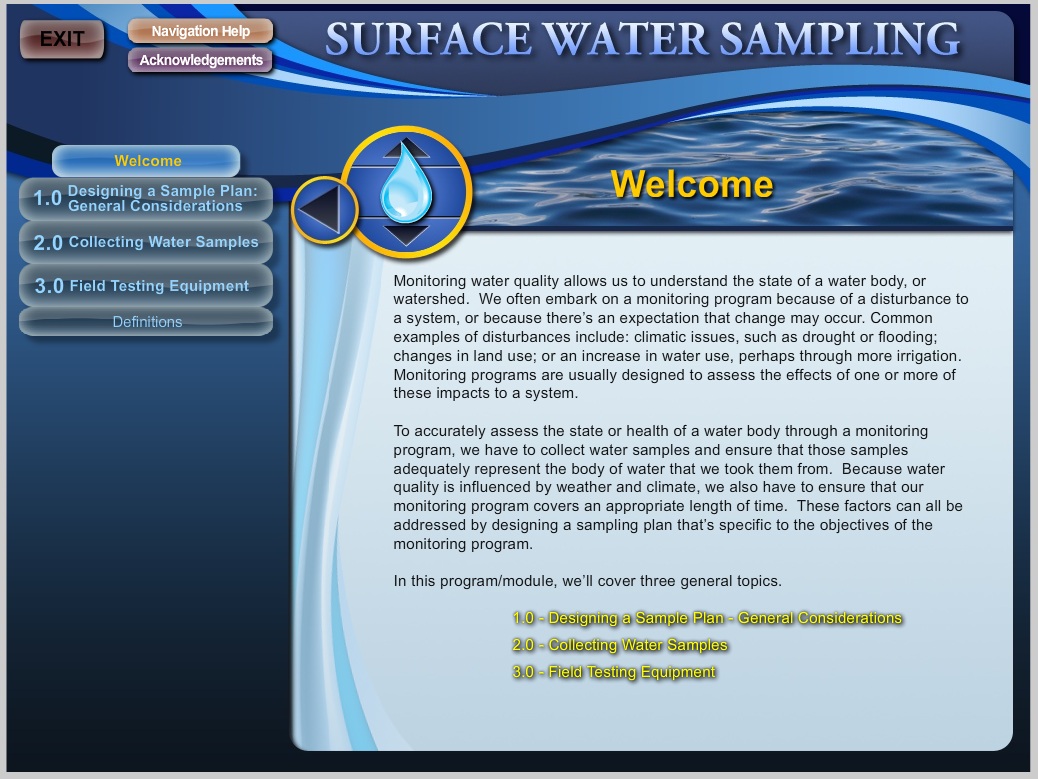
A screen shot of the Welcoming page in the Surface Water Sampling section of the DVD

Agriculture and Agri-Food Canda used past experiences and current information to create a trilingual (English, French and Spanish) set of educational modules.  This self-paced DVD provides users with interactive flash animations, video clips and text screens which educates about issues of water quality, beneficial management practices (BMPs) and watershed management.  The DVD is available free of charge to any interested parties. 

What Have We Learned?

A screen shot of the Hydrologic Cycle Animation that is found on the DVD.

Integrated watershed management is a complex topic and involves all types of people with varying levels of knowledge.  Any type of educational tool that can be used to help stakeholders better understand their watersheds and how to appropriately monitor and manage them are very useful.

Future Plans

To continue to find ways to extend our knowledge to the sector.

Authors

Serena McIver, Senior Water Quality Engineer, Agriculture and Agri-Food Canada, serena.mciver@agr.gc.ca               

Additional Information

More information on the organization and agriculture in Canada can be found at www.agr.gc.ca


The authors are solely responsible for the content of these proceedings. The technical information does not necessarily reflect the official position of the sponsoring agencies or institutions represented by planning committee members, and inclusion and distribution herein does not constitute an endorsement of views expressed by the same. Printed materials included herein are not refereed publications. Citations should appear as follows. EXAMPLE: Authors. 2013. Title of presentation. Waste to Worth: Spreading Science and Solutions. Denver, CO. April 1-5, 2013. URL of this page. Accessed on: today’s date.

On-Site Analytical Laboratories to Monitor Process Stability Of Anaerobic Digestion Systems

Waste to Worth: Spreading science and solutions logoWaste to Worth home | More proceedings….

Abstract

The anaerobic digestion of complex materials is a highly dynamic, multi-step process, where physicochemical and biochemical reactions take place in sequential and parallel ways.  The stability of the process depends on a delicate balance between the formation and consumption of products. When the concentration of a particular substance reaches the homeostatic equilibrium of certain organism or group of organisms, such balanced is disrupted, and the process becomes upset. If measures to correct the source of the problem are not taken, substrate stabilization and biogas production will progressively decrease, and eventually stop. Recovery of a digester can take several weeks to months, during which, energy generation and waste treatment are not possible, resulting in increased operational costs for the facility. To detect process perturbations and prevent major digester upsets, periodic monitoring is essential.

In this study, analytical laboratories were installed on selected on-farm anaerobic digestion systems in New York State, to periodically monitor key process parameters and to evaluate performance and stability of the operations.  Preliminary results showed that analytical labs were critical to detect process upsets efficiently, particularly in co-digestion systems, where loading rates and influent characteristics are usually variable. The laboratory is rather optional in manure-only operations, where the influent consists of a steady and predictable waste.

Authors

Rodrigo Labatut, Cornell University ral32@cornell.edu   

Curt Gooch, Cornell University


The authors are solely responsible for the content of these proceedings. The technical information does not necessarily reflect the official position of the sponsoring agencies or institutions represented by planning committee members, and inclusion and distribution herein does not constitute an endorsement of views expressed by the same. Printed materials included herein are not refereed publications. Citations should appear as follows. EXAMPLE: Authors. 2013. Title of presentation. Waste to Worth: Spreading Science and Solutions. Denver, CO. April 1-5, 2013. URL of this page. Accessed on: today’s date.

Federal Regulations and Pending Legislation Affecting Nutrient Management

Waste to Worth: Spreading science and solutions logoWaste to Worth home | More proceedings….

Why Should We Follow Regulatory Discussions About Nutrient Management?

The presenters will discuss the Clean Water Act as it pertains to nutrient management.  The presentation will describe current and ongoing federal action in several watersheds in the form of a Total Maximum Daily Load or Numeric Nutrient Criteria.  Areas discussed will include the Chesapeake Bay, the Oregon Coast, the Illinois River in Arkansas and Oklahoma, marine and freshwater systems in Florida, and the Mississippi River watershed.  The presentation will conclude with a discussion on the agriculture community’s role in nutrient management issues.

Decisions are being made everyday in Washington, D.C. by federal agencies, Congress, and the courts on how farmers and ranchers must manage their manure and their operations. It is important that producers and experts in the field educate their elected representatives and regulators on the important use  of nutrients and our efforts to protect the environment at the same time we attempt to feed an ever-growing world.

Presenters

Jeff Blackwood, The Fertilizer InstituteAt the time of this presentation, Jeff Blackwood was the director of government relations at The Fertilizer Institute in Washington, DC where he monitored and lobbied legislative and regulatory matters regarding nutrient use issues, agriculture policy, chemical security and water quality. Prior to joining TFI, Jeff worked as Legislative Assistant to United States Senator Byron Dorgan (D-N.D.), advising the Senator on legislation related to agriculture policy. In this position he managed bills and amendments including several considered during the 2008 Farm Bill and the annual agriculture appropriations process. Prior to his work with Sen. Dorgan, Blackwood was the Senior Grassroots Advocacy Advisor with the National Rural Electric Cooperative Association and previously served as a Legislative Assistant to Congressman Brad Carson (D-Okla.). Since that time Jeff has taken a new position as Manager of Government Affairs for agriculture policy at BASF.  jeff.blackwood@basf.com

 

Ashley McDonald, National Cattlemen's Beef AssociationAshley Lyon McDonald, Esq., Deputy Environmental Counsel, National Cattlemen’s Beef Association. Ashley grew up on a diversified agricultural operation with row crops and a small commercial beef backgrounding and feeding operation in the town of Norborne, Missouri.  She received her Agriculture Economics degree from the University of Missouri-Columbia and her J.D. from George Mason University School of Law in Arlington, VA. As NCBA’s Deputy Environmental Counsel Ashley represents cattle producers before Congress, the U.S. Environmental Protection Agency, the U.S. Department of Agriculture, and the Office of Management and Budget on many environmental issues that increasingly affect the cattle industry. Ashley can be contacted at: amcdonald@beef.org
 

The authors are solely responsible for the content of these proceedings. The technical information does not necessarily reflect the official position of the sponsoring agencies or institutions represented by planning committee members, and inclusion and distribution herein does not constitute an endorsement of views expressed by the same. Printed materials included herein are not refereed publications. Citations should appear as follows. EXAMPLE: Authors. 2013. Title of presentation. Waste to Worth: Spreading Science and Solutions. Denver, CO. April 1-5, 2013. URL of this page. Accessed on: today’s date.

Converting Onion Waste into Energy as a Co-digestant with Dairy Waste

Waste to Worth: Spreading science and solutions logoWaste to Worth home | More proceedings….

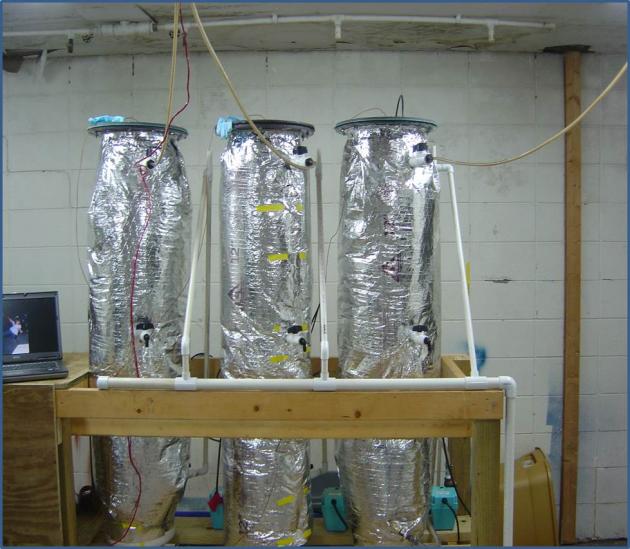
Lab scale anaerobic digesters constructed from PVC pipe used to evaluate co-digestion of manure with onion waste

Ninety liter (90 L) anaerobic digesters (anaerobic filters) were constructed from PVC pipe.  The digesters were filled with lava rock.  A thermocouple is placed in the center of each digester to be used in controlling temperature.  Each digester is controlled by a datalogger by reading temperature and turning on or off pumps to circulate water around digester maintaining temperature at 35 oC.  Biogas is collected in a tipping bucket and recorded on datalogger.

Abstract

Consumers demand high quality fruits and vegetables. As a result, packing sheds around the country cull or remove bad fruits and vegetables prior to packing then in boxes for shipment to stores. The culling process produces millions of pounds of waste fruits and vegetables annually. This culled fruit or vegetable then has to be disposed of in some form or fashion. Therefore, a project was designed to investigate the feasibility of using culled onions in conjunction with dairy waste to produce methane gas. The experiment used 90 liter downflow anaerobic filters to process a 50/50 mix of onion juice and dairy waste. Results from this study indicate the co-digestion of culled onions and dairy waste provides a good way to dispose of the waste onions while at the same time producing a renewable energy that can potentially be used in the packing shed where the onions are separated. The 50/50 blend of onion waste and dairy waste has consistently returned an average of 15 liters of biogas (70-75% methane) per 3 liters of mixed waste entering the digesters with a cleaning efficiency over 85%.

Why Look at Food Waste for Co-Digestion with Manure?

Culled onions or any fruit and vegetable has to be disposed.  Some of these are fed to animals, but some are thrown on fields and potentially tilled into the soil.  However, if they are piled and allowed to decay in place the liquid produced during the decaying process can have a high chemical oxygen demand (COD).  If this liquid is allowed to run into waterbodies they could be polluted or if allowed to infiltrate could be transferred to a waterbody through underground movement.  Therefore, this project investigated the characteristic of liquid produced from decaying onions as well as the feasibility of using waste onions along with dairy waste to produce methane gas in anaerobic digesters.  If feasible, the culled onions (or other fruits and vegetables) could be used as a source of energy verses a disposal issue.

What Did We Do?

The experiment had two parts.  The first part placed whole onions in a steel tank on a 2 foot bed of sand where the onions could naturally decay.  The liquid along with any rainwater was collected in portions and tested for its pH and Chemical Oxygen Demand.  Additionally, waste onions were juiced and mixed with dairy wastewater in a 50/50 mixture and used as feedstock for an anerobic filter digester.  Temperature was controlled in the mesophilic range and biogas was measured.

What Have We Learned?

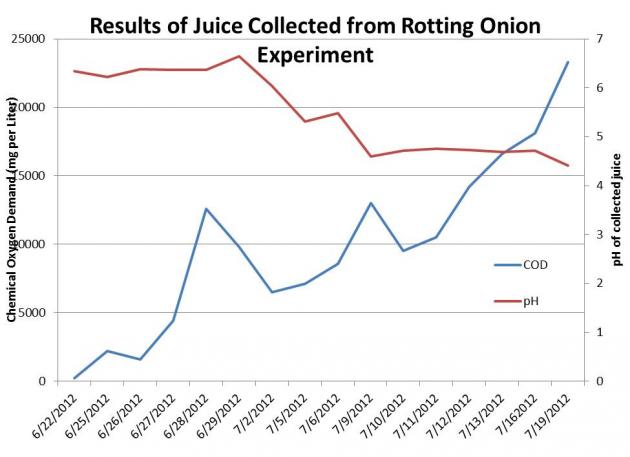
As expected, the decaying onions release a liquid that over time increases the COD profile of the liquid draining from the decaying pile.  It is expected that if onions were continually piled on the same spot, the COD and pH of the liquid would equalized at a COD value measured to be approximately 80 g/L and the pH would drop to approximately 3.5 (these numbers based on some previous studies and bench scale observations).  The data also suggest that, and as would be expected, onions decay faster in the summer months as opposed to winter months in Georgia.  It was also found that a 50/50 mix of onion waste and dairy wastewater fed to a pilot scale mesophilic anaerobic filter fed at 3 liters per day and a retention time of 7 days will produce approximately 15 liters of biogas daily with a methane composition of 70-75%.  The treatment level of the influent was also found to average greater than 85%.

The Chemical Oxygen Demand (COD) of liquid collected from the bottom of a tank full of decaying onions increases over time. Likewise, the pH of the liquid decreases. If these onions are disposed of in a wet area or area adjacent to a waterbody, the stre

The Chemical Oxygen Demand (COD) of liquid collected from the bottom of a tank full of decaying onions increases over time.  Likewise, the pH of the liquid decreases.  If these onions are disposed of in a wet area or area adjacent to a waterbody, the stream would be affected by the high COD and low pH liquid.

Biogas production from the mixed 50/50 onion/dairy waste fed at a rate of 3 liters per day. The methane composition of the biogas ranged from 70-75%. Treatment efficiencies of the waste, based on COD reduction, averaged greater than 85% (over 20 g L-1 i

Biogas production from the mixed 50/50 onion/dairy waste fed at a rate of 3 liters per day.  The methane composition of the biogas ranged from 70-75%.  Treatment efficiencies of the waste, based on COD reduction, averaged greater than 85% (over 20 g L-1 influent to less than 2 gL-1 in effluent).

Future Plans

Future plans will be continue the investigation of using waste onions (and other fruit and vegetables) as a feedstock for anaerobic digesters.  This feedstock, which is very available in onion growing regions seasonally, liquid from the onions can be stored over time (as observed in other research project) to provide a year round feedstock for the production of methane gas.  As we now know that the decaying onions release a liquid that has a high COD, using the onions for production of energy may reduce potential problems with water pollution as well as provide growers with additional income streams.  Plans will be to continue this work and look at optimizing the feed rate and mix ratios.

Authors

Gary Hawkins, University of Georgia, ghawkins@uga.edu

Additional Information

A few articles have been written about the project, research papers will be written in the near future.

Acknowledgements

The Vidalia Onion Research Committee and the USDA-AFRI Speciality Crops Initative

The authors are solely responsible for the content of these proceedings. The technical information does not necessarily reflect the official position of the sponsoring agencies or institutions represented by planning committee members, and inclusion and distribution herein does not constitute an endorsement of views expressed by the same. Printed materials included herein are not refereed publications. Citations should appear as follows. EXAMPLE: Authors. 2013. Title of presentation. Waste to Worth: Spreading Science and Solutions. Denver, CO. April 1-5, 2013. URL of this page. Accessed on: today’s date.

Adoption Trends of Nutrient Related Practices on Canadian Livestock Farms

Waste to Worth: Spreading science and solutions logoWaste to Worth home | More proceedings….

Abstract

This presentation will provide key results of the 2011 Farm Environmental Management Survey (FEMS) for practices related to manure nutrient management on Canadian livestock farms.   A number of landscape based practices are evaluated for both confined livestock and grazing livestock.  For confined livestock this includes various aspects of manure management such as time, rate, and method of land application.  For grazing livestock specific practices include degree of access to surface water bodies, and management of in field winter feeding systems such as swath or bale grazing.  For confined livestock a number of farmyard based practices are also evaluated.  These include size and features of manure storages, manure treatment technologies, and management of wastewater.  

The presentation will also provide a comparison of adoption of these practices with the previous FEMS 2006 survey.   FEMS is a joint initiative of Statistics Canada (StatsCan) and Agriculture and Agri-Food Canada (AAFC) in collaboration with various provincial government agriculture departments.  The survey is used, together with other data sources, to generate agri-environmental indicators that measure effectiveness of past programs and policies, and help develop appropriate future responses.  (Note:  Data is to be released to AAFC in September, 2012.  Analysis to be done in the fall 2012 and early winter 2013.  Abstract can be updated at a later date prior to the conference to include key results.)

Authors

Dennis Haak, Agriculture and Agri-Food Canada dennis.haak@agr.gc.ca


The authors are solely responsible for the content of these proceedings. The technical information does not necessarily reflect the official position of the sponsoring agencies or institutions represented by planning committee members, and inclusion and distribution herein does not constitute an endorsement of views expressed by the same. Printed materials included herein are not refereed publications. Citations should appear as follows. EXAMPLE: Authors. 2013. Title of presentation. Waste to Worth: Spreading Science and Solutions. Denver, CO. April 1-5, 2013. URL of this page. Accessed on: today’s date.

Phosphorus Concentrations Have Been Declining In The Illinois River: Was It Point Sources, Farm-Level Nutrient Management, Or What?

Waste to Worth: Spreading science and solutions logoWaste to Worth home | More proceedings….

Abstract

Elevated phosphorus concentrations in the Illinois River Watershed (IRW) have long been an environmental issue between the states of Arkansas and Oklahoma, which has led to the development of a watershed-reservoir model and future TMDL by the U.S. Environmental Protection Agency.  Here, we examine phosphorus concentrations from multiple sources, including the Arkansas Water Resources Center and the U.S. Geological Survey, to evaluate trends in flow-adjusted concentrations.   Flow-adjusted phosphorus concentrations have been decreasing in the Illinois River at Arkansas Highway 59, and this translates into decreases further downstream to Tahlequah, Oklahoma.  However, flow-adjusted concentrations in Flint Creek have been increasing over time until the last few years.  These decreases are tied to the reductions in effluent phosphorus, which have occurred over the last couple decades.  But, the application of poultry litter has also likely decreased within the IRW.  A nutrient mass balance of the Watershed Research and Education Center in Fayetteville, Arkansas showed that reduced litter applications and increased forage export (i.e., hay being removed from fields) can result in phosphorus export at the farm-scale.  The missing piece of this study would be understanding legacy phosphorus, and how this influences source apportionment and changes over time.

Authors

Brian Haggard, Arkansas Water Resources Center, haggard@uark.edu

Thad Scott, Crop, Soil and Environmental Sciences Department, Division of Agriculture, University of Arkansas System


The authors are solely responsible for the content of these proceedings. The technical information does not necessarily reflect the official position of the sponsoring agencies or institutions represented by planning committee members, and inclusion and distribution herein does not constitute an endorsement of views expressed by the same. Printed materials included herein are not refereed publications. Citations should appear as follows. EXAMPLE: Authors. 2013. Title of presentation. Waste to Worth: Spreading Science and Solutions. Denver, CO. April 1-5, 2013. URL of this page. Accessed on: today’s date.

What Happens When You Mix Chitosan and Poultry Litter?

Waste to Worth: Spreading science and solutions logoWaste to Worth home | More proceedings….

Abstract

The solubility of phosphorus (P) and low nitrogen(N):P ratio of poultry litter present environmental challenges when using this resource to supply nutrients to crops and forages.  Here, we explore the use of chitosan to reduce water extractable P (WEP) in poultry litter and potentially increase the N:P ratio.  Chitosan is derived from chitin, which is a waste product from the commercial shellfish industry; chitin is processed into chitosan through deacetylation, removing acetyl groups from this long-chained molecule.  Chitin has been successfully used in manure separation and flocculation in wastewater treatment processes, as well as immobilizing algae in wastewater streams to uptake nutrients. 

We performed a series a lab studies to evaluate how chitosan might reduce WEP, influence ammonia volatilization and potentially increase the N:P ratio of poultry litter.  Our experiments showed that chitosan was effective at reducing WEP content of poultry litter and increasing the N:P ratio, but ammonia volatilization might be increased under moist conditions.  We would like to take this from the lab to small plot and then field trials in the near future.

Authors

Brian Haggard, Arkansas Water Resources Center, haggard@uark.edu

I.M. Bailey, Formerly Biological Engineering Program, University of Arkansas, D.A. Zaharoff, Biomedical Engineering Department, University of Arkansas


The authors are solely responsible for the content of these proceedings. The technical information does not necessarily reflect the official position of the sponsoring agencies or institutions represented by planning committee members, and inclusion and distribution herein does not constitute an endorsement of views expressed by the same. Printed materials included herein are not refereed publications. Citations should appear as follows. EXAMPLE: Authors. 2013. Title of presentation. Waste to Worth: Spreading Science and Solutions. Denver, CO. April 1-5, 2013. URL of this page. Accessed on: today’s date.


Supporting Small-Scale Poultry and Livestock Businesses

Waste to Worth: Spreading science and solutions logoWaste to Worth home | More proceedings….

Why Work With Small Poultry and Livestock Operations?

Understand the business planning and development issues confronting small-scale livestock and poultry producers.

What Did We Do?

Colorado State University has been building educational programming to benefit small-scale crop and livestock producers across the state since 2007.  The Colorado Building Farmers and Ranchers program uses a classroom, experiential learning and community-building approach to help smaller-scale and new agricultural producers build their businesses in a profitable, safe and sustainable manner. To date, we have graduated more than 300 producers, 65% of whom have completed business plans to expand or develop their agricultural business. These producers are primarily characterized by their focus on direct marketing, and many are located relatively close to urban areas; locations that provide both marketing opportunities as well as production constraints. The classroom education takes place over 8 weeks and helps producers build sustainable business plans, and develop a network of producers and technical assistance providers (e.g. NRCS, FSA, county planning staff).  Topics covered include developing a production plan, recordkeeping, pricing, risk management, and on-farm food safety.  In addition, since small-scale livestock production is a more complex business model, we have built a curriculum that guides producers through all the business planning considerations necessary to start and operate a profitable livestock operation: from acquiring poultry, sheep or goats, to health and environmental issues, to processing and creating a unique market niche.

What Have We Learned?

Given that smaller or more diversified poultry and small ruminant operations may be trying to maintain a greater number of enterprises on one farm or operation, it may be more difficult for those producers to stay on top of good management practices, as well as any requirements necessary to remain in good standing with local government and marketing partners. For example, these small-scale operations may be maintained on a limited number of acres, thus requiring very careful land and animal management.  Additionally, many smaller-scale operations are located in areas where agriculture is not the primary land use.  Such operations may be in the urban-rural interface, the suburbs or even in towns or cities.  The research for this curriculum provided a basic overview of production, management and marketing considerations and opportunities for smaller-scale poultry and small ruminant production, and a means to discuss the relationship between resource stewardship and long-term business viability. We examined, in particular, emerging niche market opportunities and some of the costs and benefits inherent to pursuing those newer markets, finding that the costs and management skills required make it extremely difficult to operate a commercially viable small-scale livestock business in an urban area.

Future Plans

Next steps involve developing enterprise budgets with different numbers of poultry and small ruminants to understand the point at which these businesses become financially viable. This is important for helping prospective new livestock enterprises to truth their business plans, based on realistic assumptions.

Raising Poultry for Profit Video

Raising Sheep and Goats for Profit Video

Authors

Martha Sullins, Extension Regional Specialist, Colorado State University Extension, Martha.sullins@colostate.edu

Additional Information

Acknowledgements

David Weiss and Dawn Thilmany (Department of Agricultural and Resource Economics, CSU), Blake Angelo (Urban Ag Educator, Denver/Jefferson Counties, CSU Extension),  Marisa Bunning (Department of Food Science and Human Nutrition, CSU); Thomas Bass (Montana State University).

The authors are solely responsible for the content of these proceedings. The technical information does not necessarily reflect the official position of the sponsoring agencies or institutions represented by planning committee members, and inclusion and distribution herein does not constitute an endorsement of views expressed by the same. Printed materials included herein are not refereed publications. Citations should appear as follows. EXAMPLE: Authors. 2013. Title of presentation. Waste to Worth: Spreading Science and Solutions. Denver, CO. April 1-5, 2013. URL of this page. Accessed on: today’s date.

Design, Hydrologic Performance, and Effluent Characteristics Of A Woodchip Heavy-Use Area With Subsurface Drainage For Wintering Beef Cattle

Waste to Worth: Spreading science and solutions logoWaste to Worth home | More proceedings….

Abstract

Benefits to cattle welfare and pasture condition from wintering or confining animals on woodchip heavy use areas have been reported elsewhere in the world, but no known installations of this Best Management Practice have occurred in the United States.  Furthermore, increasing environmental concern and regulatory scrutiny of winter feeding areas and other heavy use areas demand improved management of nutrient-laden runoff.  A pilot study was initiated to evaluate the environmental impact of such a woodchip heavy use area as a winter herd management method for a pasture-based beef operation in northern West Virginia.  A dosed vegetative treatment system was installed to treat drainage effluent.  Effluent volume was recorded and nutrient concentrations were monitored during three years of winter stocking.  Measured data and hydrologic performance of this system was used for a comparison to runoff and nutrient loadings from other types of open-lot systems.  While a degree of pollutant reduction and retention occurred during percolation through the woodchip media, low-cost control of effluent from such systems remains a challenge, as in similar open-lot situations.  Woodchip heavy use area and drainage system design specifications are also reported with adjusted design recommendations.  Results indicate what the potential for expanded application of these systems is and offer a baseline for continuing research of this relatively unexplored technology in the region and elsewhere.

Authors

Joshua  Faulkner, West Virginia University   jwfaulkner@mail.wvu.edu

John Miller, West Virginia University, Thomas Basden, West Virginia University


The authors are solely responsible for the content of these proceedings. The technical information does not necessarily reflect the official position of the sponsoring agencies or institutions represented by planning committee members, and inclusion and distribution herein does not constitute an endorsement of views expressed by the same. Printed materials included herein are not refereed publications. Citations should appear as follows. EXAMPLE: Authors. 2013. Title of presentation. Waste to Worth: Spreading Science and Solutions. Denver, CO. April 1-5, 2013. URL of this page. Accessed on: today’s date.

Coupling Dairy Manure Anaerobic Digesters with Commercial Greenhouses – An assessment of Technical and Economic Feasibility

Waste to Worth: Spreading science and solutions logoWaste to Worth home | More proceedings….

Abstract

Despite all of the positive environmental benefits of anaerobic digestion, the economics are not sufficient for widespread adoption by US farmers when selling surplus power to the grid.  Often farms are only paid the wholesale price (2 to 3 cents/kWh) for electricity, making it difficult to justify generating it in the first place.  In addition, typically in the Northeast, approximately 40% of the energy from a digester goes unused (excess heat).  Therefore, promising value-added technology/business partnerships need to be evaluated and demonstrated, such as partnering anaerobic digestion with commercial greenhouses. 

Greenhouses are an ideal end user of the waste heat and surplus electricity produced by a digester.  In the Northeast and other similar climates, heat and electricity represent a major expense for greenhouse growers.  Greenhouses can make use of excess heat to provide the necessary growing conditions for year-round production and excess electricity can be used to run supplemental lighting to keep production constant year-round.

To facilitate the adoption of digester/greenhouse unions, we are developing a comprehensive computer model of both the energy output of farm-based digesters, the energy requirements of the associated farm, and the energy required by greenhouses, in terms of timing and magnitude.  We will use existing and project-developed data collected from five Northeast digesters and three greenhouse operations to aid in developing and validating the model.  The model will be complex enough to handle varying biomass inputs and required outputs, and the economics of operation.  We will use the model to run several real-world “what ifs” and use the outputs for making recommendations to existing anaerobic digesters considering coupling with greenhouses. System economics are also going to be included.

Authors

Curt Gooch, Cornell PRO-DAIRY cag26@cornell.edu

Tim Shelford, Cornell PRO-DAIRY


The authors are solely responsible for the content of these proceedings. The technical information does not necessarily reflect the official position of the sponsoring agencies or institutions represented by planning committee members, and inclusion and distribution herein does not constitute an endorsement of views expressed by the same. Printed materials included herein are not refereed publications. Citations should appear as follows. EXAMPLE: Authors. 2013. Title of presentation. Waste to Worth: Spreading Science and Solutions. Denver, CO. April 1-5, 2013. URL of this page. Accessed on: today’s date.