On-Farm Comparison of Two Liquid Dairy Manure Application Methods in Terms of Ammonia Emission, Odor Emission, and Costs

Waste to Worth: Spreading science and solutions logoWaste to Worth home | More proceedings….

Abstract

* Presentation slides are available at the bottom of the page.

Ammonia and odor emissions from land application of liquid dairy manure, and costs associated with manure land application methods are serious concerns for dairy owners, regulators, academic, and the general public. Odor and ammonia samples from agricultural fields receiving liquid dairy manure applied by surface broadcast and subsurface injection methods were collected and analyzed. Costs associated with both of the manure application methods were estimated. The test results showed that subsurface injection reduced both the odor and ammonia emissions compared with surface broadcast; therefore, applying liquid dairy manure by subsurface injection could be recommended as one of the best management practices to control ammonia and odor emissions. The estimated costs associated with subsurface injection were higher than surface broadcast. However the higher costs could be partially compensated by the higher nitrogen fertilizer value captured in the soil by the deep injection method.

Why Study Air Emissions from Dairy Farms?

A floating self-propelled mixing pump and a remote controller (yellow)

Agriculture is the single most important economic sector in Idaho. Dairy production currently stands as the single largest agricultural pursuit in Idaho. Currently, Idaho ranks as the third largest milk production state in the US. Idaho has roughly 550 dairy operations with 580,000 milk cows. Over 70% of milk cows are located in the Magic Valley in southern Idaho (Idaho Department of Agriculture-Bureau of Dairying, 1/22/2013). A number of dairies in the Magic Valley use flushing systems resulting in huge amount of lagoon water which is applied to crop lands near the lagoons via irrigation systems during the crop growing seasons. The volatilization of ammonia (NH3) from the irrigated lands and lagoons is not only a loss of valuable nitrogen (N), but also causes air pollution. Concentrated dairy production in a limited area such as the Magic Valley has caused air and water quality concerns. Controlling odor and capturing N in dairy manure are big challenges facing the southern Idaho dairy industry.

Direct injection incorporates manure directly beneath the soil surface and thus minimizes odor and NH3 emissions during application. Injecting manure decreases soluble phosphorus (P) and N in runoff relative to surface application. Some common types of direct injection applications are liquid tankers with injectors and drag-hose systems with injectors. Manure can be successfully injected in both conventional tillage and non-till systems with currently available equipment. The manure direct injection has been proven in other regions, such as the Midwest, to effectively manage odors and manure nutrients. The purpose of this research was to demonstrate, evaluate, and encourage the widespread adoption of the manure direct injection method in southern Idaho for mitigating odors and managing manure nutrients.

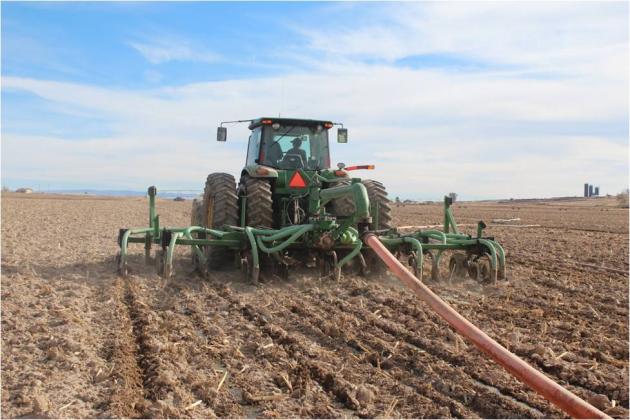
Subsurface injection with drag hose system

What Did We Do?

A manure application field day was held on October 31, 2012 on a dairy in Buhl, Idaho, to demonstrate and evaluate dairy manure land application via a drag-hose system and manure mixing equipment. The dairy had approximately 3,500 milking cows managed in a free-stall and open-lot mix set-up, with about 60% of the cows housed in free stalls. Waste is flushed from lanes running under the feeding alleys and from the milking parlor. The wastewater passes through solids removal equipment and basins and then into three lagoons in series. Manure used for this demonstration study was from the last lagoon, which had about 9 million gallons of manure at the beginning of the demonstration field day and its sludge had been not cleaned for 5 years.

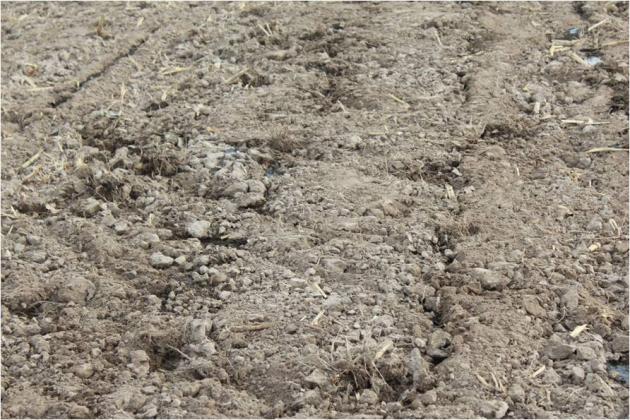
Soil after manure subsurface injection

The on-farm manure application trials conducted at two sites were comprised of two manure application methods: surface broadcast and subsurface injection. At each of the sites, a square plot of approximately 3,600 m2 in the western portion of the site was used for surface broadcast and the rest of the land was used for subsurface injection. The western portion of the site was chosen because the prevailing winds were from the north during the test period. The previous crop at the two sites was corn; both sites had been disked after harvest.

The manure lagoon was agitated before and during application with a floating mixing pump. Manure was pumped from the lagoon directly to the application field via drag hoses. The two manure application methods were demonstrated with the same equipment. Subsurface injection placed manure behind the shank in a band approximately 20 cm (8 inches) deep. Surface broadcast was realized by lifting the shanks above ground so manure was applied on the soil surface. Manure was applied from east to west and back again until the site was finished. The equipment shanks were lifted only when the equipment was in the designated 3,600 m2 square plot for surface application. After manure application in the site, three towers, each 1.5 m high, were placed in a north-to-south orientation with approximately 15 m spacing. The middle tower was placed at the center of the manure surface applied plot. Three towers were placed in the manure subsurface injected field parallel to the ones in the manure surface broadcasted plot and approximately 200 m apart to avoid or minimize cross-contamination between the two manure application methods.

Passive NH3 samplers (Ogawa & Co. USA Inc., Pompano Beach, FL) were installed on each tower at a height of 0.5 and 1 m to determine the NH3 concentration at each location. Ammonia samplers were changed approximately every 24 hours over a two-day period after manure application. Right after collection of NH3 samplers in field, samplers were placed into airtight containers and then shipped back to the U-Idaho Twin Falls Waste Management Laboratory where the NH3 sampler filters were carefully removed from the samplers and transferred into 15-mL centrifuge tubes. Five mL of 1 M KCI was added to each of the centrifuge tubes to extract NH3 trapped in the filters. The extractant was transported to the USDA Northwest Irrigation and Soils Research Laboratory (NWISRL) located in Kimberly, Idaho where it was analyzed for NH4-N using a flow-injection analysis system (Quickchem 8500, Lachat Instruments, Milwaukee, WI). Background concentrations of NH3 were determined by placing three towers 50 m upwind (north) of the site following the same procedure described previously. Concentrations from passive samplers are time-average concentrations for the amount of time the sampler was exposed to the air and were calculated with the following equation:

[NH3-N]air (mg/m3) = 1,000,000 *[NH4-N]extractant (mg/L)/200/time deployed (min)/31.1 (cm3/min)

In this, [NH3-N]air is the concentration of NH3-N in the air, [NH4-N]extractant is the concentration of NH4-N in the extractant, and 31.1 cm3/min is a constant used to calculated diffusion to the trap (Roadman et al., 2003; Leytem et al., 2009). Details regarding the design and calculation of NH3 concentrations can be found in Roadman et al. (2003) and Leytem et al. (2009).

Air samples were collected from the first test site right after manure application using Tedlar bags. One air sample was collected at 1 m above ground from each of the three towers located in the surface broadcast plot, subsurface injection, and background, respectively. A total of nine air samples were collected and then sent via UPS over-night service to Iowa State University Olfactometry Laboratory for odor analysis. The nine air samples were analyzed within 24 hours based on ASTM E679-04 (ASTM, 2004).

For each test site, a grab sample (about 1 L) of liquid manure was collected and transported to a commercial lab (Stukenholtz Laboratory, Inc., located in Twin Falls, Idaho) for pH and total nitrogen analysis. The manure pH, total N, and calculated total N application rates are shown in Table 1. The liquid manure application rate was approximately 20,000 gallons per acre on both the test sites.

Table 1. Manure pH and total N concentrations and application rates of total N at the two test sites

Site and Application Method

Manure pH

Manure total N concentration (mg/L)

Manure total N Application Rate (kg/acre)

Site 1

7.4

3433

257

Site 2

7.3

3519

265


A soil temperature probe with data logger (HOBO U23 Pro v2 2x external temperature data logger-U23-003) was placed 3 cm below the soil surface to record soil temperature data in 15-min increments. Wind speed, temperature, and relative humidity data were obtained from local Buhl Airport, located six miles from the test sites, due to failure of the mobile weather station set on the test sites. The ambient weather conditions and soil temperature at the test sites over the test period are shown in Table 2.

Table 2. Ambient weather conditions and soil temperature at the test sites


Site 1

Site 2

Item

Day 1

Day 2

Day 1

Day 2

Average wind speed, m/s

5.0

4.2

4.2

3.1

Air temperature,  average(minimum, maximum),˚F

61 (42, 78)

49 (45, 63)

49 (45, 63)

47 (38, 61)

Average relative humidity,  %

28

53

53

51

Soil temperature, average(minimum, maximum), ˚F

50.9               (51.1, 56.1)

47.3              (51.1, 51.2)

46.5                (51.5, 52.1)

66.7              (51.6, 69.1)

Cost analysis was carried out for four different manure land application systems as shown in the “What Have We Learned?” section below. Cost calculations are based on 500 hours annual use for the tractor and 200 hours annual use for the injection system. Tractor operator labor is figured at $11.70/hour, diesel is figured at $4.00/gallon. Equipment costs were determined using the MACHCOST program from the University of Idaho’s department of Agricultural Economics and Rural Sociology. The program is available on the AERS web page at https://www.uidaho.edu/cals/idaho-agbiz/resources/tools. Equipment data was provided by John Smith at Smith Equipment Co. Rupert, ID 83350. Some machinery data was taken from “Costs of Owning and Operating Farm Machinery in the Pacific Northwest” PNW 346 available on line at: https://www.extension.uidaho.edu/publishing/pdf/PNW/PNW0346/PNW0346.html.

What Have We Learned?

Odor results from test site 1

T-test for Odor showed there was no significant difference between the background and subsurface injection (P=0.41), there was significant difference between the background and surface broadcast (P=0.03), and P value was 0.08 for the t-test of mean difference between the subsurface injection and surface broadcast. The field day attendees felt there was significant difference in odor perception between the subsurface injection and surface broadcast methods.

Test site 1

First day ammonia sample results from test site 1.

Second day ammonia sample results from test site 1.

The NH3 concentration data from test site 1 showed significant difference between surface broadcast and subsurface injection based on P<0.05. The NH3 concentration data from test site 1 showed 82% and 64% reduction in NH3 concentration for first and second sampling day, respectively when liquid dairy manure was applied by subsurface injection vs. surface broadcast.

Test site 2

First day ammonia sample results from test site 2.

Second day ammonia sample results from test site 2.

The NH3 concentration data from test site 2 showed significant difference between surface broadcast and subsurface injection based on P<0.05. There were 64% and 41% decrease in NH3 concentration for first and second sampling day, respectively when manure was applied by subsurface injection compared with surface broadcast.

The NH3 concentration data from both the test sites showed lower NH3 concentration in the air from the subsurface injected soil vs. surface applied land which means higher nitrogen fertilizer value captured in the soil by the subsurface injection method.

Cost analysis results:

*Fuel and Lubricant Costs are assigned to the Power Unit.

The above fact sheet summarizes probable costs of operation for a 7,400 gallon tank with a 2,000 gpm discharge rate and a 15 foot wide broadcast unit. A 180 PTO HP tractor is needed to pull this unit at an average ground speed of 8 mph. Up to 10 acres per hour can be covered with the unit. The tank is discharged in approximately 4 minutes. Time and equipment to refill the tank is not included in these calculations.

*Fuel and Lubricant Costs are assigned to the Power Unit.

The above fact sheet summarizes probable costs of operation for a 7,400 gallon tank with a 2,000 gpm discharge rate and a 12 foot wide broadcast unit. A 215 PTO HP tractor is needed to pull this unit at an average ground speed of 7 mph. Up to 7 acres per hour can be covered with the unit. The tank is discharged in approximately 4 minutes. Time and equipment to refill the tank is not included in these calculations.

*Fuel and Lubricant Costs are assigned to the Power Unit.

The above fact sheet summarizes probable costs of operation for a 7,400 gallon tank with a 2,000 gpm discharge rate and a 12 foot wide broadcast unit. A 225 PTO HP tractor is needed to pull this unit at an average ground speed of 7 mph. Up to 7 acres per hour can be covered with the unit. The tank is discharged in approximately 4 minutes. Time and equipment to refill the tank is not included in these calculations.

*Fuel and Lubricant Costs are assigned to the Power Unit.

The above fact sheet summarizes probable costs of operation for a system utilizing 5,280 FT of 8 inch hose and 1,320 FT of 5 inch hose. The pump unit capacity is 1,500 gpm to a 16 foot knife injection unit. A 250 PTO HP tractor is needed for the injection unit operating at 75% field efficiency and at an average ground speed of 3.5 mph. The lagoon pump is a 270 HP unit and operating efficiency assumed at 70%. Beyond 2 miles a booster pump would be necessary. Up to 4.75 acres per hour can be covered with the unit. Operation is continuous as no tank refill is needed.

Based on the estimated costs above, the subsurface injection method has higher costs mainly due to the need of larger tractor and lower operating speed. However, we did not include the time and equipment costs associated with refilling the tank for the tank application system. Due to the short time to discharge the tank on the tank broadcast and tank injection systems additional equipment to refill the tank in a timely fashion would be desirable. This would increase the investment in equipment and also would reduce the number of acres that could be covered per hour due to down time while the tank is refilled.

In summary, subsurface injection can reduce both the odor and NH3 emissions compared with surface broadcast; therefore, applying liquid dairy manure by subsurface injection could be recommended as one of the best management practices to control NH3 and odor emissions. The estimated costs associated with subsurface injection were higher than surface broadcast. However, the higher costs could be partially compensated by the higher nitrogen fertilizer value captured in the soil by the subsurface injection method.

Future Plans

We will finish development of educational videos to demonstrate the manure subsurface injection technique and disseminate results from this study to our stakeholders.

Authors

Lide Chen, Waste Management Engineer and Assistant Professor, Biological and Agricultural Engineering Department, University of Idaho lchen@uidaho.edu

Mario de Haro Marti, Extension Educator

Wilson Gray, District Extension Economist and Extension Professor

Howard Neibling, Extension Irrigation and Water Management Specialist and Associate Professor

Mireille Chahine, Extension Dairy Specialist and Associate Professor

Sai Krishna Reddy Yadanaparthi, Graduate student, University of Idaho

Acknowledgements

This project was supported by the USDA Natural Resource Conservation Service through a Conservation Innovation Grant. We would also like to thank Dr. April Leytem and Mr. Myles Miller (USDA Northwest Irrigation and Soils Research Laboratory (NWISRL) located in Kimberly, Idaho) for their help with analysis of ammonia samples.


The authors are solely responsible for the content of these proceedings. The technical information does not necessarily reflect the official position of the sponsoring agencies or institutions represented by planning committee members, and inclusion and distribution herein does not constitute an endorsement of views expressed by the same. Printed materials included herein are not refereed publications. Citations should appear as follows. EXAMPLE: Authors. 2013. Title of presentation. Waste to Worth: Spreading Science and Solutions. Denver, CO. April 1-5, 2013. URL of this page. Accessed on: today’s date.

 

Managing Odors, Neighbor Relations, and Estimating Setbacks for Animal Feeding Operations

When a new or expanded animal feeding operation is proposed, air quality and odors are often identified as a concern by community members. Available science-based resources will help you better understand odor, health and zoning issues. Understanding these issues can help community members with diverse interests and perspectives engage in informed conversations as they deal with community decisions regarding zoning and land use related to large animal feeding operations.

Neighbor Relations and Odor Management

Odor is a surprisingly complex issue that can impact neighbors and others. Farmers care about their impact on neighbors and look for effective methods to reduce odors. The goal is to keep odors at non-detectable or non-offensive levels. This 9 minute video will introduce some odor management issues and options available to reduce odors. Odor mitigation includes careful site planning and, as needed, the use of natural (windbreaks and setbacks), technological and management practices. The costs of different odor reduction practices vary and should be carefully considered to determine if they are a good fit for each individual operation. Visit the Feedlot Air Emissions Treatment Cost Calculator to download a spreadsheet to help calculate costs and benefits of installing technologies to treat odors and gas emissions from animal feeding operations.

Setback Tools

This nine minute video describes three setback estimation tools developed and used in Minnesota, Nebraska and Iowa as the result of extensive research. These tools determine appropriate setback distances to manage odors when building new or expanding existing livestock or poultry facilities.

The siting of a livestock or poultry production facility is the first step in odor control to minimize impacts on nearby neighbors and public areas. Each facility needs a site-specific plan as there is no one-size-fits-all recommendation. Topography, local weather, presence of other odor sources in the area, sensitivity of the neighbors, and the characteristics of the animal facility all play a role in determining setbacks. Fortunately there are science-based tools available to assist producers, concerned citizens, and policy makers in making sound decisions.

Some of the ways farmers can manage odors include:

Also see the excellent video on “Odors on Livestock Farms: A Case Study From Nebraska” and visit the Livestock and Poultry Environmental Learning Center air quality page for more resources on managing air emissions.

More Videos in This Series

Additional educational materials are available at Air Quality in Animal Agriculture

Acknowledgements

For more information about this video or these resources, contact Dr. Kevin Janni, University of Minnesota kjanni@umn.edu

These materials were based upon work supported by the by the National Institute of Food and Agriculture, U.S. Department of Agriculture under Agreement No. 2010-85112-20520.

Any opinions, findings, conclusions, or recommendations expressed in this video are those of the speaker and do not reflect the view of the U.S. Department of Agriculture.

Airborne Emissions in Animal Agriculture

Air emissions from animal agriculture operations and manure storage include gases and particulate matter (dust). Some of these are potentially hazardous (hydrogen sulfide and ammonia). Others are scrutinized because they are greenhouse gases (carbon dioxide, methane, nitrous oxide) and others because they are odorous. All in all, hundreds of gases can be emitted from manure and animal housing.

The materials on this page were developed to assist educators and professors who include an introduction to airborne emissions and their management as a topic in their classrooms or educational programs.

Fact Sheet

Neslihan Akdeniz and Kevin Janni, University of Minnesota; Wendy Powers, Michigan State University

Acknowledgements

These materials were developed by the Air Quality Education in Animal Agriculture (AQEAA) project with financial support from the National Research Initiative Competitive Grant 2007-55112-17856 from the USDA National Institute of Food and Agriculture.

For questions about the materials on this page contact Dr. Kevin Janni, University of Minnesota (kjanni@umn.edu). For questions about the AQEAA project, contact Dr. Rick Stowell, Unviersity of Nebraska (rstowell2@unl.edu).

If you have presentations, photos, video, publications, or other instructional materials that could be added to the curricula on this page, please contact Dr. Janni or Jill Heemstra (jheemstra@unl.edu).

Biofilters for Animal Agriculture Air Quality Curriculum Materials

Air emissions from animal agriculture operations and their associated manure storage are being examined more closely for ways to mitigate potentially harmful gases. One of the options being evaluated is biofilters.  The materials on this page were developed to assist educators and professors who include biofilters as a topic in their classrooms or educational programs.

Fact Sheets

Kevin Janni, Minnesota; Richard Nicolai; South Dakota State (emeritus); Steve Hoff, Iowa State; Rose Stenglein, Minnesota

Webcasts and Videos

Video: Biofilters for Managing Odors and Air Emissions

Technology Summaries

These are from a 2008 conference. Contact information is provided in each article for obtaining updates.

Photo Slideshow

Acknowledgements

These materials were developed by the Air Quality Education in Animal Agriculture (AQEAA) project with with financial support from the National Research Initiative Competitive Grant 2007-55112-17856 from the USDA National Institute of Food and Agriculture.

For questions about the materials on this page contact Dr. Kevin Janni, University of Minnesota (kjanni@umn.edu). For questions about the AQEAA project, contact Dr. Rick Stowell, Unviersity of Nebraska (rstowell2@unl.edu).

If you have presentations, photos, video, publications, or other instructional materials that could be added to the curricula on this page, please contact Dr. Janni or Jill Heemstra (jheemstra@unl.edu).

Manure and Litter Additives for Odor Control on Farms

Air emissions from animal agriculture operations and their associated manure storage are being examined more closely as a way to mitigate potentially harmful gases and odors. Manure additives and litter amendments go right to the source and are used to change one or more characteristics of manure to try and reduce emissions emissions of odorous gases. The materials on this page were developed to assist educators and professors who include manure additives or litter amendments as a topic in their classrooms or educational programs.

Fact Sheets

Sanjay Shah, Garry Grabow, Philip Westerman, North Carolina State University

Sanjay Shah, Philip Westerman, James Parsons, North Carolina State University

Technology Summaries

These are from a 2008 conference hosted by Iowa State University

Acknowledgements

These materials were developed by the Air Quality Education in Animal Agriculture (AQEAA) project with with financial support from the National Research Initiative Competitive Grant 2007-55112-17856 from the USDA National Institute of Food and Agriculture.

For questions about the materials on this page contact Dr. Kevin Janni, University of Minnesota (kjanni@umn.edu). For questions about the AQEAA project, contact Dr. Rick Stowell, Unviersity of Nebraska (rstowell2@unl.edu).

If you have presentations, photos, video, publications, or other instructional materials that could be added to the curricula on this page, please contact Dr. Janni or Jill Heemstra (jheemstra@unl.edu).

Manure Storage Covers Curriculum Materials

Air emissions from animal agriculture operations and their associated manure storage are being examined more closely as a way to mitigate potentially harmful gases. Covers are becoming popular as a way to collect methane (a potent greenhouse gas) for beneficial reuse as a renewable energy source.  The materials on this page were developed to assist educators and professors who include manure storage covers as a topic in their classrooms or educational programs.

Fact Sheets

Rose Stenglein, Charles J. Clanton, David R. Schmidt, Larry D. Jacobson, and Kevin A. Janni, University of Minnesota

Video: Manure Storage Covers for Reducing Odor Emissions

Photo Galleries

Positive Air Pressure Covers

Negative Air Pressure Covers

Technology Summaries

These are from a 2008 conference hosted by Iowa State University

Acknowledgements

These materials were developed by the Air Quality Education in Animal Agriculture (AQEAA) project with with financial support from the National Research Initiative Competitive Grant 2007-55112-17856 from the USDA National Institute of Food and Agriculture. For questions about the materials on this page contact Dr. Kevin Janni, University of Minnesota (kjanni@umn.edu). For questions about the AQEAA project, contact Dr. Rick Stowell, Unviersity of Nebraska (rstowell2@unl.edu). If you have presentations, photos, video, publications, or other instructional materials that could be added to the curricula on this page, please contact Dr. Janni or Jill Heemstra (jheemstra@unl.edu).

Odors from Livestock Farms Curriculum Materials

One of the easiest air emissions to recognize from livestock and poultry farms is odor. It is also the most complex to characterize and study. Odors are a combination of hundreds of different emissions. Each person who smells odor interprets it differently than another person as well. With all of these variables, how can we communicate the issue of odor to students and ag professionals? These materials were developed for instructors to use in classrooms or extension programs.

Laboratory Exercise on Odor and Smell

From Dr. Doug Hamilton, Oklahoma State University

Slides and recording of author presenting the workshop. A 2 hour laboratory/workshop exercise has been presented to over 250 college freshmen.

Odor Laboratory–step by step instructions on setting up a laboratory exercise on odor

Observations and Data from Oklahoma State experience with the laboratory exercises

Video: Odors on Livestock and Poultry Farms

What role does odor play today for livestock and poultry producers? Are there ways to effectively manage odors from livestock and poultry operations and still keep the industry viable? This video examines some of the odor issues that exist in rural communities and shows examples from Nebraska of how research information is being put to use on farms.

Download a Copy of This Video

To download this video, right click on the link and select “save link as”.
Odors from Livestock Farms: A Case Study in Nebraska
File size: 34MB
Format: MP4

For More Information

Some additional resources for learning about odors and animal feeding operations:

Acknowledgements

If you have any questions or comments about the lecture or laboratory exercises, contact Dr. Doug Hamilton, Oklahoma State University dhamilt@okstate.edu. For questions on this video, contact Dr. Rick Stowell, University of Nebraska, rstowell2@unl.edu.

These materials were developed by the Air Quality Education in Animal Agriculture (AQEAA) project with with financial support from the National Research Initiative Competitive Grant 2007-55112-17856 from the USDA National Institute of Food and Agriculture.

Air Emission and Energy Usage Impacts of No Pit Fans in a Wean to Finish Deep Pit Pig Facility

What Is Being Measured?

The objectives of this research project are to monitor the indoor air quality of a deep-pit; wean-to-finish pig building over one pig-growth cycle (six months) by semi-continuously measuring concentrations of ammonia (NH3), hydrogen sulfide (H2S), carbon dioxide (CO2), methane (CH4), and volatile organic compounds (VOCs) and intermittently measuring particulate matter (PM10) and odor. The project will also monitor semi-continuous emissions of NH3, H2S, CO2, CH4, and VOCs plus intermittent sampling of odor emissions from the barn’s pit and wall exhaust streams over the six month growth period. Energy usage, both electrical and LP gas usage will be measured for both pit and non-pit ventilated rooms over the pig growth, along with pig performance (daily gain, feed efficiency, and death loss) between the rooms.

Current Activities

A cooperating pork producer is being located in southern Minnesota with a tentative starting date of July 1, 2008 for data collection.

Does the Use of Pit Fans Make a Difference in Air Emissions from Deep-Pit Pig Barns?

Air emissions from tunnel ventilated pig finishing barns have been monitored and partitioned between pit and wall fans during the past two years in Minnesota. The results showed that a disproportionate amount of hydrogen sulfide (H2S) and ammonia (NH3) emissions were emitted from the deep pit finishing barn through pit fans even though it was concluded that “pit” ventilation has little effect on the barn’s indoor air quality (figure 1). Thus producers might be able to reduce emissions of these hazardous gases and the associated odor of these gases simply by limiting or not using pit ventilation fans. Such a strategy would save electrical energy use since larger more efficient wall fans could replace the less efficient pit fans.

Figure 1. Hydrogen Sulfide Emissions from a 1200 head pig finishing barn with varying pit ventilation rates during a winter (January 26 to March 4, 2006) period. Contributed to eXtension CC2.5

Why is This Important?

Data collected from the deep pit facility will be used to determine the benefit of pit fans to indoor air quality in swine wean to finish buildings and what impact the use of pit fans has on energy usage and gas, odor, and particulate matter emissions from this stage of pork production buildings .

For More Information

Jacobson, L.D., B.P. Hetchler, and D.R. Schmidt. 2007. Sampling pit and wall emission for H2S, NH3, CO2, PM, & odor from deep-pit pig finishing facilities. Presented at the International Symposium on Air Quality and Waste Management for Agriculture. Sept 15-19, 2007. Broomfield, CO. St. Joseph, Mich.: ASABE

Authors: Larry D. Jacobson, David Schmidt and Brian Hetchler, University of Minnesota

This report was prepared for the 2008 annual meeting of the regional research committee, S-1032 “Animal Manure and Waste Utilization, Treatment and Nuisance Avoidance for a Sustainable Agriculture”. This report is not peer-reviewed and the author has sole responsibility for the content.

Odor Mitigation Using Vegetative Environmental Buffers Research Summary

Why Study Trees for Controlling Odors from Livestock and Poultry Buildings?

The objective of this research is to evaluate the bio-physical, economic and social efficacy of the use of Vegetative Environmental Buffers (VEBs) – purposefully planted linear arrangements of trees and shrubs – to incrementally mitigate livestock and poultry odor. Our research has demonstrated that tree barriers can help impede, alter, absorb, and/or dissipate livestock odor plumes and other emissions prior to contact with people. As air moves across vegetative surfaces, leaves and other aerial plant surfaces remove some of the dust, gas, and microbial constituents of airstreams. Trees and other woody vegetation also enhance localized air dispersion by increasing mechanical turbulence. Our research program into the efficacy of VEBs involves a multi-disciplinary, multi-species and multi-analytic perspective. Related: Archived webcast on “Trees, Shelterbelts, and Windbreaks for Mitigating Livestock and Poultry Odors

Activities

The efficacy of VEBs in mitigating livestock and poultry odor is being examined from a three- pronged perspective measuring efficacy in:

  1. field measured bio-physical terms (e.g. physical reductions in downwind movement of particulates, odor and ammonia and long-term tree health)
  2. financial feasibility terms at the farm-level (e.g. total costs of VEB establishment and maintenance vs. producer willingness to pay), and
  3. in terms of social approval of the use of VEBs (e.g. evaluation of the impact of VEBs on production site aesthetics and consumer willingness to pay for environmentally friendly meat products).

The quantification of physical odor mitigation via the use of VEBs is approached with field trials using full size VEB systems (multiple rows of trees) at working poultry and swine facilities as well as using scale models of these facilities for wind tunnel examinations and advanced computer simulation.

Custom rate financial data has been collected and applied to a range of livestock facilities (e.g. differing VEB designs, production scale, etc.) to calculate typical upfront and long-term costs. Producer willingness to pay has been determined via multi-state producer surveys. Social opinion data was collected via multi-state consumer focus groups (utilizing photo elicitation techniques) and a series of integrated social surveys.

Can Trees Reduce Odor Movement?

Baseline physical data suggests that VEBs can contribute up to a 10% reduction in the movement of odor downwind. The technology broadly applied at the farm level seems to be financially feasible to most swine producers – with total costs ranging from $0.01 to $0.33 per pig produced; these costs by and large being well below maximum producer willingness to pay for the use of VEBs. And social surveys in IA and NC show strong social support and appreciation of the use of trees for air quality purposes with strong social agreement that VEBs improve the aesthetics of confinement production.

Why is This Important?

Affordable, tertiary odor mitigation technology with the added benefit of being socially acceptable is a strong compliment to any comprehensive manure management program at production sites .

For More Information

Author: John Tyndall, Iowa State University

Visit the Iowa State University vegetative environmental buffers website.

Read the following article: Tyndall, J.C. and J.P. Colletti. 2007. Mitigating Swine Odor with Strategically Designed Shelterbelt Systems: A Review. Agroforestry Systems. Volume 69, Number 1/January, 2007.

This report was prepared for the 2008 annual meeting of the regional research committee, S-1032 “Animal Manure and Waste Utilization, Treatment and Nuisance Avoidance for a Sustainable Agriculture”. This report is not peer-reviewed and the author has sole responsibility for the content.

Simultaneous Treatment of Odor, Volatile Organic Compounds, Hydrogen Sulfide, Ammonia, and Pathogens With Ultraviolet Light

Printer friendly version of this summary.

Is It Feasible to Treat or Reduce Several Air Emissions from Pig Barns at Once?

The simultaneous treatment of odors, gases, airborne pathogens using novel ultraviolet (UV) treatment project addresses a critical need of the control of odor and pathogens generated in commercial swine production. The same technology could potentially be used for other species (e.g., poultry) that are housed in mechanically-ventilated barns. This study will test the potential for using currently available technology for the simultaneous degradation of most offensive odorants, ammonia (NH3), and model pathogens (SIV, BVDV). Such UV light-based technology is suitable for application for ventilation air and could be applied to exhaust air (to treat emissions) and inlet air (to prevent the spread of infectious diseases) for new and existing operations.

The long-term goal is to develop a cost-effective technology for the simultaneous treatment of odor and pathogens in swine and possibly poultry housing in order to limit their impact on air quality and health (both human and animal).

Activities

A standard gas/odor system for generating and measuring gases is being used for lab-scale experiments. The system generates 13 odorous gases including hydrogen sulfide (H2S), mercaptans, volatile fatty acids (VFAs), and phenolic compounds responsible for swine odor. NH3 gas and its removal is included. Odor measurement with a standard ASTM method are conducted by the Olfactometry Lab.

Did UV Light Reduce Pathogens and Odorants?

We measured the effectiveness of odor treatment and pathogen inactivation in laboratory scale. Almost 100% removal was achieved for all the compounds tested except H2S and dimethylsulfide using only 1 sec irradiation. Removals of H2S and dimethylsulfide are also significant. Longer UV irradiation times resulted in complete percent reduction of target compounds and odor. Of specific interest is very efficient removal of p-cresol which has been recognized as priority odorant responsible for the characteristic livestock odor. Treatment cost of $0.25 per pig and continuous operation during growing cycle was estimated when the lab-scale results were extrapolated to typical ventilation rates and electricity cost at a swine finish operation in rural Iowa.

Why is This Important?

Comprehensive solutions to swine aerial emissions are expected to be even more urgent in the future. Thus, the proposed study addresses several critically important issues confronting pork and poultry producers, but also has a broader applicability to homeland security, human/animal health, indoor air quality and hazardous waste treatment.

For More Information

Authors: Jacek Koziel, Jeff Zimmerman, Steven Hoff, Hans van Leeuwen, William Jenks, Iowa State University

Read the following articles or visit the Iowa State University odor research website.

Yang, X., Koziel, J.A., Cai L., Hoff, S. et al. Novel treatment of VOCs and odor using photolysis. ASABE Annual International Meeting, 2007, Minneapolis, MN, paper No. 074139.

Koziel, J.A., X. Yang, T. Cutler, S. Zhang, J. Zimmerman, S. J. Hoff, W. Jenks, Y. Laor, U. Ravid, R. Armon, J.H. van Leeuwen. 2008. Mitigation of odor and pathogens from CAFAs with UV/TiO2: exploring cost effectiveness. In the proceedings of the Mitigating Air Emissions From Animal Feeding Operations Conference. Des Moines, May, 2008.

This report was prepared for the 2008 annual meeting of the regional research committee, S-1032 “Animal Manure and Waste Utilization, Treatment and Nuisance Avoidance for a Sustainable Agriculture”. This report is not peer-reviewed and the author has sole responsibility for the content.