Example of odor visualization system using colors and shapes to replace chemical jargon.
Why Is Smell and Odor Important to Animal Agriculture?
Smell is perhaps the least understood of our five senses. Yet, the human perception of odor may mean the difference between war and peace for a livestock farmer and his neighbors. Because the science of smells is complex, there is a tendency to run straight for the organic chemistry book when we try to describe farmstead odors. This approach goes right over the heads of most people. There must be a better way to communicate odors to diverse audiences. This workshop can be utilized by teachers or extension staff to teach about communication of a topic that is frequently encountered by farmers, ag professionals, and others. To see the presentation slides, scroll to the bottom of the page.
Learning Objectives
This two hour workshop will explain how to use an innovative visual technique to describe farmstead odors to general audiences without resorting to chemical jargon. The visualization technique based on shapes and colors was developed at Oklahoma State University in the mid 1990s, and has been used to talk about odors with many diverse audiences. The method demonstrates that odors have “structure”, and can be measured using the four concepts: character, concentration, intensity, and persistence.
Students will also participate in a mock laboratory exercise to demonstrate how odor intensity and pleasantness are measured. Results of the exercise will be analyzed in “real time”. Further analyses of previous exercise runs will be compared and contrasted to the workshop results. This laboratory has been presented to over 250 college freshmen and their results are presented in this recording.
Workshop Introduction
What is an Odor?
Measuring Odors
Odor Experiment
Another Odor Experiment
Physiology of Smell
Author
Douglas W. Hamilton, Associate Professor and Extension Waste Management Specialist, Oklahoma Cooperative Extension Service dhamilt@okstate.edu
Doug Hamilton is an associate professor of Biosystems and Agricultural Engineering at Oklahoma State University. He has three degrees in Agricultural Engineering from the University of Arkansas, Iowa State University, and Penn State University. His sense of smell remains keen despite the fact he has worked with livestock manure for nearly 34 years.
The authors are solely responsible for the content of these proceedings. The technical information does not necessarily reflect the official position of the sponsoring agencies or institutions represented by planning committee members, and inclusion and distribution herein does not constitute an endorsement of views expressed by the same. Printed materials included herein are not refereed publications. Citations should appear as follows. EXAMPLE: Authors. 2013. Title of presentation. Waste to Worth: Spreading Science and Solutions. Denver, CO. April 1-5, 2013. URL of this page. Accessed on: today’s date.
Gaseous ammonia emissions from feedlot operations pose serious risks to human and ecosystem health. In particular, nitrogen deposition in Colorado‟s Rocky Mountain National Park may be associated with livestock feeding in the western Corn Belt and Colorado. Feedlot operators can implement a variety of Best Management Practices (BMPs) to reduce ammonia emissions. These BMPs vary in effectiveness, simplicity, managerial time, effort and financial capital. Although the ammonia-mitigating potential of various BMPs is well-researched, little research examines the barriers that prevent feedlot operations from adopting these BMPs.
What Did We Do?
To learn more about these barriers, a questionnaire was mailed to 1,998 dairy and feedlot producers in June 2007. Survey responses (overall response rate of 7.6% for feedlots and dairies) allow determination of current levels of BMP adoption as well as producer perceptions of the environmental impact and economic feasibility of each BMP. This research uses discrete choice modeling to evaluate factors influencing adoption for the average producer as well as subsets of producers.
What Have We Learned?
Of the thirteen BMPs surveyed, six of the BMPs had adoption rates greater than 50%, indicating sizeable overall adoption levels. Probit analysis enables estimation of the conditional probability of adoption given a set of attributes. Hiring a nutritionist, incorporating manure within 48 hours, collecting runoff from drylots and testing for nutrients are practices most amenable to large operations. These practices range from 50-75% adoption rates, indicating potential for increased adoption. The perception of high cost seems to limit the adoption of hiring a nutritionist, especially for small producers who are unable to distribute the high fixed cost across as many animals. A perception of technical expertise decreases the probability of testing manure and compost for nutrients, as well as for performing yearly soil tests. The technical expertise constraint particularly impacts smaller producers for testing manure and compost, while it persists across all sizes for conducting yearly soil tests. Both providing bedding in pens and shade in drylots (require less technical assistance than the average practice. This result, combined with the negative relationship between adoption and size indicates they are better suited for adoption by smaller operations, as well as operations where the feedlot represents the principal revenue stream
Future Plans
This study aimed to provide outreach professionals with a profile of ammonia BMP adoptees and factors influencing adoption decisions, based on findings from the survey sample. Two principal limitations characterized these findings. First, the low response rate limited the ability to generalize to the population of feedlot operators. Further research needs to improve the response rate, identifying issues that hindered operator participation. Potential reasons include the length of the survey and the sensitive political nature of ammonia emissions. Furthermore, dairy operations play a key role in managing ammonia emissions, yet the survey response rate for dairy operators was prohibitively low, preventing an empirical analysis similar to the feedlot analysis. This low response rate can likely be attributed to lower overall numbers of dairy operations, as well as reluctance to participate for unknown reasons. Our intention is to repeat the survey effort with an improved elicitation method, but also to update BP’s to those that are part of the feasible set of adoption by producers.
Authors
James Pritchett, Associate ProfessorDepartment of Agriculture and Resource Economics, Colorado State University james.pritchett@colostate.edu
Carolyn Davidson, Economic Analyst, National Renewable Energy Laboratory
Nicole Embertson, Science and Planning Coordinator, Whatcom Conservation District
Jessica Davis, Professor and Director for the Institute for Livestock and the Environment, Colorado State University
The authors are solely responsible for the content of these proceedings. The technical information does not necessarily reflect the official position of the sponsoring agencies or institutions represented by planning committee members, and inclusion and distribution herein does not constitute an endorsement of views expressed by the same. Printed materials included herein are not refereed publications. Citations should appear as follows. EXAMPLE: Authors. 2013. Title of presentation. Waste to Worth: Spreading Science and Solutions. Denver, CO. April 1-5, 2013. URL of this page. Accessed on: today’s date.
Livestock production is the largest source of atmospheric ammonia, accounting for over 50 % and 40 % of the national and global inventories, respectively. At beef feedlots for example, 40 to 60 percent of the fed nitrogen is lost to the atmosphere as ammonia. Once ammonia enters the atmosphere it can convert to an aerosol and travel long distances from the source. Most of this fugitive nitrogen is eventually deposited back to the ground when scavenged from the air by precipitation. Unfortunately, this unintentional nitrogen transport and fertilization is having a negative ecological impact on pristine ecosystems around the globe. Thus, it is not surprising that livestock ammonia is an area of growing public concern and regulatory debate. Perhaps nowhere is ammonia from livestock under greater scrutiny than along the Front Range of Colorado. Increased levels of atmospheric nitrogen deposition are having a negative impact on the ecology of Rocky Mountain National Park, a crown jewel of the National Park System. While studies suggest many different sources are contributing to nitrogen deposition in the park (e.g., urban, out of state sources), much attention has been directed to the beef feedlots and dairies that populate the plains just east of the mountains. The keynote address will briefly discuss ammonia emissions from livestock at global scales, with commentary on a new United Nations report “Our Nutrient World” that draws considerable attention to manure management and atmospheric ammonia. The remainder of the presentation will focus on Colorado’s regional ammonia issue and what is being done to reduce ammonia loss from feedlots and dairies along the Front Range. New technologies for measuring ammonia and minimizing environmental impacts will be discussed.
About the Author
Jay Ham joined the Department of Soil and Crop Sciences at CSU in 2008 with an appointment that includes research, teaching, and extension responsibilities. Prior to joining the faculty at CSU, he led a program in Micrometeorology and Environmental Physics for 18 years at Kansas State University. Dr. Ham’s research includes: (1) evaluation of air and water quality issues at animal feeding operations; (2) instrumentation development for environmental, soil, and crop research; (3) micrometeorological studies of water, carbon, and contaminant transport between the surface and atmosphere; and (4) air quality impacts of oil and gas development. His teaching responsibilities include courses in micrometeorology and research proposal development.
Dr. Ham acts as lead investigator for several federally-funded research projects ($1.75 million) that focus on ammonia emissions from feedlots and dairies. This work includes the develop of management practices to reduce emissions from livestock operations and track atmospheric transport of ammonia along the Front Range – including nitrogen deposition in Rocky Mountain National Park. Jay and his team were recently awarded a new grant as part of the National Robotics Initiative (NSF and USDA) to develop air quality robotics for use at feedlots and diaries. Other research interests include the air quality impacts of hydraulic fracturing used in oil and gas exploration.
He can be contacted at:
Jay Ham, Dept. of Soil and Crop Sciences, Colorado State University
970-491-4112 jay.ham@colostate.edu
A study was conducted to evaluate the pathogen inactivation on 9 dairy facilities in Wisconsin with a combination of anaerobic digestion and solid/liquid separation technologies. Samples were collected every 2 weeks over the course of eight months to assess dairy pathogen inactivation in full-scale operational digesters and solid/liquid separators. Samples were then analyzed by qPCR for pathogens including protozoa, bacteria. bovine viruses, and indicators.
Preliminary results indicate full-scale anaerobic digesters reduce pathogen levels by 99% to 99.9%. And after digestion and separation of the digestate, the liquid fraction contains the majority of pathogens. Although the solids fraction contained fewer pathogens, the concentration could still be above the infectious dose, particularly for calves. Results have implications for a variety of digestate end uses including bedding and land spreading.
Purpose
Anaerobic digestion and bedding recovery units are increasing in on-farm use around the United States as a component of manure management systems. Nearly all on-farm systems with a digester in the United States have a mechanical solid/liquid separation system following digestion which fractions the digestate into a solid and a liquid product. Processing of manure using digestion and/or a solid/liquid separation process can impact the nutrient and pathogen content of each stream. Lack of data for real world performance has limited the use of end products and has reduced revenues and resulted in operational problems for many dairies in Wisconsin.
The purpose of this study was to evaluate the fate of pathogens and nutrients through full scale anaerobic digestion and solid liquid separation systems to better understand the impacts of manure processing.
What Did We Do?
In order to assess real world performance of digesters and solid/liquid separation systems, an assessment of 9 on-farm systems was conducted over the course of one year. The study design includes sampling every other week pre and post digestion (if a digester is on-farm) and the solid and liquid portion after separation. This allows for assessment of the digestion process and the separation system. Samples are evaluated for nutrients, solids, pathogens (particularly those associated with herd health) and pathogen indicators. The results indicate impacts to pathogen and nutrient concentrations throughout the system.
What Have We Learned?
Pathogen content from farm to farm and within one farm varies significantly. Performance of digesters on pathogen destruction is extremely variable. Through the solid/liquid separation process the majority of the pathogens within the stream remain in the liquid portion.
Future Plans
To continue evaluation through controlled systems to identify key operational techniques to increase pathogen removal.
Authors
Rebecca Larson, Assistant Professor, University of Wisconsin – Madison, ralarson2@wisc.edu
Mark Borchardt, Research Microbiologist, USDA – ARS
Asli Ozkaynak, Post-Doctoral Researcher, University of Wisconsin – Madison
Susan Spencer, Research Microbiologist, USDA – ARS
Additional Information
Data is to be published
Acknowledgements
Funded by the USDA
The authors are solely responsible for the content of these proceedings. The technical information does not necessarily reflect the official position of the sponsoring agencies or institutions represented by planning committee members, and inclusion and distribution herein does not constitute an endorsement of views expressed by the same. Printed materials included herein are not refereed publications. Citations should appear as follows. EXAMPLE: Authors. 2013. Title of presentation. Waste to Worth: Spreading Science and Solutions. Denver, CO. April 1-5, 2013. URL of this page. Accessed on: today’s date.
The solubility of phosphorus (P) and low nitrogen(N):P ratio of poultry litter present environmental challenges when using this resource to supply nutrients to crops and forages. Here, we explore the use of chitosan to reduce water extractable P (WEP) in poultry litter and potentially increase the N:P ratio. Chitosan is derived from chitin, which is a waste product from the commercial shellfish industry; chitin is processed into chitosan through deacetylation, removing acetyl groups from this long-chained molecule. Chitin has been successfully used in manure separation and flocculation in wastewater treatment processes, as well as immobilizing algae in wastewater streams to uptake nutrients.
We performed a series a lab studies to evaluate how chitosan might reduce WEP, influence ammonia volatilization and potentially increase the N:P ratio of poultry litter. Our experiments showed that chitosan was effective at reducing WEP content of poultry litter and increasing the N:P ratio, but ammonia volatilization might be increased under moist conditions. We would like to take this from the lab to small plot and then field trials in the near future.
Authors
Brian Haggard, Arkansas Water Resources Center, haggard@uark.edu
I.M. Bailey, Formerly Biological Engineering Program, University of Arkansas, D.A. Zaharoff, Biomedical Engineering Department, University of Arkansas
The authors are solely responsible for the content of these proceedings. The technical information does not necessarily reflect the official position of the sponsoring agencies or institutions represented by planning committee members, and inclusion and distribution herein does not constitute an endorsement of views expressed by the same. Printed materials included herein are not refereed publications. Citations should appear as follows. EXAMPLE: Authors. 2013. Title of presentation. Waste to Worth: Spreading Science and Solutions. Denver, CO. April 1-5, 2013. URL of this page. Accessed on: today’s date.
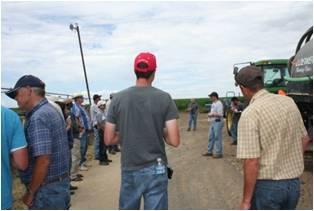
Teaching Best Management Practices (BMP) or introducing new agricultural waste management practices to livestock producers and farmers is a challenge. This poster describes a series of on-farm field days designed to deliver information and demonstrate on-site several waste management techniques, most of them well established in other parts of the country but sparsely used in Idaho. During these field days, Extension personnel presented each technique and offered written information on how to apply them. But without a doubt, presentations by the livestock producers and farmers who are already applying the techniques and hosted each field day at their farms was the main tool to spark interest and conversations with attendees.
Four field days were delivered in 2012 with more programmed for 2013. Demonstrated techniques reduce ammonia and odor emissions, increase nitrogen retention from manure, reduce run-off risks, and reduce emissions of greenhouse gases. Topics addressed on each field day were, a: Dairy manure collection and composting, 20 attendees. b: Dairy manure land application ten attendees. c: Grape vine prunings and dairy manure composting, 50 attendees. d: Mortality and offal on-farm composting, 40 attendees. In all cases farm owners and their managers presented and were available to answer attendees’ questions, sharing their experience, and opinions regarding the demonstrated practices. Many attendees expressed their interest and willingness to adopt some of the demonstrated practices. On-farm field days are an excellent tool to increase understanding and adoption of BMP and new technologies. Hearing experiences first hand from producers applying the techniques and being able to see them in action are excellent outreach tools. On-farm field days also fit the fast pace, busy schedule of modern producers who can later visit with Extension and other personnel if they need more details, information, and help on how to adopt the techniques they are interested in.
Why Hold Field Days on Ag Waste Management?
The dairy industry is the number one revenue commodity in Idaho. At the same time Idaho is ranked third in milk production in the nation. Idaho has more than 580,000 dairy cows distributed in 550 dairy operations (Idaho State Department of Agriculture 1/2013). The Magic Valley area in south-central Idaho hosts 54% of those dairies and 73% of all dairy cows in the state (Idaho Dairymen’s Association internal report, 2012). Odors from dairies and other animal feeding operations are a major issue in Idaho and across the country. In addition, the loss of ammonia from manures reduces the nutrient value of the manure and generates local and regional pollution. Dairy farmers of all sizes need more options on how to treat and dispose of the manure generated by their operations. Odor reductions, capture of nitrogen in dairy manure, reduction of greenhouse gases emissions, off-farm nutrients export, water quality protection, and reduction of their dairy operation’s environmental impact are some of the big challenges facing the dairy industry in Idaho and around the country. There are many Best Management Practices (BMP) that are proven to work on providing results related to the challenges mentioned before. Some of these practices are widely adopted in certain parts of the country or in other countries, with a lack of adoption by dairy producers and farmers in other parts of the country. This poster shows a series of Extension and research efforts designed to introduce and locally test proven BMP to dairy producers and crop farmers in southern Idaho in an effort to increase their adoption and incorporate those BMP as regular practices in Idaho agriculture. The four projects described were delivered in 2012 and some will continue in 2013.
What Did We Do?
To demonstrate and test BMP we chose to develop on-farm research projects to collect data and couple these projects with on-farm field days to demonstrate the applicability of the BMP in a real-world setting. Extension personnel developed the research and on-farm field days and did several presentations at each location. But without a doubt the stars during those field days were the dairy producers and farmers who hosted the research and demonstration events and who are already using or starting to use the techniques showcased. These pioneer producers are not only leading the way in using relatively new BMP in southern Idaho, they also share their experiences with other producers and with the academia so everybody around can learn from them. Topics addressed in each field day were, a: Dairy manure collection and composting, 20 attendees. b: Dairy manure land application, 10 attendees. c: Grapevine prunings and dairy manure composting, 50 attendees. d: Mortality and offal on-farm composting, 40 attendees.
On-farm manure collection and composting field day.
Some highlights from each project are: a. The dairy manure collection and composting field day demonstrated the operation and use of a vacuum manure collection system and a compost turner. Dairy managers and machinery operators shared their experiences, benefits and challenges related to the use of these two technologies. During the field day attendees also visited the whole manure management system of the dairy and were able to observe diverse manure management techniques. As a result of this project Extension personnel determined the necessity of generating educational programs for compost and manure management operators for dairy employees. A composting school in Spanish and English proposal was presented and a grant was obtained to develop and deliver them in 2013.
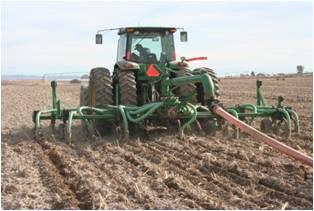
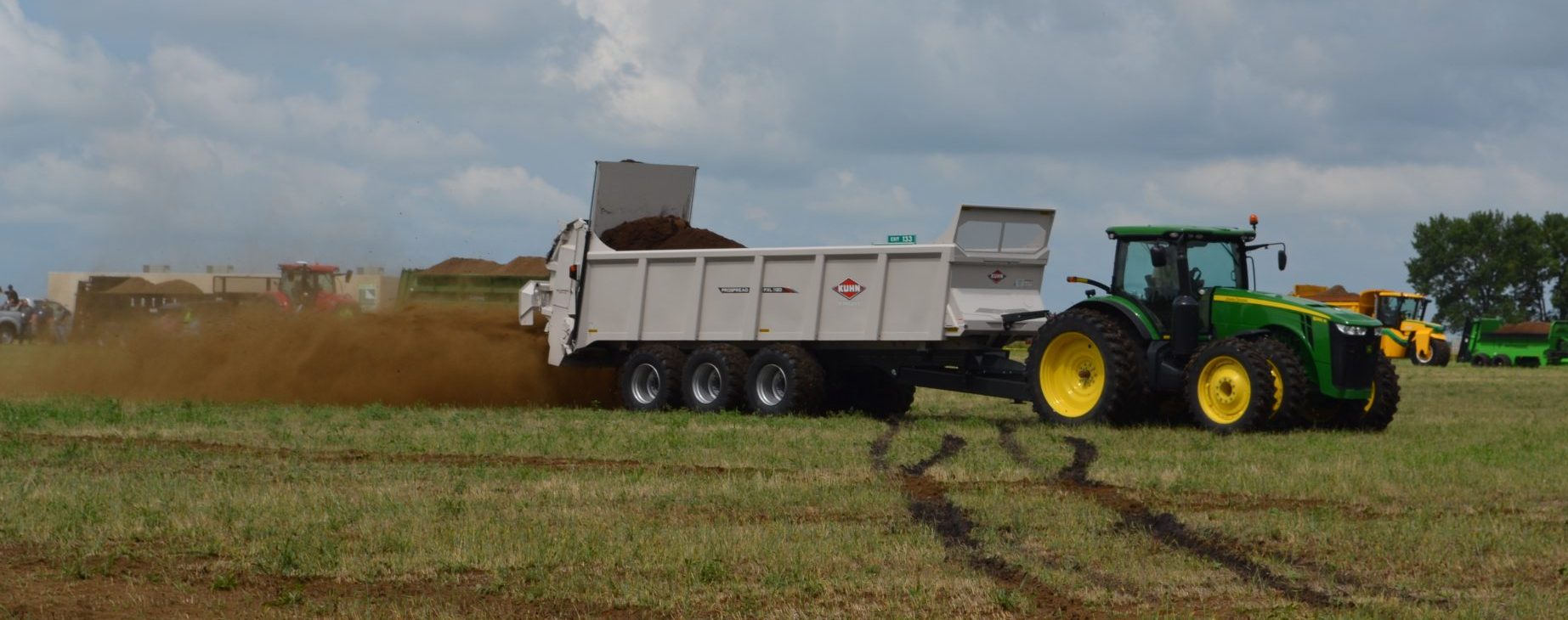
b. The dairy manure land application field day featured the demonstration of a floating manure storage pond mixer and pump, and a drag hose manure injection system. We also showed an injection tank that wasn’t operated during the demonstration. The floating pond mixer serves as lagoon mixer and pump. It mixes and pumps the manure through the drag hose system to the subsurface injector. This system dramatically reduces the time required to land apply liquid and slurried manures. It also significantly reduces ammonia and odor emissions to near background levels, as well as avoids runoff after applications. This project included research of emissions on the manure injection sites (see Chen L., et al. in this conference proceedings).
Demonstrating dairy manure subsurface injection using a drag hose system.
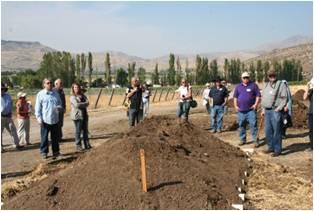
c. The grapevine prunings and dairy manure composting project involves research on the implications of increasing the carbon content of dairy manures using grapevine prunings and other carbon sources to retain more nitrogen in the compost, and how it varies among three diferent composting techniques. This project includes two field days, one during the project (2012), and another one at the end of it in 2013. The demonstration includes how to compost using mechanically turned windrows (common in Idaho), passive aerated, and forced aerated windrows (both very rarely used in Idaho). Another novelty in this project is that it aims to bring together dairy producers and fruit & crop producers, or landscaping insustry so they can combine their waste streams to produce a better compost and to reduce the environmental impact of each operation. Several producers of the diverse audience who attended showed interest in adopting some of the composting techniques presented during the field day.
d. The mortality and offal on-farm composting project was located at a diversified sheep farm that includes sheep and goat dairy and cheese plant, meat lambs, and chickens. A forced aerated composting box was used to compost lamb offal, hives, lamb and chicken mortalities, and whey from the cheese plant. A very diversified audience attended the field day and the composting system generated a lot of interest. The farm owner was so pleased with the system that she created a second composter with materials she had on-hand to increase her composting capabilities and compost all year round. The producer stopped disposing of lamb offal, hives, and mortalities at the local landfill.
What Have We Learned?
On-farm field days are a great tool to demonstrate and encourage the application of otherwise seldom applied techniques. They also can serve a dual purpose of demonstration and research, allowing for quality data collection if designed properly. Farmers’ collaboration and full participation during all phases of the project is paramount and pays off by having a very enthusiastic and collaborative partner. Identiying progressive and pioneer producers that are already applying new BMP or are willing to take the risk is very important to develop this kind of on-farm experience. In general these individuals are also willing to share their knowledge, experience, and results with others to increase the adoption of such techiques. Having a producer hosting and presenting during the field day, at their facilities (as opposed to a dedicated research facility) generates great enthusiasm from other producers and helps to “break the ice” and bring everybody to a friendly conversation and exchange of ideas if properly facilitated.
Future Plans
On both projects, a. manure collection and composting and b. manure injection we will generate a series of videos to demonstrate the proper application of BMP, and educational printed material will also be published. Project c. grape prunings and manure composting is still going on and we will finish collecting data by mid 2013. A second field day will be offered and videos and printed educational material will be developed. Project d. will see an expansion with a mortality composter for dairy calves being installed at a dairy, and with a field day following after the first compost batch is ready. Additional programs are in the works; these programs incorporate the on-farm demonstration and research dual purpose and have high participation from the involved producers.
Authors
Mario E. de Haro-Marti, Extension Educator, Gooding County Extension Office, University of Idaho Extension. mdeharo@uidaho.edu
Lide Chen, Waste Management Engineer
Howard Neibling, Extension Irrigation and Water Management Specialist
Mireille Chahine, Extension Dairy Specialist
Wilson Gray, District Extension Economist
Tony McCammon, Extension Educator
Ariel Agenbroad, Extension Educator
Sai Krishna Reddy Yadanaparthi, Graduate student
James Eells, Research Assistant. University of Idaho Extension.
Acknowledgements
Projects a. and b. were supported by a USDA-NRCS Conservation and Innovation Grant (CIG). Project c. was supported by a USDA-NRCS Idaho CIG. Project d. was supported by a University of Idaho USDA-SARE mini grant. We also want to thank Jennifer Miller at the Northwest Center for Alternatives to Pesticides for her help and support with projects c. and d. Finally, we want to thank all producers involved in these projects for their support and openess to work with us, and for their innovative spirit.
The authors are solely responsible for the content of these proceedings. The technical information does not necessarily reflect the official position of the sponsoring agencies or institutions represented by planning committee members, and inclusion and distribution herein does not constitute an endorsement of views expressed by the same. Printed materials included herein are not refereed publications. Citations should appear as follows. EXAMPLE: Authors. 2013. Title of presentation. Waste to Worth: Spreading Science and Solutions. Denver, CO. April 1-5, 2013. URL of this page. Accessed on: today’s date.
Ammonia emissions from cattle feedlots have been a topic for much debate regarding air quality and environmental impacts. With increasing concern about future regulation of the industry, understanding the fundamentals of ammonia emission and volatilization from feedlots has become crucial. Wu et al. 2003 described ammonia flux as demonstrating a strong environmental dependency on the ammonium concentration, pH, and the product of the acid dissociation and Henry constant. The objectives of this research are to address the production of ammonia via urea hydrolysis and quantify its release from the soil surface based on the Henry constant. This will be accomplished by studying the rate of urea hydrolysis in feedlots systems, as well as by looking at a new approach to measuring the Henry constant. Urea hydrolysis results will be discussed from a variety of feedlot soils at a fixed water content and urea concentration. Measuring the Henry constant includes measuring the gas phase ammonia above the solution and the ammonia present in the solution. The Henry constant values should provide insight as to how feedlot soil matrices deviate from less complex systems. The results of this work will allow for a better understanding of the fate of ammonia in feedlot systems from production to emission.
Jay M Ham, Colorado State University; Department of Soil and Crop Sciences, Thomas Borch, Colorado State University; Department of Soil and Crop Sciences and Department of Chemistry
The authors are solely responsible for the content of these proceedings. The technical information does not necessarily reflect the official position of the sponsoring agencies or institutions represented by planning committee members, and inclusion and distribution herein does not constitute an endorsement of views expressed by the same. Printed materials included herein are not refereed publications. Citations should appear as follows. EXAMPLE: Authors. 2013. Title of presentation. Waste to Worth: Spreading Science and Solutions. Denver, CO. April 1-5, 2013. URL of this page. Accessed on: today’s date.
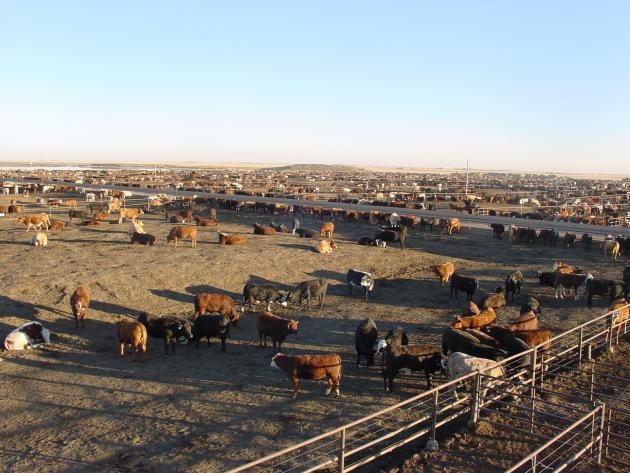
Ammonia volatilization is a major component of the nitrogen balance of a feedyard, and the effects of ammonia loss range from the economic (loss of manure fertilizer value) to the environmental (air quality degradation, overfertilization of ecosystems). Although not yet regulated, ammonia emissions from cattle are required to be reported under the Emergency Planning and Community Right to Know Act. Emission factors are used to estimate ammonia emissions for purposes of reporting and national inventories, but current emission factors are based on limited data. Our objective was to definitively quantify ammonia emissions and emission factors from commercial feedyards on the southern High Plains of Texas.
A typical feedyard on the High Plains of Texas. In the foreground, cattle in corrals with a stocking density of about 150 sq. ft./animal. In the background on the left, the runoff water retention pond, and center, a mound of stockpiled manure.
What Did We Do?
Ammonia emissions were quantified at three commercial feedyards in the Texas Panhandle from 2002 to 2008 using micrometeorological methods. Seasonal, intensive measurement campaigns were conducted from 2002 to 2005 at one feedyard, and ammonia emissions were near-continously monitored from 2007-2008 at two more feedyards. Meteorological and cattle management data were also collected.
What Have We Learned?
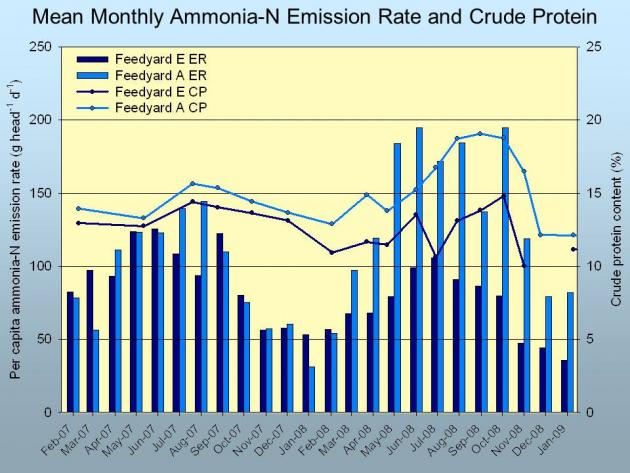
Ammonia emissions followed a distinct annual pattern. Emissions during summer were about twice those during winter, while spring and autumn emissions were intermediate. Annualized ammonia emissions ranged from 0.20 to 0.37 lb NH3/animal/day, and averaged 0.26 lb NH3/animal/day over all studies. Ammonia loss as a fraction of nitrogen fed to cattle averaged 41% during winter and 69% during summer; on an annual basis, 54% of fed nitrogen was lost as ammonia. Greatest emissions were observed when crude protein in cattle rations exceeded the nutrient requirements of beef cattle. Mean monthly ammonia emissions were strongly correlated with mean monthly temperature, and the relationship can be used to predict ammonia emissions from southern High Plains feedyards. Cattle feeders that meet recommended crude protein in rations can expect to lose half of fed N as ammonia. We recommend an annual emission factor of 88 lb/head for beef cattle feedyards based on one-time capacity, or 39 lb/head fed, based on a 150-d feeding period.
The annual pattern of ammonia emission rates (ER) followed seasonal temperatures, but also was sensitive to dietary crude protein (CP). Adding distillers grains to rations from March, 2008 to October, 2008 increased crude protein at Feedyard A to as high as 19%. Ammonia emissions greatly increased compared with the previous year and compared with Feedyard E.
Future Plans
Next steps involve using the extensive database from this research to adapt and refine process-based models of ammonia emissions. These models, based on the actual physical and chemical processes that control ammonia loss, will be more generally applicable than emission factors to a wider range of feedyards.
On an annual basis, ammonia emission averaged 0.26 lb per animal per day across the three feedyards and six years of study. Increased ammonia emission at Feedyard A in 2008 was due to high dietary crude protein when distillers grains were added to rations. Using these data and other estimates of ammonia loss from retention ponds and stockpiles, we recommend, for beef cattle fed a diet that meets protein requirements, an annual emission factor of 88 lb/head based on one-time capacity, or 39 lb/head fed, based on a 150-d feeding period.
Authors
Richard W. Todd, Research Soil Scientist, USDA-ARS Conservation and Production Research Laboratory, Bushland, Texas, richard.todd@ars.usda.gov
Richard W. Todd, Research Soil Scientist; N. Andy Cole, Research Leader and Research Animal Scientist (Nutrition); and Heidi M. Waldrip, Research Soil Scientist: USDA-ARS Conservation and Production Research Laboratory, Bushland, Texas.
Additional Information
Cole, N.A., R.N. Clark, R.W. Todd, C.R. Richardson, A. Gueye, L.W. Greene, and K. McBride. 2005. Influence of dietary crude protein concentration and source on potential ammonia emissions from beef cattle manure. J. Anim. Sci. 83:722 731.
Cole, N.A., A.M. Mason, R.W. Todd, M. Rhoades, and D.B. Parker. 2009. Chemical composition of pen surface layers of beef cattle feedayrds. Prof. Anim. Sci. 25:541-552.
Flesch, T.K., J.D. Wilson, L.A. Harper, R.W. Todd, and N.A. Cole. 2007. Determining ammonia emissions from a cattle feedlot with an inverse dispersion technique. Agric. For. Meteorol. 144:139-155.
Hristov, A. N., M. Hanigan, A. Cole, R. Todd, T. A. McAllister, P. M. Ndegwa, A. Rotz. 2011. Ammonia emissions from dairy farms and beef feedlots: A review. Can. J. Anim. Sci. 91:1-35.
Rhoades, M.B., D.B. Parker, N.A. Cole, R.W. Todd, E.A. Caraway, B.W. Auvermann, D.R. Topliff, and G.L. Schuster. 2010. Continuous ammonia emission measurements from a commercial beef feedyard in Texas. Trans. ASABE 53:1823-1831.
Sakirkin, S.L., N.A. Cole, R.W. Todd, and B.W. Auvermann. 2011. Ammonia emissions from cattle-feeding operations. Part 1: issues and emissions. Texas Agricultural Experiment Station Bulletin, Air Quality Education in Animal Agriculture, Issues: Ammonia, December, 2011. p. 1-11.
Sakirkin, S., R.W. Todd, N.A. Cole, and B.W. Avermann. 2011. Ammonia emissions from cattle-feeding operations. Part 2: abatement. Texas Agricultural Experiment Station Bulletin, Air Quality Education in Animal Agriculture, Issues: Abatement, December, 2011. p. 1-11.
Todd, R.W., N.A. Cole, and R.N. Clark. 2006. Reducing crude protein in beef cattle diet reduces ammonia emissions from artificial feedyard surfaces. J. Environ. Qual. 35:404-411.
Todd, R.W., N.A. Cole, M.B. Rhoades, D.B. Parker, and K.D. Casey. 2011. Daily, monthly, seasonal and annual ammonia emissions from southern High Plains cattle feedyards. J. Environ. Qual. 40:1-6.
Todd, R.W., N.A. Cole, H.M. Waldrip, and R.M. Aiken. 2013. Arrhenius equation for modeling feedyard ammonia emissions using temperature and diet crude protein. J. Environ. Qual. 2013. (accepted for publication).
Acknowledgements
Research was supported by CSREES Grant #TS2006-06009 under the direction of Dr. John Sweeten, Resident Director, Texas A&M University AgriLife Research and Extension Center, Amarillo, TX. Larry Fulton, Research Technician, USDA-ARS-CPRL, provided invaluable technical and logistical support and expertise.
The authors are solely responsible for the content of these proceedings. The technical information does not necessarily reflect the official position of the sponsoring agencies or institutions represented by planning committee members, and inclusion and distribution herein does not constitute an endorsement of views expressed by the same. Printed materials included herein are not refereed publications. Citations should appear as follows. EXAMPLE: Authors. 2013. Title of presentation. Waste to Worth: Spreading Science and Solutions. Denver, CO. April 1-5, 2013. URL of this page. Accessed on: today’s date.
Through the Air Quality Education in Animal Agriculture (AQEAA) project, Land-Grant University specialists from across the U.S. have been collaborating in delivering applied, research-based air quality information to those who work with livestock and poultry producers. The AQEAA project developed Air Quality content on the Animal Manure Management eXtension website in collaboration with the Livestock and Poultry Environmental Learning Center (LPELC). The Air Quality web content makes widely accessible the educational resources produced by this project for use in developing the knowledge base and skills of professionals who interact [and pre-professionals who plan to interact] with livestock and poultry producers. The online materials include 18 written publications, 3 videos, and 16 recorded webinars (webcasts). Also made accessible are selected research and technology summaries as well as online content produced by other organizations. The AQEAA project also developed the skills of professionals regarding air quality topics via professional development events. Website usage information, participant polls, and stakeholder surveys provided evidence that the resources developed by this project are being utilized and that delivery of the information via eXtension has been an effective means of communicating information on this topic. Webcasts were especially effective in communicating information and providing continuing professional development. AQEAA-sponsored workshops were effective in providing in-depth air quality information and experiences to more than 300 professionals. Collaboration with the LPELC facilitated having a ready eXtension outlet for project materials and is providing continued, sustainable access to online information from this project.
Jill M. Heemstra and Dennis D. Schulte, University of Nebraska, Lincoln, NE, Ronald E. Sheffield, Louisiana State University, Baton Rouge, LA, Eileen F. Wheeler, The Pennsylvania State University, University Park, PA, Kevin A. Janni, University of Minnesota, St. Paul, MN
The authors are solely responsible for the content of these proceedings. The technical information does not necessarily reflect the official position of the sponsoring agencies or institutions represented by planning committee members, and inclusion and distribution herein does not constitute an endorsement of views expressed by the same. Printed materials included herein are not refereed publications. Citations should appear as follows. EXAMPLE: Authors. 2013. Title of presentation. Waste to Worth: Spreading Science and Solutions. Denver, CO. April 1-5, 2013. URL of this page. Accessed on: today’s date.
Manage Cookie Consent
To provide the best experiences, we use technologies like cookies to store and/or access device information. Consenting to these technologies will allow us to process data such as browsing behavior or unique IDs on this site. Not consenting or withdrawing consent, may adversely affect certain features and functions.
Functional
Always active
The technical storage or access is strictly necessary for the legitimate purpose of enabling the use of a specific service explicitly requested by the subscriber or user, or for the sole purpose of carrying out the transmission of a communication over an electronic communications network.
Preferences
The technical storage or access is necessary for the legitimate purpose of storing preferences that are not requested by the subscriber or user.
Statistics
The technical storage or access that is used exclusively for statistical purposes.The technical storage or access that is used exclusively for anonymous statistical purposes. Without a subpoena, voluntary compliance on the part of your Internet Service Provider, or additional records from a third party, information stored or retrieved for this purpose alone cannot usually be used to identify you.
Marketing
The technical storage or access is required to create user profiles to send advertising, or to track the user on a website or across several websites for similar marketing purposes.


 Author