Simultaneous Treatment of Odor, Volatile Organic Compounds, Hydrogen Sulfide, Ammonia, and Pathogens With Ultraviolet Light

Printer friendly version of this summary.

Is It Feasible to Treat or Reduce Several Air Emissions from Pig Barns at Once?

The simultaneous treatment of odors, gases, airborne pathogens using novel ultraviolet (UV) treatment project addresses a critical need of the control of odor and pathogens generated in commercial swine production. The same technology could potentially be used for other species (e.g., poultry) that are housed in mechanically-ventilated barns. This study will test the potential for using currently available technology for the simultaneous degradation of most offensive odorants, ammonia (NH3), and model pathogens (SIV, BVDV). Such UV light-based technology is suitable for application for ventilation air and could be applied to exhaust air (to treat emissions) and inlet air (to prevent the spread of infectious diseases) for new and existing operations.

The long-term goal is to develop a cost-effective technology for the simultaneous treatment of odor and pathogens in swine and possibly poultry housing in order to limit their impact on air quality and health (both human and animal).

Activities

A standard gas/odor system for generating and measuring gases is being used for lab-scale experiments. The system generates 13 odorous gases including hydrogen sulfide (H2S), mercaptans, volatile fatty acids (VFAs), and phenolic compounds responsible for swine odor. NH3 gas and its removal is included. Odor measurement with a standard ASTM method are conducted by the Olfactometry Lab.

Did UV Light Reduce Pathogens and Odorants?

We measured the effectiveness of odor treatment and pathogen inactivation in laboratory scale. Almost 100% removal was achieved for all the compounds tested except H2S and dimethylsulfide using only 1 sec irradiation. Removals of H2S and dimethylsulfide are also significant. Longer UV irradiation times resulted in complete percent reduction of target compounds and odor. Of specific interest is very efficient removal of p-cresol which has been recognized as priority odorant responsible for the characteristic livestock odor. Treatment cost of $0.25 per pig and continuous operation during growing cycle was estimated when the lab-scale results were extrapolated to typical ventilation rates and electricity cost at a swine finish operation in rural Iowa.

Why is This Important?

Comprehensive solutions to swine aerial emissions are expected to be even more urgent in the future. Thus, the proposed study addresses several critically important issues confronting pork and poultry producers, but also has a broader applicability to homeland security, human/animal health, indoor air quality and hazardous waste treatment.

For More Information

Authors: Jacek Koziel, Jeff Zimmerman, Steven Hoff, Hans van Leeuwen, William Jenks, Iowa State University

Read the following articles or visit the Iowa State University odor research website.

Yang, X., Koziel, J.A., Cai L., Hoff, S. et al. Novel treatment of VOCs and odor using photolysis. ASABE Annual International Meeting, 2007, Minneapolis, MN, paper No. 074139.

Koziel, J.A., X. Yang, T. Cutler, S. Zhang, J. Zimmerman, S. J. Hoff, W. Jenks, Y. Laor, U. Ravid, R. Armon, J.H. van Leeuwen. 2008. Mitigation of odor and pathogens from CAFAs with UV/TiO2: exploring cost effectiveness. In the proceedings of the Mitigating Air Emissions From Animal Feeding Operations Conference. Des Moines, May, 2008.

This report was prepared for the 2008 annual meeting of the regional research committee, S-1032 “Animal Manure and Waste Utilization, Treatment and Nuisance Avoidance for a Sustainable Agriculture”. This report is not peer-reviewed and the author has sole responsibility for the content.
Siting Swine Facilities Using Iowa State’s Community Assessment Model

Printer friendly version of this summary.

Does It Make a Difference If a New Pig Barn is Built In an Area With Existing Barns?

A model, called the Community Assessment Model for Odor Dispersion (CAM), was developed to predict receptor odor exposure from multiple swine production sources. The intended use of CAM was to provide a tool for evaluating the odor exposure to receptors in a community when siting new swine production systems and how a change in odor control technology alters the odor exposure to receptors.

CAM can handle up to 20 swine production sources with up to 100 receptors in a community of any size. CAM predicts the number of hours of exposure to weak (2:1) and greater or identifiable (7:1) and greater odors and these are used to assess siting options.

Activities

CAM has been used in the state of Iowa for over 150 specific cases since June, 2005. The implementation of CAM has been a voluntary process, initiated by the farmer and implemented through a joint effort between the Coalition to Support Iowa’s Farmers (CSIF), the Iowa Pork Industry Center (IPIC), and faculty with Iowa State University’s College of Agriculture and Life Sciences. The use of CAM requires on on-site visit to assess and map community receptors and existing animal-related odor sources.

The mapped data is then brought to the Department of Agricultural and Biosystems Engineering where one of two faculty members implement CAM. A one-page report is generated and this report is given to the farmer, through a follow-up on-site visit with an IPIC staff member. At the conclusion of a CAM modeling run, a staff member from IPIC conducts a follow-up site visit with the farmer to explain results of CAM predictions. The estimated total expense (currently free to the farmer) to implement CAM is $1,000 per siting case.

What We Have Learned

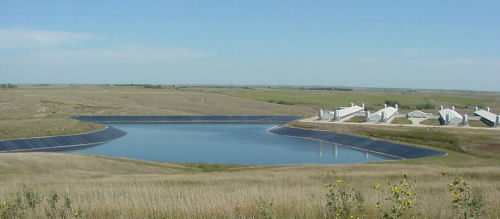
Modeling odor dispersion by itself is a relatively straight-forward procedure. The difficulty arises when a modeling procedure is to be used by farmers and community planners to guide facility siting choices. Any modeling procedure developed must be based on an accepted modeling platform, must incorporate site parameters that can be applied equitably to a wide range of field conditions, must have the ability to easily handle multiple sources and multiple receptors, and must predict odor concentration that is conservative for the receptor without being overly restrictive for the farmer. Any odor dispersion model that incorporates these considerations and shows good agreement with field collected odor data could be considered for siting purposes.barns and manure storage pond

Why is This Important?

Having the ability to fairly and accurately determine the adequacy of a proposed siting choice is imperative for the future expansion of animal agriculture.

For More Information

Authors: Steven Hoff, hoffer@iastate.edu or (515) 294-6180, Jay Harmon and Colin Johnson, Iowa State University

  • Hoff, S. J. and D. S. Bundy. 2003. Modeling odor dispersion from multiple sources to multiple receptors. In: Proceedings of the International Symposium on Gaseous and Odour Emissions from Animal Production Facilities. Norsens, Denmark. June 1-4, 2003. pp 331-339.
  • Hoff, S. J., D. S. Bundy, and J.D. Harmon. 2008. Modeling receptor odor exposure from swine production sources. Applied Engineering in Agriculture (in-review).
  • Photo CC 2.5 Rick Koelsch

This report was prepared for the 2008 annual meeting of the regional research committee, S-1032 “Animal Manure and Waste Utilization, Treatment and Nuisance Avoidance for a Sustainable Agriculture”. This report is not peer-reviewed and the author has sole responsibility for the content.

Clearing the Air on Biofilters

Biofilters have been widely adopted to filter gas, odor and particulate matter from livestock facilities. However, the science behind “how they work” and the configurations that are in practice are continually evolving. This webinar discusses past and present applications of biofilters, on-going research to better design and manage biofilters, and how to incorporate biofilters as part of an environment control system.This webcast was originally broadcast on December 7, 2012. More… Continue reading “Clearing the Air on Biofilters”

Life-Cycle Assessment Modeling for the Pork Industry

green stylized pig logoDo the pork industry’s efforts to improve production and economics affect its greenhouse gas emissions and carbon foot print? Research by the University of Arkansas combined with efforts led by the National Pork Board indicates that increased production efficiencies have reduced the carbon footprint of each pound of pork produced.

Following up on the June 15th, 2012 webcast, this webinar presents an overview of a research and extension project wherein the existing research-based carbon footprint model is refined and expanded. The project goal is to improve this model’s ability to serve as a farm-level educational and decision aid tool that incorporates environmental, production, and economic concerns. The webcast also highlights feed management concepts and ongoing research, which are major components of the project. This webcast was originally broadcast on July 20, 2012. More… Continue reading “Life-Cycle Assessment Modeling for the Pork Industry”

Producer Association Efforts to Address Carbon Footprints: Pork and Poultry

green stylized pig logoHave you wondered how food animal producer groups have responded to the attention given to their industries as sources of greenhouse gas emissions? Wonder no longer. Since 2008, the National Pork Board has been working on a specific plan to assess and better understand the pork industry’s carbon footprint. This webinar introduces you to this project and shows highlighted current results of this research, including description of tools designed for producers to begin to assess greenhouse gas emissions and manage resource efficiency in sow and grow-finish production. This webcast was originally broadcast on June 15, 2012. More… Continue reading “Producer Association Efforts to Address Carbon Footprints: Pork and Poultry”

National Air Emissions Monitoring Study (NAEMS) Selected Results and Discussion of Their Significance

This webcast highlights the findings of the National Air Emissions Monitoring Study (NAEMS). The purpose of the NAEMS was to measure emissions of regulated gases from representative livestock and poultry facilities across the U.S. and improve the state of knowledge of agricultural air emissions, especially in the context of prospective regulation of those emissions. This webcast was originally broadcast on September 16, 2011. More… Continue reading “National Air Emissions Monitoring Study (NAEMS) Selected Results and Discussion of Their Significance”