Environmental Impacts of Dairy Production Systems in the Changing Climate of the Northeast

To meet the nutritional needs of a growing population, dairy producers must increase milk production while minimizing farm environmental impacts. As we look to the future, management practices must also be adapted to maintain production under projected climate change. To plan for the future, better information is needed on practices that can reduce emissions from the farm and adapt to changes in the climate while maintaining or improving production and profitability.

What did we do?

We conducted a comprehensive assessment of the effects of climate change on both the productivity and environmental performance of farms as influenced by strategies to reduce emissions and adapt to the changing climate. Production systems were evaluated using three representative northeastern dairy farms: a 1500-cow farm in New York, a 150-cow farm in Wisconsin and a 50-cow farm in southern Pennsylvania. A cradle-to-farm gate life cycle assessment was conducted using farm-scale process-based modeling and climate projections for high and low emission scenarios. Environmental considerations included the carbon footprint of the milk produced and reactive N and P losses from the farms.

What we have learned?

We found that the environmental impact of the three representative dairy farms generally increased in the near future (2050) climate if no mitigation measures were taken. Overall, feed production was maintained as decreases in corn grain yield were compensated by increases in forage yields. Adaptation of the cropping system through changes in planting and harvest dates and corn variety led to a smaller reduction in corn grain yield, but the detrimental effects of climate change could not be fully negated. Considering the increased forage yield, total feed production increased except for the most severe projected climate change. Adoption of farm-specific beneficial management practices substantially reduced the greenhouse gas emissions and nutrient losses of the farms in current climate conditions and stabilized the environmental impact in future climate conditions, while maintaining feed and milk production (See Figure 1 for example results).
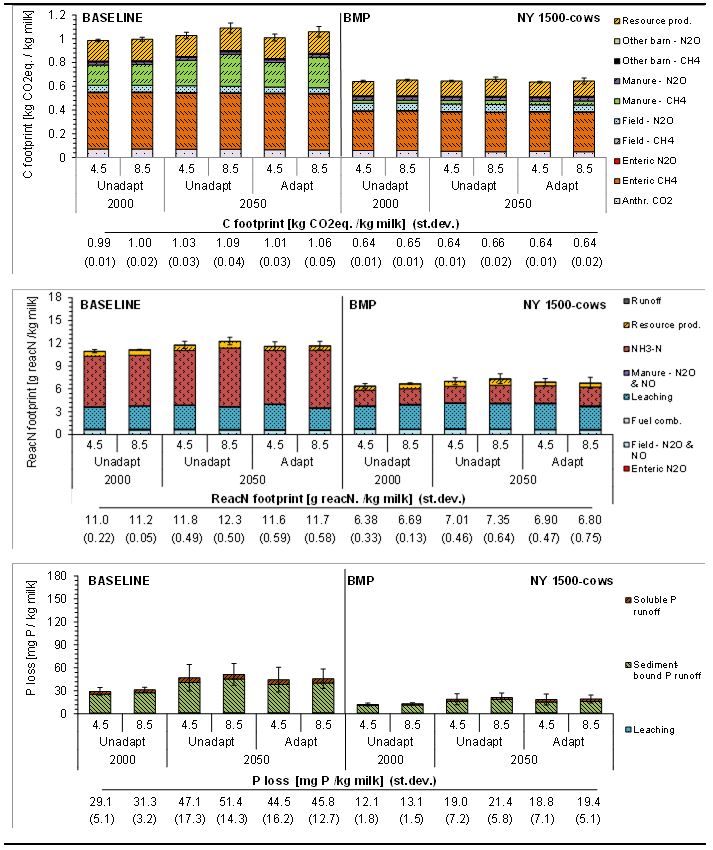
Figure 1. Carbon footprint, reactive nitrogen footprint and P loss in recent (2000) and future (2050) climate conditions (RCP4.5 and RCP8.5) for a 1500-cow farm in New York with baseline and Best Management Practice (BMP) scenarios, with and without crop system adaptions in 2050. Error bars represent the standard deviation of IFSM simulations for 3 climate scenarios per RCP. Unadapt = not adapted cropping system. Adapt = adapted cropping system.

The take-home message is that with appropriate management changes, our dairy farms can become more sustainable under current climate and better prepared to adapt to future climate variability.

Future plans

A more comprehensive life cycle assessment is being done by linking the output of the farm model with life cycle assessment software. The process level simulation of the farm provides inventory information for an inclusive life cycle assessment with multiple environmental considerations. This integrated software will provide a more complete sustainability assessment of the potential benefits of alternative management strategies for both now and the future.

Authors

Karin Veltman, University of Michigan; C. Alan Rotz, USDA-ARS; Larry Chase, Cornell University; Joyce Cooper, Washington State University; Chris Forest, Penn State University; Pete Ingraham, Applied GeoSolutions; R. César Izaurralde, University of Maryland; Curtis D. Jones, University of Maryland; Robert Nicholas, Penn State University; Matt Ruark, University of Wisconsin; William Salas, Applied GeoSolutions; Greg Thoma, University of Arkansas; Olivier Jolliet, University of Michigan.

Additional information

Information on the Integrated Farm System Model is available in the reference manual:

Rotz, C., Corson, M., Chianese, D., Montes, F., Hafner, S., Bonifacio, H., Coiner, C., 2018. The Integrated Farm System Model, Reference Manual Version 4.4. Agricultural Research Service, USDA. Available at: https://www.ars.usda.gov/northeast-area/up-pa/pswmru/docs/integrated-farm-system-model/#Reference.

Information on the analysis of Best Management Practices on northeastern dairy farms is available in:

Veltman, K., C. A. Rotz, L. Chase, J. Cooper, P. Ingraham, R. C. Izaurralde, C. D. Jones, R. Gaillard, R. A. Larsson, M. Ruark, W. Salas, G. Thoma, and O. Jolliet. 2017. A quantitative assessment of beneficial management practices to reduce carbon and reactive nitrogen footprints and phosphorus losses of dairy farms in the Great Lakes region of the United States. Agric. Systems 166:10-25.

Acknowledgements

This work was supported by the National Institute of Food and Agriculture, U.S. Department of Agriculture, under award number 2013-68002-20525. Any opinions, findings, conclusions, or recommendations expressed in this publication are those of the authors and do not necessarily reflect the view of the U.S. Department of Agriculture. USDA is an equal opportunity provider and employer.

The authors are solely responsible for the content of these proceedings. The technical information does not necessarily reflect the official position of the sponsoring agencies or institutions represented by planning committee members, and inclusion and distribution herein does not constitute an endorsement of views expressed by the same. Printed materials included herein are not refereed publications. Citations should appear as follows. EXAMPLE: Authors. 2019. Title of presentation. Waste to Worth. Minneapolis, MN. April 22-26, 2019. URL of this page. Accessed on: today’s date.
Talking Climate with Animal Agriculture Advisers


Proceedings Home | W2W Home w2w17 logo

Purpose             

The Animal Agriculture in a Changing Climate (AACC) project was established to leverage limited Extension expertise across the country in climate change mitigation and adaptation, with the goal of building capacity among Extension professionals and other livestock advisers to address climate change issues.

What did we do? 

The Animal Agriculture in a Changing Climate project team created a suite of educational programs and products to build capacity across the United States. Key products of the project:

  • Online courses: 363 participants registered with a 35% completion rate (Whitefield et al., JOE, 2016)
  • National and regional symposia and workshops: 11 face-to-face conferences with approximately 1,350 attendees.
  • Website: Over 5,900 users with over 21,100 total views. Project videos have received nearly 8,900 views.
  • Social media: AACC weekly blog (990 subscribers); daily Southeast Climate Blog (38,506 site visits); regional newsletters (627 subscribers); Facebook & Twitter (280 followers)
  • Ready-to-use videos, slide sets, and fact sheets
  • Educational programming: 390 presentations at local, regional, and international meetings
  • Collaboration with 14 related research and education projects

What have we learned? 

A survey was sent out to participants in any of the project efforts, in the third year of the project and again in year five. Overall, participants found the project resources valuable, particularly the project website, the online course, and regional meetings. We surveyed two key measures: abilities and motivations. Overall, 60% or more of respondents report being able or very able to address all eight capabilities after their participation in the AACC program. A sizeable increase in respondent motivation (motivated or very motivated) existed after participation in the program, particularly for helping producers take steps to address climate change, informing others about greenhouse gases emitted by agriculture, answering client questions, and adding new information to programs or curriculum.

The first challenge in building capacity in Extension professionals was finding key communication methods to engage them. Two key strategies identified were to: 1) start programming with a discussion of historical trends and agricultural impacts, as locally relevant as available, and 2) start the discussion around adaptation rather than mitigation. Seeing the changes that are already apparent in the climatic record and how agriculture has adapted in the past and is adapting to more recent weather variability and climatic changes often were excellent discussion starters.

Another challenge was that many were comfortable with the science, but were unsure how to effectively communicate that science with the sometimes controversial discussions that surround climate change. This prompted us to include climate science communication in most of the professional development opportunities, which were then consistently rated as one of the most valuable topics.

Future Plans    

The project funding ended on March 31, 2017. All project materials will continue to be available on the LPELC webpage.

Corresponding author, title, and affiliation        

Crystal Powers, Extension Engineer, University of Nebraska – Lincoln

Corresponding author email    

cpowers2@unl.edu

Other authors   

Rick Stowell, University of Nebraska – Lincoln

Additional information

lpelc.org/animal-agriculture-and-climate-change

Acknowledgements

Thank you to the project team:

Rick Stowell, Crystal Powers, and Jill Heemstra, University of Nebraska – Lincoln

Mark Risse, Pam Knox, and Gary Hawkins, University of Georgia

Larry Jacobson and David Schmidt, University of Minnesota

Saqib Mukhtar, University of Florida

David Smith, Texas A&M University

Joe Harrison and Liz Whitefield, Washington State University

Curt Gooch and Jennifer Pronto, Cornell University

This project was supported by Agricultural and Food Research Initiative Competitive Grant No. 2011-67003-30206 from the USDA National Institute of Food and Agriculture.


The authors are solely responsible for the content of these proceedings. The technical information does not necessarily reflect the official position of the sponsoring agencies or institutions represented by planning committee members, and inclusion and distribution herein does not constitute an endorsement of views expressed by the same. Printed materials included herein are not refereed publications. Citations should appear as follows. EXAMPLE: Authors. 2017. Title of presentation. Waste to Worth: Spreading Science and Solutions. Cary, NC. April 18-21, 2017. URL of this page. Accessed on: today’s date.
Do We Know the Carbon Footprint of the Pork Industry?

green stylized pig logoA carbon footprint is a total of all the greenhouse gas emissions (GHG) from a process or industry. A life cycle assessment (LCA) is the process used to figure out what GHG emissions will be included in the footprint. More technically, it is systematic way of looking at a product’s complete life cycle and calculating a “footprint”.  In addition to carbon footprints, there are efforts to calculate land, water, and other environmental footprints.

Below are highlights from several different reports that looked at the carbon footprint of the pork industry on a national and international scale. A comparison between different ways to raise pigs was also highlighted.

Snapshot of the Present Time

On a national scale, a report on the National Life Cycle Carbon Footprint Study for Production of Swine in the U.S. was conducted and published in 2011.

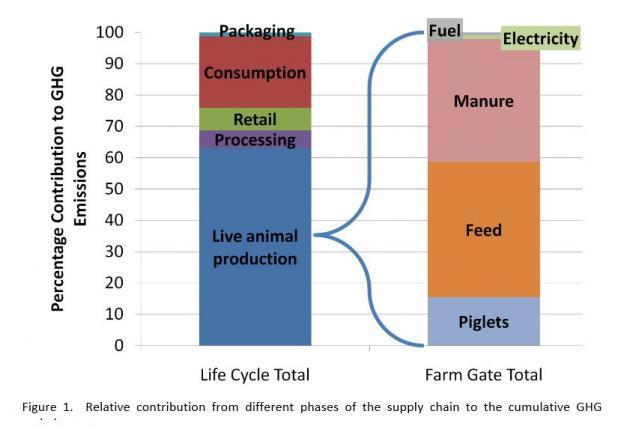
The report concluded that the carbon footprint to prepare and consume a 4 oz serving of pork was ~2.5 lbs of carbon dioxide equivalents. Figure 1 (below) from that report shows the relative breakdown of the industry’s estimated greenhouse gas emissions:

  • Live animal production made up 62.1% of the emissions. That is further broken down and presented in second column (right).
  • Processing – 5.6%
  • Retail – 7.54%
  • Consumption – 23.5% including refrigeration, cooking, and methane from food waste in landfill
  • Packaging (1.3%);

Life cycle assessment of pork production in the U.S.

Comparison Over 50 Years of Production

Another example of an industry-wide analysis, this one comparing over time, is a “50-year comparison of the carbon footprint of the U.S. swine herd 1959 – 2009” (29 pp; PDF). The pork industry overall emits more total greenhouse gases than 50 years ago, but actually emits much less per pound of pork produced because of improvements in efficiency.

From that publication:

The U.S. swine industry produces pigs far more efficiently today (2009) than in 1959. The number of hogs marketed has increased 29% (87.6 million in 1959 to 112.6 million in 2009 after removing market hogs imported directly to harvest) from a breeding herd that is 39% smaller. The efficiency gain is even more impressive when measured against the total dressed carcass weight harvested. Dressed carcass yield leaving the farm has nearly doubled in 50 years from 12.1 billion pounds to 22.8 billion pounds. This increase in productivity has resulted in an increase of 2,231 pounds (2.5x) of carcass harvested annually per sow – year. Today, it takes only five hogs (breeding and market) to produce the same amount of pork that  required eight hogs in 1959.

Comparing Different Ways of Raising Pigs

An example of an LCA that looks at different types of systems is “Life-cycle assessment of commodity and niche swine operations“. (informal Q&A and journal article both available). From the journal article (bottom of page 5):

High-profitability operations have consistently lower impacts compared to low-profitability operations for both commodity and deep-bedded niche piglet production.

Global Assessment from Backyard to Industrial Systems

On an international scale, the report “Greenhouse gas emissions from pig and chicken supply chains” was published in 2013. This study looked at all scales of farms from backyard pigs to industrial production (large confinement operations). Over the entire scale, they estimated that the carbon footprint of pork for every kg (~2.2 lbs) of pig carcass weight has an emissions intensity of 6.1 kg of carbon dioxide equivalent.

This report found that backyard systems, especially in some parts of the world, have low emissions, largely due to by-product or “second-grade” feeds. Industrial pig systems tended to have more emissions intensity than backyard systems, with the emissions from liquid/slurry manure management systems being a big reason. From the conclusion of the report:

When drawing any conclusions about scope for improvement, the following points should be borne in mind: (a)differences in emission intensity may reflect differences in production systems that have arisen over time to enable the system to perform better within a given context, e.g. to make them more profitable, or resilient; (b) focusing on a single measure of efficiency (in this case GHG emissions per kg of output) can lead to positive and negative side effects on, for instance, biodiversity, water quality and animal welfare; (c) reducing GHG emissions is not the only objective producers need to satisfy, as they also need to respond to changing economic and physical conditions.

How Do Carbon Footprints Compare?

It is very important to note that when looking at data and numbers generated from different reports like these, the carbon footprints are difficult to compare unless they use the same LCA. Presenting carbon footprints from different LCA’s is an “apples to oranges” comparison. Only when the same LCA is used, can they be an “apples to apples” comparison.

Additional Information

Acknowledgements

Authors: Amy Carroll, University of Arkansas and Jill Heemstra, University of Nebraska jheemstra@unl.edu

This information is part of the program “Integrated Resource Management Tool to Mitigate the Carbon Footprint of Swine Produced In the U.S.,” and is supported by Agriculture and Food Research Initiative Competitive Grant no. 2011-68002-30208 from the USDA National Institute of Food and Agriculture. Project website.

Exploring Interactions Betwen Agricultural Decisions and Greenhouse Gas Emissions Using Swine Production

green stylized pig logoThe materials on this page are an interactive lab designed to introduce students (high school level) to pig farming and the connections between management decisions  and the greenhouse gas emissions. It also includes information on the economic implications of those decisions. Background information and activities are provided in a graphical (visual) format. Part one can be a stand-alone activity or prepare students for part two.

You can download each of the files individually using the links below or download the entire lab (134 pages – PDF format). The information contains references to Arkansas agriculture and swine production in some areas, but the information is still applicable in other states.

What do you know about swine and greenhouse gases?

This one page (PDF format) fact sheet (including a fun short quiz) can be utilized as part of this lab or as a stand-alone handout to stimulate discussion. Download factsheet

Part One Activity  – The Basics

This section includes five files that introduce the basic concepts of greenhouse gases, swine production systems, and glossary of swine production terms. This activity utilizes both text and graphical presentation of concepts and emphasizes information comprehension. Download Part One

  • Resource information – lesson plan and background information. This includes three aspects of swine management systems including feed management, housing management, and manure management.
  • Farm management system graphics – a visual aid to depict how each individual practice/component contributes to the building of a given pig farm system.
  • Farm flashcards – brief description and graphical rendering of various swine farm components
  • Lab report form – several structured questions designed to
  • Farm management option guide (FMOG)*

*The FMOG also doubles as a scenario key for the completion of Part 2.

Part Two Activity – Challenging

This section provides more in-depth information on swine production systems and greenhouse gases. It provides insight into management obstacles faced by pig farmers in balancing carbon footprints, available resources, producer goals, and legal compliance. This critical-thinking activity is meant to be completed in small groups. Download Part Two

  • Resource information – lesson plan and background information.
  • Farm management option guide FMOG
  • Three scenarios – each covers manure, feed, and housing
  • Flashcards – including health and feed, housing, manure

Acknowledgements

Authors: Rick Fields and Karl Vandevender, University of Arkansas. For questions about these materials, contact Rick at rfields@uaex.edu

This information is part of the program “Integrated Resource Management Tool to Mitigate the Carbon Footprint of Swine Produced In the U.S.,” and is supported by Agriculture and Food Research Initiative Competitive Grant no. 2011-68002-30208 from the USDA National Institute of Food and Agriculture. Project website.

Navigating Agriculture through the Water-Energy-Food Symposium

The Navigating Agriculture through the Water-Energy-Food Symposium was held in Austin, TX on November 19, 2015. The symposium was organized by David Smith (dwsmith@tamu.edu).

The videos listed below are in the same order as they appear in the embedded playlist to the right. The direct link to each video is provided if you wish to go directly to a presentation.

Opening Remarks

There is a lot that cannot be predicted, but we need to plan nonetheless. Government’s role is to be in the background and ensure that social justice needs are met. https://youtu.be/iT27yd37bIo

Texas State Rep. Tracy O. King, District 80, Chairman—House Agriculture and Livestock Committee, Member—Natural Resources Committee

Water-energy-food nexus—applications for agriculture communities

The Nexus Platform Tool allows users to examine the water gap in Texas. Planners are looking at different scenarios in order to anticipate bottlenecks and needs and prepare to meet those challenges or take advantage of opportunities. https://youtu.be/0N38ooLKJsA

Dr. Rabi Mohtar, Texas Engineering Experiment Station Endowed Professor, Texas A&M University; Founding Director of Qatar Environment and Energy Research Institute

Water supply & demand – trends and challenges for the Southwest

This presentation examined the Ogallala Aquifer (which is 40% of all water use in Texas) and the anticipated strategies to meet needs of different users such as agriculture and municipalities. https://www.youtube.com/watch?v=CphzrKOX6UE

Dr. Robert Mace, Deputy Executive Director, Texas Water Development Board

Value of water to agricultural communities

In addition to the Ogallala Aquifer, there are two deeper ones including Edwards-Trinity and Dockum (Santa-Rosa). All are part of the High Plains Water District, an organization that has undergone extensive planning and outreach efforts. They have developed a tool to look at each permitted well in the district and its characteristics. The presenter also discussed the groundwater rights of land owners and the “water-neutral” business model adopted by some and the potential for this to attract new business in water-limited areas. https://youtu.be/DHtR-d_AUoA

Jason Coleman, P.E. General Manager, High Plains Water District

The shale boom—Impacts for agriculture production and producers

The nature of the oil business is often that there are “booms” in local areas when reserves are discovered or when prices make a particular resource worth developing. This presentation discusses some of the activity in the U.S. and especially Texas and how the industry has evolved technologically. The need for long-term planning to leverage these resources into long-standing infrastructure and development for community is also highlighted. https://youtu.be/HZibOjAfGb4

Dr. Thomas Tunstall, Research Director, The University of Texas at San Antonio, Institute for Economic Development

The future of renewable energy and agriculture

This presentation discusses the overall energy needs of the U.S.and creative ways that energy needs can be evened out at grid-scale decision levels that involve very local (domestic water heater or electric car) ways to “store” excess energy and use it when needed. These types of decisions could reduce the needs for new power plant construction or need to bring a plant online for short periods of time for peak demand. As agriculture on on the “edges” of the grid, it could be part of the areas where change is likely to happen first. https://youtu.be/6QrXKOLmEZ8

Dr. Wendell Porter, P.E., Lecturer, Agricultural & Biological Engineering Department, University of Florida

Global market impacts and implications for local farms and ranches

What is the world view of agriculture and markets? Policy, exports, population growth (demand), currency values, and the potential impacts on U.S. agriculture and on Texas are presented. https://youtu.be/QQnYpIdpRls

Dr. James W. Richardson, Regents Professor & AgriLife Research Senior Faculty Fellow, Co-Director Agriculture & Food Policy Center, Department of Agricultural Economics, Texas A&M University

Innovation and technology applications for agriculture production

What is the role of technology in food production? This presentation looks at sensors, autonomous vehicles, data communication and analysis, and innovative practices that protect natural resources. https://youtu.be/4r40cMU9IGQ

Dr. Reza Ehsani, Associate Professor of Agricultural & Biological Engineering, University of Florida, Citrus Research & Education Center

Turning climate change into opportunities for agricultural producers

Climate change and the accompanying changes in weather are fairly important to agricultural producers. This presentation discusses the improvements in predicting changes in weather and climate and how it can be used in planning for different scenarios in agricultural production. https://youtu.be/5oVaZdzcS18

Dr. John Nielsen-Gammon, Regents Professor of Atmospheric Sciences, Texas A&M University, Texas State Climatologist

The rapidly evolving legal and regulatory framework for agriculture producers

This presentation breaks down the land resources available and discusses water policy that can or will affect agriculture. Topics include “Waters of the U.S.” (surface water), ground water and surface water resources, and the tension between private land ownership and the need to regulate usage of water (especially ground water). There are also differences (and sometimes contradictions) between local and state or federal rules. https://youtu.be/N7tRiC702Mw

Jim Bradbury, Attorney, James D. Bradbury, PLLC, Austin & Fort Worth, Texas

Educating tomorrow’s nexus thinkers

How do we reach young people on their own terms (especially as digital ‘natives’) to pass on the important knowledge and context they will need to advance science, policy and education? This generation is increasingly urban, worldly, socially conscious, and disconnected from direct food production. How do we especially highlight the connections of food, water, and energy? https://youtu.be/_Pumw9uRDTI

Dr. Christopher T. Boleman, Assistant Director and State Leader for 4-H Youth Development, Texas A&M AgriLife Extension Service, College Station, Texas

Acknowledgments

The symposium was part of the Animal Agriculture in a Changing Climate project that was funded by USDA NIFA under award # 2011-67003-30206 For more on the project and to discover resources for educators and professionals in addition to these videos, visit http://lpelc.org/animal-ag-climate-change/

Greenhouse Gases and Agriculture (Self Study Lesson)

This is a self-guided learning lesson about greenhouse gases (GHG) and their connections to livestock and poultry production. It is useful for self-study and for professionals wishing to submit continuing education credits to a certifying organization. Anticipated time: 60 minutes. At the bottom of the page is a quiz that can be submitted and a score of 7 out of 10 or better will earn a certificate of completion. (Teachers/educators: visit the accompanying GHG curriculum materials page)

Module Topics

  1. Why does climate change?
  2. How does US agriculture to compare to other industries and worldwide agriculture?
  3. What greenhouse gases (GHG) are emitted by livestock and poultry farms?
  4. What are mitigation and adaptation strategies

What is Climate Change?

Download and read “Why Does Climate Change?” (PDF; 8 pages). Includes basics and terminology about natural and man-made drivers of climate change.

US Agriculture Comparisons to Other Industries and Worldwide Agriculture

Watch this short video “Agriculture and Greenhouse Gases: Some Perspective” (5 minutes). This also includes some very good reasons why farmers, ranchers, and ag professionals should care about the topic of climate change, regardless of political stances on solutions.

Greenhouse Gases Emitted by Livestock, Poultry. and Other Agricultural Activities

Watch this short video discussing the most important gases produced through livestock, poultry, and cropping activities on farms and ranches. (8 minutes)

Review the following fact sheet:

Mitigation and Adaptation

Watch this short video “Carbon, Climate Change, and Controversy” by Marshall Sheperd, University of Georgia (4 minutes)

Watch this video on “Mitigation and Adaptation: Connections to Agriculture” (13 minutes)

Quiz

When you have completed the above activities, take this quiz. If you score at least 7 of 10 correct, you will receive a certificate of completion via email. If you are a member of an organization that requires continuing education units (CEUs), we recommend that you submit your certificate to them for consideration as a self-study credit (each individual organization usually has a certification board that decides which lessons are acceptable). Go to quiz….

American Registry of Professional Animal Scientist (ARPAS) members can self-report their completion of this module at the ARPAS website.

Acknowledgements

Author: Jill Heemstra, University of Nebraska-Lincoln

Building Environmental Leaders in Animal Agriculture (BELAA) is a collaborative effort of the National Young Farmers Educational Association, University of Nebraska-Lincoln, and Montana State University. It was funded by the USDA National Institute for Food and Agriculture (NIFA) under award #2009-49400-05871. This project would not be possible without the Livestock and Poultry Environmental Learning Community and the National eXtension Initiative.

Western Region Symposium on Animal Agriculture in a Changing Climate March 31, 2015

These presentations were from the Western Region Symposium on Animal Agriculture in a Changing Climate at the Waste to Worth Conference, Seattle WA. 3/31/2015.

Climate Change Impacts On Western Livestock

Lara Whitely-Binder is an outreach specialist with the University of WA’s Climate Impact’s Group.  Her presentation describes the Western U.S regional climate outlook and projected impacts to agriculture. She examines the impacts (some positive, some negative) on water supply, changes in yield, rangeland fire risk and forage quality, and milk and beef production.

Livestock Grazing In a Changing Climate: Implications for Adaptive Management

Justin Derner, PhD is a Rangeland scientist with the USDA-ARS in Cheyenne, WY, and the director of the Northern Plains Climate Hub in Ft. Collins, CO. This presentation discusses livestock grazing in a changing climate and the implications for adaptive management on rangelands. Adaptive management is a process by which a manager is constantly evaluating the system and making adjustments to reduce risks and uncertainty. View Dr. Derner’s proceedings paper for the conference.

USDA Northwest Region Climate Hub Update

Bea Van Horne, PhD is with the USDA Forest Service and the director of the USDA for the Pacific Northwest Regional Climate Hub. She gave an update of the Pacific Northwest Climate Hub.  Climate change is expected to have significant impacts on agriculture. The climate hubs aim to deliver region-specific information and serve as a clearinghouse for providing science-based information to agricultural managers.

Beef Cattle Selection and Management For Adaptation To Drought

Megan Rolfe, PhD is an assistant professor in animal science department at Oklahoma State University and a beef extension specialist for the state of Oklahoma. The presentation discusses her program’s research findings on beef cattle selection and management for adaptation to drought. She discusses areas such as water intake, quality and quantity of available water, and animal performance and carcass characteristics under water restriction.

Adopting Policies and Priorities to Encourage Climate-Smart Agricultural Practices

Susan Capalbo is Professor and Department Head of Applied Economics at Oregon State University. She gave an presentation discussing ways to encourage the ag community to adopt practices and policy makers to create policies that are beneficial in terms of climate and food production.

Acknowledgements

This page was developed as part of a project “Animal Agriculture and Climate Change” an extension facilitation project to increase capacity for ag professionals. It was funded by USDA-NIFA under award # 2011-67003-30206. If you have questions about any of the topics or have problems with links, contact Crystal Powers cpowers2@unl.edu or Jill Heemstra jheemstra@unl.edu.

For questions about the AACC project, contact Rick Stowell rstowell2@unl.edu or Crystal Powers.

Global Climate Change – What Does It Mean For Us?

Climatologists are seeing noticeable patterns in data that points toward future weather that will be more extreme and extreme more often. In this presentation, Gary McManus, the State Climatologist for Oklahoma, discusses the basics of climate science, the trends and more. The lecture focuses on Oklahoma and the Southern Plains; however most of the information is relevant nationally.

This presentation was recorded at the “Climate and Cattle Workshop” held in November, 2014 in Stillwater, OK.

Introduction and Trends in Climate

Climate Science: The Basics

What is the greenhouse effect and what are the physics of this phenomenon?

Observational Data

What are we measuring that indicates climate is changing? What are some of nature’s indicators?

Climate Projections

How confident are climatologists in predicting future patterns? Where are there uncertainties?

Download links – Educational Resources

If you need to download a copy of a segment, submit a request.

Acknowledgements

This material was developed through support from the USDA National Institute for Food and Agriculture (NIFA) under award #2011-67003-30206.

The project wishes to gratefully acknowledge Mr. McManus for presenting at the workshop and allowing us to record the lecture. David Smith, Texas A&M dwsmith@tamu.edu and Dr. Saqib Mukhtar organized the workshop.

Animal Agriculture and Climate Change Curriculum Materials

The materials available for each topic vary, but there are generally presentation slides, video, video lecture, or factsheets. Also see the comprehensive, free, online course. It requires about 10-12 hours and you receive a certificate upon completion.

Sources of Greenhouse Gases (Animal Agriculture)

Additional materials (videos, related projects, archived webinars, other resources). If you need to download a copy of a segment, submit a request.

  • Animal ag & GHGs materials developed for ag teachers (AFNR cross-referenced) More…
  • Six archived webinars (dairy, pork, poultry, manure application & animal ag)
  • Beef Sustainability: Where Does Climate Change Fit? View (31:37, 83 MB)

Climate Science – the Basics

Additional materials (videos, related projects, archived webinars, other resources). If you need to download a copy of a segment, submit a request.

  • Map with links to each state climatology office More…
  • [online article] Global Climate Change – What Does It Mean for Us? More…

Climate and Weather Trends

Impacts on Animal Production

Additional materials (videos, related projects, archived webinars, other resources). If you need to download a copy of a segment, submit a request.

  • Intro to Heat Stress in Dairy (10:51, 20 MB) View
  • Economics of Heat Stress (25:59, 49 MB) View
  • Impacts of Heat on Swine (28:51, 36 MB) View

Adaptation & Risk Management

Additional materials (videos, related projects, archived webinars, other resources). If you need to download a copy of a segment, submit a request.

  • [videos – pigs] Intro to pig heat stress & ventilation (11:11, 18 MB) View ; Emergency ventilation (11:15, 17 MB) View; Evaporative Cooling (6:14, 9MB) View
  • [videos – dairy] Maintaining reproduction during heat stress (album of 8 videos) View
  • Cooling Strategies for Dairy (51:33, 98 MB) View
  • Matching cattle to forage resources (45:05, 71 MB) View
  • Preparing for a flood (17:21, 34 MB) View
  • Adapting to Hotter Periods of Heat: Heat Stress on Dairy Farms (6:06) View

Mitigating Greenhouse Gases

Additional materials (videos, related projects, archived webinars, other resources). If you need to download a copy of a segment, submit a request.

  • Pork-specific mitigation info (FAQs, research summaries) More…
  • [video-beef] Mitigation & Adaptation (1:07:20, 44 MB) View
  • Anaerobic digesters – benefits & feasibility View (5:43)

Communicate about climate

Additional materials (videos, related projects, archived webinars, other resources). If you need to download a copy of a segment, submit a request.

Regulations, Markets, & Opportunities For Animal Agriculture In Climate Change

Additional materials (videos, related projects, archived webinars, other resources). If you need to download a copy of a segment, submit a request.

More Curriculum Materials on Animal Agriculture & Environmental Stewardship

  • Air quality… (generally written for college-level classes and professional continuing education programs/extension).
  • Multiple topics… (developed for high school, jr. college, beginning farmers, and extension educators and are cross-referenced to the national ag education [AFNR] standards)

Archived Webinars on Sources of GHGs

This list was too long to put in the table above.

Acknowledgements

This page was developed as part of a project “Animal Agriculture and Climate Change” an extension facilitation project to increase capacity for ag professionals. It was funded by USDA-NIFA under award # 2011-67003-30206. If you have questions about any of the resources or have problems downloading/viewing, contact Crystal Powers cpowers2@unl.edu or Jill Heemstra jheemstra@unl.edu.

For questions about the AACC project, contact Rick Stowell rstowell2@unl.edu or Crystal Powers.

Climate Change and Animal Agriculture Self-Study Topics

Each of these free, self-paced modules tackles a specific topic about climate change and animal agriculture. It is best to go through the materials/topics in order as they are designed to progressively take you through the material.


Climate and Weather Trends

How has climate changed? What are the recent trends in rainfall, temperature, etc.? How do I learn more about my region?


Climate Impacts on Animal Production

How does/will climate change impact animal production? Are there opportunities as well? The materials are categorized by species (beef, dairy, pigs, poultry).


Adaptation & Risk Management

Will farmers need to look at investing in ways to manage the risks of extreme weather events? Includes information specific to different species and disaster management resources.


Sources of Greenhouse Gases and Introduction to Life Cycle Assessment

Which greenhouse gases (GHGs) are produced by animal agriculture? How much and how does the industry compare to other GHG sources?


Mitigating (Reducing or Eliminating) GHGs

How does animal production, in general, reduce the amount of greenhouse gases it emits? What items or practices are unique to each species?


Regulations, Opportunities and Market Options

What are the main ways policy makers could approach greenhouse gas reductions? Are there opportunities for agriculture?


Communicating Science Amidst Controversy

How do I provide science-based information when people do not even agree about the topic?


Acknowledgements

This page was developed as part of a project “Animal Agriculture and Climate Change” an extension facilitation project to increase capacity for ag professionals. It was funded by USDA-NIFA under award # 2011-67003-30206. If you have questions about any of the topics or have problems with links, contact Crystal Powers cpowers2@unl.edu or Jill Heemstra jheemstra@unl.edu.

For questions about the AACC project, contact Rick Stowell rstowell2@unl.edu or Crystal Powers.