Calculating Manure Application Rate

How much manure can I apply to this field? is a common question when developing a nutrient management plan for the upcoming year. This type of planning allows a farmer to ensure there is enough crop land available to adequately use manure nutrients, plan for manure storage emptying, or estimate commercial fertilizer needs to take advantage of lower pricing. Manure is a very good source of nutrients for plants and organic matter for soils. These nutrients have significant value if managed properly. This page describes the information needed to make these calculations. While the process may seem complicated, it is not difficult and provides an easy template to follow in future years.

How Many Nutrients Will the Crop Use?

The starting point for determining manure application is to calculate the amount of nutrients, especially nitrogen (N) and phosphorus (P), expected to be used by that year’s crop. To find the values recommended for your area, do a web search for “crop nutrient uptake” or “crop nutrient removal” plus your state’s name. If your search turns up empty, contact your local extension service for assistance. The following pieces of information are usually needed to use your state crop nutrient tables.

  • What is the crop to be grown?
  • What is the soil type in the field? (Not needed in all states.)
  • What is the expected yield for this crop?

A realistic yield can be determined by taking the 5-year average yield for this field and crop and add 10% (some states may recommend a different factor to add) to account for improvements in hybrids and farming techniques. If the 5-year average includes a disaster or exceptionally low yield due to hail, flooding, or similar situation, remove that year from the calculation. The crop nutrient uptake tables for your state will usually provide a factor to calculate nutrient need of the crop based on the expected yield.

Nitrogen Credits from Legumes and Past Manure Application

Organic-nitrogen from past legume crops or past manure applications continues to mineralize into crop-available nitrate-nitrogen for several years. To estimate how much nitrogen will become available from past manure or compost applications, see “Estimating Crop Nutrient Availability of Manure and Other Organic Nutrient Sources“. Legume credits recommended for your state can be found by doing a web search for “legume credit” plus your state name.

What Level of Plant Available Nutrients Are Already Present In the Soil?

In addition to organic-nitrogen that may be already present in soils, there may be plant-available nitrate-nitrogen already present. The best way to determine this is to do a soil nitrate test. To find recommended procedures and labs in your state, do a web search for “soil testing” plus your state name.

Phosphorus and potassium form past manure applications are mostly plant-available right away. If overapplied year after year (as can be the case with a field that receives repeated manure applications) the levels will build up over time. For phosphorus, this is a concern because of the potential for runoff to water. In some states, soils with extremely high phosphorus levels may be off-limits for further manure application (due to the relatively high phosphorus content of manure in comparison to nitrogen). Most states have developed a phosphorus index which is a risk management tool for avoiding fields or situations with greater potential for phosphorus runoff to water. If you are concerned that some of your fields fall into this category, see “What is the P Index?

How Many Nutrients Are In the Manure?

Manure is highly variable from farm to farm. The nutrient content changes based on how is the manure collected, stored, and treated. It also varies by animal species. When doing pre-season planning, the best indicator of nutrient content in the manure is to look at past manure tests from your own farm. If you are doing your nutrient planning close to the time manure will be land-applied, then sampling manure in your storage will provide good information. As a last resort, planning can be done using “book values” or averages based on research and testing done in your state (do a web search for “manure book values” plus your state name).

It is impossible for plants to use applied nutrients with 100% efficiency, regardless if source is animal manures or commercial fertilizers. Studies have shown that nutrient use efficiency for nitrogen ranges from 30% to 75%, and is dependent on the crop, the specific nutrient, weather, and many other environmental factors. The goal of a nutrient management planner and waste applicator is to obtain the best use of the manure nutrients. This requires intensive management.

Nutrient Management Planning

Nutrient management guidance is typically done at the state level. General guidance may be available at a regional or national level from USDA Natural Resources Conservation Service (NRCS). You can also seek the advice of a local expert who is with the Cooperative Extension Service, land grant institution, state department of agriculture, or the state regulatory agency to obtain manure nutrient generation values relevant to the area, specieds, and system you are working with.

Tables that offer production volumes for manure as well as manure nutrient concentration are available for planning purposes, but should not be used to determine application rates on a daily basis. Frequent manure sampling is the only way to make a good assessment of manure nutrient value. Then, with data that relates to loss potential as it relates to manure application method and timing, one can make good recommendations as to appropriate application rates that assure maximum crop use efficiency and minimize losses.

Author: Karl Shafer, North Carolina State University

How Do I Participate in a Webinar?

It is strongly recommended that first-time viewers complete Step 1 several days or weeks before a webinar.

Step 1: Test Your Software

To test your software and connection speed, go to our LPELC Meeting Test Room. This room will be slightly different than the actual webinar room, but should allow you to:

    • install a small program that allows the webinar to work
    • test the controls in the room
    • find the chat box so you can ask questions during the webinar

If you are unable to connect to the testing room, contact your IT staff or our webinar coordinator.

Step 2: Connect to the webinar

On the scheduled day and time (about 15 minutes before the webinar begins), connect to the virtual meeting room through our Live Webinar Information page. Fill out the registration information when prompted.. If you want to download the power point presentations, and view other resources, go to the Live Webinar Information page.

Step 3: Participate in the webinar

The following is a list of the controls you have during the webinar:

    • View participant list
      • Raise Hand – notifies host
      • Rename – change your name that is seen in the participant list
    • Chat
    • Q&A – this is where you have the opportunity to ask questions of the presenters.
    • Leave Meeting

Manure as a Source of Crop Nutrients and Soil Amendment

What Is Manure Worth Compared to Commercial Fertilizer?

Animal manure is considered an agricultural commodity that can be utilized as a fertilizer source for pastureland, cropland and hay production. Manure is recognized as an excellent source of the plant nutrients nitrogen (N), phosphorus (P) and potassium (K). In addition, manure returns organic matter and other nutrients such as calcium, magnesium and sulfur to the soil, building soil fertility and quality.

Any financial valuation of manure would be dependent on the market value of the N, P, K, and other plant nutrients that the manure is replacing, organic matter as a soil amendment, and the nutrient needs of the crops and fields receiving the litter.

The nutrient content of manure will vary depending on animal type and diet, type and amount of bedding, manure moisture content, and storage method. For more information, see the Clemson University publication Livestock Manure Production Rates and Nutrient Content.

Buyers and sellers should have a lab analysis to determine moisture and nutrient concentration of the manure. Generally speaking, liquid manures will contain a lower nutrient content than solid manures, due to the dilution effect. Assuming all nutrients are needed by the crop, higher manure nutrient content corresponds to higher manure value. Higher values help to offset transportation and handling costs.

truck

CC2.5 LPELC

Manure Composition

Nitrogen in Manure

Nitrogen in manure is found in the organic and inorganic forms. The organic form (slow release) slowly mineralizes providing plant-available N, while inorganic forms (fast release) consist primarily of NH4-N and are immediately plant available. However, inorganic forms are also susceptible to loss through ammonia volatilization during storage and field application. Promptly incorporating the manure into the soil can reduce these N losses. Due to the slow release organic form and potential losses of the inorganic form, not all of the N is available to the crops during the year of application. Nitrogen that is expected to be available to the plant has value as a fertilizer. The N which is lost to the environment or which is not available to the crop in the year it is needed or subsequent years does not have value. The guide “Fertilizer Nutrients in Animal Manure” provides information on the amount of N expected to be available in the 1st year and subsequent years from various manure sources:

Phosphorus and Potassium in Manure

Phosphorus and Potassium in manure are mostly present in the inorganic form. This means that P and K are similar to commercial fertilizer in that they are readily available for plant uptake. Most nutrient management plans are based on a P-Index or P-threshold which may limit manure application on some fields. Therefore, the value of these nutrients is based on crop nutrient needs as determined by a soil test and yield goal.

Micronutrients in Manure

Other nutrients such as calcium (Ca), magnesium (Mg) and sulfur (S) may be found in manure and are beneficial to the soil if a deficiency exists. Both Ca and Mg create an added value by producing a liming effect when added to the soil.

Organic Matter

Organic matter, primarily undigested feed and bacteria in the feces, increases infiltration of water, increases water holding capacity, enhances retention of nutrients, reduces wind and water erosion and promotes the growth of beneficial organisms when added to the soil. Although the value of organic matter is hard to quantify, higher quality soils are associated with increased yields and higher economic returns.

Manure As a Plant Fertilizer

Because manure is not a balanced fertilizer, some plant nutrient needs may be met while other nutrients may be under- or over-supplied. Any nutrient that is undersupplied by a manure application could incur a subsequent fertilizer application cost which would, in effect, lower the net value of the manure. Any nutrient that is oversupplied by a manure application would not have immediate value because it was not needed by the crop.

Additional Links

Authors: Josh B. Payne, Oklahoma State University and John Lawrence, Iowa State University

Reviewers: Ray Massey, University of Missouri and Kelsi Bracmort, NRCS

Solid Manure Application Equipment

Livestock and Poultry Environmental Learning Center:

Home Page

All articles about:

Handling, Storage & Mortalities

How is solid manure applied to cropland?

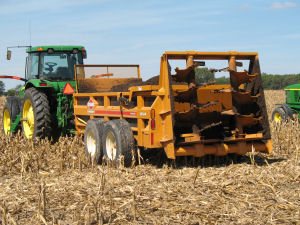
The most common equipment for applying solids to the land is a rear-discharge, box-type spreader equipped with beaters that broadcast the manure over a width of several feet (see Image 1).

Usually, the manure is conveyed to the beaters at the rear by slats attached at each end to a sprocket-driven chain. Some use a powered front end-gate to push the material to the beaters at the rear. To handle semisolid manure, a tight-fitting, closable rear end-gate is required.

Some spreaders have a side discharge; most of these have V-shaped hoppers and feed the material to the discharge with augers. A rotating expeller slings the material out of the discharge port. The application rate is varied by an adjustable gate opening, usually operated by a hydraulic cylinder.

Flail-type spreaders have a semicircular hopper bottom and a rotating shaft with chain-suspended hammers to fling the material from the hopper. The flail-type and the side-discharge spreaders are adapted to both semisolid and solid manure.

Image 1: Broadcasting manure on cropland.

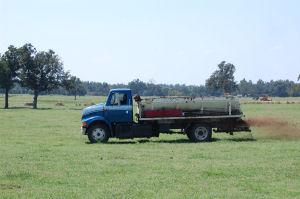
Manure spreaders may be tractor-drawn models or they may be mounted on a truck. Most tractor-drawn spreaders are PTO operated, but some are driven from the ground wheels. Some are hydraulically powered for greater speed variation, especially for the apron drive, to vary the application rate. In the past, spreader capacities varied from about 30 to 400 cubic feet with tractor horsepower requirements ranging from 10 to more than 120.

Recommended Reading About Land application of Manure

Land Application Equipment for Livestock and Poultry Manure Management

Authors: Jon Rausch, Ohio State University and Ted Tyson, Auburn University.

Livestock and Poultry Environmental Learning Center Contents

Live Webinar March 1

Waste to Worth 2019

Previous Waste to Worth Recordings/Proceedings

Topics:

About Us

Archived Webcasts

Upcoming Webcasts

Continuing Education Units

Resources:

Costs of Manure Application and Transport

When talking about the value of manure, costs are reported in terms of dollars. While reporting in terms of dollars is usually helpful, it is not the only metric for discussing costs. Any resource that is required to accomplish a task can be considered a cost. With this in mind, this page will discuss the cost of manure distribution in terms of dollars and time. The limiting resource, dollar cost or hours required, determines how manure is distributed. Hours could be converted to dollars but that would possibly obscure the management of these costs.

Factors Influencing Cost of Manure Management

The three major activities that influence the cost of manure management are loading, transporting and land applying. Each activity can require its own specialized equipment and can constrain the use of the manure. For example, except for an external manure storage structure, loading is best done when animals are not present and thus limited to those time periods. Transportation can be time consuming depending on the distance traveled and the amount of water hauled in the manure. Land applying requires proper soil and plant conditions and specialized equipment.

Livestock manure is either liquid, slurry or solid. Different types of manure will have different impacts on the cost of distribution. For example, solid manure can usually be hauled farther for less money because less water is being transported. Liquid manure, because of its high water content, can’t be transported as far but low cost irrigation systems can be used to distribute it relatively inexpensively. This page will address each manure type separately. Because the dollar cost of managing manure is so dependent on location, type of livestock, form of manure, availability of land, etc. No dollar estimate will be given in this page. The quickest way to get a cost estimate would be to contact a custom manure hauler and ask the price charged for different services.

The table below summarizes the relative costs of manure application and distribution. When reading it, compare the costs within a column, rather than within a row. In other words, use it to compare the cost of loading, transportation, or land application for each type of manure. The more dollar signs ($) a manure type has, the more expensive it is relative to the other types of manure. Click on a type of manure in this table to be taken to a description of why different manures will have different costs.

Summary of Manure Application and Distribution Costs
Manure Type Loading Transportation Land Application
Solid Manure      
Fresh $$ $$ $$$
Stockpiled $$$ $$ $$$
Slurry Manure      
Tanker $ $$$$ $$$
Dragline hose $ $$$ $$
Liquid Manure      
Dragline hose $ $$$ $$
Irrigation system $ $ $

Custom application

Because much of the equipment used in manure application is unique to manure application, many livestock producers choose to not own the equipment but rather hire custom operators to handle their manure. Custom operators can lower the cost of manure management, relative to owner operated equipment, by spreading the cost of expensive equipment over more units. Many custom operators can also apply the manure more quickly due to experience and because they have larger equipment or multiple pieces of equipment. Because they work for many livestock producers, they may not be able to apply an individual’s manure at opportune times. This uncertainty of when the manure will be applied is a cost that needs to be taken into account. Contracting Certified Manure Haulers contains instructions for comparing custom hauling with producer hauling of manure.

Livestock manures are an excellent source of organic nutrients. However, they are generally more expensive to transport and land apply than more concentrated commercial fertilizers. The cost of manure transport and distribution are critical to understand and manage in order to derive maximum value from manure. A research project completed in the late 1990’s includes this information. The actual costs presented may no longer be relevant but the conclusions are still valid.

A spreadsheet to estimate the cost of hauling various types of manure can be obtained at University of Missouri.

Related Web Pages

Authors: Ray Massey, University of Missouri and Josh B. Payne, Oklahoma State University

Costs of Slurry Manure Application and Transport

Livestock and Poultry Environmental Learning Center:

Home Page

All articles about:

Manure Value and Economics

Livestock such as dairy and swine often have slurry type manure. The manure is liquid but does not flow easily. It is either stored directly below the animal pens, or scraped or pumped periodically into a holding pen outside of the building.

Loading Slurry Manure

Loading slurry manure is accomplished with a pump powered by a tractor or stationary engine. The slurry can be loaded into tractor-pulled or truck-mounted tankers, or pumped through a hose attached to a tractor that applies it as it is being pumped from the pit. The cost of loading slurry is usually low because the pump can do it quickly and the volume per animal is not usually high.

Slurry Manure Transport

Transportation of slurry by tanker can be expensive because a lot of water is being transported and the same equipment that is hauling the slurry is usually land applying the slurry. When tankers are used, the number of hours spent transporting the slurry is frequently the limiting cost. The land may become unavailable to receive the slurry, due to crop planting times or soil conditions, before all of the slurry can be land applied. Often, the distance transported is limited so that the time constraints can be met.

If the slurry is pumped through a hose to the field, the transport time is negligible. As the slurry is pumped, it is simultaneously injected or surface applied to the land. The important cost becomes the cost of purchasing pipe and hose that is sufficient for this method of land application.

Land Application of Slurry Manure

The cost of land application of slurry varies with the type of equipment used. Tankers can be expensive to own unless they are used for many animals on many acres. There is a definite economy of scale with tankers. Additionally, the tankers usually require fairly large tractors or trucks. If the livestock owner does not have a cropping enterprise that requires the large tractor, ownership of the tractor for manure distribution alone becomes expensive.

Tankers are economical for large-scale operations with slurry manure.

When slurries are applied via hoses (called dragline hoses), a tractor pulled distributor is used to move the hose around the field so that the slurry is evenly distributed. The cost of the equipment can be very expensive, but the amount of time is decreased considerably compared to using tankers because most of the time is spent in applying the slurry. Very little time is spent getting into and out of the field, as is the case when using tankers.

Authors: Ray Massey, University of Missouri and Josh Payne, Oklahoma State University

Costs of Liquid Manure Application and Transport

Livestock and Poultry Environmental Learning Center:

Home Page

All articles about:

Manure Value and Economics

What Systems Produce Liquid Manure?

Liquid manures are most common with pork production where the manure is flushed from the building and stored outside in lagoons. Liquid manures are mostly water with some organic matter and nutrients suspended in the water. Most of the organic matter decomposes in the lagoons and is not removed.

Options to Haul and Apply Liquid Manure

While some livestock producers haul liquid manure in tankers, it is usually considered cost prohibitive. The amount of water is so great that the hours spent distributing it and the resulting dollar cost exceeds the value of the manure supplied nutrients when using tankers.

Liquid manure is usually pumped through pipes and hoses to the land that will be accepting the manure. This means that loading costs and transportation costs are relatively low. Once the manure is at the field, it can be applied with a tractor that pulls the dragline hose through the field or via an irrigation system. The irrigation system can be a stationary sprinkler or a single big gun sprinkler that must be moved periodically by the operator.

Liquid manure can be land applied with a dragline hose.

Other options include, a big gun sprinkler or a center pivot irrigation system that move automatically through the field. The center pivot irrigation system is usually too expensive to own just for liquid manure distribution; it is usually part of an irrigation system that also pumps clean water. The stationary and big gun sprinklers are inexpensive and easy to use.

Authors: Ray Massey, University of Missouri and Josh Payne, Oklahoma State University

Nutrient Planning on Small Farms

livestock and poultry environmental learning center logo with cow, pig, and chicken sillhouettes over a map of the U.S. with three circling arrowsThe LPE Learning Center hosted a webcast on Nutrient Planning on Small Farms in June, 2008.

Positive Impacts of Manure

When managed properly, manure can be a valuable resource on a farm. Manure can be a source of nutrients for crop production and improve soil quality. The organic matter present in manure can improve both tilth and water holding capacity of the soil. Livestock and poultry manure is a valuable fertilizer for crop and pasture production. Most farm owners do not realize the value of the manure that is produced on their farms.

Negative Impacts of Manure

When not managed properly, manure can pollute the environment; mainly as ground or surface water pollution due to the nutrients nitrogen (N), phosphorus (P), and carbon (organic matter). In addition manure can lead to air quality concerns, pathogens in water supplies, odors, dust, and the presence of vermin.

Manure Nutrients

Manure nutrients can be beneficial for the soil and plant growth; however, manure application rates should be based on plant growth needs. Excessive manure application to the soil can result in nutrient leaching and increased losses through runoff. In addition, manure contains soluble salts and minerals such as arsenic, copper, and zinc which in excessive amounts may negatively impact the soil quality.

Manure nutrients, (N, P, and organic matter) can be major pollutants in lakes and estuaries as well as rivers. Nitrogen and phosphorus attached to soil particles may reach waterways through surface runoff or wind deposition. Dissolved N and P may leach through the soil, ultimately reaching water bodies. Organic matter can enter water bodies in the form of manure, vegetative matter, or animal carcasses. Waters rich in minerals, organic matter, and nutrients promote a proliferation of plant life, especially algae. This process is called eutrophication. Algae growth and the decomposition of organic matter in water bodies reduces the dissolved oxygen content of the water, which may lead to the death of aquatic life.

Pathogens and Vermin

In addition to the concerns regarding nutrients, pathogens may be present in manure. Some examples of the pathogens are E. coli, Salmonella, and Cryptosporidium parvum. These pathogens can impair water bodies and potentially pose human health risks when manure or contaminated water comes in contact with food sources. Flies and rodents are other manure related concerns on livestock farms. These problems can be minimized by proper design of animal housing and manure storage, and proper handling procedures when turning or moving manure piles.

Air Quality

Air quality concerns arise from odors, particulate matter, and aerial pathogens. Ammonia released from manure can result in odor and may react with other compounds in the atmosphere producing particulate matter (PM 2.5) which can affect the environment and public health. There are a variety of other compounds released from manure such as hydrogen sulfide, green house gases (methane and nitrous oxide), and some volatile organic compounds that can also cause air quality concerns. Particulate matter that arises from dust and reaction of ammonia with other compounds in the atmosphere are also a concern.

Why Implement Nutrient Management Planning?

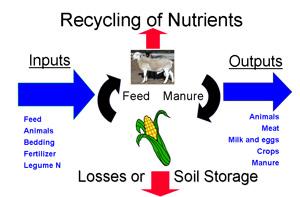
The purpose of nutrient management is to implement practices that permit the efficient use of manure for crop production while protecting potential environmental damage that may be caused by nutrients. Nutrient management planning is a site specific exercise; and, if the recommendations are followed, nutrient losses should be minimal. In general, nutrient management considers the nutrients available on a farm, how best to use them, and the potential impacts of the nutrients on the environment. Factors typically considered in nutrient management planning are: goals of the farming operation as well as any constraints; available farm resources (land, equipment, financial resources); potential critical areas on the farm (sensitive water bodies, neighbor concerns, erosion, manure storage); and nutrient balance analysis (shown in the figure below).
 

Recycling

CC2.5 Mike Westendorf

Farm nutrient inputs consist of animals, feed, fertilizer, legume nitrogen, and bedding. Outputs are animals, milk, meat, eggs, manure, and crops. Recycling also occurs on the farm with nutrients moving from feed through livestock, applied to soil, utilized by plants, and back to feed again. The optimal goal (Whole Farm Nutrient Balance) is for the farm to remain in balance between inputs and outputs without losses as runoff or leachate from either the soil or manure. Soil can store some nutrients assuming that the amount of manure applied to the soil is not excessive.


Small Farms are Different than Large Farms

The challenges of managing manure nutrients are different on a small farm than on many larger farms although the principles are similar. Small farms have fewer animals and sometimes several animal species on the same farm. They also may have limited acreage and/or lack equipment for spreading manure. The nutrient management planning section provides information on feeding animals and managing their diets; manure production; basic soil science and soil fertility; and nutrient (manure) management. The section details on- and off-farm use within the context of a nutrient management plan.

The following articles are coming soon!

  • Basic soil science and fertility
  • Nutrient management on the farm
  • Crop utilization
  • Nutrient management plans
  • Off-farm utilization
  • Soil and manure testing
  • Record keeping

Additional Resources

Nutrient Management–SIMPLIFIED! by Randall James, Ohio State University Extension

Authors: Jactone Arogo Ogejo, Virginia Polytechnic Institute and State University (Virginia Tech) and Michael Westendorf, Rutgers, The State University of New Jersey

Managing Dietary Phosphorus for Livestock and Poultry

Phytate Phosphorus

Phosphorus is required in the diet of animals, but if overfed or wasted, can contaminate the environment and water supplies. Cereal grains fed to livestock contain phytate-bound phosphorus. Phytate-bound phosphorous is digestible by ruminant animals such as cows, sheep, and goats, but it cannot be digested by single-stomached animals, such as pigs and chickens. Phytate consists of a carbon ring structure with balanced phosphate groups surrounding the ring. Since horses are a hind gut fermenter, they are able to process the phosphorus much like ruminant animals.

Since phytate-bound phosphorous is unavailable to pigs, chickens, and other single stomached animals, phosphorous from other sources is supplemented to meet the needs of the animal. The extra phytate-bound phosphorus will be unavailable and excreted in the manure.

Reducing the proportion of cereal grains in the diet will usually reduce the amount of phosphorus fed. However, for pigs and chickens, and there are few economic alternatives to cereal grains. Plant breeders are working to develop feed grains lower in phytate content and higher in available phosphorus.

Phytase in the Feed

An enzyme called phytase can be included with the diet. Phytase will break down phytate and release digestible phosphorus. Mixing phytase (commercially available) in the diet will reduce the phosphorus required in supplements.

Interactions Between Nutrients

Another factor affecting phosphorus availability is the presence of other nutrients in the diet. Overfeeding calcium can limit the availability of phosphorus. Calcium and other nutrients should be fed in balance so as not to disrupt the availability of phosphorus.

Calcium:Phosphorus Ratio for Horses

Horses are a bit unique; they require calcium and phosphorus to be in a specific ratio in the diet. Young growing horses, as well as lactating mares, should receive a Ca:P ratio of 2:1, while mature horses not reproducing can get by with a 1:1 ratio. Calcium should never be fed at a level lower than phosphorus because phosphorus will tend to interfere with calcium absorption into bone. Horses at maintenance require .17% phosphorus in the diet and .24% Ca. The highest levels of phosphorus are needed in reproducing mares (.34%). Typical horse diets approach 2 to 3 times the required level of phosphorus, which can be detrimental to the environment. This high phosphorus level is partially due to the estimated Ca:P ratio in alfalfa hay being 6:1. Many horse owners try to counteract this by adding more phosphorus to the diets. Many equine supplements already contain more phosphorus than is necessary. There are also phosphorus concerns for ruminant animals such as cows, sheep, goats, and etc.

Ruminants and Phosphorus

Ruminant animals have a phytate enzyme produced naturally within the rumen that breaks down phytate-bound phosphorus and makes it available to the animal. According to the National Research Council, a lactating dairy cow requires between .35 and .40% phosphorus in the diet. Previous dairy feeding practices included as high as .55% or .60% phosphorus in the diet. This would mean an excess of 25 to 30 pounds fed to a cow in a normal lactation. If you multiply this over a dairy herd with 100 cows, then nearly 3,000 pounds extra phosphorous would be fed over the course of a year. Some dairy farmers think that phosphorus is a mineral required for proper reproductive function. While phosphorous is indeed important for normal bodily functions and is important for reproduction just as all nutrients are important for reproduction, there is no special link between phosphorus and reproduction in a cow. Most dairy farmers have already reduced phosphorus in their diets to levels given by the National Research Council.