Life Cycle Greenhouse Gas Emissions of Dairy and Bioenergy Systems


Why Study Greenhouse Gas Emissions from Dairy Systems?

Animal agriculture presents multiple challenges for sustainability and the dairy sector alone contributes 30% of agricultural greenhouse gas (GHG) emissions. Bioenergy systems have been implemented to reduce GHG emissions and contribute to energy independence goals, but the production of bioenergy must be done with caution to avoid the generation of additional emissions during feedstock production and harvesting. This research used life cycle assessment (LCA) techniques to evaluate the integration of dairy and bio-energy systems to address global warming. The first place for integration is the dairy feed preparation level, where potential co-products of the biofuel industry (e.g. dry distillers grains with solubles and soybean meal) can be included in the dairy ration. A lifecycle approach should be considered to evaluate changes in GHG emissions related to the production of these added dairy feeds. This is important because the embedded emissions and energy resources related to upstream processes (e.g. manufacturing of seeds, fertilizers, pesticides, and fuels) and downstream processes (e.g. transportation and harvesting) can result in added greenhouse gases. The second point where dairy and bioenergy systems can be integrated happens at the waste management level, where manure is digested in an anaerobic digestion (AD) system to produce renewable energy. Different cow feeding scenarios, management practices, and anaerobic digestion pathways are modeled to identify practices that minimize GHG emissions at the dairy farm.
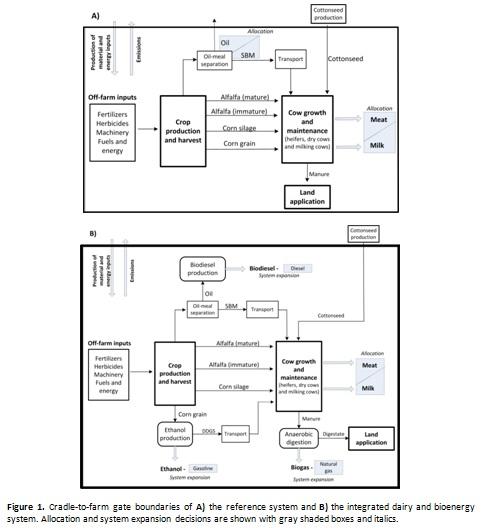
Figure 1. Cradle-to-farm gate boundaries

Figure 1. Cradle-to-farm gate boundaries

What did we do?

The effect of integrating bioenergy and dairy systems on GHG emissions was evaluated. First, a reference milk-producing system representative of Wisconsin (WI) was modeled using a partial LCA approach from cradle-to-farm gate. To integrate bioenergy products to the modeled farm, the boundaries of the system were defined and included corn and soybean production for ethanol and biodiesel, respectively. This was necessary in the analysis since co-products dry distillers grains with solubles (DDGS) and soybean meal (SBM) are part of the dairy diet in numerous farms of WI. In addition, the production of biogas through anaerobic digestion (AD) from the collected manure was evaluated as a second opportunity to integrate bioenergy systems with dairy systems. Given that this integrated system is multi-functional (producing milk, meat, ethanol, biodiesel and biogas); the GHG emissions were assigned to milk by system expansion, a method recommended by the International Organization for Standardization (ISO) to assign the environmental impacts of multi-functional systems among co-products. This method can be applied when a co-product clearly replaces the production of an external product (in our paper ethanol replaces gasoline and biodiesel replaces fossil diesel). Results indicate that GHG emissions for the reference system are 1.02 kg CO2-eq per kg of milk (corrected for fat and protein (FPCM). When analyzing the integration of ethanol and biodiesel (and after applying system expansion) GHG emissions are reduced to 0.86 kg CO2-eq per kg of FPCM in a diet that maximizes DDGS. The installation of a digester further reduced GHG emissions to 0.63 kg CO2-eq/kg FPCM, highlighting the importance of this system to achieve both energy and climate change goals.

Given the important role that AD systems have to reduce greenhouse gases, we explored different AD scenarios based on manure management practices, co-digestion strategies, and energy conversion processes in order to achieve further emission reductions. AD is the main focus of this part of the study; therefore, a new functional unit was defined as 1 GJ of produced electricity. A base-case pathway was compared against seven alternative AD pathways. In the base-case, manure is collected with a skid steer, digested in a plug-flow digester, biogas is used for electricity production without heat recovery, and digestate is separated in a screw press and land-applied by surface broadcast. The alternative AD pathways are defined in Table 1.
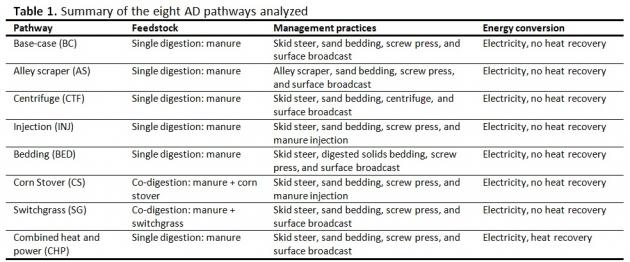
Table 1. Summary of the eight AD pathways analyzed

Table 1

For the base-case, GHG emissions are 243.3 kg CO2-eq/GJ of produced energy. Results show that the AD pathway has a substantial influence on the estimates of environmental impacts and GHG emissions range from 178 to 267 kg CO2-eq/G J of produced energy (Figure 2).
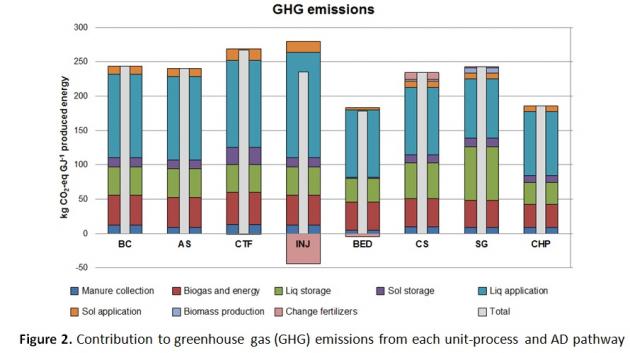
Figure 2. Contribution to greenhouse gas (GHG) emissions from each unit-process and AD pathway

Figure 2.

What have we learned?

The dairy industry will continue to dominate agricultural activities in WI for the foreseeable future and the emerging bioenergy industry will need to be integrated into existing agricultural systems. System models like this one have potential to help farmers and policy makers identify synergies between dairy production and renewable energy development. GHG emissions of a reference dairy system representative of WI are compared to a system that integrates dairy and bioenergy production. Diet scenarios that maximize DDGS content are the most effective in reducing GHG emissions. Reductions in GHG emissions come mainly from the credits of avoided emissions and primary energy from displaced fossil fuels after system expansion. GHG emissions are further reduced when implementing AD to process the manure generated in the farm.

The second part of the study focused on improving the sustainability of AD systems by evaluating different manure management practices, co-digestion strategies, and energy conversion processes. GHG emissions can be reduced 31% by management practices alone, 24% if heat from the electricity generation process is recovered, and 4% by co-digesting manure with corn stover. Replacing sand with digested solids for cow bedding contributes to reduce GHG emissions as it avoids the manufacturing of this resource. Co-digesting corn stover with manure is an effective strategy to reduce GHG emissions as this feedstock requires only harvesting as opposed to switchgrass that needs to be added to the already existing crop mix requiring additional planting as well as harvesting. Finally, results show the major improvement in GHG emissions when heating the digester with recovered heat from the generator, highlighting the potential of this pathway to reduce environmental impacts without adding major technical or economic challenges to the farmer.

Future Plans

There is potential to expand the current analysis by using the survey data collected as part of this study. For example, it would be interesting to compare management practices coming from small and large dairy farm operations.

We still need to develop our knowledge on the sustainability impacts of co-digesting manure with other waste streams, such as cheese whey and whey permeate. These pathways can provide useful information to dairy processing plants about alternative uses of whey as an energy source with and without protein separation, which could be a decisive factor when making investment decisions.

It will be important to quantify other environmental services of AD systems, such as water quality preservation and odor reduction.

Authors

Aguirre-Villegas Horacio Andres. Postdoctoral Research Associate. Department of Biological Systems Engineering, University of Wisconsin-Madison aguirreville@wisc.edu

Larson Rebecca. Assistant Professor. Department of Biological Systems Engineering, University of Wisconsin-Madison. Reinemann Douglas J. Chair and Professor. Department of Biological Systems Engineering, University of Wisconsin-Madison

Primary author: Horacio Aguirre-Villegas, aguirreville@wisc.edu, 217-898-0345

Acknowledgements      

This study is part of the Green Cheese Project, funded by Wisconsin Focus on Energy, Environmental and Economic Research and Development Program and the National Institute of Food and Agriculture, United States Department of Agriculture, under ID number WIS01604

The authors are solely responsible for the content of these proceedings. The technical information does not necessarily reflect the official position of the sponsoring agencies or institutions represented by planning committee members, and inclusion and distribution herein does not constitute an endorsement of views expressed by the same. Printed materials included herein are not refereed publications. Citations should appear as follows. EXAMPLE: Authors. 2015. Title of presentation. Waste to Worth: Spreading Science and Solutions. Seattle, WA. March 31-April 3, 2015. URL of this page. Accessed on: today’s date.

Waste to Worth 2013-Education & Outreach

Making Sense of Smells–Communicating Odors to Diverse Audiences-Doug Hamilton

Anaerobic Digester Workforce Training Curriculum Development-Jennifer Pronto

Anaerobic Digester Operator Discussion Group Management-Kathryn Barrett

Iowa Manure Management Action Group (IMMAG)-Angela Rieck-Hinz

Water Quality Initiatives for Small Iowa Beef and Dairy Feedlot Operations (Small Feedlot PRoject)-Shawn Shouse

Online Bioenergy Training for Extension Educators CHARLES GOULD

Feed Management Planners Certification Program to Reduce Nutrient Loads in Impaired Watersheds DAN LUDWIG

Extension Outreach Response to Livestock Mortality Events Associated with Algal Toxin Production in Georgia Farm Ponds-Susan Wilde

The Farm Manure to Energy Initiative: Using Excess Manure to Generate Farm Income in the Chesapeake’s Phosphorus Hotspots-Jane Corson-Lassiter

Tile Drainage Field Day to Promote Manure Management-Natalie Rector

Smartphone Apps for Manure Management-Jill Heemstra

Air Quality Waste to Worth 2013 Proceedings

W2W13 proceedings | Waste to Worth home
On this page: Ammonia | Anaerobic Digestion | Partnerships | Dust | Greenhouse Gases | Monoslope Barns

Ammonia (NH3)

Rocky Mountain National Park Emissions & Measurement

Ammonia: A Volatile, Promiscuous Fugitive

Nitrogen Isotopes to Distinguish Ammonia Sources

Activation Energy of Urea Hydrolysis and Ammonia Henry Constant Effects

Comparing Dairy Manure Application on Ammonia, Odor, and Costs

Estimating Ammonia Using Low-Cost, Time-Averaged Concentration

Mitigation & Management Nutrient Recovery

Feedlot Ammonia BMPs: Barriers and Opportunities

Management to Reduce Nitrogen Losses from Feedlots

Acid Scrubber for Reducing Ammonia

Ammonia Mitigation Using Electrolyzed Water Spray Scrubber

Ammonia Mitigation and Capture Using Gas-Permeable Membrane

Anaerobic Digestion

Potential Air Quality Impacts of Digestion of Dairy Manure

Dust, Particulate Matter (PM)

Management & Mitigation Emissions & Measurement
Stocking Density Manipulation at Cattle Feedyards

Photometric Prediction of Ground-level PM10

Dissipation of Fine Particulates Downwind of Poultry

PM Adjacent to Deep-Bedded Monoslope Facilites

Partnerships Between Industry and Agencies

Affecting Change Through Collaboration: An Industry Driven Apporach (Colorado regulators, livestock associations, farmers)

Yakima, WA Partnership Model to Address Air Emissions from Dairy

Greenhouse Gases (GHG)

Emissions & Measurement Management & Mitigation

GHG Nitrogen Gas Losses Comparing Bulking Agents for Composting Separated Hog Solids

Ammonia and GHG Surface Measurements from Beef Bedded Manure Packs

Reducing Gas Emissions from Manure Application in Semi-Arid Regions

Monoslope Beef Barns

Particulate Matter Adjacent to Cattle Deep-Bedded Monoslope Facilites

Ammonia and Greenhouse Gas Surface Measurements from Beef Bedded Manure Packs

Manure Management and Temperature Impacts on Gas Concentrations in Monoslope Cattle Facilites


Waste to Worth 2013-Feed Management

W2W13 proceedings | Waste to Worth home
On this page: Dairy Cattle | Feeding and Rations | Beef Feedlot

Dairy Cattle Feeding & Rations Beef Feedlot

Sustainable Dairy Cropping Systems

Dairy Cow Ration Impacts Manure Chemistry and the Environment

Feed Management Planners Certification Program

Integrating Manure into Feed Ration Optimization

Distiller’s Grains Effects on Sulfur Emissions

BFNMP: A Tool for Feedlot Manure Economics


Waste to Worth 2013-Manure Value & Economics

W2W13 proceedings | Waste to Worth home
On this page: Environmental Planning | Value as Fertilizer | Feeding & Rations | Manure to Energy

Environmental Planning Value as Fertilizer

Modeling to Characterize Manure Flows in Texas

Evaluating the Environmental Impact of Dairy and Beef

Sustainable Dairy Cropping Systems

Financial Benefits of Composting Stable Waste

Factors Affecting the Price of Manure Applied on Corn

Economic Analysis of Swine Diet Cost Versus Manure Value

Feeding & Rations Manure to Energy

Economic Analysis of Swine Diet Cost Vs. Manure Value

BFNMP: A Tool for Feedlot Manure Economics

Integrating Manure into Feed Ration Optimization

Production of Fuel Crops For Biodiesel Using Manure

Using Litter for On-Farm Space Heating vs. Electricity

Waste-to-Energy Technology and Environmental Revenues


Making Sense of Smells – Communicating Odors to Diverse Audiences

Waste to Worth: Spreading science and solutions logoWaste to Worth home | More proceedings….

Example of odor visualization system using colors and shapes to replace chemical jargon.

Why Is Smell and Odor Important to Animal Agriculture?

Smell is perhaps the least understood of our five senses.  Yet, the human perception of odor may mean the difference between war and peace for a livestock farmer and his neighbors.  Because the science of  smells is complex, there is a tendency to run straight for the organic chemistry book when we try to describe farmstead odors.  This approach goes right over the heads of most people.  There must be a better way to communicate odors to diverse audiences.  This workshop can be utilized by teachers or extension staff to teach about communication of a topic that is frequently encountered by farmers, ag professionals, and others. To see the presentation slides, scroll to the bottom of the page.

Learning Objectives

This two hour workshop will explain how to use an innovative visual technique to describe farmstead odors to general audiences without resorting to chemical jargon.  The visualization technique based on shapes and colors was developed at Oklahoma State University in the mid 1990s, and has been used to talk about odors with many diverse audiences.  The method demonstrates that odors have “structure”, and can be measured using the four concepts: character, concentration, intensity, and persistence.

Students will also participate in a mock laboratory exercise to demonstrate how odor intensity and pleasantness are measured.  Results of the exercise will be analyzed in “real time”.  Further analyses of previous exercise runs will be compared and contrasted to the workshop results.  This laboratory has been presented to over 250 college freshmen and their results are presented in this recording.

Workshop Introduction

What is an Odor?

Measuring Odors

Odor Experiment

Another Odor Experiment

Physiology of Smell

Author

Douglas W. Hamilton, Associate Professor and Extension Waste Management Specialist, Oklahoma Cooperative Extension Service dhamilt@okstate.edu

Doug Hamilton is an associate professor of Biosystems and Agricultural Engineering at Oklahoma State University.  He has three degrees in Agricultural Engineering from the University of Arkansas, Iowa State University, and Penn State University.  His sense of smell remains keen despite the fact he has worked with livestock manure for nearly 34 years.

For More Information


The authors are solely responsible for the content of these proceedings. The technical information does not necessarily reflect the official position of the sponsoring agencies or institutions represented by planning committee members, and inclusion and distribution herein does not constitute an endorsement of views expressed by the same. Printed materials included herein are not refereed publications. Citations should appear as follows. EXAMPLE: Authors. 2013. Title of presentation. Waste to Worth: Spreading Science and Solutions. Denver, CO. April 1-5, 2013. URL of this page. Accessed on: today’s date.

Wisconsin Producer Perspective on the Phosphorus Index

Waste to Worth: Spreading science and solutions logoWaste to Worth home | More proceedings….

Why Evaluate the P-Index from the Farmer’s Perspective?

The phosphorus index is a risk management tool, designed to evaluate the potential for runoff from a field based on the conditions and management of that field. Based on many years of work with farms in Wisconsin, the author sees the P-Index as valuable tool for comparing fields and management on the same farm and influencing choices that will lead to the lowest risk of runoff. The tool should not be used to compare between farms, as differing management and geography can cloud those comparisons. Another aspect of the p-index that causes concern is its use as a regulatory tool. When the p-index is applied from a distance–without contact with the farm or farmer, a disconnect can develop.

Author

Dennis Frame, University of Wisconsin drframe@wisc.edu

Additional Information

UW Discovery Farms http://uwdiscoveryfarms.org/

The authors are solely responsible for the content of these proceedings. The technical information does not necessarily reflect the official position of the sponsoring agencies or institutions represented by planning committee members, and inclusion and distribution herein does not constitute an endorsement of views expressed by the same. Printed materials included herein are not refereed publications. Citations should appear as follows. EXAMPLE: Authors. 2013. Title of presentation. Waste to Worth: Spreading Science and Solutions. Denver, CO. April 1-5, 2013. URL of this page. Accessed on: today’s date.

Manure Management Facilities and Structures for Small Farms

Waste to Worth: Spreading science and solutions logoWaste to Worth home | More proceedings….

Farms large and small deal with similar manure storage issues. Jean Bonhotal of the Cornell Waste Management Institute discusses some of these issues. Siting of livestock waste areas requires many considerations. Other things to be mindful of include various pad types for outdoor manure storages, structures for indoor and outdoor storage, and composting concerns.

Author

Jean Bonhotal, Cornell Waste Management Institute jb29@cornell.edu

Additional Information

Cornell Waste Management Institute http://cwmi.css.cornell.edu/

The authors are solely responsible for the content of these proceedings. The technical information does not necessarily reflect the official position of the sponsoring agencies or institutions represented by planning committee members, and inclusion and distribution herein does not constitute an endorsement of views expressed by the same. Printed materials included herein are not refereed publications. Citations should appear as follows. EXAMPLE: Authors. 2013. Title of presentation. Waste to Worth: Spreading Science and Solutions. Denver, CO. April 1-5, 2013. URL of this page. Accessed on: today’s date.

Proceedings from Waste to Worth “Spreading” Science and Solutions 2013

Waste to Worth: Spreading science and solutions logoThe 2013 Waste to Worth proceedings include a one-page submission by the author, presentation slides and (90% of the time) a recording of the presentation.

Search for Proceedings By….

Meeting agenda | Main author last name | Topic

The main author page includes every abstract submitted for W2W in alphabetical order of the primary author/presenter with a link to the full proceedings paper after each. Click on a the first letter of their last name or use your browser “find” function to locate the name of an author.

Topic

Select one of the topics below to see related papers. Alternatively, you can go to to the main author page and use your browser’s “find” function to locate a keyword.

Air Quality

Economics & Value of Manure Feed Nutrient Management

Manure Treatment (Includes Anaerobic Digestion)

Climate Change & Greenhouse Gases Small Farms

Nutrient Management

Manure Storage & Handling Education & Outreach
Mortality Management

Water Quality & Management

Grazing Animals