Manure Treatment Technologies

Options for Manure Treatment

Treatment Technologies

Webcast Presentations On Manure Treatment Technology

Research Summaries About Manure Treatment

Educational, Technical, and Financial Assistance Resources

Passive Composting of Manure

Passive Composting

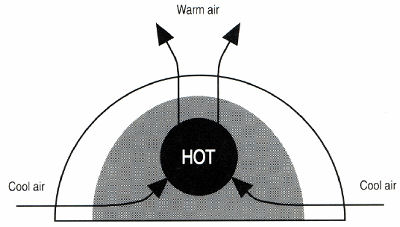
Passive composting is probably the most common method used today because it involves simply stacking feedstocks and leaving them to compost over a long period of time. Very little, if any activity is performed on the pile once it has been constructed. Initial composting parameters can be controlled but are not usually maintained during the entire process. This process relies on mother nature to draw cool air and oxygen into the pile as the warm air is released. This process is commonly referred to as the chimney effect.

“Chimney effect” within an active composting pile


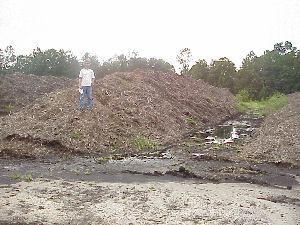
Passive/static yard waste composting


Introduction to Vegetative Treatment Systems

Vegetative treatment systems (VTS) have been explored as a manure treatment option for small farms as well as large Confined Animal Feeding Operations (CAFOs).

What Is a Vegetative Treatment System?

Runoff from livestock barnyards and feedlots can kill fish and cause algae blooms in lakes and streams. A Vegetative Treatment System (VTS) can be an economical alternative to retention (holding) ponds for controlling runoff from a livestock waste facility.

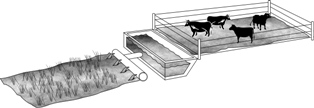
A Vegetative Treatment System (VTS) refers to a combination of treatment steps for managing runoff. It treats runoff by settling, infiltration, and nutrient use. Individual components of a VTS include, a settling structure, an outlet structure, a distribution system, and a Vegetative Treatment Area, when put together we consider it a Vegetative Treatment System.

slope

Vegetative Treatment Area

A Vegetative Treatment Area (VTA) is an area of perennial vegetation, such as a grass or a forage. The VTA is used to treat runoff from a feedlot or barnyard. It treats runoff by settling, infiltration, and nutrient use. A VTA is commonly confused with vegetative buffer (or filter) strips. A buffer strip is a narrow strip of vegetation (usually 30-60 feet wide), between cropland and a stream or other surface water. Runoff passes through buffers with some “filtering” of pollutants, but no attempt is made to control solids or flow. A VTS, however, collects runoff from a barnyard or feedlot, separates the solids from the liquids, and uniformly distributes the liquid over the vegetated area. Little or no runoff should leave a VTA.

The first step in a VTS is to collect runoff from a open lot or barnyard area in a sediment settling structure, usually a basin. Such basins are very effective for removing most solids. The runoff then flows into a VTA (Vegetative Treatment Area) whose soil treats and stores the runoff. Once the runoff is in the soil, natural processes allow plants to use the nutrients.

The general idea behind this technology is that the plants will take up the nutrients contained in the runoff and that natural factors will eliminate undesirable components such as pathogens. There are many different types of VTA’s, level, infiltration basins, sloped, sprinkler, dual and multiple systems, etc. To learn more about the different combinations, and when they are appropriate, see VTS System Types and Configurations.

How is a Vegetative Treatment Area Different From a Buffer Strip?

The critical aspect of the VTA is that is has been designed and sized to treat the runoff nutrients generated by the lot–letting runoff flow uncontrolled across the nearest pasture or crop field is not likely to achieve the desired treatment. The runoff needs to be released in a controlled manner. This control is what differentiates a VTA from grass filter/buffer strips. Controls also need to be put in place to eliminate any discharge from the VTA.

Designing a Vegetated Treatment Area

VTA’s must be graded to achieve uniform distribution. To achieve this, the existing landscape will need to be altered (leveled, graded, terraced, etc). If the site requires a great deal of work to create a functional VTA, the costs will obviously be higher than a site that requires only minimal alteration. Essentially, the VTA replaces the holding pond for storing (and utilizing) the nutrients and the liquid volume. In a holding pond this is impounded in a pond, in the VTA, the storage is a fraction of the available water holding capacity in the root zone.

Nitrogen Removal

The percent of the nitrogen removed from the runoff is directly related to the size of the VTA in relation to the size of the feedlot or barnyard as well as the distance that the runoff flows across the VTA. Increases in size of the VTA and flow distance remove more nitrogen. Up to 80% removal can be expected, depending on the design used. Maintaining the system so that the flow is uniform across the VTA, rather than becoming channelized, is also important to the performance of the system. Regular harvesting of the vegetation from the VTA preserves its ability to remove nutrients. Grazing a VTA is not acceptable, as this does not remove nutrients from the system. For more information on technical and design information on VTS, see some outside links to VTS Resources and some frequently asked questions about large CAFO VTS’s.

Phosphorus Removal

Phosphorus removal is directly related to solids removal. One literature review that summarized a large number of research projects, found an average of 70% phosphorus removal. Use of a solids settling basin before the runoff enters the VTA will result in a much lower amount of phosphorus that needs to be treated by the VTA. The settling basin does need to be cleaned out on a regular basis and the material land applied appropriately or utilized in another manner. If solids are not settled out prior to entering the VTA, the maintenance of the VTA itself is increased and the solids have potential to damage the vegetation.

The most common application for VTAs, in the past, have been for smaller, unregulated feedlots. Interest in their use for larger, permitted operations is growing and there is a body of evidence to suggest that a properly engineered and maintained VTS can perform as well as conventional treatments. Their use, as with any other technology is likely to be an individual decision dependent on site specific factors, interests and skills of the operator, and acceptance by regulators.

Need more information?

Read these factsheets, “Got Barnyard Runoff?” and “Need a Vegetative Treatement System for your Lot?”.

In depth planning and design information is available at “Vegetative Treatment Systems Guidance Document”

There are also several Webcasts and Virtual Tours of VTS systems available if you would like to see more in-depth discussions or take a tour of some actual systems.

Page developed and maintained by Chris Henry and Rick Koelsch, University of Nebraska Extension
Page reviewed by: Mark Rice, North Carolina State University
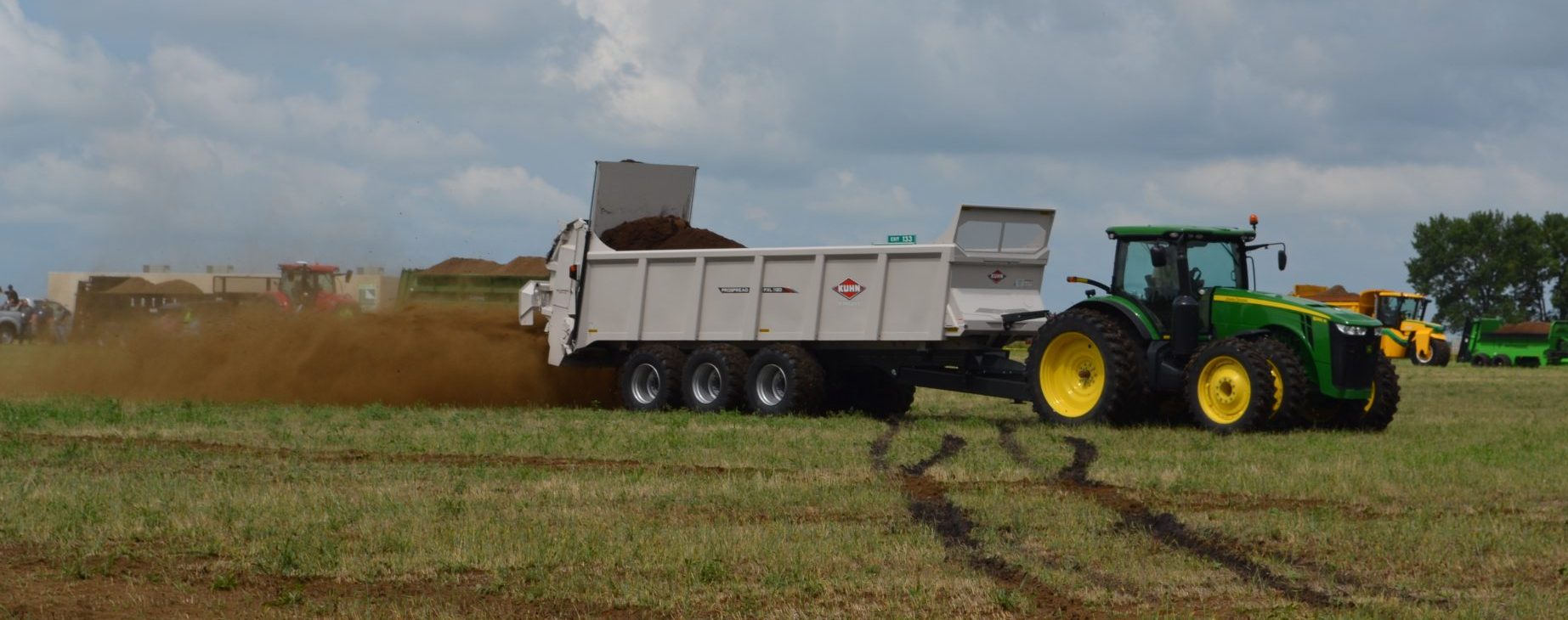

In Vessel Composting of Manure

In-Vessel Composting

In-vessel composting refers to any type of composting that takes place inside a structure, container or vessel. Each type of system relies upon mechanical aeration and turning to enhance and decrease the duration of the composting process. The goal of in-vessel composting systems is to combine various composting techniques into one controlled environment, which utilizes the strength and minimizes the weakness inherent to other forms of composting.

Farmers Automatic composting system – mechanically aerated in-vessel. CC 2.5 Jason Governo


In-vessel composting system used for poultry manure. CC 2.5 Jason Governo.


Composting Manure in Windrows

Windrow composting

Windrow composting is similar to passive composting although the piles of materials are turned or aerated by mechanical equipment to maintain optimum conditions. Materials are placed in long rows where the actual size and shape of the windrow are dependent upon the feedstocks and type of turning equipment. Dimensions of the windrow normally range from three feet to twelve feet high and anywhere between eight to twenty feet wide. Mechanical turning is usually done with a front-end loader or a machine specifically designed for turning windrows

Windrow composting using a front end mounted two pass turner


Educational and Commercial Resources for Manure Composting

Educational Resources

Commercial Resources

Consulting Resources

  • Coker Composting & Consulting, Roanoke VA, provides professional support to the composting industry with experience in planning, designing, building and running compost facilities
  • Tetra Tech provides responsible resource management and sustainable infrastructure services, offering innovative and cost effective solutions to complex problems
  • Midwest Biosystems offers consulting services to fit the need of any proposed or existing composting operation
  • Gershman, Brickner & Bratton, Inc. is a national management consulting firm that helps public and private sector organizations find solutions to solid waste management challenges

Author: Jason Governo, University of Georgia

Equipment and Software for Manure Composting

Composting Equipment & Software

  • Engineered Compost Systems is a company that designs and manufactures equipment, including CompTroller(tm) compost control and monitoring systems, aeration hardware, motor controls, feedstock mixers, product refinement equipment, ASP pile building conveyors and transfer conveyor systems. They also provide technical support for compost process and facility design and trouble-shooting, pro-forma facility analysis, compost marketing support, and operator training.
  • Green Mountain Technologies designs and manufactures in-vessel composting equipment. It also supplies compost management software and instrumentation, including 1)Windrow Manager 2.0 Software which includes a handheld Pocket PC, probe for temperature and oxygen sampling, and desktop software; 2)Compost Lab, a full suite of tools for managing compost batch data; and 3)Compost Calc – Recipe Software for predicting success of compost batches beforehand.
  • Reotemp Instruments is a California composting company manufacturing bimetal thermometers, pressure gauges, diaphragm seals and related accessories, moisture meters, the EcoProbe wireless monitoring system that allows monitoring from the office and the Compost Data Logger that records up to 16,000 temperature readings over extended periods and is downloadable to computers.
  • Industrial Telemetry, Inc., an Oklahoma Company, provides the BioMESH WindRow Control software program designed to allow the user to track the building and managing of the WindRows, static or turned, of a compost facility using patented transceiver/repeater REALMESH radio telemetry coupled with some of ITI’s sophisticated mapping techniques to transmit and track information while supporting simultaneous manual data entry.
  • Midwest Bio-Systems manufactures specialized equipment for the production of humified compost. The Aeromaster line of compost turning equipment includes pull-type and self-propelled compost turners, water trailers, probes, thermometers, sulfide test kits, windrow covers and Aeromaster service parts. The Advanced Composting System line of inoculants include the N-Converter, Humifier and Finisher products.
  • Renewable Carbon Management, LLC sells and licenses the NaturTech Composting System for converting organic materials into value added commodities. It is a biofiltration, in-vessel composting system that can be located in the smallest area possible with production ranging in size from 4 to 1000 tons/day. Programs can be implemented within 5 to 75 days, depending on the complexity of the process.
  • Compost Wizard software program uses critical user-inputs such as types of feedstocks, types of equipment, number of workers and location of the facility, to develop a preliminary design of the composting process and facility, and an estimate of capital and operating costs. The user can quickly generate many different design scenarios that can be used to estimate the feasibility of composting as a waste management option.

Author: Jason Governo, University of Georgia

Estimating Crop Nutrient Availability of Manure and Other Organic Nutrient Sources

All manure should be applied at the rate and time that assures maximum utilization of the nutrients by the crop.  Manure testing will provide the quantity of manure nutrients, but during storage and after land application, there are many factors that affect how much will become available to the current crop.

Locating State-Specific Manure Nutrient Availability Information

Most states or regions have developed tables for estimates of mineralization rates based on the common types of manure handling methods, typical manure application windows, and typical environmental conditions that affect mineralization. These tables can vary significantly from state to state. The following options can help you find the resources based on research in your state:

    • Contact your local or state extension service
    • Do a web search for “manure nutrient availability” plus your state’s name and select extension publications (.edu addresses) from the list
    • State Specific Nutrient Management Resources

The sections below will discuss common calculations and rules of thumb.

Organic Forms of Nutrients and Mineralization Rates

Not all of the nutrients in manure are directly plant available. Organic forms must be mineralized into inorganic, or “plant-available” forms–such as nitrate. The rate of this mineralization changes depending on soil type, moisture, temperature, manure composition, and other factors. Researchers continue to improve and refine predictions, but it is still necessary to use assumptions and estimates when defining mineralization rates. Organic forms of nitrogen will continue to mineralize and become available to crops in years 2, 3, and even 4 after the initial application. Most availability tables will provide calculations to use when calculating nutrient availability in subsequent years.

Environmental Losses of Nutrients

There are some inherent losses of nutrients to the environment during and after manure application. The three macronutrients, nitrogen (N), phosphorus (P), and potassium (K), each have unique characteristics with respect to expected losses. These losses vary by manure application method (sub-surface injection versus surface application).

Nitrogen is the most dynamic nutrient when it comes to potential loss. Some of the N in manure is in ammonia form or is readily be converted to this form after application. Ammonia is volatile (quickly changes to gas and disperses to the atmosphere) and losses of ammonia from land-applied manure can be significant. Many of the state availability tables (referenced previously) have coefficients describing ammonia and other nutrient losses based on animal species, manure handling system, and manure application method. Some states will vary the N-availability tables for ammonia based on the time (usually hours or days) after manure application if the manure has been left on the ground surface.

Manure Collection, Storage, and Treatment Losses

How manure is managed on the farm will affect the nutrient availability once land applied. The more highly treated or processed the manure is, the more the nutrients are bound up chemically or organically and the less plant available they become. Some treatment and storage processes enhance organic nutrient development whereas others decrease it.

Composting manure is a treatment that results in a high degree of manure processing with a high resulting level of organic nutrients. Thus, the nutrients (especially nitrogen) are usually much less plant available at the time of application and must be mineralized over the course of several years to become plant available. Some forms of solids removal, including chemical flocculation or precipitation, also result in manure nutrients being physically or chemically tied up and thus more slowly plant available.

Manure composting with old hay. CC 2.5 Karl Shaffer.

Timing of Manure Applications

Manure application is generally scheduled to accommodate the crop planting and harvesting schedule. The size of manure storage may also factor in to the timing of manure application. Occasionally, lack of storage can require that manure be applied at times that are less than ideal for maximum crop nutrient uptake.

Organic nutrients applied in the spring will have a higher mineralization rate than the same nutrients applied during the fall. A nutrient management planner should apply the appropriate mineralization rate coefficients for these application periods. Fall applications could result in nutrient losses if they are simply pre-plant applications for the following spring. The nitrate form of nitrogen is very mobile in the soil and subject to leaching losses. Depending on the climate, significant conversion of ammonia to nitrate may occur, with subsequent leaching of nitrate.

Availability of Nitrogen (N), Phosphorus (P), and Potassium (K)

Nitrogen is the most dynamic of the three macronutrients. Availability factors for P and K are fairly consistent between states because these nutrients have minimal loss potential with volatilization or leaching (as compared to N), and they remain relatively stable in the soil. Most regions of the US show that 80-100% of the P and K in manure is considered plant available.

There are many factors that ultimately affect the amount of N that will be plant available. Manure management and application method, as stated above, are two of the key factors. Other factors are mineralization and volatilization factors. These are determined by the environmental conditions at the time of manure application (air temperature, humidity, wind, soil temperature, soil C:N ratios, etc.).

Because N dynamics have many variables, several factors can be applied to the manure N analysis to assess its availability for crop use. Some states assign a flat 50% ammonia loss factor for manure that is surface applied without incorporation. Some states will segregate these factors based on time of year. Others will apply an increasing scale of volatilization (hence a decreasing scale of availability) depending on how long manure sits on the soil surface before incorporation.

Typically, volatilization losses are assumed to cease after 7-10 days. Depending on the state, manure application method, manure type (animal species), and handling system, nitrogen availability can range from 10% to 95%. Producers that wish to minimize N losses (maximize the manure value) will use application methods such as injection or immediate incorporation.

Author: Karl Shaffer, North Carolina State University
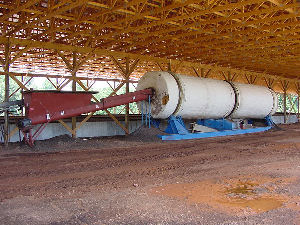
Composting Livestock or Poultry Manure

Compost not only describes the completed degradation of a mixture of materials; it also denotes the process that materials undergo before becoming compost. A workable definition for compost is that it is an organic soil conditioner that has been stabilized to a humus like product, is free of viable human and plant pathogens and plant seeds, does not attract insects or vectors, can be handled and stored without nuisance, and is beneficial to the growth of plants. A more useful explanation of the process of composting is the controlled biological process of the decomposition of organic materials into a humus rich product that can be used beneficially as a soil amendment or in erosion control techniques.

Compost is produced through the activity of aerobic microorganisms that require oxygen, moisture and food. These microorganisms generate heat, water vapor and carbon dioxide as they transform raw materials into a compost product. Effective composting begins with a basic knowledge of the material or feedstock properties, the general principles of decomposition and a method for controlling the process.

What Factors Influence Composting?

There are a few feedstock characteristics that are most influential in the composting process. These include carbon to nitrogen ratio (C:N ratio), moisture content, and the size and distribution of the feedstock particles. Raw materials blended to provide a C:N ratio between 25:1 and 30:1 is ideal for active composting, although initial C:N ratios from 20:1 to 40:1 consistently give good composting results.

High quality mature compost

When ratios fall outside this range, odor problems and longer composting times can be the result. Too little moisture, as well as too much moisture, can lead to poor composting conditions and decreased microbial activity. A moisture content ranging between 40-60% usually provides the water levels needed by microbes without saturating the required air pore space within the compost matrix . With regard to particle size distribution, a size of 90 percent cumulative passing through 2 to 3 inch openings usually is sufficient to provide a composting substrate with adequate surface area for microbial degradation and with adequate porosity for the storage of oxygen.

Methods of Manure Composting

Harnessing the natural process of decomposition to best serve a purpose within a set of specific parameters is the basis for composting systems. There are four general composting groups or methods commonly used by the composting industry:

Additional Information About Manure Composting

Author: Jason Governo, University of Georgia

Aerobic Manure Treatment

The term “aerobic treatment” refers to biological manure treatment processes that occur in the presence of oxygen. In these processes, aerobic microorganisms oxidize bio-available organic and nitrogenous compounds. Removal of these oxygen demanding compounds provides a means to reduce odor emission and to reduce ammonia emissions. Aerobic treatment has not been used much in treatment of liquid or slurry manure primarily due to the costs associated with operating the motors, compressors or fans required to supply enough oxygen to support aerobic bacteria.

The amount of aeration needed (in increasing order) depends on whether it is desired to just reduce odor, or completely remove the oxygen demand of the organic matter, or to supply enough oxygen for oxidation of ammonium to nitrate (nitrification).

Advantages of Aerobic Manure Treatment

Advantages of aeration include the potential reduction of emissions of odor, methane (a greenhouse gas), and ammonia. Nitrification of ammonia to nitrate also has the advantage of conversion to a nitrogen form that is readily crop available, although it is also more prone to leaching. The nitrate can also be biologically converted to nitrogen gas in the presence of organic compounds, resulting in nitrogen removal from the liquid or slurry.

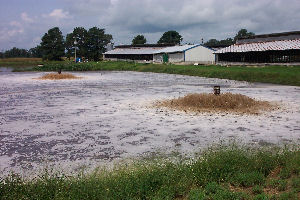
Surface aerators and mixers used in Sequencing Batch Reactor treatment of flushed pig manure.

Disadvantages of Aerobic Manure Treatment

Disadvantages of aerobic treatment include higher capital cost for aeration equipment, higher operating cost (particularly energy for pumps or aerators), higher maintenance requirements, and possibly monitoring requirements for checking the dissolved oxygen level in the liquid.

There are various methods and types of equipment for aeration, whether in a tank reactor or in an aeration pond, and selecting the most efficient equipment and methods may be difficult. There are also various designs to maintain the aerobic bacteria in sufficient quantity, such as attached to suspended solids or on fixed media. Consultation with knowledgeable professionals is advisable.

Recommended Reading on Aeration

Surface aerators at a pig farm to treat flushed pig manure. CC 2.5 Sarah Liehr or Phil Westerman

Manure Aeration Frequently Asked Questions

Authors: Phil Westerman and Sarah Liehr, North Carolina State University