
Feeding a Combination of Acidogenic Materials and Cation Exchangers Reduces Manure Ammonia Emissions and Improves Laying Hen Performance

Reprinted, with permission, from the proceedings of: Mitigating Air Emissions From Animal Feeding Operations Conference.

The proceedings, “Mitigating Air Emissions from Animal Feeding Operations”, with expanded versions of these summaries can be purchased through the Midwest Plan Service.

This Technology is Applicable To:

Species: Poultry (Layers)
Use Area: Animal Housing
Technology Category: Ration Manipulation
Air Mitigated Pollutants: Ammonia

System Summary

Feeding a combination of acidogens and indigestible cation exchangers reduces manure ammonia emission rates by sequestering ammonium in the manure. Average reductions of up to 68% have been noted in production environments. Reduced levels of ammonia in the production environment improve bird and worker health, reduces bird mortality, and improves productivity.


Applicability and Mitigating Mechanism

  • Ammonia emissions are reduced through the use of alternative feed components.
  • The technology is suitable for use in any layer housing system.
  • Mitigation of manure ammonia emissions is due to a combination of reduced manure pH and cation exchangers present in the manure.

Limitations

  • Overfeeding acidogenic materials can adversely affect performance and productivity.
  • Effective levels of acidogens are typically well below the threshold level at which adverse effects would be noted.
  • No adverse effects due to overfeeding cation exchangers have been noted.
  • Cation exchange capacity, buffering capacity, and selectivity for ammonium are critical to the performance of this system.
  • Acceptable ratios of acidogen to cation exchanger depend on acidogen pKa and cation exchanger buffering capacity.


Cost

Suitable acidogens and cation exchangers are available in the marketplace. Gypsum/zeolite blends are commercially available as a pre-mix. Implementation of gypsum/zeolite blends depends on feed bin availability, while admixing sodium bisulfate and either zeolite or humate can be done through a microbin system.

Per-ton feed costs are increased when the system is utilized, but increased feed costs are more than offset by reduced hen mortality, improved feed conversion and egg production, and reduced per-dozen production costs.


Authors

E. Carroll Hale III
Earth Net LLC Point of Contact:
admin@usedi.com

The information provided here was developed for the conference Mitigating Air Emissions From Animal Feeding Operations Conference held in May 2008. To obtain updates, readers are encouraged to contact the author.
Characterizing Ammonia Emissions from Swine Farms in Eastern North Carolina – Part II. Potential Environmentally Superior Technologies for Waste Treatment

Reprinted, with permission, from the proceedings of: Mitigating Air Emissions From Animal Feeding Operations Conference.

This Technology is Applicable To:

Species: Swine
Use Area: Manure Storage
Technology Category: Other Treatments
Air Mitigated Pollutants: Ammonia, Odors, Pathogens

System Summary

The need for developing environmentally superior and sustainable solutions for the management of animal waste is vital for the future of animal farms in North Carolina, the U.S. and the world. In addressing that need, the North Carolina Attorney General initiated the development, implementation, and evaluation of environmentally superior swine waste management technologies (ESTs) that would be appropriate to each category of hog farms in North Carolina. This study focuses on the emissions of nitrogen in the form of NH3 from different components/processes involved in hog waste handling and treatment, including waste storage lagoons, hog houses, and spray fields at eight selected EST sites.

A flow-through dynamic chamber system and two sets of open-path FTIR spectrometers measured NH3 fluxes continuously from water holding structures and emissions from housing units at the EST and conventional LST sites. In order to compare the emissions from the water-holding structures at the ESTs with those from the lagoons at the conventional sites under similar conditions, a statistical-observational model for lagoon NH3 flux was used. A mass balance approach was used to quantify the emissions. All emissions were normalized by nitrogen excretion rates.

Six of the eight ESTs that contained an anaerobic lagoon as part of the system did not substantially reduce ammonia emissions and therefore require additional technical modifications to be qualified as unconditional EST relative to ammonia emissions reductions. Two of the eight ESTs did not contain an anaerobic lagoon component. Both of these farms showed substantial reductions in NH3 emissions from their water-holding structures. Under the conditions reported herein these two potential ESTs meet the criteria established for ammonia emissions as described for ESTs.


Applicability and Mitigating Mechanism

  • Differs for each of the ESTs

Limitations

  • Differs for each of the ESTs

Cost

Is different for each of the ESTs (range is approximately $90-400 reported as 10 year annualized cost ($ per 1000 lbs. steady state live weight per year).


Authors

V.P. Aneja1, S.P. Arya1, I.C. Rumsey1, C.M. (Mike) Williams21Department of Marine, Earth and Atmospheric Sciences North Carolina State Univesity, 2 Department of Poultry Science, & Director, Animal and Poultry Waste Management Center, North Carolina State University
Point of Contact:
Viney P. Aneja, viney_aneja@ncsu.edu

The information provided here was developed for the conference Mitigating Air Emissions From Animal Feeding Operations Conference held in May 2008. To obtain updates, readers are encouraged to contact the author.

Characterizing Ammonia Emissions from Swine Farms in Eastern North Carolina – Part I. Conventional Lagoon and Spray Technology for Waste Treatment

Reprinted, with permission, from the proceedings of: Mitigating Air Emissions From Animal Feeding Operations Conference.

This Technology is Applicable To:

Species: Swine
Use Area: Manure Storage
Technology Category: Anaerobic Lagoon, Management
Air Mitigated Pollutants: Ammonia

System Summary

The conventional lagoon and spray technology (LST), is the current system predominantly used in North Carolina to manage pig waste. It consists of anaerobic lagoons to store and biologically treat pig waste (~99.5% liquid). Effluent from the lagoons is sprayed on surrounding crop fields as a nutrient source. Four distinct components and associated processes of LSTs release NH3 to the atmosphere: (1) production houses, (2) waste storage and treatment systems such as lagoons, (3) land application through injection or spraying, and (4) biogenic emissions from soils and crops

Applicability and Mitigating Mechanism

  • Anaerobic lagoons used to store and biologically treat hog manure
  • Manure sprayed on crops as source of nutrients


Limitations

  • Significant emissions of ammonia, odor and potential pathogens
  • Flooding during extreme weather events


Cost

Ten year annualized costs for a “Baseline” LST for a 4,320-head finishing farm using a pit recharge system of manure removal is predicted to be approximately $90 per 1,000 lbs. steady state live weight per year (Williams, 2006. see Table 8a, page 58 – Development of Environmentally Superior Technologies. 2006. Phase 3 Technology Determination Report, published by NCSU College of Agriculture and Life Sciences, 716 pgs, on file with NCSU Animal and Poultry Waste Management Center (March 8,2006). Also available at www.cals.ncsu.edu/waste_mgt/

Authors

V.P. Aneja1, S.P. Arya1, I.C. Rumsey1, C.M. (Mike) Williams21Department of Marine, Earth and Atmospheric Sciences North Carolina State Univesity, 2 Department of Poultry Science, & Director, Animal and Poultry Waste Management Center, North Carolina State University
Point of Contact:
Viney P. Aneja, viney_aneja@ncsu.edu

The information provided here was developed for the conference Mitigating Air Emissions From Animal Feeding Operations Conference held in May 2008. To obtain updates, readers are encouraged to contact the author.

Management of Dairy Operations to Prevent Excessive Ammonia Emissions

Reprinted, with permission, from the proceedings of: Mitigating Air Emissions From Animal Feeding Operations Conference.

This Technology is Applicable To:

Species: Dairy
Use Area: Animal Housing, Manure Storage
Technology Category: Management
Air Mitigated Pollutants: Ammonia

System Summary

Ammonia emissions data from open-lot and hybrid (combination of free-stalls and open-lots) dairies in the milder climate of southwest US indicated that summer emissions from these facilities were nearly 50% higher than winter emissions. Due to their large surface areas, lagoons and open-lot corrals were the highest contributors of NH3 emissions but little NH3 was emitted from lagoons during the winter months. Within open-lot corrals and free-stalls, NH3 emissions increased with greater manure loading and actively composting manure emitted considerable NH3 even during winter months. While reduction in dietary N intake is known to reduce manure nitrogen content, no information on technologies to mitigate NH3 emissions from these two types of dairy operations is available. Management practices such as frequent removal of manure from heavily loaded areas of open-lots and free-stalls, proper management of lagoons and other manure storage structures, summer irrigation of lagoon effluent during cooler temperatures, and where possible, incorporation or injection of effluent will help reduce excessive NH3 emissions. While frequent scrapping of targeted open-lot corral areas can be achieved without substantial increase in costs, covering lagoons to reduce NH3 emissions will be a very expensive mitigation practice.

Applicability and Mitigating Mechanism

  • Ammonia volatilization rate from dairy manure and processes generated waste water exposed to the environment depends upon total ammonium concentration, pH, moisture content, air velocity, temperature etc.
  • The management practices apply to mitigation of excessive NH3 emitting from open-lot corrals, lagoons, and free-stall surface of dairy operations
  • Existing dairy waste management practices can be adopted to reduce excessive NH3 emissions from critical sites at the dairy operation and during effluent irrigation during summer season


Limitations

  • Lack of excess fresh or recycled water for frequent flushing
  • Lack of extra storage capacity of retention control structures (RCS) to store additional flushed effluent.
  • Terminating or relocating the composting system out of the dairy operation


Cost

Increased frequency of flushing will require more fresh or recycled water as well as a higher storage capacity of an existing RCS or building a new one, adding higher costs to implement this practice. Another substantial cost may be covering large storage and treatment structures such as anaerobic lagoons to reduce NH3 emissions.

Authors

Saqib Mukhtar, Atilla Mutlu, Shafiqur Rahman
Texas A&M University System
Point of Contact:
Saqib Mukhtar, mukhtar@tamu.edu

The information provided here was developed for the conference Mitigating Air Emissions From Animal Feeding Operations Conference held in May 2008. To obtain updates, readers are encouraged to contact the author.

A Surface Aeration Unit for Odor Control from Liquid Swine Manure Storage Facilities

Reprinted, with permission, from the proceedings of: Mitigating Air Emissions From Animal Feeding Operations Conference.

The proceedings, “Mitigating Air Emissions from Animal Feeding Operations”, with expanded versions of these summaries can be purchased through the Midwest Plan Service.

This Technology is Applicable To:

Species: Swine, Dairy, Poultry
Use Area: Manure Storage
Technology Category: Aeration
Air Mitigated Pollutants: Odors

System Summary

A surface aeration system composed of an aerator module with six venturi air injectors has been demonstrated to effectively reduce odor level (measured by odor detection threshold) emitted from an operating swine manure anaerobic lagoon. Past research reports have shown that partially aerating manure can reduce the power consumption by up to 80% as compared to full aeration, while still achieving satisfactory odor amelioration. Data from this project provide further evidence that it is not only feasible but also affordable for animal producers to consider using this technology to control odor. A reduction in odor detection threshold by about 67% was achieved after the surface aeration system started operation in the test lagoon for about 10 days. It was also observed that the aeration treatment could maintain a dissolved oxygen level of 0.3 mg/L in the top lagoon liquid and the aerated layer worked like a biological cover that had the capability of destroying the odorous compounds passing through it. Although the surface aeration technology presented in this paper is tested in swine manure lagoons, it is expected that the technology can also be applied to manure lagoons of other animal species such as dairy and poultry. As a matter of fact, there are already experiments being carried out on a poultry lagoon in Texas using the same aeration apparatus, the results from which will be compared with those presented here. It is anticipated that the aeration system will be available to animal producers in the near future.

Applicability and Mitigating Mechanism

  • The surface aeration system can be applied to any open liquid manure storage facilities
  • Odorous compounds are intermediate products during anaerobic digestion and, without treatment, they will be emitted into air causing odor problems
  • Aeration is to provide oxygen to the aerobic microorganisms in the liquid so that they can actively decompose these odorous compounds
  • Surface aeration establishes a biological cover in which aerobes use the provided oxygen to clean up the odorous materials before they reach the air


Limitations

  • This technology is not suitable for in-barn manure storage structures such as deep pits
  • Since the surface aeration system is placed outdoors, the ambient temperature should always be above freezing point so the technology cannot be used in northern states of the country in winter.
  • Ammonia emission from the lagoon liquid under treatment may be increased due to increased pH in the liquid and the mixing effect


Cost

The capital cost of this surface aeration system is relatively inexpensive and all the venturi air injectors are commercially available (under $200/each). For a one-acre lagoon, the equipment cost including materials and installation may be anywhere between $10,000 and $15,000 and the running cost (for a 4.5 horsepower pump running 24 hours a day, 365 days a year) will be 4.5 hp x 0.75 kW/hp x 24 h/day x 365 day/year = 29,565 kWh. Assuming the price per kWh being at $0.07, the total annual cost for the operation will be 29,565 kWh x $0.07 = $2,070. Considering the particular lagoon receiving manure from 4,000 head finishing pigs and 2.5 production cycles a year, the treatment cost per pig marketed is only around 21 cents.

Authors

Jun Zhu1, Chunying Dong1, Cutis Miller1, Liang Wang1, Yecong Li1, Saqib Mukhtar21University of Minnesota, 2 Texas A&M University
Point of Contact:
Jun Zhu, zhuxx034@umn.edu

The information provided here was developed for the conference Mitigating Air Emissions From Animal Feeding Operations Conference held in May 2008. To obtain updates, readers are encouraged to contact the author.

RAPP Technology for Control of Gas and Odor from Swine Manure Pits

Reprinted, with permission, from the proceedings of: Mitigating Air Emissions From Animal Feeding Operations Conference.

The proceedings, “Mitigating Air Emissions from Animal Feeding Operations”, with expanded versions of these summaries can be purchased through the Midwest Plan Service.

This Technology is Applicable To:

Species: Swine
Use Area: Manure Storage
Technology Category: Chemical Amendment
Air Mitigated Pollutants: Odors, Ammonia, Carbon Dioxide, Sulfur Dioxide

System Summary

This gas and odor reduction technology, Rapp Technology, consists of an oil cover and a neutralizer that is an alkaline solution. The laboratory study in swine manure reactors to simulate deep manure pit demonstrated statistically significant reductions of ammonia, carbon dioxide, sulfur dioxide, and odor from the treated reactors. Compared with previously tested commercial manure additives, this technology is more effective in mitigating gas and odor emissions from simulated deep manure pits.

Applicability and Mitigating Mechanism

  • The oil cover is added at initial application. It floats on the surface of the manure slurry to slow the releases of gases and odorous molecules while allowing excrement to pass through.
  • The neutralizer solution is injected beneath the oil cover periodically. It neutralizes the volatile fatty acids and phenols in the slurry to their ammonium salts. Such salts are more prone to stay in the aqueous slurry because they are more water-soluble and less volatile than the original acids.


Limitations

  • The oil cover is not suitable for applying on the manure on the barn floors.
  • The effect of neutralizer on emission reduction could not be differentiated from the effect of oil cover in the lab test.
  • Future high quality field studies are needed.

Cost

During the lab test, the oil and the neutralizer (both by Custom Formulating & Blending, Bristol, IN) cost $1.13 and $ 0.67 per reactor, respectively. According to Juergens Environmental Control (Carroll, Iowa) for field application of the neutralizer, the fixed cost of the system for 1000 to 8000-pig finishing operations averages $2.50 – $5.00 per pig per 3-year term (shipping and labor not included). The cost of neutralizer operation averages $ 0.01 per pig per day over one year.

Authors

Ji-Qin Ni1, Sam Hanni1, Albert J. Heber1, Warren M. Kosman2, Gary Rapp3, 1Purdue University, 2Valparaiso University, 3Juergens Produce and Feed Company
Point of Contact:
Gary Rapp, garyrapp@westianet.net

The information provided here was developed for the conference Mitigating Air Emissions From Animal Feeding Operations Conference held in May 2008. To obtain updates, readers are encouraged to contact the author.

Negative Air Pressure Cover for Preventing Odor Emission from Earthen Manure Storage

Reprinted, with permission, from the proceedings of: Mitigating Air Emissions From Animal Feeding Operations Conference.

The proceedings, “Mitigating Air Emissions from Animal Feeding Operations”, with expanded versions of these summaries can be purchased through the Midwest Plan Service.

This Technology is Applicable To:

Species: Swine
Use Area: Manure Storage
Technology Category: Covers
Air Mitigated Pollutants: Odors

System Summary

An impermeable synthetic cover system was developed by DGH Engineering in Manitoba, Canada for mitigating odor emission from earthen manure storage basins (EMSB). The system uses lightweight plastic as the cover so that it is affordable to producers. An air pumping system creates negative pressure between the cover and the manure surface to hold down the cover to ensure the cover is robust enough to withstand wind forces. The air pumping system consists of small exhaust fans (four to six fans of 50 – 70 L/s each) and perforated ducts placed about the EMSB perimeter. Odor emission from the NAP covered EMSB (due to the air pumping system) is negligible (1%) in comparison with the open EMSB. Additional benefits of the NAP cover system include the retention of manure nitrogen, thus increasing the fertilizer value of manure; isolating precipitation from the manure, thereby increasing storage volume; and reducing greenhouse gas (methane) emissions.


Applicability and Mitigating Mechanism

  • Large surface areas of earthen manure storage basins emit large amount of odor to the atmosphere
  • A NAP cover forms a physical barrier between the manure surface and the atmosphere to prevent odor release into the atmosphere
  • The negative pressure between the cover and the manure surface holds the cover down to resist wind forces.


Limitations

  • When using traditional agitation and pump-out equipment, removing and replacing the cover for pump-out may increase the wear on the cover and add labor and time to the pump-out operation.
  • An air assisted agitation system should be used.


Cost

The capital cost varies from $10.00 to $15.00 per m², installed. The annual cost per pig marketed for typical 5,000 and 10,000 head swine finisher operations is estimated to be $1.40 and $1.13.

Authors

Q. Zhang1, D. Small 2
1University of Manitoba, 2 DGH Engineering
Point of Contact:
Doug Small, dgh@dghengineering.com

The information provided here was developed for the conference Mitigating Air Emissions From Animal Feeding Operations Conference held in May 2008. To obtain updates, readers are encouraged to contact the author.

A Review of Permeable Cover Options for Manure Storage

Reprinted, with permission, from the proceedings of: Mitigating Air Emissions From Animal Feeding Operations Conference.

The proceedings, “Mitigating Air Emissions from Animal Feeding Operations”, with expanded versions of these summaries can be purchased through the Midwest Plan Service.

This Technology is Applicable To:

Species: Beef, Dairy, Swine
Use Area: Manure Treatment
Technology Category: Covers
Air Mitigated Pollutants: Ammonia, Odors, Hydrogen Sulfide

System Summary

Covers have been demonstrated to provide effective odor and air emissions control for manure storage structures. Impermeable covers made from flexible synthetic materials provide excellent odor and emissions control, but typically have a high capital cost requirement. Permeable covers provide an alternative to impermeable synthetic covers. Permeable covers will typically not provide as great a level of odor control as impermeable covers, but the initial capital cost is lower. Permeable covers do not require gas or rain water collection systems since gases are allowed to migrate through the cover and rainwater will infiltrate through the cover into the storage. Permeable covers have been successfully constructed from a variety of materials including straw, light weight expanded clay aggregate (LECA), ground rubber and geotextile materials. Materials such as straw, have a short lifespan (from two to six months depending on manure solids content and rainfall levels), while materials such as LECA have been shown to remain viable for more than ten years. Various permeable cover materials have been shown to reduce odor from 40% – 90%, and to reduce ammonia from 40% to 80% depending on permeable cover material and depth.


Applicability and Mitigating Mechanism

  • Permeable covers provide a layer on the manure surface that shields the manure surface from contact with the air
  • Most permeable cover materials provide an aerobic zone in the cover material that will help control odor
  • No gas or water collection systems are required since both gases and rain water will pass through the permeable cover material
  • Some permeable cover materials such as straw provide a short-term solution, while other like LECA can last more than ten years


Limitations

  • Some permeable cover materials (such as straw) have very short effective lives (2 – 6 months)
  • Long-term permeable cover materials (such as LECA) can have costs near those of synthetic impermeable covers
  • If a permeable cover material sinks into the stored manure, it must be dealt with during land application
  • Rainwater volume must be accounted for in the manure storage since direct precipitation will infiltrate into the manure storage

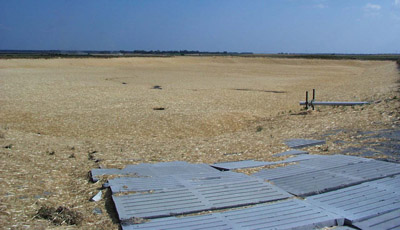
A permeable straw cover on an earthen manure storage structure.

Cost

Permeable covers can provide reductions in odor, ammonia and hydrogen sulfide emissions from manure storage facilities. A wide variety of organic and manmade materials have been utilized to construct permeable covers with variable results and costs ranging from $0.10 to $1.75 per square foot installed. Straw is the least cost permeable cover material with an approximate cost of $0.10 per square foot installed. Longer lasting materials such as LECA have installed costs that can exceed $1.00 per square foot installed. Permeable cover materials are typically floated on the stored manure surface and can provide an aerobic zone that manure gases must pass through when released. Permeable covers can be used with earthen, concrete and steel manure storage systems and with slurry manures generated by swine, dairy and beef animals.

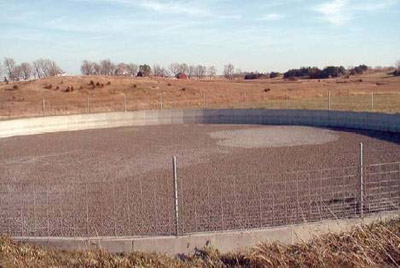
Lightweight expanded clay aggregate (LECA) cover on a concrete swine manure storage tank.

Authors

Robert Burns and Lara Moody, Iowa State University
Point of Contact:
Robert Burns, rburns@iastate.edu

The information provided here was developed for the conference Mitigating Air Emissions From Animal Feeding Operations Conference held in May 2008. To obtain updates, readers are encouraged to contact the author.

Technologies for Mitigating Ethanol and Methanol Emissions from Animal Agriculture

Livestock and Poultry Environmental Learning Center:

Home Page

Reprinted, with permission, from the proceedings of:
Mitigating Air Emissions From Animal Feeding Operations Conference.

The proceedings, “Mitigating Air Emissions from Animal Feeding Operations”, with expanded versions of these summaries can be purchased through the Midwest Plan Service.

Technologies for Ethanol and Methanol Mitigation in Animal Agriculture

Use of Sodium Bisulfate to Reduce Ammonia Emissions from Poultry and Livestock Housing

Reprinted, with permission, from the proceedings of: Mitigating Air Emissions From Animal Feeding Operations Conference.

The proceedings, “Mitigating Air Emissions from Animal Feeding Operations”, with expanded versions of these summaries can be purchased through the Midwest Plan Service.

This Technology is Applicable To:

Species: Poultry (Broiler, Layer, and Turkey), Beef, horses
Use Area: Animal Housing
Technology Category: Chemical Amendment
Air Mitigated Pollutants: Ammonia, Volatile Organic Compounds (VOCs)

System Summary

The application of Sodium bisulfate (SBS) has been shown to effectively reduce ammonia emissions from poultry housing, horse stalls, and dairy facilities. In addition, VOC emissions from fresh cattle manure are also greatly reduced (Marsh Johnson, et al. 2006, Ullman, et al., 2004; Blake and Hess, 2001; Sweeney, et al., 1996; Harper, 2002, Sun et al, 2008). Currently, 40-50% of all broilers produced in the United States are raised on SBS treated litter (PLT® litter acidifier, Jones-Hamilton Co., Walbridge, OH) for the purpose of controlling interior ammonia levels below 20 PPM and reducing litter bacterial levels for bird welfare and performance reasons. In addition to reducing ammonia emissions by 60% from fresh dairy manure, ethanol and methanol emissions were also reduced 61% and 58%, respectively (Sun, et al. 2008). Sodium bisulfate is broadcast over the surface of the bedding material and can be applied in the presence of poultry and livestock.

Sodium bisulfate is a dry, granular acid salt. Current application rates are dependent on litter age, animal density, and other factors and range from 0.32-1.95 kg/m2 (50-300 lbs/1000 sqft) of animal housing space. Decreasing interior ammonia concentrations in poultry housing allow for a reduced ventilation rate leading to substantial fuel savings of up to 43% with sodium bisulfate application (Terzich, 1997). In addition, sodium bisulfate usage improves bird performance, reduces pathogens on poultry carcasses, and decreases poultry respiratory lesions and ascites (Pope and Cherry, 2000; Terzich et al, 1998 a & b).

Applicability and Mitigating Mechanism

  • SBS reduces litter and bedding pH reducing ammonia flux
  • SBS reacts with ammonia to form ammonium sulfate preventing release of ammonia as pH increases over time
  • The combination of sodium and hydrogen reduce manure bacterial populations thereby reducing VOC emissions and pathogens
  • SBS can be safely applied in the presence of animals or prior to animal placement

Limitations

  • SBS application rates need to be increased as ammonia demand in the litter increases

Cost

Sodium bisulfate costs $0.50/kg ($0.23/lb) and the use of a commercial applicator is approximately $40-45 per house. SBS is safe enough to be applied by the farmer or poultry grower. No additional house preparation is necessary for application. Fuel savings in the first 2-3 days recoup the cost of SBS and its application. Improvements in feed conversion, weight, livability, and paw quality all provide substantial additional return on investment.

Authors

Trisha Marsh Johnson1, Bernard Murphy21Veterinary & Environmental Technical Solutions, PC, 2 Jones-Hamilton Co.
Point of Contact:
Dr. Bernard Murphy, bmurphy@jones-hamilton.com

The information provided here was developed for the conference Mitigating Air Emissions From Animal Feeding Operations Conference held in May 2008. To obtain updates, readers are encouraged to contact the author.