The Use of Vegetative Environmental Buffers For Livestock and Poultry Odor Mitigation

Reprinted, with permission, from the proceedings of: Mitigating Air Emissions From Animal Feeding Operations Conference.

The proceedings, “Mitigating Air Emissions from Animal Feeding Operations”, with expanded versions of these summaries can be purchased through the Midwest Plan Service.

This Technology is Applicable To:

Species: Poultry, Dairy, Beef, Swine
Use Area: Animal Housing and Manure Storage
Technology Category: Vegetative Buffers
Air Mitigated Pollutants: Particulate Matter, Odor, Ammonia

System Summary

Vegetative Environmental Buffers (VEBs) – linear arrangements of trees and shrubs planted near and around livestock/poultry production sites – have been shown to incrementally mitigate odors, particulates, and ammonia through a complex of dynamics. Among the most important dynamics are: 1) enhancement of vertical atmospheric mixing through forced mechanical turbulence – leading to enhanced dilution/dispersion of odor; 2) odor filtration through particulate interception and retention – odor largely travels by way of particulates; capturing particulates also captures odors; 3) odor/particulate fallout due to gravitational forces enhanced by reduced wind speeds; 4) adsorption and absorption of ammonia onto and into the plant – this is due to a chemical affinity that ammonia has to the waxy coating on tree leaves; 5) softening socio-psychological responses to odor due to improved site aesthetics and creating “out of sight, out of mind” dynamics; and 6) improved producer/community relations by using highly visible odor management technology.

Applicability and Mitigating Mechanism

  • As air moves across vegetative surfaces, leaves and other aerial plant surfaces can remove odors, dust, gas, and microbial constituents of airstreams.
  • VEBs can mitigate odors/ particulates from all livestock/poultry species;
  • VEBs are size neutral technology and can be used to mitigate odors/particulates from all sources of odor: buildings, manure storage, and land application.
  • Trees/shrubs are among the most efficient natural filtering structures in a landscape.

Limitations

  • Mitigation effectiveness is highly site specific and will vary considerably from farm to farm.
  • VEBs often require considerable land area and may take up to five years to become physically effective.
  • Care in VEB design must be taken to avoid causing snow deposition, ventilation, and on-farm visibility problems.
  • At best, odor/particulate mitigation will be “incremental” and therefore should be always used with other odor management strategies.

Cost

Costs for VEB systems are highly variable and are site/design specific – but for midsized producers (and larger) VEBs likely amount to just a few cents per animal produced. There are three main categories of expenses associated with VEBs: 1) Site prep costs, 2) tree establishment costs, and 3) long term maintenance costs. It should be noted that the majority (usually in the range of 40-70%) of the total cost is “upfront” and is tied to the cost of the initial planting stock (e.g. older, larger nursery stock can be considerably more expensive than bare-root seedlings but such an investment may “buy time” in VEB establishment). Long term maintenance costs vary depending upon the overall health of the VEB. It should be recognized that there are expenditures that occur regularly throughout the life of a VEB and maintenance is an annual process, however as a VEB system matures the annual maintenance requirements will likely decrease over time.

Authors

John C. Tyndall11Department of Natural Resource Ecology and Management
Point of Contact:
John C. Tyndall, jtyndall@iastate.edu

The information provided here was developed for the conference Mitigating Air Emissions From Animal Feeding Operations Conference held in May 2008. To obtain updates, readers are encouraged to contact the author.

Pennsylvania’s Odor Siting Index

Reprinted, with permission, from the proceedings of: Mitigating Air Emissions From Animal Feeding Operations Conference.

This Technology is Applicable To:

Species: Swine, Beef, Poultry, Dairy
Use Area: Animal Housing and Manure Storage
Technology Category: Facility Siting and Management
Air Mitigated Pollutants: Odors

System Summary

The Pennsylvania Siting Index was developed in response to specific state legislation (PA Act 38 of 2005) in an effort to objectively evaluate locations for new or expanding regulated animal operations, then develop an Odor Management Plan to reduce the potential for community conflict from building and manure storage odors. The goal is to construct livestock operations where community odor conflict potential is minimized. Data from the site and site map are entered into the index and the resulting score indicates the complexity of Best Management Practices (BMPs) that must be adopted for a producer to develop the site. Scores of less than 50 index points do not require BMPs. Scores from 50 to 99.9 index points require “Level 1” BMPs, which are generally standard, industry-accepted practices. Scores greater than 100 points require more costly and complicated “Level 2” BMPs. The index cannot be used to prevent an individual from constructing an operation, nor is it used to mitigate specific air emissions.

Applicability and Mitigating Mechanism

  • Required for new and expanding regulated animal operations in Pennsylvania.
  • Objectively scores sites on a numerical scale.
  • Encourages producers to locate animal operations on sites with a low risk of community odor conflict.
  • Requires odor-reduction Best Management Practices if the index score is high.
  • Requires approved Odor Management Plan and annual operation inspection.

Limitations

  • The index does not measure odors or gasses, nor assess effectiveness of BMPs.
  • Weighting of index scores is based on limited data.
  • Producers may not be required to implement BMPs when the number of surrounding homes is minimal, even if those homes are relatively close to the animal facility.
  • The index does not account for future development around an animal operation.
  • Potential for inversion odor conflict is not included in the index.

Cost

The Pennsylvania State Conservation Commission estimates the cost to producers will be approximately $1120 for an index and associated odor management plan. BMP installation and maintenance would vary, depending on BMP complexity. If producers choose a site with an index score of <50 points, BMPs would not be required thus erasing all BMP costs.

Authors

Robert Mikesell1, Karl Dymond2, 1Penn State Department of Dairy and Animal Science, 2 Pennsylvania State Conservation Commission
Point of Contact:
Robert Mikesell, rem9@psu.edu

The information provided here was developed for the conference Mitigating Air Emissions From Animal Feeding Operations Conference held in May 2008. To obtain updates, readers are encouraged to contact the author.

A Receptor-Based Siting Strategy for Swine Production Systems

Reprinted, with permission, from the proceedings of: Mitigating Air Emissions From Animal Feeding Operations Conference.

The proceedings, “Mitigating Air Emissions from Animal Feeding Operations”, with expanded versions of these summaries can be purchased through the Midwest Plan Service.

This Technology is Applicable To:

Species: Swine
Use Area: Animal Housing, Manure Storage
Technology Category: Facility Siting
Air Mitigated Pollutants: Odor

System Summary

A model, called the Community Assessment Model for Odor Dispersion (CAM), was developed to predict receptor odor exposure from multiple swine production sources. The intended use of CAM was to provide a tool for evaluating the odor exposure to receptors in a community when siting new swine production systems and how a change in odor control technology alters the odor exposure to receptors. CAM can handle up to 20 swine production sources with up to 100 receptors in a community of any size. The model incorporates historical (10+ years) average local weather data, coordinates locations of all sources and receptors, ground and above-ground area sources, seasonal variations in odor emission, source production footprint and orientation, and documented proven odor mitigation technologies. CAM does not predict the influence of calm conditions, topography, or obstruction downwash. CAM predicts the number of hours of exposure to weak (2:1) and greater or identifiable (7:1) and greater odors and these are used to assess siting options.

Applicability and Mitigating Mechanism

  • Site location planning for new swine housing and manure storage systems
  • Model developed specific for swine production systems
  • CAM can model up to 20 swine sources and up to 100 receptors in a land area of any size

Limitations

  • CAM has been developed and calibrated for swine systems only
  • Calm conditions not modeled
  • Terrain features beyond rural terrains not modeled
  • CAM requires local historical weather data (10+ years)

Cost

The CAM model requires site specific information to properly implement. Currently CAM is implemented with the ½-time support of an on-campus staff member with no charge to the farmer. A more formal procedure is being developed where a CAM evaluation will require a farmer-fee of either $500/siting case or $1,000/siting case depending on the complexity of the proposed site. A $500 cost to a farmer would be a situation where a campus or extension field staff member is required to visit a proposed site to help guide siting decisions using localized odor plots (described in paper). If the complexity of the proposed site warrants a full CAM modeling run, an additional $500 is required from the farmer.

Authors

Steven J. Hoff1, Dwaine S. Bundy1, Jay D. Harmon1, Colin D. Johnson11Iowa State University Point of Contact:
Steven J. Hoff, hoffer@iastate.edu

The information provided here was developed for the conference Mitigating Air Emissions From Animal Feeding Operations Conference held in May 2008. To obtain updates, readers are encouraged to contact the author.

Siting of Livestock & Poultry Facilities Using MNSET

Reprinted, with permission, from the proceedings of: Mitigating Air Emissions From Animal Feeding Operations Conference.

The proceedings, “Mitigating Air Emissions from Animal Feeding Operations”, with expanded versions of these summaries can be purchased through the Midwest Plan Service.

This Technology is Applicable To:

Species: Poultry, Dairy, Beef, Swine
Use Area: Animal Housing, Manure Storage
Technology Category: Facility Siting
Air Mitigated Pollutants: Odor, Hydrogen Sulfide, Ammonia

System Summary

MNSET predicts three separate air quality impacts. The first prediction is for odor impacts at any given distance downwind from the facilities. The second prediction is for the frequency of exceeding the MN state standard for hydrogen sulfide (30 ppb / 30-minute average not to be exceeded twice in a five day period). Although this may not be applicable for other states it does show relative impacts of hydrogen sulfide. Additionally, MNSET estimates both daily and annual pounds of hydrogen sulfide and ammonia emitted from the modeled facility. Remember however that the outputs of the models are only as valid as the inputs. A literature review was done to develop the flux values used in the model.

MNSET can be used to evaluate the impact of existing sites and quantify reductions of these impacts using various treatment technologies. Unfortunately, this requires reliable quantification of the emission reductions from the mitigation technologies.

Applicability and Mitigating Mechanism

  • Tool for predicting air quality impacts for odor, hydrogen sulfide and ammonia
  • Allows for adding mitigation to reduce these impacts
  • Free downloadable spreadsheet
  • User can add new technologies

Limitations

  • Based on average flux values
  • Conservative predictions
  • Based on Minnesota weather conditions and regulations

Cost

This software can be downloaded free at University of Minnesota Manure Management. The use of MNSET to evaluate the downwind impacts of any mitigation technologies is very valuable both in new construction and in solving existing air quality problems.

Authors

David Schmidt and Larry Jacobson, University of Minnesota
Point of Contact:
David Schmidt, schmi071@umn.edu

The information provided here was developed for the conference Mitigating Air Emissions From Animal Feeding Operations Conference held in May 2008. To obtain updates, readers are encouraged to contact the author.

Siting Animal Production Facilities and Evaluating Odor Control Options Using the Odor Footprint Tool

Reprinted, with permission, from the proceedings of: Mitigating Air Emissions From Animal Feeding Operations Conference.

This Technology is Applicable To:

Species: Poultry, Dairy, Beef, Swine
Use Area: Animal Housing, Manure Storage
Technology Category: Facility Siting
Air Mitigated Pollutants: Odor

System Summary

The Odor Footprint Tool is a worksheet/spreadsheet that provides objective, science-based information on the risk-based impact of odors generated by livestock facilities. The user enters information about the livestock facilities for a given site, the site location (for selection of regional weather data), use of supplemental odor control, and any special terrain around the site. After using the Odor Footprint Tool, the user obtains minimum setback distances in four directions matching up with targets for avoiding odor annoyance. The Odor Footprint Tool can help assess the reduction in the size of a facility’s odor footprint due to use of proven odor control technology.

By using the Odor Footprint Tool, producers and their advisors can mitigate neighbor impacts of odor and air-borne pollutants through improved siting of facilities. They can also use the Odor Footprint Tool to assess the benefit of odor control technologies in terms of reduced area of odor impact, which encourages the utilization of effective control technologies.

Applicability

  • Assesses frequency of odor annoyance from housed swine, cattle and poultry production facilities
  • Considers animal housing facilities and manure storage facilities
  • Assesses reduction in odor footprint due to using proven odor control technology
  • Used on a regional basis within a state
  • Recommended for use as a planning and screening tool

Limitations

  • Not ready for use with open lots, treatment lagoons, and other large area sources
  • Not for assessing odor annoyance during application of manure
  • Requires its own set of emission values
  • Dispersion modeling is required upfront for confident use in a new region having differing weather patterns.
  • Simplified footprints may seem over-simplified or lack desired level of precision

Cost

There is no direct cost for using the publicly available versions of the Odor Footprint Tool to obtain directional setback distances or for conferring with an Extension educator. When producers defer use to an advisor/consultant, it is reasonable to expect to pay for consultant time associated with using the tool, getting their technical response and recommendations, creating project-specific visuals, and presenting material to permitting authorities, local zoning commissions, lenders, etc.

The primary costs associated with the Odor Footprint Tool are upfront costs of calibrating and validating the dispersion model and performing dispersion modeling using weather data for a specific area. Grant funds have been utilized within Nebraska and South Dakota for this purpose.

Authors

Rick Stowell, Chris Henry, Crystal Powers, and Dennis Schulte
University of Nebraska-Lincoln
Point of Contact:
Rick Stowell, rstowell2@unl.edu

The information provided here was developed for the conference Mitigating Air Emissions From Animal Feeding Operations Conference held in May 2008. To obtain updates, readers are encouraged to contact the author.

Reducing H2S, NH3, PM, & Odor Emissions from Deep-pit Pig Finishing Facilities by Managing Pit Ventilation

Reprinted, with permission, from the proceedings of: Mitigating Air Emissions From Animal Feeding Operations Conference.

The proceedings, “Mitigating Air Emissions from Animal Feeding Operations”, with expanded versions of these summaries can be purchased through the Midwest Plan Service.

This Technology is Applicable To:

Species: Swine (maybe Dairy and Poultry)
Use Area: Animal Housing
Technology Category: Management
Air Mitigated Pollutants: Odor, Hydrogen Sulfide, Ammonia, Particulates (PM10)

System Summary

A recent study determined that a large majority (75 to 80 %) of the total NH3 and H2S emissions from a 2000-head tunnel-ventilated deep-pit pig-finishing barn for 45 days during August and September 2004 were emitted from the pit exhaust stream even though only 20 to 30 % of the total barn’s ventilation air was being provided by pit fans. This information allows producers with deep-pit facilities to strategically utilize catch and treat emission control technologies, such as biofilters, ONLY on pit fans airstreams that would result in large reductions (>50%) in the emissions of hazardous gases, odor, and particulate matter by treating only a small portion of the total ventilation air (figure 1). Another follow up study found that emissions of certain pollutants, may be reduced slightly (10 to 20%) by simply eliminating pit fans altogether for a deep-pitted pig building.

The phenomenal of a majority of the barn’s airborne pollutants being emitted by pit fans, may also be true for other swine production phases or for even other species (dairy and poultry) housed in deep pit facilities. This would mean that emission reductions of >50 % for certain pollutants are potentially possible when emission control technologies like biofilters are strategically placed on large emitting pit fan sources in deep-pit buildings. If only small reductions (<20%) of certain pollutants are needed, this maybe accomplished by the elimination of pit fans altogether.

Applicability and Mitigating Mechanism

  • Pit Fan(s) airstreams contain a majority of the critical airborne pollutants (NH3, H2S, PM10, odor) from deep-pitted pig buildings
  • If biofilters are strategically used on pit exhaust air, sizable (>50%) emission reductions of some pollutants are possible for either existing or new deep-pit facilities

Limitations

  • Information only available presently for deep-pit pig finishing barns but anticipated similar results for other swine plus dairy and poultry housed in deep-pit buildings
  • Valid for NH3, H2S, odor, and certain PM fractions, not known if greenhouse gases will also be concentrated in the pit fan exhaust air of deep-pit facilities

Cost

There is no additional cost of this “technology” since a well-designed and operating ventilation system is required in any animal facility and especially in a deep-pitted pig building. There actually may be a cost saving if producers decided to install no or only a limited number of pit fans instead of the standard number for the livestock industry which is approximately 20% of the total barn’s ventilation system. A cost savings is often realized since the installation of pit fans is typically more expensive than wall fans plus pit fans have higher maintenance requirements and are more frequently in need of replacement.

Authors

Larry D. Jacobson1, Brian P. Hetchler1,David R. Schmidt11Bioproducts & Biosystems Engineering, University of Minnesota
Point of Contact:
Larry D. Jacobson, jacob007@umn.edu

The information provided here was developed for the conference Mitigating Air Emissions From Animal Feeding Operations Conference held in May 2008. To obtain updates, readers are encouraged to contact the author.

Diet Modification to Reduce Odors, Gas Emissions and Nutrient Excretions from Swine Operations

Can Changing Pig Diets Reduce Odor Emissions?

The pork industry has undergone a rapid change in the past two decades, with a decrease in farm numbers and an increase in farm size. These changes magnify the stress of the compatibility of pork production with neighbors in rural America. Concerns of the potential impact of the swine operation on water and air quality and health are also raised due to numerous compounds often produced from anaerobic degradation of animal manures, such as, sulfurous compounds, volatile fatty acids (VFAs), and ammonia (NH3). Since the pig is the point source of excreted nutrients resulting in gas and odor emissions, diet modification has the potential to reduce nutrient output and improve air quality.

Our hypothesis is that by utilizing a low nutrient excretion diet formulation and an alternative manure management strategy, the amount of nutrient output and gas/odor emissions will be reduced over the wean-finish period.

Activities

A total of 1, 920 pigs (initial BW = 5.29 kg) were used in a 2 x 2 factorial, wean-finish experiment to determine the effects of diet (control, CTL vs. low nutrient excretion, LNE) and manure management (6 mo. deep-pit, DP vs. monthly pull plug-recharge, PP) on growth performance, nutrient output, and air quality. Pigs were housed in a 12-room environmental building.

Pigs were split-sex and phase-fed to meet or exceed their nutrient requirements (NRC, 1998) at different stages of growth. The CTL and LNE diets were corn-soybean meal based and formulated to an equal Lysine:calorie. The LNE diet formulation had reduced CP and P, increased synthetic amino acids, phytase, non-sulfur trace mineral premix and added fat. Improvements in pig performance were observed over the wean-finish period.

Did Lysine Affect Performance or Odorous Emissions?

Pigs fed the LNE diets were 4.3 kg heavier (131.2 vs. 126.9 kg) at market, gain was increased by 0.03 kg/d (0.83 vs. 0.80 kg/d), feed intake was reduced by 0.16 kg/d (1.95 vs. 2.11 kg/d), and overall feed efficiency was increased by 11.6% (0.43 vs. 0.38) compared to CTL fed pigs (P<0.01). In addition, manure generation was reduced by 0.39 L/pig/d when the LNE diets were fed vs. the CTL diets (4.05 vs. 4.44 L/pig/d, P<0.008).

Excretion of total N, P, and K was reduced (P<0.001) by 27.5, 42.5, and 20.4%, respectively, from LNE fed pigs. Pigs fed the LNE diets had a 25.5, 23.8, 32.3, 18.5, 35.8, and 26.7% reduction (P<0.05) in manure acetate, iso-butyrate, iso-valerate, valerate, and total VFA production, respectively, compared to CTL fed pigs. Using the PP manure strategy reduced manure ammonium N and VFA production by 10.3 % (16.5 vs. 18.4 g/pig/d; P<0.002) and 20.5% (26.0 vs. 32.7 mM/pig/d; P<0.001), respectively, compared to DP strategy. Pigs fed LNE diets had a 13.6% (P<0.001) reduction in aerial NH3 emissions over the wean-finish period compared to pigs fed CTL diets. Aerial H2S and SO2 emissions and odor were not different (P>0.10) between dietary treatments.

Why is This Important?

Feeding LNE diet formulations are effective in reducing environmental impacts of pork production while maintaining growth performance. In addition, utilizing a monthly pull plug-recharge manure management strategy can improve air quality parameters, however can be more labor intensive.

For More Information

Contact us at jradclif@purdue.edu or (765)496-7718.

By Scott Radcliffe, Brian Richert, Danielle Sholly, Ken Foster, Brandon Hollas, Teng Lim, Jiqin Ni, Al Heber, Alan Sutton – Purdue University

This report was prepared for the 2008 annual meeting of the regional research committee, S-1032 “Animal Manure and Waste Utilization, Treatment and Nuisance Avoidance for a Sustainable Agriculture”. This report is not peer-reviewed and the author has sole responsibility for the content.

Air Emission and Energy Usage Impacts of No Pit Fans in a Wean to Finish Deep Pit Pig Facility

What Is Being Measured?

The objectives of this research project are to monitor the indoor air quality of a deep-pit; wean-to-finish pig building over one pig-growth cycle (six months) by semi-continuously measuring concentrations of ammonia (NH3), hydrogen sulfide (H2S), carbon dioxide (CO2), methane (CH4), and volatile organic compounds (VOCs) and intermittently measuring particulate matter (PM10) and odor. The project will also monitor semi-continuous emissions of NH3, H2S, CO2, CH4, and VOCs plus intermittent sampling of odor emissions from the barn’s pit and wall exhaust streams over the six month growth period. Energy usage, both electrical and LP gas usage will be measured for both pit and non-pit ventilated rooms over the pig growth, along with pig performance (daily gain, feed efficiency, and death loss) between the rooms.

Current Activities

A cooperating pork producer is being located in southern Minnesota with a tentative starting date of July 1, 2008 for data collection.

Does the Use of Pit Fans Make a Difference in Air Emissions from Deep-Pit Pig Barns?

Air emissions from tunnel ventilated pig finishing barns have been monitored and partitioned between pit and wall fans during the past two years in Minnesota. The results showed that a disproportionate amount of hydrogen sulfide (H2S) and ammonia (NH3) emissions were emitted from the deep pit finishing barn through pit fans even though it was concluded that “pit” ventilation has little effect on the barn’s indoor air quality (figure 1). Thus producers might be able to reduce emissions of these hazardous gases and the associated odor of these gases simply by limiting or not using pit ventilation fans. Such a strategy would save electrical energy use since larger more efficient wall fans could replace the less efficient pit fans.

Figure 1. Hydrogen Sulfide Emissions from a 1200 head pig finishing barn with varying pit ventilation rates during a winter (January 26 to March 4, 2006) period. Contributed to eXtension CC2.5

Why is This Important?

Data collected from the deep pit facility will be used to determine the benefit of pit fans to indoor air quality in swine wean to finish buildings and what impact the use of pit fans has on energy usage and gas, odor, and particulate matter emissions from this stage of pork production buildings .

For More Information

Jacobson, L.D., B.P. Hetchler, and D.R. Schmidt. 2007. Sampling pit and wall emission for H2S, NH3, CO2, PM, & odor from deep-pit pig finishing facilities. Presented at the International Symposium on Air Quality and Waste Management for Agriculture. Sept 15-19, 2007. Broomfield, CO. St. Joseph, Mich.: ASABE

Authors: Larry D. Jacobson, David Schmidt and Brian Hetchler, University of Minnesota

This report was prepared for the 2008 annual meeting of the regional research committee, S-1032 “Animal Manure and Waste Utilization, Treatment and Nuisance Avoidance for a Sustainable Agriculture”. This report is not peer-reviewed and the author has sole responsibility for the content.

Odor Emissions and Chemical Analysis of Odorous Compounds from Animal Buildings

Why Study Odor Emissions from Animal Housing?

  • To determine odor emission characteristics by using common protocols and standardized olfactometry, from four mechanically-ventilated National Air Emissions Monitoring Study (NAEMS) sites, two dairy and two swine.
  • To develop a comprehensive chemical library that delineates the most significant odorants, and correlate this library with olfactometry results.
  • To disseminate information to stakeholders including producers, agencies, regulators, researchers, local government officials, consultants, and neighbors of animal operations.

Current Activities

Data is being collected from the four NAEMS sites (dairy sites in Wisconsin and Indiana and pig sites in Iowa and Indiana). Data collection is about ¼ completed (first 13 week cycle completed in April, 2008 and second cycle started in May, 2008) Raw data compilation in a U of MN website based spreadsheets for this first round is nearly completed. Olfactometry data is being done at the U of MN, Iowa State, and Purdue labs while GC-MS data is analyzed at West Texas State University and GC-MS-O data is processed at Iowa State University.

What We Have Learned

Sorbent tubes for both GC-MS data and GC-MS-O data have been successfully used to trap VOC in the emissions streams from the four barns without “breakouts” occurring. Approximately 15 to 20 compounds are being identified and with airflow data, actual emission data of these compounds should be able to be calculated.

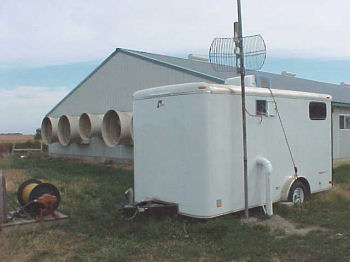
instrumentation trailer making air quality measurements and air flow rates as part of the NAEMS study


Why is This Important?

This study is supplementing the National Air Emissions Monitoring Study (NAEMS) with comprehensive measurements of odor emissions. The NAEMS will help livestock and poultry producers comply with EPA regulations concerning regulated gases and particulate matter by monitoring these pollutants continuously for 24 months, in order to determine which types of farms are likely to emit threshold levels of contaminants under the current regulations. Although odor plagues the animal industry with the greatest overall challenge, it is not included in the NAEMS, because the EPA does not regulate it and therefore did not include it in the Air Consent Agreement.

This project adds odor emission measurements at four NAEMS sites during 12 months of the study. Both standard human sensory measurements (using dynamic forced-choice olfactometry), and a novel chemical analysis technique (GC-MS-O) for odorous compounds found in these emissions is being done in this study. The sensory and chemical methods would be correlated to gain both quantitative and qualitative understanding of odor emissions from animal buildings.

For More Information

Contact Larry D Jacobson, University of Minnesota, BBE Department, 1390 Eckles Ave, St. Paul, MN 55108. email: jacob007@umn.edu or phone 612-625-8288.

Larry D. Jacobson, Ipek Celen and Brian Hetchler, University of Minnesota

This report was prepared for the 2008 annual meeting of the regional research committee, S-1032 “Animal Manure and Waste Utilization, Treatment and Nuisance Avoidance for a Sustainable Agriculture”. This report is not peer-reviewed and the author has sole responsibility for the content.

Odor Mitigation Using Vegetative Environmental Buffers Research Summary

Why Study Trees for Controlling Odors from Livestock and Poultry Buildings?

The objective of this research is to evaluate the bio-physical, economic and social efficacy of the use of Vegetative Environmental Buffers (VEBs) – purposefully planted linear arrangements of trees and shrubs – to incrementally mitigate livestock and poultry odor. Our research has demonstrated that tree barriers can help impede, alter, absorb, and/or dissipate livestock odor plumes and other emissions prior to contact with people. As air moves across vegetative surfaces, leaves and other aerial plant surfaces remove some of the dust, gas, and microbial constituents of airstreams. Trees and other woody vegetation also enhance localized air dispersion by increasing mechanical turbulence. Our research program into the efficacy of VEBs involves a multi-disciplinary, multi-species and multi-analytic perspective. Related: Archived webcast on “Trees, Shelterbelts, and Windbreaks for Mitigating Livestock and Poultry Odors

Activities

The efficacy of VEBs in mitigating livestock and poultry odor is being examined from a three- pronged perspective measuring efficacy in:

  1. field measured bio-physical terms (e.g. physical reductions in downwind movement of particulates, odor and ammonia and long-term tree health)
  2. financial feasibility terms at the farm-level (e.g. total costs of VEB establishment and maintenance vs. producer willingness to pay), and
  3. in terms of social approval of the use of VEBs (e.g. evaluation of the impact of VEBs on production site aesthetics and consumer willingness to pay for environmentally friendly meat products).

The quantification of physical odor mitigation via the use of VEBs is approached with field trials using full size VEB systems (multiple rows of trees) at working poultry and swine facilities as well as using scale models of these facilities for wind tunnel examinations and advanced computer simulation.

Custom rate financial data has been collected and applied to a range of livestock facilities (e.g. differing VEB designs, production scale, etc.) to calculate typical upfront and long-term costs. Producer willingness to pay has been determined via multi-state producer surveys. Social opinion data was collected via multi-state consumer focus groups (utilizing photo elicitation techniques) and a series of integrated social surveys.

Can Trees Reduce Odor Movement?

Baseline physical data suggests that VEBs can contribute up to a 10% reduction in the movement of odor downwind. The technology broadly applied at the farm level seems to be financially feasible to most swine producers – with total costs ranging from $0.01 to $0.33 per pig produced; these costs by and large being well below maximum producer willingness to pay for the use of VEBs. And social surveys in IA and NC show strong social support and appreciation of the use of trees for air quality purposes with strong social agreement that VEBs improve the aesthetics of confinement production.

Why is This Important?

Affordable, tertiary odor mitigation technology with the added benefit of being socially acceptable is a strong compliment to any comprehensive manure management program at production sites .

For More Information

Author: John Tyndall, Iowa State University

Visit the Iowa State University vegetative environmental buffers website.

Read the following article: Tyndall, J.C. and J.P. Colletti. 2007. Mitigating Swine Odor with Strategically Designed Shelterbelt Systems: A Review. Agroforestry Systems. Volume 69, Number 1/January, 2007.

This report was prepared for the 2008 annual meeting of the regional research committee, S-1032 “Animal Manure and Waste Utilization, Treatment and Nuisance Avoidance for a Sustainable Agriculture”. This report is not peer-reviewed and the author has sole responsibility for the content.