
Odorgon: Overhead Spray System to Neutralize Odors

Reprinted, with permission, from the proceedings of: Mitigating Air Emissions From Animal Feeding Operations Conference.

This Technology is Applicable To:

Species: Poultry, Dairy, Beef, Swine
Use Area: Animal Housing
Technology Category: Chemical Amendment
Air Mitigated Pollutants: Ammonia, Hydrogen Sulfide, Odors

System Summary

Odorgon is a water based formulation that is applied in confined animal feeding operations through a high pressure mist system. Odorgon is sprayed on an automated timer basis from the ceilings through high pressure nylon lines and nozzles to neutralize malodors.

Applicability and Mitigating Mechanism

  • Unique class of cationic surfactants
  • Atomized solution sprayed at 600 psi
  • Buffer resulting in non volatile organic salts
  • Greatly reduces ammonia & hydrogen sulfide
  • Creates better environment for animals to thrive in resulting in lower mortality, less culls and less days to finish.
  • Better conditions for workers/employees
  • Mitigates neighbor/social issues

Limitations

  • Water based, subject to freezing
  • Summer use may be curtailed in

open buildings during windy conditions

Cost

Equipment cost for a 42 by 200 foot finishing building with all components installed is approximately $4900. Annual usage for this facility would average $2100 of Odorgon concentrate or .73 per animal unit but could vary with region/climate. Nursery cost for swine is .19 per animal unit. Odorgon is mixed with water at a rate of 50 parts water to 1 part concentrate resulting in a cost of $1.50 per gallon diluted. Cost also varies based on building dimensions and desired results.

Authors

Steve Opheim, VP Klean Air Inc.
Point of Contact:
Ron Hamilton, rrhamilto@aol.com

The information provided here was developed for the conference Mitigating Air Emissions From Animal Feeding Operations Conference held in May 2008. To obtain updates, readers are encouraged to contact the author.

Atomization Treatment to Improve Air Quality in a Swine Concentrated Animal Feeding Operation (CAFO)

Reprinted, with permission, from the proceedings of: Mitigating Air Emissions From Animal Feeding Operations Conference.

The proceedings, “Mitigating Air Emissions from Animal Feeding Operations”, with expanded versions of these summaries can be purchased through the Midwest Plan Service.

This Technology is Applicable To:

Species: Swine
Use Area: Animal Housing
Technology Category: Other Treatment
Air Mitigated Pollutants: Particulate Matter (PM), Viable Bacteria, Ammonia

System Summary

Juergens Environmental Control Systems are designed to reduce particulate matter (PM), viable bacteria and ammonia and utilizes a high pressure atomization solution. Treatment consists of a formulation comprising proprietary proportions of corn oil, citric acid, ethyl alcohol, eucalyptus, vanilla and water. The formulation was developed to reduce airborne PM and ammonia through short- and long-term mechanisms. The short-term mechanisms include oil encapsulation through electrostatic attraction and coagulation. Long-term reductions occur through the suppression of dust re-suspension. Citric acid is added to neutralize gaseous ammonia. Alcohol helps dry the atomized aerosol and serves as an adjuvant so that formulation components are in complete suspension. Vanilla is added providing a deception for the olfactory senses, and eucalyptus for its respiratory medicinal property. Final formulation is atomized for 5 seconds, six times a day at a pressure of 235 psi (1620 kPa) and a rate of 45 mL/m2. The nozzles are located on the ceiling at 5 or 10 foot centers for complete coverage of the treated area and were designed to produce an aerosol 1-10 ímin diameter under conditions of this formulation and pressure.

Applicability and Mitigating Mechanism

  • Atomization treatment is effective at swine housing systems, such as in finishing, breeding and gestation production systems.
  • The oil is in a water formulation that includes alcohol, citric acid, vanilla and eucalyptus to dry and help mix the atomization solution, neutralize gaseous ammonia, and provide a pleasant odor, respectively.
  • The oil formulation is applied under high pressure, yielding micron-sized charged particles that efficiently remove PM through electrostatic attraction and coagulation.

Limitations

  • Atomization treatment is effective at swine housing systems, such as in finishing, breeding and gestation production systems.
  • The oil is in a water formulation that includes alcohol, citric acid, vanilla and eucalyptus to dry and help mix the atomization solution, neutralize gaseous ammonia, and provide a pleasant odor, respectively.
  • The oil formulation is applied under high pressure, yielding micron-sized charged particles that efficiently remove PM through electrostatic attraction and coagulation.

Cost

Field application of the atomization system and solutions are subject to change. The fixed cost of the system for 1000 – 8000-pig finishing operation averages $1.96 – $7.79 per pig per 3 year term (shipping and installation labor not included). The cost of atomization operating averages $ 0.01 per pig per day over one year. The fixed cost of the system for 500-5000-sow operation averages $9.00 – $16.00 per sow per 3 year term (shipping and installation labor not included). The cost of atomization averages $.01 per sow per day over one year.

Authors

Peter E. Juergens1, Gary L. Rapp11Juergens Environmental Control
Point of Contact:
Gary Rapp, garyrapp@westianet.net

The information provided here was developed for the conference Mitigating Air Emissions From Animal Feeding Operations Conference held in May 2008. To obtain updates, readers are encouraged to contact the author.
Mitigation of Odor and Pathogens from CAFOs with UV/TIO2: Exploring Cost Effectiveness

Reprinted, with permission, from the proceedings of: Mitigating Air Emissions From Animal Feeding Operations Conference.

This Technology is Applicable To:

Species: Swine, Poultry
Use Area: Animal Housing
Technology Category: Air Treatment (UV Photocatalysis)
Air Mitigated Pollutants: Volatile Organic Compounds, Odor, Pathogens

System Summary

Odor and target VOCs responsible for livestock odor are mitigated by UV-185 nm (‘deep’ UV) in presence of TiO2 as a catalyst into less odorous or odorless products such as CO2 and H2O. Percent removals from 80 to 99% were measured in lab-scale experiments involving simulated livestock VOCs/odorants and 1 sec irradiation with a low wattage 5.5 W lamp. Selected VOCs simulating livestock odor included p-cresol, sulfur-containing VOCs, and volatile fatty acids. Treatment cost of $0.25 per pig and continuous operation during growing cycle was estimated when the lab-scale results were extrapolated to typical ventilation rates and electricity cost at a swine finish operation in rural Iowa. The long-term goal is to develop cost-effective technology for the simultaneous treatment of odor and pathogens in livestock housing through logical progression of testing from lab-scale, through pilot-scale and finally at commercial scale. Such treatment would be applicable to both the inflow (for airborne pathogen control) and outflow air (for odor and pathogen control) at typical existing and new mechanically-ventilated barns.

Applicability and Mitigating Mechanism

  • Removal of VOCs and responsible for livestock odor in simulated barn air exhaust with UV light and advanced oxidation.
  • Research continues to move this technology from lab to commercial applications.
  • Potentially applicable to both the inflow (for airborne pathogen control) and outflow air (for odor and pathogen control) at typical existing and new mechanically-ventilated barns
  • On-demand, intermittent operation.

Limitations

  • This technology is still under development
  • Cost estimates are extrapolated from lab-scale experiments
  • Effects of particulate matter on UV treatment needs to be investigated
  • Effectiveness and costs associated long-term full-scale operation are not known at this time.

Cost

Treatment cost of $0.25 per pig and continuous operation during growing cycle was estimated when the lab-scale results were extrapolated to typical ventilation rates and electricity cost at a swine finish operation in rural Iowa. This cost could be further reduced for intermittent, on-demand operation. The capital costs would be mainly cost of ‘on-the-shelf’ deep’ UV lamps (currently at $90 for 10W lamp) and the cost of retrofitting of barn exhaust.

Authors

Jacek A. Koziel1,Xiuyan Yang1, Tim Cutler1, Shicheng Zhang1, Jeffrey Zimmerman1, Steven J. Hoff1, William Jenks1, Hans Van Leeuwen1, Yael Laor2, Uzi Ravid3, Robert Armon31Iowa State University, 2’Ya’ar Research Center, Agricultural Research Organization, Israel, 3Faculty of Civil and Environmental Engineering Technion, Haifa, Israel
Point of Contact:
Jacek Koziel, koziel@iastate.edu

The information provided here was developed for the conference Mitigating Air Emissions From Animal Feeding Operations Conference held in May 2008. To obtain updates, readers are encouraged to contact the author.

Gas Impermeable Film and Sheet for Control of Methane and Odors in Agricultural Applications

Reprinted, with permission, from the proceedings of: Mitigating Air Emissions From Animal Feeding Operations Conference.

The proceedings, “Mitigating Air Emissions from Animal Feeding Operations”, with expanded versions of these summaries can be purchased through the Midwest Plan Service.

This Technology is Applicable To:

Species: Swine, Dairy, Beef, Poultry
Use Area: Manure Storage, Manure Treatment
Technology Category: Covers
Air Mitigated Pollutants: Odors, Methane, Ammonia

System Summary

For many years, food packaging has incorporated barrier layers to contain odors, flavors, oils and moisture along with the food contents while excluding contamination and oxygen. Until recently, agricultural films and geomembranes were monolithic structures employing only a single polymer or blend. Recent advances in extrusion and lamination equipment allow the incorporation of these barrier layers in large scale agricultural structures and operations such as floating covers over animal waste storage, containment geomembranes for biogas generation, silage storage and fumigation films.

To view the video in full screen, click the icon second from right on the bottom of the viewer.
Download a copy of this video

Co-extruding a thin layer of ethylene vinyl alcohol (EVOH) in a linear low density polyethylene (LLDPE) geomembrane dramatically reduces the permeability to a wide range of gases and volatile organic carbon molecules including: methane, ammonia, carbon dioxide, oxygen, aromatic hydrocarbons, aliphatic hydrocarbons, methyl bromide and most odorous compounds. Methane permeabilites for four geomembranes are given below.

Methane Permeability (cc/(m2*day))
PVC LLDPE HDPE Barrier LLDPE
0.76 mm (30 mils) 1.0 mm (40 mils) 1.0 mm (40 mils) 0.5 mm (20 mils)
900 690 300 <1

Applicability and Mitigating Mechanism

  • Barrier to noxious gases and odors
  • Useful in cover and containment systems

Limitations

  • EVOH is a crystalline polymer and is not elastic. It is flexible but should not be used as part of an elastomeric structure.

Cost

Engineered floating covers with ballasted weight systems, gas extraction systems and rainwater removal systems costs vary greatly. For waste lagoon of about 1/2 acre in size, the cover system can cost from $150,000 to $200,000. Addition of the barrier layer to the geomembrane adds less than $5,000.

Authors

Gary Kolbasuk, Raven Industries, Engineered Films Division
Point of Contact:
Gary.Kolbasuk@Ravenind.com

The information provided here was developed for the conference Mitigating Air Emissions From Animal Feeding Operations Conference held in May 2008. To obtain updates, readers are encouraged to contact the author.

Characterizing Ammonia Emissions from Swine Farms in Eastern North Carolina – Part I. Conventional Lagoon and Spray Technology for Waste Treatment

Reprinted, with permission, from the proceedings of: Mitigating Air Emissions From Animal Feeding Operations Conference.

This Technology is Applicable To:

Species: Swine
Use Area: Manure Storage
Technology Category: Anaerobic Lagoon, Management
Air Mitigated Pollutants: Ammonia

System Summary

The conventional lagoon and spray technology (LST), is the current system predominantly used in North Carolina to manage pig waste. It consists of anaerobic lagoons to store and biologically treat pig waste (~99.5% liquid). Effluent from the lagoons is sprayed on surrounding crop fields as a nutrient source. Four distinct components and associated processes of LSTs release NH3 to the atmosphere: (1) production houses, (2) waste storage and treatment systems such as lagoons, (3) land application through injection or spraying, and (4) biogenic emissions from soils and crops

Applicability and Mitigating Mechanism

  • Anaerobic lagoons used to store and biologically treat hog manure
  • Manure sprayed on crops as source of nutrients


Limitations

  • Significant emissions of ammonia, odor and potential pathogens
  • Flooding during extreme weather events


Cost

Ten year annualized costs for a “Baseline” LST for a 4,320-head finishing farm using a pit recharge system of manure removal is predicted to be approximately $90 per 1,000 lbs. steady state live weight per year (Williams, 2006. see Table 8a, page 58 – Development of Environmentally Superior Technologies. 2006. Phase 3 Technology Determination Report, published by NCSU College of Agriculture and Life Sciences, 716 pgs, on file with NCSU Animal and Poultry Waste Management Center (March 8,2006). Also available at www.cals.ncsu.edu/waste_mgt/

Authors

V.P. Aneja1, S.P. Arya1, I.C. Rumsey1, C.M. (Mike) Williams21Department of Marine, Earth and Atmospheric Sciences North Carolina State Univesity, 2 Department of Poultry Science, & Director, Animal and Poultry Waste Management Center, North Carolina State University
Point of Contact:
Viney P. Aneja, viney_aneja@ncsu.edu

The information provided here was developed for the conference Mitigating Air Emissions From Animal Feeding Operations Conference held in May 2008. To obtain updates, readers are encouraged to contact the author.

A Surface Aeration Unit for Odor Control from Liquid Swine Manure Storage Facilities

Reprinted, with permission, from the proceedings of: Mitigating Air Emissions From Animal Feeding Operations Conference.

The proceedings, “Mitigating Air Emissions from Animal Feeding Operations”, with expanded versions of these summaries can be purchased through the Midwest Plan Service.

This Technology is Applicable To:

Species: Swine, Dairy, Poultry
Use Area: Manure Storage
Technology Category: Aeration
Air Mitigated Pollutants: Odors

System Summary

A surface aeration system composed of an aerator module with six venturi air injectors has been demonstrated to effectively reduce odor level (measured by odor detection threshold) emitted from an operating swine manure anaerobic lagoon. Past research reports have shown that partially aerating manure can reduce the power consumption by up to 80% as compared to full aeration, while still achieving satisfactory odor amelioration. Data from this project provide further evidence that it is not only feasible but also affordable for animal producers to consider using this technology to control odor. A reduction in odor detection threshold by about 67% was achieved after the surface aeration system started operation in the test lagoon for about 10 days. It was also observed that the aeration treatment could maintain a dissolved oxygen level of 0.3 mg/L in the top lagoon liquid and the aerated layer worked like a biological cover that had the capability of destroying the odorous compounds passing through it. Although the surface aeration technology presented in this paper is tested in swine manure lagoons, it is expected that the technology can also be applied to manure lagoons of other animal species such as dairy and poultry. As a matter of fact, there are already experiments being carried out on a poultry lagoon in Texas using the same aeration apparatus, the results from which will be compared with those presented here. It is anticipated that the aeration system will be available to animal producers in the near future.

Applicability and Mitigating Mechanism

  • The surface aeration system can be applied to any open liquid manure storage facilities
  • Odorous compounds are intermediate products during anaerobic digestion and, without treatment, they will be emitted into air causing odor problems
  • Aeration is to provide oxygen to the aerobic microorganisms in the liquid so that they can actively decompose these odorous compounds
  • Surface aeration establishes a biological cover in which aerobes use the provided oxygen to clean up the odorous materials before they reach the air


Limitations

  • This technology is not suitable for in-barn manure storage structures such as deep pits
  • Since the surface aeration system is placed outdoors, the ambient temperature should always be above freezing point so the technology cannot be used in northern states of the country in winter.
  • Ammonia emission from the lagoon liquid under treatment may be increased due to increased pH in the liquid and the mixing effect


Cost

The capital cost of this surface aeration system is relatively inexpensive and all the venturi air injectors are commercially available (under $200/each). For a one-acre lagoon, the equipment cost including materials and installation may be anywhere between $10,000 and $15,000 and the running cost (for a 4.5 horsepower pump running 24 hours a day, 365 days a year) will be 4.5 hp x 0.75 kW/hp x 24 h/day x 365 day/year = 29,565 kWh. Assuming the price per kWh being at $0.07, the total annual cost for the operation will be 29,565 kWh x $0.07 = $2,070. Considering the particular lagoon receiving manure from 4,000 head finishing pigs and 2.5 production cycles a year, the treatment cost per pig marketed is only around 21 cents.

Authors

Jun Zhu1, Chunying Dong1, Cutis Miller1, Liang Wang1, Yecong Li1, Saqib Mukhtar21University of Minnesota, 2 Texas A&M University
Point of Contact:
Jun Zhu, zhuxx034@umn.edu

The information provided here was developed for the conference Mitigating Air Emissions From Animal Feeding Operations Conference held in May 2008. To obtain updates, readers are encouraged to contact the author.

RAPP Technology for Control of Gas and Odor from Swine Manure Pits

Reprinted, with permission, from the proceedings of: Mitigating Air Emissions From Animal Feeding Operations Conference.

The proceedings, “Mitigating Air Emissions from Animal Feeding Operations”, with expanded versions of these summaries can be purchased through the Midwest Plan Service.

This Technology is Applicable To:

Species: Swine
Use Area: Manure Storage
Technology Category: Chemical Amendment
Air Mitigated Pollutants: Odors, Ammonia, Carbon Dioxide, Sulfur Dioxide

System Summary

This gas and odor reduction technology, Rapp Technology, consists of an oil cover and a neutralizer that is an alkaline solution. The laboratory study in swine manure reactors to simulate deep manure pit demonstrated statistically significant reductions of ammonia, carbon dioxide, sulfur dioxide, and odor from the treated reactors. Compared with previously tested commercial manure additives, this technology is more effective in mitigating gas and odor emissions from simulated deep manure pits.

Applicability and Mitigating Mechanism

  • The oil cover is added at initial application. It floats on the surface of the manure slurry to slow the releases of gases and odorous molecules while allowing excrement to pass through.
  • The neutralizer solution is injected beneath the oil cover periodically. It neutralizes the volatile fatty acids and phenols in the slurry to their ammonium salts. Such salts are more prone to stay in the aqueous slurry because they are more water-soluble and less volatile than the original acids.


Limitations

  • The oil cover is not suitable for applying on the manure on the barn floors.
  • The effect of neutralizer on emission reduction could not be differentiated from the effect of oil cover in the lab test.
  • Future high quality field studies are needed.

Cost

During the lab test, the oil and the neutralizer (both by Custom Formulating & Blending, Bristol, IN) cost $1.13 and $ 0.67 per reactor, respectively. According to Juergens Environmental Control (Carroll, Iowa) for field application of the neutralizer, the fixed cost of the system for 1000 to 8000-pig finishing operations averages $2.50 – $5.00 per pig per 3-year term (shipping and labor not included). The cost of neutralizer operation averages $ 0.01 per pig per day over one year.

Authors

Ji-Qin Ni1, Sam Hanni1, Albert J. Heber1, Warren M. Kosman2, Gary Rapp3, 1Purdue University, 2Valparaiso University, 3Juergens Produce and Feed Company
Point of Contact:
Gary Rapp, garyrapp@westianet.net

The information provided here was developed for the conference Mitigating Air Emissions From Animal Feeding Operations Conference held in May 2008. To obtain updates, readers are encouraged to contact the author.

Negative Air Pressure Cover for Preventing Odor Emission from Earthen Manure Storage

Reprinted, with permission, from the proceedings of: Mitigating Air Emissions From Animal Feeding Operations Conference.

The proceedings, “Mitigating Air Emissions from Animal Feeding Operations”, with expanded versions of these summaries can be purchased through the Midwest Plan Service.

This Technology is Applicable To:

Species: Swine
Use Area: Manure Storage
Technology Category: Covers
Air Mitigated Pollutants: Odors

System Summary

An impermeable synthetic cover system was developed by DGH Engineering in Manitoba, Canada for mitigating odor emission from earthen manure storage basins (EMSB). The system uses lightweight plastic as the cover so that it is affordable to producers. An air pumping system creates negative pressure between the cover and the manure surface to hold down the cover to ensure the cover is robust enough to withstand wind forces. The air pumping system consists of small exhaust fans (four to six fans of 50 – 70 L/s each) and perforated ducts placed about the EMSB perimeter. Odor emission from the NAP covered EMSB (due to the air pumping system) is negligible (1%) in comparison with the open EMSB. Additional benefits of the NAP cover system include the retention of manure nitrogen, thus increasing the fertilizer value of manure; isolating precipitation from the manure, thereby increasing storage volume; and reducing greenhouse gas (methane) emissions.


Applicability and Mitigating Mechanism

  • Large surface areas of earthen manure storage basins emit large amount of odor to the atmosphere
  • A NAP cover forms a physical barrier between the manure surface and the atmosphere to prevent odor release into the atmosphere
  • The negative pressure between the cover and the manure surface holds the cover down to resist wind forces.


Limitations

  • When using traditional agitation and pump-out equipment, removing and replacing the cover for pump-out may increase the wear on the cover and add labor and time to the pump-out operation.
  • An air assisted agitation system should be used.


Cost

The capital cost varies from $10.00 to $15.00 per m², installed. The annual cost per pig marketed for typical 5,000 and 10,000 head swine finisher operations is estimated to be $1.40 and $1.13.

Authors

Q. Zhang1, D. Small 2
1University of Manitoba, 2 DGH Engineering
Point of Contact:
Doug Small, dgh@dghengineering.com

The information provided here was developed for the conference Mitigating Air Emissions From Animal Feeding Operations Conference held in May 2008. To obtain updates, readers are encouraged to contact the author.

A Review of Permeable Cover Options for Manure Storage

Reprinted, with permission, from the proceedings of: Mitigating Air Emissions From Animal Feeding Operations Conference.

The proceedings, “Mitigating Air Emissions from Animal Feeding Operations”, with expanded versions of these summaries can be purchased through the Midwest Plan Service.

This Technology is Applicable To:

Species: Beef, Dairy, Swine
Use Area: Manure Treatment
Technology Category: Covers
Air Mitigated Pollutants: Ammonia, Odors, Hydrogen Sulfide

System Summary

Covers have been demonstrated to provide effective odor and air emissions control for manure storage structures. Impermeable covers made from flexible synthetic materials provide excellent odor and emissions control, but typically have a high capital cost requirement. Permeable covers provide an alternative to impermeable synthetic covers. Permeable covers will typically not provide as great a level of odor control as impermeable covers, but the initial capital cost is lower. Permeable covers do not require gas or rain water collection systems since gases are allowed to migrate through the cover and rainwater will infiltrate through the cover into the storage. Permeable covers have been successfully constructed from a variety of materials including straw, light weight expanded clay aggregate (LECA), ground rubber and geotextile materials. Materials such as straw, have a short lifespan (from two to six months depending on manure solids content and rainfall levels), while materials such as LECA have been shown to remain viable for more than ten years. Various permeable cover materials have been shown to reduce odor from 40% – 90%, and to reduce ammonia from 40% to 80% depending on permeable cover material and depth.


Applicability and Mitigating Mechanism

  • Permeable covers provide a layer on the manure surface that shields the manure surface from contact with the air
  • Most permeable cover materials provide an aerobic zone in the cover material that will help control odor
  • No gas or water collection systems are required since both gases and rain water will pass through the permeable cover material
  • Some permeable cover materials such as straw provide a short-term solution, while other like LECA can last more than ten years


Limitations

  • Some permeable cover materials (such as straw) have very short effective lives (2 – 6 months)
  • Long-term permeable cover materials (such as LECA) can have costs near those of synthetic impermeable covers
  • If a permeable cover material sinks into the stored manure, it must be dealt with during land application
  • Rainwater volume must be accounted for in the manure storage since direct precipitation will infiltrate into the manure storage

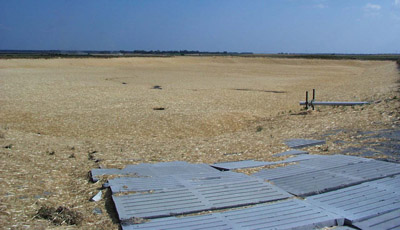
A permeable straw cover on an earthen manure storage structure.

Cost

Permeable covers can provide reductions in odor, ammonia and hydrogen sulfide emissions from manure storage facilities. A wide variety of organic and manmade materials have been utilized to construct permeable covers with variable results and costs ranging from $0.10 to $1.75 per square foot installed. Straw is the least cost permeable cover material with an approximate cost of $0.10 per square foot installed. Longer lasting materials such as LECA have installed costs that can exceed $1.00 per square foot installed. Permeable cover materials are typically floated on the stored manure surface and can provide an aerobic zone that manure gases must pass through when released. Permeable covers can be used with earthen, concrete and steel manure storage systems and with slurry manures generated by swine, dairy and beef animals.

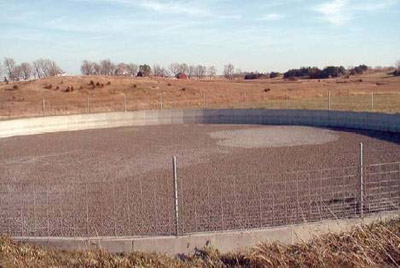
Lightweight expanded clay aggregate (LECA) cover on a concrete swine manure storage tank.

Authors

Robert Burns and Lara Moody, Iowa State University
Point of Contact:
Robert Burns, rburns@iastate.edu

The information provided here was developed for the conference Mitigating Air Emissions From Animal Feeding Operations Conference held in May 2008. To obtain updates, readers are encouraged to contact the author.

Technologies for Mitigating Ammonia Emissions from Animal Agriculture

Reprinted, with permission, from the proceedings of: Mitigating Air Emissions From Animal Feeding Operations Conference.

Land Application

Treatment of Air

Treatment of Manure or Litter

Diet Modification

Siting and General Management Strategies