How can phosphorus contamination risk be reduced? Presentations from the Waste to Worth 2015 conference

Can the risk of P contamination of water be reduced? This lesson, developed from presentations given at Waste to Worth 2015 gives learners the opportunity to:

  1. Identify how current and previous management can affect phosphorus risk,
  2. Recognize various tools to determine phosphorus risk in different situations, and
  3. Discover one method of decreasing potential water pollution from phosphorus loss.

Background

Deanna Osmond – P Loss Assessments Verses Water Quality Outcomes

Phosphorus indices provide relative loss ratings that then have a corresponding management response.  Because most state Phosphorus Indices are qualitative it is not clear how the relative loss rating corresponds to actual phosphorus inputs into the receiving water and how the receiving water would react to these additions.  Even with qualitative Phosphorus Indices, unless the water resource has a specific Total Maximum Daily Load, it is not clear how losses correspond to water quality outcomes.  These issues will be discussed in the context of the 590 Natural Resources Conservation Standard for nutrient management. Full proceedings are available here.


Legacy Phosphorus

Andrew Sharpley – How Legacy Nutrients Affect Farm Conservation Measures

Terrestrial phosphorus legacies encompass prior nutrient and land management activities that have built up soil phosphorus to levels that exceed crop requirements and modified the connectivity between terrestrial phosphorus sources and fluvial transport. River and lake phosphorus legacies encompass a range of processes that control retention and remobilization of P, and these are linked to water and sediment residence times. We provide case studies that highlight the major processes and varying timescales, over which legacy phosphorus continues to contribute phosphorus to receiving waters and undermine restoration efforts, and discuss how these phosphorus legacies could be managed in future conservation programs. We have learned that conservation practices that we implement on the land to trap phosphorus runoff, can eventually transition from sinks to sources of phosphorus. Full proceedings are available here.

Heidi Waldrip – Effects of Long-Term Poultry Litter Application on Phosphorus Distribution

Very few studies have investigated the long-term effects of manure or litter application on soil P distribution: almost no data exist on manure impacts on calcium-associated organic P in soil. Sequential fractionation techniques, coupled with phosphatase hydrolysis, have allowed for greater understanding of manure/litter effects on soil P distribution and transformation. A fairly standardized designation is separation of extracted P into labile P (H2O- and NaHCO3-P), moderately labile P (NaOH-P; assumed to be associated with amorphous Al/Fe oxides and organic matter), and stable P (HCl-P; assumed to be Ca-associated phosphates). Incubation of the extracted fractions with excess P hydrolyzing enzymes enables further characterization of organic P as phosphomonoester-like, nucleotide-like, phytate-like, or non-hydrolyzable organic P.

The specific objectives of this study were to investigate effects of long-term poultry litter application and land-use type (cultivated, grazed/ungrazed improved pasture, native rangeland) on soil P distribution in watershed-scale plots. The goal of this work is an improved understanding of how litter impacts P cycling and availability in these agronomically important calcareous soils. Full proceedings are available here.


Tools to Assess Phosphorus Risk

Andrew Sharpley – Identify and Synthesize Methods to Refine Phosphorus Indices from Three Regional Indexing Efforts

Despite the success of the Phosphorus Index concept in state-level nutrient management planning strategies as part of the NRCS 590 Standard, there remain concerns about the effectiveness of the Indexing approach for attaining water quality goals. Different versions of the Phosphorus Index have emerged to account for regional differences in soil types, land management, climate, physiographic and hydrologic controls, manure management strategies, and policy conditions. Along with this development, differences in Phosphorus Index manure management recommendations under relatively similar site conditions have also emerged. To date, we have learned that the individual projects with slightly differing objectives have shown there to be a paucity of field measured runoff, against which to reliably compare Index performance. Thus, several off-the shelf and pre-calibrated models (e.g., APEX) were tested to provide adequate phosphorus runoff information to validate Indices. Use of off-the-shelf models can provide unreliable estimates of phosphorus runoff, while calibrate models can provide more reliable estimates when given adequate site information. Full proceedings are available here.

Pete Kleinman – Modeling Phosphorus Runoff in the Chesapeake Bay Region to Test the Phosphorus Index

Modeling P runoff plays a fundamental role in the Chesapeake project. For each physiographic region, watersheds were identified where the SWAT model and the local P Index would be run to compare results. This objective has proven challenging to the SWAT model, as it requires a common scale of spatial inference with the P Index, i.e., the field. At the start of the project, the performance of SWAT was evaluated with regard to its representation of hydrologic and P cycling processes. It was determined that a version of SWAT that better represents variable source area hydrology, TOPO-SWAT, is best suited to the uplands of the Chesapeake Bay region. In addition, it was determined that the original P routines in SWAT are insensitive to the key nutrient management factors considered by the P Index (rate, timing, method and form of P application). Therefore, a new set of P routines was developed to correct the problem. Full proceedings are available here.

Deanna Osmond – Estimation of phosphorus loss from agricultural land in the Southern region of the USA using the APEX, TBET, and APLE models

Models predicted runoff accurately, but were unable to predict sediment or phosphorus losses accurately in many cases. Not surprisingly, models performed better when calibrated but even so predictions were problematic for particular locations and constituents (e.g. runoff in NC under no-tillage conditions and sediment at many sites). Full proceedings are available here.

John Lory – Estimation of phosphorus loss from agricultural land in the Heartland region using the APEX model: a first step to evaluating phosphorus indices

Full calibration provided excellent fit for runoff and total P (NSE>0.8 for each) and marginal fit for sediment (~0.3). In contrast, the BPJ resulted in unacceptable estimates of sediment and P load, and marginal fit for runoff volume (NSE~0.4). These results emphasize that failure to calibrate APEX with runoff and water quality data (the BPJ approach) will result in poor estimates of annual sediment and total P loads. Full proceedings are available here.


Reducing Loss

Josh Payne – Removing Phosphorus from Drainage Water: The Phosphorus Removal Structure

The P removal structure has removed approximately 67% of all dissolved P that has flowed into it over a 16-month time period. In addition, it has handled all flow volume from every event, including a runoff event that resulted in 600 gpm. That single event delivered 2/3 lb of dissolved P, in which the structure removed 66%. While the structure is removing P as predicted based on P loading, the structure has greatly outlasted the goal of removing 45% of cumulative dissolved P in one year. This is due to the below average rainfall received over the last two years. Full proceedings are available here.


Continuing Education Units

Certified Crop Advisers (CCA, CPAg, or CPSS)

View the archive and take the quiz. Visit the CCA continuing education page for additional CEU opportunities.


Western Region Symposium on Animal Agriculture in a Changing Climate March 31, 2015

These presentations were from the Western Region Symposium on Animal Agriculture in a Changing Climate at the Waste to Worth Conference, Seattle WA. 3/31/2015.

Climate Change Impacts On Western Livestock

Lara Whitely-Binder is an outreach specialist with the University of WA’s Climate Impact’s Group.  Her presentation describes the Western U.S regional climate outlook and projected impacts to agriculture. She examines the impacts (some positive, some negative) on water supply, changes in yield, rangeland fire risk and forage quality, and milk and beef production.

Livestock Grazing In a Changing Climate: Implications for Adaptive Management

Justin Derner, PhD is a Rangeland scientist with the USDA-ARS in Cheyenne, WY, and the director of the Northern Plains Climate Hub in Ft. Collins, CO. This presentation discusses livestock grazing in a changing climate and the implications for adaptive management on rangelands. Adaptive management is a process by which a manager is constantly evaluating the system and making adjustments to reduce risks and uncertainty. View Dr. Derner’s proceedings paper for the conference.

USDA Northwest Region Climate Hub Update

Bea Van Horne, PhD is with the USDA Forest Service and the director of the USDA for the Pacific Northwest Regional Climate Hub. She gave an update of the Pacific Northwest Climate Hub.  Climate change is expected to have significant impacts on agriculture. The climate hubs aim to deliver region-specific information and serve as a clearinghouse for providing science-based information to agricultural managers.

Beef Cattle Selection and Management For Adaptation To Drought

Megan Rolfe, PhD is an assistant professor in animal science department at Oklahoma State University and a beef extension specialist for the state of Oklahoma. The presentation discusses her program’s research findings on beef cattle selection and management for adaptation to drought. She discusses areas such as water intake, quality and quantity of available water, and animal performance and carcass characteristics under water restriction.

Adopting Policies and Priorities to Encourage Climate-Smart Agricultural Practices

Susan Capalbo is Professor and Department Head of Applied Economics at Oregon State University. She gave an presentation discussing ways to encourage the ag community to adopt practices and policy makers to create policies that are beneficial in terms of climate and food production.

Acknowledgements

This page was developed as part of a project “Animal Agriculture and Climate Change” an extension facilitation project to increase capacity for ag professionals. It was funded by USDA-NIFA under award # 2011-67003-30206. If you have questions about any of the topics or have problems with links, contact Crystal Powers cpowers2@unl.edu or Jill Heemstra jheemstra@unl.edu.

For questions about the AACC project, contact Rick Stowell rstowell2@unl.edu or Crystal Powers.

Changes, Challenges and Opportunities for Animal Agriculture

Waste to Worth Conference; April 1, 2015

Challenges and Opportunities for Animal Agriculture In a Dynamic Water-Energy-Food-Land Nexus – Some International Perspectives

Dr. Beverly Henry, Queensland University of TechnologyView recorded presentation….

Dr. Beverley Henry – Associate Professor, Institute for Future Environments, Queensland University of Technology

Dr. Henry is a Principal Research Fellow in the Institute for Future Environments at Queensland University of Technology, and an agricultural consultant. She has almost 30 years’ experience working in academic, government and agricultural industry organisations on research areas that include managing for climate variability, sustainable land management, resource use efficiency, food security and climate change and greenhouse gas mitigation.  She participates in advisory and technical groups for several national and international organisations including the UN Food and Agriculture Organisation, International Standards Organisation and the International Wool Textile Organisation.

Droughts and Climate Extremes: Lessons for the Future

View recorded presentation….

Dr. Mike Hayes, Director, National Drought Mitigation CenterDr. Mike Hayes – Director, National Drought Mitigation Center, University of Nebraska – Lincoln

Dr. Michael Hayes is currently the Director for the National Drought Mitigation Center (NDMC) located within the School of Natural Resources at the University of Nebraska-Lincoln.  He became the NDMC’s Director in August 2007 and has worked at the NDMC since it was founded in 1995.  The NDMC now has 17 faculty and staff working on local, tribal, state, national, and international drought-, climate-, and water-related issues.  Dr. Hayes’ main interests focus on drought risk management strategies.  Dr. Hayes received his academic degrees from the University of Wisconsin-Madison and the University of Missouri-Columbia.

Measuring the Environmental Hoofprint of Dairy and Beef Production Systems

View proceedings paper and recorded presentation….

Dr. Al Rotz, USDA ARSDr. C. Alan Rotz – Agricultural Engineer, USDA Agricultural Research Service, University Park, Pennsylvania

Life cycle assessment requires good data on the inputs and outputs of the system, and process level simulation of farm or ranch production can help provide this information. Life cycle assessment is best used to monitor the impact of system changes such as those imposed by climate change.

Dr. Rotz is an Agricultural Engineer with the USDA’s Agricultural Research Service. His work has included the development, evaluation and application of a farm simulation model used to evaluate and compare the performance, economics, and environmental impacts of farming systems. His current work emphasizes the measurement and modeling of gaseous emissions from farms and the environmental and economic sustainability of farm production systems. Al grew up on a dairy farm in southern Pennsylvania. He holds degrees from Elizabethtown College and The Pennsylvania State University. He spent three years as an Assistant Professor at Michigan State University before joining the Agricultural Research Service in 1981. For 16 years, he led the East Lansing Cluster of the U.S. Dairy Forage Research Center. Since 1997, he serves as the lead scientist of the integrated farming systems project at the Pasture Systems and Watershed Management Research Unit in University Park, Pennsylvania. He is a Fellow of the American Society of Agricultural and Biological Engineers and a registered Professional Engineer in the State of Michigan. He is also a member of the American Dairy Science Association, the American Forage and Grassland Council, and the Pennsylvania Forage and Grassland Council.

How climate change impacts manure management systems

View the recorded presentation…

Mr. Karl J Czymmek; Cornell UniversityKarl Czymmek, J.D. – Senior Extension Associate, Cornell University PRO-DAIRY Program, Cornell University, Ithaca, NY

Changing weather patterns will require dairy producers to further intensify manure management in order to meet environmental expectations and regulations.  Considerations, impacts and potential solutions will be discussed with an eye toward differences between humid and arid regions.

Mr. Czymmek:

  • Member of the PRO-DAIRY team since 1999.
  • Statewide extension responsibilities in the area of nutrient management for field crops with emphasis on CAFO and environmental regulatory issues.
  • Key collaborator with the Nutrient Management Spear Program at Cornell University.
  • Holds a BS degree from Cornell University majoring in Agronomy and a JD (Juris Doctor) degree from University of Buffalo School of Law.
  • Admitted to the NY Bar in 1994.
  • Has work experience on farms and in the private and public sectors.
  • Works with producers, public and private planners, researchers and state and federal agency staff to communicate issues relating to farming, regulations and science with the goal to help design and implement practical solutions that enhance farm production and sustainability.

Adapting Agriculture to Sustainably Feed the World

Dr. Marty Matlock, University of ArkansasView recorded presentation….

Dr. Marty Matlock – Executive Director, Office for Sustainability, Biological & Agricultural Engineering, University of Arkansas

Future challenges and opportunities for animal agriculture to increase food production with fewer resources and less environmental impact.

Dr. Matlock is Executive Director of the UA Office for Sustainability and Professor of Ecological Engineering in the Biological and Agricultural Engineering Department at the University of Arkansas.  He received his Ph.D. in Biosystems Engineering from Oklahoma State University in 1996, is a registered professional engineer, a Board Certified Environmental Engineer, and a Certified Ecosystem Designer. Dr. Matlock has co-authored three books, more than 50 peer-reviewed manuscripts, and has been awarded two US and five international patents. The focus of Dr. Matlock’s research is development of technologies and processes to increase the resilience and effectiveness of human-dominated ecosystems.  His work is interdisciplinary by nature; he works in urban, agricultural, and rural systems with ecologists, engineers, architects, social and political scientists, agricultural scientists, economists, and business leaders to solve complex problems.  His interdisciplinary work has been recognized by the leading organizations in architecture, landscape architecture, and sustainable design with over 25 national and international awards. He coordinates academic, research, outreach, and facilities efforts in sustainable systems across the UA campus, and has led numerous sustainability initiatives from local to international in scope.   He serves on the US Secretary of Agriculture’s Committee for the 21st Century, as Chairman of the Cherokee Nation Environmental Protection Commission, on the Arkansas-Oklahoma Governor’s Commission for the Illinois River, and as science advisor for sustainability for 12 food and agricultural product companies.

Global Climate Change – What Does It Mean For Us?

Climatologists are seeing noticeable patterns in data that points toward future weather that will be more extreme and extreme more often. In this presentation, Gary McManus, the State Climatologist for Oklahoma, discusses the basics of climate science, the trends and more. The lecture focuses on Oklahoma and the Southern Plains; however most of the information is relevant nationally.

This presentation was recorded at the “Climate and Cattle Workshop” held in November, 2014 in Stillwater, OK.

Introduction and Trends in Climate

Climate Science: The Basics

What is the greenhouse effect and what are the physics of this phenomenon?

Observational Data

What are we measuring that indicates climate is changing? What are some of nature’s indicators?

Climate Projections

How confident are climatologists in predicting future patterns? Where are there uncertainties?

Download links – Educational Resources

If you need to download a copy of a segment, submit a request.

Acknowledgements

This material was developed through support from the USDA National Institute for Food and Agriculture (NIFA) under award #2011-67003-30206.

The project wishes to gratefully acknowledge Mr. McManus for presenting at the workshop and allowing us to record the lecture. David Smith, Texas A&M dwsmith@tamu.edu and Dr. Saqib Mukhtar organized the workshop.

Animal Agriculture and Climate Change Curriculum Materials

The materials available for each topic vary, but there are generally presentation slides, video, video lecture, or factsheets. Also see the comprehensive, free, online course. It requires about 10-12 hours and you receive a certificate upon completion.

Sources of Greenhouse Gases (Animal Agriculture)

Additional materials (videos, related projects, archived webinars, other resources). If you need to download a copy of a segment, submit a request.

  • Animal ag & GHGs materials developed for ag teachers (AFNR cross-referenced) More…
  • Six archived webinars (dairy, pork, poultry, manure application & animal ag)
  • Beef Sustainability: Where Does Climate Change Fit? View (31:37, 83 MB)

Climate Sciencethe Basics

Additional materials (videos, related projects, archived webinars, other resources). If you need to download a copy of a segment, submit a request.

  • Map with links to each state climatology office More…
  • [online article] Global Climate Change – What Does It Mean for Us? More…

Climate and Weather Trends

Impacts on Animal Production

Additional materials (videos, related projects, archived webinars, other resources). If you need to download a copy of a segment, submit a request.

  • Intro to Heat Stress in Dairy (10:51, 20 MB) View
  • Economics of Heat Stress (25:59, 49 MB) View
  • Impacts of Heat on Swine (28:51, 36 MB) View

Adaptation & Risk Management

Additional materials (videos, related projects, archived webinars, other resources). If you need to download a copy of a segment, submit a request.

  • [videos – pigs] Intro to pig heat stress & ventilation (11:11, 18 MB) View ; Emergency ventilation (11:15, 17 MB) View; Evaporative Cooling (6:14, 9MB) View
  • [videos – dairy] Maintaining reproduction during heat stress (album of 8 videos) View
  • Cooling Strategies for Dairy (51:33, 98 MB) View
  • Matching cattle to forage resources (45:05, 71 MB) View
  • Preparing for a flood (17:21, 34 MB) View
  • Adapting to Hotter Periods of Heat: Heat Stress on Dairy Farms (6:06) View

Mitigating Greenhouse Gases

Additional materials (videos, related projects, archived webinars, other resources). If you need to download a copy of a segment, submit a request.

  • Pork-specific mitigation info (FAQs, research summaries) More…
  • [video-beef] Mitigation & Adaptation (1:07:20, 44 MB) View
  • Anaerobic digesters – benefits & feasibility View (5:43)

Communicate about climate

Additional materials (videos, related projects, archived webinars, other resources). If you need to download a copy of a segment, submit a request.

Regulations, Markets, & Opportunities For Animal Agriculture In Climate Change

Additional materials (videos, related projects, archived webinars, other resources). If you need to download a copy of a segment, submit a request.

More Curriculum Materials on Animal Agriculture & Environmental Stewardship

  • Air quality… (generally written for college-level classes and professional continuing education programs/extension).
  • Multiple topics… (developed for high school, jr. college, beginning farmers, and extension educators and are cross-referenced to the national ag education [AFNR] standards)

Archived Webinars on Sources of GHGs

This list was too long to put in the table above.

Acknowledgements

This page was developed as part of a project “Animal Agriculture and Climate Change” an extension facilitation project to increase capacity for ag professionals. It was funded by USDA-NIFA under award # 2011-67003-30206. If you have questions about any of the resources or have problems downloading/viewing, contact Crystal Powers cpowers2@unl.edu or Jill Heemstra jheemstra@unl.edu.

For questions about the AACC project, contact Rick Stowell rstowell2@unl.edu or Crystal Powers.

Climate Change and Animal Agriculture Self-Study Topics

Each of these free, self-paced modules tackles a specific topic about climate change and animal agriculture. It is best to go through the materials/topics in order as they are designed to progressively take you through the material.


Climate and Weather Trends

How has climate changed? What are the recent trends in rainfall, temperature, etc.? How do I learn more about my region?


Climate Impacts on Animal Production

How does/will climate change impact animal production? Are there opportunities as well? The materials are categorized by species (beef, dairy, pigs, poultry).


Adaptation & Risk Management

Will farmers need to look at investing in ways to manage the risks of extreme weather events? Includes information specific to different species and disaster management resources.


Sources of Greenhouse Gases and Introduction to Life Cycle Assessment

Which greenhouse gases (GHGs) are produced by animal agriculture? How much and how does the industry compare to other GHG sources?


Mitigating (Reducing or Eliminating) GHGs

How does animal production, in general, reduce the amount of greenhouse gases it emits? What items or practices are unique to each species?


Regulations, Opportunities and Market Options

What are the main ways policy makers could approach greenhouse gas reductions? Are there opportunities for agriculture?


Communicating Science Amidst Controversy

How do I provide science-based information when people do not even agree about the topic?


Acknowledgements

This page was developed as part of a project “Animal Agriculture and Climate Change” an extension facilitation project to increase capacity for ag professionals. It was funded by USDA-NIFA under award # 2011-67003-30206. If you have questions about any of the topics or have problems with links, contact Crystal Powers cpowers2@unl.edu or Jill Heemstra jheemstra@unl.edu.

For questions about the AACC project, contact Rick Stowell rstowell2@unl.edu or Crystal Powers.

How Farmers and Ranchers Are Adapting to Local Weather Extremes

Most farmers and ranchers are acutely aware of weather and how it factors into their risk management planing. Climatologists have indicated that the trend toward more extreme events and greater extremes is going to continue. This has many implications for animal agriculture producers. The farmers featured in this Waste to Worth panel all provided their perspectives on adapting to extreme events through diversity, building resilience, and keeping an eye toward long-term profitability.

Diversity, Resilience and Manure Management with Cover Crops

A former ag teacher, Keith Berns understands that you need to be open to multiple ways of achieving a goal. His desire to build resilience into his farm system led to a business selling cover crop seeds that emphasize diversity. He outlines several scenarios where he uses cover crops on his farm and also several ways his seed customers utilize diverse cover crop and annual forage mixes. High stocking densities naturally incorporate manure, and residue helps conserve and hold valuable moisture during/after extreme rainfall events. [Nebraska/Kansas]

Perspectives On a Changing Climate

Dr. Sandra Matheson, DVM (retired) raises grass-fed beef cattle on her northwestern ranch. Weather extremes have created more dust, mud, and she has seen an increase in disease and health issues with cattle. She utilizes the decision-making process, holistic management, and planned grazing to create a system with the greatest amount of adaptability and resilience for her environment and its potential extremes. Her goals converge around building the soil. [Washington]

Grazing Dairy Finds Plants that Work in Low Water Environments

Michael DeSmet watched his cows when they entered a new paddock and noticed something surprising – they liked weeds. Upon further investigation, he found out that the weeds they were selecting were high-protein, palatable, and could survive on very small amounts of precipitation. Michael was no stranger to making changes; he had already converted the family dairy operation into a grazing-based system selling milk into niche markets. He continues to examine forage options for his pastures that allow the farm to utilize limited water, extend the grazing season, and improve soil quality. [New Mexico]

The authors are solely responsible for the content of these proceedings. The technical information does not necessarily reflect the official position of the sponsoring agencies or institutions represented by planning committee members, and inclusion and distribution herein does not constitute an endorsement of views expressed by the same. Printed materials included herein are not refereed publications. Citations should appear as follows. EXAMPLE: Authors. 2015. Title of presentation. Waste to Worth: Spreading Science and Solutions. Seattle, WA. March 31-April 3, 2015. URL of this page. Accessed on: today’s date.

Proceedings for Waste to Worth 2015 “Advancing Sustainability in Animal Agriculture”

Waste to Worth: Spreading science and solutions logoSeattle was the site for the second Waste to Worth conference (March 30-April 3, 2015). Each proceedings paper include a one-page submission by the author, presentation slides and (90% of the time) a recording of the presentation.

Search for a Proceedings Paper By….

Meeting agenda | Abstract/Presenter | Topic
Also – us your browser “find” function to locate the name of an author or keyword.

Topic

Species
Dairy | Beef | Swine – Pigs | Poultry | Equine – Horses
Topics
Air Quality Economics & Value of Manure Outreach Tools for Ag Professionals
Manure Treatment (all)
Anaerobic Digestion
– Separation
Composting
Climate Change & Greenhouse Gases Nutrient Management (all)
– Phosphorus
– Nitrogen
Small Farms Manure Storage & Handling Environmental Planning & Farming Systems
Mortality Management
– emphasis on composting
Water Quality & Management Grazing Animals

Grazing Animals

Grazing in a changing climate: adaptive management Derner
Equine pasture management introduction Siciliano
Measuring pasture dry matter intake of horses Siciliano
Improving pasture utilization by optimizing horse preference Martinson
Effects of rotational grazing on nutrient content of a mixed grass horse pasture McIntosh
Existing equine pasture best management survey findings Swinker

Air Quality

Ammonia (NH3) Particulates Bioaerosols
Open lot dairy NH3 losses & N balance Todd
Ammonia & nitrous oxide model for open lot cattle Bonifacio
Regulating ag NH3: potential pitfalls & limitations Shaver
Manure management to mitigate gases from naturally ventilated dairy barns Ndegwa
Controlling NOx to reduce PM in San Joaquin Valley Villegas
PM from open lots: recent developments Auvermann
Impact of aerosols on respiratory health of dairy workers & nearby residents Reynolds
Estimation of infectious risks in residents near dairy wastewater spraying Dungan
Odors Volatile Organic Compounds (VOCs) Hydrogen Sulfide
Humic manure additive reduces odor from PA swine finisher Fabian
Effects of subsurface litter application on odor quality Hile
Use of zilpaterol hydrocholride to reduce odors & gases from beef fed diets with/out ethanol byproducts Woodbury
VOC emissions from pen surface as affected by location, moisture, & temperature Woodbury Manure management to mitigate gases from naturally ventilated dairy barns Ndegwa
Greenhouse Gases – see Climate & Greenhouse Gases section

Economics & value of manure

Economics of N in a long-term cropping system Flores

Manure storage

Evaporation pond – waste storage design spreadsheet Hanson

Manure treatment

Manure Treatment: Anaerobic digestion

Overview Process Management Separation
Technologies for digestion of flushed swine manure Hamilton
A look at North Carolina’s clean energy future Simmons
Farms of the future: seeking energy independence Simmons
The great biogas gusher Simmons
Renewable natural gas – biogas cleaning & upgrading 101 Frear
Effect of temperature on CH4 production from field scale digesters Arikan
Effects of mixing on biogas production & methanogen distribution  Wang
Gas reduction benefits of anaerobic digestion & separation Holly
Economics Co-digestion Systems
Anaerobic digestion projects: environmental credits 101 Kruger
Making dairy manure more valuable than milk Freund
Renewable natural gas – economics Kruger
Economical anaerobic digestion of CAFO animal waste Germane
Digested solids – forms, markets & trends Jensen
Low tech waste to energy applications in developing countries Bledsoe
Value of manure on small to mid-sized farms through digestion Afghan Panel Discussion – Expanding markets for manure treatment technologies
Co-digestion: A primer on substrates & project considerations Frear
Two-year evaluation of a co-digestion system – final results Gooch
Coupling anaerobic digesters with greenhouses Gooch
Farm-based digestion – wastewater & nutrient considerations Yorgey
How to capitalize on BioCNG at your wastewater plant Simmons
The dairy bio-refinery Yorgey
Pathogens & Pharmaceuticals Greenhouse Gases Novel approaches
Antibiotic degradation during anaerobic digestion & effects on biogas Mitchell Gas reduction benefits of anaerobic digestion & separation Holly A novel system for treatment of dry-lot manures Loetscher
Poultry digestion: emerging farm opportunity Frear
Discharge quality water from dairy manure: McLanahan NS System Wallace
Food & processing waste for renewable energy Syu-Ruei Jhang
Technologies for digestion of flushed swine manure Hamilton

Manure Treatment: Solid-liquid Separation, Aeration, Markets

Field scale management of separated dairy manure fractions Haak
Low-power aerators combined with center pivot manure application at a NE hog finisher Melvin
Gasification of animal manures – another tool for the toolbox Porter
Gas reduction benefits of anaerobic digestion & separation Holly

Panel Discussion – Expanding markets for manure treatment technologies

Manure Treatment: Composting

Equine/Horse Manure Mortalities Dairy Barns
Horse manure composting: facilities & methods Bonhotal
Low cost aerated static composting or small equine operations Hashemi
Use of compost as an alternative horse stall bedding Youngquist
Composting horse mortality and mortality disposal alternatives Bonhotal
Mortality and Manure Management in a Farm Biosecurity Plan for PEDV #2: Swine mortality compost Schmidt
Sustainable Dairy Housing / Manure System: Compost Bedded Loose Barn Taraba
Pathogens, Herbicides Economics
Case study of contaminated compost: collaborations to mitigate persistent herbicide residues Greene
Mortality and Manure Management in a Farm Biosecurity Plan for PEDV  #1: Manure composting Schmidt
Composting swine slurry to reduce indicators & antibiotic resistance genes Cook
Markets for composted agricultural waste Bogardus

Water Quality & Management

What are the sources of bacteria in your watershed? Wagner
Evaluation of reports on NO3 in wells in the Yakima Basin Lazarus

Nutrient Management

Nitrogen

NO3 testing protocol for lands receiving injected manure Meinen
Economics of N in a long-term cropping system Flores
Overwinter fate of fall-applied manure N Chantigny
Fate of manure N applied for grass silage Harrison
Evaluation of reports on NO3 in wells in the Yakima Basin Lazarus
How much N in dairy rations is partitioned to milk, manure, crops & environmental loss? Powell
Variation in state-based manure N availability approaches Lory

Phosphorus

Methods to refine P indices from three regional indexing efforts Sharpley
Modeling P runoff in the Chesapeake Bay region to test the P Index Kleinman
Estimation of P loss from ag land in the South using the APEX, TBET, & APLE models Osmond
Estimation of P loss from ag land in the Heartland using the APEX model: evaluating P indices Lory
Phosphorus Indices: What is the water quality goal? Osmond
Perspectives on the P Index – nutrient management planner surveys in NY, PA & DE Kleinman
User capabilities and next generation P indices Lory
Checking ambition with reality – Pros & cons of national vs regional vs local P index Kleinman
How legacy nutrients affect farm conservation Sharpley
Organic & inorganic soil P after long-term litter amendment: effects of rate & land-use Waldrip
Removing P from drainage water: the P removal structure Payne
Relationship between surface waters & ditch sediment in selected Eagle Creek tributaries Williams

More…

Fertilizer value of swine manure: Comparing a lagoon & deep pit slurry Chastain
Effect of litter, swine effluent, & biosolids on plot pathogen, antibiotic resistance, & nutrient levels Brooks
Plant nutrient & carbon content of equine manure as influenced by stall management Chastain
Wood chip pad winter feeding area for manure management Basden
Evaluation of feed storage runoff water quality & collection design Larson
Implementation of a manure Application Risk Management (ARM) system Embertson
Initial evaluation of vegetated treatment areas for runoff from small swine operations Harmel
Effect of woody biochar amendment to sand on nutrient leaching with dairy manure Bradley
A new amendment for reducing NH3  volatilization  & P runoff from poultry litter Moore
The importance of nitrogen stabilization Galloway
Electrolysis of swine manure effluents using three different electrodes Rahman
Manure separation: bedding & nutrient recovery Lenkaitis
Enhancing the recovery of P from scraped dairy manure using process effluent Ogejo
Improved recovery of NH3 from swine manure using gas-permeable membranes & aeration Vanotti
Utilizing acid-tolerant nitrifying bacteria to generate acidity needed to operate NH3 scrubbers Moore
Factors affecting household use of organic fertilizer McCann
Industrial scale production of amino acid fertilizer from fish waste Ovissipour
Manure hauler education improves implementation of NMPs Halopka
Whole farm walkovers prioritize soil & water management Klingberg
The Pathways Project Cortus
Effects of observability & complexity on adopting env. practices McCann
A primer on available & emerging N, P, & salt recovery – performance & cost Ma
A profitable process for the removal of N & P from waste streams Burke
Farm-based anaerobic digestion – wastewater & nutrient considerations Yorgey

Environmental Planning & Farming Systems

Effects of observability & complexity on adopting env. practices McCann
Farming Systems Lally
Using solar to provide animals with water while protecting water quality Hawkins
Coupling anaerobic digesters with greenhouses Gooch
Making dairy manure more valuable than milk Freund
A look at North Carolina’s clean energy future Simmons

Pathogens and Pharmaceuticals

What are the sources of bacteria in your watershed? Wagner
Antibiotic losses during thermophilic composting Bary
Effect of litter, swine effluent, & biosolids on plot pathogen, antibiotic resistance, & nutrient levels Brooks
Abundance & fate of fecal indicators, pathogens & antibiotic resistant bacteria in a vegetated system receiving feedlot runoff Durso
Manure irrigation: Airborne pathogen transport & assessment of technology use in Wisconsin Larson
Surface runoff transport of E. coli after litter application on pasture Payne
Abundance & fate of antibiotics & hormones in a VTS receiving cattle feedlot runoff Miller
Antibiotic degradation during anaerobic digestion & effects of antibiotics on biogas Mitchell
Dairy cationic polymers & high-speed centrifugation effects on pathogens during separation Liu
Environmental antibiotic resistance bacteria & genes: A link to public health? Roberts
Composting swine slurry to reduce indicators & antibiotic resistance genes Cook

Mortality and Manure Management in a Farm Biosecurity Plan for PEDV Schmidt #1: Manure composting | #2: Swine mortality compost

Small Farms

Low tech waste to energy applications in developing countries Bledsoe
Value of manure on small to mid-sized farms through compact anaerobic digestion Afghan

Greenhouse Gases & Climate Change

Big Picture Life Cycle Analysis/Carbon Footprint
Challenges & opportunities for animal ag in a dynamic water-energy-food-land nexus Henry
Droughts and climate extremes: Lessons for the future Hayes
How climate change impacts manure management systems
Czymak
Adapting agriculture to sustainably feed the world
Matlock
Western Ag outlook: Changing climate Whitely Binder
Adopting policies to encourage climate-smart agriculture Capalbo
Life cycle GHG emissions of dairy & bioenergy Aguirre-Villegas
LCA from a dairy co-digesting manure & food waste Ebner
Alan Rotz, Measuring the environmental hoofprint of dairy & beef
Practical use of a poultry C-footprint tool: Two broiler farms Dunkley
Adapting dairy farms to climate change Rotz
Manure Management Enteric Fermentation
Karl Czymmek, How climate change impacts manure management systems
Gas reduction benefits of anaerobic digestion & separation Holly
Measuring N2O & CH4 emissions from feedyard surfaces; NFT-NSS chamber technique Casey
Impact of manure management on GHG emissions in semi-arid regions Miller
Effects of treated poultry litter on potential GHG emission & field application Bolu
Manure management for mitigation of gases from naturally ventilated dairy barns Ndegwa
Improving estimate of enteric CH4 emissions from cattle: A meta-analysis Liu
Effect of protein supplement on low-quality forage diets on enteric CH4 in steers Cole
Tools/Resources Land Application
Feed strategies to mitigate cost & environmental footprint of pigs Burek
USDA Climate Hub update Van Horne
Grazing in a changing climate: adaptive management Derner
Beef cattle selection & management for drought Rolf
Factors affecting N2O emissions following subsurface manure application Smith
N2O emissions in snow-covered ag soils – manure-induced fluxes Chantigny

Changes, Challenges, and Opportunities for Animal Agriculture (Grand Ballroom) Czymmek, Henry, Matlock, Hayes, Rotz

Mortality Management

Composting horse mortality and mortality disposal alternatives Bonhotal
Multi-specie mortality composting demonstrations in SW Neb Hicks

Mortality and Manure Management in a Farm Biosecurity Plan for PEDV Schmidt Swine mortality compost

Dairy

Open lot dairy NH3 losses & N balance Todd
Ammonia & nitrous oxide model for open lot cattle Bonifacio
Regulating NH3 from ag: potential pitfalls & limitations Shaver
Controlling NOx is effective strategy to reduce PM in San Joaquin Valley Villegas
PM from open lot dairies & cattle feeding: recent developments Auvermann
Impact of aerosols on respiratory health of dairy workers & nearby residents Reynolds
Estimation of infectious risks in residents near dairy wastewater spraying Dungan
A novel system for treatment of dry-lot manures Loetscher
How much N in dairy rations is partitioned to milk, manure, crops & environmental loss? Powell
The dairy bio-refinery Yorgey
Discharge quality water from dairy manure: McLanahan Nutrient Separation System Wallace
Life cycle GHG emissions of dairy & bioenergy Aguirre-Villegas
LCA of GHG emissions from a dairy farm  co-digesting manure & food waste Ebner
Improving estimate of enteric CH4 emissions from cattle: A meta-analysis Liu
Effect of woody biochar amendment to sand on nutrient leaching with dairy manure Bradley
Measuring N2O & CH4 emissions from feedyard surfaces; NFT-NSS chamber technique Casey
Enhancing the recovery of P from scraped dairy manure using process effluent Ogejo
Dairy cationic polymers & high-speed centrifugation effects on pathogens during separation Liu
Making dairy manure more valuable than milk Freund
Adapting dairy farms to climate change Rotz
Sustainable Dairy Housing / Manure System: Compost Bedded Loose Barn Taraba

Beef

Regulating NH3 from ag: potential pitfalls & limitations Shaver
Ammonia & nitrous oxide model for open lot cattle Bonifacio
A novel system for treatment of dry-lot manures Loetscher
Improving estimate of enteric CH4 emissions from cattle: A meta-analysis Liu
Effect of protein supplement on low-quality forage diets on enteric CH4 production of steers Cole
Measuring N2O & CH4 emissions from feedyard surfaces; NFT-NSS chamber technique Casey
Abundance & fate of antibiotics & hormones in a VTS receiving cattle feedlot runoff Miller

Poultry

Poultry digestion: emerging farm opportunity Frear
Effect of litter, swine effluent, & biosolids on plot pathogen, antibiotic resistance, & nutrient levels Brooks
A new amendment for reducing NH3  volatilization  & P runoff from poultry litter Moore
Practical use & application of poultry C-footprint tool: Comparing two broiler farms Dunkley
Effects of treated poultry litter on potential GHG emission & field application Bolu

Swine – Pigs

Fertilizer value of swine manure: Comparing a lagoon & deep pit slurry Chastain
Effect of litter, swine effluent, & biosolids on plot pathogen, antibiotic resistance, & nutrient levels Brooks
Initial evaluation of vegetated treatment areas for runoff from small swine operations Harmel
Electrolysis of swine manure effluents using three different electrodes Rahman
Feeding strategies to mitigate cost & environmental footprint of pig production Burek
Improved recovery of NH3 from swine manure using gas-permeable membranes & aeration Vanotti
Composting swine slurry to reduce indicators & antibiotic resistance genes Cook
Mortality and Manure Management in a Farm Biosecurity Plan for PEDV Schmidt #1: Manure composting | #2: Swine mortality compost

Equine – Horses

Equine pasture management introduction Siciliano
Measuring pasture dry matter intake of horses Siciliano
Improving pasture utilization by optimizing horse preference Martinson
Effects of rotational grazing on nutrient content of a mixed grass horse pasture McIntosh
Existing equine pasture best management survey findings Swinker
Plant nutrient & carbon content of equine manure as influenced by stall management Chastain
Environmental management on equine farms: the good, bad, and ugly Westendorf
Horse manure composting: facilities & methods Bonhotal
Low cost aerated static composting or small equine operations Hashemi
Markets for composted agricultural waste Bogardus
Case study of contaminated compost: collaborations to mitigate persistent herbicide residues Greene
Use of compost as an alternative horse stall bedding Youngquist
Reducing hay waste associated with outdoor feeding of adult horses Martinson

Effects of Mixing Duration on Biogas Production and Methanogen Distribution in Dairy Manure Anaerobic Digesters

Why Did We Study Mixing Duration?

Mixing is an important parameter for anaerobic digesters for both design and operation. This is especially true for digesters that treat diary manure, which is a mixture of feces, urine, blood, food wastes, and bedding. Many of the solids fed to the digester have no or low degradability, and some of the large fibers can clog pumps or pipes in the transfer system. Mixing also plays an important role in maintaining a uniform environment for biological processes. However, the energy input for operating mechanical mixers requires a large part of the total energy for a biogas plant. Previous studies have suggested that optimum biogas production does not require continuous active mixing. It is essential to evaluate the mixing duration in order to balance energy inputs and biogas production rates.

What Did We Do?

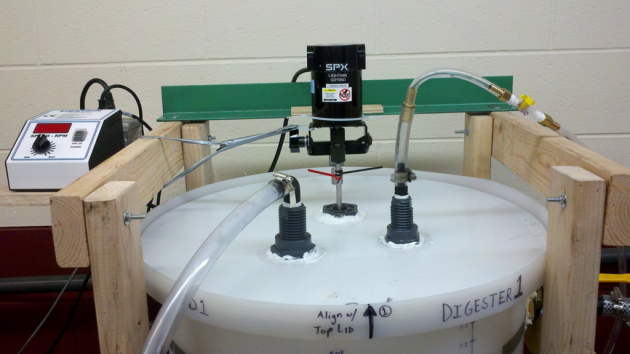
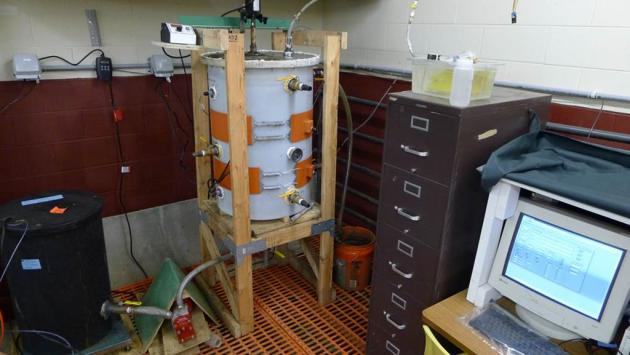
The study was designed as a one factor (mixing duration) experiment with three levels and was carried out in triplicates. Three pilot scale anaerobic digesters were used to compare the impact of different mixing duration (continuous – CON, intermittent – INT, and no mixing – NO) on the performance of biogas production from dairy manure, Figure 1.

Figure 1. a laboratory scale digester

Figure 1: Digester Design

During the experiment, all digesters were fed 8 kg of dairy manure daily (total solid content = 5.5%), and operated at 37oC with a hydraulic retention time (HRT) of 21 days.  The mixing and feeding were controlled by an automated computer system, Figure 2. Mixers were set at a speed of 450 revolution per min (RPM). Biogas production was recorded three times a week and the percentage of methane content was analyzed weekly. Manure samples were collected weekly from the feed tank, top, middle & bottom of the digester, and from the effluent tank for volatile solids (VS), chemical oxygen demand (COD), pH, carbon to nitrogen ratio (C/N), and violate fatty acids (VFAs).  The concentration of archea and five common methanogens found in digesters was also determined using quantitative polymerase chain reaction (qPCR).

Figure 2. A closeup of the top of the lab-scale digester

Figure 2: Digester Mixing System

What Have We Learned?

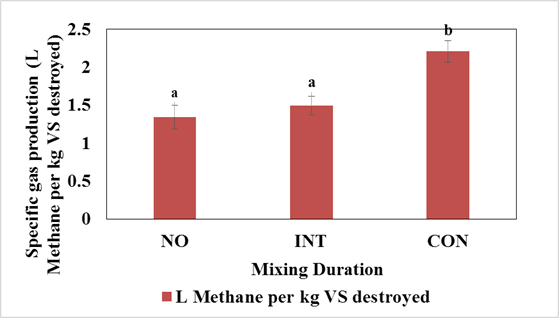
The cumulative biogas production from digesters with no mixing was statistically significantly higher than intermittent and continuous (CON) mixing at the same loading rate. However, CON had a higher methane production rate per kg of volatile solids destroyed, Figure 3.

Figure 3: Methane Production Rate per Volatile Solids Destroyed

Future Plans

We are currently exploring the settling of manure solids in digesters with different mixing duration through a tracer study. The impact of different settling time on the hydraulic retention time (HRT), would help us better understand the performance of the anaerobic digesters with different mixing duration.

Authors

Hui Wang, Graduate Research Assistant, University of Wisconsin-Madison, hwang355@wisc.edu

Rebecca A. Larson, Assistant Professor and Extension Specialist, University of Wisconsin-Madison, ralarson2@wisc.edu

Acknowledgements

This material is based upon work supported by the National Institute of Food and Agriculture, United States Department of Agriculture, under ID number WIS01693.

Institute for Environmentally Integrated Dairy Management (Marshfield, WI), United States Dairy Forage Research Center

The authors are solely responsible for the content of these proceedings. The technical information does not necessarily reflect the official position of the sponsoring agencies or institutions represented by planning committee members, and inclusion and distribution herein does not constitute an endorsement of views expressed by the same. Printed materials included herein are not refereed publications. Citations should appear as follows. EXAMPLE: Authors. 2015. Title of presentation. Waste to Worth: Spreading Science and Solutions. Seattle, WA. March 31-April 3, 2015. URL of this page. Accessed on: today’s date.

Poultry Digestion – Emerging Farm-Based Opportunity

While EPA AGSTAR has long supported the adoption of anaerobic digestion on dairies and swine farms, they have not historically focused on the use of anaerobic digestion on egg laying and other poultry facilities. This has been because the high solids and ammonia concentrations within the manure make anaerobic digestion in a slurry-based system problematic. Development of enhanced downstream ammonia and solids recovery systems is now allowing for effective digestion without ammonia toxicity. The process also generates dilution water, avoiding the need for fresh water consumption, and eliminating unwanted effluent that needs to be stored or disposed of to fields. The system produces high-value bio-based fertilizers. In this presentation, a commercial system located in Fort Recovery Ohio will be used to detail the process flow, its technologies, and the co-products sold.

Why Examine Anaerobic Digestion on Poultry Farms?

The purpose of this presentation is to supply a case study on a commercial poultry digestion project for production of combined heat and power as well as value-added organic nutrients on a 1M egg-layer facility in Ohio.

What did we do?

In this study we used commercial farm information to demonstrate that poultry digestion is feasible in regard to overcoming ammonia inhibition while fitting well into an existing egg-layer manure management system. Importantly, during the treatment process a significant portion of nutrients within the manure are concentrated for value-added sales, ammonia losses to the environment are reduced, and wastewater production is minimized due to recycle of effluent as dilution water.

What have we learned?

In this study, commercial data shows that ammonia and solids/salts levels that are potentially inhibitory to the biology of the digestion process can be controlled. The control is through a post-digestion treatment that includes ammonia stripping and recovery as ammonium sulfate as well as fine solids separation using a dissolved air flotation process with the addition of a polymer. The resulting treated effluent is sent back to the front of the digester as dilution water for the high solids poultry manure. The separated fine solids and the ammonium sulfate solution are dried using waste engine heat to produce a nutrient-rich fertilizer for off-farm sales. The stable anaerobic digestion process resulting from the control of potential inhibitors that might accumulate in the return water, if no post-treatment occurred, leads to production of a significant supply of electrical power for sales to the grid.

Demonstration at commercial scale shows the promise anaerobic digestion with post-digestion treatment and effluent recycle can play in a more sustainable poultry manure treatment system including managing nutrients for export out of impacted watersheds.

Future Plans

Future plans include continued work with industry in developing and/or providing extension capabilities around novel digestion and post-treatment processes for a variety of manures and on-farm situations. Expansion of such processes to poultry and other on-farm business plans will allow for improved reductions in wastewater production, concentrate nutrients for export out of impacted watersheds and do so within a positive economic business plan.

Authors

Craig Frear, Assistant Professor at Washington State University cfrear@wsu.edu

Quanbao Zhao, Project Engineer DVO Incorporated, Steve Dvorak, President DVO Incorporated

Additional information

Additional information about the corresponding author can be found at http://www.csanr.wsu.edu while information about the poultry project and the industry developer can be found at http://www.dvoinc.net. Numerous articles related to anaerobic digestion, nutrient recovery and separation technologies for climate, air, water and human health improvements can be found at the WSU website using their searchable articles function.

Acknowledgements

This research was supported by funding from USDA National Institute of Food and Agriculture, Contract #2012-6800219814; National Resources Conservation Service, Conservation Innovation Grants #69-3A75-10-152; and Biomass Research Funds from the WSU Agricultural Research Center. 

The authors are solely responsible for the content of these proceedings. The technical information does not necessarily reflect the official position of the sponsoring agencies or institutions represented by planning committee members, and inclusion and distribution herein does not constitute an endorsement of views expressed by the same. Printed materials included herein are not refereed publications. Citations should appear as follows. EXAMPLE: Authors. 2015. Title of presentation. Waste to Worth: Spreading Science and Solutions. Seattle, WA. March 31-April 3, 2015. URL of this page. Accessed on: today’s date.