Odorgon: Overhead Spray System to Neutralize Odors

Reprinted, with permission, from the proceedings of: Mitigating Air Emissions From Animal Feeding Operations Conference.

This Technology is Applicable To:

Species: Poultry, Dairy, Beef, Swine
Use Area: Animal Housing
Technology Category: Chemical Amendment
Air Mitigated Pollutants: Ammonia, Hydrogen Sulfide, Odors

System Summary

Odorgon is a water based formulation that is applied in confined animal feeding operations through a high pressure mist system. Odorgon is sprayed on an automated timer basis from the ceilings through high pressure nylon lines and nozzles to neutralize malodors.

Applicability and Mitigating Mechanism

  • Unique class of cationic surfactants
  • Atomized solution sprayed at 600 psi
  • Buffer resulting in non volatile organic salts
  • Greatly reduces ammonia & hydrogen sulfide
  • Creates better environment for animals to thrive in resulting in lower mortality, less culls and less days to finish.
  • Better conditions for workers/employees
  • Mitigates neighbor/social issues

Limitations

  • Water based, subject to freezing
  • Summer use may be curtailed in

open buildings during windy conditions

Cost

Equipment cost for a 42 by 200 foot finishing building with all components installed is approximately $4900. Annual usage for this facility would average $2100 of Odorgon concentrate or .73 per animal unit but could vary with region/climate. Nursery cost for swine is .19 per animal unit. Odorgon is mixed with water at a rate of 50 parts water to 1 part concentrate resulting in a cost of $1.50 per gallon diluted. Cost also varies based on building dimensions and desired results.

Authors

Steve Opheim, VP Klean Air Inc.
Point of Contact:
Ron Hamilton, rrhamilto@aol.com

The information provided here was developed for the conference Mitigating Air Emissions From Animal Feeding Operations Conference held in May 2008. To obtain updates, readers are encouraged to contact the author.

Gas Impermeable Film and Sheet for Control of Methane and Odors in Agricultural Applications

Reprinted, with permission, from the proceedings of: Mitigating Air Emissions From Animal Feeding Operations Conference.

The proceedings, “Mitigating Air Emissions from Animal Feeding Operations”, with expanded versions of these summaries can be purchased through the Midwest Plan Service.

This Technology is Applicable To:

Species: Swine, Dairy, Beef, Poultry
Use Area: Manure Storage, Manure Treatment
Technology Category: Covers
Air Mitigated Pollutants: Odors, Methane, Ammonia

System Summary

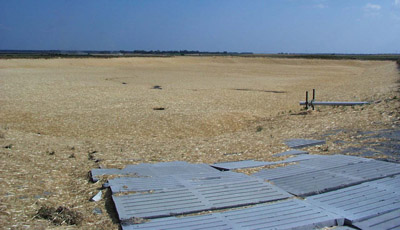
For many years, food packaging has incorporated barrier layers to contain odors, flavors, oils and moisture along with the food contents while excluding contamination and oxygen. Until recently, agricultural films and geomembranes were monolithic structures employing only a single polymer or blend. Recent advances in extrusion and lamination equipment allow the incorporation of these barrier layers in large scale agricultural structures and operations such as floating covers over animal waste storage, containment geomembranes for biogas generation, silage storage and fumigation films.

To view the video in full screen, click the icon second from right on the bottom of the viewer.
Download a copy of this video

Co-extruding a thin layer of ethylene vinyl alcohol (EVOH) in a linear low density polyethylene (LLDPE) geomembrane dramatically reduces the permeability to a wide range of gases and volatile organic carbon molecules including: methane, ammonia, carbon dioxide, oxygen, aromatic hydrocarbons, aliphatic hydrocarbons, methyl bromide and most odorous compounds. Methane permeabilites for four geomembranes are given below.

Methane Permeability (cc/(m2*day))
PVC LLDPE HDPE Barrier LLDPE
0.76 mm (30 mils) 1.0 mm (40 mils) 1.0 mm (40 mils) 0.5 mm (20 mils)
900 690 300 <1

Applicability and Mitigating Mechanism

  • Barrier to noxious gases and odors
  • Useful in cover and containment systems

Limitations

  • EVOH is a crystalline polymer and is not elastic. It is flexible but should not be used as part of an elastomeric structure.

Cost

Engineered floating covers with ballasted weight systems, gas extraction systems and rainwater removal systems costs vary greatly. For waste lagoon of about 1/2 acre in size, the cover system can cost from $150,000 to $200,000. Addition of the barrier layer to the geomembrane adds less than $5,000.

Authors

Gary Kolbasuk, Raven Industries, Engineered Films Division
Point of Contact:
Gary.Kolbasuk@Ravenind.com

The information provided here was developed for the conference Mitigating Air Emissions From Animal Feeding Operations Conference held in May 2008. To obtain updates, readers are encouraged to contact the author.
A Review of Permeable Cover Options for Manure Storage

Reprinted, with permission, from the proceedings of: Mitigating Air Emissions From Animal Feeding Operations Conference.

The proceedings, “Mitigating Air Emissions from Animal Feeding Operations”, with expanded versions of these summaries can be purchased through the Midwest Plan Service.

This Technology is Applicable To:

Species: Beef, Dairy, Swine
Use Area: Manure Treatment
Technology Category: Covers
Air Mitigated Pollutants: Ammonia, Odors, Hydrogen Sulfide

System Summary

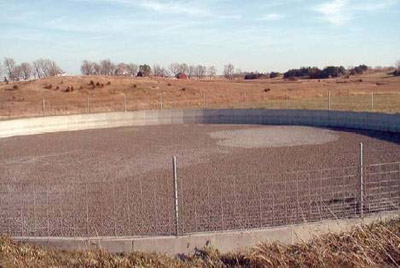
Covers have been demonstrated to provide effective odor and air emissions control for manure storage structures. Impermeable covers made from flexible synthetic materials provide excellent odor and emissions control, but typically have a high capital cost requirement. Permeable covers provide an alternative to impermeable synthetic covers. Permeable covers will typically not provide as great a level of odor control as impermeable covers, but the initial capital cost is lower. Permeable covers do not require gas or rain water collection systems since gases are allowed to migrate through the cover and rainwater will infiltrate through the cover into the storage. Permeable covers have been successfully constructed from a variety of materials including straw, light weight expanded clay aggregate (LECA), ground rubber and geotextile materials. Materials such as straw, have a short lifespan (from two to six months depending on manure solids content and rainfall levels), while materials such as LECA have been shown to remain viable for more than ten years. Various permeable cover materials have been shown to reduce odor from 40% – 90%, and to reduce ammonia from 40% to 80% depending on permeable cover material and depth.


Applicability and Mitigating Mechanism

  • Permeable covers provide a layer on the manure surface that shields the manure surface from contact with the air
  • Most permeable cover materials provide an aerobic zone in the cover material that will help control odor
  • No gas or water collection systems are required since both gases and rain water will pass through the permeable cover material
  • Some permeable cover materials such as straw provide a short-term solution, while other like LECA can last more than ten years


Limitations

  • Some permeable cover materials (such as straw) have very short effective lives (2 – 6 months)
  • Long-term permeable cover materials (such as LECA) can have costs near those of synthetic impermeable covers
  • If a permeable cover material sinks into the stored manure, it must be dealt with during land application
  • Rainwater volume must be accounted for in the manure storage since direct precipitation will infiltrate into the manure storage

A permeable straw cover on an earthen manure storage structure.

Cost

Permeable covers can provide reductions in odor, ammonia and hydrogen sulfide emissions from manure storage facilities. A wide variety of organic and manmade materials have been utilized to construct permeable covers with variable results and costs ranging from $0.10 to $1.75 per square foot installed. Straw is the least cost permeable cover material with an approximate cost of $0.10 per square foot installed. Longer lasting materials such as LECA have installed costs that can exceed $1.00 per square foot installed. Permeable cover materials are typically floated on the stored manure surface and can provide an aerobic zone that manure gases must pass through when released. Permeable covers can be used with earthen, concrete and steel manure storage systems and with slurry manures generated by swine, dairy and beef animals.

Lightweight expanded clay aggregate (LECA) cover on a concrete swine manure storage tank.

Authors

Robert Burns and Lara Moody, Iowa State University
Point of Contact:
Robert Burns, rburns@iastate.edu

The information provided here was developed for the conference Mitigating Air Emissions From Animal Feeding Operations Conference held in May 2008. To obtain updates, readers are encouraged to contact the author.

Use of Sodium Bisulfate to Reduce Ammonia Emissions from Poultry and Livestock Housing

Reprinted, with permission, from the proceedings of: Mitigating Air Emissions From Animal Feeding Operations Conference.

The proceedings, “Mitigating Air Emissions from Animal Feeding Operations”, with expanded versions of these summaries can be purchased through the Midwest Plan Service.

This Technology is Applicable To:

Species: Poultry (Broiler, Layer, and Turkey), Beef, horses
Use Area: Animal Housing
Technology Category: Chemical Amendment
Air Mitigated Pollutants: Ammonia, Volatile Organic Compounds (VOCs)

System Summary

The application of Sodium bisulfate (SBS) has been shown to effectively reduce ammonia emissions from poultry housing, horse stalls, and dairy facilities. In addition, VOC emissions from fresh cattle manure are also greatly reduced (Marsh Johnson, et al. 2006, Ullman, et al., 2004; Blake and Hess, 2001; Sweeney, et al., 1996; Harper, 2002, Sun et al, 2008). Currently, 40-50% of all broilers produced in the United States are raised on SBS treated litter (PLT® litter acidifier, Jones-Hamilton Co., Walbridge, OH) for the purpose of controlling interior ammonia levels below 20 PPM and reducing litter bacterial levels for bird welfare and performance reasons. In addition to reducing ammonia emissions by 60% from fresh dairy manure, ethanol and methanol emissions were also reduced 61% and 58%, respectively (Sun, et al. 2008). Sodium bisulfate is broadcast over the surface of the bedding material and can be applied in the presence of poultry and livestock.

Sodium bisulfate is a dry, granular acid salt. Current application rates are dependent on litter age, animal density, and other factors and range from 0.32-1.95 kg/m2 (50-300 lbs/1000 sqft) of animal housing space. Decreasing interior ammonia concentrations in poultry housing allow for a reduced ventilation rate leading to substantial fuel savings of up to 43% with sodium bisulfate application (Terzich, 1997). In addition, sodium bisulfate usage improves bird performance, reduces pathogens on poultry carcasses, and decreases poultry respiratory lesions and ascites (Pope and Cherry, 2000; Terzich et al, 1998 a & b).

Applicability and Mitigating Mechanism

  • SBS reduces litter and bedding pH reducing ammonia flux
  • SBS reacts with ammonia to form ammonium sulfate preventing release of ammonia as pH increases over time
  • The combination of sodium and hydrogen reduce manure bacterial populations thereby reducing VOC emissions and pathogens
  • SBS can be safely applied in the presence of animals or prior to animal placement

Limitations

  • SBS application rates need to be increased as ammonia demand in the litter increases

Cost

Sodium bisulfate costs $0.50/kg ($0.23/lb) and the use of a commercial applicator is approximately $40-45 per house. SBS is safe enough to be applied by the farmer or poultry grower. No additional house preparation is necessary for application. Fuel savings in the first 2-3 days recoup the cost of SBS and its application. Improvements in feed conversion, weight, livability, and paw quality all provide substantial additional return on investment.

Authors

Trisha Marsh Johnson1, Bernard Murphy21Veterinary & Environmental Technical Solutions, PC, 2 Jones-Hamilton Co.
Point of Contact:
Dr. Bernard Murphy, bmurphy@jones-hamilton.com

The information provided here was developed for the conference Mitigating Air Emissions From Animal Feeding Operations Conference held in May 2008. To obtain updates, readers are encouraged to contact the author.

Water Requirements for Dust Control on Feedlots

Reprinted, with permission, from the proceedings of: Mitigating Air Emissions From Animal Feeding Operations Conference.

The proceedings, “Mitigating Air Emissions from Animal Feeding Operations”, with expanded versions of these summaries can be purchased through the Midwest Plan Service.

This Technology is Applicable To:

Species: Beef, Dairy
Use Area: Animal Housing
Technology Category: Facility Management
Air Mitigated Pollutants: Dust, Odor

System Summary

Feedlot dust contributes to cattle illness along with potential non-attainment of PM10 emission standards in localized areas of North America. Increasing the surface moisture content decreases the potential for entrainment of PM10 particles during evening cattle activity resulting in improved cattle health and attainment with air quality standard. Individual feedlots vary in capacity, pen density and overall area necessitating educational outreach efforts including one-on-one technology transfer. A computer model was developed to enable feedlot owners to evaluate their particular facilities including the potential water requirements and cost of mitigating dust and other air emissions. The water requirement is estimated based on initial soil moisture, desired final moisture content, surface coverage area, soil wetting depth, sprinkler efficiency and application time. These parameters are used to estimate well capacity, main and branch water pipe size, number of wetting zones based on sprinkler head capacity, application time and nozzle requirements. Pumping requirements are based on application rate, pump efficiency and total head losses. Operational costs are based on an initial investment in the system along with pumping cost. This results in a total cost per head per month based on the fixed and variable cost.

Applicability and Mitigating Mechanism

  • Design sprinkler package for open lot dust control
  • Economic analysis of the dust control system
  • Spreadsheet based model – easy to use
  • Provides quick evaluation of when inputs parameters are varied
  • Estimates daily water requirements per head for dust control

Limitations

  • Results dependent on input parameters
  • Assumes water application is uniform
  • Assumes initial cost of installation of a sprinkler package is known
  • Adequate water availability for dust control

Cost

The cost of dust control on open feedlots ranges from $0.60 to $2.40 per marketed head. The cost of the infrastructure of the sprinkler system or water application equipment is reduced with increases in feedlot capacity or marketed head per year. The fixed cost represents 60 to 80 percent of the annual cost. The variable costs are dependent on the days per year necessary for attainment of PM10 emissions from open feedlots or earthen dry lots commonly found in the High Plains region of the North America.

Authors

Joseph Harner 1, Ronaldo Maghirang1, Edna Razote11Kansas State University
Point of Contact:
Joseph Harner, jharner@ksu.edu

The information provided here was developed for the conference Mitigating Air Emissions From Animal Feeding Operations Conference held in May 2008. To obtain updates, readers are encouraged to contact the author.

Technologies for Mitigating Air Emissions in Beef Production

Reprinted, with permission, from the proceedings of: Mitigating Air Emissions From Animal Feeding Operations Conference.

The proceedings, “Mitigating Air Emissions from Animal Feeding Operations”, with expanded versions of these summaries can be purchased through the Midwest Plan Service.

Air Mitigation Technologies for Beef Production

The Use of Vegetative Environmental Buffers For Livestock and Poultry Odor Mitigation

Reprinted, with permission, from the proceedings of: Mitigating Air Emissions From Animal Feeding Operations Conference.

The proceedings, “Mitigating Air Emissions from Animal Feeding Operations”, with expanded versions of these summaries can be purchased through the Midwest Plan Service.

This Technology is Applicable To:

Species: Poultry, Dairy, Beef, Swine
Use Area: Animal Housing and Manure Storage
Technology Category: Vegetative Buffers
Air Mitigated Pollutants: Particulate Matter, Odor, Ammonia

System Summary

Vegetative Environmental Buffers (VEBs) – linear arrangements of trees and shrubs planted near and around livestock/poultry production sites – have been shown to incrementally mitigate odors, particulates, and ammonia through a complex of dynamics. Among the most important dynamics are: 1) enhancement of vertical atmospheric mixing through forced mechanical turbulence – leading to enhanced dilution/dispersion of odor; 2) odor filtration through particulate interception and retention – odor largely travels by way of particulates; capturing particulates also captures odors; 3) odor/particulate fallout due to gravitational forces enhanced by reduced wind speeds; 4) adsorption and absorption of ammonia onto and into the plant – this is due to a chemical affinity that ammonia has to the waxy coating on tree leaves; 5) softening socio-psychological responses to odor due to improved site aesthetics and creating “out of sight, out of mind” dynamics; and 6) improved producer/community relations by using highly visible odor management technology.

Applicability and Mitigating Mechanism

  • As air moves across vegetative surfaces, leaves and other aerial plant surfaces can remove odors, dust, gas, and microbial constituents of airstreams.
  • VEBs can mitigate odors/ particulates from all livestock/poultry species;
  • VEBs are size neutral technology and can be used to mitigate odors/particulates from all sources of odor: buildings, manure storage, and land application.
  • Trees/shrubs are among the most efficient natural filtering structures in a landscape.

Limitations

  • Mitigation effectiveness is highly site specific and will vary considerably from farm to farm.
  • VEBs often require considerable land area and may take up to five years to become physically effective.
  • Care in VEB design must be taken to avoid causing snow deposition, ventilation, and on-farm visibility problems.
  • At best, odor/particulate mitigation will be “incremental” and therefore should be always used with other odor management strategies.

Cost

Costs for VEB systems are highly variable and are site/design specific – but for midsized producers (and larger) VEBs likely amount to just a few cents per animal produced. There are three main categories of expenses associated with VEBs: 1) Site prep costs, 2) tree establishment costs, and 3) long term maintenance costs. It should be noted that the majority (usually in the range of 40-70%) of the total cost is “upfront” and is tied to the cost of the initial planting stock (e.g. older, larger nursery stock can be considerably more expensive than bare-root seedlings but such an investment may “buy time” in VEB establishment). Long term maintenance costs vary depending upon the overall health of the VEB. It should be recognized that there are expenditures that occur regularly throughout the life of a VEB and maintenance is an annual process, however as a VEB system matures the annual maintenance requirements will likely decrease over time.

Authors

John C. Tyndall11Department of Natural Resource Ecology and Management
Point of Contact:
John C. Tyndall, jtyndall@iastate.edu

The information provided here was developed for the conference Mitigating Air Emissions From Animal Feeding Operations Conference held in May 2008. To obtain updates, readers are encouraged to contact the author.

Pennsylvania’s Odor Siting Index

Reprinted, with permission, from the proceedings of: Mitigating Air Emissions From Animal Feeding Operations Conference.

This Technology is Applicable To:

Species: Swine, Beef, Poultry, Dairy
Use Area: Animal Housing and Manure Storage
Technology Category: Facility Siting and Management
Air Mitigated Pollutants: Odors

System Summary

The Pennsylvania Siting Index was developed in response to specific state legislation (PA Act 38 of 2005) in an effort to objectively evaluate locations for new or expanding regulated animal operations, then develop an Odor Management Plan to reduce the potential for community conflict from building and manure storage odors. The goal is to construct livestock operations where community odor conflict potential is minimized. Data from the site and site map are entered into the index and the resulting score indicates the complexity of Best Management Practices (BMPs) that must be adopted for a producer to develop the site. Scores of less than 50 index points do not require BMPs. Scores from 50 to 99.9 index points require “Level 1” BMPs, which are generally standard, industry-accepted practices. Scores greater than 100 points require more costly and complicated “Level 2” BMPs. The index cannot be used to prevent an individual from constructing an operation, nor is it used to mitigate specific air emissions.

Applicability and Mitigating Mechanism

  • Required for new and expanding regulated animal operations in Pennsylvania.
  • Objectively scores sites on a numerical scale.
  • Encourages producers to locate animal operations on sites with a low risk of community odor conflict.
  • Requires odor-reduction Best Management Practices if the index score is high.
  • Requires approved Odor Management Plan and annual operation inspection.

Limitations

  • The index does not measure odors or gasses, nor assess effectiveness of BMPs.
  • Weighting of index scores is based on limited data.
  • Producers may not be required to implement BMPs when the number of surrounding homes is minimal, even if those homes are relatively close to the animal facility.
  • The index does not account for future development around an animal operation.
  • Potential for inversion odor conflict is not included in the index.

Cost

The Pennsylvania State Conservation Commission estimates the cost to producers will be approximately $1120 for an index and associated odor management plan. BMP installation and maintenance would vary, depending on BMP complexity. If producers choose a site with an index score of <50 points, BMPs would not be required thus erasing all BMP costs.

Authors

Robert Mikesell1, Karl Dymond2, 1Penn State Department of Dairy and Animal Science, 2 Pennsylvania State Conservation Commission
Point of Contact:
Robert Mikesell, rem9@psu.edu

The information provided here was developed for the conference Mitigating Air Emissions From Animal Feeding Operations Conference held in May 2008. To obtain updates, readers are encouraged to contact the author.

Siting of Livestock & Poultry Facilities Using MNSET

Reprinted, with permission, from the proceedings of: Mitigating Air Emissions From Animal Feeding Operations Conference.

The proceedings, “Mitigating Air Emissions from Animal Feeding Operations”, with expanded versions of these summaries can be purchased through the Midwest Plan Service.

This Technology is Applicable To:

Species: Poultry, Dairy, Beef, Swine
Use Area: Animal Housing, Manure Storage
Technology Category: Facility Siting
Air Mitigated Pollutants: Odor, Hydrogen Sulfide, Ammonia

System Summary

MNSET predicts three separate air quality impacts. The first prediction is for odor impacts at any given distance downwind from the facilities. The second prediction is for the frequency of exceeding the MN state standard for hydrogen sulfide (30 ppb / 30-minute average not to be exceeded twice in a five day period). Although this may not be applicable for other states it does show relative impacts of hydrogen sulfide. Additionally, MNSET estimates both daily and annual pounds of hydrogen sulfide and ammonia emitted from the modeled facility. Remember however that the outputs of the models are only as valid as the inputs. A literature review was done to develop the flux values used in the model.

MNSET can be used to evaluate the impact of existing sites and quantify reductions of these impacts using various treatment technologies. Unfortunately, this requires reliable quantification of the emission reductions from the mitigation technologies.

Applicability and Mitigating Mechanism

  • Tool for predicting air quality impacts for odor, hydrogen sulfide and ammonia
  • Allows for adding mitigation to reduce these impacts
  • Free downloadable spreadsheet
  • User can add new technologies

Limitations

  • Based on average flux values
  • Conservative predictions
  • Based on Minnesota weather conditions and regulations

Cost

This software can be downloaded free at University of Minnesota Manure Management. The use of MNSET to evaluate the downwind impacts of any mitigation technologies is very valuable both in new construction and in solving existing air quality problems.

Authors

David Schmidt and Larry Jacobson, University of Minnesota
Point of Contact:
David Schmidt, schmi071@umn.edu

The information provided here was developed for the conference Mitigating Air Emissions From Animal Feeding Operations Conference held in May 2008. To obtain updates, readers are encouraged to contact the author.

Siting Animal Production Facilities and Evaluating Odor Control Options Using the Odor Footprint Tool

Reprinted, with permission, from the proceedings of: Mitigating Air Emissions From Animal Feeding Operations Conference.

This Technology is Applicable To:

Species: Poultry, Dairy, Beef, Swine
Use Area: Animal Housing, Manure Storage
Technology Category: Facility Siting
Air Mitigated Pollutants: Odor

System Summary

The Odor Footprint Tool is a worksheet/spreadsheet that provides objective, science-based information on the risk-based impact of odors generated by livestock facilities. The user enters information about the livestock facilities for a given site, the site location (for selection of regional weather data), use of supplemental odor control, and any special terrain around the site. After using the Odor Footprint Tool, the user obtains minimum setback distances in four directions matching up with targets for avoiding odor annoyance. The Odor Footprint Tool can help assess the reduction in the size of a facility’s odor footprint due to use of proven odor control technology.

By using the Odor Footprint Tool, producers and their advisors can mitigate neighbor impacts of odor and air-borne pollutants through improved siting of facilities. They can also use the Odor Footprint Tool to assess the benefit of odor control technologies in terms of reduced area of odor impact, which encourages the utilization of effective control technologies.

Applicability

  • Assesses frequency of odor annoyance from housed swine, cattle and poultry production facilities
  • Considers animal housing facilities and manure storage facilities
  • Assesses reduction in odor footprint due to using proven odor control technology
  • Used on a regional basis within a state
  • Recommended for use as a planning and screening tool

Limitations

  • Not ready for use with open lots, treatment lagoons, and other large area sources
  • Not for assessing odor annoyance during application of manure
  • Requires its own set of emission values
  • Dispersion modeling is required upfront for confident use in a new region having differing weather patterns.
  • Simplified footprints may seem over-simplified or lack desired level of precision

Cost

There is no direct cost for using the publicly available versions of the Odor Footprint Tool to obtain directional setback distances or for conferring with an Extension educator. When producers defer use to an advisor/consultant, it is reasonable to expect to pay for consultant time associated with using the tool, getting their technical response and recommendations, creating project-specific visuals, and presenting material to permitting authorities, local zoning commissions, lenders, etc.

The primary costs associated with the Odor Footprint Tool are upfront costs of calibrating and validating the dispersion model and performing dispersion modeling using weather data for a specific area. Grant funds have been utilized within Nebraska and South Dakota for this purpose.

Authors

Rick Stowell, Chris Henry, Crystal Powers, and Dennis Schulte
University of Nebraska-Lincoln
Point of Contact:
Rick Stowell, rstowell2@unl.edu

The information provided here was developed for the conference Mitigating Air Emissions From Animal Feeding Operations Conference held in May 2008. To obtain updates, readers are encouraged to contact the author.