Integrated Process-Based Swine Operation Model with Life Cycle Assessment (LCA) and Life Cycle Costing (LCC) Economic Analysis

green stylized pig logoDr. Greg Thoma, Dr. Richard Ulrich and Dr. Jennie Popp – University of Arkansas, Dr. William Salas and Dr. Chengsheng Li – DNDC Applications, Research and Training

Why Develop Models for Pork Production and Environmental Footprint?

Change in complex systems can occur either systemically, for example by government policy or regulation, or by adoption of new practices by individuals followed by wider adoption where the new practice is effective. This is costly and early adopters incur high risk of failure. This risk can be reduced through good decision support systems to aid in the selection of optimal practices – in effect, with a good model of the system, adoption of management techniques or technology can be tested by simulation before physical implementation.

This is the fundamental utility of models: they provide an inexpensive low risk alternative to experimental trial and error. The swine production model being developed for this project is based on the National Pork Board (NPB) Pig Production Environmental Footprint Calculator written at the University of Arkansas and first released in May 2011.

The National Academy of Sciences reported that EPA methodology should be improved by replacing emission factors with “process-based” models.” The tradeoff is that process-based models are more complex. Our team worked with the National Pork Board to create a process based emission model for swine production to serve as the foundation for a decision support system. This combined emission and cost model, the Pig Production Environmental Footprint Calculator (V2), was released in June 2013, and V3 will be released in Fall, 2015.

This model estimates GHG emissions, water use, land occupation and day-to-day costs from multiple farm operations to identify major contributions and provide a test bed for evaluating potential reduction strategies. The model requires readily available input information such as the type of barn, animal throughput, ration used, the time in the barn, weather for the area, type of manure management system as well as energy and feed prices. The model output includes a summary GHG emissions, water consumption, land occupation and costs by source, of as well as feed and energy usage for the simulation.

University of Arkansas DNDC-ART logo Project Objectives

Integrate process-models of swine production with coupled life cycle assessment (LCA) and economic models to create a decision support tool to identify economical swine production system options which minimize GHG emission and increase sustainability of production systems.

  • Improve existing process algorithms to capture effects of barn climate control, feed phases, water distribution, solar insolation, and manure application technology on GHG emissions.
  • Expand and improve the user interface, making it more intuitive and user-friendly.
  • Expand the feed ingredient list and improve estimations of important feed characteristics needed for the model.
  • Develop economic algorithms and compile relevant cost databases to capture the costs of day-to-day activities that entail water use and generate GHGs on farm.

Research Summary: What Have We Done? What Have We Learned?

Scale of the farm and manure systems

The model was converted from barn-level to a farm-level tool by integrating the barns and manure systems together through the model input procedures. In this way the emissions from the various on-farm operations can be compared on the same basis and put into perspective with regard to emission sources. There can be up to ten barns, each with its own associated manure system (subfloor, deep pit and, added in year 4, dry bedding) and 10 separate downstream manure handling systems (lagoon, outside storage and, recently added, a digester). Each barn can have its manure stream routed to any downstream manure system enabling streams to be combined for processing before going to the fields. An algal turn scrubber option can be added as an adjunct to any downstream system.

All of the manure handling systems, both those associated with a barn and those downstream of the barns, were written at the University of Arkansas and all but the digester are process-based. A digester option was added with options for burning the produced methane as barn heat or for producing electricity. Emissions are calculated for the transport of manure to the fields but not for emissions after application.

Growth, performance and amino acid inclusion in rations

The National Research Council (NRC) growth and performance model was integrated into the full farm level model in order to link ration characteristics and growth performance. We have closed the mass balance over the farm for carbon, nitrogen, phosphorous, water and manure solids. Addition of the NRC model also brought in the effects of ractopamine and immunocastration management options.

Testing of the revised growth equations with respect to the effects of individual amino acids (AA) was completed and a manuscript has been partially drafted. A revised equation predicting the effects of heat stress on feed intake was derived and incorporated into the model resulting in much better predictions of these effects than provided by the native NRC equations. Equations describing the impact of heat and cold stress on energy maintenance costs were also constructed, but have yet to be incorporated into the model. These latter 2 efforts were carried out primarily by a postdoctoral student employed on the National Animal Nutrition Program (NRSP-9) with the resulting equations made available to the project. Two manuscripts describing this work have been drafted and will be submitted in Fall, 2015. Finally, a method of deriving model settings to match observed rates of daily gain and feed conversion efficiency was devised and recently passed onto the barn model team for incorporation into the barn model. This will allow the model to be easily calibrated to observed gain and feed efficiency as input by the user.

Weather information

We updated the model weather files from the MERRA database for each of the 3102 counties in the U.S. These files have, in addition to temperature and humidity, other useful information such as precipitation, solar insolation, subsurface temperatures at various depths, and snow cover. The additional MERRA information facilitated addition of a solar panel option and will be used to estimate rainwater contribution to outside manure handling facilities and of solar insolation on inside barn temperatures.

What Is the DNDC Model?

The DNDC (DeNitrification and DeComposition) model was developed for quantifying N2O emissions from agricultural soils in the late 1980s (US EPA, 1995). By including fundamental bio-geochemical processes of carbon and nitrogen transformations, DNDC was extended to model soil C sequestration and other trace gases (e.g., methane, nitric oxide, ammonia etc.) in the early 1990s.

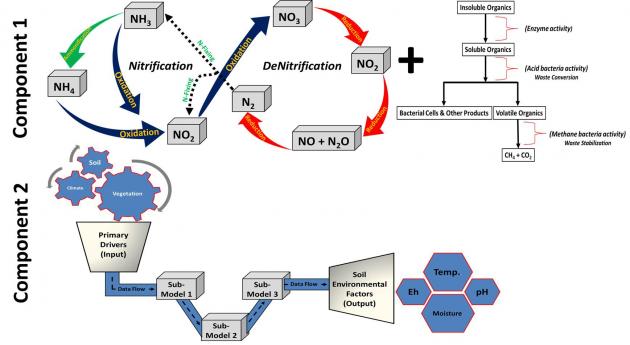
DNDC consists of two components. The first component entails three sub-models and converts primary drivers (i.e., climate, soil, vegetation and anthropogenic activity) to soil environmental factors (i.e., temperature, moisture, pH, Eh and substrate concentration gradient). The second component consists of nitrification, denitrification and fermentation sub-models; and simulates production/consumption of N2O, NO, N2, NH3 and CH4 driven by the modeled soil environmental conditions [see graphic below]. With the bio-geochemical reactions embedded in the model framework, DNDC can predict the turnover of soil organic matter and the consequent trace gas emissions and nitrate leaching losses.

Feed ingredients

With input from industry and academic experts, our feed ingredient database was revised to better capture the expected range of ingredients typically available to producers in the US. Carbon, water and land footprint data as well as nutritional characteristics for the NRC growth equations were compiled for each feed ingredient. Economic models, that estimate the cost of feed, manure handling, utilities (water, electricity, gas, propane and diesel), dead animal disposal and immunocastration were integrated into the model. Capital costs are not considered. We are conducting cost benefit analyses on combinations of operations, manure management and dietary feeding systems aimed at reducing GHG emissions. These will help identify incentives to minimize  mitigation strategy cost. Routines have been developed that will allow the user to download a set of updated prices for utilities and major feed ingredients.

DeNitrification and DeComposition (DNDC) Model (Soil)

The DeNitrification and DeComposition (DNDC) model requires numerous weather and site inputs, many of which are output from the environmental calculator, and others which require site-specific geographical characteristics (e.g., soil type). We analyzed the agricultural area of each continental-US county using agricultural classes from the 2013 NASS Cropland Data Layer. For each county, we assigned the mean latitude/longitude of all agricultural pixels as the agriculture-weighted centroid from which representative weather data will be extracted.

County soils data are derived from the NRCS General Soils Map (STATSGO). We derived the spatial intersection of STATSGO soil polygons with county boundaries. We summarized top soil data for each soil polygon from 0 to 10cm depth for clay fraction (a proxy for soil texture), bulk density, organic matter fraction (to estimate soil organic carbon, SOC), and pH. Modeled results will be based on either the comprehensive set of soil polygon attributes or a representative distribution of soil attributes for each county (depending on timing and available computing power).

Summary

The model will enable the user to find hot spots in their emissions profile, evaluate the effects of operational changes, and estimate the emissions from facilities during the design stage. The further addition of an operational economic model will provide the ability to perform cost/benefit analyses of practices that can change impact GHG emissions (see video).

Work will continue on this project through Spring, 2016.

Figure 1. Diagram of the DeNitrification and DeComposition (DNDC) model
diagram

Why Does This Matter?

The environmental footprint model, with improved algorithms for manure management, economics, and animal performance provide high resolution and flexible decision support for the swine industry. The model enables users to identify hot spots in their emissions and water/land use profiles, evaluate the effects of operational changes, and estimate the emissions from facilities during the design stage. The further addition of an operational economic model enables cost/benefit analyses.

These enhancements support evaluations of dietary energy, protein, and amino acid content for much of the life cycle and immunocastration and the use of ractopamine during the growth cycle. They also allow assessment of the performance, economic, and environmental impact of transient health events during the growth cycle with respect to whole farm operation.

For More Information

  • Related Research Projects
  • [archived webinar] Life Cycle Assessment Modeling for the Pork Industry – More… (July, 2012)
  • [archived webinar] Producer Association Efforts to Address Carbon Footprint (Pork and Poultry) – More… (June, 2012)

Contact Information

Dr. Greg Thoma
gthoma@uark.edu
Phone: (479) 575-7374

Dr. Richard Ulrich
(retired)

Dr. Jennie Popp
jhpopp@uark.edu
Phone: (479) 575-2279

Dr. William Salas
wsalas@dndc-art.com
Phone: (603) 292-5747

Dr. Chengsheng Li
cli@dndc-art.com
Phone: (603) 862-1771

Acknowledgements

This information is part of the program “Integrated Resource Management Tool to Mitigate the Carbon Footprint of Swine Produced In the U.S.,” and is supported by Agriculture and Food Research Initiative Competitive Grant no. 2011-68002-30208 from the USDA National Institute of Food and Agriculture. Project website: https://lpelc.org/integrated-resource-management-tool-to-mitigate-the-carbon-footprint-of-swine-produced-in-the-united-states/.

Evaluating the Environmental Footprint of Pork Production

green stylized pig logoThe use and impacts on land and soils, air, water, and greenhouse gases all make up the environmental footprint of pork production. This section highlights many different aspects of pork production and how those impact emissions of greenhouse gases and other aspects of environmental impact.


Estimating Greenhouse Gases (GHGs)
Carbon Footprint and Life Cycle Assessment – The Basics
Which GHGs Are Emitted by Pig Farms? Carbon Footprint of the Pork Industry What Is the Role of Models?
Reducing Greenhouse Gas Emissions
The Basics Diet (Reduced Nitrogen)

What Is Gasification?

Different Types of Gasifiers?

Animal Health Growth Enhancers Algae Nutrient Removal
Solid-Liquid Separation Anaerobic Digestion  
Beyond Greenhouse Gases
Environmental Footprint Land Footprint Economics
(Life Cycle Costing or LCC)
Water Footprint (University fact sheet) Water Footprint (Pork Checkoff) Air Quality

Tools for Farmers

Pork Production Environmental Footprint Calculator – a tool that allows users to input data from a farm and look at the environmental and economic implications of difference choices.

Materials for Educators

Ag in the Classroom activity on exploring interactions between agricultural decisions and greenhouse gas emissions using swine production

Fact sheets: What is a water footprint? | What is a land footprint? | What is a carbon footprint?

Videos/Archived Webinars

  • Thermal Conversion of Animal Manure to Biofuel – Go to archive… (February, 2014)
  • Life Cycle Assessment Modeling for the Pork Industry – Go to archive…. (July, 2012)
  • Producer Association Efforts to Address Carbon Footprint (Pork and Poultry) – Go to archive… (June, 2012)

Research Summaries

a five-year project examining different aspects of the environmental footprint of pork production was recently completed. This project looked at feed rations, animal health, and manure management to provide data for integration into a comprehensive

Acknowledgements

This information is part of the program “Integrated Resource Management Tool to Mitigate the Carbon Footprint of Swine Produced In the U.S.,” and is supported by Agriculture and Food Research Initiative Competitive Grant no. 2011-68002-30208 from the USDA National Institute of Food and Agriculture. Project website: https://lpelc.org/integrated-resource-management-tool-to-mitigate-the-carbon-footprint-of-swine-produced-in-the-united-states/.

Greenhouse Gases and Animal Agriculture Curriculum Materials

Greenhouse gases and their contributions to climate change are some of the most studied topics in animal agriculture right now. What greenhouse gases are emitted by agriculture? How much is emitted in comparison to other industries?

Farmers, Ranchers, and Ag Professionals

Check out the self-study module “Greenhouse Gases and Agriculture“. When completed, you can receive a certificate or submit your completion for continuing education credits.

Teachers, Extension

The following materials were developed for teachers and educators to use in their classrooms and programs. The target age range is high school, jr. college and beginning farmer groups.

  • Instruction Guide (Lesson Plan): Includes links to additional information, connections to national agriculture education standards (AFNR Career Content Cluster Standards), application to Supervised Agricultural Experience (SAE) projects, activity and science fair ideas, sample quiz/review questions, and enrichment activities. PDF format (0.5 MB; best if you want to use it as-is) | RTF format (60 MB; best if you want to modify the file)
  • Presentation – 33 slides, Powerpoint 97-2003 format. Annotated. Preview in Slideshare | Download (14 MB)

Acknowledgements

Author: Jill Heemstra, University of Nebraska

Reviewers: Crystal Powers, University of Nebraska; David Schmidt, University of Minnesota; Liz Whitefield, Washington State University

Building Environmental Leaders in Animal Agriculture (BELAA) is a collaborative effort of the National Young Farmers Educational Association, University of Nebraska-Lincoln, and Montana State University. It was funded by the USDA National Institute for Food and Agriculture (NIFA) under award #2009-49400-05871. This project would not be possible without the Livestock and Poultry Environmental Learning Center and the National eXtension Initiative.

Greenhouse Gas Emissions from Livestock & Poultry

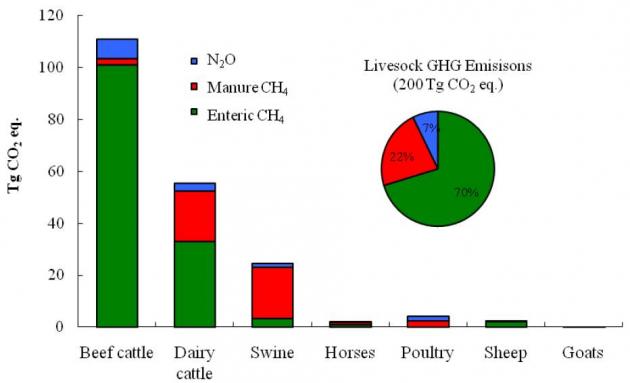
Agriculture is both a source and sink for greenhouse gases (GHG). A source is a net contribution to the atmosphere, while a sink is a net withdrawal of greenhouse gases.  In the United States, agriculture is a relatively small contributor, with approximately 8% of the total greenhouse gas emissions, as seen below.  Most agricultural emissions originate from soil management, enteric fermentation (the ruminant digestion process that produces methane), energy use, and manure management.  The primary greenhouse gases related to agriculture are carbon dioxide, methane, and nitrous oxide. Within animal production, the largest emissions are from beef followed by dairy, and largely dominated by the methane produced in during cattle digestion.

U.S. GHG Inventory

U.S. greenhouse gas inventory with electricity distributed to economic sectors (EPA, 2013) 

Ag Sources of GHGs

U.S. agricultural greenhouse gas sources (Adapted from Archibeque, S. et al., 2012)

Greenhouse gas emissions from livestock in 2008 (USDA, 2011)

Soil Management

Excess nitrogen in agriculture systems can be converted to nitrous oxide through the nitrification-denitrification process. Nitrous oxide is a very potent greenhouse gas, with 310 times greater global warming potential than carbon dioxide.  Nitrous oxide can be produced in soils following fertilizer application (both synthetic and organic).

As crops grow, photosynthesis removes carbon dioxide from the atmosphere and stores it in the plants and soil life. Soil and plant respiration adds carbon dioxide back to the atmosphere when microbes or plants breakdown molecules to produce energy.  Respiration is an essential part of growth and maintenance for most life on earth. This repeats with each growth, harvest, and decay cycle, therefore, feedstuffs and foods are generally considered to be carbon “neutral.”

Some carbon dioxide is stored in soils for long periods of time.  The processes that result in carbon accumulation are called carbon sinks or carbon sequestration.  Crop production and grazing management practices influence the soil’s ability to be a net source or sink for greenhouse gases.  Managing soils in ways that increase organic matter levels can increase the accumulation (sink) of soil carbon for many years.

Animals

The next largest portion of livestock greenhouse gas emissions is from methane produced during enteric fermentation in ruminants – a natural part of ruminant digestion where microbes in the first of four stomachs, the rumen, break down feed and produce methane as a by-product. The methane is released  primarily through belching.

As with plants, animals respire carbon dioxide, but also store some in their bodies, so they too are considered a neutral source of atmospheric carbon dioxide.

Manure Management

A similar microbial process to enteric fermentation leads to methane production from stored manure.  Anytime the manure sits for more than a couple days in an anaerobic (without oxygen) environment, methane will likely be produced.  Methane can be generated in the animal housing, manure storage, and during manure application. Additionally, small amounts of methane is produced from manure deposited on grazing lands.

Nitrous oxide is also produced from manure storage surfaces, during land application, and from manure in bedded packs & lots.

Other sources

There are many smaller sources of greenhouse gases on farms. Combustion engines exaust carbon dioxide from fossil fuel (previously stored carbon) powered vehicles and equipment.  Manufacturing of farm inputs, including fuel, electricity, machinery, fertilizer, pesticides, seeds, plastics, and building materials, also results in emissions.

To learn more about how farm emissions are determined and see species specific examples, see the Carbon Footprint resources.

To learn about how to reduce on-farm emissions through mitigation technology and management options, see the Reducing Emissions resources.

 Additional Resources

Additional Animal Agriculture and Climate Change Resources


Author: Crystal A. Powers, UNL
Reviewers:

Mandatory Greenhouse Gas Emissions Reporting for Animal Agriculture

logo for animal agriculture climate change which includes a weather vane with cow and topImportant note: Congress has prohibited EPA from expending any funds to implement subpart JJ (manure management) of the rule. Industry efforts to overturn subpart JJ are underway, but the outcome is unknown at this time. Though EPA cannot technically enforce the rule, livestock and poultry operations should remain aware of the requirements in the event the Congressional
prohibition is allowed to expire.

[Archived webinar] Mandatory GHG Reporting Rule & Carbon Footprint of Dairy Systems

Which Livestock or Poultry Facilities Meet the Reporting Threshhold?

Several industries are impacted by this rule, including animal agriculture. The rule estimates that around 100 animal facilities will meet the threshhold of 25,000 metric tons of annual carbon dioxide (equivalent) emissions. The following table was excerpted from page 558 of the rule after it was first published (2009). For updates, please visit the EPA Greenhouse Gas Reporting Program.

Animal Population (Annual) Below Which Facilities Are Not Required to Report Emissions
Animal Group Average Annual Animal Population (Head)
Beef 29,300
Dairy 3,200
Swine 34,100
Poultry: Layers 723,000
Poultry: Broilers 38,160,000
Poultry: Turkeys 7,710,000

Facilities below these populations will not be required to report emissions. Facilities that meet or exceed these populations will need to conduct an analysis to determine if they emit more than 25,000 tons of CO2 equivalent.

An important point in the reporting requirements for animal agriculture are that emissions need to be calculated and reported only for the manure management system. Enteric fermentation (fermentation occurring naturally in the rumen or gut) is not included. Emissions from land application of manure are also not included.

Large facilities with more than one type of animal (even if the species present do not individually meet the population listed above) will need to calculate a combined animal group factor.

Reducing GHG Emissions Can Change Reporting Requirements

Facilities that implement technologies or management that reduce their GHG emissions will be able to cease reporting:

  • after 5 consecutive years of emissions below 25,000 metric tons CO2e/year
  • after 3 consecutive years of emissions below 15,000 metric tons CO2e/year
  • if the GHG-emitting processes or operations are shut down

Learning More About Greenhouse Gas Emissions from Animal Agriculture

NRCS Online Air Quality, Energy and Climate Change Courses

The Natural Resources Conservation Service (NRCS) has begun developing online courses in three curriculum tracks: air quality, energy, and climate change. Air Quality, Climate Change, and Energy is the lead-in to the three tracks.

The courses are designed for all Natural Resource Conservation Service (NRCS) employees, but particularly for State Air Quality and Energy Contacts, conservation planners, partnership employees, and conservation technical assistance providers to assist them in integrating air quality, energy and climate change into conservation planning and programs. Although these courses were developed specifically for NRCS employees, the information contained in them may also be useful to NRCS partners and others associated with conservation in agriculture.

*A USDA eAuthentication account is needed to access the courses.*

Introductory Course

Air Quality Curriculum Track

Energy Curriculum Track

Climate Change Curriculum Track

Environmental Credit Trading

Other courses are either in development or are being planned to supplement the learning modules for each of these curriculum tracks

Air Quality, Climate Change, and Energy

Turkey production. Photo courtesy USDA NRCS.

Upon completion of the course, participants will be able to:

  • Define air quality, climate change, and energy as they relate to the NRCS mission and explain how they are interrelated
  • Explain the importance of these issues for land managers and NRCS itself
  • Recognize how soil, water, air, plants, animals and human activity all affect, and are affected by, energy and climate change
  • Identify examples of how air quality, climate change, and energy concepts apply to agricultural conservation
  • List and locate additional resources that can be used to expand knowledge of these topics

Course Link. Air quality is already a functional part of the NRCS conservation portfolio (the first ‘A’ in SWAPA+H). Climate change and energy are now becoming significant considerations in conservation planning. This course will provide a broad overview of these three topics, and how they are related to each other and SWAPA+H components. Students will learn how agricultural activities can contribute to air emissions, sequester carbon, manage greenhouse gas emissions, and better conserve energy. The course also will provide examples of addressing these issues via NRCS planning and programs. 90 minutes Go to Air Quality, Climate Change, and Energy….

Why Should We Care About Air Quality?

Upon completion of the course, participants will be able to:

  • State why air is an important natural resource
  • Explain why it is important to take a holistic approach to conservation planning
  • List the major reasons why NRCS addresses air quality and atmospheric change
  • Identify several agricultural activities that can release air emissions
  • Describe various reasons for land managers to address air quality and atmospheric change
  • Identify the role of NRCS employees in addressing air quality and atmospheric change

Course link. As the first “A” in SWAPA+H, air is an important natural resource that is vital to life. Although our agency has addressed issues related to air quality and atmospheric change since its formation, these issues have not been a traditional focus area for the NRCS in most locations. As our partners and the public have begun placing a larger emphasis on air quality and atmospheric change issues, NRCS has needed to develop the technical expertise for integrating conservation of the air resource into our assistance portfolio.

This course will provide a broad overview of air quality and atmospheric change and begin to equip NRCS conservationists and our partners with the knowledge and confidence to address air-related resource concerns. 30 minutes. Go to Why Should We Care About Air Quality?…

Manure management system for a swine farm. Photo courtesy USDA NRCS.

Air Quality Resource Concerns

Upon completion of the course, participants will be able to:

  • Identify the four primary air quality resource concerns and the emissions that contribute to these concerns
  • Identify the effects of particulate matter, ozone precursors, and odors on air quality
  • Discuss greenhouse gases as an atmospheric change issue
  • Derive potential solutions to reduce agricultural emissions of particulate matter, ozone precursors, odors, and greenhouse gases
  • List and locate additional resources that can be used to expand knowledge of these topics

Course link. The NRCS utilizes the concept of “resource concerns” in conservation planning. There are four broad categories of air-related resource concerns: particulate matter, ozone precursors, odors, and greenhouse gases and carbon sequestration. This course provides an overview of each of these four air quality resource concerns and how they can most effectively be addressed in the NRCS planning framework. Principal air emissions from agricultural operations are discussed, and how each of these is related to one or more of the air resource concerns. Finally, a variety of mitigation strategies are presented for managing emissions and improving these four air quality concerns. 50 minutes Go to Air Quality Resource Concerns…

Air Quality and Animal Agriculture

Upon completion of the course, participants will be able to:

  • Identify the primary reasons that animal production operations are currently the main focus when discussing air quality issues in agriculture
  • Identify the primary air emissions from animal production operations and describe how these emissions are generated, emitted, and transported
  • Identify NRCS options for mitigating air emissions from animal production operations

When discussing air quality issues in agriculture, animal production operations are typically the primary focus for mitigation and regulation.  This course will introduce the air emissions associated with animal operations and provide information on how NRCS can help producers mitigate these emissions. 60 minutes Go to Air Quality and Animal Agriculture…

Greenhouse Gases and Carbon Sequestration

Upon completion of the course, participants will be able to:

  • Explain the greenhouse effect
  • Discuss the characteristics of sunlight and earth’s radiation balance
  • Determine how changes in greenhouse gas emissions can influence global climate change
  • Identify methodologies in which agricultural and natural resource systems can mitigate greenhouse gas emissions and effects
  • Given a scenario, explain the importance of a holistic approach to the reduction of greenhouse gas emissions

Course Link Climate change and carbon offset trading have gained great interest in many parts of the agricultural community over the past few years. But why should we as NRCS conservationists be interested in these issues? Conservation systems that we design and help implement can often have a positive influence on the emission or storage of gases which, when in the atmosphere, can affect climate change. This course shows the importance of greenhouse gases to life on earth, the potential negative consequences of increasing greenhouse gas concentrations in the atmosphere, agricultural sources of greenhouse gases, and potential methods in which agriculture can reduce its net emissions of greenhouse gases to the atmosphere. 60 minutes Go to Greenhouse Gases and Carbon Sequestration…

Why Do We Care About Energy?

Upon completion of the course, participants will be able to:

  • Describe why energy costs and energy security are so important to land managers.
  • Describe environmental impacts of fossil fuel exploration, production and use.
  • Describe energy opportunities available to land managers and NRCS

Course Link While energy has not traditionally been addressed in the NRCS planning process, it is receiving unprecedented attention in the national and international news. This short course provides insight into why energy issues are important to agriculture and the nation. It gives participants the opportunity to explore how our energy choices can impact NRCS and the natural resources we work to conserve. 30 minutes Go to Why Do We Care About Energy?…

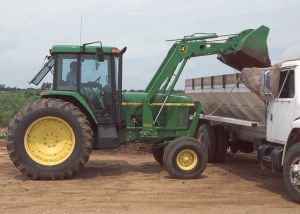
Tractor loading chicken litter into spreader truck. Photo courtesy USDA NRCS.

Energy Basics

Upon completion of the course, participants will be able to:

  • Describe basic terminology and energy concepts.
  • Identify non-renewable and renewable sources of energy and describe their origins, benefits and uses
  • Explain life cycle analysis and it relevance to comprehensive energy planning
  • Describe agriculture’s role in utilizing renewable energy alternatives

Course Link Understanding energy basics is fundamental to effective energy conservation planning. This course establishes a technical foundation to prepare NRCS planners to incorporate energy considerations into conservation plans. It provides general background on the fundamental principles behind energy issues in agricultural settings. 90 minutes Go to Energy Basics…

Why Do We Care about Climate Change?

At the completion of this course, students will be able to:

  • Understand climate change and its key drivers
  • Explain the impacts of climate change on agriculture and natural resources
  • Differentiate mitigation from adaptation
  • Discuss NRCS’ role in helping land managers and owners in mitigating and adapting to the impacts of climate change

Course link. Climate plays a key role in conservation planning, natural resource management and agricultural production. Changes in climate can have significant impacts on managing and protecting agricultural and natural resources.  NRCS is educating its employees and partners about climate change, and communicating climate change impacts to NRCS customers. Understanding climate change and its impacts will help NRCS assist private landowners, producers, and land managers cope and adapt to changing climate.

This course discusses climate change and related concepts, the impacts of climate change on agriculture and natural resources, and NRCS’ role in helping private land owners and land managers address climate change mitigation and adaptation through conservation planning. 30 minutes. Go to “Why Care About Climate Change?”

Technical Contact: Carolyn Olson at Carolyn.olson@wdc.usda.gov

Introduction to Environmental Credit Trading

Course link: This course provides an introductory discussion of environmental credits, environmental credit trading, and market-based approaches providing environmental and economic benefits.

At the completion of this course, students will be able to:

  • Understand environmental credit trading
  • Identify markets for environmental credits
  • Explore the benefits and costs of participating in markets
  • Understand how different environmental practices can produce various environmental credits
  • Outline various ways agricultural producers can benefit from environmental credit trading
  • Explain how producers can participate in environmental credit trading

Course length: 90 minutes. Go to “Introduction to Environmental Credit Trading

Technical Contact: Carolyn Olson at carolyn.olson@wdc.usda.gov

Page Manager

Greg Zwicke, P.E.
Air Quality Engineer
Air Quality and Atmospheric Change Team
USDA-NRCS, WNTSC
2150 Centre Ave.
Building A, Suite 231
Ft. Collins CO  80526

greg.zwicke@ftc.usda.gov
Ph. 970.295.5621

Methane Emissions from Dairy Cattle

Reprinted, with permission, from the proceedings of: Mitigating Air Emissions From Animal Feeding Operations Conference.

This Technology is Applicable To:

Species: Dairy
Use Area: Animal Housing
Technology Category: Diet Modification
Air Mitigated Pollutants: Methane

System Summary

There are a large number of options that can potentially be used to mitigate methane emissions from dairy cattle. The basic result of using these approaches is an improvement in the efficiency of nutrient use in the animal and increased productivity. Methane emissions per unit of milk produced will decrease as a result of these changes. An important component is continuing to improve forage quality. Higher quality forages have higher digestibility in the cow and less methane emissions than lower quality forages. A second approach is to better balance the diet protein and carbohydrate fractions to improve the efficiency of both rumen fermentation and feed nutrient use. Methane emissions will be reduced as a result. There are also opportunities to provide specific feed additives to decrease methane emissions from the cow. Their use is currently limited due to lack of data to demonstrate their efficacy in lactating dairy cows. Ionophores are one feed additive that does have data indicating improved feed efficiency and decreased methane emissions.

Applicability and Mitigating Mechanism

Potential mitigation options include:

  • Improved forage quality
  • Rations balanced to improve efficiency of rumen fermentation
  • Use of ionophores in rations

Limitations

  • Many options will require some financial investment
  • Management changes may be needed
  • Requires a systems approach
  • Feed additives that could be helpful in reducing methane emissions have not been tested in animal trials
  • Cost to benefit ratio cannot be defined for many practices that could be use

Cost

The cost of practices that could be implemented on a dairy farm to reduce methane emissions will be highly farm specific. Each farm will need to evaluate the available mitigation options to determine the best choices for their situation. The costs for implementation will also vary between farms due to differences in their current cost structures. The initial benefits to the farm will be improved efficiency of animal production, efficiency of nutrient use and improved profitability.

Authors

Larry Chase, Cornell University
Point of Contact:
Dr. L.E. Chase, lec7@cornell.edu

The information provided here was developed for the conference Mitigating Air Emissions From Animal Feeding Operations Conference held in May 2008. To obtain updates, readers are encouraged to contact the author.

Scientific Overview of Agricultural Carbon Research & the Implications for Climate

In response to the rapid pace of global climate change, the work of the Marin Carbon Project and the Carbon Cycle Institute has focused on measuring the effects of rangeland management practices and their implications for carbon sequestration into permanent soil carbon pools. This presentation was originally broadcast on April 11, 2014. More… Continue reading “Scientific Overview of Agricultural Carbon Research & the Implications for Climate”

Clearing the Air on Biofilters

Biofilters have been widely adopted to filter gas, odor and particulate matter from livestock facilities. However, the science behind “how they work” and the configurations that are in practice are continually evolving. This webinar discusses past and present applications of biofilters, on-going research to better design and manage biofilters, and how to incorporate biofilters as part of an environment control system.This webcast was originally broadcast on December 7, 2012. More… Continue reading “Clearing the Air on Biofilters”

Life-Cycle Assessment Modeling for the Pork Industry

green stylized pig logoDo the pork industry’s efforts to improve production and economics affect its greenhouse gas emissions and carbon foot print? Research by the University of Arkansas combined with efforts led by the National Pork Board indicates that increased production efficiencies have reduced the carbon footprint of each pound of pork produced.

Following up on the June 15th, 2012 webcast, this webinar presents an overview of a research and extension project wherein the existing research-based carbon footprint model is refined and expanded. The project goal is to improve this model’s ability to serve as a farm-level educational and decision aid tool that incorporates environmental, production, and economic concerns. The webcast also highlights feed management concepts and ongoing research, which are major components of the project. This webcast was originally broadcast on July 20, 2012. More… Continue reading “Life-Cycle Assessment Modeling for the Pork Industry”