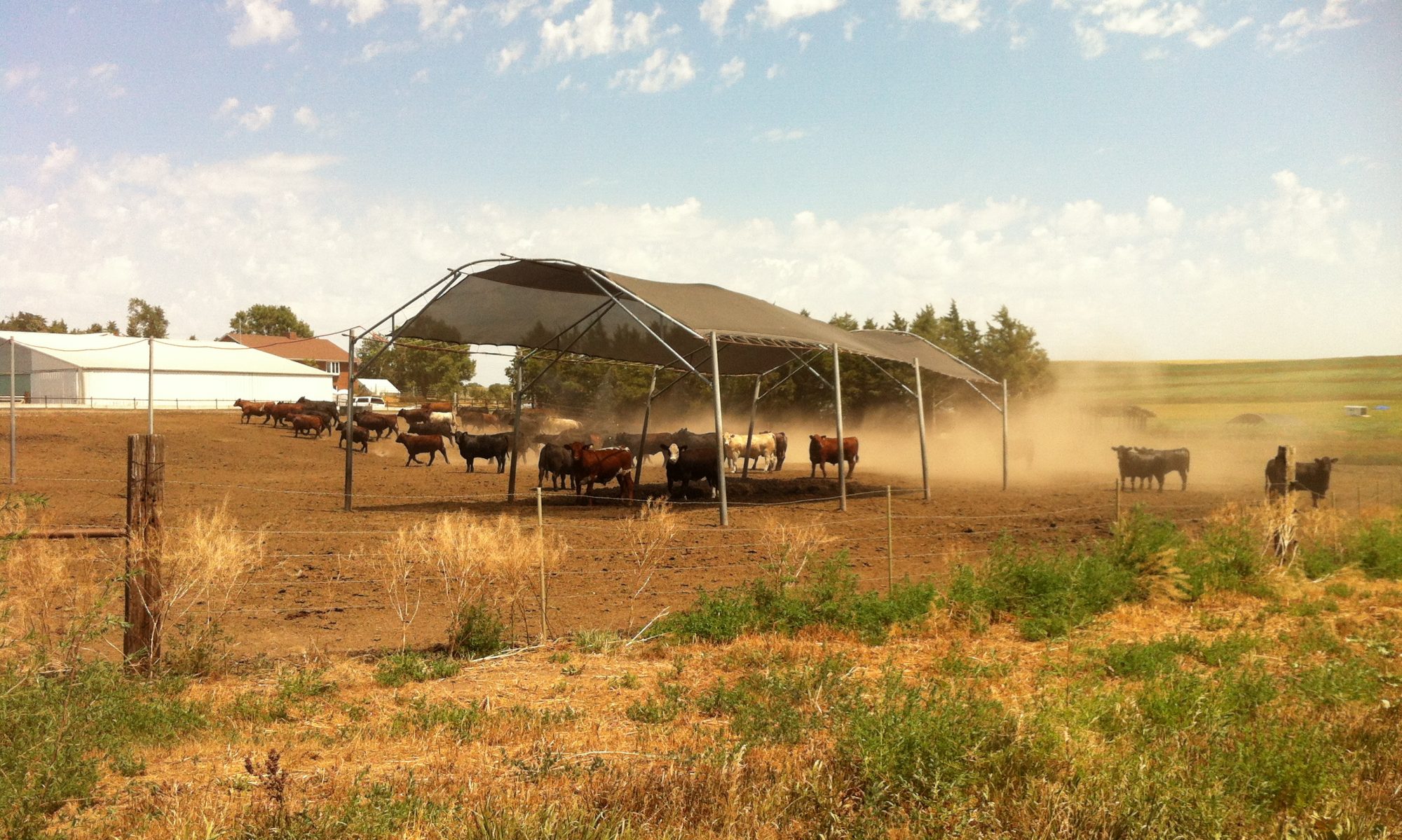
This webinar will focus on assisting livestock farmers and veterinarians to better identify, diagnose, and treat sick animals with the goal of improving farm efficiency and antibiotic stewardship. This webinar is brought to you by the iAMResponsibleTM Project, a nationwide team of researchers and extension experts working to develop and deliver effective outreach on antimicrobial resistance for diverse audiences. This presentation was originally broadcast on August 18, 2023. Continue reading “Improving disease identification, treatment, & antibiotic stewardship in livestock production”
Article Submissions for the Newsletter!
We are always looking for articles to include in our monthly newsletter, so we created a form to make submission easier. Send an article related to some aspect of animal agriculture and environmental stewardship. All we need is the author, title, and link to the article so we can review it and put in the newsletter. Fill the form out below or go to https://forms.gle/rzQTRVfRzeE1baMh9.
Upcoming Webinars
How Do I Participate in a Webinar?
Past webinars are available at Webinar Archive
When Are Webinars Held?
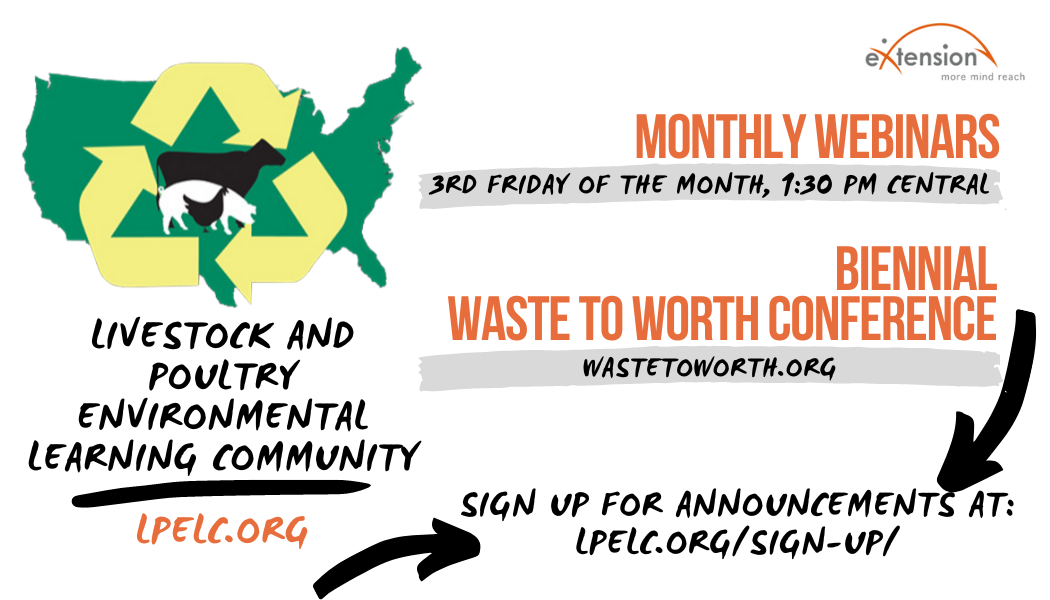
The one-hour webinar seminars are typically held on the third Friday of each month at 2:30 pm (eastern), 1:30 pm (central), 12:30 pm (mountain) and 11:30 am (pacific). This schedule is subject to change. To view a webinar, connect through the Live Webinar Information page.
Webinar Schedule
| Date | Topic/Title | Add to Calendar | Marketing Materials | Registration | ||
|---|---|---|---|---|---|---|
| March 20, 2026 | Nutrient Management Solutions for Small Farms | Outlook | Printable Flyer | Online Announcement | Registration Now Available! | |
| April 2026 | TBD | |||||
Collaborating on Integrated Projects
 Collaborating on integrated projects can seem difficult, but, when implemented well, the potential for beneficial outcomes from such projects can make facing the challenges very worthwhile. That’s part of the reason why there’s growing movement by funding agencies toward supporting integrated, collaborative projects. Here are a few tips to help make collaborating on integrated efforts more enjoyable.
-
- Involve all collaborators from start to finish.
-
- When developing an integrated project, include all prospective collaborators from the beginning. Involving project team members early helps develop a coherent shared vision and makes collaborators feel like they are truly a team that is working on one integrated project.
- Avoid making last-minute requests for an outreach plan from extension, stakeholder engagement, partners in on-farm demonstration efforts, or matching funds, etc. Some thoughtful planning can lead to more productive collaborations and outcomes.
- Extension personnel appreciate being included as an author in research publications related to the project. Research can be much more impactful when practical implications of results are communicated to lay audiences and through stakeholder networks.
- Stakeholder engagement is important as well. By keeping the communication with the stakeholders open, you avoid trying to explain or give directions to someone without prior engagement.
-
- Be specific and ready to answer questions.
-
- Here are just a few on the questions that might be asked, and collaborators should be ready to answer:
-
- What are you asking of a collaborator and what will be done by someone else?
- What is the goal of the project?
- Is there funding to do everything you’re proposing?
- Will you need to hire other help?
-
- Clearly define the roles of collaborators and their organizations. This can help prevent confusion between collaborators on how much they are responsible for in the project.
- Have a clear title and summary of the project to communicate the project and how things tie together. This can help collaborators that might have joined after the collaboration has started.
- Make sure your plan includes objectives that specifically relate to the collaborator and have programming funds built into on-farm demonstration efforts.
- Here are just a few on the questions that might be asked, and collaborators should be ready to answer:
-
- Be ready for collaborators and stakeholders who are promoting or wary of products/systems.
-
- Use the diverse backgrounds and past experiences of your collaborators to your advantage. Collaborators with different perspectives may see things in ways that you don’t. Because of previous experiences, collaborators may be wary of some aspects of the proposal. For example:
-
-
-
- Specific products:
- Some collaborators may have concerns about side effects of products, so they may be wary of its use, but they may have ideas how to test for those side effects.
- Equipment usage or practicality:
- Some collaborators may better understand how the end user needs the equipment to work for them, so have them help with prototype development so it’s easier to take the equipment from prototype to commercial production.
- Certain systems:
- If you’re trying to bring a certain system to a new area, stakeholders and collaborators may be able to provide insight about other systems that have been tried in their area, both successfully and not-so-much.
- Specific products:
-
- Just because collaborators and stakeholders may be wary of your proposal doesn’t mean they shouldn’t be included. In fact, the opposite may be true. They may be able to guide the proposal in a way that strengthens it but be prepared for a little push back.
-
-
- Involve all collaborators from start to finish.
It takes some effort to build a productive team and keep everyone on the same page, but good collaborations are hard to beat.
American Registry of Professional Animal Scientists (ARPAS) Continuing Education Units
These webinars have been approved for 1 continuing education unit (each) as part of the American Registry of Professional Animal Scientists (ARPAS) program. To receive CEUs, view a live or archived webinar, complete an evaluation (if available), and contact ARPAS, 217-356-5390 to have the credit applied to your CEU balance. Repeat this process for each webinar being utilized for CEUs.
2026 Webinars
More Webinars…
Topics include: Drones, Remote Sensing, Nutrient Cycle, Mortality Management, 360Rain, Discharge Water Quality, Ammonia Deposition, NRCS-CIG Programs, Manure Application More…
Topics include: AFO Air Emission Estimations, Soil Health, Mortalities, Air Quality, Models & Tools, Circularity, Precision Ag, Environmental Progress, Dairy Manure, Farm Safety, PFAS. More…
Topics include: Carbon Markets, Soil Health, Mortalities, Air Quality, Models & Tools, Vector Control, Antibiotic Stewardship, Manure Additives, Minimizing Risk, and Energy Conservation. More…
Topics include: Carbon Markets, Worker Safety, CEAP I & II, Antimicrobial Resistant movement, Manure Nutrient Trends, Vermifiltration, Urban Manure Management, Manure Pipelines, and Lagoon and Digester Cleanouts. More…
Topics include: Edge of Field Monitoring, PFAS, Food Safety, Digesters & Natural Gas, Manuresheds, Extreme Events, Antimicrobial Resistance, Sustainability, Weeds, and Soil Health. More…
Topics include: Less typical species, designer manure, precision technologies, human health, poultry systems, communicating science, compost emissions, PFAS, and manure transfers. More…
Topics include: Separation technologies, soil health, cleaning barn exhaust air, pathogens, antimicrobial resistance, greenhouse gas emissions, nutrient inventories, and phosphorus management. More…
Topics include: Emergency response, treatment technologies, manure foaming, small farm equipment, manure’s impact on soil, manure irrigation, manure pit death, sampling, and biosecurity. More…
Topics include: Climate resiliency, avian influenza, side-dressing nitrogen on emerged corn, runoff risk advisory tools, anaerobic digestion, manure handling safety, long-term manure application, and managing edge of field losses.. More…
Topics include: Construction and maintenance of manure ponds, antibiotic resistance, manure entomology, NAQSAT, Drones, manure safety and transport, the nutrient recycling challenge, Vermont nutrient management training course, and pathogens. More…
Topics include: Manure Apps, Gypsum Bedding, Livestock Housing, Tile Drained Lands, Micro Manure Management, Horse Manure Composting, Uses of Biochar, Thermal Manure-to-Energy Systems, Mortality Management during Avian Influenza, Communication Pathways, Communicating During Controversy. More…
Topics include: Capturing Nutrients, Manure as a biofuel, Water Quality Index, Liquid manure nutrients, Carbon credits, Bioaerosols, WOTUS, Biosecurity, Mortality composting, Whole Farm Nutrient management, Winter manure application, Next generation activities. More…
2013 Webinars
Topics include: Risk Management, Waste to Worth, Mono-slope beef barns and research results, Bioavailability of Phosphorus, Capturing Nutrients. More…
2012 Webinars
Topics include: Biofilters, The 4Rs, Microbes, Life-Cycle Assessments, Carbon Footprints, Nitrates, Adaptive Nutrient Managment, Chesapeake Bay, Emergency Management. More…
2011 Webinars
Topics include: Top-dressing manure, Chesapeake Bay, Soil Health, Reducing Odor Risk, Anaerobic Digestion, NMP implementation, NAEMS, Lagoon Closure, Manure Economics, 2011 NPDES CAFO rule. More…
2010 Webinars
Topics include: Cover Crops, Vegetative Environmental Buffers, Mortality Composting, Manure Spills, NAQSAT, Manure on No-Till, SPCC, Ammonia Emissions. More…
2009 Webinars
Topics include: Feeding Strategies, Carbon Footprint, Conserving Nitrogen, AFO Inspection, Mortalities, Air Emissions, Grazing Management. More…
2008 Webinars
Topics include: Market Based Conservation, Antibiotics and Hormones, Dry Manure Housing Systems, Ammonia, Small Farms, Regulations, Manure Management Planner Software. More…
2007 Webinars
Topics include: Integrated Nutrient Management, Manure Application to Legumes, Value of Manure in Land Application, Smithfield Project, Value Added Processing of Manure, Manure Treatment Technologies, Value of Manure in Energy Generation, Vegetative Treatment Systems, and Innovative Manure Treatment Technologies. More…
2006 Webinars
Topics include: CNMP Core Curriculum, Pathogens, EPA CAFO Regulations. More…
Having Trouble?
If you experience difficulty in viewing webinars, please visit our webinar troubleshooting page:
Certified Crop Advisers (CCA) Continuing Education Units Available Through the Livestock and Poultry Environmental Learning Center
How Do I Get CEUs?
Certified Crop Advisors (CCA), Certified Professional Agronomists (CPAg), and Certified Professional Soil Scientists (CPSS) are eligible for CEUs. You can obtain them by doing one of the following:
-
- View a live webinar. You will be instructed to submit your name, email and CCA# during registration. This will be submitted to the CCA program along with an attendance list.
- View an archived webinar, and click on the quiz link on each page or search for the title of the webinar in the CCA course catalog. The CCA program charges a fee for CEUs obtained through self-study.
Nutrient Management CEUs
Soil & Water Management CEUs
Professional Development CEUs
Crop Management CEUs
Integrated Pest Management CEUs
Having Trouble?
If you have difficulties playing back one or more of the webinars, visit our webinar troubleshooting page.
Environmental Benefits of Manure Application
For centuries, animal manure has been recognized as a soil “builder” because of its contributions to improving soil quality. Environmental benefits are possible from manure application if manure and manure nutrients are applied and timing and placement follows best management practices. When compared to more conventional fertilizer, manure properly applied to land has the potential to provide environmental benefits including:
-
- Increased soil carbon and reduced atmospheric carbon levels
- Reduced soil erosion and runoff
- Reduced nitrate leaching
- Reduced energy demands for natural gas-intensive nitrogen(N) fertilizers
Manure Effects on Soil Organic Matter
Manure contains most elements required for plant growth including N, P, potassium, and micronutrients (Manure as a Source of Crop Nutrients and Soil Amendment). However, it is manure’s organic carbon that provides its potential environmental value. Soil organic matter is considered nature’s signature of a productive soil. Organic carbon from manure provides the energy source for the active, healthy soil microbial environment that both stabilizes nutrient sources and makes those nutrients available to crops.

Several long-term manure application studies have illustrated its ability to slow or reverse declining soil organic levels of cropland:
-
The ability of manure to maintain or build soil organic matter levels has a direct impact on enhancing the amount of carbon sequestration in cropped soils.Manure organic matter contributes to improved soil structure, resulting in improved water infiltration and greater water-holding capacity leading to decreased crop water stress, soil erosion, and increased nutrient retention. An extensive literature review of historical soil conservation experiment station data from 70 plot years at 7 locations around the United States suggested that manure produced substantial reductions in soil erosion (13%-77%) and runoff (1%-68%). Increased manure application rates produced greater reductions in soil erosion and runoff. Additional studies during years following manure application suggest a residual benefit of past manure application.
Overview of Manure Impacts on Soil (Mark Risse, University of Georgia). Visit the archived webinar for additional videos on carbon, fertility, and soil health.Manure Effects on Soil Erosion
In addition, surface application of manure behaves similarly to crop residue. Crop residue significantly decreases soil erosion by reducing raindrop impact which detaches soil particles and allows them to move offsite with water runoff. Data has been published showing how manure can coat the soil surface and reduce raindrop impact in the same way as crop residue. Therefore, in the short-term, surface manure applications have the ability to decrease soil erosion leading to a positive impact on environmental protection.
Organic Nitrogen
In addition, organic N (manure N tied to organic compounds) is more stable than N applied as commercial fertilizer. A significant fraction of manure N is stored in an organic form that is slowly released as soils warm and as crops require N. Commercial fertilizer N is applied as either nitrate or an ammonium (easily converted to nitrate). Nitrate-N is soluble in water and mobile. These forms contribute to leaching during excess precipitation (e.g., spring rains prior to or early in growing season) or irrigation. Manure N’s slow transformation to nitrate is better timed to crop N needs, resulting in less leaching potential. In fact, manure N is a natural slow-release form of N.
Energy Benefits
Recycling of manure nutrients in a cropping system as opposed to manufacturing or mining of a new nutrient resource also provides energy benefits. Commercial nitrogen fertilizers consume significant energy as a feedstock and for processing resulting in greenhouse gas emissions. Anhydrous ammonia requires the equivalent of 3300 cubic feet of natural gas to supply the nitrogen requirements of an acre of corn (assuming 200 lb of N application). Phosphorus and potassium fertilizers also have energy requirements for mining and processing. Substituting manure for commercial fertilizers significantly reduces crop production energy costs
It is important to remember that the environmental benefits of manure outlined in this article are only beneficial when best management practices for reducing soil erosion are implemented in concert with proper levels of manure nutrient application and use.
Recommended Reading on Environmental Benefits of Manure
- University of Minnesota (2002) Organic Matter Management
- Oklahoma State University publication (1998) Manure and Soil Quality
- Ontario Ministry of Agriculture, Food and Rural Affairs (2015) What is the Impact of Manure on Soil Organic Matter?
- Transactions of ASABE article (2000) Runoff and Soil Loss as Affected by the Application of Manure
- Journal of Environmental Quality article (2005) Phosphorus Runoff during Four Years following Composted Manure Application
- Journal of Environmental Quality article (2007) Residual Effects of Compost and Plowing on Phosphorus and Sediment in Runoff
- Authors: Rick Koelsch, University of Nebraska, and Ron Wiederholt, North Dakota State University
- Reviewers: Charles Wortmann, University of Nebraska, and Steve Brinkman, Iowa NRCS
Last reviewed on October 25, 2022 by Leslie Johnson, Animal Manure Management Extension Educator, Nebraska Extension.
Archived Webinars, Livestock and Poultry Environmental Learning Center
Browse Webinars in Chronological Order
Each archive page contains video clips, presentation slides, written summaries of the question and answer session (when available), and links to additional information.
Most Recent Webinars
-
- Pathogens Beyond the Animal: Environmental Drivers of Disease in Livestock Systems – February 20
- Clear Communication, Safer Operations: Why Multilingual Manure Management and Farm Safety Training Matters – January 23
- A view from above – application of drones and remote sensing for air and water quality measures around livestock farms – December 12
Software Need to View Archived Webinars
Webinars require Flash Player (already installed in 98% of web browsers). The power point presentations and other documents are available in PDF format and require Adobe Reader to open.
Air Quality
-
- A view from above – application of drones and remote sensing for air and water quality measures around livestock farms
- A USDA multi-location project monitoring ammonia deposition near animal production sites
- The Role of Agriculture in Atmospheric Nitrogen Deposition: Sources, Impacts, and Management
- Animal Feeding Operations Air Emission Estimation Methods
- Energy Conservation in Livestock and Poultry Operations
- Improving Air Quality In and Around Livestock Facilities
- Emissions from Composting
- Human Health: Pathogens and Contaminants in Livestock Systems
- California’s Efforts to Reduce Greenhouse Gases from Dairy and Livestock Operations
- Three Options for Cleaning Barn Exhaust Air
- Considerations of the use of Manure Irrigation Practices
- Poo is not to play with: Manure Handling Safety
- Implementation and Experiences of NAQSAT Around the US
- Novel Livestock Housing
- Bioaerosols from Feedlots and Dairy Farm Operations
- Results of the Mono-slope Beef Barn Research Project
- Clearing the Air on Biofilters
- Life-Cycle Assessment Modeling for the Pork Industry
- Producer Association Efforts to Address Carbon Footprints: Pork and Poultry
- National Air Emissions Monitoring Study (NAEMS) Selected Results and Discussion of Their Significance
- Planning Livestock & Poultry Facilities for Reduced Odor Risk
- Controlling Ammonia and Air Emissions in Poultry Facilities
- Live from the National Poultry Waste Symposium
- NAQSAT for Swine and Poultry
- NAQSAT for Beef and Dairy
- Animal Ag’s Role in Greenhouse Gas Production
- Mitigating Air Emissions with Vegetative Environmental Buffers
- Greenhouse Gas Emissions Estimation and Reporting
- Air Emissions After Manure Land Application Including Subsurface Application of Poultry Litter and Solid Manure
- Carbon Footprint of Animal Agriculture
- Greenhouse Gas Emissions from Animal Agriculture
- Air Emissions From Cattle Feedyards and Dairies
- Feeding Strategies To Reduce Animal Air Emissions
- Hydrogen Sulfide, How Serious an Outdoor Air Quality Concern
- Federal Air Quality Regulations and Update on the National Air Emissions Monitoring Study
- Ammonia, The Air-Water Interface
Regulations
-
- Pathogens Beyond the Animal: Environmental Drivers of Disease in Livestock Systems
- Clear Communication, Safer Operations: Why Multilingual Manure Management and Farm Safety Training Matters
- A Systems-Approach to Understanding the Nutrient Cycle Across the Pork Ecosystem
- Mortality Management – From Routine to Catastrophic
- Flies, Frass, Feces, and Fields
- Food Safety and Manure Application
- Next Generation Strategies for Managing Edge of Field Nutrient Losses
- A Nutrient Management Training Course for Farmers: A Vermont Case Study
- Drone Use in Animal Agriculture
- Recent Developments in Animal Ag: Idaho Ag Gag Ruling (brought to you via the Ag Law Seminar Series)
- Animal Agriculture Legal Update (brought to you via the Ag Law Seminar Series)
- EPA’s Proposed Waters of the U.S. Regulations
- Chesapeake Bay 2012 – Implications of the TMDL
- 2011 Proposed NPDES CAFO Reporting Rule
- Spill Prevention, Control and Countermeasures
- Greenhouse Gas Emissions Estimation and Reporting
- What To Expect When Your Animal Feeding Operation Is Inspected
- Final Rule on Concentrated Animal Feeding Operations (CAFO), 2008
- Federal Air Quality Regulations and Update on the National Air Emissions Monitoring Study
Manure Treatment Technologies
-
- A Systems-Approach to Understanding the Nutrient Cycle Across the Pork Ecosystem – November 14
- Rethinking Manure Management with 360Rain: Expanding Application Windows and Improving Nutrient Use Efficiency
- Flies, Frass, Feces, and Fields
- Manure processing for discharge water quality – technical performance and county perspectives for advancing water quality
- Mobilizing Microbes in Treatment Processes
- Upcoming Models and Tools to Improve Manure Management
- Implications of Manure Additives: Both Purposeful and Accidental
- Carbon Markets for Livestock Operations: Producer Perspectives
- Carbon Markets for Livestock Operations: Manure Treatment and Handling
- Worker Safety in Animal Production Systems
- Use of Vermifiltration as a Tool for Manure Management
- Cleanout for Lagoons and Anaerobic Digesters
- Coupling Manure Digesters with Renewable Natural Gas Systems
- Phosphorus Management Lessons Learned from the Field
- Managing Manure to Mitigate Antibiotic Resistance
- What’s New with Solid Separation? NRCS has an Answer
- California’s Efforts to Reduce Greenhouse Gases from Dairy and Livestock Operations
- Reduction and fate of manure pathogens and antimicrobial resistance
- Separation Technologies for Capturing Nutrients from Manure
- Determining Causes of Deep‐pit Swine Manure Foaming Issues and Potential Mitigation Strategies
- Making Sense of Treatment Technology Options for Livestock Farms
- Next Generation Strategies for Managing Edge of Field Nutrient Losses
- Anaerobic Digestion Systems
- U.S. EPA Nutrient Recycling Challenge
- MANURE ENTOMOLOGY: Manure Management That Won’t “Bug You”
- Thermal Manure-to-Energy Systems for Farms: Technical and Environmental Feasibility
- Agronomic and Environmental Uses of Biochar (Part 2)
- Agronomic and Environmental Uses of Biochar (Part 1)
- Horse Manure Composting: Specific Steps to Start or Improve the Process
- Micro Manure Management
- Thermal Conversion of Animal Manure to Biofuel
- Capturing Valuable Nutrients from Manure: Part 3
- Capturing Valuable Nutrients from Manure: Part 2
- Capturing Valuable Nutrients from Manure: Part 1
- Prediction of Bioavailability of Phosphorus for Dairy Cattle
- Anaerobically Digested Manures
- Overview of Alternative Manure Treatments, Matching the Treatment to the Environmental Concern
- Dry Manure Housing, Bedded Barns for Beef Cattle and Compost Barns for Dairy Cattle
- Virtual Tours of Vegetative Treatment Systems (VTS)
- Small Business Innovation Research (SBIR) Program and Two Innovative Technologies–Vermicomposting and Pyrolysis
- Evaluating Manure Treatment Through Farm Pilot Project Coordination
Manure Nutrient Management
-
- A view from above – application of drones and remote sensing for air and water quality measures around livestock farms
- A Systems-Approach to Understanding the Nutrient Cycle Across the Pork Ecosystem – November 14
- Rethinking Manure Management with 360Rain: Expanding Application Windows and Improving Nutrient Use Efficiency
- A USDA multi-location project monitoring ammonia deposition near animal production sites
- Application of Manure on Growing Crops
- Engaging Farm Safety and Manure Management: Innovative Teaching Methods in Action
- Managing Dairy Manure for Increased Soil Health and Forage Production Sustainability
- Fifty Years of Environmental Progress for US Dairy Farms
- Staying in the Loop: Circularity in Integrated Crop and Livestock Production
- Precision Ag In the Barn and In the Pasture
- Implications of Managing Manure on a Nitrogen Basis
- Upcoming Models and Tools to Improve Manure Management
- Models & Tools to Improve Manure Management: Part II
- Implications of Manure Additives: Both Purposeful and Accidental
- Models & Tools to Improve Manure Management
- Manure and Soil Health: Current Research and Future Directions
- Carbon Markets for Livestock Operations: Producer Perspectives
- Soil Carbon: How to change it and sell it
- Worker Safety in Animal Production Systems
- Manure nutrient trends and creating dynamic “book values” through ManureDB
- Going the distance: considerations for the use of manure pipelines
- Incentives for Sustainable Practices
- Hunkering Down for Extreme Events
- Manuresheds: Advancing nutrient recycling in US agriculture
- Food Safety and Manure Application
- Edge of Field Monitoring
- Successful Strategies for Transferring Manure
- Litter Nutrients and Management in Poultry Systems
- Precision Technologies for Managing Manure
- Designer Manure: Customizing Manure Nutrients to Meet Crop Needs
- Managing manure beyond the farmyard: Manure management for less-typical species and settings
- Phosphorus Management Lessons Learned from the Field
- Watershed Nutrient Inventories – Opportunities and Needs
- Separation Technologies for Capturing Nutrients from Manure
- Manure Sampling Considerations in Different Animal Production Systems
- Live from the North American Manure Expo 2018
- Considerations of the use of Manure Irrigation Practices
- Animal Manure’s Impact on Soil Properties
- Making Sense of Treatment Technology Options for Livestock Farms
- Next Generation Strategies for Managing Edge of Field Nutrient Losses
- Effects of Long-Term Manure Applications on Soil in the Irrigated Northwest
- The Use of Runoff Risk Advisory Tools for Water Quality Protection
- On-Farm Nutrient Management Research: Replacing Commercial Sidedress Nitrogen with Liquid Livestock Manure on Emerged Corn
- Planning for Climate Resiliency
- A Nutrient Management Training Course for Farmers: A Vermont Case Study
- Manure and Soil Health (MaSH) Project
- U.S. EPA Nutrient Recycling Challenge
- Agronomic and Environmental Uses of Biochar (Part 2)
- Agronomic and Environmental Uses of Biochar (Part 1)
- Micro Manure Management
- Manure and Nutrient Management in Tile Drained Lands
- Winter Manure Application Options
- Linking Feed Management to Whole Farm Nutrient Management
- Making Maximum Use of Nutrients in Liquid Manure
- Water Quality Index for Agricultural Runoff Tool
- Thermal Conversion of Animal Manure to Biofuel
- Capturing Valuable Nutrients from Manure: Part 3
- Capturing Valuable Nutrients from Manure: Part 2
- Capturing Valuable Nutrients from Manure: Part 1
- Prediction of Bioavailability of Phosphorus for Dairy Cattle
- Manure Application Risk Management Tools and Advisory Systems
- The 4Rs of Nutrient Stewardship
- Nitrates in Groundwater
- Adaptive Nutrient Management
- Chesapeake Bay 2012 – Implications of the TMDL
- Proper Closure of Earthen Manure Storage Structures
- Manure Application to Frozen and Snow-Covered Soils
- Improving Implementation of Nutrient Management Plans
- Ethanol Co-Products Impact on Manure Nutrient Management
- Managing Manure on Small Farms
- The Soil Health Paradigm: Holistic Manure Management
- Changing Management of Nutrients in the Chesapeake Bay Watershed
- Utilizing Liquid Livestock Manure as a Top-dress to Wheat and Side-dress to Corn
- Live from the National Poultry Waste Symposium
- Manure Application in No-Till
- Precision Phosphorus Feeding for Dairy Cattle
- Live from the National Water Quality Meetings
- Manure Nutrients, Cover Crops, and Slurry Seeding
- Snap-Shot Assessments of Nutrient Use on Dairy Farms
- Conserving Manure Nitrogen in Animal Housing
- Manure Management Planner Software
- Manure Impacts on Soil
Manure Value and Economics
-
- Clear Communication, Safer Operations: Why Multilingual Manure Management and Farm Safety Training Matters
- A Systems-Approach to Understanding the Nutrient Cycle Across the Pork Ecosystem – November 14
- Rethinking Manure Management with 360Rain: Expanding Application Windows and Improving Nutrient Use Efficiency
- Flies, Frass, Feces, and Fields
- Managing Dairy Manure for Increased Soil Health and Forage Production Sustainability
- Staying in the Loop: Circularity in Integrated Crop and Livestock Production
- Optimizing Agricultural Practices: Balancing Manure Use and Minimizing Compaction
- Upcoming Models and Tools to Improve Manure Management
- Energy Conservation in Livestock and Poultry Operations
- Minimizing Risk on Livestock & Poultry Operations
- Implications of Manure Additives: Both Purposeful and Accidental
- Manure and Soil Health: Current Research and Future Directions
- Carbon Markets for Livestock Operations: Producer Perspectives
- Soil Carbon: How to change it and sell it
- Carbon Markets for Livestock Operations: Manure Treatment and Handling
- Manure nutrient trends and creating dynamic “book values” through ManureDB
- Use of Vermifiltration as a Tool for Manure Management
- Coupling Manure Digesters with Renewable Natural Gas Systems
- Successful Strategies for Transferring Manure
- Precision Technologies for Managing Manure
- Designer Manure: Customizing Manure Nutrients to Meet Crop Needs
- Animal Manure’s Impact on Soil Properties
- Anaerobic Digestion Systems
- Manure and Soil Health (MaSH) Project
- Thermal Manure-to-Energy Systems for Farms: Technical and Environmental Feasibility
- Agronomic and Environmental Uses of Biochar (Part 2)
- Agronomic and Environmental Uses of Biochar (Part 1)
- Linking Feed Management to Whole Farm Nutrient Management
- Economics of Using and Transporting Manure
- Live from the National Poultry Waste Symposium
Emerging Issues
-
- Pathogens Beyond the Animal: Environmental Drivers of Disease in Livestock Systems
- Clear Communication, Safer Operations: Why Multilingual Manure Management and Farm Safety Training Matters
- A view from above – application of drones and remote sensing for air and water quality measures around livestock farms
- A Systems-Approach to Understanding the Nutrient Cycle Across the Pork Ecosystem
- Application of Manure on Growing Crops
- Responding to PFAS on Dairy Farms in Maine
- Engaging Farm Safety and Manure Management: Innovative Teaching Methods in Action
- The Role of Agriculture in Atmospheric Nitrogen Deposition: Sources, Impacts, and Management
- Staying in the Loop: Circularity in Integrated Crop and Livestock Production
- Precision Ag In the Barn and In the Pasture
- Optimizing Agricultural Practices: Balancing Manure Use and Minimizing Compaction
- Implications of Managing Manure on a Nitrogen Basis
- Upcoming Models and Tools to Improve Manure Management
- Energy Conservation in Livestock and Poultry Operations
- Minimizing Risk on Livestock & Poultry Operations
- Implications of Manure Additives: Both Purposeful and Accidental
- Improving disease identification, treatment, & antibiotic stewardship in livestock production
- Vector Control on Livestock Operations
- Moving Manure and Mortalities after Highly Pathogenic Avian Influenza
- Manure and Soil Health: Current Research and Future Directions
- Carbon Markets for Livestock Operations: Producer Perspectives
- Soil Carbon: How to change it and sell it
- Carbon Markets for Livestock Operations: Manure Treatment and Handling
- Worker Safety in Animal Production Systems
- Swimming with superbugs: Exploring how antimicrobial resistance moves in our environment
- Manure nutrient trends and creating dynamic “book values” through ManureDB
- Going the distance: considerations for the use of manure pipelines
- Cleanout for Lagoons and Anaerobic Digesters
- The Interplay Between Manure and Compaction
- Weeding the Worries Out of Manure Use
- Incentives for Sustainable Practices
- Industry Initiatives for Environmental Sustainability – a Role for Everyone
- Addressing Antimicrobial Resistance Through Livestock Management
- Hunkering Down for Extreme Events
- Manuresheds: Advancing nutrient recycling in US agriculture
- Coupling Manure Digesters with Renewable Natural Gas Systems
- PFAS in Agricultural Operations
- PFAS – What is in Your Water
- Emissions from Composting
- Communicating Science Using the Science of Communication
- Litter Nutrients and Management in Poultry Systems
- Human Health: Pathogens and Contaminants in Livestock Systems
- Precision Technologies for Managing Manure
- Managing Manure to Mitigate Antibiotic Resistance
- California’s Efforts to Reduce Greenhouse Gases from Dairy and Livestock Operations
- Reduction and fate of manure pathogens and antimicrobial resistance
- Separation Technologies for Capturing Nutrients from Manure
- Intersections of Environmental Management and Biosecurity in Animal Agriculture
- Live from the North American Manure Expo 2018
- Considerations of the use of Manure Irrigation Practices
- Determining Causes of Deep‐pit Swine Manure Foaming Issues and Potential Mitigation Strategies
- Next Generation Strategies for Managing Edge of Field Nutrient Losses
- The Use of Runoff Risk Advisory Tools for Water Quality Protection
- On-Farm Nutrient Management Research: Replacing Commercial Sidedress Nitrogen with Liquid Livestock Manure on Emerged Corn
- Avian Influenza Mortality Management Options, Composting Procedures and Lessons Learned
- Planning for Climate Resiliency
- Pathogens 101: Manure and Veterinary Pathogens of Concern, Who are they and what do they do?
- Manure and Soil Health (MaSH) Project
- Drone Use in Animal Agriculture
- Implementation and Experiences of NAQSAT Around the US
- Antibiotic Resistance and Animal Agriculture
- Construction and Maintenance of a Manure Pond
- Communicating Science Amidst Controversy
- Recent Developments in Animal Ag: Idaho Ag Gag Ruling (brought to you via the Ag Law Seminar Series)
- Animal Agriculture Legal Update (brought to you via the Ag Law Seminar Series)
- Mortality Management Options During an Avian Influenza Outbreak
- Thermal Manure-to-Energy Systems for Farms: Technical and Environmental Feasibility
- Agronomic and Environmental Uses of Biochar (Part 2)
- Agronomic and Environmental Uses of Biochar (Part 1)
- Micro Manure Management
- Novel Livestock Housing
- Waste to Worth Preview: Gypsum Bedding Risks and Rewards
- Livestock Mortality Composting – Beyond the Basics Part 2
- Livestock Mortality Composting – Beyond the Basics Part 1
- Managing Biosecurity to Control Porcine Epidemic Diarrhea virus (PEDv)
- Bioaerosols from Feedlots and Dairy Farm Operations
- Scientific Overview of Agricultural Carbon Research & the Implications for Climate
- Thermal Conversion of Animal Manure to Biofuel
- Prediction of Bioavailability of Phosphorus for Dairy Cattle
- Manure Application Risk Management Tools and Advisory Systems
- Clearing the Air on Biofilters
- Microbes: From Farm to Public Risk
- Life-Cycle Assessment Modeling for the Pork Industry
- Producer Association Efforts to Address Carbon Footprints: Pork and Poultry
- Nitrates in Groundwater
- Emergency Management: Preparing Your Natural Disaster Response
- Antibiotics and Hormones: Occurrence in Water, Fate and Transport, and Best Management Practices
- Antibiotics and Hormones: Use in Animal Agriculture, Impacts, and Resistance
- Grazing Management for Water Quality Protection
Manure Storage, Handling and Mortality Management
-
- Mortality Management – From Routine to Catastrophic
- Application of Manure on Growing Crops
- Responding to PFAS on Dairy Farms in Maine
- Precision Ag In the Barn and In the Pasture
- Optimizing Agricultural Practices: Balancing Manure Use and Minimizing Compaction
- Upcoming Models and Tools to Improve Manure Management
- Minimizing Risk on Livestock & Poultry Operations
- Models & Tools to Improve Manure Management: Part II
- Implications of Manure Additives: Both Purposeful and Accidental
- Vector Control on Livestock Operations
- Models & Tools to Improve Manure Management
- Moving Manure and Mortalities after Highly Pathogenic Avian Influenza
- Manure and Soil Health: Current Research and Future Directions
- Carbon Markets for Livestock Operations: Producer Perspectives
- Soil Carbon: How to change it and sell it
- Worker Safety in Animal Production Systems
- Swimming with superbugs: Exploring how antimicrobial resistance moves in our environment
- Use of Vermifiltration as a Tool for Manure Management
- Going the distance: considerations for the use of manure pipelines
- Cleanout for Lagoons and Anaerobic Digesters
- The Interplay Between Manure and Compaction
- Weeding the Worries Out of Manure Use
- Hunkering Down for Extreme Events
- Coupling Manure Digesters with Renewable Natural Gas Systems
- Food Safety and Manure Application
- Emissions from Composting
- Litter Nutrients and Management in Poultry Systems
- Managing Manure to Mitigate Antibiotic Resistance
- What’s New with Solid Separation? NRCS has an Answer
- California’s Efforts to Reduce Greenhouse Gases from Dairy and Livestock Operations
- Separation Technologies for Capturing Nutrients from Manure
- Intersections of Environmental Management and Biosecurity in Animal Agriculture
- Manure Pit Death: A Preventable Tragedy
- Live from the North American Manure Expo 2018
- Considerations of the use of Manure Irrigation Practices
- Determining Causes of Deep‐pit Swine Manure Foaming Issues and Potential Mitigation Strategies
- Making Sense of Treatment Technology Options for Livestock Farms
- Emergency Response to Natural Disasters for Livestock Facilities
- Next Generation Strategies for Managing Edge of Field Nutrient Losses
- Effects of Long-Term Manure Applications on Soil in the Irrigated Northwest
- Poo is not to play with: Manure Handling Safety
- Anaerobic Digestion Systems
- The Use of Runoff Risk Advisory Tools for Water Quality Protection
- On-Farm Nutrient Management Research: Replacing Commercial Sidedress Nitrogen with Liquid Livestock Manure on Emerged Corn
- Avian Influenza Mortality Management Options, Composting Procedures and Lessons Learned
- U.S. EPA Nutrient Recycling Challenge
- Manure Safety and Transport
- MANURE ENTOMOLOGY: Manure Management That Won’t “Bug You”
- Construction and Maintenance of a Manure Pond
- Mortality Management Options During an Avian Influenza Outbreak
- Thermal Manure-to-Energy Systems for Farms: Technical and Environmental Feasibility
- Agronomic and Environmental Uses of Biochar (Part 2)
- Agronomic and Environmental Uses of Biochar (Part 1)
- Horse Manure Composting: Specific Steps to Start or Improve the Process
- Micro Manure Management
- Manure and Nutrient Management in Tile Drained Lands
- Novel Livestock Housing
- Waste to Worth Preview: Gypsum Bedding Risks and Rewards
- Winter Manure Application Options
- Linking Feed Management to Whole Farm Nutrient Management
- Livestock Mortality Composting – Beyond the Basics Part 2
- Livestock Mortality Composting – Beyond the Basics Part 1
- Managing Biosecurity to Control Porcine Epidemic Diarrhea virus (PEDv)
- Making Maximum Use of Nutrients in Liquid Manure
- Thermal Conversion of Animal Manure to Biofuel
- Capturing Valuable Nutrients from Manure: Part 3
- Capturing Valuable Nutrients from Manure: Part 2
- Capturing Valuable Nutrients from Manure: Part 1
- Results of the Mono-slope Beef Barn Research Project
- Mono-Slope Beef Barn Design and Management
- Proper Closure of Earthen Manure Storage Structures
- Anaerobically Digested Manures
- Dry Manure Housing, Bedded Barns for Beef Cattle and Compost Barns for Dairy Cattle
- Managing Livestock Mortalities
Small Farms
-
- Mortality Management – From Routine to Catastrophic
- Application of Manure on Growing Crops
- Engaging Farm Safety and Manure Management: Innovative Teaching Methods in Action
- Carbon Markets for Livestock Operations: Producer Perspectives
- Soil Carbon: How to change it and sell it
- Worker Safety in Animal Production Systems
- Weeding the Worries Out of Manure Use
- Food Safety and Manure Application
- Managing manure beyond the farmyard: Manure management for less-typical species and settings
- Equipment and facilities for managing manure on small farms
- Anaerobic Digestion Systems
- Planning for Climate Resiliency
- Horse Manure Composting: Specific Steps to Start or Improve the Process
- Micro Manure Management
- Livestock Mortality Composting – Beyond the Basics Part 2
- Livestock Mortality Composting – Beyond the Basics Part 1
- Managing Manure on Small Farms
- Virtual Tours of Vegetative Treatment Systems (VTS)
- Livestock and Poultry Mortality Composting
- Live from the National Water Quality Meetings
- Grazing Management for Water Quality Protection
- Managing Livestock Mortalities
Environmental Planning
-
- Mortality Management – From Routine to Catastrophic
- Manure processing for discharge water quality – technical performance and county perspectives for advancing water quality
- A USDA multi-location project monitoring ammonia deposition near animal production sites
- Application of Manure on Growing Crops
- Responding to PFAS on Dairy Farms in Maine
- Managing Dairy Manure for Increased Soil Health and Forage Production Sustainability
- The Role of Agriculture in Atmospheric Nitrogen Deposition: Sources, Impacts, and Management
- Fifty Years of Environmental Progress for US Dairy Farms
- Staying in the Loop: Circularity in Integrated Crop and Livestock Production
- Precision Ag In the Barn and In the Pasture
- Optimizing Agricultural Practices: Balancing Manure Use and Minimizing Compaction
- Implications of Managing Manure on a Nitrogen Basis
- Upcoming Models and Tools to Improve Manure Management
- Animal Feeding Operations Air Emission Estimation Methods
- Energy Conservation in Livestock and Poultry Operations
- Minimizing Risk on Livestock & Poultry Operations
- Models & Tools to Improve Manure Management: Part II
- Implications of Manure Additives: Both Purposeful and Accidental
- Vector Control on Livestock Operations
- Models & Tools to Improve Manure Management
- Moving Manure and Mortalities after Highly Pathogenic Avian Influenza
- Manure and Soil Health: Current Research and Future Directions
- Carbon Markets for Livestock Operations: Producer Perspectives
- Soil Carbon: How to change it and sell it
- Carbon Markets for Livestock Operations: Manure Treatment and Handling
- Swimming with superbugs: Exploring how antimicrobial resistance moves in our environment
- Manure nutrient trends and creating dynamic “book values” through ManureDB
- Going the distance: considerations for the use of manure pipelines
- Cleanout for Lagoons and Anaerobic Digesters
- The Interplay Between Manure and Compaction
- Weeding the Worries Out of Manure Use
- Incentives for Sustainable Practices
- Industry Initiatives for Environmental Sustainability – a Role for Everyone
- Addressing Antimicrobial Resistance Through Livestock Management
- Hunkering Down for Extreme Events
- Manuresheds: Advancing nutrient recycling in US agriculture
- Coupling Manure Digesters with Renewable Natural Gas Systems
- Food Safety and Manure Application
- PFAS in Agricultural Operations
- Edge of Field Monitoring
- Successful Strategies for Transferring Manure
- PFAS – What is in Your Water
- Emissions from Composting
- Communicating Science Using the Science of Communication
- Precision Technologies for Managing Manure
- Phosphorus Management Lessons Learned from the Field
- Managing Manure to Mitigate Antibiotic Resistance
- Watershed Nutrient Inventories – Opportunities and Needs
- Reduction and fate of manure pathogens and antimicrobial resistance
- Three Options for Cleaning Barn Exhaust Air
- Manure Sampling Considerations in Different Animal Production Systems
- Live from the North American Manure Expo 2018
- Considerations of the use of Manure Irrigation Practices
- Animal Manure’s Impact on Soil Properties
- Making Sense of Treatment Technology Options for Livestock Farms
- Emergency Response to Natural Disasters for Livestock Facilities
- Next Generation Strategies for Managing Edge of Field Nutrient Losses
- Effects of Long-Term Manure Applications on Soil in the Irrigated Northwest
- Anaerobic Digestion Systems
- The Use of Runoff Risk Advisory Tools for Water Quality Protection
- Avian Influenza Mortality Management Options, Composting Procedures and Lessons Learned
- Planning for Climate Resiliency
- Pathogens 101: Manure and Veterinary Pathogens of Concern, Who are they and what do they do?
- A Nutrient Management Training Course for Farmers: A Vermont Case Study
- Manure and Soil Health (MaSH) Project
- U.S. EPA Nutrient Recycling Challenge
- Antibiotic Resistance and Animal Agriculture
- Construction and Maintenance of a Manure Pond – Part 2
- Construction and Maintenance of a Manure Pond – Part 1
- Mortality Management Options During an Avian Influenza Outbreak
- Thermal Manure-to-Energy Systems for Farms: Technical and Environmental Feasibility
- Agronomic and Environmental Uses of Biochar (Part 2)
- Agronomic and Environmental Uses of Biochar (Part 1)
- Horse Manure Composting: Specific Steps to Start or Improve the Process
- Micro Manure Management
- Manure and Nutrient Management in Tile Drained Lands
- Winter Manure Application Options
- Livestock Mortality Composting – Beyond the Basics Part 2
- Livestock Mortality Composting – Beyond the Basics Part 1
- Scientific Overview of Agricultural Carbon Research & the Implications for Climate
- Making Maximum Use of Nutrients in Liquid Manure
- Water Quality Index for Agricultural Runoff Tool
- Thermal Conversion of Animal Manure to Biofuel
- Capturing Valuable Nutrients from Manure: Part 3
- Capturing Valuable Nutrients from Manure: Part 2
- Capturing Valuable Nutrients from Manure: Part 1
- Prediction of Bioavailability of Phosphorus for Dairy Cattle
- Results of the Mono-slope Beef Barn Research Project
- Mono-Slope Beef Barn Design and Management
- Manure Application Risk Management Tools and Advisory Systems
- Clearing the Air on Biofilters
- The 4Rs of Nutrient Stewardship
- Microbes: From Farm to Public Risk
- Life-Cycle Assessment Modeling for the Pork Industry
- Producer Association Efforts to Address Carbon Footprints: Pork and Poultry
- Nitrates in Groundwater
- Adaptive Nutrient Management
- Chesapeake Bay 2012 – Implications of the TMDL
- Emergency Management: Preparing Your Natural Disaster Response
- Proper Closure of Earthen Manure Storage Structures
- Improving Implementation of Nutrient Management Plans
- Planning Livestock & Poultry Facilities for Reduced Odor Risk
- The Soil Health Paradigm: Holistic Manure Management
- Changing Management of Nutrients in the Chesapeake Bay Watershed
- Utilizing Liquid Livestock Manure as a Top-dress to Wheat and Side-dress to Corn
- Controlling Ammonia and Air Emissions in Poultry Facilities
- Spill Prevention, Control and Countermeasures
- NAQSAT for Swine and Poultry
- Manure Application in No-Till
- NAQSAT for Beef and Dairy
- Manure Spills and Emergency Planning
- Livestock and Poultry Mortality Composting
- Snap-Shot Assessments of Nutrient Use on Dairy Farms
- Market Based Conservation
Professional Development
-
- Engaging Farm Safety and Manure Management: Innovative Teaching Methods in Action
- Staying in the Loop: Circularity in Integrated Crop and Livestock Production
- Precision Ag In the Barn and In the Pasture
- Upcoming Models and Tools to Improve Manure Management
- Minimizing Risk on Livestock & Poultry Operations
- Models & Tools to Improve Manure Management: Part II
- Models & Tools to Improve Manure Management
- Moving Manure and Mortalities after Highly Pathogenic Avian Influenza
- Worker Safety in Animal Production Systems
- Manure nutrient trends and creating dynamic “book values” through ManureDB
- Industry Initiatives for Environmental Sustainability – a Role for Everyone
- Communicating Science Using the Science of Communication
- Human Health: Pathogens and Contaminants in Livestock Systems
- Manure Innovation: Teaching Styles and Marketing Programs
- Managing manure beyond the farmyard: Manure management for less-typical species and settings
- Intersections of Environmental Management and Biosecurity in Animal Agriculture
- Manure Pit Death: A Preventable Tragedy
- Poo is not to play with: Manure Handling Safety
- Planning for Climate Resiliency
- Drone Use in Animal Agriculture
- Communicating Science Amidst Controversy
- Pathways for Effective Information Transfer Between Manure Management Professionals
- Mobile Manure Apps
- Reaching the Next Generation through Fun and Interactive Activities
LPELC Marketing
How do I use the fact sheets and social media post?
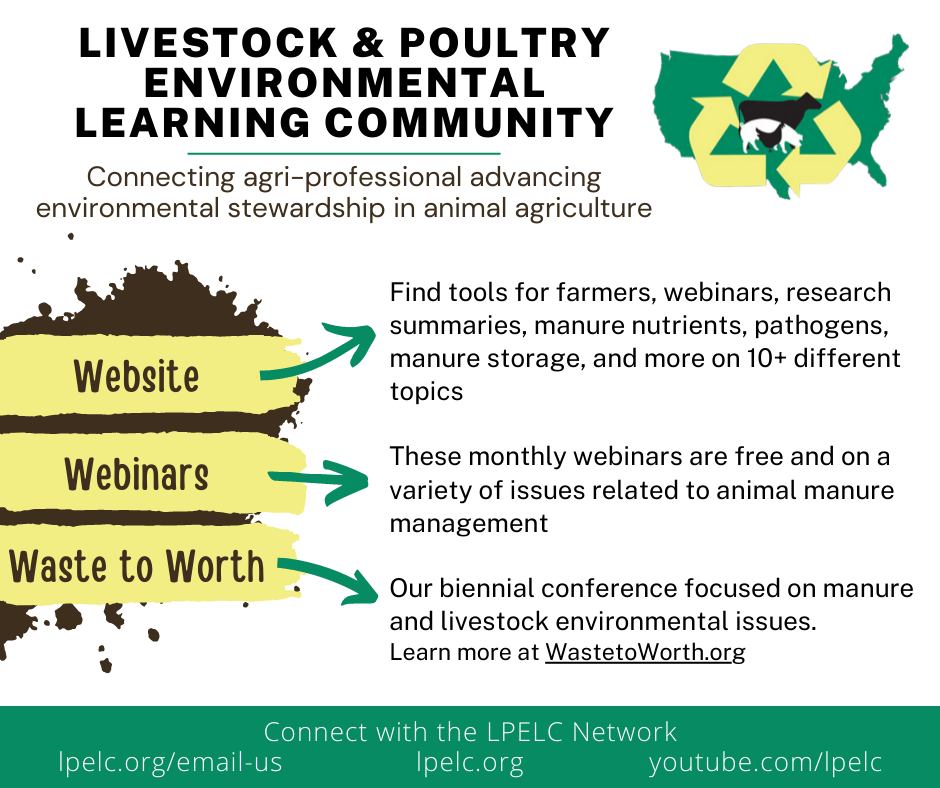 These downloadable sheets and social media posts are meant to help individuals learn about the Livestock and Poultry Environmental Learning Community.
Fact Sheets and Social Media Posts
 What is the LPELC?
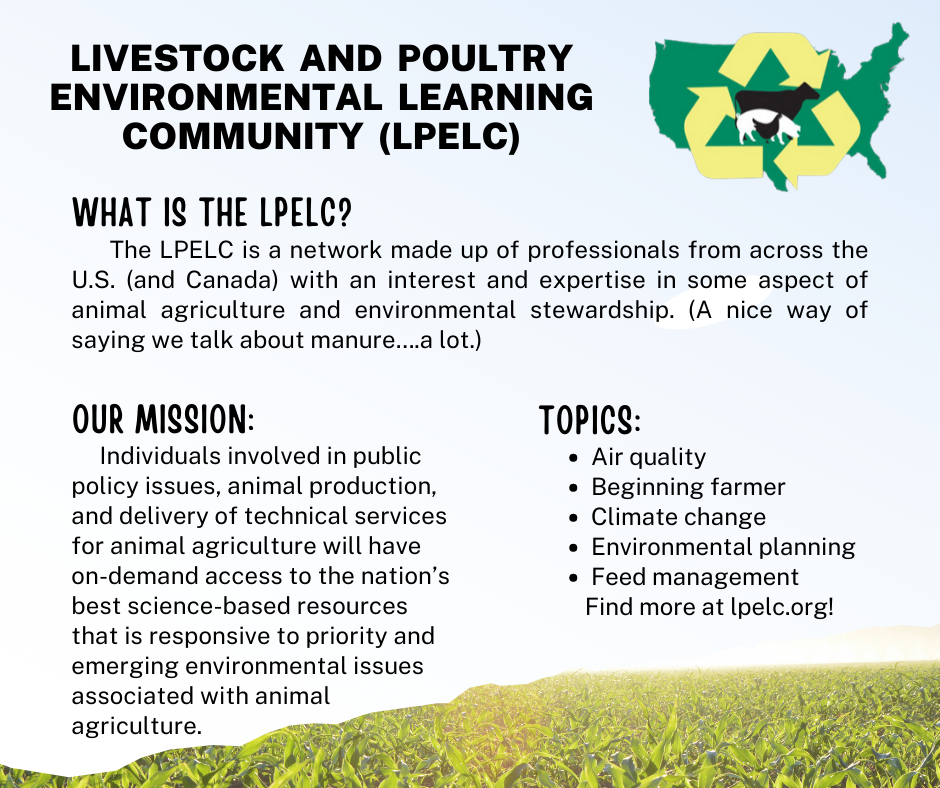
The LPELC is a learning network that strives to bring together all types of expertise; all the way from research and technical knowledge to application of science on the farm.
 What is on the LPELC website?
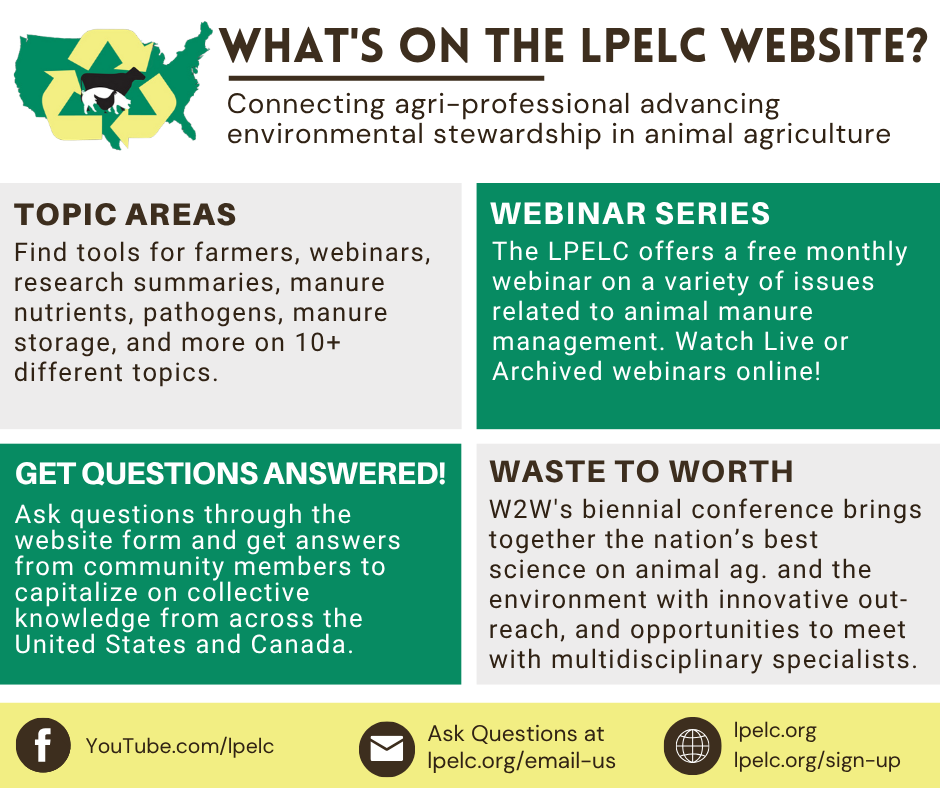
The website contains educational curricula, tools for farmers, regulations, and more, across 10+ topic areas. It has monthly and archived webinars, waste to worth conference proceedings. You can also get all of your manure questions answered by experts across the country.
 Check out the LPELC Webinar Series
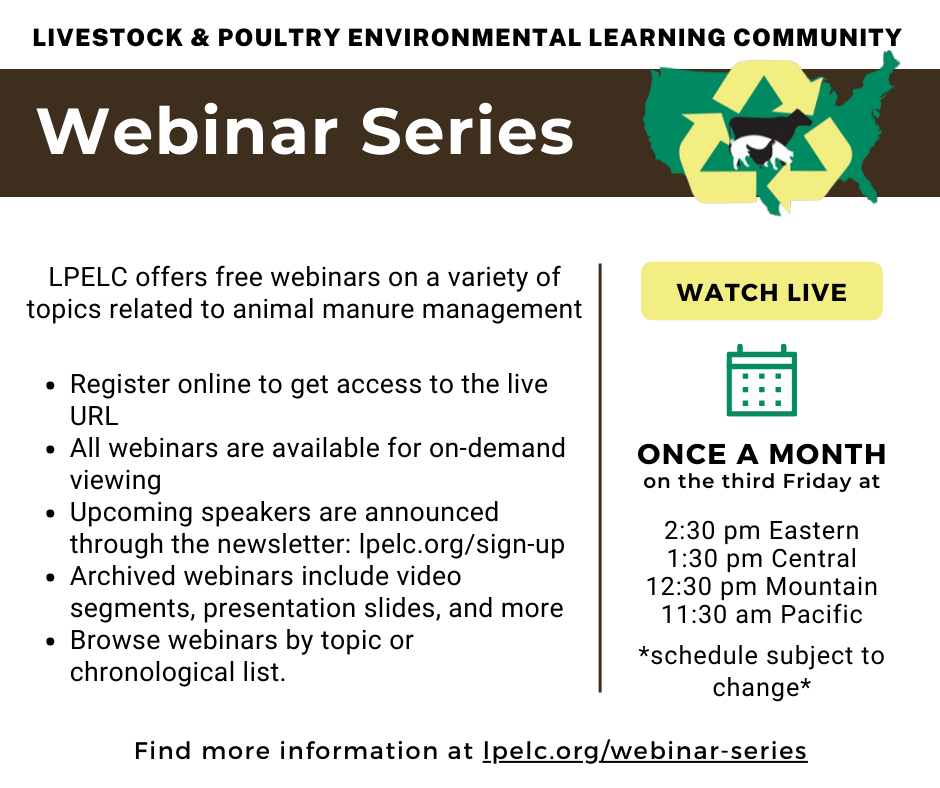
LPELC offers a free monthly webinar on a variety of issues related to animal manure management. Missed a webinar or want to watch past topic? You can find the archived webinars on our website too.
 Learn about the Merits of Manure Content Library
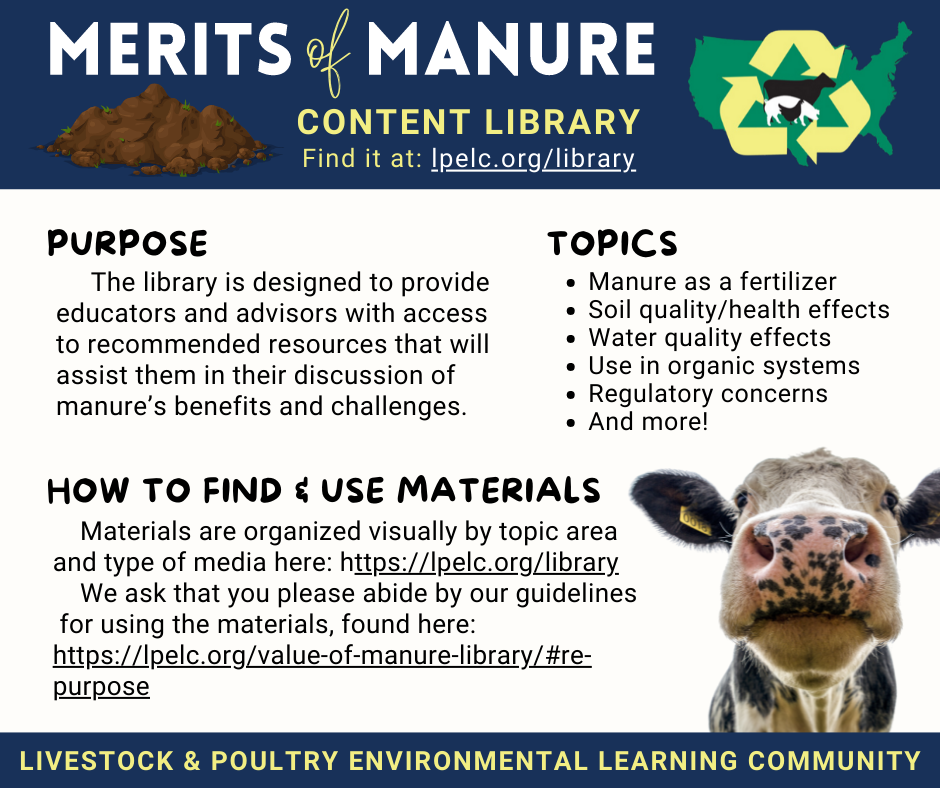
The Merits of Manure Content Library was created to provide educators and advisors with access to recommended resources that will assist them in their discussion of manure’s benefits and challenges.
 Navigate the W2W proceedings
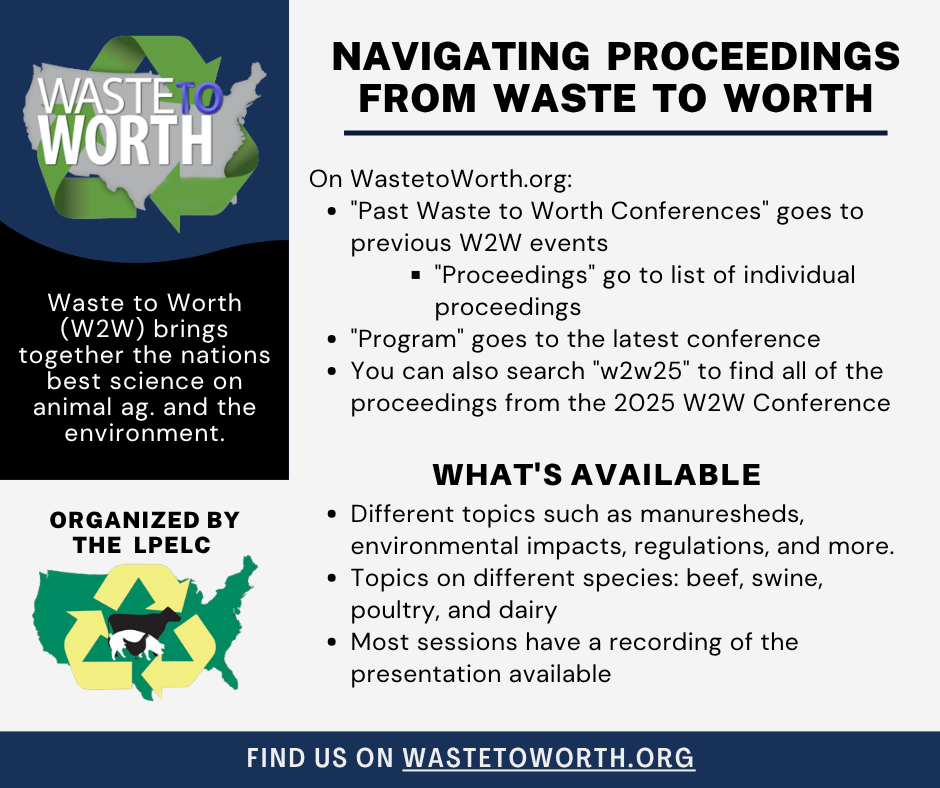
Waste to Worth (W2W) is a biennial conference that brings together the nations best science on animal agriculture and the environment. Find sessions about many different topics including air quality, manure management, environmental impacts, and more!
Business Cards and Half Sheets
LPELC Business Cards & LPELC Half-Sheet Cards

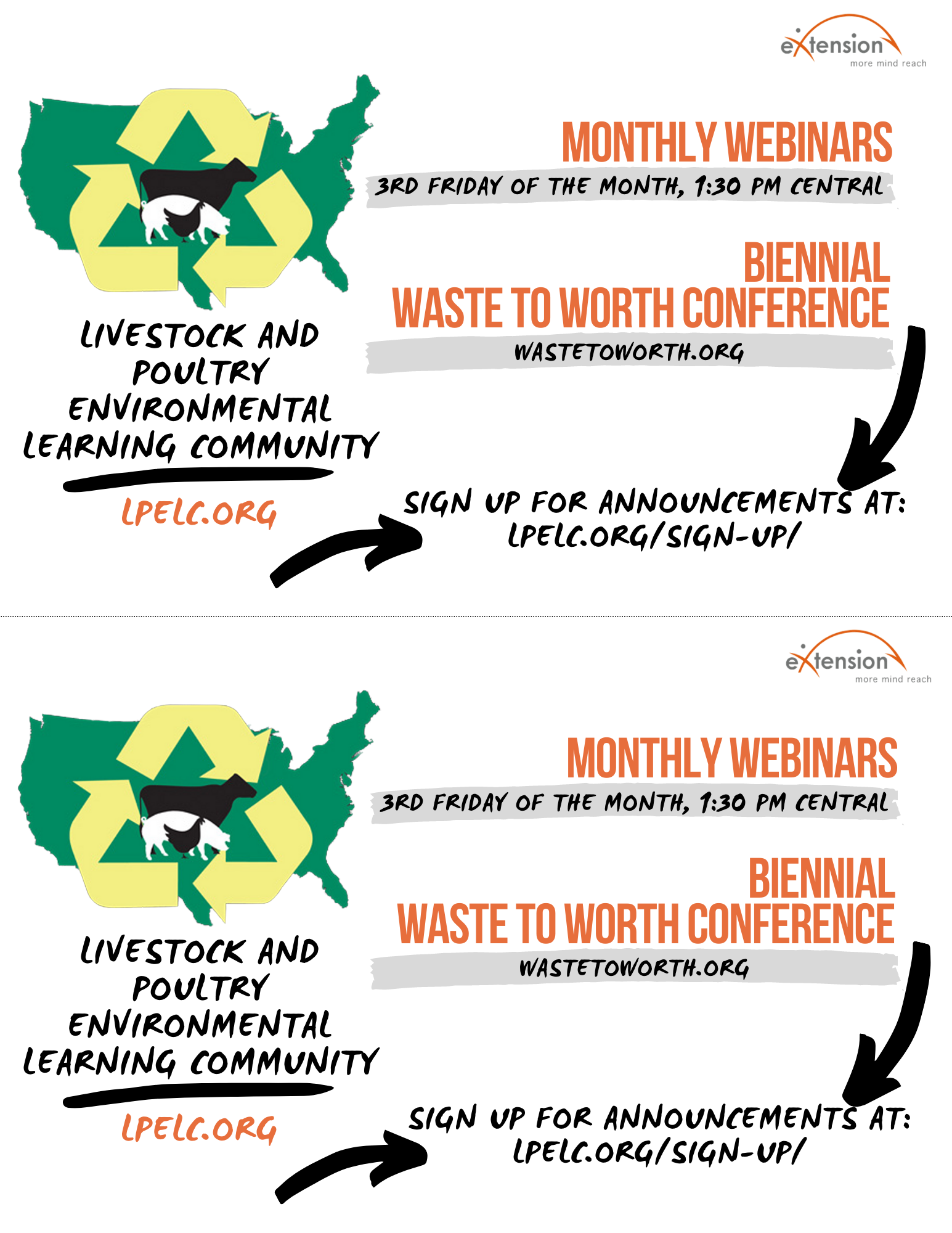
LPELC Factsheet Downloadable PDF Links
LPELC Factsheet Downloadable PNG Links
Economics of Anaerobic Digesters for Processing Animal Manure
Digesters are of interest with regards to climate change, energy, air quality, and water quality. However, digesters are capital-intensive and difficult to maintain. Profitability of a farm-based digester usually requires utilizing the energy, carbon credits, tipping fees, and marketing other co-products such as manure solids that are separated out and composted.
The Environmental Protection Agency’s AgSTAR program has a website http://www.epa.gov/agstar/ with information to assist livestock producers who are considering installation of a digester. The website contains a database of farm digesters that are operating in the United States or that have operated in the past. It also provides a spreadsheet-based screening tool to help assess the potential feasibility of a project based on factors such as the feedstock, onsite conditions, the system type and size, and the planned biogas use.
What does a digester cost to install? Costs will vary widely depending on the situation, but the two sources discussed below show what some recent dairy farm digester installations have cost. The reports are the 2015 article by Manning and Hadrich, and the annual reports of the California Department of Food and Agriculture’s Dairy Digester Research and Development Program (CDFA).
The CDFA funded 117 dairy farm projects between 2015 and 2021. All but one of them were covered lagoon digesters (see the fact sheet by Hamilton for a discussion of digester types). Those funded in 2015 generated electricity, but most of those funded in 2017 and later have renewable natural gas (RNG) as the end-use of the biogas. The AgSTAR database lists the herd sizes for 19 of these digester projects that are producing RNG. For those projects, the average herd size was 7,479 cows and the average project cost was $947/cow or $4,384,479 total before deducting the CDFA grant. For the entire group of 117 projects, the CDFA grant funds covered 33 percent of the total cost.
The total cost of the greenhouse gas reductions achieved by these 117 projects was $30.94 per 1 metric ton of carbon dioxide equivalent including both the CDFA grants and the matching funds, or $9.88/1 metric ton considering only the CDFA grant funding. Those greenhouse gas reductions are calculated using methodology developed by the California Air Resources Board.
Manning and Hadrich report on 12 California dairy operations that had installed digesters and were using the biogas to generate electricity. They found that in 2014 the average initial cost of a lagoon system was $1.1 million ($869/cow with an average herd size of 2,496 cows) while a plug-flow system was $ 1.5 million ($1,114/cow and 1,620 cows). Subsidies covered around half of the initial investment on average.
The 12 Manning-Hadrich digesters included seven covered lagoon digesters and five plug-flow digesters. Seven of the digesters were providing benefits to the operations that exceeded their costs after subsidies. The other five were not operating profitably, including three of the plug-flows and two of the lagoon systems. Three of the unprofitable plug-flow digesters had ceased operation at the time of the study while the others were all operating. The seven profitable digesters had average annual operating costs of $0.98/cow while the five unprofitable ones averaged $2.72/cow.
Author: William F. Lazarus, University of Minnesota
Related:
Dairy Digester Research and Development Program (2022). Report of Funded Projects (2015-2022) 2022: Report to the Joint Legislative Budget Committee, California Department of Food and Agriculture, from https://www.cdfa.ca.gov/oefi/ddrdp/docs/2022_DDRDP_Legislative_Report.pdf.
Hamilton, D. (2019). “Types of Anaerobic Digesters.” Retrieved 8/4/22, 2022 from https://lpelc.org/types-of-anaerobic-digesters/.
Manning, D. T. and J. C. Hadrich (2015). “An evaluation of the social and private efficiency of adoption: Anaerobic digesters and greenhouse gas mitigation.” Journal of Environmental Management 154: 70-77.
U.S. AgSTAR. “AgSTAR: Biogas Recovery in the Agriculture Sector.” Retrieved 8/3/22, from http://www.epa.gov/agstar/.
-
 Find these topics and many other related Farm Energy media resources at the Farm Energy Media archive.